
Our readers keep the lights on and the weekend projects moving. As an Amazon Associate, I earn from qualifying purchases.
An audiophile AV receiver is the brain of a high-fidelity home theater, tasked with translating digital signals into a soundstage so transparent you forget the hardware exists. The difference between a generic receiver and one built for critical listening lies in the components—ESS Sabre DACs, discrete amplifier topologies, and room-correction software that adapts to your space rather than just guessing.
I’m Rikta — the founder and writer behind FitlyFast. My research focuses on the measurable performance data of high-end audio electronics, comparing DAC signal-to-noise ratios, amplifier power delivery across all channels, and the real-world efficacy of automated room calibration systems.
Whether you are building a dedicated listening room or upgrading a media space, choosing the right audiophile av receiver requires understanding how digital-to-analog conversion, amplification topology, and room correction interact to create an accurate, emotionally engaging sound.
How To Choose The Best Audiophile AV Receiver
An audiophile-grade AV receiver must satisfy two often conflicting goals: pristine stereo music reproduction and immersive multi-channel movie sound. The best units do not compromise on either. Here are the three critical factors to evaluate before buying.
DAC Quality and Processing Architecture
The digital-to-analog converter is the first active component your audio signal touches. Look for ESS Sabre or AKM Velvet Sound DACs, which offer higher dynamic range and lower total harmonic distortion (THD+N) than generic chips. The number of independent DAC channels (one per channel in premium units versus shared op-amps in budget models) directly affects channel separation and soundstage width.
Amplifier Topology and Power Delivery
Class A/B amplifiers—like those in the Denon PMA-1700NE and OSD Audio Nero HTA7200—deliver warmer, more natural tonality at the cost of heat and weight. Class D designs (Pioneer VSX-935, WiiM Amp Ultra) run cooler and more efficiently but can sound clinical if not properly implemented. For an audiophile system, look for a minimum of 100W per channel with all channels driven, and verify that the receiver has pre-outs so you can add a discrete power amplifier later.
Room Correction That You Trust
Room acoustics color everything you hear. Dirac Live (found in Onkyo TX-RZ50 and TX-RZ70) provides the most granular, frequency-specific correction with target curve customization. YPAO R.S.C. (Yamaha RX-A4A and RX-A6A) is excellent for auto-setup but offers less user control. Audyssey MultEQ XT32 (Marantz Cinema 50 and 40) is a strong mid-point—reliable, intuitive, and effective for subwoofer integration. Avoid any receiver whose room correction only measures a single position.
Quick Comparison
On smaller screens, swipe sideways to see the full table.
| Model | Category | Best For | Key Spec | Amazon |
|---|---|---|---|---|
| Onkyo TX-RZ50 | AV Receiver | Best Overall Value with Dirac Live | 120W/ch, ESS Sabre DAC, Dirac Live | Amazon |
| Onkyo TX-RZ70 | AV Receiver | Premium 11.2-Channel Power | 140W/ch, ESS Sabre, Dirac Live | Amazon |
| Yamaha RX-A6A | AV Receiver | Surround:AI and Auro-3D | 9.2-ch, YPAO R.S.C., 11.2 processing | Amazon |
| Marantz Cinema 40 | AV Receiver | Analog Warmth for Music | 125W/ch, HDAM, Audyssey XT32 | Amazon |
| Denon PMA-1700NE | Integrated Amp | End-Grade Two-Channel Stereo | 140W/ch, AL32 Processing, MM/MC Phono | Amazon |
| Sony STR-AZ5000ES | AV Receiver | 360 Spatial Sound Mapping | 11.2-ch, 130W/ch, D.C.A.C. IX | Amazon |
| Yamaha RX-A4A | AV Receiver | Mid-Range Yamaha Performance | 7.2-ch, YPAO R.S.C., Surround:AI | Amazon |
| Marantz Cinema 50 | AV Receiver | Marantz HDAM Tonal Signature | 110W/ch, 9.4-ch, Audyssey XT32 | Amazon |
| Sony STR-AZ1000ES | AV Receiver | Entry-Level Sony ES Performance | 7.2-ch, 100W/ch, D.C.A.C. IX | Amazon |
| Denon PMA-600NE | Integrated Amp | Budget Two-Channel Stereo | 70W/ch, AHC Circuit, Phono | Amazon |
| WiiM Amp Ultra | Streaming Amp | Ultra-Compact Hi-Fi Streaming | 100W/ch, ESS9039Q2M DAC, RoomFit EQ | Amazon |
| Pioneer VSX-935 | AV Receiver | Budget 7.2-Channel Surround | 7.2-ch, Dolby Atmos, HDMI 2.1 | Amazon |
| OSD Audio Nero HTA7200 | Power Amplifier | Seven-Channel External Amplification | 145W/ch (8Ω), Class A/B, XLR | Amazon |
In‑Depth Reviews
1. Onkyo TX-RZ50

The Onkyo TX-RZ50 delivers Dirac Live Full Bandwidth room correction out of the box—a feature typically reserved for receivers costing twice as much. This system measures your room with a supplied mic and then applies precise filters to tame standing waves and minimize reflection smear, resulting in a significantly cleaner bass response and more accurate imaging. The THX Select certification also guarantees a minimum level of dynamic headroom for loud movie playback without audible distortion.
Under the hood, an ESS Sabre DAC handles the digital-to-analog conversion. Customer reports consistently highlight how the TX-RZ50 outperforms older receivers in detail retrieval, especially with well-recorded Dolby Atmos soundtracks on Blu-ray. The 9.2-channel layout supports a 7.1.4 Atmos configuration when paired with an external two-channel amplifier, giving you room to grow into a full height-channel system without replacing the receiver.
One notable concern is the unit’s size—it is deeper than many standard AV racks. Additionally, the included remote feels budget relative to the receiver’s build quality. Software updates have been smooth according to recent reviews, and the HDMI 2.1 ports handle 4K/120Hz gaming without handshake issues. For the price, this is the most balanced audiophile-value proposition available.
Why it’s great
- Dirac Live Full Bandwidth included — superior room correction at this price tier
- ESS Sabre DAC provides high dynamic range and low noise floor
- Pre-outs for all channels allow easy external amplifier expansion
Good to know
- Large chassis depth (15.68 inches) may require deeper cabinetry
- On-screen setup menus can be sluggish compared to app-based interfaces
2. Onkyo TX-RZ70
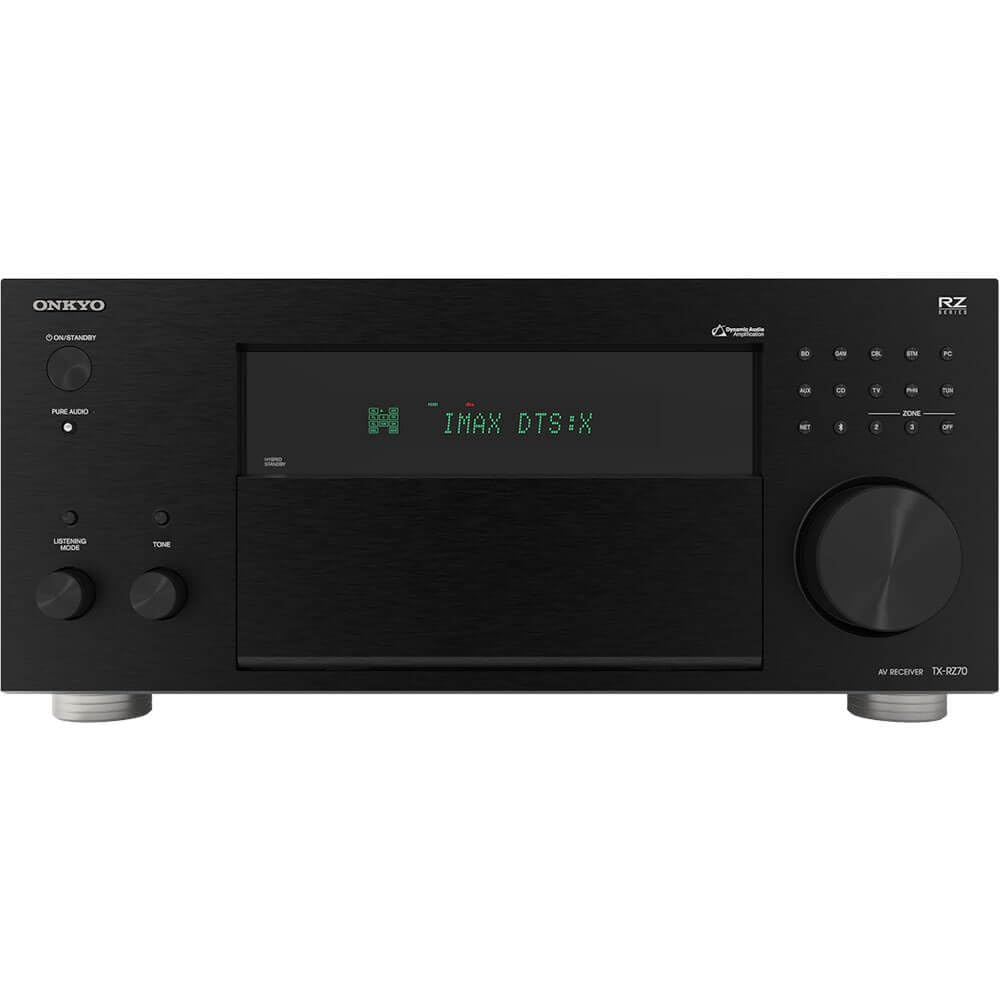
The Onkyo TX-RZ70 takes everything the TX-RZ50 does well and amplifies it—literally. With 140 watts per channel across 11 channels, this receiver can drive a full 7.1.4 Atmos system without breaking a sweat. The ESS Sabre DAC array handles 11.2 channels natively, and the Dirac Live Full Bandwidth calibration is included from day one. A firmware upgrade unlocks Dirac Live Bass Control, which individually manages multiple subwoofers to smooth out the low-frequency response in ways single-sub systems cannot achieve.
Reviews from owners who paired the TX-RZ70 with Klipsch RF-7 III speakers and Parasound external amps describe the sound as “clean, dynamic, and reference-grade.” The THX certification means the unit passed stringent noise and distortion tests across all input combinations. HDMI 2.1 support with 4K/120Hz and VRR makes this a viable centerpiece for a high-end gaming and home theater hybrid system. The unit is Roon Ready, so it integrates directly into an audiophile-grade music streaming ecosystem.
The major physical trade-off is the receiver’s size: weighing 57.85 pounds and measuring 24 inches deep, it requires a substantial AV cabinet. Some users also note that Zone 2 control from the app is less refined than the main zone. For those building a no-compromise home theater who want Dirac Live built in without purchasing a separate MiniDSP unit, the TX-RZ70 is a compelling choice.
Why it’s great
- 11 channels of Class A/B amplification with discrete ESS Sabre DACs
- Dirac Live Full Bandwidth plus optional Bass Control upgrade
- Roon Ready and THX Certified for studio-grade performance
Good to know
- Extremely large and heavy—verify cabinet clearance before buying
- Zone 2 control via app is basic and lacks volume numbering
3. Yamaha RX-A6A

Yamaha’s RX-A6A belongs to the Aventage line, which means it benefits from a premium chassis designed to damp vibration, independent power supply blocks for analog and digital sections, and gold-plated speaker terminals. This 9.2-channel receiver can process 11.2 channels internally, so adding an external two-channel amp unlocks a full Dolby Atmos height system. The YPAO R.S.C. room correction with 3D and multipoint measurement delivers consistent calibration across a wide listening area, though it offers less parametric control than Dirac Live.
The standout feature is Surround:AI, a Yamaha-exclusive technology that analyzes real-time audio scenes and adjusts the surround processing to prioritize dialogue clarity, bass impact, or spatial effects depending on what is happening on screen. This is not a gimmick—reviewers report that the algorithm genuinely enhances immersion during action-heavy movies without making music sound artificial. The RX-A6A also supports Auro-3D, a format that uses a three-layer speaker array for a more natural height soundstage than traditional Atmos.
Owners report that the MusicCast streaming platform is functional but the app interface is less intuitive than competitors. Yamaha’s decision to drop Alexa and Google Assistant support unexpectedly has frustrated some long-term users. The receiver itself sounds excellent—detailed, neutral, and capable of huge dynamic swings—and the build quality justifies the price. For those who prioritize surround-sound intelligence over manual tuning, the RX-A6A is a strong contender.
Why it’s great
- Surround:AI intelligently optimizes audio in real-time for movies
- Auro-3D support for a different height-channel experience
- Premium Aventage build with anti-vibration construction
Good to know
- Alexa/Google voice support discontinued by manufacturer
- MusicCast app interface can feel clunky and unresponsive
4. Marantz Cinema 40
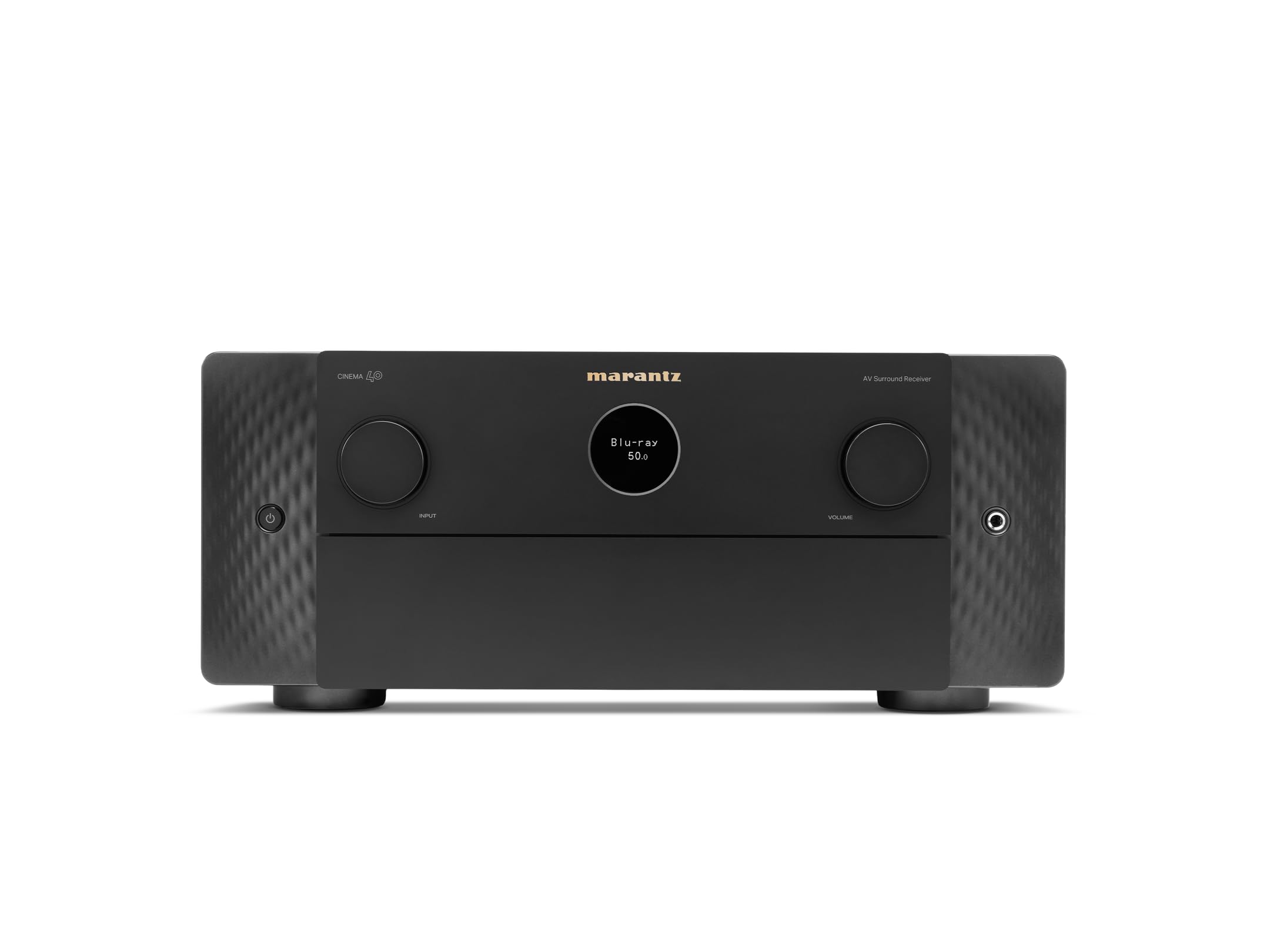
The Marantz Cinema 40 is built around the brand’s proprietary HDAM (Hyper Dynamic Amplifier Module) discrete circuitry, which replaces the generic op-amps found in most receivers. The result is a warmer, more “analog” sound presentation that many audiophiles prefer for stereo music. A blind comparison between the Cinema 40 and a Denon X4800H conducted by one reviewer showed that listeners consistently rated the Marantz as having more natural vocal timbre and less digital edge, despite both sharing similar underlying Audyssey MultEQ XT32 calibration.
With 125 watts per channel across nine channels, the Cinema 40 can drive a 7.1.4 system with an external two-channel amplifier. The four independent subwoofer outputs allow for flexible low-frequency management, and the Audyssey XT32 calibration handles subwoofer integration exceptionally well—measuring multiple positions to create a unified bass response across the room. The unit is also IMAX Enhanced certified, ensuring compatibility with the expanded aspect ratio and dynamic range of IMAX-encoded discs.
The main drawback reported by several owners is the complexity of the HDMI-CEC implementation, which can occasionally conflict with television controls. The unit also runs warm during extended use, and an AC Infinity cooling fan is a recommended add-on. For listeners who value a slightly richer, more forgiving tonal character over clinical precision, the Cinema 40 delivers that signature Marantz sound without the price of separates.
Why it’s great
- HDAM discrete circuitry delivers warmer, more natural sound than typical receivers
- Audyssey MultEQ XT32 provides excellent multi-point room calibration
- Four independent subwoofer outputs for precise bass management
Good to know
- HDMI-CEC behavior can be unpredictable with some TV brands
- Runs hot during extended listening; aftermarket cooling recommended
5. Denon PMA-1700NE

The Denon PMA-1700NE is a two-channel integrated amplifier, not a multi-channel AV receiver, but it represents the pinnacle of stereo performance for listeners who prioritize music over home theater. Its Advanced AL32 Processing Plus technology upsamples any digital signal to 384 kHz/32-bit before conversion, reducing quantization noise and reconstructing audio waveforms with exceptional smoothness. The built-in PCM1795 DAC is no slouch either, although some owners report better results using a standalone DAC for critical listening.
The amplifier section uses a single push-pull circuit with a high-current power transformer that delivers 140 watts per channel into 4 ohms. This is enough power to drive demanding speakers like the KEF R3 with authority. The phono stage supports both MM and MC cartridges, which is rare at this price point and a huge plus for vinyl enthusiasts. The unit weighs 38.8 pounds—a testament to the robust toroidal transformer and rigid chassis construction.
Purists should note the lack of digital connectivity: no Wi-Fi, no Bluetooth, no subwoofer output. This is a strict stereo amplifier designed for a single sound source pair. The remote is plastic and lacks tone control functionality, which feels out of place on an otherwise premium product. For the dedicated two-channel listener who already owns a separate DAC and streamer, the PMA-1700NE is an end-game integrated amplifier that will serve for decades.
Why it’s great
- AL32 Processing Plus for ultra-smooth digital playback
- High-current power supply drives difficult 4-ohm speakers easily
- Built-in MM/MC phono stage for turntable integration
Good to know
- No Wi-Fi, Bluetooth, or subwoofer output—strictly stereo
- Plastic remote feels cheap relative to the amplifier build quality
6. Sony STR-AZ5000ES

Sony’s ES line has always targeted the audiophile community, and the STR-AZ5000ES continues that tradition with 360 Spatial Sound Mapping technology. This proprietary DSP creates virtual phantom speakers between your physical channels, effectively increasing the perceived speaker count. In a 5.1.2 setup, the receiver creates the illusion of a full 7.1.4 array. The Digital Cinema Auto Calibration IX (D.C.A.C. IX) system measures your room and adjusts the 360 Spatial Sound Mapping algorithm accordingly.
With 130 watts per channel across 11.2 channels, this receiver has ample power for even large rooms. The 7 HDMI 2.1 inputs support 8K/60Hz and 4K/120Hz pass-through, along with VRR and ALLM for gaming. Owners consistently praise the receiver for making dialogue stunningly clear in movies, even during complex action scenes. The built-in Chromecast, AirPlay 2, and Spotify Connect make wireless streaming effortless. The unit is also Sonos-compatible via a Sonos Port.
Two main drawbacks are worth noting. The first is heat: the receiver runs very hot under load, and an AC Infinity Aircom T10 cooling fan is almost a requirement. The second is the lack of support for HDR10+—a limitation for those with Samsung and some Panasonic televisions. For buyers who prioritize surround sound immersion over absolute format compatibility and who are willing to manage the thermal output, the STR-AZ5000ES is a remarkable engineering achievement.
Why it’s great
- 360 Spatial Sound Mapping creates convincing phantom channels for immersive audio
- D.C.A.C. IX calibration optimizes the DSP for your specific room geometry
- Excellent dialogue clarity and center channel performance in movies
Good to know
- Runs very hot—requires external cooling for sustained high-volume playback
- Does not support HDR10+; only Dolby Vision and HDR10
7. Yamaha RX-A4A

The Yamaha RX-A4A is a 7.2-channel receiver that inherits many of the Aventage line’s design principles—vibration-resistant chassis, symmetrical PCB layout, and independent power supplies—at a lower price than the RX-A6A. It supports Dolby Atmos and DTS:X processing with 7.2 channels of amplification, and it includes YPAO R.S.C. with multipoint measurement and precision EQ. The Surround:AI mode is present here as well, though it is limited to 7.1.4 processing (meaning you still need an external amp for heights).
All seven HDMI inputs support 8K60 and 4K120 pass-through at 40 Gbps, along with ALLM and VRR for gaming. The built-in MusicCast system enables multi-room streaming, and the receiver is Roon Tested for high-resolution audio integration. Owner feedback across multiple reviews is positive regarding sound quality—described as detailed, neutral, and capable of handling complex movie soundtracks without strain. The unit also includes a phono input for turntable connection.
Some users report that the initial firmware update process is tedious, requiring a USB flash drive rather than an over-the-air update. The lack of a front-panel HDMI input is a minor inconvenience for those who connect devices temporarily. For a mid-range audiophile receiver that punches above its weight in build quality and surround sound capability, the RX-A4A remains a solid choice for those who trust YPAO’s calibration logic.
Why it’s great
- Aventage build quality at a lower price than the flagship models
- Surround:AI enhances movie soundtracks in real-time
- All HDMI inputs support full 8K60 and 4K120 bandwidth
Good to know
- Firmware update requires a USB flash drive—not over-the-air
- No front-panel HDMI input for quick device connections
8. Marantz Cinema 50

The Marantz Cinema 50 occupies the sweet spot between the feature-rich Cinema 40 and the more affordable Cinema 60. It delivers 110 watts per channel across nine channels and features the signature HDAM circuitry that gives Marantz receivers their warm, detailed character. The Audyssey MultEQ XT32 calibration system is included here, and the unit also supports Dolby Atmos, DTS:X Pro, IMAX Enhanced, and Auro-3D, making it one of the most format-complete receivers at this price.
Connectivity is extensive: nine HDMI inputs (six rear, three front) with eARC support, four subwoofer outputs, a phono input for turntables, and HEOS multi-room streaming. Owners report that setup via the on-screen graphical interface is relatively intuitive, and the Audyssey microphone and cardboard stand make the initial room measurement simple. The Cinema 50 also includes Dolby Height Virtualization, which can create a convincing overhead effect without physical ceiling speakers for those not ready to install them.
One criticism involves the supply chain for firmware updates and app support—some users worry that Marantz’s long-term software support may not match the hardware’s lifespan. The unit also runs warm, and aftermarket cooling is a common recommendation. For listeners who want the Marantz sound at a lower price than the Cinema 40 and who do not need the extra headroom of the 40’s 125W rating, the Cinema 50 provides the same tonal DNA in a more accessible package.
Why it’s great
- HDAM discrete circuitry delivers warm, natural Marantz tonality
- Audyssey MultEQ XT32 provides reliable multi-point room correction
- Supports Dolby Atmos, DTS:X Pro, IMAX Enhanced, and Auro-3D
Good to know
- Long-term firmware update support is a concern for some users
- Runs warm during extended use; cooling fan is recommended
9. Sony STR-AZ1000ES

The Sony STR-AZ1000ES is the entry-level model in Sony’s revered ES (Evolutionary Standard) series, which has a decades-long reputation for build quality and sound integrity. This 7.2-channel receiver delivers 100 watts per channel and includes Sony’s Digital Cinema Auto Calibration IX and the 360 Spatial Sound Mapping technology found in the higher-end AZ5000ES. The result is a receiver that creates a convincing phantom height effect even in a basic 5.1.2 configuration.
HDMI connectivity spans six inputs and two outputs, all supporting 8K/60Hz and 4K/120Hz pass-through with HDMI 2.1 features. The receiver is compatible with Dolby Atmos and DTS:X, and it includes support for Dolby Vision and IMAX Enhanced. Owners highlight the receiver’s excellent dialogue clarity and the unique “Picture-in-Picture” mode that lets you see the on-screen menu without switching away from your source. The setup process via the graphical UI, web interface, and iOS app is praised for its simplicity.
At this price, the STR-AZ1000ES faces stiff competition from the Onkyo TX-RZ50, which includes Dirac Live for room correction rather than Sony’s proprietary D.C.A.C. IX. The Sony also runs hot, and an AC Infinity cooling fan is a wise investment. For those who value Sony’s particular approach to sound field processing and want the ES badge without the flagship price, the AZ1000ES is a capable starting point.
Why it’s great
- 360 Spatial Sound Mapping creates immersive phantom channels
- Digital Cinema Auto Calibration IX for precise room tuning
- Image-in-Picture mode allows menu navigation without losing video feed
Good to know
- Runs hot; external cooling is recommended for reliable operation
- Room correction is proprietary D.C.A.C. IX, not Dirac Live
10. Denon PMA-600NE

The Denon PMA-600NE is a budget-friendly stereo integrated amplifier that punches well above its weight in sound quality. Despite being rated at only 70 watts per channel, its Advanced High Current (AHC) push-pull circuit delivers robust power that can drive speakers up to 4 ohms with surprising authority. Owners who have compared it to modern AV receivers note that the PMA-600NE sounds richer and more detailed than units with double the rated power, thanks to the robust power supply and separated analog/digital circuitry.
The built-in DAC supports optical and coaxial inputs, and the Bluetooth receiver streams from any smartphone with solid fidelity. An Analog Mode is available that disconnects the digital circuits entirely, allowing the amplifier to function as a pure analog device—a feature purists will appreciate for vinyl playback. The phono input supports both moving magnet cartridges, making it simple to integrate a turntable. The unit also includes a subwoofer output, which is rare for a stereo amplifier at this price.
On the downside, the PMA-600NE lacks Wi-Fi, AirPlay, and any multi-room streaming capabilities—it is a strictly wired stereo amplifier with Bluetooth convenience. The remote control is basic and the plastic build does not inspire the confidence of higher-end models. For the listener building their first serious two-channel system or adding a dedicated music zone without breaking the bank, the PMA-600NE is an outstanding value.
Why it’s great
- Advanced High Current circuit delivers more real-world power than the 70W rating suggests
- Analog Mode disconnects digital circuits for pure analog playback
- Subwoofer output and phono input add versatility for a stereo system
Good to know
- No Wi-Fi, AirPlay, or multi-room streaming support
- Build quality and remote feel budget compared to the Denon higher-end models
11. WiiM Amp Ultra

The WiiM Amp Ultra is a streaming amplifier that packs premium components into a compact unibody aluminum chassis. Its ESS ES9039Q2M DAC is the same chip found in dedicated audiophile DACs costing several times this unit’s price. Dual TI TPA3255 Class D amplifiers deliver 100 watts per channel with total harmonic distortion plus noise measured at -106 dB—exceedingly clean by any standard. The built-in RoomFit room correction uses your smartphone’s microphone to measure frequency response and apply corrective filters, though it does not offer the granular control of Dirac Live.
Connectivity is modern and extensive: Wi-Fi 6, Bluetooth 5.3 with LE Audio, HDMI ARC for TV integration, optical and RCA inputs, and a 3.5-inch touchscreen display for album art and system settings. The unit supports streaming from Spotify, TIDAL, Qobuz, Amazon Music, and is Roon Ready. Owners who replaced traditional AV receivers report that the Amp Ultra sounds more detailed and dynamic, especially in the bass region, with the subwoofer output integrating seamlessly with active subwoofers.
The primary limitation is the lack of multi-channel support—this is a 2.1-channel amplifier, not a surround sound receiver. It is also incompatible with AirPlay, which is a notable omission for Apple users. For a dedicated listening room or a high-fidelity TV audio upgrade where stereo playback is the priority, the WiiM Amp Ultra represents a new benchmark in affordable streaming amplification.
Why it’s great
- ESS ES9039Q2M DAC is a premium chip found in high-end separates
- RoomFit EQ auto-calibrates sound using your smartphone mic
- Wi-Fi 6 and Bluetooth 5.3 with LE Audio for reliable wireless streaming
Good to know
- 2.1-channel only—no surround sound or multi-channel processing
- Does not support Apple AirPlay for iOS device streaming
12. Pioneer VSX-935
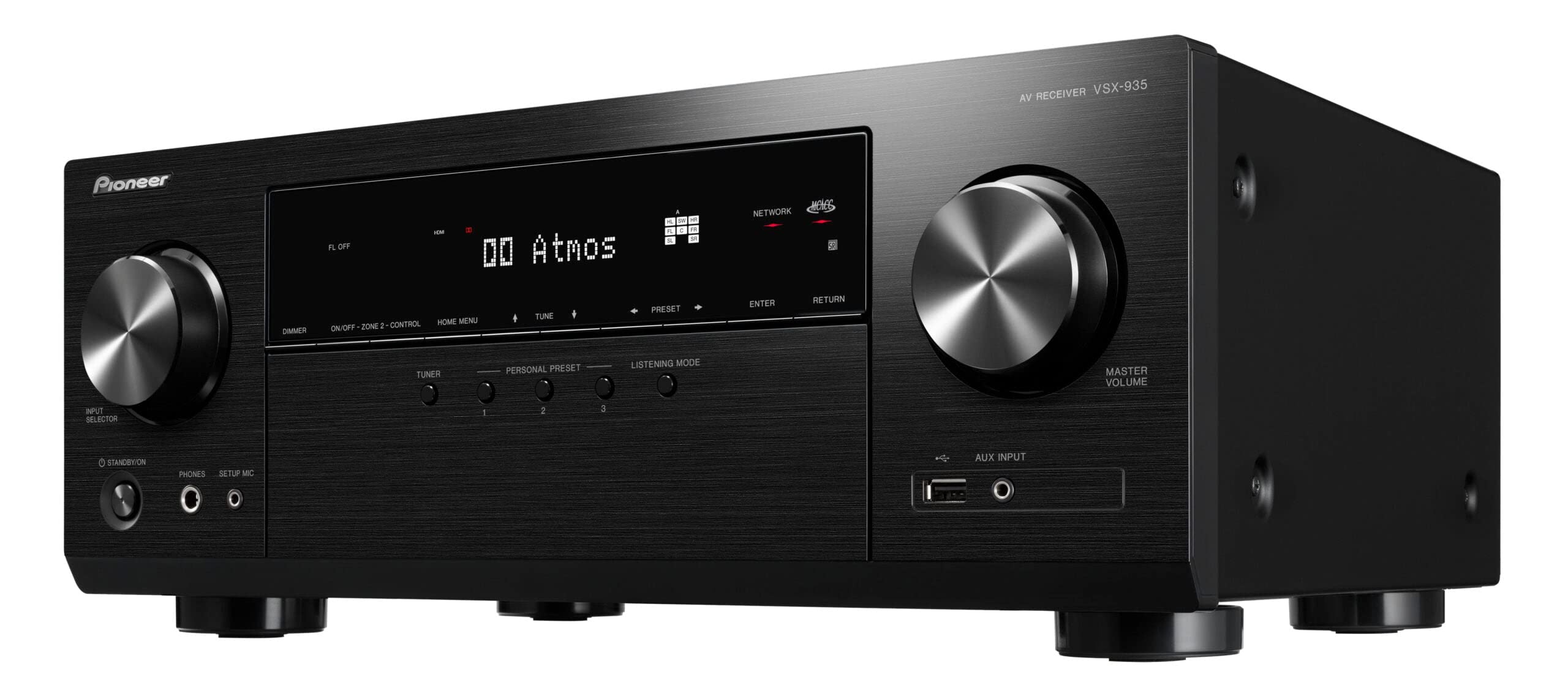
The Pioneer VSX-935 is a 7.2-channel surround receiver that focuses on core performance without premium audiophile frills like advanced room correction or high-end DACs. It supports Dolby Atmos and DTS:X, includes Dolby Atmos Height Virtualization for creating height effects without ceiling speakers, and features HDMI 2.1 inputs with 8K pass-through. The receiver is a solid choice for those building a first home theater on a budget who still want modern video features.
Connectivity includes Wi-Fi, Bluetooth, Chromecast built-in, and support for streaming services like Spotify and TIDAL. The setup is relatively straightforward, though the manual adjustment of speaker distances and levels is recommended rather than relying solely on the automated calibration. Owners report that the audio is crisp and clear for movies, with good dialogue intelligibility. The unit also supports bi-amping for front left and right speakers, which can improve stereo clarity in a budget system.
The main consistency issues surface in customer reliability reports: multiple users have experienced unit failures shortly after purchase, including HDMI handshake problems and loss of surround sound function. Pioneer support has been described as inconsistent. The firmware update process (USB-only) is also a point of frustration. For those willing to take a chance on affordability and basic feature set, the VSX-935 can work, but it lacks the reliability of the higher-tier options in this guide.
Why it’s great
- Dolby Atmos Height Virtualization creates convincing overhead effects
- HDMI 2.1 with 8K pass-through for modern gaming consoles
- Bi-amping capability for improved front channel clarity
Good to know
- Inconsistent reliability and reported hardware failures
- Room correction is basic—manual distance/level adjustment recommended
13. OSD Audio Nero HTA7200

The OSD Audio Nero HTA7200 is a seven-channel Class A/B power amplifier, not a receiver—it lacks any digital processing, HDMI inputs, or streaming capabilities. It is designed to be paired with an AV receiver that has pre-outs, offloading the speaker driving duties to a dedicated amplifier. With 145 watts per channel into 8 ohms and 210 watts into 4 ohms, the HTA7200 can drive any speaker to reference levels with headroom to spare.
Build quality is exceptional: the amplifier weighs 71 pounds, features a toroidal transformer, individual channel status LEDs, and both RCA and balanced XLR inputs. The 12-volt trigger input allows it to power on automatically with your AV receiver. The signal-to-noise ratio is rated at 110 dB at full power, meaning the amplifier is effectively silent when no music is playing. Owners who have added the HTA7200 to their system report a noticeable improvement in soundstage width and dynamic impact compared to relying solely on their receiver’s internal amplifiers.
The main considerations are size and weight—this is a heavy, deep component that requires a sturdy AV rack. It also lacks any channel-bridging options for subwoofer use (dedicated subwoofer outputs on the receiver are required). For the enthusiast building a separates system who wants clean, high-current amplification for all channels, the OSD Nero HTA7200 offers performance that rivals amplifiers costing far more.
Why it’s great
- Class A/B topology delivers warm, natural sound with high current delivery
- Balanced XLR inputs for clean signal transmission over long cable runs
- 110 dB SNR ensures a silent background during quiet passages
Good to know
- Extremely heavy—requires a sturdy rack and two people for installation
- Requires an AV receiver with pre-outs—not a standalone receiver
FAQ
What is the difference between Dirac Live and YPAO room correction?
Do I need a separate power amplifier with an audiophile AV receiver?
What is the advantage of ESS Sabre DACs over generic DACs in AV receivers?
Can I use an integrated stereo amplifier like the Denon PMA-1700NE for home theater?
What is the importance of THX certification in an audiophile AV receiver?
Final Thoughts: The Verdict
For most users, the audiophile av receiver winner is the Onkyo TX-RZ50 because it combines Dirac Live Full Bandwidth room correction, ESS Sabre DACs, and THX certification at a price that undercuts competitors with similar specs. If you want unparalleled surround processing and Auro-3D compatibility, grab the Yamaha RX-A6A. And for a pure two-channel stereo system where music fidelity is the only priority, nothing beats the Denon PMA-1700NE.