
Our readers keep the lights on and the weekend projects moving. As an Amazon Associate, I earn from qualifying purchases.
The gap isn’t subtle—it’s the difference between hearing a recording and feeling every transient, harmonic, and spatial cue the artist intended.
I’m Rikta — the co-founder and writer behind FitlyFast. I’ve spent countless hours analyzing frequency response graphs, driver materials, crossover designs, and amplifier topologies to separate genuine acoustic engineering from marketing hype in the powered speaker market.
Whether you are building a critical listening station or a high-end gaming rig, finding the right audiophile computer speakers requires understanding driver topology, amplification type, and room integration rather than just wattage numbers.
How To Choose The Best Audiophile Computer Speakers
Audiophile-grade computer speakers differ from general multimedia speakers in three critical areas: driver design, amplifier architecture, and connectivity options. Your desk is a nearfield listening environment, which means speaker placement, dispersion pattern, and the absence of room reflections play a larger role than they would in a living room setup. The goal is to find speakers that deliver a flat, uncolored frequency response with low distortion at moderate volumes, paired with a DAC that bypasses your computer’s noisy internal sound card.
Driver Configuration and Tweeter Type
The tweeter is the most critical driver in a nearfield setup because the human ear is most sensitive to the high-frequency range where spatial cues and instrument separation live. Standard silk dome tweeters deliver a warm, non-fatiguing sound ideal for long listening sessions, while AMT (Air Motion Transformer) tweeters—found in premium models like the Kanto TUK—offer faster transient response and wider horizontal dispersion. Ceramic or aluminum drivers reduce cone breakup at higher volumes, and woven paper cones, like those in the Kanto ORA, provide a natural midrange but may need EQ to control muddiness.
Amplifier Topology and Signal Chain
Active speakers with built-in amplification eliminate the need for a separate amplifier and simplify the signal path, but the quality of that amplification varies dramatically. Class D amplifiers are energy-efficient and compact, suitable for desktop use, while bi-amplified designs—where separate amplifier channels power the woofer and tweeter—reduce intermodulation distortion. The weak link in most computer audio chains is the DAC; speakers that include a high-quality USB DAC, like the Audioengine HD6’s 24-bit/192kHz processor, directly improve clarity and noise floor compared to relying on your computer’s headphone jack.
Nearfield Integration and Subwoofer Compatibility
Audiophile computer speakers must integrate well with your physical desk layout. Front-firing ports or sealed enclosures prevent bass boom when placed near a wall, while rear-panel DSP switches—as found on the ADAM D3V—compensate for boundary gain. Active crossover outputs that automatically filter sub-bass frequencies when a subwoofer is connected allow you to offload the lowest octave, reducing distortion and letting the main speakers focus on vocals and mids. This is especially important for 3-inch and 4-inch drivers that naturally roll off below 70 Hz.
Quick Comparison
On smaller screens, swipe sideways to see the full table.
| Model | Category | Best For | Key Spec | Amazon |
|---|---|---|---|---|
| KEF LS50 Meta | Passive / Premium | Detailed nearfield imaging | 47 Hz – 45 kHz; THD 0.07% | Amazon |
| Kanto TUK | Active / Premium | All-in-one desk solution | AMT tweeter; 260W peak | Amazon |
| Audioengine HD6 | Active / Mid-Range | Warm, non-fatiguing sound | 24-bit/192kHz DAC | Amazon |
| Edifier S1000W | WiFi Active / Mid-Range | Multi-room streaming | 5.5″ woofers; 120W RMS | Amazon |
| Klipsch RP-600M II | Passive / Mid-Range | High efficiency home theater | 400W max; Tractrix horn | Amazon |
| Polk ES20 | Passive / Mid-Range | Warm bass presence | 6.5″ woofer; Power Port | Amazon |
| Yamaha HS5 | Studio Monitor / Mid-Range | Flat reference monitoring | 54 Hz – 30 kHz; bi-amp | Amazon |
| ADAM D3V | Active / Value | Deep bass from small drivers | 45 Hz extension; D-ART tweeter | Amazon |
| Kanto ORA | Active / Value | Ultra-compact desktop setup | 100W; 70 Hz – 22 kHz | Amazon |
In‑Depth Reviews
1. KEF LS50 Meta (Pair)

The KEF LS50 Meta represents the pinnacle of nearfield acoustic engineering for the desktop, leveraging Metamaterial Absorption Technology (MAT) that absorbs 99% of unwanted rear-wave energy from the Uni-Q driver array. This single innovation eliminates the timing smear and coloration that plagues conventional two-way designs, producing a soundstage so coherent that individual instrument placement within the stereo field becomes palpable. The 12th-generation Uni-Q driver places the tweeter at the acoustic center of the woofer cone, creating a single point source that delivers consistent dispersion across the listening window—critical for a desk setup where you sit close and slightly off-axis.
In practice, the LS50 Meta excels at moderate listening levels around 70 dB where its clarity, transient speed, and imaging precision shine. The frequency range extends from 47 Hz to 45 kHz, and with 85 dB sensitivity, a high-current amplifier of at least 40 watts per channel is necessary to control the 3-ohm impedance dips. Owners report that the speakers sound best when paired with a quality subwoofer, such as the RSL Speedwoofer 10S, to cover the deepest bass, as the 5.25-inch drivers naturally roll off below 50 Hz. The cabinet is dead silent—zero resonance or panel vibration—thanks to the constrained-layer damping, making every micro-detail audible without listener fatigue.
These are not plug-and-play desktop speakers; they require a separate amplifier (ideally a clean Class AB or GaN-based design) and careful placement 8 to 12 inches from a rear wall. The trade-off is that when properly set up, the LS50 Meta outperforms speakers costing twice as much in resolution, soundstage width, and tonal neutrality. For the serious listener who already owns a quality DAC and amplifier, the LS50 Meta is the ultimate endgame speaker for a computer-based audio system.
Why it’s great
- MAT technology eliminates 99% of driver resonance for unmatched clarity
- Uni-Q driver provides coherent point-source imaging perfect for nearfield
- Zero cabinet resonance allows micro-detail retrieval
Good to know
- Requires an external high-current amplifier (minimum 40WPC)
- Bass roll-off below 50 Hz makes a subwoofer almost mandatory
- Not a self-contained powered system; increases total cost and desk footprint
2. Kanto TUK Powered Speakers
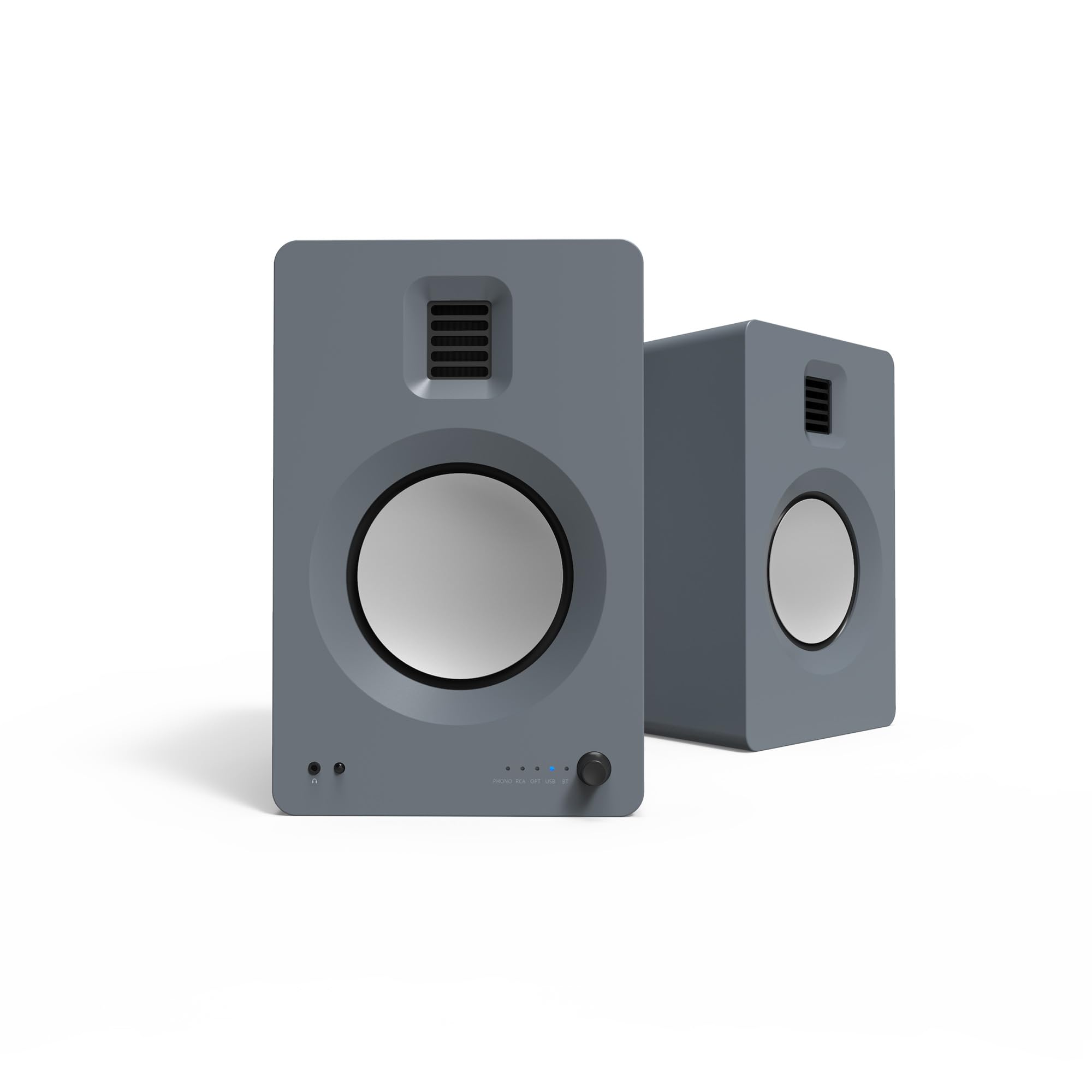
The Kanto TUK closes the gap between convenience and high-end sound by combining an Air Motion Transformer tweeter with a 5.25-inch aluminum driver and 260 watts of bi-amplified Class D power. The AMT tweeter is the defining feature here: its folded diaphragm squeezes air like an accordion, producing faster transient response and wider horizontal dispersion than any dome tweeter at this price point. In a desktop nearfield setup, this translates to a soundstage that extends beyond the physical speaker boundaries, with cymbal decays, vocal sibilants, and ambient reverb tails rendered with airy precision.
What makes the TUK genuinely versatile is the input panel: a USB DAC, optical input, RCA with a dedicated phono preamp for turntables, and Bluetooth 4.2 with aptX HD. The integrated phono stage is rare in powered bookshelf speakers and lets you connect a turntable directly without an external preamp—a meaningful advantage if your computer desk doubles as a vinyl listening station. The active crossover filters out frequencies below 80 Hz when a subwoofer is connected, offloading low-end duties cleanly. Owners consistently note that the TUK outperforms the Klipsch The Fives and Audioengine HD6 in soundstage width and mid-bass clarity.
The remote control cycles through inputs sequentially, which is tedious if you switch sources frequently, and the power cords are shorter than ideal for some desk configurations. At normal listening distances the TUK delivers a balanced, U-shaped frequency response with detailed highs, punchy mid-bass, and enough low-end extension to avoid sounding thin without a subwoofer. Its ability to accept a subwoofer, a turntable, and a computer simultaneously makes it the most complete all-in-one powered speaker for the audiophile desktop.
Why it’s great
- AMT tweeter offers faster transients and wider dispersion than dome tweeters
- Built-in phono preamp eliminates need for external turntable gear
- Active crossover with subwoofer output maintains clean midrange when paired with a sub
Good to know
- Remote control cycles inputs instead of offering direct source buttons
- Power and interconnect cables are short, limiting placement flexibility
- High volumes can cause listening fatigue due to the AMT’s detail retrieval
3. Audioengine HD6 Powered Bookshelf Speakers
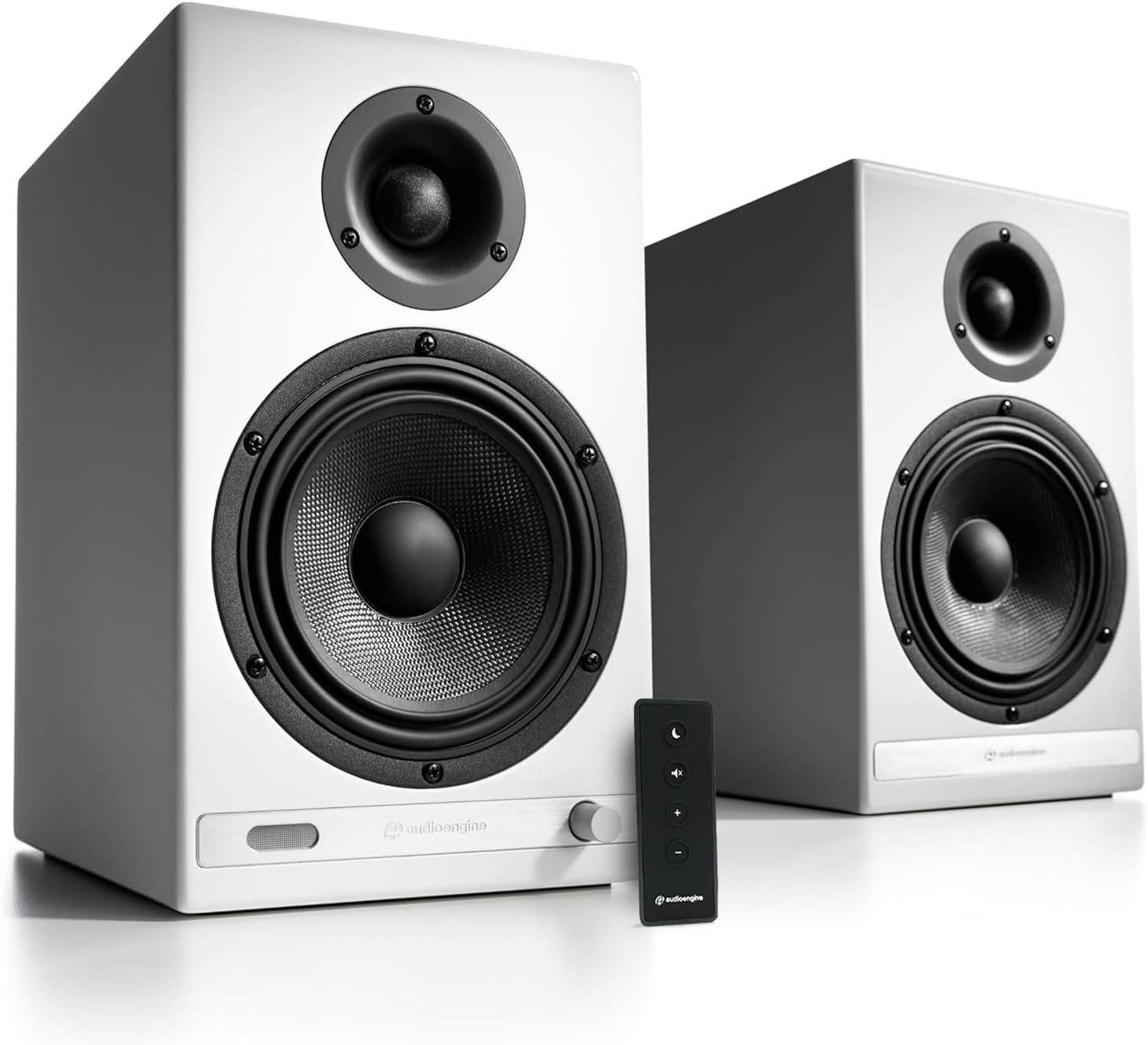
The Audioengine HD6 is engineered for listeners who prioritize long-term listening comfort over analytical detail retrieval. Its 1-inch silk dome tweeter produces a smooth, laid-back high-frequency response that never sounds harsh or etched, even after hours of continuous playback on a computer desk. The 5.5-inch woofers are tuned for tight, taut bass rather than boosted low-end, and the 150-watt total power (50 watts RMS per channel) is sufficient for moderate volumes in a small to medium room without distortion.
The integrated 24-bit/192kHz DAC bypasses your computer’s low-quality audio circuitry, and the optical input accepts digital signals directly from a TV or gaming console. The aptX HD Bluetooth streaming maintains high-resolution quality wirelessly, though some users report occasional disconnection that requires re-pairing the device. The hand-built cabinets use real wood veneer (walnut, black, or white) with magnetic grilles and aluminum trim, making the HD6 visually at home in a living space rather than a studio.
After a 50-hour break-in period, the sound opens up significantly: the treble becomes more extended, bass tightens, and the overall presentation becomes notably more transparent. The HD6 is not designed for ground-shaking bass; a subwoofer is recommended if you listen to electronic or orchestral music with deep sub-40 Hz content. For acoustic, vocal, and jazz recordings, the HD6’s natural tonal balance and non-fatiguing character make it one of the most enjoyable powered speakers for all-day desktop use.
Why it’s great
- Silk dome tweeter provides smooth, non-fatiguing highs for long listening sessions
- Built-in 24-bit DAC delivers cleaner audio than computer sound cards
- Furniture-grade wood veneer and magnetic grilles integrate into any decor
Good to know
- Requires a full break-in period of roughly 50 hours to reach optimal sound
- Bass extension is limited; a subwoofer is recommended for low-end heavy genres
- Bluetooth connection may require occasional re-pairing
4. Edifier S1000W WiFi Audiophile Active Bookshelf Speakers

The Edifier S1000W stands apart from other active bookshelf speakers by integrating Wi-Fi streaming natively, supporting AirPlay 2, Spotify Connect, and Tidal Connect without needing a separate streamer. This is a significant advantage for a computer-based audiophile system because it lets you route high-resolution audio directly from your network rather than compressing it over Bluetooth. The speaker accepts sample rates up to 24-bit/192kHz over its digital inputs, ensuring that the fidelity you pay for in streaming services actually reaches your ears.
Acoustically, the S1000W uses a 5.5-inch aluminum cone woofer paired with a 1-inch silk dome tweeter, delivering a frequency response that extends to roughly 37 Hz at -3 dB—impressively deep for its driver size. The 120-watt RMS Class D amplifier drives the speakers to room-filling levels without audible distortion, and the bass remains tight and controlled even during complex orchestral passages. The cabinetry is robust, with solid wood side panels that reduce panel resonance and give the speakers a weighty, premium feel despite their mid-range positioning.
Some users note a very slight tweeter hiss audible within six inches of the driver, but at a normal listening distance of two to three feet, it is inaudible. The remote control is small and easily misplaced, and switching between input sources can be cumbersome without the remote. For the audiophile who wants a powered system that works equally well as a computer speaker and as a multi-room music hub, the S1000W offers value and feature density that competitors cannot match at this tier.
Why it’s great
- Native Wi-Fi streaming with AirPlay 2, Spotify Connect, and Tidal Connect
- Deep bass extension to 37 Hz from a 5.5-inch driver
- Solid wood side panels reduce cabinet resonance and improve build quality
Good to know
- Minor tweeter hiss at very close distances under six inches
- Small remote control is easy to lose, reducing functionality
- Input switching is inconvenient without the remote
5. Klipsch Reference Premiere RP-600M II Bookshelf Speakers

The Klipsch RP-600M II is a high-efficiency passive bookshelf speaker designed to produce high sound pressure levels from modest amplification, making it an ideal partner for low-powered tube or Class A amplifiers on a desktop. The 90×90 Tractrix horn loaded with a 1-inch titanium diaphragm tweeter delivers crisp, forward treble that projects sound with exceptional clarity and directivity. The new Cerametallic woofer with a copper-spun finish reduces cone breakup and distortion, allowing the speaker to handle up to 400 watts of peak power without mechanical strain.
The RP-600M II’s 94 dB sensitivity means that a 10-watt amplifier can drive them to satisfying listening levels, while the rear-firing Tractrix port requires at least 10 inches of clearance from a wall to prevent bass bloom. The sound signature is characteristically Klipsch: forward, dynamic, and slightly emphasized in the upper midrange and treble, which works well for vocals, acoustic instruments, and cinematic content. A subwoofer is not strictly necessary for most music, but it extends the low-end response below the speaker’s natural roll-off around 52 Hz.
Furniture-grade MDF cabinets with a real wood vinyl veneer and a magnetically attached grille give the RP-600M II a clean, modern aesthetic. Bi-wiring and bi-amping terminals provide flexibility for system building, though most desktop users will only need a single set of quality speaker cables. The forward treble character can become fatiguing over very long sessions with poorly recorded material, but with well-mastered recordings, the RP-600M II delivers a thrilling, alive-in-the-room presence that few other speakers in its tier can match.
Why it’s great
- 94 dB sensitivity works beautifully with low-power tube and Class A amplifiers
- Titanium Tractrix horn delivers high directivity and energetic treble
- 400-watt power handling allows dynamic peaks without distortion
Good to know
- Forward treble character may cause fatigue with harsh recordings or long sessions
- Rear port requires significant wall clearance to avoid bass bloat
- Passive design requires an external amplifier, adding cost and complexity
6. Polk Audio Signature Elite ES20 Bookshelf Speakers (Pair)

The Polk Audio Signature Elite ES20 is a passive bookshelf speaker that prioritizes bass weight and ease of driveability, making it a strong candidate for desktop systems that already include a high-quality amplifier. The defining technology here is Polk’s Patented Power Port, a flared port design that extends into the bottom of the cabinet to reduce turbulence and port noise, delivering up to 3 dB more bass output than a conventional ported enclosure. The 6.5-inch mica-reinforced polypropylene woofer moves enough air to produce genuine low-end impact without needing a subwoofer for most music genres.
The ES20 uses a 1-inch Terylene dome tweeter that produces a bright-but-non-fatiguing top end, which many listeners describe as “neutral” after a break-in period of several hours. The speaker handles 4-ohm and 8-ohm loads comfortably, making it compatible with a wide range of amplifiers. At nearly 18 inches deep, the cabinet is surprisingly large for a bookshelf speaker—these are more accurately described as compact towers—and they require substantial desk or stand space. The rear power port also demands careful placement; at least 6 inches of clearance is needed to prevent bass from becoming boomy.
Build quality is excellent for the price point, with a thick MDF cabinet and a vinyl wrap that looks convincing from a distance but reveals its texture up close. The ES20 speakers are timbre-matched to the larger Signature Elite series, so they integrate seamlessly if you expand to a home theater system later. For a desktop nearfield setup, the ES20 delivers the most bass output of any passive speaker in its price range, though its physical size and depth make it a better fit for a dedicated desk with ample real estate.
Why it’s great
- Power Port technology delivers up to 3 dB more bass output with lower distortion
- 6.5-inch woofer provides genuine low-end impact without a subwoofer
- High sensitivity and 4-8 ohm compatibility make it easy to drive
Good to know
- Extremely deep cabinet (18 inches) requires substantial desk or stand space
- Rear port needs at least 6 inches of wall clearance for optimal bass
- Vinyl veneer looks high-end at a distance but feels less premium up close
7. Yamaha HS5 Powered Studio Monitor (Pair)

The Yamaha HS5 is the industry-standard nearfield studio monitor, revered in professional recording environments for its intentionally flat, uncolored frequency response that reveals mix flaws without sugarcoating. The two-way bi-amplified design delivers 45 watts to the 5-inch cone woofer and 25 watts to the 1-inch dome tweeter, providing clean headroom for critical listening at moderate levels. The low-cut control and room control switches on the rear panel let you compensate for boundary gain and desk reflections, making the HS5 highly adaptable to imperfect desktop acoustics.
For the audiophile computer user, the HS5 is a double-edged sword: it excels at revealing detail, imaging, and channel balance, but its flat response can sound lean and analytical compared to consumer speakers that boost bass and treble. The frequency range extends from 54 Hz to 30 kHz, and the bass roll-off below 60 Hz is noticeable, making a subwoofer almost essential for full-range listening. The ported cabinet is placed forward-facing on some later revisions, reducing placement sensitivity, but the rear port on earlier versions requires careful wall distance management.
The HS5 pair accepts balanced XLR and TRS inputs, which is a significant advantage for reducing ground loop noise in a computer environment. The cabinet is robust MDF with a black vinyl finish that blends into any studio or desk setup. While the HS5 lacks Bluetooth, USB, or any convenience features, its sonic neutrality makes it the most honest reference tool for evaluating recordings, streaming quality, and system synergy. For the listener who wants to hear music exactly as it was mixed, the HS5 is the accurate choice.
Why it’s great
- Industry-standard flat frequency response provides honest, uncolored monitoring
- Bi-amp design with separate amplification for woofer and tweeter reduces distortion
- Rear-panel room control switches adapt to desktop boundary reflections
Good to know
- Bass roll-off below 60 Hz makes a subwoofer necessary for full-range listening
- Analytical sound signature can feel lean or boring compared to consumer speakers
- No USB, Bluetooth, or convenience features for casual use
8. ADAM Audio D3V Active Desktop Monitoring System
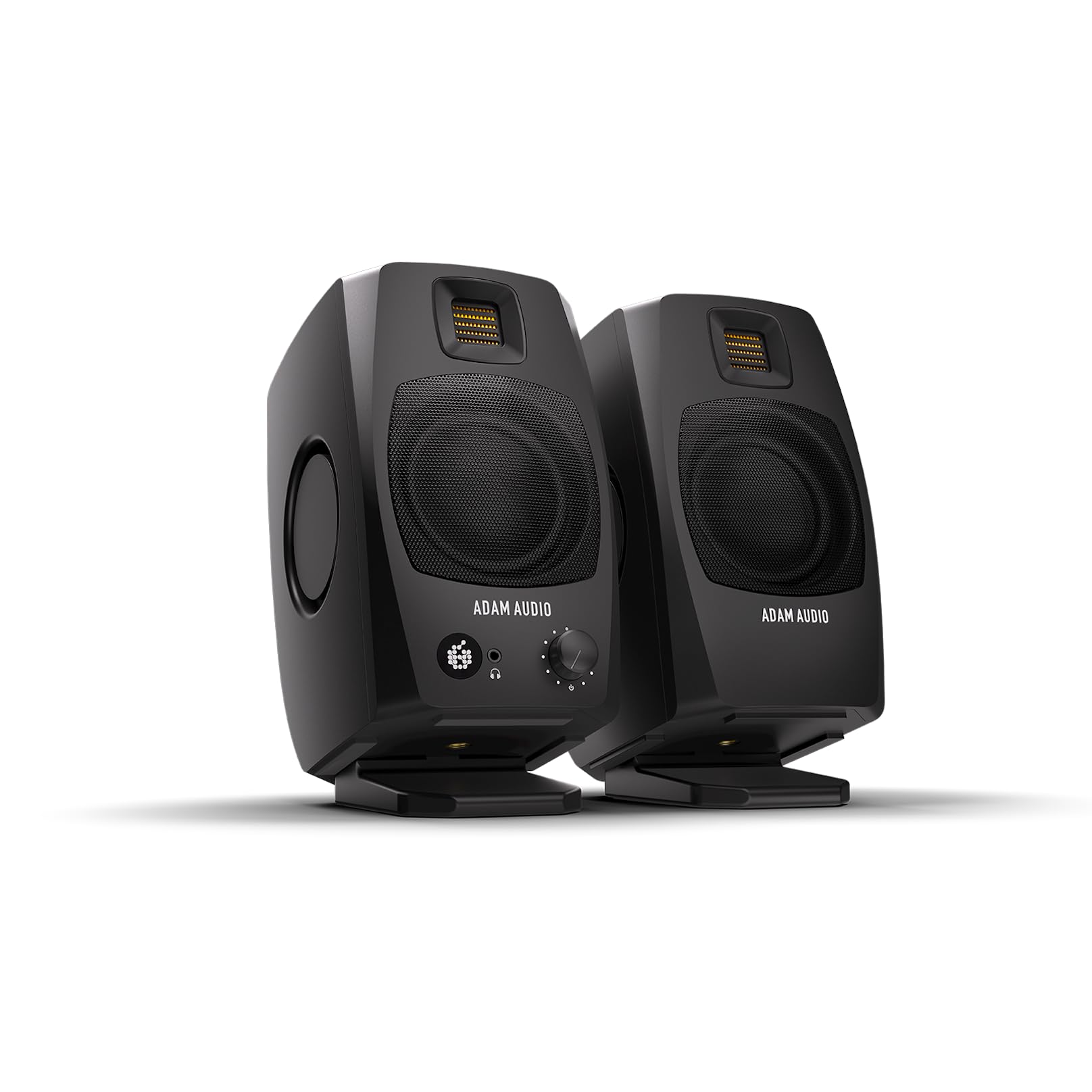
The ADAM Audio D3V is a compact active monitoring system that defies its physical footprint by incorporating dual 3.5-inch passive radiators alongside a 3.5-inch aluminum woofer and a handmade 1.5-inch D-ART (Desktop Accelerated Ribbon Tweeter). This four-driver-per-speaker configuration allows the D3V to reach down to 45 Hz—a depth typically reserved for speakers twice its size. The D-ART tweeter is the same folded-ribbon design used in ADAM’s larger studio monitors, providing the same precise, unfatiguing high-frequency reproduction that makes mid-range ADAM monitors so valued in professional environments.
The system connects directly to a computer via USB-C, and the left speaker backplate includes balanced 1/4-inch inputs plus DSP-controlled switches to correct for room acoustics. The front-panel headphone output and volume knob add convenience, while the included detachable stands angle each speaker at 15 degrees toward your ears for optimal nearfield alignment. The primary limitation is that the USB input is 16-bit only, which means users with high-resolution DACs will want to feed the D3V via the analog input for full detail retrieval.
Multiple reviewers note that the D3V’s initial firmware had a 20-minute auto-sleep mode that could interrupt long mixing or gaming sessions, but this has been addressed with a firmware update. The proprietary interconnect cable between the left and right speakers is non-standard, so losing it requires a factory replacement. For its size, the D3V produces an astonishingly full-range sound with clean bass, extended highs, and a wide soundstage that makes it an excellent choice for cramped desks where larger speakers simply cannot fit.
Why it’s great
- Four drivers per speaker deliver 45 Hz extension from a 3.5-inch footprint
- D-ART ribbon tweeter provides precise, non-fatiguing high-frequency detail
- Direct USB-C connection simplifies desktop integration without an external DAC
Good to know
- Proprietary interconnect cable between speakers is not replaceable with standard cables
- USB input is limited to 16-bit; external DAC required for high-resolution playback
- Firmware update required to disable aggressive auto-sleep during long sessions
9. Kanto ORA Powered Reference Desktop Speakers

The Kanto ORA is a bi-amplified powered speaker system that packs 100 watts of DSP-tuned Class D power into a chassis small enough to lay sideways under a monitor. Its 3-inch paper cone woofers and 3/4-inch silk dome tweeters produce a reference-quality sound that reviewers consistently describe as “linear” and “studio-grade” for the size. The paper cone material offers a natural, warm midrange with good transient response, though the speaker rolls off below roughly 70 Hz, and some users report mild muddiness around 400 Hz that requires a gentle EQ cut to resolve.
Connectivity covers the essential desk inputs: USB-C for high-quality computer audio, Bluetooth 5.0 for phone pairing, and RCA for analog sources. When a subwoofer is connected, the automatic crossover network engages at 100 Hz, relieving the ORA of sub-bass duties and allowing the system to play louder with less distortion. The 1/4-20 threaded inserts on each speaker enable wall or ceiling mounting, making the ORA unusually flexible for unconventional desk layouts. The magnetically shielded drivers also mean you can place them directly next to a CRT monitor without interference.
The enclosure is plastic with a visible assembly seam, which detracts from the premium feel at this price point. The MSRP is positioned toward the higher end of competitive range, but street pricing at the budget-friendly to mid-range tier makes the ORA a compelling value. The external power brick is an inconvenience for clean cable management, but the trade-off is that the compact cabinet size fits where larger speakers cannot. For the user who needs reference-quality sound in an ultra-compact package with subwoofer upgrade path, the ORA is a strong entry point into high-fidelity desktop audio.
Why it’s great
- Bi-amplified Class D design delivers clean, linear sound from a compact chassis
- Automatic 100 Hz crossover optimizes subwoofer integration for higher volume limits
- USB-C input, wall-mount capability, and magnetic shielding offer maximum desk flexibility
Good to know
- Visible plastic assembly seam and external power brick reduce premium feel
- Mild midrange muddiness around 400 Hz requires EQ correction
- Bass roll-off below 70 Hz makes a subwoofer beneficial for full-range sound
FAQ
Do I need a separate DAC for audiophile computer speakers?
Can I use a passive bookshelf speaker on my computer desk without a separate amplifier?
How much wall clearance do audiophile computer speakers need to avoid bass boom?
Final Thoughts: The Verdict
For most users, the audiophile computer speakers winner is the Kanto TUK because it delivers AMT tweeter precision, a built-in phono preamp, USB DAC, and subwoofer integration in a single powered package. If you want the absolute highest imaging resolution and have a high-current amplifier, grab the KEF LS50 Meta. And for a budget-friendly nearfield setup that still provides genuine audiophile detail in a tiny footprint, nothing beats the ADAM Audio D3V.