
Our readers keep the lights on and the weekend projects moving. As an Amazon Associate, I earn from qualifying purchases.
The difference between a muddy, lifeless digital stream and a holographic soundstage that places every instrument in its own space comes down to one component: your digital-to-analog converter. A subpar DAC introduces timing errors, jitter, and a flat noise floor that compresses dynamics and masks micro-detail, turning high-resolution files into compromised audio. The right converter unlocks the full potential of your headphones or speakers, revealing the nuance that recording engineers intended.
I’m Rikta — the co-founder and writer behind FitlyFast. Hundreds of hours of research comparing DAC chipsets, output stages, and real-world listening impressions from a dedicated community of critical listeners inform the recommendations in this guide.
Whether you are upgrading from a motherboard output or building a reference desktop system, finding the right audiophile dac means matching your headphone impedance, preferred sonic signature, and connectivity needs to a converter that delivers measurable noise and distortion figures below the threshold of human hearing.
How To Choose The Best Audiophile DAC
Selecting a DAC is not simply about picking the most expensive option with the highest sample rate support. Your choice must account for your headphone impedance, preferred sound signature, and the connectivity ports available on your amplifier or active speakers. An entry-level desktop DAC like the FiiO K7 provides a dramatic improvement over motherboard audio for under a moderate outlay, while premium network streamers like the Bluesound Node ICON integrate multiple sources into a single chassis. Understanding a few core specifications will guide you to the right decision.
DAC Chip Architecture: Delta-Sigma vs R2R
Most modern converters use delta-sigma chips from ESS Sabre or AKM, which offer exceptional measured performance with extremely low THD+N figures. These chips are neutral, transparent, and resolve fine detail effortlessly. R2R DACs, such as the FiiO K13 R2R, use precision resistor ladders to reconstruct the waveform directly, producing a warmer, more analog-like timbre with natural transient decay. R2R designs usually measure worse in objective tests but are prized for musicality and reduced listening fatigue.
Balanced Output and Headphone Amplifier Power
A true balanced output uses separate amplifier circuits for the positive and negative signal phases, cancelling common-mode noise and doubling the voltage swing. This matters most for high-impedance dynamic headphones and power-hungry planar magnetics. Look for a DAC/amp combo that specifies output power in milliwatts at a given impedance — the TOPPING DX5 II delivers 7600mW per channel into a balanced load, easily driving demanding headphones like the HiFiMan Arya Stealth.
Connectivity and Digital Interfaces
USB inputs are universal, but the interface chip inside the DAC matters. XMOS XU208 and XU316 controllers provide native driver support for Windows and bit-perfect playback up to PCM 768kHz and DSD512. Optical and coaxial inputs are useful for connecting CD transports or TV outputs, while I2S (used on the SMSL DO400 and Gustard DAC-X30) offers a dedicated path for low-jitter streaming from compatible sources. If you plan to stream wirelessly, LDAC Bluetooth support is the current high-water mark for convenience without major quality loss.
Quick Comparison
On smaller screens, swipe sideways to see the full table.
| Model | Category | Best For | Key Spec | Amazon |
|---|---|---|---|---|
| FiiO K7 | Desktop Combo | First balanced upgrade | THX AAA 788+ amp, 2000mW BAL | Amazon |
| iFi Zen DAC 3 | Desktop DAC | USB-C simplicity, warm tonality | Burr-Brown True Native, DSD512 | Amazon |
| TOPPING DX5 II | Desktop Combo | High-power balanced amp with PEQ | Dual ES9039Q2M, 7600mW BAL | Amazon |
| FiiO K13 R2R | Desktop Combo | Warm analog timbre, NOS mode | 24Bit R2R, 2400mW BAL, PEQ | Amazon |
| SMSL DO200 MKII | DAC Only | Neutral DAC with MQA full decode | Dual ES9068AS, XU316, MQA | Amazon |
| SMSL DO400 | Desktop Combo | Power for demanding planars | ES9039MSPRO, 3W/32Ω BAL | Amazon |
| Bluesound Node ICON | Network Streamer | Multi-room streaming + DAC | Dual ES9039Q2M, THX AAA, Dirac | Amazon |
| Sennheiser HDV 820 | Reference Amp/DAC | Sennheiser HD800S companion | ESS 9028PRO, XLR4 balanced out | Amazon |
| GUSTARD DAC-X30 | Streaming DAC | Reference network streaming | 4× ES9039SPRO, LAN/Roon/UPnP | Amazon |
In‑Depth Reviews
1. FiiO K7 Full Balanced HiFi DAC Headphone Amplifier

The FiiO K7 occupies a sweet spot in the desktop DAC/amp market by pairing a six-stage audio circuit with dual AK4493SEQ DAC chips and a THX AAA 788+ amplification stage. This combination yields 2000mW of balanced output into a 32Ω load, enough headroom to drive full-size planars without strain while remaining inaudibly quiet with sensitive IEMs. The dedicated digital volume knob includes a mute zone at the bottom, a thoughtful touch for those swapping between low-impedance earphones and high-impedance headphones.
Sound quality is transparent and dynamic, with a mild but audible improvement in soundstage width and instrument separation over any motherboard or entry-level USB dongle. The K7 supports USB, optical, coaxial, and AUX inputs, with balanced output available through 4.4mm and 4-pin XLR connectors. Real-world listening impressions confirm that the K7 runs cool, carries solid build quality in its titanium-finished chassis, and eliminates RF interference that plagues unshielded computer audio outputs.
Comparisons to the iFi Zen DAC V2 suggest the FiiO offers slightly better separation and a more neutral presentation, while the iFi leans warmer with fuller bass. The K7’s main limitation is that DAC chip upgrades to higher-end models like the K9 ESS bring noticeable improvements in treble refinement and transient speed, but for most listeners the K7 represents a near-endgame desktop solution without crossing into premium pricing territory.
Why it’s great
- Outstanding price-to-performance with THX AAA amplification
- Versatile input/output options including balanced XLR/4.4mm
- Quiet enough for sensitive IEMs, powerful enough for planars
Good to know
- No Bluetooth or wireless streaming built in
- Balanced output improvements over single-ended are subtle but present
2. iFi Zen DAC 3 Desktop Digital Analog Converter
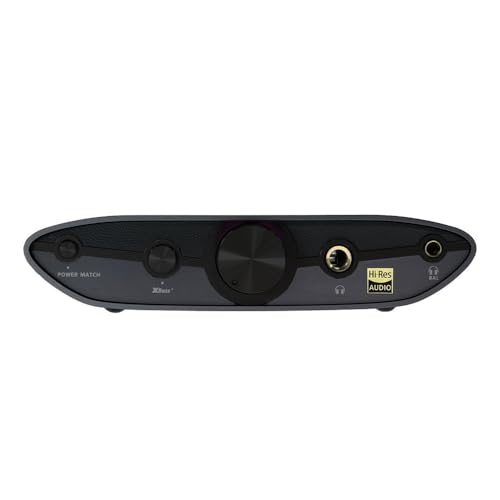
The iFi Zen DAC 3 uses the Burr-Brown True Native chipset to deliver a warm, detailed, and slightly forward presentation that many listeners find more engaging than purely neutral converters. Its output stage supports PCM up to 32-bit/768kHz and full MQA decoding, making it a strong candidate for Tidal Master subscribers. The compact matte aluminum housing looks understated, and the volume knob has a weighty, precise feel that reflects an overall build quality exceeding its placement in the market.
iFi includes PowerMatch (gain adjustment for different headphone sensitivities) and TrueBass (a smooth low-end boost that avoids bloat) as hardware-toggled features. The headphone output via 4.4mm balanced is clean and detailed, though some users report it sounding slightly underpowered for high-impedance models like the AKG K712 Pro — the upper registers can become a touch prominent at higher volumes. For studio monitors or powered speakers, the variable line-out works well, though audio plays to all connected outputs simultaneously without a mute toggle for one path.
Compared to the previous Zen DAC V2, the V3 reduces background haptic noise and sharpens transient edges without becoming fatiguing. The Xbass circuit in the V3 delivers a harder-hitting sub-bass punch versus the V2’s smoother Truebass. Pairing is critical here — reviewers note that the FiiO FT1 headphones driven by this DAC outperform setups costing several times more, underscoring that synergy between source and transducer matters more than absolute spend.
Why it’s great
- Warm, detailed signature with excellent midrange presence
- USB-C powered with no external adapter needed
- TrueBass adds tasteful low-end weight without muddying
Good to know
- Headphone out may lack current for high-impedance dynamics
- Simultaneous output to headphone and line-out with no mute option
3. TOPPING DX5 II Hi-Res DAC & Headphone Amp Combo
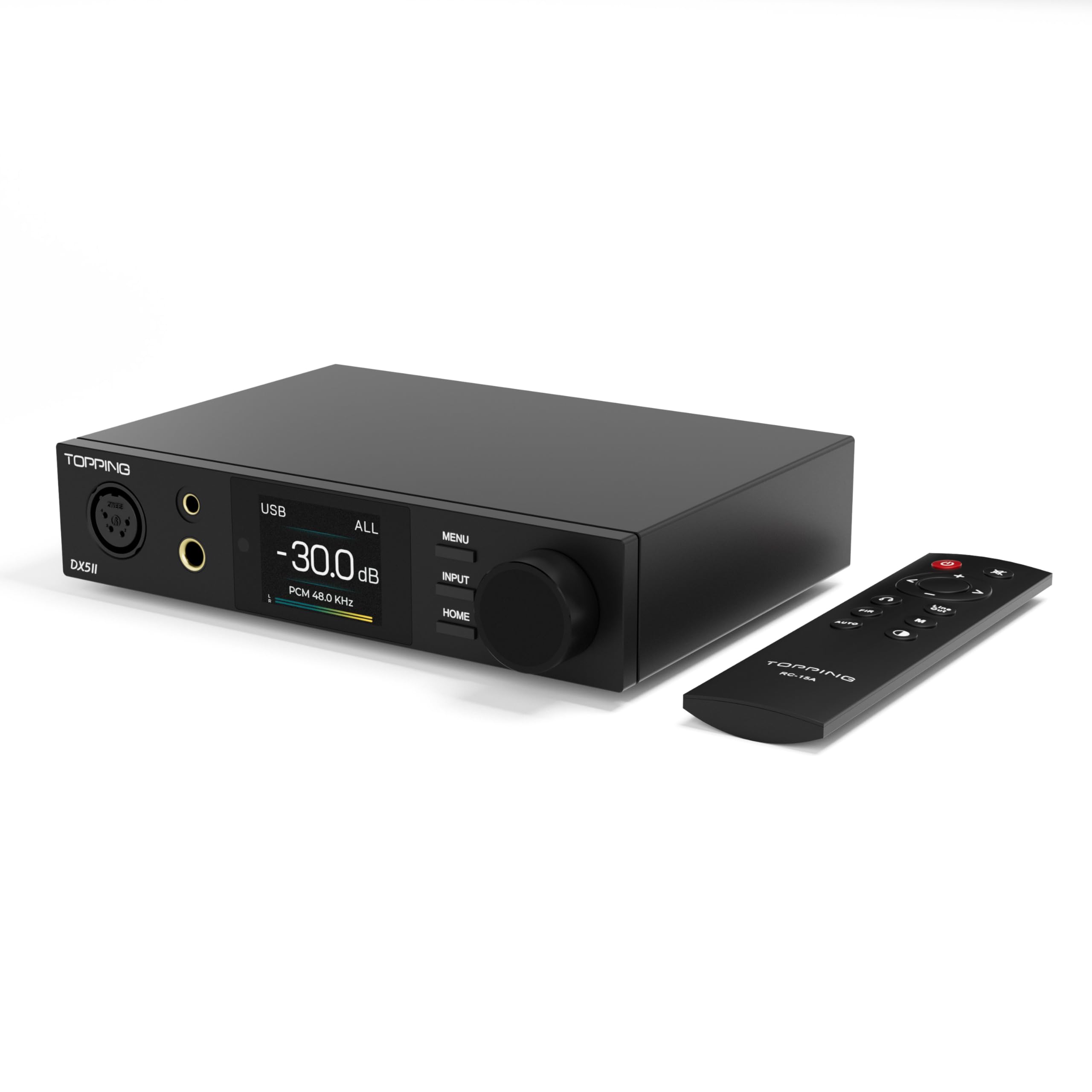
The TOPPING DX5 II sets a high bar for desktop DAC/amp combos by incorporating dual ES9039Q2M DAC chips with an X-Hybrid balanced headphone amplifier capable of 7600mW per channel. This amount of power makes it a legitimate option for driving difficult planars like the HiFiMan Arya Stealth, where it delivers clean, distortion-free output with ample headroom. The 10-band precision PEQ is a standout feature — it allows users to tailor frequency response to their headphone’s tonal balance or correct for room acoustics when used as a preamp.
Connectivity is extensive: USB (XMOS XU316), Bluetooth 5.1 with LDAC, coaxial, and optical inputs cover nearly every digital source. The 2.0-inch Aurora UI display with nine customizable themes and a pressable knob make navigation intuitive. The DX5 II also supports a 12V trigger for seamless integration with power amplifiers or active speakers. Sound is transparent, with a neutral noise floor that reveals micro-detail without added coloration, and the XLR balanced output to powered monitors eliminates ground loop hum.
Reports of quality control issues appear in user feedback — one reviewer experienced distortion on the balanced output after a few weeks, and a warranty replacement failed months later. While many units perform flawlessly, the inconsistent reliability is a concern for a purchase intended as a long-term desktop anchor. When working properly, the DX5 II delivers reference-grade performance that competes with separates costing substantially more.
Why it’s great
- Extreme balanced output power for demanding headphones
- Built-in 10-band PEQ with Auto EQ preset sharing
- Bluetooth LDAC adds wireless convenience without major quality loss
Good to know
- Reported quality control issues on balanced outputs
- No I2S input for dedicated streamer integration
4. FiiO K13 R2R Desktop DAC & Headphone Amp
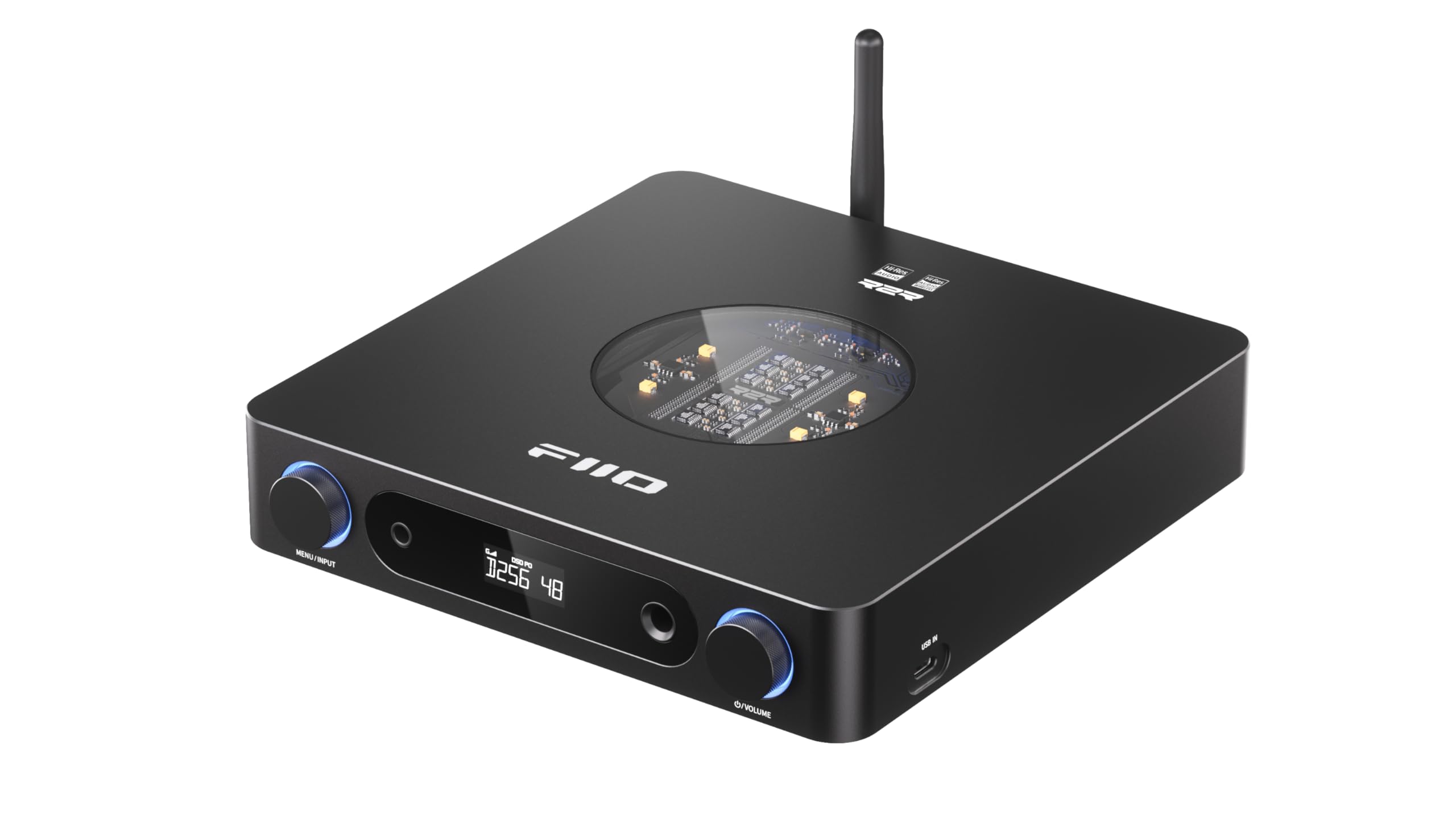
The FiiO K13 R2R stands apart from its delta-sigma competitors by using a proprietary fully differential 24-bit R2R DAC built from 192 precision thin-film resistors. This architecture produces a warmer, more analog-sounding timbre with a natural decay that reduces treble fatigue during long listening sessions. The ability to toggle between NOS (Non-Oversampling) and OS (Oversampling) modes is a defining feature — NOS preserves the original sample rate for a pure, relaxed presentation, while OS upsamples to 384kHz for slightly sharper attack and improved measured performance.
Output power is rated at 2400mW balanced, sufficient for most dynamic and planar headphones, though the headphone amp section is competent rather than exceptional when compared to dedicated units. The line-out via XLR and RCA is where the K13 truly shines — users report a wide, holographic soundstage with impressive depth and layering that rivals more expensive DACs. A 10-band PEQ with app control and web interface allows full customization, and Bluetooth 5.4 with LDAC adds wireless flexibility without tethering to a computer.
Build quality is solid with a heavy aluminum chassis and customizable RGB lighting, though the volume knob has a slight wobble and the tiny display makes volume level hard to read at a glance. The remote control has loud, resistant buttons and a dangerous design flaw: the “Line Out” button instantly sends full volume to connected speakers. Despite these ergonomic quirks, the K13’s R2R sound signature — musical, immersive, and emotionally engaging — makes it a compelling choice for listeners who prioritize timbre over clinical transparency.
Why it’s great
- Unique R2R DAC with warm, analog-like musicality
- NOS mode preserves original sample rate for natural sound
- 10-band PEQ with app control and shared presets
Good to know
- Small display with poor volume legibility from listening position
- Remote control has loud buttons and a risky full-volume line-out trigger
5. SMSL DO200 MKII MQA Balanced DAC
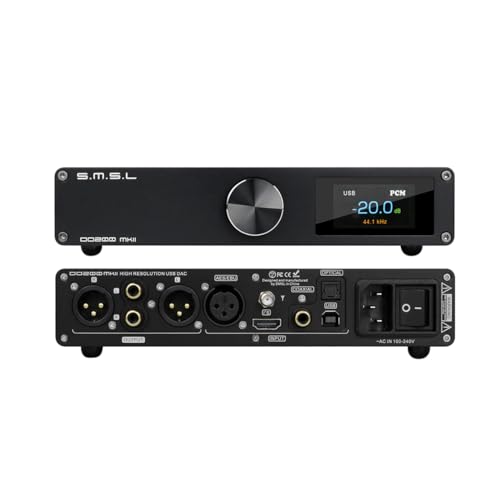
The SMSL DO200 MKII is a DAC-only unit designed for users who already own a dedicated headphone amplifier or preamp. It uses dual ES9068AS DAC chips in a balanced configuration with five OPA1612A operational amplifiers, yielding a THD+N figure near the theoretical floor of audible measurement. The XMOS XU316 USB controller handles PCM up to 768kHz and native DSD512, with full MQA decoding for Tidal’s Master-tier tracks. Input options include USB, optical, coaxial, AES/EBU, and I2S, making it compatible with nearly any digital source.
Sonically, the DO200 MKII is detailed and neutral, with a slight forwardness in the upper frequencies that some listeners find analytical. The ES9068AS chip is known for exceptional resolution, and it reveals micro-detail in recordings — subtle studio reverb, the texture of bow on strings, and the decay of cymbal crashes — that cheaper DACs gloss over. Sound tone modes (NOS, minimum phase, linear phase filters) allow minor tuning, though the unit lacks a built-in headphone amplifier, so users must factor in the cost of a separate amp if they don’t own one.
Build quality is excellent, with a full-metal chassis, an IPS color display with dimming, and a full-featured remote. Some users note that the English manual is too brief and omits necessary XMOS driver installation instructions for Windows. The DO200 MKII occupies a specific niche: it is ideal for desktop listeners with an existing high-quality amplifier who want a clean, feature-rich DAC that handles all modern file formats without adding coloration.
Why it’s great
- Exceptional measured performance with ultra-low THD+N
- Full MQA decoding and native DSD512 support
- I2S input for low-jitter connection to streamers
Good to know
- No headphone amplifier built in
- Highs can sound forward without tone filter adjustment
6. SMSL DO400 Full Balanced DAC Headphone Amplifier

The SMSL DO400 integrates the flagship ES9039MSPRO DAC chip with a powerful headphone amplifier that delivers 3 watts per channel into 32Ω via the balanced output. This is enough current to drive notoriously power-hungry planars like the Hifiman HE6se without breaking a sweat. The XMOS XU316 processor handles MQA full decoding, PCM 768kHz, and DSD512, while six input options — USB, AES, optical, coaxial, I2S, and Bluetooth — cover every conceivable source. A retro knob and suspended display window give the silver chassis a distinctive visual identity.
Sound is transparent and powerful, with a full, punchy bass response and a treble that avoids the harshness of earlier ESS implementations. Users comparing the DO400 to the TOPPING DX3 Pro+ report a more joyful, musical presentation with richer midrange tonality and more realistic bass texture. The headphone amplifier runs cool even during extended use, and channel matching is perfect down to low volumes, a critical detail for IEM users. Firmware updates are available to address early reports of pop/crackle noise on certain USB configurations.
Despite its performance, the DO400 is not without quirks. The USB driver must be installed carefully — one reviewer found that leaving the XMOS driver uninstalled resolved pop issues entirely. The display is clear and customizable, but the remote control is basic. For users who want a single-box solution that drives high-end headphones with authority and pairs well with active speakers via XLR pre-out, the DO400 delivers endgame capability without stepping into ultra-premium pricing.
Why it’s great
- 3W balanced output drives the most demanding planars
- Full MQA decoding with I2S input for streamers
- Transparent yet musical sound with rich midrange
Good to know
- Firmware updates may be needed to resolve USB pop issues
- Remote control is basic compared to the unit’s overall feature set
7. Bluesound Node ICON Multi-Room Wireless Music Streamer

The Bluesound Node ICON is a network streamer, DAC, and headphone amplifier all housed in a premium aluminum chassis with a 5-inch HD display. Its dual-mono DAC section uses two ESS SABRE ES9039Q2M chips — one per channel — with MQA Labs’ QRONO d2a technology to correct timing errors during digital-to-analog conversion. The result is a soundstage with exceptional width, depth, and transient precision that places this unit close to dedicated DACs and streamers at a higher price. Dirac Live room correction is available as a paid upgrade, a rare feature for a streaming DAC at this level.
The THX AAA headphone amplifier provides a clean, linear output via dual 1/4-inch jacks. It is not the most powerful stage for demanding planars, but it drives most high-impedance dynamics with authority and clarity. Connectivity is comprehensive: HDMI eARC for TV audio, USB-C for PC input, aptX Adaptive Bluetooth, AirPlay 2, and dual-band Wi-Fi. The BluOS ecosystem allows multi-room synchronization with other Bluesound speakers, controlled through the BluOS Controller app on any device.
Setup can be glitchy — some users report BluOS app connection issues and SMS notification interruptions, but these are typically resolved with firmware updates. The Node ICON runs warm and requires ventilation in cabinets. DSD playback is limited to 256, not 512, which may disappoint purists with large DSD libraries. Overall, the Node ICON is a compelling all-in-one hub for the listener who wants streaming, DAC, and headphone functionality in a single, beautifully built box that integrates seamlessly with a high-end stereo system.
Why it’s great
- True dual-mono DAC design with QRONO d2a timing correction
- THX AAA headphone amp in a full-featured streamer
- HDMI eARC for high-res TV audio integration
Good to know
- DSD limited to 256; no DSD512 support
- Generates noticeable heat; needs ventilation
8. Sennheiser HDV 820 Reference Headphone Amplifier DAC

The Sennheiser HDV 820 is the official companion amplifier for the Sennheiser HD 800 S and HD 820 headphones, built around the ESS 9028PRO Sabre DAC chip. It is designed and tuned specifically to extract the full potential of Sennheiser’s reference transducers, and it delivers on that promise with a natural, full-bodied sound that preserves the HD 800 S’s famous soundstage while adding warmth and body to its leaner midrange. The XLR4 balanced output is the star here — users report a 60% improvement in clarity and dynamics over single-ended operation with the HD 800 S.
Build quality is exceptional. The aluminum chassis with its distinctive curved front panel and large volume knob feels like a piece of high-end laboratory equipment. Inputs include USB, optical, and coaxial, with fixed and variable RCA outputs for connecting to a preamp or powered monitors. The amplifier section has ample power for multiple headphone types, and the noise floor is inaudible even with sensitive IEMs. The HDV 820 is particularly effective at revealing micro-detail in classical and acoustic recordings, where the decay of piano notes and the texture of string instruments become tangible.
The HDV 820 is not a versatile multi-function unit — it lacks streaming, Bluetooth, PEQ, and a remote control worth mentioning. Windows driver compatibility can be finicky, with some users unable to establish a stable USB connection. Its primary purpose is to serve as the analog heart of a Sennheiser-based system, and it performs that role superbly. For owners of the HD 800 S or any high-impedance dynamic headphone that benefits from Sennheiser’s tuning philosophy, the HDV 820 is a reference-grade match that avoids the pitfalls of generic DAC/amp pairings.
Why it’s great
- Perfectly tuned synergy with Sennheiser HD 800 S/HD 820
- XLR4 balanced output reveals significant performance gains
- Class-leading build quality and analog amplifier design
Good to know
- No streaming, Bluetooth, or PEQ features
- Windows USB driver installation can be problematic
9. GUSTARD DAC-X30 HiFi Network Streaming DAC
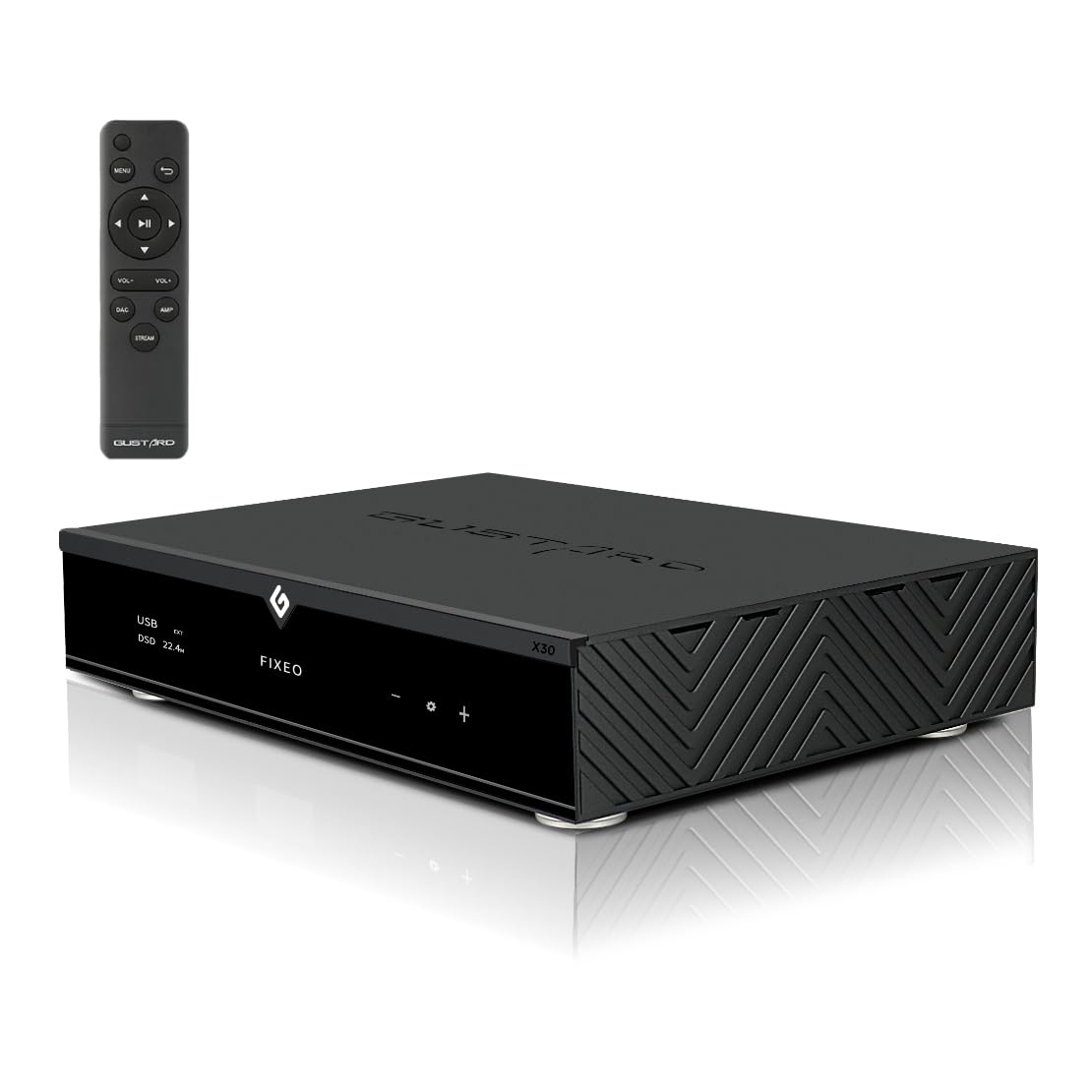
The GUSTARD DAC-X30 represents a true flagship design, employing four ESS ES9039SPRO chips in a fully balanced configuration — two DACs per channel with independent power and grounding. This architecture pays substantial dividends in channel separation, noise rejection, and overall dynamic range. The DAC-X30 is also a full network streamer, supporting Roon Bridge, UPnP, and NAA protocols over its LAN input, allowing direct streaming from a NAS or Qobuz/Tidal without needing a separate computer. An external 10MHz clock input and internal OCXO oscillator further reduce jitter to vanishingly low levels.
Sound quality is described by users as exceptionally musical — more so than the equivalent Gustard R26, which uses a different chipset. The X30 offers superior clarity, instrument separation, and extension across the frequency spectrum, with an engaging, lively presentation that avoids the sterile neutrality some flagchip DACs can exhibit. It requires approximately two days of continuous playback to fully burn in. Poor recordings become more obviously flawed through the X30, but well-mastered tracks achieve a tangibility that encourages long listening sessions.
Connectivity includes USB, LAN, optical, coaxial, AES/EBU, and dual I2S inputs, with XLR and RCA outputs. The SD card slot included on the rear panel is not functional in the current firmware — this must be noted to avoid confusion. The DAC-X30 drops Bluetooth compared to its predecessor, which may disappoint wireless users. Setup requires a degree of network competence, particularly for Roon or UPnP configuration, and the English manual is minimal. For the listener seeking a no-compromise network DAC that serves as the centerpiece of a reference system, the DAC-X30 delivers extraordinary performance that competes with converters at a substantially higher price.
Why it’s great
- Four ES9039SPRO chips in dual-mono balanced architecture
- Integrated network streaming with Roon/UPnP/NAA
- OCXO clock and external 10MHz input for ultra-low jitter
Good to know
- SD card interface is non-functional despite physical presence
- No Bluetooth; network setup requires technical skill
FAQ
Does a more expensive DAC always sound better than a budget model?
Is a balanced output worth it for listening with headphones?
What sample rate and bit depth do I actually need for streaming?
Can I use a DAC with powered studio monitors or a home stereo amplifier?
What is the role of the USB interface chip in a DAC?
Final Thoughts: The Verdict
For most users, the audiophile dac winner is the FiiO K7 because it delivers THX AAA amplification, dual AK4493SEQ chips, and balanced outputs at a price that leaves room for a headphone upgrade without sacrificing performance. If you want a warmer, more analog sound signature with the flexibility of NOS/OS modes and a built-in PEQ, the FiiO K13 R2R is the standout choice. And for a premium all-in-one network streamer, DAC, and headphone amp that integrates seamlessly into a multi-room system, nothing beats the Bluesound Node ICON.