
Our readers keep the lights on and the weekend projects moving. As an Amazon Associate, I earn from qualifying purchases.
The gap between a decent pair of headphones and a truly resolving audiophile setup has narrowed dramatically, especially under $500. You no longer need to spend a month’s rent to hear the texture of a double bass or the air around a cymbal—what matters now is choosing the right tuning, driver topology, and build integrity for your library and gear. The challenge is separating genuine transient speed and soundstage depth from marketing specs that sound impressive on paper but fall apart in the listening chair.
I’m Rikta — the co-founder and writer behind FitlyFast. I’ve spent years analyzing planar magnetic driver topologies, diaphragm thickness benchmarks, and impedance matching strategies across the –$500 bracket to identify which models actually deliver studio-grade resolution and fatigue-free listening.
All of the options below sit comfortably within a serious budget, and choosing the right one comes down to driver type, weight, and impedance synergy with your source. This guide breaks down the nine best audiophile headphones under $500 based on measured specs and real-world user feedback.
How To Choose The Best Audiophile Headphones Under $500
Picking the right pair at this price point is about trade-offs between driver speed, frequency response balance, and comfort for long sessions. You can’t get everything, but you can get exactly what your music demands.
Driver Type: Planar Magnetic vs Dynamic
Planar magnetic drivers use a flat diaphragm suspended in a magnetic field, offering extremely low distortion and fast transient response — ideal for complex orchestral passages and fast metal riffing. Dynamic drivers, on the other hand, use a traditional cone and voice coil, which can deliver more impactful bass slam and a warmer tonal balance. For critical analytical listening, planar magnetics generally win on detail retrieval, while dynamics often sound more musical and forgiving.
Impedance and Sensitivity: The Source Matching Trap
A high-impedance headphone (300 ohms or more) will sound thin and lifeless out of a phone or laptop — you need a dedicated amplifier. Low-impedance models (under 50 ohms) are easier to drive but can expose noise floors in poor-quality sources. Sensitivity measured in dB/mW tells you how loud the headphones will go per milliwatt: aim for at least 96 dB/mW if you plan to use portable gear without an amp.
Frequency Response and Tuning Preference
Neutral or reference tuning reveals every flaw in a recording but can sound clinical and fatiguing. A warm tilt with a slight bass lift and smooth treble is more forgiving for long listening sessions and poorly mastered tracks. Know your library: classical and acoustic require flat mids and extended treble, while electronic and hip-hop benefit from planar bass extension and controlled sub-bass.
Quick Comparison
On smaller screens, swipe sideways to see the full table.
| Model | Category | Best For | Key Spec | Amazon |
|---|---|---|---|---|
| FiiO FT5 | Planar | Critical detail retrieval | 90mm planar, 6µm diaphragm | Amazon |
| Sennheiser HD 490 PRO | Dynamic | Mixing & long sessions | Dual ear pads, 5–36kHz | Amazon |
| Sennheiser HD 660S2 | Dynamic | Vocal intimacy & depth | 42mm transducer, 300Ω | Amazon |
| HIFIMAN Ananda Nano | Planar | Wide soundstage & imaging | Nanometer diaphragm, stealth magnets | Amazon |
| Sony MDR-MV1 | Dynamic | Spatial audio & comfort | 24Ω, 5Hz–80kHz | Amazon |
| Sennheiser HD 550 | Dynamic | All-day comfort & gaming | 6Hz–39.5kHz, reduced clamp | Amazon |
| FiiO FT1 Pro | Planar | Value planar entry point | 95x86mm planar, 1µm diaphragm | Amazon |
| Sony MDR-M1 | Dynamic | Closed-back monitoring | 5Hz–80kHz, 216g | Amazon |
| Monolith M1060 | Planar | Large driver value | 106mm planar, 50Ω | Amazon |
In‑Depth Reviews
1. FiiO FT5

The FiiO FT5 represents the ceiling of what a planar magnetic headphone can achieve at this price point. Its 90mm driver with a 6µm ultra-thin diaphragm delivers a level of transient speed and micro-detail retrieval typically found in kilobuck designs. The bass is tight and articulate, not boomy, while the midrange remains neutral enough for critical listening without becoming sterile. The open-back design creates a soundstage that feels naturally expansive rather than artificially wide, making it excellent for orchestral and complex rock arrangements.
Build quality is a standout — FiiO uses a lightweight magnesium alloy construction to keep the weight manageable at 36 ohms impedance, making it easier to drive than many planars. The cable is high-purity silver-plated monocrystalline copper with interchangeable 3.5mm, 4.4mm, and 6.35mm plugs, plus a balanced XLR adapter included in the package. The luxurious leather storage case and both protein leather and suede earpads add serious value for the price.
That said, the FT5 is not forgiving of poor recordings — its resolution exposes sibilance and compression in low-bitrate files. It also benefits noticeably from a dedicated amplifier, despite its moderate impedance, to reach its full dynamic potential. Some users report the weight (around 450g) can cause fatigue after several hours, though the padded headband mitigates this well. For analytical listeners who value precision over warmth, this is the benchmark.
Why it’s great
- Exceptional transient speed and detail retrieval for the price
- Premium accessories: balanced cables, suede/protein pads, leather case
- Interchangeable plugs for all common outputs
Good to know
- Not forgiving of poorly mastered recordings
- Weight around 450g may cause fatigue over long sessions
- Still benefits from a dedicated amplifier
2. Sennheiser HD 490 PRO

Sennheiser’s HD 490 PRO is a professional-grade open-back that brings the company’s studio heritage into the mid-range price bracket. Its unique selling point is the inclusion of two distinct sets of ear pads — one tuned for producing (slightly warmer) and one for mixing (more neutral reference). The driver is a custom dynamic unit with a low-frequency cylinder system that delivers bass extension tighter and more defined than most open-back dynamics at this level. Imaging is pinpoint accurate, making it a favorite for competitive gaming and critical panning work.
The Open-frame Architecture minimizes total harmonic distortion and resonance, which translates to cleaner high-frequency extension and less ear fatigue over long sessions. At just over 260g, the HD 490 PRO is one of the most comfortable options in this roundup, with a clamp force that is secure without being tight. The detachable cable uses a mini-XLR connector that locks in place, and the pads are washable and replaceable — a nod to sustainability and long-term ownership.
On the downside, the soundstage is more intimate than some planar competitors; it doesn’t project instruments far beyond the ear cups. The proprietary mini-XLR connector limits aftermarket cable options compared to standard 3.5mm jacks. At its price point, it lacks a balanced cable in the box — you get a single-ended 1.8m cable and a 3.5mm to 6.35mm adapter. For mixing engineers or gamers who prioritize positioning accuracy above all else, this is a top-tier choice.
Why it’s great
- Two included ear pad sets for different tuning preferences
- Excellent imaging and low THD for studio work
- Lightweight, comfortable for 8+ hour sessions
Good to know
- Soundstage is intimate rather than expansive
- Proprietary mini-XLR cable limits aftermarket options
- No balanced cable included by default
3. Sennheiser HD 660S2
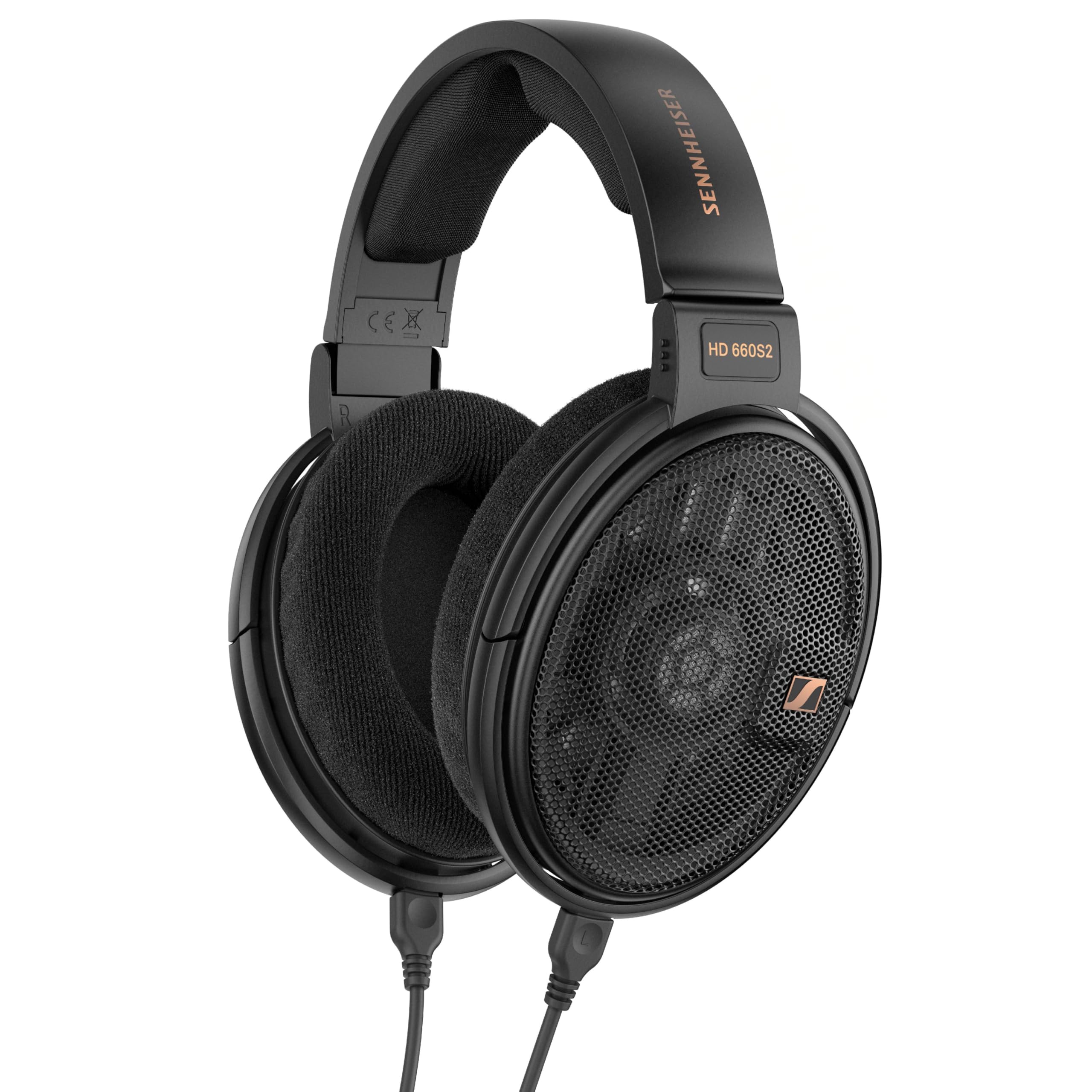
The HD 660S2 is Sennheiser’s refined evolution of the legendary HD 600-series formula, now with deeper sub-bass extension and a slightly warmer tilt that makes vocals sound lifelike and present. The 42mm dynamic driver uses an ultra-light aluminum voice coil to maintain transient speed while extending the low end down to 27.5 Hz — enough to feel the fundamental of a kick drum or bass piano note without bloat. The midrange remains the star here: rich, natural, and intimate, placing the vocalist firmly in the center of your head.
Build quality is classic Sennheiser — matte black plastics and metal mesh grilles with a utilitarian elegance that prioritizes function over flash. The open-back design is bred in Germany and Ireland, and the package includes both a 6.3mm unbalanced cable and a 4.4mm balanced cable, plus a carry pouch. The 300-ohm impedance means it benefits significantly from a dedicated headphone amplifier, but paired properly, the HD 660S2 delivers a holographic vocal presentation that few competitors match at this price.
The main trade-off is a relatively narrow soundstage compared to planar competitors like the Ananda Nano or the FT5. If you regularly listen to large orchestral works or live concert recordings, the intimate staging may feel congested. The stock cables also have a reputation for microphonics near the earcup connectors, though this is easily remedied with third-party options. For vocal-centric and solo instrumental listening, this is the most emotionally engaging choice.
Why it’s great
- Lifelike vocal reproduction with natural midrange warmth
- Deep, controlled sub-bass extension for a dynamic driver
- Both 6.3mm and 4.4mm cables included
Good to know
- Narrow soundstage — less expansive than planars
- Requires a powerful amplifier for full potential
- Stock cables are microphonic near the earcups
4. HIFIMAN Ananda Nano

The Ananda Nano takes HIFIMAN’s acclaimed Ananda design and upgrades it with a nanometer-thickness diaphragm borrowed from the flagship SUSVARA. The result is dramatically lower distortion and faster transient response than the standard Ananda, with dynamics and detail retrieval that approach the + HE1000 series. The stealth magnet array allows sound waves to pass through without diffraction interference, producing a soundstage that wraps around the listener with precise instrument placement and depth.
Bass response is tight and controlled rather than overwhelming — the Nano delivers articulate sub-bass that underpins without dominating. Midrange is upfront and clear, making vocals and acoustic instruments feel present and tactile. The treble region has a slight elevation around 8-10 kHz that adds air and sparkle but may be too bright for listeners sensitive to sibilance; a simple EQ cut at 8kHz tames it effectively. The window-shade grill design reduces internal reflections for clarity.
Comfort is a mixed bag: the hybrid headband distributes weight well, but some users find the clamp force too light and the elastic strap stretches over time, reducing stability. The asymmetrical ear cups are spacious for large ears, but the stock pads are shallow and may benefit from aftermarket memory foam replacements. At this price point, the Nano offers class-leading resolution and soundstage width, but it demands careful source matching and a tolerance for HIFIMAN’s occasional QC inconsistencies.
Why it’s great
- Class-leading detail retrieval and low distortion for the bracket
- Expansive, holographic soundstage with precise imaging
- Nanometer diaphragm and stealth magnet technology from flagship models
Good to know
- Bright treble may cause fatigue — EQ recommended
- Elastic headband can stretch over time
- Occasional quality control variances reported
5. Sony MDR-MV1

Sony’s MDR-MV1 is a reference open-back monitor designed explicitly for spatial and immersive audio production. With a 24-ohm impedance and high sensitivity, it is one of the easiest headphones in this guide to drive — you can run it off a laptop or a portable DAC dongle without breaking a sweat. The frequency response extends from 5 Hz to 80 kHz, with a gentle V-shape tuning that adds warmth in the low end and presence in the treble without ever sounding harsh or sibilant.
The soundstage is impressively wide for a dynamic driver, with excellent depth and layering that makes panning effects and reverb tails clearly audible. Imaging is sharp enough for competitive gaming, while the tonal balance remains musical enough for casual listening. At just 223 grams with plush suede ear pads and a low clamping force, the MV1 is arguably the most comfortable headphone in this roundup — ideal for marathon mixing sessions or all-day wear with glasses.
The build quality is mixed: the lightweight aluminum alloy construction is solid, but the stock cable is a weak point — it tangles easily, transmits microphonics, and terminates in a bulky 1/4-inch plug with a poorly designed 3.5mm adapter. The earpads, while comfortable, are non-replaceable by design, which limits long-term repairability. For users who prioritize extreme comfort, easy drivability, and a spacious yet non-fatiguing sound, the MDR-MV1 is a hidden gem.
Why it’s great
- Extremely lightweight and comfortable for all-day wear
- Easy to drive from portable devices without an amplifier
- Wide soundstage with precise spatial imaging
Good to know
- Stock cable is mediocre: tangles and microphonics
- Earpads are non-replaceable by design
- Slightly recessed midrange — not for critical vocal monitoring
6. Sennheiser HD 550

The Sennheiser HD 550 is the entry point into Sennheiser’s audiophile series without the high-impedance demands of the HD 600 line. Its custom dynamic driver covers 6 Hz to 39.5 kHz with a balanced, non-fatiguing tuning that leans slightly toward the warmer side of neutral. The midrange is clear and natural — reminiscent of the HD 600 — but with notably better bass extension and a more forgiving treble response that avoids sibilance and listener fatigue.
Sennheiser specifically redesigned the headband and ear pads to reduce clamping force, making the HD 550 one of the most comfortable open-backs in its class. The metal mesh grille and reduced plastic construction give it a premium feel without adding unnecessary weight. It comes with a 1.8m cable terminated in 3.5mm with a screw-on 6.35mm adapter, plus a drawstring storage bag. It is microphone-ready via a detachable accessory cable, which makes it versatile for remote work and gaming as well.
The soundstage is wider than the HD 660S2 but still intimate compared to planar competitors like the Ananda Nano. Detail retrieval is very good for the price, but it doesn’t reach the micro-detail level of the FT5 or the HD 490 PRO. The bass, while extended, lacks the punch and definition of planar bass — it’s more about texture than slam. For listeners who want a comfortable, all-rounder open-back that works with gaming, podcasts, and streaming without requiring an amplifier, the HD 550 is a solid value.
Why it’s great
- Reduced clamp force for extended comfort
- Warm, non-fatiguing tuning suitable for all genres
- Easy to drive without a dedicated amplifier
Good to know
- Soundstage is intimate, not expansive
- Bass lacks the slam and definition of planar options
- Detail retrieval is good but not class-leading
7. FiiO FT1 Pro

The FiiO FT1 Pro represents a massive step forward in budget planar performance. Its driver measures 95x86mm — a size previously reserved for flagship models — yet the headphone weighs only about 374 grams thanks to a lightweight build. The 1µm ultra-thin PET diaphragm, coated with sapphire and aluminum using a proprietary dual-coating process, delivers frequency response up to 40 kHz with exceptional resolution for the price. The uniform magnetic field design minimizes segmented vibrations and distortion, resulting in a clean, detailed presentation that punches well above its weight.
Sound quality is balanced and revealing: bass is tight and extended, mids are neutral with good vocal presence, and treble is extended but can take on a slight metallic timbre that some listeners may notice. The soundstage is wide and open, creating a convincing sense of space that competes with mid-range planars. The package includes both 3.5mm and 4.4mm balanced cables, a 6.35mm adapter, and a hard carrying case — impressive value for the price.
The elephant in the room is quality control. Multiple user reports describe yoke cracking near the screw points within days of ownership, as well as bass distortion at high sound pressure levels on some units. While these issues are not universal, they are common enough to warrant caution. The ear pads have a slightly dry texture that some compare to gym shorts, and the headband can develop a hotspot after extended wear. For listeners willing to gamble on QC, the FT1 Pro offers astonishing performance for the money.
Why it’s great
- Exceptional value — performance rivals mid-range planars
- Large 95x86mm driver with 1µm ultra-thin diaphragm
- Includes both 3.5mm and 4.4mm cables and a hard case
Good to know
- Quality control concerns: yoke cracking and distortion reported
- Ear pads have a dry, sporty texture
- Headband may develop a pressure hotspot over time
8. Sony MDR-M1

The Sony MDR-M1 is the modern professional reference closed-back monitor, designed with input from industry engineers for accurate reproduction across the full 5 Hz–80 kHz range. Its 40mm dynamic driver delivers ultra-wideband playback with low distortion and high sound isolation — ideal for recording, editing, and mixing in noisy environments. The tuning is neutral with a very slight bass emphasis that adds warmth without becoming boomy, making it less fatiguing than the classic MDR-7506 for extended sessions.
At just 216 grams, the MDR-M1 is incredibly lightweight and comfortable, with thick, soft earpads that fit well for long hours. The closed-back design provides effective passive isolation without the hollow, pressurized feeling of many closed headphones. The package includes two detachable cables (1.2m with 3.5mm, and 2.5m with a 1/4-inch screw-on connector), plus a 3.5mm to 6.3mm adapter. The cable attachment uses a screw system for secure connection and easy replacement.
The soundstage is intimate, as expected from closed-backs, but imaging is precise and separation is clear — you can easily track individual instruments in a mix. Some users report that the earpads can get warm after prolonged use, and the treble can be slightly sibilant out of the box, though this tends to settle with burn-in. No carry case is included, which is surprising at this price. For anyone who needs a closed-back option for monitoring or late-night listening without disturbing others, the MDR-M1 is the best choice in this guide.
Why it’s great
- Exceptional comfort at only 216 grams
- Neutral, detailed sound with effective passive isolation
- Two detachable cables with screw-on secure connector
Good to know
- No carry case included in the package
- Earpads can get warm during extended sessions
- Soundstage is intimate — not for spatial listening
9. Monolith M1060

The Monolith M1060 is an entry-level planar that offers a massive 106mm driver and an open-back design at a budget-friendly price point. Its tuning leans slightly warm and musical, with a bass that is accentuated but not overwhelming, and a treble that rolls off gently to avoid fatigue. The soundstage is wide — one of the widest at this price — though depth and layering are somewhat lacking compared to more refined planars. It is easy to drive at 50 ohms, making it compatible with a wider range of sources.
Comfort is a highlight thanks to large, plush earpads that accommodate extended listening sessions without major pressure points. The revised version features 2.5mm detachable connectors, which improves cable compatibility over the original. Many users find the M1060 to be a relaxing, easy-to-enjoy headphone that pairs well with tube amplifiers for a classic, warm sound. It is also a solid gaming headphone for its large soundstage and positional accuracy.
Build quality is where the M1060 stumbles. The headband design can be too short for larger heads, causing the metal band to dig into the scalp, and the earpads have insufficient clamping force, allowing the cups to slide down. Monoprice’s warranty support has been criticized for being slow and unhelpful in cases of headband breakage or driver failure. The treble rolls off early, which means air and sparkle are traded for smoothness — great for fatigue-free listening, less ideal for detail hounds. For a fun, forgiving entry into planar sound with a large soundstage, the M1060 offers solid value if you accept its limitations.
Why it’s great
- Wide, immersive soundstage for a budget planar
- Warm, non-fatiguing tuning suitable for long sessions
- Large 106mm driver at a budget-friendly price point
Good to know
- Headband can be too short for large heads
- Treble rolls off early — limited air and detail
- Warranty support from Monoprice is reportedly poor
FAQ
What is the difference between planar magnetic and dynamic drivers in audiophile headphones?
Do I need a dedicated amplifier for audiophile headphones under $500?
What does soundstage mean and why does it matter for music listening?
Final Thoughts: The Verdict
For most users, the definitive audiophile headphones under $500 winner is the FiiO FT5 because it combines planar magnetic transient speed, exceptional accessory value, and a balanced, resolving tuning that competes with kilobuck designs. If you want a lighter, more comfortable option for spatial audio and all-day wear, grab the Sony MDR-MV1. And for vocal intimacy and emotional engagement with a tube amp, nothing beats the Sennheiser HD 660S2.