
Our readers keep the lights on and the weekend projects moving. As an Amazon Associate, I earn from qualifying purchases.
Choosing your next amplifier is a decision that hinges on the most critical component in your signal path. A single misstep in DAC selection or power circuit design will mask the finest details your speakers can produce, leaving you wondering why your system never quite comes alive. The difference between a lifeless, flat presentation and a holographic soundstage is measured in the parts you choose to connect.
I’m Rikta — the co-founder and writer behind FitlyFast. For this guide, I’ve meticulously analyzed the internal DAC architecture, power supply topologies, and measured distortion figures across dozens of current models to isolate the units that deliver genuine sonic breakthroughs, not just marketing bullet points.
Whether you value the organic texture of vacuum tubes or the surgical precision of a modern ESS Sabre DAC, finding the right audiophile receiver requires understanding how each component interacts with your speakers and listening room.
How To Choose The Best Audiophile Receiver
Selecting an audiophile-grade receiver is a deliberate exercise in component matching. You are not simply buying a box with a volume knob; you are choosing the foundation for your entire listening experience. The path is defined by three interlocking decisions: amplifier topology, DAC quality, and room correction capability.
Amplifier Topology: Class D vs Class A/B vs Tube
The amplification stage defines the character of your system. Modern Class D designs, like the WiiM Amp Ultra, deliver impressive power density and vanishingly low distortion, often integrating streaming and room correction into a single compact chassis. Class A/B amplifiers, such as the Denon PMA-1700NE, provide a robust, high-current push-pull circuit that excels with demanding low-impedance speakers, offering a dynamic, punchy signature. Vacuum tube designs, like the Willsenton R8, introduce even-order harmonic distortion that many listeners describe as warm, spacious, and three-dimensional. Your choice should align with your speaker’s sensitivity: high-efficiency speakers (over 90dB) thrive on tube watts, while power-hungry, 4-ohm speakers benefit from the current reserves of Class A/B.
DAC Architecture: The Key to Resolution
The digital-to-analog converter is the brain of your receiver. The shift from single-chip to dual-mono DAC designs, as seen in the Bluesound Node ICON with two ESS Sabre ES9039Q2M chips, eliminates crosstalk between channels, producing a wider, more precise soundstage. Flagship DACs like the AK4499EX found in the S.M.S.L PL200 achieve measured distortion as low as 0.00006%, while the ESS SABRE family offers excellent dynamic range and detail retrieval. For high-res streaming, ensure your receiver supports 24-bit/192kHz or DSD512 natively through its USB input. The DAC chip is the single component that either resolves micro-detail or smears it into a muddy blur.
Room Correction: Dirac Live vs YPAO vs Proprietary EQ
No amount of component quality compensates for a poorly treated room. Advanced room correction software uses machine learning to analyze your listening space and apply precise filters to tame standing waves and reflections. Dirac Live, available on the Onkyo TX-RZ70, offers full-bandwidth calibration and optional bass control for multiple subwoofers, delivering the most neutral, accurate frequency response possible. Yamaha’s YPAO R.S.C. with 3D and multipoint measurement, found in the Aventage series, provides excellent integration for surround systems. Even the WiiM Amp Ultra’s built-in RoomFit EQ, while less sophisticated, can dramatically improve imaging in an untreated room. If you are placing your system in a living space without acoustic panels, prioritize a receiver with robust room correction.
Quick Comparison
On smaller screens, swipe sideways to see the full table.
| Model | Category | Best For | Key Spec | Amazon |
|---|---|---|---|---|
| WiiM Amp Ultra | Streaming Amp | All-in-One High-Res Streaming | 100W, ESS ES9039Q2M DAC, RoomFit | Amazon |
| Denon PMA-600NE | Integrated Amp | Analog Purity with Vinyl | 70W, Advanced High Current, Analog Mode | Amazon |
| S.M.S.L PL200 | CD Player/DAC | CD Playback & High-Res DAC | AK4499EX DAC, MQA Decoding, DSD512 | Amazon |
| Cambridge Audio AXR100 | Stereo Receiver | Classic Receiver with Phono | 100W, FM/AM, Dedicated Sub Out | Amazon |
| Marantz NR1510 | Slim AV Receiver | Compact 5.2 Home Theater | 50W x5, HEOS, MM Phono, 4K HDR | Amazon |
| Bluesound Node ICON | Network Streamer | Hi-Res Streaming & DAC | Dual ESS Sabre DAC, THX AAA Headphone | Amazon |
| Willsenton R8 | Tube Integrated Amp | Pure Tube Soundstage | 45W Triode/Ultra-Linear, KT88/EL34 | Amazon |
| Onkyo TX-RZ70 | AV Receiver | Reference 11.2 Home Theater | 140W x11, Dirac Live, THX Certified | Amazon |
| Yamaha RX-A6A | AV Receiver | Versatile 9.2 Surround with AI | 150W x9, Surround:AI, YPAO R.S.C. | Amazon |
| Denon PMA-1700NE | High-End Integrated Amp | High-Current Class A/B Power | 140W, AL32 Processing, MM/MC Phono | Amazon |
| Yamaha RX-A8A | Flagship AV Receiver | Ultimate 11.2 Immersion | 150W x11, Surround:AI, XLR Pre-Outs | Amazon |
| Marantz SR8015 | AV Receiver | High-End 11.2 Home Theater | 140W x11, 8K, HEOS, Audyssey XT32 | Amazon |
| Sony STR-AZ7000ES | Flagship AV Receiver | 13.2 Premium ES Cinema | 150W x13, 360SSM, D.C.A.C. IX | Amazon |
In‑Depth Reviews
1. WiiM Amp Ultra
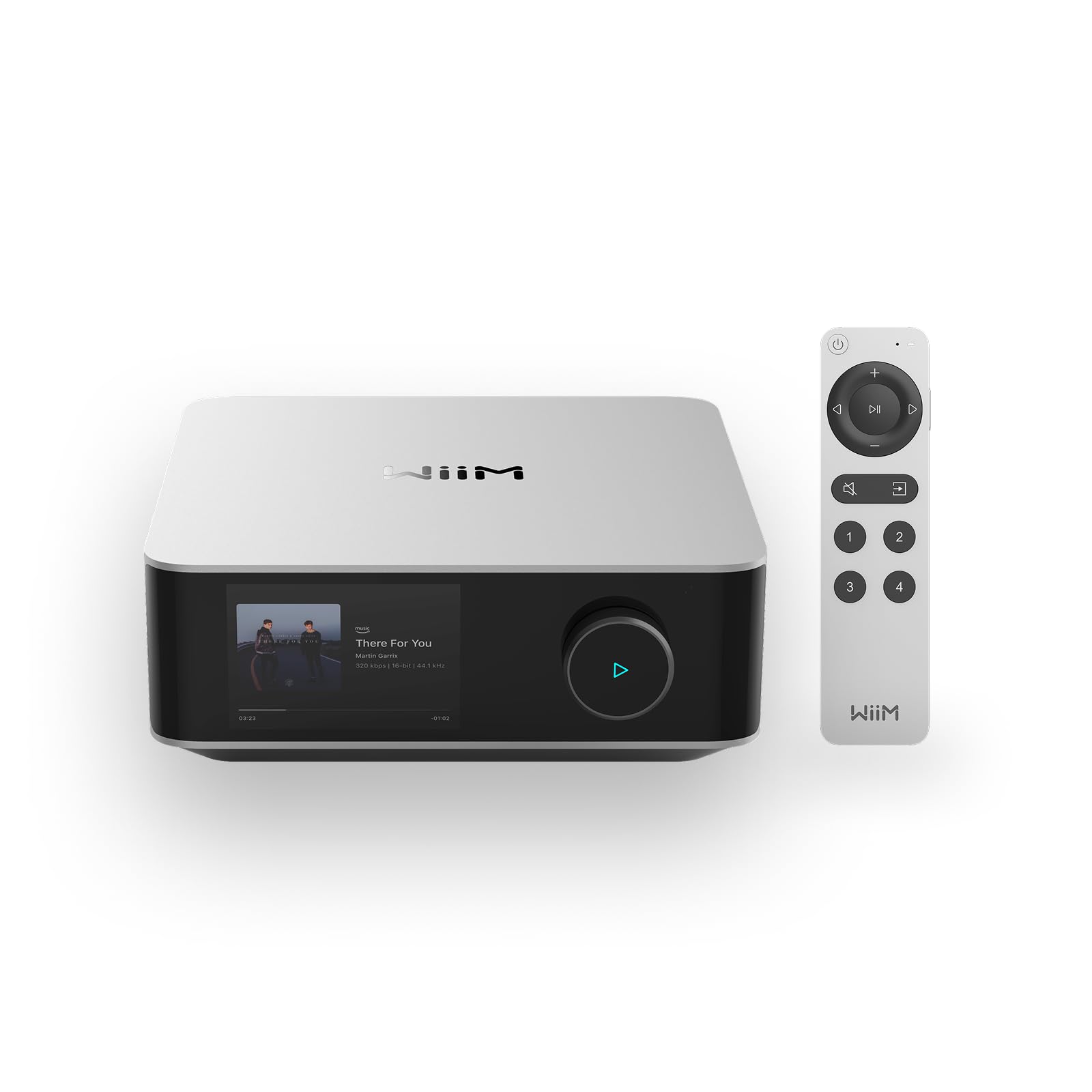
The WiiM Amp Ultra redefines what a streaming amplifier can achieve at its price point. Dual TI TPA3255 amplifiers driven by an ESS SABRE ES9039Q2M DAC produce 100W of ultra-low distortion power, measuring an impressive THD+N of -106 dB. The integration of RoomFit EQ, a built-in 3.5-inch touchscreen, and Wi-Fi 6 connectivity makes this a genuinely complete hub for high-resolution digital audio.
Users upgrading from older Class A/B units consistently report a cleaner, more detailed sound across the entire frequency spectrum, with particular praise for bass management and the subwoofer output precision. The amplifier drives demanding three-way tower speakers with authority, while the app control allows granular EQ adjustments per source.
One caveat: the device is incompatible with AirPlay, so Apple ecosystem users must rely on Chromecast or Bluetooth 5.3 for wireless streaming. The lack of HDMI eARC as a primary audio input means TV integration is handled through optical, though this remains a minor compromise for the overall value.
Why it’s great
- ESS SABRE DAC delivers studio-level clarity and resolution
- RoomFit EQ auto-calibrates for your specific room acoustics
- Compact, cool-running Class D design fits any shelf
Good to know
- No AirPlay support; Chromecast and Bluetooth only
- Lacks coaxial digital input for older CD transports
2. Denon PMA-600NE

The Denon PMA-600NE proves that analog purity is not solely the domain of exorbitant separates. Its divided circuitry design includes an Analog Mode that disengages the digital and Bluetooth circuits entirely, allowing the Advanced High Current (AHC) push-pull amplifier to deliver an unadulterated signal path. Rated at 70W per channel into 4 ohms, it comfortably drives a wide range of bookshelf and floorstanding speakers.
Listeners describe the sonic signature as warm and tube-like, a characteristic reminiscent of classic 1970s solid-state gear. The internal DAC handles optical and coaxial inputs with respectable clarity, though many owners note that using an external DAC elevates the performance further. The built-in MM phono preamp is remarkably quiet, making this an excellent choice for vinyl enthusiasts.
The headphone output is powerful enough to drive high-impedance Sennheiser 300-ohm headphones at low volume settings, a feature often absent in this price tier. The remote control volume, however, is coarsely stepped, and the relay switching produces an audible click between inputs. It lacks USB or network streaming, positioning it as a pure analog tool with digital convenience.
Why it’s great
- Analog Mode provides a pure signal path by disabling digital circuits
- Warm, spacious soundstage with excellent vocal clarity
- Included MM phono preamp is dead quiet for vinyl playback
Good to know
- No built-in Wi-Fi or USB DAC for direct streaming
- Remote volume control is laggy and only offers coarse adjustment
3. S.M.S.L PL200

The S.M.S.L PL200 is a multi-role marvel, functioning as a high-end CD player, Bluetooth 5.1 receiver, and USB DAC all in a single CNC-machined chassis. Its heart is the flagship AK4499EX DAC chip, which delivers a measured distortion floor of just 0.00006%, making it one of the most transparent digital converters available in this tier. The top-loading CD mechanism with a magnetic puck and weighted cover adds a ceremonial, high-end feel to disc playback.
The unit doubles as a powerful headphone amplifier, with 1000mW of output that drives planar magnetic and demanding dynamic headphones with authority. Users praise the expansive, detailed soundstage, noting that it replaces reference CD players like the Marantz CD6006 with ease. The versatility of multiple digital outputs, including USB-C input for computer audio, makes it a central hub for digital sources.
The manual is almost exclusively in Chinese, which can make advanced settings a guessing game for English speakers. The top-loading design also means it cannot be stacked under other components, and the price tag, while justified by the DAC performance, places it firmly in enthusiast territory for those who value CD playback.
Why it’s great
- Flagship AK4499EX DAC with exceptionally low 0.00006% distortion
- Top-loading CD transport with magnetic puck for high-end feel
- 1000mW headphone amp drives even difficult headphones easily
Good to know
- Manual is mostly in Chinese, limiting easy configuration
- Premium pricing relative to CD player functionality alone
4. Cambridge Audio AXR100

The Cambridge Audio AXR100 delivers a classic, no-compromise stereo receiver experience with 100 watts per channel and a dedicated subwoofer output. Its clean, neutral sound profile is described as having a slight warmth, making it suitable for long listening sessions across jazz, classical, and rock. The built-in phono stage is adequately clean, and the unit includes both analog and digital inputs for modern and legacy sources.
Setup is straightforward, and the receiver drives challenging speakers like Klipsch RP-600M and RF7 with excellent control, providing a wide soundstage with precise imaging. Users report that the Bluetooth connection works reliably, though the pairing process is initially unintuitive due to a small front-panel symbol. The absence of audible fan noise is a welcome feature for quiet listening environments.
Bluetooth range is somewhat limited compared to modern standards, and the internal DAC, while functional, is not the unit’s strength; owners typically bypass it with an external DAC for serious listening. The remote control’s IR range is poor, and the fixed internal subwoofer crossover at 200Hz may require external bass management for some setups.
Why it’s great
- Solid 100W per channel with clean, neutral sound signature
- Dedicated subwoofer output and built-in MM phono stage
- Operates silently with no fan noise interference
Good to know
- Internal DAC is outperformed by external options
- Fixed subwoofer crossover may not suit all speaker/sub combinations
5. Marantz NR1510

The Marantz NR1510 packs a full 5.2-channel home theater experience into a remarkably slim 4-inch chassis. Each channel delivers 50W of discrete power, and the receiver supports Dolby TrueHD, DTS-HD Master Audio, and full 4K UHD video passthrough with Dolby Vision. The HEOS wireless multi-room system allows seamless streaming from TIDAL, Spotify, and Amazon Music, with voice control via Alexa, Google Assistant, or Siri.
Users consistently note that the sound quality is a significant upgrade over budget receivers, with clear, distortion-free audio at all volume levels. The inclusion of an MM phono preamp for turntables and 6 HDMI inputs with HDCP 2.2 makes it a versatile hub for both music and movies. The compact form factor is ideal for cabinets with limited depth, and the built-in Bluetooth/Wi-Fi eliminates the need for external streamers.
The 50W per channel power rating is modest; pairing with low-sensitivity speakers may require careful consideration. The receiver runs hot during extended use, and the enclosure needs generous ventilation clearance. The HEOS app is functional but less intuitive than competing platforms, and the unit lacks support for Auro-3D or higher-channel Atmos counts.
Why it’s great
- Ultra-slim 4-inch design fits tight AV cabinets
- Integrated MM phono stage and HEOS multi-room streaming
- Crystal-clear 5.1 audio with clean power delivery
Good to know
- Modest 50W per channel limits volume with inefficient speakers
- Runs hot and requires substantial ventilation clearance
6. Bluesound Node ICON

The Bluesound Node ICON is a reference-class network streamer built around a true dual-mono DAC design, leveraging two ESS Sabre ES9039Q2M chips to eliminate channel crosstalk. This architecture produces an exceptionally wide soundstage with precise instrument placement and deep, black backgrounds. MQA Labs QRONO d2a technology further refines timing accuracy during conversion, ensuring the output mirrors the original master tape.
The inclusion of THX AAA headphone amplification is a major differentiator, delivering the world’s most linear response with feed-forward error correction for remarkably low noise and distortion. Balanced XLR outputs and HDMI eARC connectivity make it a flexible hub for both stereo and TV audio systems. The 5-inch full-color HD display and high-quality aluminum chassis match its premium internal components.
Setup can be finicky, with some users reporting glitches in the BluOS app and difficulty recognizing WAV files from USB drives. The unit runs warm and requires ventilation, and the lack of a touchscreen on such an expensive component is a notable omission. DSD playback is limited to DSD256, which may frustrate users with extensive DSD512 libraries.
Why it’s great
- True dual-mono DAC design with two ESS Sabre chips for immense soundstage
- THX AAA headphone amp delivers world-class, ultra-low distortion output
- Balanced XLR outputs and HDMI eARC for flexible system integration
Good to know
- No touchscreen interface despite premium price point
- BluOS app setup can be glitchy and requires patience
7. Willsenton R8

The Willsenton R8 is a hand-wired, pure tube integrated amplifier that punches well above its weight class, delivering a sonic experience that often rivals amplifiers costing three times more. Accepting KT88, EL34, or 6550 tubes, the R8 allows users to tune the sound signature via tube rolling, from the punchy, dynamic KT88 to the warmer, sweeter EL34. The switchable triode (25W) and ultra-linear (45W) modes offer further tonal flexibility.
The build quality is exceptional for the price, featuring heavy, potted transformers, a machined aluminum remote, and a dead-silent noise floor. Users report a rich, three-dimensional soundstage with solid, tight bass and airy, extended highs. The R8 requires a 100-300 hour burn-in to reach its full potential, after which the musicality becomes deeply engaging and non-fatiguing.
At 70 pounds, the R8 is a beast to move, and its deep chassis requires a sturdy shelf. There is no subwoofer output, so integration with a powered sub requires an external crossover. The remote’s volume control is imprecise, and the unit is sensitive to AC line voltage fluctuations, necessitating a stable 115V supply. Tube life averages 1000-2000 hours, adding a recurring cost for replacement sets.
Why it’s great
- True tube sound with switchable triode/ultra-linear modes
- Accepts KT88, EL34, or 6550 tubes for easy sonic customization
- Heavy-duty build with potted transformers and dead-quiet background
Good to know
- Weighs 70 pounds and requires a sturdy, well-ventilated space
- No subwoofer output; needs external crossover for sub integration
8. Onkyo TX-RZ70
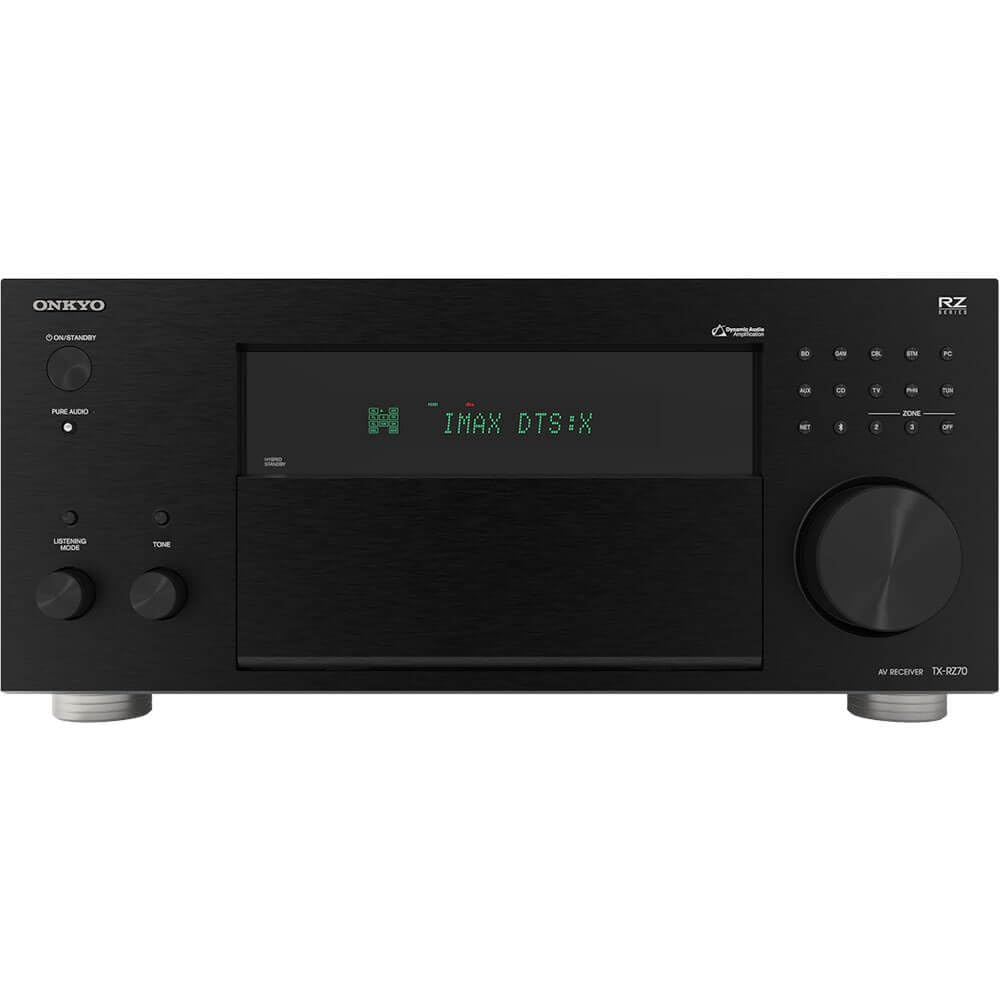
The Onkyo TX-RZ70 is a studio-grade 11.2-channel AV receiver that delivers 140W per channel with ESS Sabre DACs and THX Certification. Its inclusion of Dirac Live Full Bandwidth room calibration, with optional upgrade for Bass Control, makes it one of the most technically advanced receivers in its segment. The unit supports all modern immersive formats, including Dolby Atmos, DTS:X, and Auro-3D, with IMAX Enhanced certification.
Users consistently report exceptional power delivery, with bench tests confirming the amplifier section exceeds its 140W rating, delivering closer to 170W per channel. The HDMI 2.1 implementation is flawless, with no handshake issues and full support for 4K/120Hz and VRR. The pre-outs allow seamless integration with external amplifiers for dedicated front channels, satisfying the most demanding custom installers.
The remote control feels cheap and clunky given the receiver’s premium positioning. The Zone 2 control implementation is poorly designed, reverting to the main zone after a few seconds, making multi-room operation frustrating. The chassis is exceptionally large and heavy, requiring a deep AV cabinet, though the heat management is excellent, running cool even at high volumes.
Why it’s great
- Built-in Dirac Live Full Bandwidth for professional-grade room correction
- Flawless HDMI 2.1 with 4K/120Hz, VRR, and trouble-free handshake
- Huge power reserves; tested at 170W per channel in real conditions
Good to know
- Zone 2 control system is poorly designed and difficult to manage
- Included remote control does not match the flagship build quality
9. Yamaha RX-A6A

Yamaha’s RX-A6A is a feature-rich 9.2-channel AV receiver that processes up to 11.2 channels, delivering 150W per channel to drive a comprehensive surround system. The Surround:AI technology analyzes audio content in real-time and automatically optimizes surround effects, enhancing dialogue clarity and spatial cues without manual intervention. Full HDMI 2.1 support with 8K/60Hz and 4K/120Hz passthrough ensures future-proof connectivity for gaming and streaming.
The YPAO R.S.C. room calibration with 3D multipoint measurement provides precise EQ adjustments for the listening environment. Users praise the receiver for its powerful, clean sound with excellent mid-bass punch and a deep, controlled low end. The receiver integrates with Sonos via a Port, supports all major streaming services through MusicCast, and includes a phono input for vinyl playback.
User reviews express significant frustration with the MusicCast app, describing it as unintuitive and less polished than competitors. Some users also report abrupt discontinuation of Alexa and Google Assistant support, which was a key purchase motivator for many. The lack of a browser-based PC management interface forces users to rely on the smartphone app for all advanced settings.
Why it’s great
- Surround:AI optimizes audio in real-time for movies and music
- Full HDMI 2.1 with 8K/60Hz and 4K/120Hz for next-gen gaming
- Powerful 150W per channel with clean, dynamic sound quality
Good to know
- MusicCast app is clunky and not user-friendly
- Voice assistant support (Alexa/Google) was unexpectedly discontinued
10. Denon PMA-1700NE

The Denon PMA-1700NE is a high-power, 140W-per-channel integrated amplifier that combines a robust Advanced High Current (AHC) single push-pull circuit with Advanced AL32 Processing Plus for 384kHz/32-bit resolution. The unit is built like a tank, weighing over 38 pounds with a rigid aluminum chassis that resists vibration. The built-in MM/MC phono equalizer is dead quiet, making it an exceptional partner for high-end turntables from brands like Rega or Pro-Ject.
The amplifier delivers a smooth, tube-like tonal quality through its MOSFET output stage, producing tight, controlled bass and non-fatiguing highs. The built-in USB-DAC (PCM1795) performs well, though purists may prefer an external DAC for the absolute best resolution. The Analog Mode disengages all digital processing for vinyl playback, maintaining signal purity.
The overall experience is that of an heirloom-quality component designed for the long term. The sound is balanced, never muddy or overly bright, and the amplifier has no trouble driving 4-ohm speakers like the KEF R3 Meta. On the downside, it has no Wi-Fi or Bluetooth for network streaming, and the plastic remote control feels incongruous with the premium build. There is also no front-panel volume display indicator.
Why it’s great
- High-current AHC circuit delivers exceptional dynamics and speaker control
- Dead-quiet MM/MC phono stage for serious vinyl reproduction
- Heirloom-quality aluminum chassis and robust internal construction
Good to know
- No built-in Wi-Fi, Bluetooth, or network streaming capabilities
- Remote control is plastic and feels cheap relative to the amp quality
11. Yamaha RX-A8A

The Yamaha RX-A8A is the brand’s flagship AVENTAGE receiver, an 11.2-channel powerhouse with independent subwoofer adjustment and XLR pre-out connections for professional integration. Its Surround:AI technology dynamically analyzes and optimizes audio in real-time, while YPAO R.S.C. with 3D multipoint measurement delivers precise room EQ. All seven HDMI inputs support 8K/60Hz and 4K/120Hz at 40 Gbps, with full HDCP 2.3 compliance.
Users upgrading from previous Marantz and Denon receivers consistently cite the RX-A8A as a sonic upgrade, with more dynamic, punchy sound and deeper bass extension. The backlit remote control, which lights on pickup, is a thoughtful touch. The receiver’s ability to handle a 5.2.4 setup with independent subwoofer EQ is highly valued by home theater enthusiasts.
Several reports indicate HDCP 2.2 errors requiring complete system resets after firmware updates, and there are concerns about warranty coverage when purchased from unauthorized third-party Amazon sellers. The MusicCast app remains a weak point, with a clunky interface that complicates system configuration. The receiver’s full-screen OSD also wastes significant screen real estate.
Why it’s great
- Surround:AI delivers real-time, adaptive audio optimization
- XLR pre-outs and independent subwoofer EQ for professional setups
- Backlit remote control is premium and responsive
Good to know
- HDCP 2.2 errors reported after firmware updates
- MusicCast app interface is clunky and detracts from user experience
12. Marantz SR8015

Marantz’s SR8015 is an 11.2-channel AV receiver that delivers 140W per channel with the signature Marantz warm, smooth sound. Its discrete amplifier topology provides excellent transient response and high-frequency extension, outperforming rivals in terms of musicality. The unit supports 8K video passthrough, HEOS multi-room streaming, and full voice control compatibility with Alexa and Google Assistant. It is ideal for a 7.2.4 immersive home theater setup.
Users pairing the SR8015 with Klipsch speakers report a remarkable combination of clarity, crisp highs, and punchy, well-defined bass. The Audyssey MultEQ XT32 room correction provides solid speaker integration, though users note that manual calibration is often necessary to achieve optimal subwoofer levels. The receiver runs cooler than many competitors, a testament to its efficient power supply and ventilation design.
The remote control is widely criticized as feeling flimsy and unresponsive, an unacceptable compromise at this price. The amplifier lacks XLR inputs/outputs, which limits its compatibility with premium pre-amplifiers. Subwoofers require manual enabling in the menu, a commonly missed step that leaves users without bass until they correct it.
Why it’s great
- Warm, smooth Marantz sound signature with excellent high-frequency extension
- Ideal for 7.2.4 Atmos setups with ample channel count and power
- Runs cooler than most competitors under heavy load
Good to know
- Remote control feels cheap and is occasionally unresponsive
- No XLR inputs/outputs for premium balanced connections
13. Sony STR-AZ7000ES

The Sony STR-AZ7000ES is the undisputed reference in consumer AV receivers, delivering 150W per channel across 13.2 channels of amplification. Its Digital Cinema Auto Calibration IX (D.C.A.C. IX) and 360 Spatial Sound Mapping (360SSM) create an incredibly convincing, immersive soundfield, especially in smaller rooms where full speaker placements are impractical. All seven HDMI inputs support 8K and 4K/120Hz with full HDCP 2.3 and Dolby Vision passthrough.
Users consistently describe the sound quality as the best they have ever heard from a single-box receiver. The 360SSM technology is particularly magical, making a 5.1.2 system sound like a full 7.1.4 array with improved imaging and height perception. The auto-calibration mic and setup process are straightforward, though manual adjustments to speaker distances and heights are recommended for the best results. The unit integrates with Sonos, Chromecast, and AirPlay 2 for streaming flexibility.
The receiver runs very hot and an external cooling fan is strongly recommended for reliable operation. It also lacks support for HDR10+ and QMS (Quick Media Switching), which may matter for users with specific display requirements. The chassis is large and heavy at over 55 pounds, demanding a spacious, well-ventilated AV rack. The unit also lacks QFT (Quick Frame Transport) for competitive gaming.
Why it’s great
- 360 Spatial Sound Mapping creates a huge, convincing soundstage
- 13.2 channels of amplification with 150W per channel
- Industry-leading D.C.A.C. IX auto-calibration for precise room EQ
Good to know
- Runs very hot; an AC Infinity fan is almost mandatory for safety
- Lacks HDR10+ and QMS support for some display setups
FAQ
What is the advantage of a dual-mono DAC design?
Should I choose a Class D or Class A/B amplifier for my audiophile system?
How important is room correction like Dirac Live for an audiophile system?
Do I need a separate headphone amplifier if my receiver has a built-in amp?
What is the difference between a stereo receiver and an AV receiver for music?
Final Thoughts: The Verdict
For most users, the audiophile receiver winner is the WiiM Amp Ultra because it delivers an ESS Sabre DAC, 100W of clean power, and automatic room correction in a compact, streaming-ready package at a price that outperforms expectations. If you want the soulful, three-dimensional character of vacuum tubes, grab the Willsenton R8 for its switchable triode/ultra-linear modes and ability to roll KT88 or EL34 tubes. And for the ultimate multi-channel home theater system with professional-grade Dirac Live room correction, nothing beats the Onkyo TX-RZ70.