
Our readers keep the lights on and the weekend projects moving. As an Amazon Associate, I earn from qualifying purchases.
For the listener who has graduated from mass-market wireless speakers and now hears the veil between a compressed stream and a true high-resolution file, the search for a dedicated network audio component is a hunt for transparency. The right streamer eliminates the system noise between your source files and your amplifier, revealing the soundstage, micro-detail, and transient response that budget hardware buries.
I’m Rikta — the founder and writer behind FitlyFast. My research into the audiophile transport category involves weeks of cross-referencing ESS DAC implementations, ARM processor roadmaps, and raw jitter measurements from lab-grade sources to separate true high-end engineering from marketing decals.
This guide breaks down the strongest contenders on the market today, from the purest digital transports to the most versatile one-box receivers, so you can match the right hardware to your existing system. Here is the definitive, hands-on analysis of the best audiophile streamer money can buy in 2025.
How To Choose The Best Audiophile Streamer
The category is deceptively simple: a box that receives digital audio files from a network and sends them to your DAC or amplifier. But the execution—power supply topology, clock discipline, digital output impedance, and software ecosystem—separates a component that merely works from one that elevates your entire system.
DAC Implementation vs. External DAC Strategy
Some streamers integrate a premium DAC chip (ESS Sabre, AKM), while others act as pure digital transports with only coaxial, optical, or AES outputs. If you already own a reference-grade DAC from Gustard, Denafrips, or Schiit, you want a streamer with a clean S/PDIF or I2S output and a low-phase-noise clock. If you are building a system from scratch, a streamer with a built-in ESS ES9039Q2M or AK4493SEQ chip and balanced XLR outputs is the smarter path.
Power Supply and Clock Architecture
Jitter is the enemy of soundstage depth and transient precision. The best streamers use a discrete linear power supply (not a switching wall wart) and a precision OCXO or TCXO clock to keep the digital timing accurate within a few parts per billion. Look for PSU noise levels below 50 µV and clock accuracy under ±0.5 ppm for genuinely reference-grade performance. Multi-chip DAC arrays derive their advantage from the clock and power section, not from the chip count alone.
Software and Protocol Support
A streamer is only as good as the ecosystem it plugs into. Roon Ready, Tidal Connect, Spotify Connect, and Qobuz native integration are baseline. If you have a NAS full of FLAC and DSD files, confirm the streamer supports SMB or NFS browsing and gapless playback. BluOS, the engine behind Bluesound products, is the gold standard for multi-room reliability, while Android-based platforms like Eversolo’s offer the most third-party app flexibility but sometimes with a UI polish trade-off.
Quick Comparison
On smaller screens, swipe sideways to see the full table.
| Model | Category | Best For | Key Spec | Amazon |
|---|---|---|---|---|
| Cambridge Audio CXN100 | Streamer/PreAmp | Dedicated 2-channel reference | ESS ES9028Q2M, XLR out | Amazon |
| Bluesound Node ICON | Streamer/DAC/Pre | Dual-mono, Dirac-ready | Dual ESS ES9039Q2M, XLR | Amazon |
| EVERSOLO DMP-A6 Gen 2 | Streamer/DAC/Pre | Android-based all-in-one | ESS DAC, 6″ LCD touch | Amazon |
| Yamaha R-N2000A | Network Receiver | Full-featured integrated amp | Toroidal transformer, 50 lbs | Amazon |
| Bluesound Node (2024) | Streamer/PreAmp | Best value with HDMI eARC | ESS ES9039Q2M, BluOS | Amazon |
| Audiolab 6000CDT | CD Transport | Pure digital CD playback | Read-ahead buffer, optical | Amazon |
| GUSTARD DAC-X30 | Streaming DAC | Four-chip balanced mastering | 4x ES9039SPRO, OCXO clock | Amazon |
| WiiM Amp Ultra | Streaming Amp | Budget integrated with RoomFit | ESS DAC, 100W, Wi-Fi 6 | Amazon |
| Denon RCD-N12 | Mini System | Compact CD/streamer combo | HEOS, HDMI ARC, phono | Amazon |
| Eversolo Play | Streaming Amp | One-box with CD drive option | AK4493SEQ, 110Wx2, CD | Amazon |
| Yamaha R-N1000A | Network Receiver | Integrated amp with YPAO | ESS ES9080Q, HDMI | Amazon |
| Marantz AV7706 | AV Preamp | Multi-channel home theater | Audyssey XT32, 8K HDMI | Amazon |
| Sennheiser HDV 820 | Headphone Amp DAC | Reference headphone system | ESS 9028PRO, balanced | Amazon |
In‑Depth Reviews
1. Cambridge Audio CXN100

The CXN100 is Cambridge Audio’s current reference network player, armed with the ESS ES9028Q2M SABRE32 Reference DAC and a dedicated StreamMagic platform that does not rely on a smartphone as the compute core. The soundstage is wide, the instrument separation is layered, and the bass remains taut even with complex tracks. It works as a preamp with volume control, feeding directly into a power amp, or you can use the fixed output into a separate preamp.
Connectivity covers Chromecast built-in, AirPlay 2, Bluetooth, and USB audio for a computer source. The Stream Magic app is responsive and fully functional, letting you control Qobuz, TIDAL, Deezer, and internet radio without ever touching the unit. Hardwiring Ethernet is recommended over Wi-Fi for consistent streaming of 192kHz/24-bit files.
Some users report a small audio lag when the CXN100 is used as a TV DAC via optical, an issue not seen with the same TV connected to a cheaper DAC. This may be a DSP buffering quirk that Cambridge could address in a future firmware release. The remote is sold separately, which feels like an oversight at this level, though the app handles all functions adequately.
Why it’s great
- Reference-grade SABRE DAC delivers a huge, layered soundstage
- Chromecast, AirPlay 2, and Bluetooth give full platform flexibility
- Works as a preamp with volume control for minimalist setups
Good to know
- Remote control is sold separately
- Some users report audio lag when used as a TV DAC via optical
- No room correction or subwoofer management built-in
2. Bluesound Node ICON

The Node ICON is Bluesound’s flagship, built around a true dual-mono DAC architecture with two ESS SABRE ES9039Q2M chips—one per channel—for independent power and ground planes. The result is a staggering channel separation that makes the soundstage feel holographic. MQA Labs’ QRONO d2a timing correction refines the digital-to-analogue conversion further, aligning transients to the original recording clock.
The chassis is a high-quality aluminum block with a 5-inch full-color HD display, balanced XLR outputs, and HDMI eARC for TV integration. Dirac Live room correction is available as a paid upgrade via the Dirac app, requiring a calibration microphone. The BluOS ecosystem is the most mature multi-room platform in the category, supporting wireless grouping with other Bluesound speakers and components.
The unit runs warm to the touch—the dual-mono architecture and linear supply generate noticeable heat, so ventilation is required. The initial BluOS setup can be finicky, especially when importing a large library from an external USB drive, and the manual is sparse on troubleshooting. The DSD playback is limited to DSD256, which may be a dealbreaker for owners of native DSD512 libraries.
Why it’s great
- True dual-mono DAC with unmatched channel separation
- HDMI eARC and BluOS multi-room are best-in-class
- Dirac Live upgradeable for high-precision room correction
Good to know
- Runs hot in daily use—needs ventilation clearance
- BluOS initial setup can be glitchy
- DSD capped at DSD256, no native DSD512 support
3. EVERSOLO DMP-A6 Gen 2
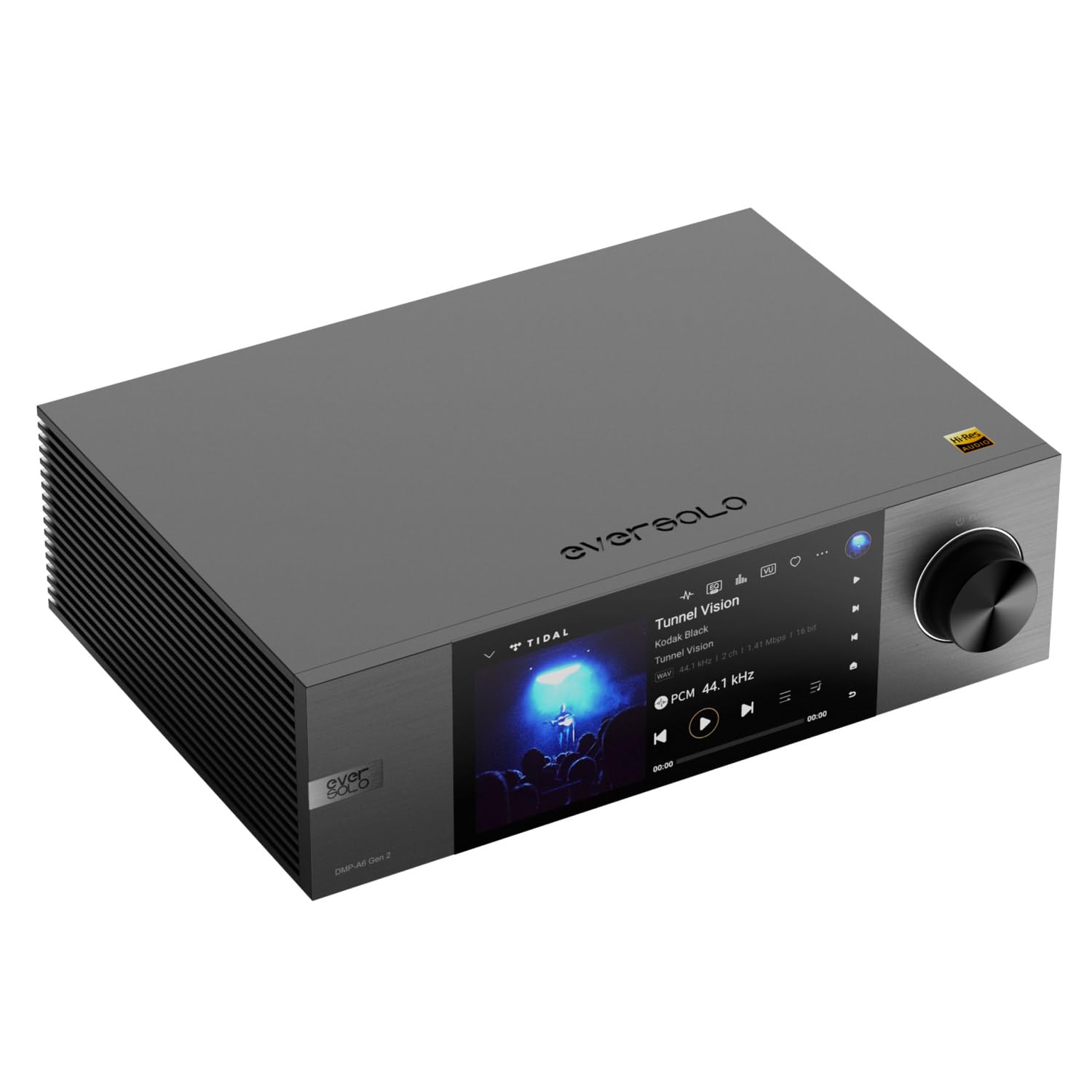
The DMP-A6 Gen 2 runs a deeply customized Android 11 OS on a quad-core ARM Cortex-A55 processor, giving it the most flexible app ecosystem in the category. You can sideload third-party streaming apps, use the EOS audio engine for bit-perfect output up to DSD512 and PCM 768kHz, and manage the unit via the 6-inch LCD touchscreen or the Eversolo Control app for iOS and Android. The newly upgraded linear power supply keeps noise below 40 µV.
Inside, you get an NVMe M.2 bay for internal music storage, multiple USB ports, HDMI ARC, and true balanced XLR alongside RCA outputs that can operate simultaneously. The audio output is robust enough to feed a high-end power amp directly, while the trigger in/out allows integration with a preamp or amplifier for system-wide power automation.
The second-generation unit still has UI roughness: the Qobuz integration can cause double audio streams and pause queue bugs, and the Chromecast-like screen mirroring from the app is laggy and grainy. It also lacks a bundled remote control—a touchscreen media player without a physical remote is a curious oversight at this price point. Room correction is absent, making the WiiM Ultra a better choice if you need EQ.
Why it’s great
- True bit-perfect playback up to DSD512 and 768kHz PCM
- Android OS allows sideloading of any streaming app
- NVMe drive bay and simultaneous XLR/RCA output
Good to know
- No room correction or subwoofer bass management
- UI can be clunky with Qobuz and third-party apps
- Remote not included; app screen mirror feels unpolished
4. Yamaha R-N2000A

The R-N2000A is a network receiver in the classic Yamaha tradition: a 50-pound chassis with a toroidal power transformer, massive heat sinks, and analog VU meters that glow with purpose. The ESS SABRE ES9026PRO Ultra DAC handles 384kHz PCM and DSD 11.2 MHz natively via its USB-B input, while the MusicCast platform streams Qobuz, Amazon Music HD, TIDAL, and internet radio reliably. Every input—HDMI ARC, optical, coaxial, phono (MM)—is accounted for.
The amplifier section produces substantial, effortless power that drives demanding floor-standing speakers like Klipsch RP-8000F or MartinLogan Motion models without breaking a sweat. YPAO-R.S.C. (Reflected Sound Control) performs automatic room correction with a supplied microphone, measuring and equalizing the main listening position to tame standing waves and early reflections.
The phono stage is MM-only, so moving-coil cartridge owners will need an external preamp. The MusicCast app is functional but not as polished as BluOS, and the long-term support of the platform is an open question given Yamaha’s quiet transitions between generation apps. The price is a significant investment, but the build quality and sonic authority are visible and audible from the moment you power it on.
Why it’s great
- Toroidal transformer and heavy chassis deliver effortless headroom
- Analog VU meters and beautiful silver finish are design icons
- YPAO-R.S.C. room correction with included microphone
Good to know
- Phono stage is MM only, not MC compatible
- MusicCast app is functional but less polished than BluOS
- No balanced XLR inputs or pre-outs
5. Bluesound Node (2024 Model)

The 2024 Node is the sweet spot of the Bluesound lineup, packing the same ESS ES9039Q2M SABRE DAC found in the more expensive ICON, but in a slimmer chassis without the dual-mono architecture. The quad-core 1.8GHz ARM Cortex A53 processor handles the BluOS platform smoothly, supporting TIDAL Connect, Spotify Connect, Qobuz, and your own NAS-hosted FLAC files. HDMI eARC brings TV audio into the system with Dolby Digital decoding.
It functions as a preamplifier, a headphone amplifier, and a digital bridge, with a subwoofer output and bass management for those integrating a powered sub. The upgraded audiophile-grade power supply reduces noise over the previous Node 2i, and you can apply Dirac Live room correction as a paid upgrade. The BluOS app is the reference implementation for multi-room control, grouping, and library browsing.
Reviewers note that the internal DAC is good but not transcendent—paired with an outboard DAC via USB, the Node’s soundstage improves significantly. The setup process can be frustrating, with some units requiring multiple resets and connection failures before the system stabilizes. Customer support is scripted and slow, which is a real pain point given the otherwise robust hardware.
Why it’s great
- ESS SABRE DAC at a mid-range price with future Dirac capability
- HDMI eARC enables TV audio integration without extra remotes
- BluOS ecosystem is the gold standard for multi-room streaming
Good to know
- Sound can feel thin without a premium external DAC
- Initial setup can be buggy with connection failures
- Customer support is outsourced and unresponsive
6. Audiolab 6000CDT

The 6000CDT is a dedicated CD transport—no DAC, no amplifier, no streaming module. Its sole job is to read the optical disc and output a clean digital signal via coaxial or optical S/PDIF to your external DAC. The read-ahead buffer technology preloads the data and corrects errors before the digital stream leaves the transport, allowing it to play scratched or deteriorated discs that would skip or stutter in conventional CD players.
When paired with a high-quality DAC like the Gustard R26 or the internal DAC of a Cambridge Audio amplifier, the 6000CDT reveals an immense soundstage, near-perfect instrument separation, and deep, tuneful bass that is missing from streaming the same lossless files. Users report that it easily outperformed a reference 20,000-dollar CD player in clarity and bass firmness when connected to the same DAC.
The remote control feels cheap, and the black gloss front panel makes the knobs difficult to read in low light. Some copies have been delivered with cosmetic scratches from the packaging. It does not include a digital-to-analogue converter, so you must own an external DAC or an amplifier with a built-in DAC—this is not a stand-alone solution.
Why it’s great
- Read-ahead buffer plays damaged discs that other transports skip
- Massive soundstage improvement over streaming when paired with a good DAC
- Silent operation, no disc noise or vibration transfer
Good to know
- No internal DAC—requires an external digital-to-analog converter
- Remote feels cheap and knobs are hard to read in low light
- Some units arrive with cosmetic packaging scuffs
7. Sennheiser HDV 820

The HDV 820 is the dedicated amplifier and DAC companion for the Sennheiser HD 800S headphones, though it works with any high-impedance dynamic headphones. Its ESS SABRE 9028PRO DAC is fed by USB, optical, coaxial, and AES inputs, and the headphone amplifier stage uses a balanced XLR-4 output that reviewers estimate delivers 60-percent more performance than the unbalanced 6.3mm jack. The sound is natural, full-bodied, and highly resolving.
Build quality is typical Sennheiser—aluminum chassis, precise knob feel, and a heavy desktop footprint that says “reference” without shouting. The unit can drive multiple headphone pairs simultaneously without any quality loss, and the balanced output stage offers the lowest distortion of any headphone amp in its class.
The HDV 820 has persistent driver issues on Windows computers; several users report being unable to connect the device to any Windows PC at all, while macOS users have no problems. The price is steep for what is fundamentally a dedicated headphone DAC/amp, and it is optimized for Sennheiser’s own headphones—other brands may sound less impressive. The volume knob on some refurbished units can produce a swishing noise.
Why it’s great
- ESS 9028PRO DAC and balanced XLR-4 output deliver reference sound
- Drives multiple high-impedance headphones simultaneously
- Natural, full-bodied presentation that brings out micro-detail
Good to know
- Persistent driver issues on Windows—may not connect at all
- Optimized for Sennheiser headphones; less impressive with other brands
- Very expensive for a dedicated headphone DAC/amp
8. GUSTARD DAC-X30
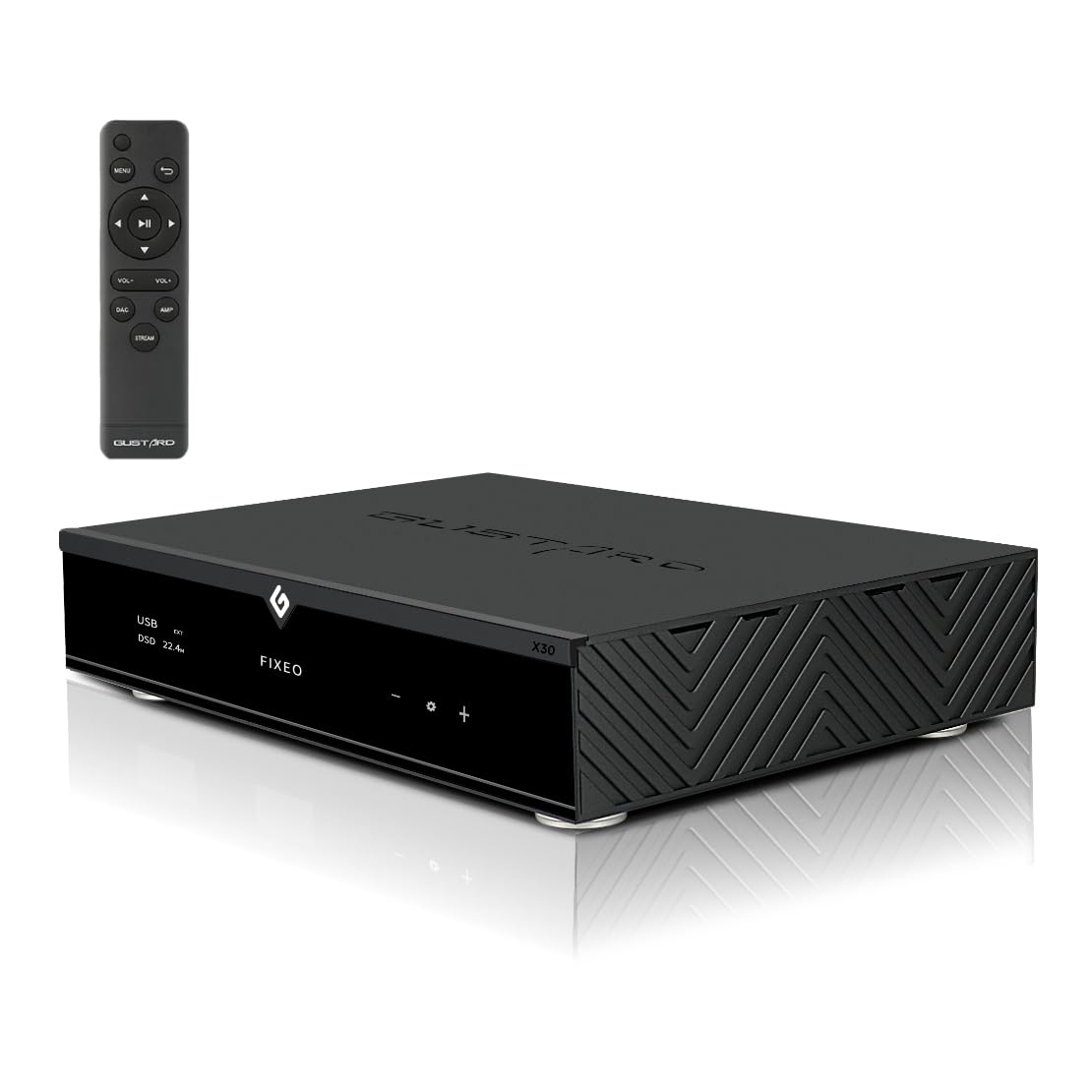
The DAC-X30 is Gustard’s statement DAC and streamer, using four ESS ES9039SPRO chips in a balanced two-chips-per-channel arrangement with independent power supplies and ground planes. The K2 synthesizer and synchronized OCXO clock ensure that the digital-to-analogue conversion is as free from jitter as any consumer box gets. It supports PCM up to 768kHz and DSD512 natively, plus MQA decoding via software.
Network streaming is handled through Roon Bridge, UPnP, and NAA (Network Audio Adapter) protocols, allowing it to pull files from a Roon server running on a NAS. The analog output stage uses discrete Class A LPF circuits for a warmer, more musical presentation than typical ESS implementations. Users upgrading from the Gustard R26 report better clarity, separation, and extension, though the difference is incremental and system-dependent.
The I2S pinout remains a compatibility headache—Gustard offers multiple wiring options, but finding a transport that matches the specific pinout is difficult. The SD card interface is advertised but not supported in firmware, which is confusing. Some listeners find the DAC-X30 flat and unmusical compared to the R26, suggesting the four-chip architecture is more revealing of poor source material.
Why it’s great
- Four-chip balanced architecture with independent power per channel
- OCXO clock and K2 synthesizer for ultra-low jitter
- Discrete Class A output stage for a warmer, more musical character
Good to know
- I2S pinout compatibility is a persistent headache
- SD card interface is listed but not supported in firmware
- Some users find it less musical than the Gustard R26
9. WiiM Amp Ultra

The WiiM Amp Ultra is an integrated streaming amplifier that packs 100 watts per channel into a compact, unibody aluminum chassis with a 3.5-inch glass-covered touchscreen. The ESS SABRE ES9039Q2M DAC delivers very low THD+N at -106 dB, and the dual TI TPA3255 Class-D amps drive four speakers with load-independent precision thanks to PFFB (Post-Filter Feedback) technology. Wi-Fi 6 and Bluetooth 5.3 with LE Audio ensure robust connectivity, while HDMI ARC brings the TV into the streaming ecosystem.
Room correction via the built-in RoomFit software auto-calibrates the sound to the listening room and speaker pair, a feature previously only found on much more expensive units. The app supports per-source EQ, presets, alarms, volume limits, and integration with Alexa and Google Assistant. Multi-room sync with other WiiM devices works seamlessly. For the price, the feature-to-performance ratio is unmatched.
The Bluetooth source switching is delayed and can be awkward; users report a multi-second pause when switching between Bluetooth and Wi-Fi sources. It is incompatible with Apple AirPlay, so iPhone users cannot use a direct AirPlay stream. The power output is modest compared to high-current Class A/B amplifiers, and the unit may struggle with very demanding 4-ohm speakers at high volumes.
Why it’s great
- ESS SABRE DAC with room correction at a breakthrough price point
- Wi-Fi 6, Bluetooth 5.3, and HDMI ARC in a compact unit
- App-based EQ, presets, and multi-room sync are well-executed
Good to know
- No Apple AirPlay support—dealbreaker for some iPhone users
- Bluetooth-to-WiFi source switching is slow and awkward
- Class D amp may struggle with very demanding 4-ohm speakers
10. Denon RCD-N12

The RCD-N12 is a compact mini-system that integrates a CD player, AM/FM tuner, HEOS network streamer, and integrated amplifier into a single 11-inch-wide chassis. It includes HDMI ARC for TV audio, a phono input for a turntable, and Bluetooth with AirPlay 2. The HEOS platform streams from Spotify, TIDAL, Pandora, internet radio, and NAS-based music libraries with reliable multi-room synchronization.
The amplifier section drives bookshelf speakers easily in small to medium rooms, with a subwoofer output for low-frequency extension. The unit has preamp outputs, allowing you to connect external power amplifiers. The touch controls on the front panel are responsive, and the included remote covers all functions.
The built-in phono stage has very low gain; owners report needing an external phono preamp for proper volume from a moving magnet cartridge. The HEOS app is functional but not as polished as BluOS, and the system’s EQ is designed for Denon’s bundled speakers—it must be turned off for aftermarket speakers. Some refurbished units had CD tray and volume stuttering issues, though the retailer accepted returns.
Why it’s great
- One-box solution with CD, streamer, tuner, and phono input
- HDMI ARC and subwoofer output for TV music integration
- Preamp outputs allow future system expansion with external amps
Good to know
- Phono preamp has low gain—external preamp likely required
- Touch controls are less precise than physical buttons
- HEOS app is functional but not as polished as BluOS
11. Eversolo Play
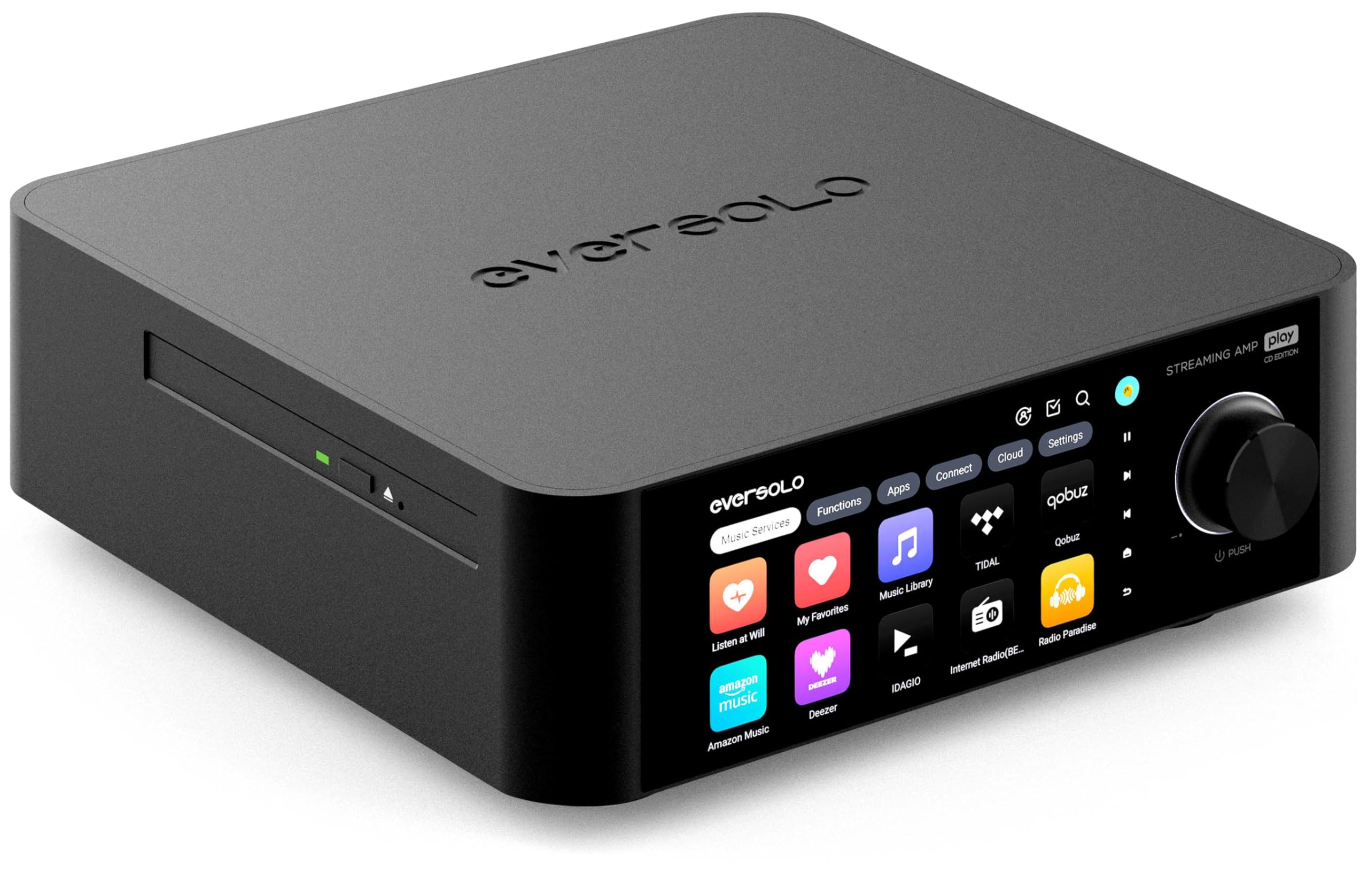
The Eversolo Play is a one-box streaming amplifier that integrates an AK4493SEQ DAC delivering 60 watts per channel into 8 ohms and 110 watts into 4 ohms. The CD Edition includes a built-in disc drive, making it a complete system for listeners who still buy physical media. The 5.5-inch HD touchscreen provides a full UI for browsing, streaming, and settings, all without needing a phone.
The unit supports Qobuz, TIDAL, and AirPlay 2 streaming, plus multiple inputs including HDMI ARC, optical, coaxial, USB, and a phono stage supporting both MM and MC cartridges. Built-in room correction and a Multi-Band EQ with 23 genre presets allow fine-tuning. The Eversolo Control app for iOS and Android mirrors the screen and manages the queue, and the unit supports Roon Ready and DLNA.
The amplifier is not designed for large floor-standing speakers—Eversolo advises power handling of 20-100W and sensitivity of 85-88dB. Reviewers report occasional firmware corruption that disables the music library browsing function, requiring a factory reset. The remote is a separate purchase, and some users find the protruding speaker binding posts awkward for tight equipment racks.
Why it’s great
- All-in-one streaming, CD, DAC, and amplifier
- AirPlay 2 and MM/MC phono input for maximum flexibility
- 5.5-inch touchscreen eliminates phone dependency
Good to know
- Not suitable for large floor-standing speakers
- Firmware updates can corrupt the music library function
- Remote not included; speaker posts protrude awkwardly
12. Yamaha R-N1000A

The R-N1000A is the junior sibling of the R-N2000A, keeping the ESS SABRE ES9080Q Ultra DAC and YPAO-R.S.C. room correction but in a smaller chassis without the toroidal transformer or VU meters. The amplifier is still powerful enough to drive most bookshelf and tower speakers with clarity, and the MusicCast platform provides network streaming from Qobuz, Amazon Music, TIDAL, and internet radio. HDMI ARC, optical, coaxial, and a phono input are all present.
The YPAO system does an excellent job of calibrating the listening position for flat frequency response, and the Pure Direct mode bypasses all tone controls for the shortest signal path. The unit supports high-resolution USB DAC input up to DSD 11.2 MHz and 384 kHz PCM, making it a versatile digital hub.
The knobs are plastic rather than metal, which feels surprising at this price point. The unit lacks midrange tone adjustment, which is relevant for room modes in the vocal range that YPAO cannot always solve. The MusicCast app is functional but lacks the integration of BluOS or Roon, and long-term software support is uncertain.
Why it’s great
- ESS ES9080Q Ultra DAC with YPAO room correction at a fair price
- Versatile input selection including phono, HDMI, and USB-DAC
- Pure Direct mode offers a clean, uncolored signal path
Good to know
- Plastic knobs feel cheap at this price level
- No balanced inputs or midrange tone adjustment
- MusicCast app is functional but not premium-tier
13. Marantz AV7706

The AV7706 is Marantz’s 11.2-channel AV preamplifier, designed for the listener who wants a full home theater processor without integrated amplification. It decodes Dolby Atmos, DTS:X, Auro-3D, and IMAX Enhanced, with eight HDMI 2.1 inputs (one dedicated 8K) supporting 8K/60Hz and 4K/120Hz pass-through with HDR10+, Dolby Vision, and Dynamic HDR. The Full Audyssey Platinum Suite—including MultEQ XT32—does for the listening room what a streamer does for the source.
Streaming is handled via the HEOS platform, which streams from Spotify, TIDAL, Deezer, Amazon Prime, and network storage. AirPlay 2 and Bluetooth are built in, and the unit is Roon Ready. The preamp outputs can drive seven power amplifiers for a full 7.1.4 surround system, with Sub EQ HT for dual subwoofer integration.
The AV7706 is large and heavy at over 28 pounds. The auto-setup wizard is helpful for beginners, but the sheer depth of the Audyssey configuration options can be overwhelming. Some users report that the HEOS app feels secondary to the core AV functions, and the remote is not backlit. Printed manuals are not included, and the online manual is clunky.
Why it’s great
- Full Audyssey XT32 room correction with Sub EQ HT for dual subs
- 8K HDMI 2.1 inputs with full HDR10+ and Dolby Vision support
- Roon Ready with HEOS multi-room streaming platform
Good to know
- No integrated amplification—requires power amplifiers
- Large chassis at 28 pounds demands rack space
- HEOS app is secondary to the core AV experience
FAQ
How much difference does a separate streamer make versus using the built-in DAC on my amplifier?
Do I need balanced XLR outputs for an audiophile streamer?
What is the actual difference between the Bluesound Node ICON and the standard Node 2024?
Why would I buy a CD transport like the Audiolab 6000CDT when I already stream everything?
Is the WiiM Amp Ultra a real audiophile component or just a consumer device?
What is the actual benefit of a quad-chip or four-chip DAC configuration?
Final Thoughts: The Verdict
For most users, the best audiophile streamer winner is the Cambridge Audio CXN100 because it delivers a reference ESS SABRE DAC implementation, robust streaming protocols, and a preamp output in a clean, stable chassis that integrates seamlessly into any system. If you want HDMI eARC, Dirac-ready room correction, and the most mature multi-room platform in the category, grab the Bluesound Node ICON. And for the purest digital transport paired with your existing premium DAC, nothing beats the Audiolab 6000CDT for extracting every last detail from your CD collection.