
Our readers keep the lights on and the weekend projects moving. As an Amazon Associate, I earn from qualifying purchases.
You’ve outgrown the soundbar that smears detail and the portable speaker that can’t separate a kick drum from a bass line. The gap between convenience and true high-fidelity playback has finally closed, but filtering the real performers from the marketing noise demands a deep understanding of driver topology, amplification architecture, and wireless codec support. This guide focuses exclusively on powered or streaming-ready systems that deliver genuine audiophile-grade resolution without forcing you back into a rack of separates.
I’m Rikta — the co-founder and writer behind FitlyFast. My workflow for this guide involved hundreds of hours dissecting technical datasheets, mapping real-world frequency response measurements against customer feedback, and cross-referencing driver types, amplifier topologies, and wireless streaming capabilities to separate the genuinely high-fidelity from the merely loud.
Whether you want studio-monitor precision for a desktop nearfield setup, a stylish all-in-one for the living room that doesn’t compromise on resolution, or a multi-room streaming system with true hi-res playback, this deep-dive into the audiophile wireless speakers market will show you exactly which models deliver on their promises — and which cut corners you cannot afford.
How To Choose The Best Audiophile Wireless Speakers
Committing to a high-end wireless speaker system requires looking beyond brand names and wattage claims. The thinnest differentiators — driver topology, amplifier configuration, and DAC quality — determine whether you get sterile loudness or a three-dimensional soundstage. Here are the three non-negotiable categories every serious buyer must evaluate.
Driver Design and Crossover Topology
A true audiophile system doesn’t rely on a single full-range driver. Look for at least a two-way design with a dedicated tweeter and woofer, or ideally a three-way setup with a separate midrange driver. Planar magnetic or ribbon tweeters (found on the Edifier S2000MKIII and HiVi-Swans M300MKII) offer superior transient speed and lower distortion compared to conventional dome tweeters. Pay attention to crossover points — a well-implemented active crossover with DSP alignment ensures seamless driver integration and a coherent soundstage.
Amplifier Architecture and Power Delivery
Total harmonic distortion (THD) below 0.1% at reference level is the baseline for true high-fidelity. Tri-amped or quad-amped designs, where each driver receives its own dedicated amplifier channel, eliminate passive crossover losses and improve dynamic control. Systems like the Edifier S2000MKIII (tri-amped, 130W) and SVS Prime Wireless Pro (200W, 50W x 4) demonstrate that discrete amplification per driver yields superior clarity at both low and high volumes. Beware of single-chip Class-D implementations that sacrifice damping factor for compactness.
Wireless Codec Support and Input Versatility
Bluetooth alone — even aptX — cannot match the bit-perfect fidelity of a wired connection. Prioritize speakers with Wi-Fi streaming, AirPlay 2, Chromecast, or Spotify Connect for gapless, lossless playback at 24-bit/192kHz or higher. Systems that include HDMI eARC (KEF LSX II, SVS Prime Wireless Pro) allow direct connection to your TV without degrading audio quality. Optical and coaxial inputs are essential for connecting dedicated DACs or CD transports. If the speaker relies solely on Bluetooth with no option for a wired high-resolution source, it does not qualify as audiophile-grade.
Quick Comparison
On smaller screens, swipe sideways to see the full table.
| Model | Category | Best For | Key Spec | Amazon |
|---|---|---|---|---|
| KEF LS50 Meta | Passive + Amp | Reference nearfield imaging | MAT dampening, Uni-Q driver | Amazon |
| KEF LSX II | Powered Bookshelf | Compact hi-res streaming | HDMI eARC, 24/384kHz | Amazon |
| HiVi-Swans M300MKII | Powered 3-Way | Ribbon tweeter clarity | Ribbon tweeter, 360W RMS | Amazon |
| SVS Prime Wireless Pro | Powered Bookshelf | Multi-device connectivity | HDMI, 200W total, 24/192kHz | Amazon |
| Bowers & Wilkins Zeppelin Pro | All-in-One | Stylish living room centerpiece | 240W, 5 drivers, Titanium Dome | Amazon |
| Edifier S2000MKIII | Powered Bookshelf | Best value tri-amped sound | Planar tweeter, aptX HD | Amazon |
| Edifier S1000W | Powered Bookshelf | Multi-room Wi-Fi streaming | AirPlay 2, Spotify Connect | Amazon |
| Audioengine HD6 | Powered Bookshelf | Silk dome natural midrange | Built-in 24-bit DAC, aptX | Amazon |
| JBL Authentics 500 | All-in-One | Dolby Atmos party sound | 3.1 channel, 270W, auto tuning | Amazon |
| Naim Mu-So 2nd Gen | All-in-One | Premium single-box system | 6 drivers, 450W total | Amazon |
| Bose L1 Pro8 | Portable PA | Live performance & vocal clarity | 180° horizontal coverage | Amazon |
In‑Depth Reviews
1. KEF LS50 Meta (Pair, Mineral White)

The KEF LS50 Meta represents a genuine leap in driver engineering. KEF’s Metamaterial Absorption Technology (MAT) absorbs 99% of unwanted rear-wave radiation from the 12th-generation Uni-Q driver, eliminating the resonant coloration that plagues conventional two-way designs. The result is a midrange purity and transient snap that few speakers at double the price can match. The 5.25-inch magnesium-aluminum cone and 1-inch aluminum dome tweeter operate as a single point source, producing a wide, holographic soundstage with pin-point imaging.
These are passive speakers — you must supply your own amplification, preferably a high-current amplifier rated for 3-ohm loads. They reward quality gear with stunning clarity at moderate listening levels (around 70 dB), but they are not for loud parties or cavernous rooms. The low-end extends to 47 Hz at -6 dB, which is tight and articulate rather than deep; integrating a subwoofer is recommended for full-range playback. Cabinet resonance is virtually non-existent due to the constrained-layer damping construction.
Owners consistently praise the LS50 Meta for revealing new details in familiar recordings, with natural vocal reproduction and airy treble that avoids fatigue. The narrow sweet spot and requirement for substantial amplifier power are the main barriers to entry. If you already own a quality integrated amplifier and want reference-level nearfield or small-room performance, this is the most sonically honest system in this guide.
Why it’s great
- MAT eliminates cabinet coloration for pure midrange clarity
- Uni-Q driver delivers exceptional imaging and wide sweet spot
- Build quality and finish are outstanding
Good to know
- Requires high-current amplifier (minimum 40wpc into 3 ohms)
- Limited bass extension without subwoofer
- Best in small to medium rooms at moderate volumes
2. KEF LSX II (Carbon Black)

The LSX II distills KEF’s Uni-Q driver philosophy into a compact, powered package that fits on a bookshelf or desktop without sacrificing hi-res capability. Streaming support goes up to 24-bit/384kHz via Wi-Fi, with native integration for Spotify, Tidal, Amazon Music, and Qobuz. HDMI eARC input means you can connect it directly to your TV and bypass the anemic audio of any flatscreen. USB-C input further expands compatibility with laptops and game consoles.
The 4.5-inch woofer and 0.75-inch tweeter in each cabinet are driven by a 70W per-channel amplifier. Bass is surprisingly taut and articulate for the size, though the LSX II benefits from a subwoofer for cinematic material or bass-heavy genres. The soundstage is wide and layered, with KEF’s characteristic midrange clarity and airy top end. The LT version saves money by removing the analog input and some color options, but the standard LSX II is the fully featured choice.
User experiences highlight the convenience of the all-in-one streaming platform and the dramatic upgrade over soundbars. The main complaints center on the clunky KEF Connect app and the fact that the standard model requires two power cords (one for each speaker, a limitation fixed in the LT version). Break-in of roughly 40 hours is real — the speakers sound constrained out of the box and open up significantly over time.
Why it’s great
- Hi-res streaming up to 24/384kHz with native Tidal/Qobuz support
- HDMI eARC makes it a true TV upgrade
- Compact footprint belies expansive soundstage
Good to know
- Standard version needs two power cords
- App interface has stability issues
- Requires break-in period for optimal sound
3. HiVi-Swans M300MKII
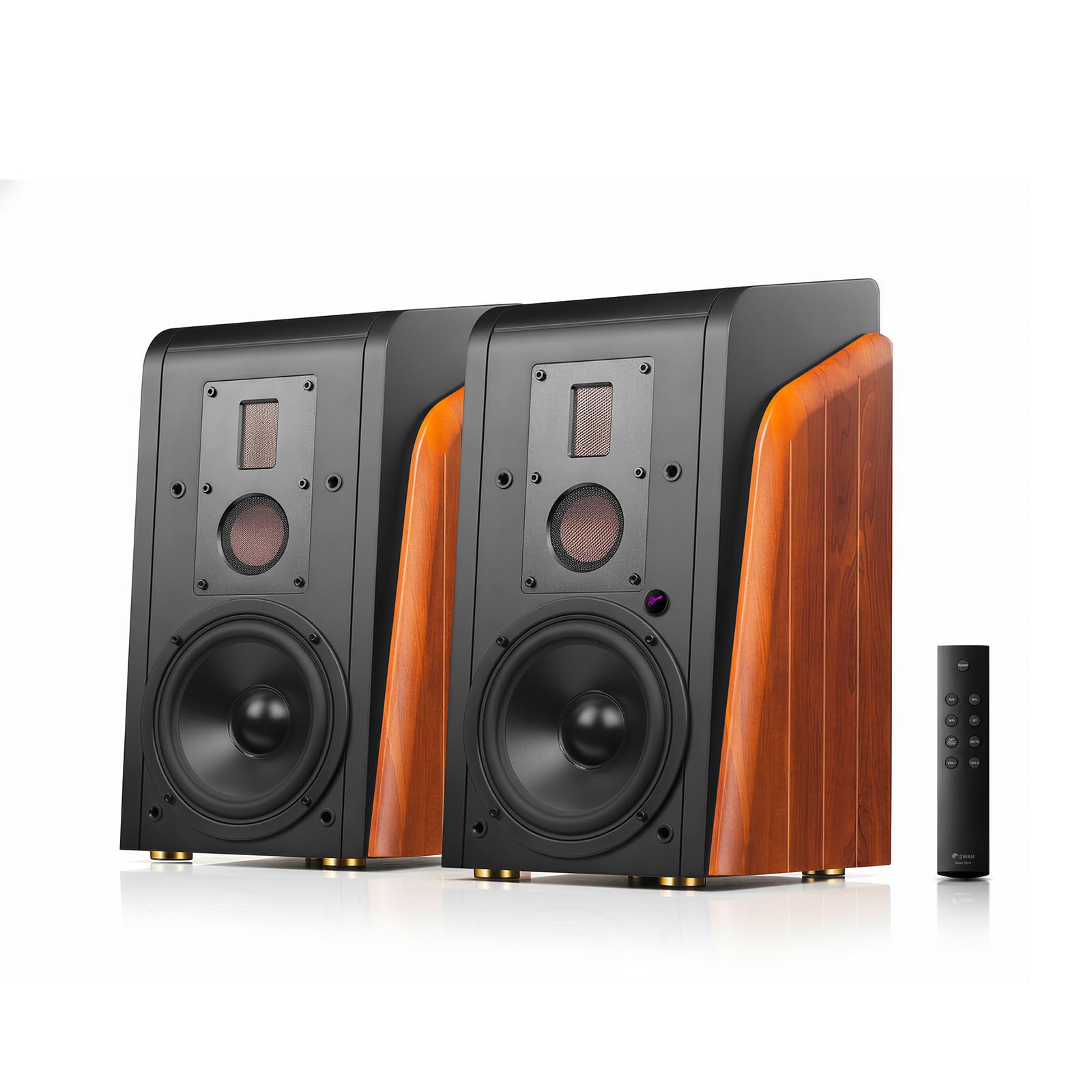
The M300MKII is one of the few powered speakers in this class to use a true isodynamic ribbon tweeter, capable of extending to 40 kHz with virtually zero distortion. Paired with a 2-inch metal midrange driver and a 6.5-inch woofer, this three-way configuration allows each driver to operate within its optimal frequency band, avoiding the intermodulation distortion that plagues two-way designs at higher volumes. The 360W RMS total power rating delivers headroom that few competitors can match at this level.
The active crossover and DSP alignment are tuned to deliver a cohesive soundstage with excellent depth. The angled front panel (4 degrees) improves time alignment to the listening position. Bass extends to 38 Hz, which is genuinely deep for a bookshelf form factor, though the low end is more controlled than overly punchy. The remote control is essential because there are no front-panel controls, and the included connecting cable between speakers is too short at roughly 10 feet for wide placements.
Listeners frequently describe the sound as “warm” and “natural” with a sweet treble that is detailed without being harsh. The system performs best at moderate to high volumes where the ribbon tweeter truly shines. WiFi setup can be fussy, and Swan’s customer support is not known for speed. If you prioritize driver separation and a three-way topology over brand recognition, the M300MKII offers tremendous value.
Why it’s great
- Ribbon tweeter delivers exceptional high-frequency detail and extension
- True 3-way design with dedicated midrange driver
- Deep, controlled bass from 6.5-inch woofer
Good to know
- Short connecting cable limits placement options
- No front-panel controls, depends on remote
- WiFi connectivity can be temperamental
4. SVS Prime Wireless Pro (Pair, Gloss White)

SVS designed the Prime Wireless Pro as a connectivity powerhouse. The 200W total amplifier (50W x 4 channels) drives the 5.25-inch glass-fiber woofers and 1-inch aluminum dome tweeters through a precision-tuned digital crossover. HDMI input, optical, 3.5mm AUX, line-level RCA, and Ethernet are all present, alongside Wi-Fi 5 with DTS Play-Fi, Apple AirPlay 2, Chromecast, and Spotify Connect. This is the most input-flexible system in the mid-range category.
Frequency response reaches 45 Hz at -3 dB, which is impressive for the driver size and delivers satisfying bass for acoustic and electronic music alike. Soundstage width is good, though customers note that the imaging is not as precise as systems using planar or ribbon tweeters. The DSP provides a clean, distortion-free experience at high volumes, and the subwoofer output allows easy integration of a dedicated sub for home theater use.
Reviews are generally very positive, with many buyers praising the huge upgrade over budget monitors. The main friction point involves the DTS Play-Fi app, which can lose connection with certain routers and requires occasional firmware updates to stay stable. There is no front-panel power button, but the auto on/off function works reliably for desktop use. For a buyer who needs maximum connectivity in a clean, powered stereo pair, the Prime Wireless Pro is a formidable all-arounder.
Why it’s great
- Extensive input options including HDMI and Ethernet
- Clean, distortion-free playback at high volumes
- Subwoofer output for easy system expansion
Good to know
- DTS Play-Fi app stability varies by router
- Imaging not as precise as ribbon-tweeter designs
- No front-panel volume/power control
5. Bowers & Wilkins Zeppelin Pro Edition (Solar Gold)
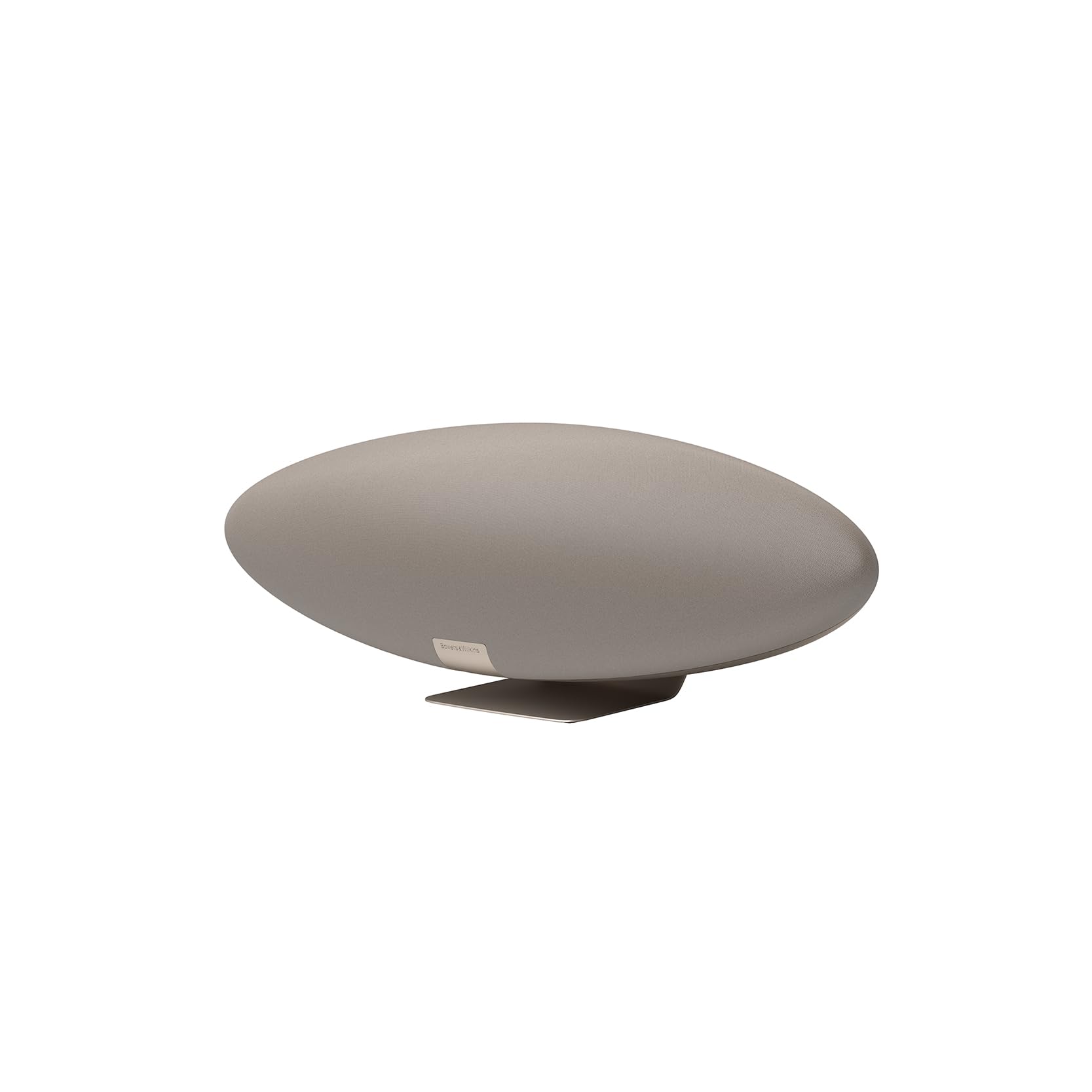
The Zeppelin Pro Edition is B&W’s most refined all-in-one wireless speaker to date. The iconic elongated shape houses five drivers: two 1-inch Titanium Dome tweeters derived from the acclaimed 600 Series, two 3.5-inch woven glass-fiber midrange drivers, and a 6-inch subwoofer, all powered by 240W of total amplification. This gives it genuine three-way separation within a single enclosure, something most all-in-ones cannot achieve. The frequency response spans from 35 Hz to 24 kHz.
Sound quality leans toward the refined and detailed side of neutral. The Titanium Dome tweeters deliver crisp highs without metallic edge, and the midrange drivers present vocals and instruments with weight and clarity. Bass is deep and well-controlled, not bloated, though the sealed design means it will not pressurize a large room like a dedicated sub. AirPlay 2 and Spotify Connect work reliably, while the B&W Music app provides access to hi-res streaming services. The ambient light is adjustable via the app.
Customer feedback highlights the Zeppelin’s ability to serve as both furniture and high-fidelity system, with many users impressed by its stereo imaging from a single cabinet. The main drawbacks are its reliance on Wi-Fi or AirPlay for best sound quality (Bluetooth is adequate but not reference-grade) and the occasional connection drop with AirPlay on complex networks. For a buyer who values aesthetics as much as audio and wants one elegant box, the Zeppelin Pro is a top contender.
Why it’s great
- True 5-driver, 3-way design in a single cabinet
- Titanium Dome tweeters deliver detailed, fatigue-free highs
- Aesthetic build quality serves as a design piece
Good to know
- AirPlay connectivity can be unreliable in complex networks
- Bluetooth sound quality falls short of hi-res potential
- Single enclosure limits stereo separation compared to separated speakers
6. Edifier S2000MKIII (Walnut)
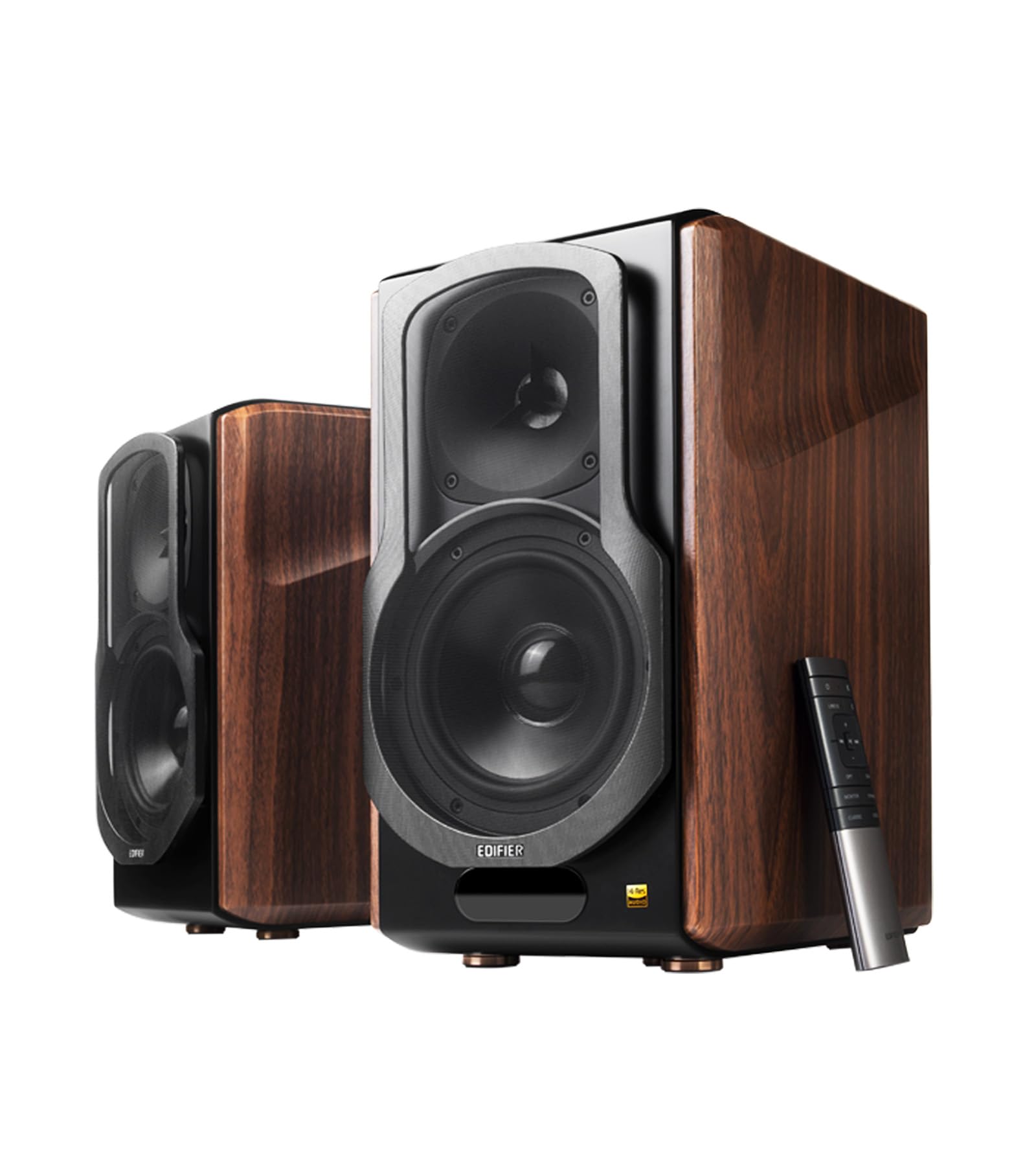
The Edifier S2000MKIII is a clear standout in the value-to-performance ratio. It uses a planar diaphragm tweeter — a rarity at this price point — paired with a 5.5-inch aluminum diaphragm woofer in each cabinet, with a dedicated amplifier channel per driver (tri-amped, 130W total). Planar tweeters offer significantly lower distortion and faster transient response than conventional dome tweeters, providing an airy, detailed top end with excellent separation. The aptX HD Bluetooth 5.0 codec supports 24-bit streaming wirelessly.
Bass response is deep and “chest-thumping” according to EDM listeners, with no distortion up to volume level 48 (out of 60). The soundstage benefits greatly from careful placement — about 6 inches from the back wall, 5 feet apart, slightly toed in. The remote control is functional but has minuscule, unreadable labeling that requires memorization. The cabinet is heavy (40 lbs) with real wood side panels that resonate less than MDF alone.
Customers consistently report that the S2000MKIII rivals systems costing three times as much in terms of clarity and bass weight. The slight treble roll-off may not appeal to those who prefer a bright, analytical sound, and the Bluetooth can introduce intermittent static in certain environments. For anyone seeking a high-value nearfield or living room system, this is the benchmark.
Why it’s great
- Planar tweeter offers exceptional clarity and low distortion
- Tri-amped design provides excellent dynamic control
- Deep, clean bass rivaling systems many times the price
Good to know
- Remote control labeling is borderline unreadable
- Bluetooth can produce intermittent static near some devices
- Treble slightly rolled off for a warmer signature
7. Edifier S1000W WiFi (Pair)

The S1000W takes the proven driver architecture of Edifier’s popular S1000 series and adds native Wi-Fi streaming with AirPlay 2, Alexa voice control, and Spotify Connect. The 5.5-inch woofers and 1-inch silk dome tweeters handle 120W RMS with a natural, uncolored sound signature that reviewers describe as “neutral and balanced.” Frequency response tests by customers have measured extension down to 37 Hz at -3 dB, which is excellent for a sealed bookshelf design. The multi-room grouping via the Edifier Home app allows synchronized playback across multiple Edifier Wi-Fi speakers.
Build quality is outstanding for the price, with solid wood side panels and a heavy, rigid cabinet that reduces resonance. The sound is notably precise, with customers remarking that the S1000W reveals new detail in tracks they have heard for years. Input selection is easy via the metal remote, and the optical input supports 24-bit/192kHz playback from a TV or streamer. The Bluetooth 5.0 with aptX provides a solid wireless fallback.
The main cautions involve the remote — switching between Wi-Fi and Bluetooth inputs can feel cumbersome, and losing the remote severely limits functionality. The speakers are also quite heavy (45 lbs), making placement adjustments a two-person job. For an enthusiast building a multi-room system that competes with Sonos in convenience but far exceeds it in sound quality, the S1000W is a smart choice.
Why it’s great
- Native AirPlay 2 and Spotify Connect for seamless streaming
- Neutral, detailed sound with deep bass extension
- Rugged build quality with real wood side panels
Good to know
- Remote-reliant operation — losing it reduces functionality
- Heavy cabinets make placement changes difficult
- Input switching between Wi-Fi and Bluetooth is not intuitive
8. Audioengine HD6 (Walnut)
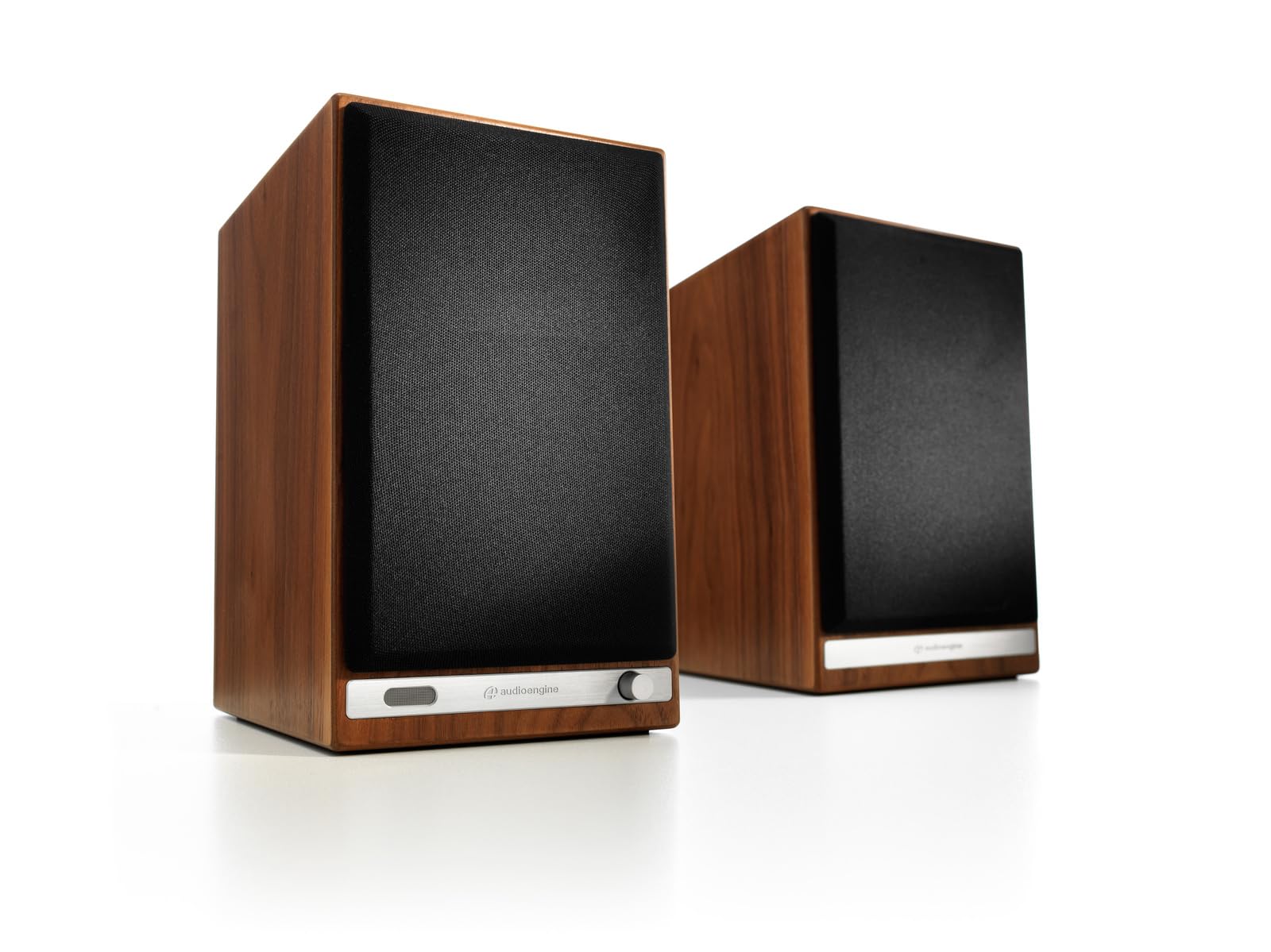
The Audioengine HD6 targets the listener who prizes vocal presence and natural midrange realism over raw bass extension. The 1-inch silk dome tweeter delivers a laid-back, non-fatiguing top end that integrates beautifully with the custom-tuned 5.5-inch aramid fiber woofer. The analog amplifier (50W per channel) is discrete Class A/B, not Class-D, which contributes to the HD6’s warm, organic character. The built-in 24-bit DAC supports optical and USB inputs in addition to aptX HD Bluetooth.
The cabinet is handcrafted with real wood veneer and aluminum trim, giving it a furniture-grade appearance. Bass is taut and articulate but not authoritative — the HD6 is not designed to rattle windows. It is best suited for small to medium rooms and close-to-midfield listening. Many owners recommend adding the S6 subwoofer for a more complete low-end foundation. The speakers require a substantial break-in period (40-50 hours) before they sound their best; out of the box, they can sound constrained and unimpressive.
Customer satisfaction is high among buyers who value ease of use and a clutter-free setup — the HD6 needs no receiver or separate DAC. The Bluetooth connection occasionally requires re-pairing, and the lack of any EQ controls limits tonal adjustment. For the dedicated midrange enthusiast who listens primarily to vocals, jazz, and acoustic music, the HD6 delivers a natural, engaging presentation that is hard to beat.
Why it’s great
- Silk dome tweeter provides smooth, fatigue-free highs
- Analog Class A/B amplifier offers warm, natural midrange
- Furniture-grade build with real wood veneer
Good to know
- Requires 40-50 hours of break-in for optimal sound
- Low-end is controlled, not powerful — subwoofer recommended
- Bluetooth pairing can drop and require re-pairing
9. JBL Authentics 500 (Black/Gold)

The JBL Authentics 500 is a retro-styled, feature-packed all-in-one that leans into party functionality while retaining genuine high-fidelity capability. Its 3.1-channel array includes three 1-inch tweeters, three 2.75-inch woofers, and a single 6.5-inch subwoofer, driven by 270W of amplification. Dolby Atmos processing attempts to create height and width, though purists argue its effect is more of a soundstage enhancer than a true Atmos experience. Automatic self-tuning calibrates the EQ to the room each time it powers on.
Sound quality is characterized by a V-shaped profile with plentiful, non-bloated bass and crisp high-frequency detail. At half power, the system fills a 1,200-square-foot space with balanced sound. At full volume in a large room, the bass remains controlled but the midrange can become slightly mechanical, lacking the natural life of the KEF or B&W systems. The built-in Alexa and Google Assistant work well, and the JBL One app provides bass, treble, and EQ adjustments.
Customer reviews are split: many praise the Authentics 500 as “the best sounding speaker in its class” for casual listening, while others warn that it lacks the stereo separation and midrange refinement expected by strict audiophiles. The exposed bass driver is a handling concern, and the large footprint is bigger than a typical soundbar. For a buyer who needs high-volume clean output, voice assistant integration, and a classic aesthetic, this is a strong but not purist choice.
Why it’s great
- Powerful 270W 3.1-channel array with room calibration
- Controlled bass and crisp highs at moderate to high volumes
- Alexa and Google Assistant built-in with app EQ control
Good to know
- Midrange can sound mechanical at full party volume
- Dolby Atmos adds width but lacks true height channels
- Large footprint and exposed bass driver require care
10. Naim Mu-So 2nd Generation (Black)

The Naim Mu-So 2nd Generation is the cost-no-object all-in-one for those who refuse to compromise on sound quality but demand zero system clutter. Its aluminum enclosure houses six drivers — two tweeters, two midranges, and two oval woofers — each powered by its own 75-watt amplifier for a total of 450W. This per-driver amplification approach eliminates passive crossovers and provides astonishing dynamic headroom. The internal DAC handles up to 24-bit/384kHz, and the streaming platform covers Tidal, Qobuz, Spotify Connect, and network-attached storage playback.
Sonically, the Mu-So delivers a detailed, musical presentation with excellent bass weight for a single-box system. The stereo separation is limited by physics — two feet of physical width cannot match the channel separation of a pair of bookshelf speakers placed six feet apart. Within that constraint, the soundstage is wide and well-defined. Adding the optional isolation bumpers improves focus and reduces low-frequency smearing. The build quality is exceptional, with a brushed aluminum case that feels as expensive as it is.
Customer opinions are polarized on value: many describe it as “the best sounding all-in-one” and praise its seamless integration into a tidy living room, while others find it overpriced at roughly three times the cost of multi-component systems that outperform it. The app is stable but lacks advanced EQ features. For the buyer who prioritizes industrial design and a single-box footprint above all else and is willing to pay a premium for that luxury, the Mu-So is peerless.
Why it’s great
- Six discrete amplifiers (75W each) for per-driver control
- High-resolution streaming up to 24/384kHz with NAS support
- Premium aluminum build quality and minimalist design
Good to know
- Physical stereo separation limited by single enclosure
- Premium price that some find hard to justify vs. separates
- Lacks advanced EQ and room correction options
11. Bose L1 Pro8 (Portable PA)

The Bose L1 Pro8 serves a completely different audience than the other systems in this guide: live performers and mobile DJs who need portable, full-range sound with wide coverage. The C-shaped extended-frequency line array contains eight articulated 2-inch neodymium drivers that project sound with 180 degrees of horizontal dispersion, meaning the audience hears the same tonal balance regardless of where they stand. The integrated subwoofer uses a 7×13-inch high-excursion Race Track driver that performs like a conventional 12-inch woofer in a smaller footprint.
Sound quality prioritizes vocal clarity and instrumental definition over deep bass extension. The built-in three-channel mixer allows simultaneous connection of a microphone, instrument, and Bluetooth source, with the Bose app providing wireless control. The system is lightweight enough to be carried in one trip, with the column and base packing separately. Coverage is consistent across a small venue, and the system avoids the comb filtering that plagues typical point-source PA speakers.
Owners highlight the L1 Pro8’s vocal fidelity and ease of transport as its greatest strengths. Some note that the speaker column does not lock into the base as securely as previous generations, and the lack of a travel cover for the base is a minor omission. For a singer-songwriter, acoustic duo, or mobile DJ who needs professional-grade audio in a portable package, the L1 Pro8 is an excellent tool.
Why it’s great
- 180-degree horizontal coverage ensures uniform audience sound
- Lightweight and portable for one-trip venue setup
- Integrated mixer with Bluetooth and app control
Good to know
- Not designed for audiophile home listening
- Column lock can feel less secure than previous models
- No travel cover included for the base unit
FAQ
Do I really need a subwoofer with these audiophile wireless speakers?
What is the actual difference between aptX HD and standard aptX Bluetooth?
Can these speakers work as part of a home theater setup?
Is a break-in period really necessary for these speakers?
What is the difference between a 2-way and a 3-way speaker design?
Final Thoughts: The Verdict
For most users, the audiophile wireless speakers winner is the KEF LS50 Meta because its MAT-dampened Uni-Q driver delivers reference-class clarity and imaging that no other speaker in this roundup approaches at the price. If you want a compact all-in-one streaming system with HDMI eARC, grab the KEF LSX II — it packs hi-res capability into a desktop-friendly form. And for the purest value in a tri-amped powered design that rivals systems costing multiples more, nothing beats the Edifier S2000MKIII with its planar tweeter and deep, clean bass.