
Our readers keep the lights on and the weekend projects moving. As an Amazon Associate, I earn from qualifying purchases.
The best autism toy is the one that meets a child where they are — engaging a specific sensory system without flooding it with competing noise, harsh textures, or unpredictable motion. The line between a toy that soothes and one that overwhelms is defined by specific design choices: dimmable or low-brightness lights, adjustable or absent sound output, repetitive cause-and-effect feedback, and materials that invite touch without irritating skin. Parents and therapists who shop this category know the difference between a throwaway plastic gadget and a tool that builds regulation, focus, and motor planning.
I’m Rikta — the co-founder and writer behind FitlyFast. I’ve spent countless hours analyzing this specific toy subsection, cross-referencing the engineering specs, material reports, and real caregiver feedback that determine whether a product actually supports neurodivergent development rather than just lighting up on a shelf.
The risk of choosing poorly isn’t just wasted money — it’s adding a source of dysregulation to a space that needs calm. This guide focuses exclusively on finding the best autism toys, filtering for build quality, true sensory compatibility, and functional longevity.
How To Choose The Best Autism Toys
An autism toy must serve a primary sensory or motor goal. The best picks do one thing well: they either provide deep proprioceptive input, offer regulated visual feedback without audio overload, or build a specific fine-motor or gross-motor skill through repetitive practice. General-purpose toys that do many things poorly tend to overstimulate and get dropped quickly.
Identify the Sensory System First
The vestibular system is the most commonly undersupported in commercial toys. Products like spinning chairs and stepping stones with motion sensors directly address this. If your child seeks spinning or rocking, focus on toys that provide safe, controlled vestibular input. If they need calming visual focus, light-up boards with low-brightness bulbs and a master off-switch are better than flashing musical toys.
Prioritize Adjustable Output
The safest pattern in autism toys is low-brightness LED lighting with a built-in on/off master switch and no forced audio. Toys that allow a parent to remove batteries or toggle sound off (like the Grarain Busy Board, which has no noise) offer significant advantage. Any toy that cannot be silenced or dimmed should be avoided unless it is specifically prescribed for therapeutic sound exposure.
Check Material Safety and Assembly Quality
Autism toys take heavy repetitive use. Look for BPA-free plastics, splinter-free sanded wood, and screw-secured battery compartments that prevent a child from accessing button cells. Weight capacity matters for spinning chairs — models that wobble or tip under an 80-pound child are dangerous. For stepping stones, a rubberized non-slip base prevents sliding on smooth floors.
Quick Comparison
On smaller screens, swipe sideways to see the full table.
| Model | Category | Best For | Key Spec | Amazon |
|---|---|---|---|---|
| Pterying Spinning Chair | Vestibular Tool | Vestibular therapy & regulation | 150 lb capacity, PP/metal base | Amazon |
| Lehoo Castle Stepping Stones | Motion/Music Set | Gross motor & rhythm play | LED + 3 music modes, 200 lb limit | Amazon |
| HarVow LED Busy Board | LED Board | Calming visual cause-and-effect | 24 LEDs, 13 switches, 6.7 x 5.3 in | Amazon |
| Grarain Busy Board | LED Board | Travel-friendly no-sound play | 23 LEDs, wood build, AAA | Amazon |
| BYFWH Spin Stack Toy | Stacking Toy | Fine motor & visual tracking | 6 disks, spiral rod, BPA-free | Amazon |
| Playbees Light-Up Car | Musical Car | Obstacle-aware movement play | LED + music, bump-and-go | Amazon |
| MORECOLL Preschool Workbook | Educational | Early literacy & pen control | 62 reusable pages, 16 activities | Amazon |
In‑Depth Reviews
1. Pterying Spinning Chair for Autistic Kids
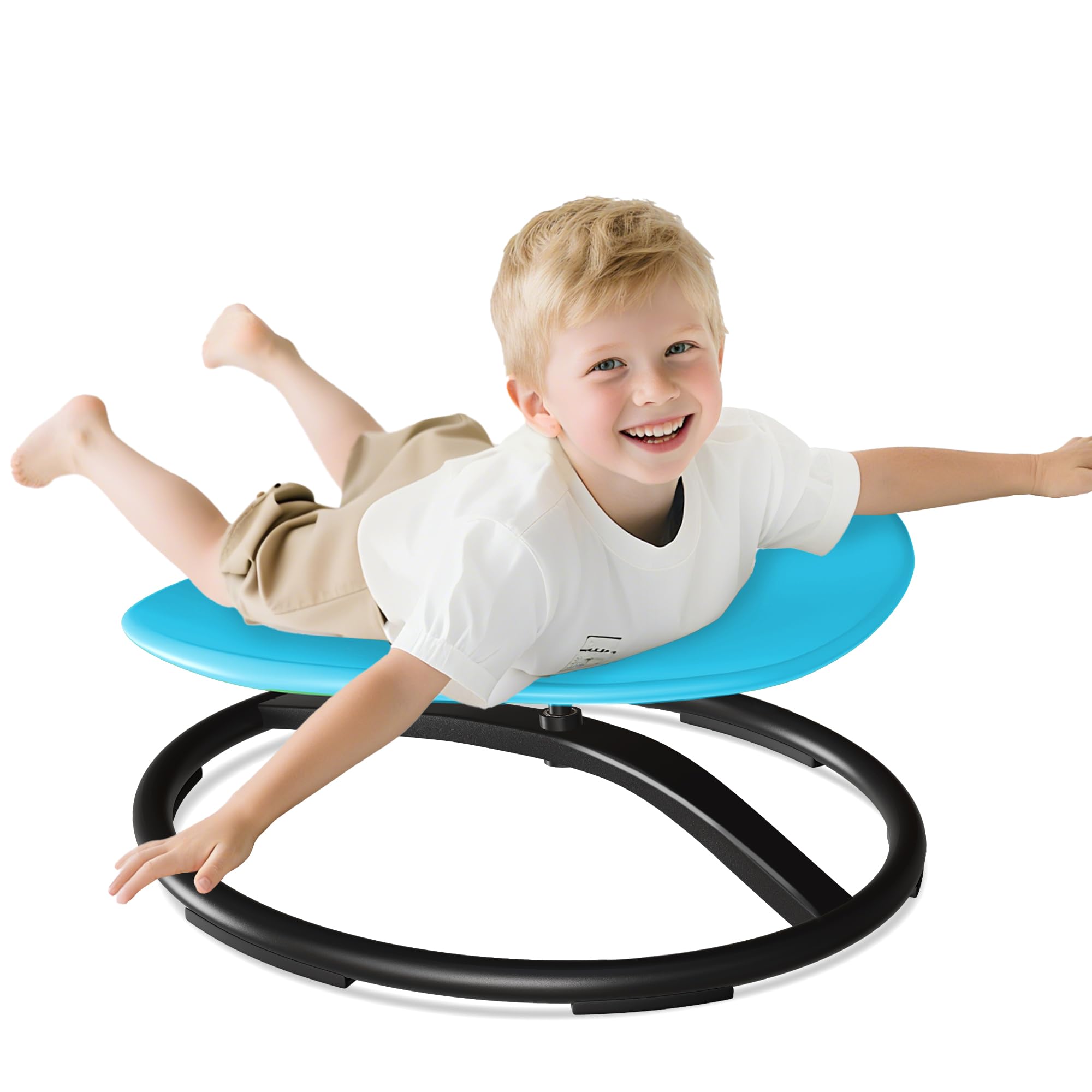
This spinning chair is designed with pediatric occupational therapy in mind, targeting the vestibular system directly. The round polypropylene base sits on a reinforced metal swivel that allows the child to spin while sitting, kneeling, or lying down — providing controlled rotational input that helps desensitize motion sensitivity and improve balance coordination. The thickened edge gives a safe handhold, and the quiet rotation mechanism avoids auditory overload during spinning.
Assembly takes roughly five minutes without tools. The plastic construction feels dense and the base is broad enough to resist tipping even during aggressive spinning. Multiple customer reports confirm it holds an adult without wobbling, and the 150-pound weight spec is conservative — it appears to handle more without deformation.
The chair works as a regulation reset for kids who seek constant movement. It is also lightweight enough for a child to carry between rooms independently, which promotes autonomy. The lack of any electronics or noise makes it a pure vestibular tool — no lights, no sounds, just rotational feedback.
Why it’s great
- Occupational therapist input informed the design
- Quiet rotation with zero electronics
- Easy to assemble, very difficult to tip
Good to know
- May cause motion sickness in adults using it with the child
- Assembly of the metal base is required
2. Lehoo Castle Stepping Stones
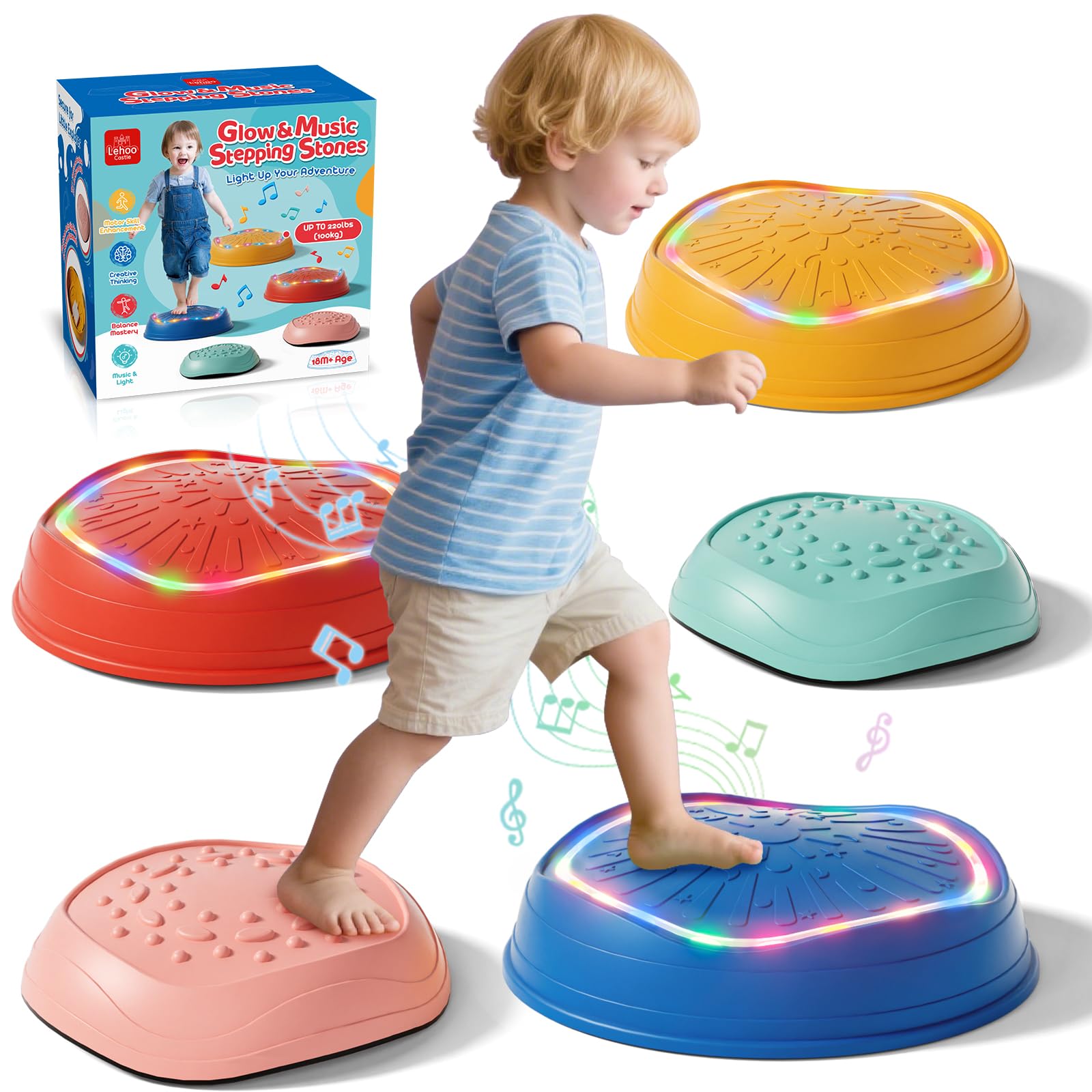
The Lehoo Castle stepping stones combine gross motor movement with cause-and-effect sensory feedback. Each stone contains a pressure sensor that triggers colored LED lights and one of three sound modes — piano tones, drum beats, or built-in songs — when stepped on. The textured top surface and rubberized bottom grip prevent slipping on hardwood or tile, making them viable for indoor obstacle courses and outdoor patio play.
The material is a thick, reinforced plastic that feels rigid underfoot but has enough flex to absorb impact. The weight capacity of 200 pounds means an adult can participate in the game without damaging the stones. The lights are bright but not harsh, and the sensors respond instantly, which reinforces the connection between action and reaction — a core skill for many neurodivergent children.
Some users noted that interest can wane after a few weeks if the play pattern is not varied. The stones work best when integrated into a larger floor-is-lava or balance-course game. They are stackable for storage, and the sound can be turned off by removing the batteries if the music becomes distracting.
Why it’s great
- Instant sensor response reinforces cause-and-effect learning
- Non-slip base allows safe use on smooth floors
- Multiple sound modes keep the activity fresh
Good to know
- Sound cannot be switched off electronically — must remove batteries
- Some children may lose engagement if play is not structured
3. HarVow LED Busy Board
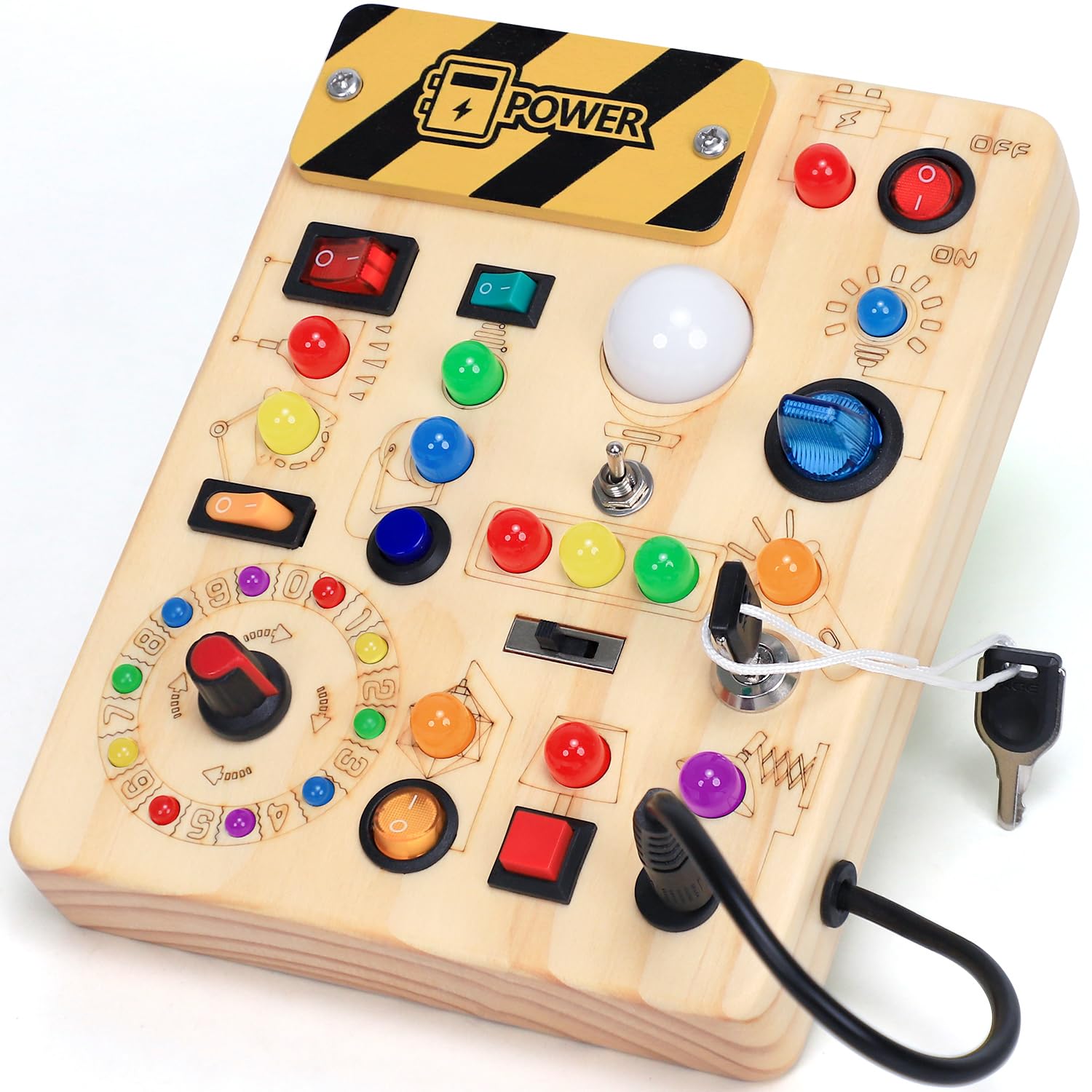
The HarVow LED busy board stands out for its thoughtful build: solid natural wood with hand-sanded edges, no splinter risk, and a compact footprint just larger than a standard tablet. The 13 mechanical switches — toggle, push-button, key turn, dial — each trigger a different LED pattern on the board, providing varied tactile feedback while the visual reward remains consistent and non-flashing. A master power switch lets the parent cut all lights instantly without removing batteries.
The reverse side is engraved with A-Z letters and 0-9 numbers, converting the board into an early literacy tool when the lights are off. This dual functionality extends the useful life of the toy beyond the sensory phase. The battery compartment uses a screw-secured cover, preventing access to the AAA batteries, and the tethered key prevents a choking hazard.
Customer reports highlight that the board is completely silent — no speaker, no buzz, no hum. This makes it one of the safest bets for a child who is sensitive to even low-level electronic noise. The LEDs are calibrated to be vivid enough to hold attention but not bright enough to cause visual strain.
Why it’s great
- Zero audio output — entirely silent operation
- Screw-secured battery compartment and tethered key for safety
- Wooden construction with engraved letters/numbers adds educational value
Good to know
- AAA batteries are not included
- Not waterproof — avoid outdoor use in wet conditions
4. Grarain Busy Board (Clocks Design)
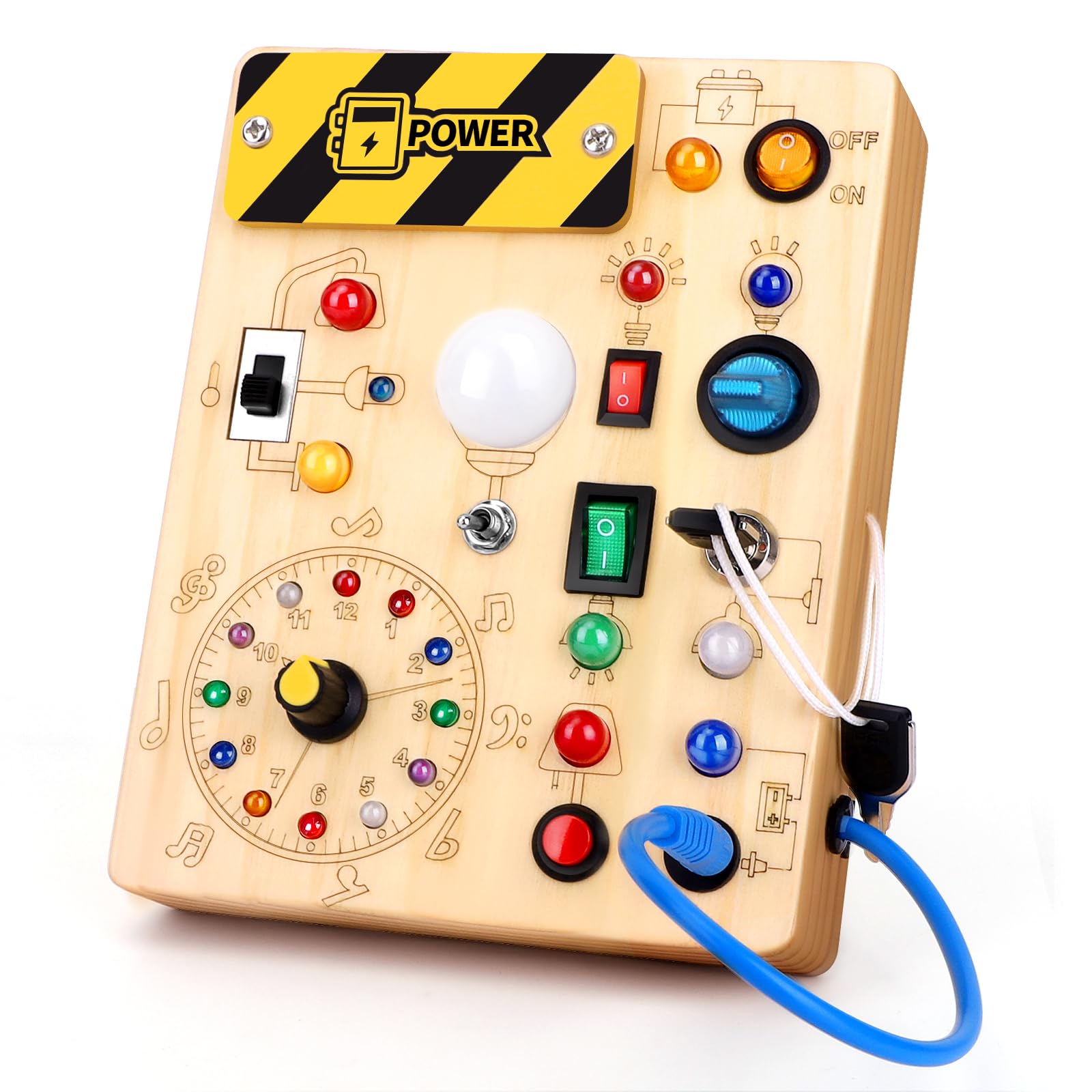
This busy board from Grarain prioritizes portability and quiet play. Slightly smaller than the HarVow version at 6.7 x 5.3 inches, it fits easily into a diaper bag or purse. The front face features a clock design outlined with 23 low-brightness LEDs that respond to the same variety of switches — toggle, key, knob, button. The back side adds an alpha-numeric chart for letter and number exposure during quiet time.
The wooden casing is drop-resistant and the low-brightness LEDs are calibrated to be gentle on developing eyes. The absence of any sound output is a deliberate feature that caregivers consistently praise in reviews — the board is often used in churches, restaurants, and airplanes without disturbing others. A master switch shuts all lights off immediately, preserving battery life.
The weight is notably light, and the rounded edges are sanded smooth. One design quirk: the largest LED cycles through multiple colors, which some children find mesmerizing and others find slightly unpredictable. Overall, this is an excellent entry-level sensory board for a child who needs visual stimulation without auditory input.
Why it’s great
- Completely silent with no speaker or buzzing
- Compact and lightweight for travel to restaurants and planes
- Wear-resistant wooden board with smooth edges
Good to know
- Largest color-changing LED may feel unpredictable to some
- Requires 2 AAA batteries (not included)
5. BYFWH Baby Spin Stack Toy

The BYFWH Spin Stack Toy is a deceptively simple construct: a spiral rod anchored in a reversible base, with six graduated disks that slide down the rod and spin. The twist is that each disk has a two-tone color scheme and a smooth bearing surface that lets it rotate freely even when stacked. Once assembled, the rod can be lifted out and the disks spin down individually in a mesmerizing cascading effect.
The plastic is BPA-free and the disk edges are rounded with no sharp seams. The base flips to two modes — wobble mode for a gentle rocking challenge, or fixed mode for stable stacking. This adjustability extends the toy’s difficulty range from simple color sorting all the way to fine-motor stacking with a balance component.
Children on the spectrum are often drawn to spinning objects, and this toy channels that interest into a structured activity that requires hand-eye coordination to align the disks with the rod. The lack of electronics is a plus for parents seeking a screen-free, silent play option. Some caregivers mentioned the spinning effect holds the attention of siblings up to age five.
Why it’s great
- BPA-free plastic with no sharp edges or seams
- Reversible base offers wobble or fixed modes for varied challenge
- Silent, no batteries, no electronic noise
Good to know
- The rod can be completely removed — small parts require supervision
- Plastic feels lightweight; not intended for throwing or rough impact
6. Playbees Light-Up Transparent Car

The Playbees transparent car offers a different sensory angle: visual and auditory engagement through movement. The transparent body reveals spinning internal gears that are visible while the car moves, providing a mechanical cause-and-effect lesson. When the car bumps into an obstacle, it changes direction automatically — this bump-and-go mechanism keeps the car moving autonomously without requiring a remote control.
The flashing LED lights inside the car are bright, and the built-in music plays at a moderate volume. Multiple caregiver reports note that for some children on the spectrum, the music may be slightly loud, but the car is fully functional with the music source removed. The transparent shell makes the gear motion easy to see, which encourages visual tracking and curiosity about how things work.
Durability is a strong point — the car survived repeated drops and bumps during testing. The battery compartment requires a small screwdriver to open, which is a safety plus for preventing battery access. For a child who responds well to movement and lights, this car provides a self-directed play loop that does not rely on adult intervention.
Why it’s great
- Visible spinning gears teach basic mechanics and cause-and-effect
- Bump-and-go navigation keeps the toy moving autonomously
- Durable enough to withstand drops and bumps
Good to know
- Music volume may be too high for sound-sensitive children
- Batteries are not included and require a screwdriver to install
7. MORECOLL Preschool Learning Workbook
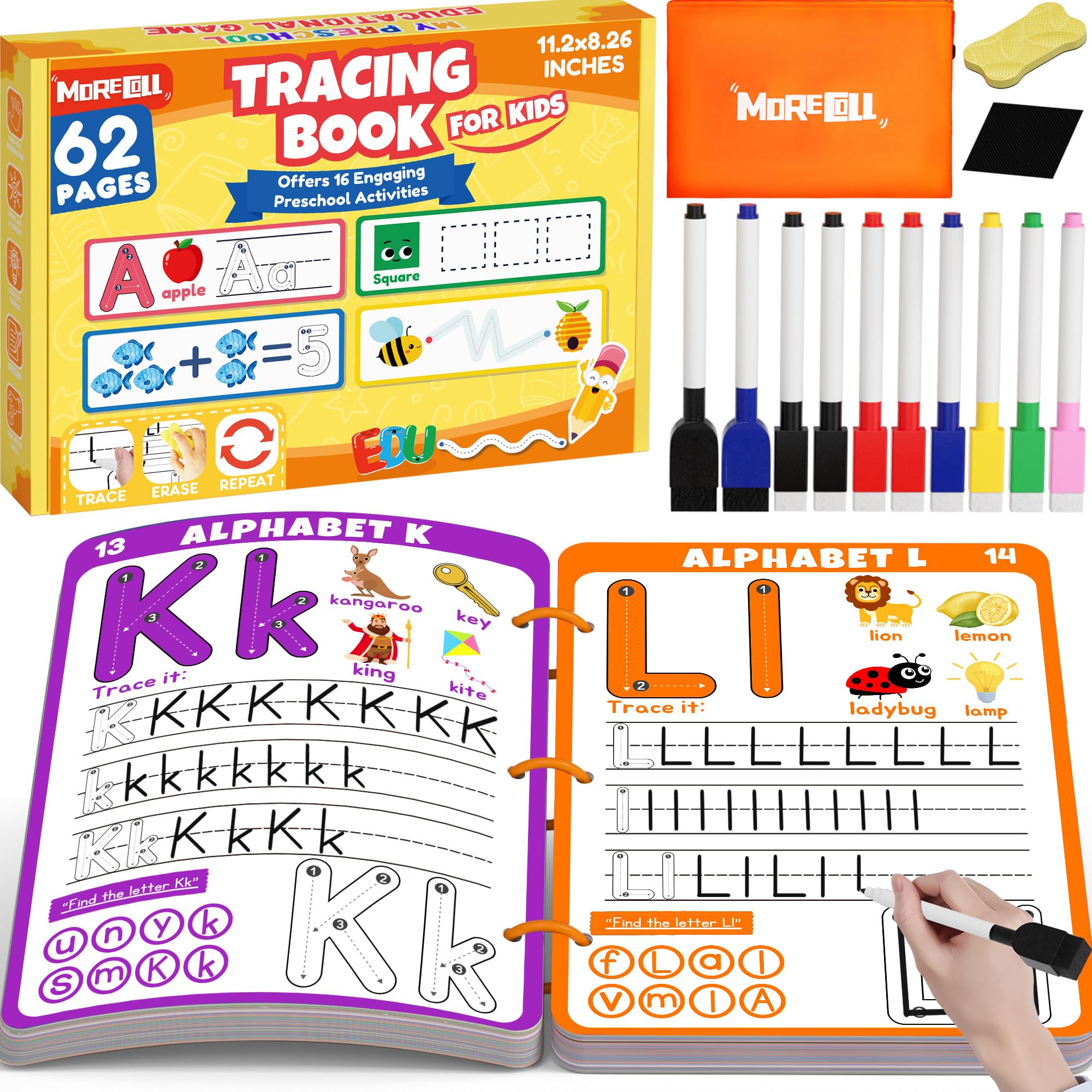
The MORECOLL workbook targets a different developmental domain: pre-academic cognitive skills through structured, self-directed practice. The 62 reusable pages are made from waterproof, tear-resistant material that wipes clean with a dry cloth, allowing a child to practice letter tracing, number writing, shape recognition, and simple math repeatedly without waste. The set includes ten dry-erase markers, six removable rings, a storage bag, and a cleaning cloth.
The content is organized into 16 distinct activity categories, including traceable letters, number practice, body parts labeling, emotions identification, spot-the-difference puzzles, and free drawing pages. A final page offers posture and grip guidance for proper handwriting habits. For children with autism or language delays, the repetition and predictable page structure can reduce anxiety around learning tasks.
The format is particularly useful for homeschooling or classroom settings where a child benefits from structured, repetitive practice. The removable rings allow the parent to pull out individual pages and focus on one skill at a time, which reduces visual overload. The workbook is also an effective tool for encouraging time away from screens, as all activities are paper-based and require marker control.
Why it’s great
- 62 reusable, wipe-clean pages allow unlimited practice
- 16 distinct activity types cover pre-K to early kindergarten skills
- Removable rings enable single-page focus to reduce visual clutter
Good to know
- Markers must be capped tightly to prevent drying out
- Some pages have small details that may frustrate children with fine motor delays
FAQ
Can these toys be used during occupational therapy sessions?
How do I know if a toy will overstimulate my child?
Are spinning chairs safe for a child who seeks intense motion?
Final Thoughts: The Verdict
For most users, the autism toys winner is the Pterying Spinning Chair because it directly addresses the vestibular system, the most commonly unmet sensory need in commercial toys, with a quiet, durable, therapist-informed design. If you want a silent, travel-friendly visual tool without any audio stimulation, grab the HarVow LED Busy Board. And for gross motor movement that combines music, lights, and balance work, nothing beats the Lehoo Castle Stepping Stones.