
Our readers keep the lights on and the weekend projects moving. As an Amazon Associate, I earn from qualifying purchases.
Finding a pressure washer that delivers enough cleaning power to strip road grime from your paintwork, yet remains gentle enough to avoid etching clear coat, is the central challenge of auto detailing. Many machines advertised for car washing either blast too hard, stripping wax, or flow too little water, making rinsing a tedious chore. The difference between a backyard wash and a showroom finish often comes down to two numbers: PSI and, more importantly for detailing, GPM.
I’m Rikta — the co-founder and writer behind FitlyFast. My approach involves many hours of cross-referencing technical specifications like pump design, water flow rates, and hose compatibility with verified user feedback from long-term owners to separate durable performers from weekend-only failures. This guide concentrates on the models that strike the right balance for your car-care routine.
Whether you maintain a single daily driver or run a side-gig mobile service, finding the right auto detailing pressure washer hinges on matching water flow to your cleaning method and work environment.
How To Choose The Best Auto Detailing Pressure Washer
Selecting a pressure washer for car care isn’t about grabbing the highest PSI number on the box. For detailing, the flow rate — how many gallons of water move through the wand each minute — determines how quickly you rinse away soap and dirt without needing to crowd the paint with the nozzle tip. A unit that delivers low GPM will leave you spraying for minutes between soap passes, which increases the risk of letting cleaning chemicals dry on the panel.
Focus on Flow Rate Over Peak Pressure
For automotive paint, a working pressure between 1,000 and 1,800 PSI is generally safe when combined with a 25° or 40° nozzle held at the proper distance. The more critical spec is GPM. A machine that pushes 1.2 GPM will rinse a sedan panel slowly; a 2.0 GPM unit strips off soap in roughly half the time. Look for a true continuous rating on the spec sheet, not marketing “max” numbers that inflate the peak.
Pump Design Determines Longevity
Most residential electric units use a simple axial cam pump with three pistons. These work fine for light use but tend to vibrate more and wear faster at the higher end of their duty cycle. Premium alternatives employ a five-piston wobble pump or a dedicated 5-piston axial pump that runs smoother and can sustain longer cleaning sessions without overheating. If you wash multiple vehicles in a day, the pump type directly dictates how many seasons you’ll get before replacement.
Hose and Fitting Compatibility
Detailing often involves upgrading the stock hose for better flexibility and length. The industry standard quick-connect is a 1/4” body, but pressure hose thread sizes vary. M22-14mm is common on many residential units, while some premium brands use M22-15mm. Using the wrong threading will cause leaks. Check the fitting size before buying aftermarket hoses or foam cannons to avoid adapter headaches.
Portability and Storage Footprint
If you transport your washer to friends’ houses or local car meets, weight and wheel quality matter more than maximum pressure. Units with integrated hose reels and cord wraps speed setup and tear-down. Compact brick-style machines that sit flat on a shelf take up minimal garage space but often lack the stability of a frame-mounted cart. Decide if you need to roll the unit around a driveway or simply pull it out of a cabinet.
Quick Comparison
On smaller screens, swipe sideways to see the full table.
| Model | Category | Best For | Key Spec | Amazon |
|---|---|---|---|---|
| Active 2.0 | Premium Electric | High-flow detailing | 2.0 GPM, 1500 PSI | Amazon |
| CAT 5-Piston | Pro-Grade Electric | High-flow pump durability | 2.0 GPM, 1800 PSI | Amazon |
| EGO Power+ HPW3200 | Cordless Premium | Portable high pressure | 3200 PSI, 1.2 GPM | Amazon |
| Kärcher K1800PS | Mid-Range Electric | Reliable home use | 1.2 GPM, 1800 PSI | Amazon |
| Sun Joe SPX3000 | Mid-Range Electric | Versatile home cleaning | 1.2 GPM, 2030 PSI | Amazon |
| Worx WG605 | Compact Electric | Compact portability | 1.4 GPM, 1800 PSI | Amazon |
| RYOBI RY141820VNM | Compact Electric | Light vehicle washing | 1.2 GPM, 1800 PSI | Amazon |
| Greenworks 1800 | Entry Electric | Budget-friendly first unit | 1.1 GPM, 1800 PSI | Amazon |
| VEVOR 2000 | Entry Electric | Low-cost home cleaning | 1.65 GPM, 2000 PSI | Amazon |
In‑Depth Reviews
1. Active 2.0 Electric Pressure Washer

The Active 2.0 sets a new benchmark in the electric detailing category by delivering a true 2.0 GPM from a compact 12-pound wall-mountable unit. While its peak PSI sits around 1,800, the working pressure at the wand is roughly 1,050 — which is actually ideal for automotive clear coat. The patented 5-piston pump runs noticeably quieter and smoother than conventional 3-piston axial designs, reducing hand fatigue during longer washes.
Owners confirm it easily handles multiple-hour duty cycles without overheating, and the 20-foot real rubber hose with M22-14mm threading allows straightforward upgrades to premium foam cannons like the MTM PF22.2. The onboard hose storage is minimal, so you will want a dedicated reel or wall hook. The included foam cannon works adequately, though many upgrade immediately for thicker foam.
Customer service response times have been flagged as slow by some users, and a small number reported early start/stop system failures. Despite those edge cases, the combination of high flow, compact footprint, and quiet operation makes this the current front-runner for serious home detailing.
Why it’s great
- True 2.0 GPM rinses soap quickly
- Compact and wall-mountable
- Quiet 5-piston pump
- Upgrade-ready M22-14mm fittings
Good to know
- Short stock hose needs extension
- Customer support can be slow
- Foam cannon is basic
2. CAT Electric Pressure Washer

The CAT enters the detailing space with an 1800-watt motor and a patented aluminum 5-piston pump that claims 30% more power and 30% less vibration than standard 3-piston setups. At 2.0 GPM and a peak 1800 PSI, it delivers cleaning units well above most residential electric models, making it effective for both vehicle paint and harder surfaces like driveways and garage floors.
The 20-foot real rubber hose uses M22-15mm connections, which is a critical detail: aftermarket parts intended for the more common M22-14mm standard will leak unless you use an adapter. The unit includes four quick-connect nozzles and a 600ml foam blaster, though several owners note that the foam cannon performs best when only half-filled. The 35-foot GFCI power cord offers good reach, but the stock gun couplings can become difficult to disconnect once hot from extended use.
Reliability feedback is generally positive, but a few units arrived with broken hose caddies, and some users report the pump and cord getting hot during continuous operation — uncoiling the cord fully from its holder helps with airflow. If you want high flow without leaping to a wall-mount form factor, this cart-style unit provides a sturdy, stable platform.
Why it’s great
- High 2.0 GPM flow rate
- Smoother 5-piston pump
- Durable real rubber hose
- 2-year residential warranty
Good to know
- M22-15mm fittings need adapters
- Couplings can stick when hot
- Basic foam cannon included
3. EGO Power+ HPW3200

The EGO HPW3200 breaks the corded tether entirely, delivering up to 3200 PSI and 2.0 GPM when paired with two 56V ARC Lithium batteries. The wand-integrated display lets you switch between ECO, High, and Turbo modes while checking battery charge wirelessly — a clear sign of thoughtful design for mobility. On High mode with two 6.0Ah batteries, runtime stretches to approximately 40 minutes, enough for a single-vehicle detail.
This is a gas-replacement machine in terms of pressure, but the 1.2 GPM rinse rate on the standard setting is slower than dedicated high-flow electric units. The siphon hose capability lets you draw from a bucket or water source if a garden hose is out of reach. The included foam cannon works well, and the stainless steel wand inspires confidence. However, the machine is heavy at over 36 pounds, and the telescopic handle, while helpful, does not match the roll-around ease of a cart.
Batteries and charger are sold separately, which significantly bumps the total investment for those not already in the EGO ecosystem. For mobile detailers who need pressure on job sites without power hookups, the freedom is unmatched. Home users with accessible outlets will find better value in a corded unit with higher flow.
Why it’s great
- True cordless operation
- Very high peak pressure
- Siphon hose for alternative water sources
- Wand display with mode selection
Good to know
- Batteries and charger not included
- Lower GPM than premium corded units
- Heavy at over 36 pounds
4. Kärcher K1800PS

Kärcher brings its German engineering heritage to the K1800PS, a CETA-certified unit that delivers an honest 1800 PSI and 1.2 GPM. The number that matters most here is the certification — independent testing verifies that the unit actually hits its claimed pressure, avoiding the inflated peak numbers that plague many competitors. The three-nozzle set includes a 15°, a turbo, and a 65° spread, giving you range from heavy stripping to gentle dirt lifting.
The on/off foot switch is a genuine ergonomic win for back-friendly operation during long washes, and the never-flat wheels roll smoothly over gravel and grass without needing air. The 20-foot hose is adequate, though some users note the wall thickness makes it stiffer than premium rubber replacements. A few units experienced slight leaking at the garden hose inlet connector, usually resolved by reseating the O-ring or upgrading to a brass quick-connect.
Assembly can be slightly fiddly — the handle and T-fitting alignment is not intuitive. Once set up, the machine runs quietly and can sustain hours of continuous use. This is a sensible mid-range choice for the home detailer who values verified specs and brand reliability over raw flow numbers.
Why it’s great
- CETA certified for verified pressure
- Ergonomic foot switch
- Never-flat wheels
- Compact break-down storage
Good to know
- Slightly fiddly handle assembly
- Inlet may need upgraded brass fitting
- Stiffer stock hose
5. Sun Joe SPX3000
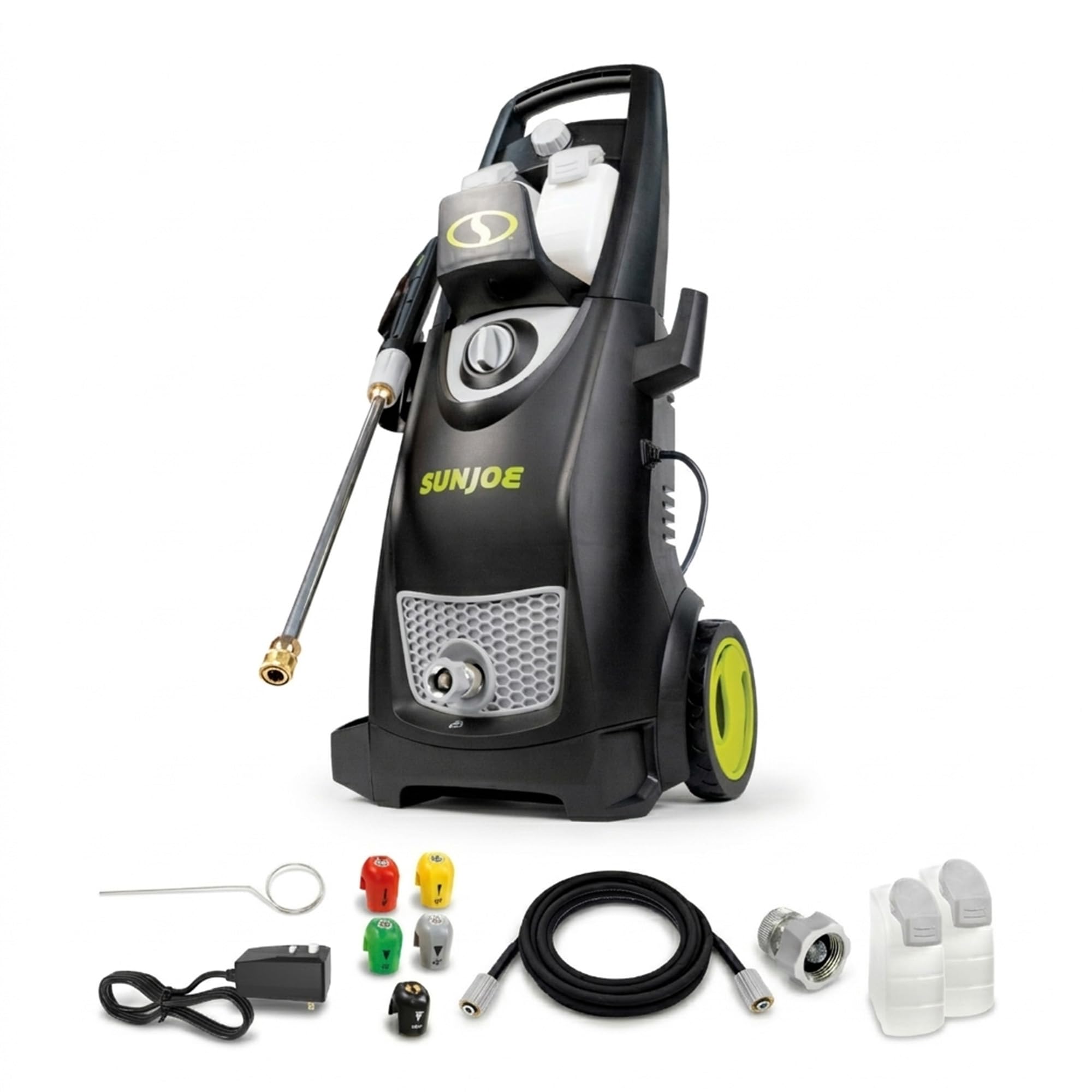
The Sun Joe SPX3000 has earned a reputation as one of the longest-running performers in the sub-150 dollar category, with some users reporting over nine years of reliable service. It delivers up to 2030 PSI and 1.2 GPM from a 13-amp motor, and the defining feature for detailing is the dual 0.9-liter detergent tank system. You can store a snow-foam mix in one side and a maintenance wash solution in the other, then switch with a turn of the dial without swapping bottles.
The stainless steel lance with brass fittings provides a solid feel, and the five quick-connect nozzles cover the full range from zero-degree pin jet to soap. The 20-foot hose is stiff, making coiling for storage more tedious than aftermarket alternatives. Some recent batches have shown a decline in quality control, with reports of plastic hose connectors cracking, but a simple switch to a metal quick-connect solves that permanently.
Note that the soap function only works with the black nozzle, and the detergent tanks can seep slightly if overfilled. For the home user who wants a single machine for cars, patio, and siding, the SPX3000 remains a durable and versatile workhorse.
Why it’s great
- Dual detergent tank system
- Proven long-term reliability
- Stainless steel lance with brass fittings
- 5 nozzle options
Good to know
- Hose is stiff and hard to coil
- Plastic connectors may need metal upgrade
- Soap only works with black nozzle
6. Worx WG605

The Worx WG605 weighs just 13.8 pounds, making it one of the lightest full-function pressure washers available, yet it still pushes a peak 1.4 GPM at 1800 PSI. The compact brick design with an integrated carry handle and cord wrap means it stores flat on a shelf and travels easily to a friend’s house for a group wash day. The metal-framed base with rubber feet provides surprising stability despite the light weight.
The spray wand uses a universal 1/4-inch quick-connect system, and the included turbo nozzle, 40° nozzle, and soap nozzle cover most detailing needs. The onboard soap tank is practical, though it adds weight when full, and the hose is notably difficult to wrap back up neatly due to its stiffness. Many owners recommend replacing the stock hose with a softer rubber variant after a season.
Users note the importance of priming the unit before triggering — running it dry even briefly can damage the pump. After about a year of intermittent weekend use, most report the machine holds up well with no leaks or pressure loss. This is a smart choice for the detailer who values portability as much as performance.
Why it’s great
- Very lightweight and portable
- Universal quick-connect wand
- Integrated cord wrap and carry handle
- Stable metal-framed base
Good to know
- Stock hose is stiff
- Must prime before each use
- Onboard tank adds weight when full
7. RYOBI RY141820VNM

The RYOBI RY141820VNM delivers an honest 1800 PSI at 1.2 GPM in a compact black frame that weighs only 16 pounds. The package includes a trigger handle with M22 connections, a spray wand, and three nozzles — a 15°, a soap nozzle, and a turbo nozzle — which is a lean but practical set for car washing. The unit is remarkably quiet compared to many competitors, and the 20-foot hose combined with the cord length provides decent reach for a two-car driveway.
Several owners note that the included foam cannon is underwhelming in foam thickness, so budget for an aftermarket upgrade if thick snow-foam is part your routine. The 1800 PSI rating is accurate for light paint cleaning, but the machine lacks the grunt for heavy concrete stain removal — its sweet spot is weekly vehicle maintenance and occasional siding washes. The compact size also makes it easy to store in a small garage corner or on a utility shelf.
Some users replaced the factory quick-connects with brass units for better feel and longevity. Overall, this is a dependable choice for the occasional detailer who wants a known brand with decent parts availability at a reasonable entry point.
Why it’s great
- Compact and lightweight
- Quiet operation
- Good for light vehicle washing
- CSA certified
Good to know
- Weak included foam cannon
- Not suitable for heavy-duty cleaning
- Factory quick-connects are plastic
8. Greenworks 1800 PSI Pressure Washer

The Greenworks 1800 is one of the most affordable PWMA-certified pressure washers on the market, making it a legitimate entry point for first-time buyers. The PWMA (Pressure Washer Manufacturers Association) certification means the 1.1 GPM and 1800 PSI numbers have been independently verified, so you know what you are getting. The machine weighs very little, features a push-button start, and runs on a no-maintenance electric motor — no gas, oil, or spark plugs to manage.
The accessory set is basic but functional: a 40° nozzle for gentle rinsing, a turbo nozzle for more demanding grime, a soap applicator, and a 20-foot tangle-free hose. The 35-foot GFCI power cord is a welcome inclusion for reaching around the vehicle without an extension. Users have reported occasional water inlet leaks at the plastic connection point, and the hose tends to arrive with a kink from packaging that never fully relaxes.
Despite those minor quirks, the unit performs well for its price class. Multiple owners confirm it handled three continuous hours of washing without overheating, and the three-year limited warranty offers peace of mind for occasional users. This is the right pick for someone who washes a single car every few weeks and wants a no-fuss machine.
Why it’s great
- PWMA certified performance
- Very low maintenance
- Long 35-foot GFCI cord
- Compact and lightweight
Good to know
- Low 1.1 GPM flow rate
- Hose arrives kinked
- Plastic inlet may leak
9. VEVOR 2000 PSI Electric Pressure Washer
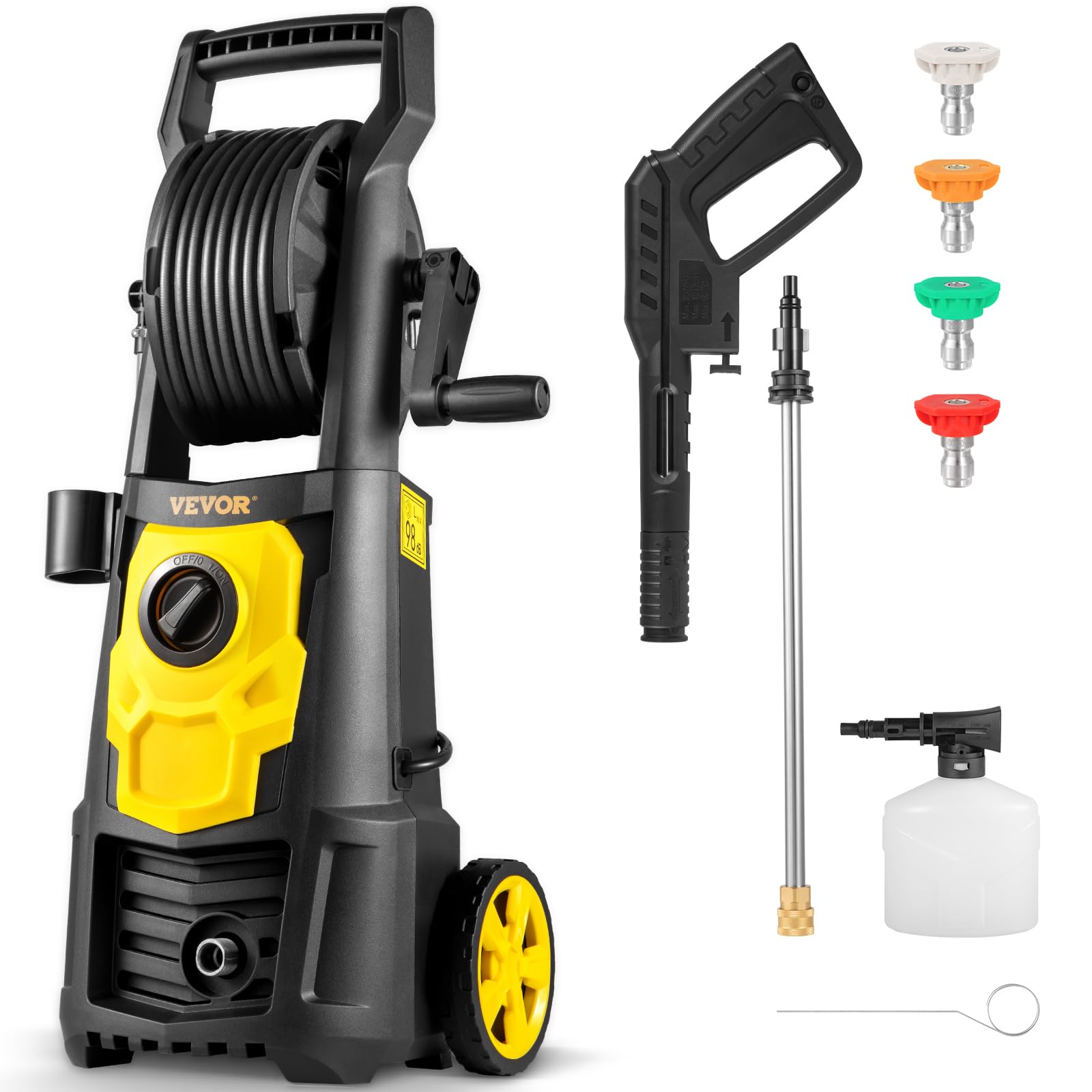
The VEVOR 2000 PSI washer stands out in the entry-tier category with its built-in hose reel, a feature usually reserved for much more expensive machines. The 1500-watt motor produces up to 1.65 GPM and 2000 PSI, and the unit includes four quick-connect metal nozzles (0°, 15°, 25°, 40°) plus a 500ml detergent bottle. The ETL listing provides some baseline safety confidence. At 11 inches wide and 26 inches tall, it rolls on two universal wheels with an ergonomic handle for easy movement around the driveway.
The TSS (Total Stop System) shuts the pump off automatically when the trigger is released, which saves energy and reduces wear during intermittent detailing. The 20-foot hose is adequate for small vehicles, but you will need to move the cart for larger trucks. Some owners report the hose can kink near the reel connection, requiring careful winding. A few also note the plastic wheel hubs feel fragile, so avoid pulling over rough terrain.
Overall, the VEVOR is a solid value for someone on a tight budget who still wants a reel and a decent nozzle selection. Expect decent cleaning performance for routine dirt and light grime, but manage expectations for heavy restoration tasks. The reel convenience alone can make quick weekly washes significantly less of a chore.
Why it’s great
- Built-in hose reel for storage
- Total Stop System (TSS) protects pump
- Four metal nozzles
- Good 1.65 GPM flow
Good to know
- Plastic wheels may not last
- Hose can kink at reel
- Not for heavy commercial use
FAQ
Can I use a pressure washer on car paint without damaging the clear coat?
What is the difference between M22-14mm and M22-15mm hose fittings?
Is a higher GPM always better for washing a car?
Final Thoughts: The Verdict
For most users, the auto detailing pressure washer winner is the Active 2.0 because the 2.0 GPM flow paired with the quiet 5-piston pump and compact wall-mountable form hits the exact sweet spot for automotive paint care. If you want a high-flow machine with a durable cart base and don’t mind the M22-15mm fitting, grab the CAT Electric. And for cordless freedom where outlets are scarce, the EGO HPW3200 sets the standard for portable battery-powered cleaning.