
Our readers keep the lights on and the weekend projects moving. As an Amazon Associate, I earn from qualifying purchases.
Manual bed leveling is the single biggest time sink for new 3D printer owners. You spend 20 minutes fiddling with a piece of paper, only to have the first layer peel up mid-print. An auto leveling 3D printer eliminates this pain by using a sensor to map the bed surface and adjust the nozzle height in real time, turning a frustrating chore into a one-tap setup.
I’m Rikta — the co-founder and writer behind FitlyFast. I’ve dug deep into the mechanics of CR Touch sensors, inductive probes, CoreXY motion systems, and heated chamber designs for the FDM and MSLA printer market to find which models actually deliver on their auto-leveling claims.
Whether you are a hobbyist printing miniatures or an engineer running functional prototypes, finding the right auto leveling 3d printer means understanding sensor accuracy, build volume, nozzle temperature range, and whether the calibration routine is truly hands-off or still requires tweaks.
How To Choose The Best Auto Leveling 3D Printer
An auto leveling 3D printer isn’t just about the sensor itself—it’s about how the entire system handles mesh compensation, motion control, and temperature stability. Focus on these four factors before you buy.
Leveling Sensor Type: CR Touch vs. Inductive vs. Mechanical
CR Touch sensors are the most common in the mid-range. They use a pin that physically probes the bed, compensating for slight warps and variations. Inductive sensors are faster but only detect metal surfaces, so you lose accuracy on PEI plates. Mechanical sensors (like pressure sensors) are rarer but offer precise multi-point readings. Check whether the sensor supports a 16×16 or 25-point grid—more points mean a smoother first layer on uneven beds.
Motion System: CoreXY vs. Traditional Bed Slinger
CoreXY printers move the print head on a gantry while the bed stays stationary, which reduces vibration and allows faster acceleration without shifting the level mesh mid-print. Traditional bed-slinger designs (where the bed moves on the Y-axis) can introduce tilt over time, especially at high speeds. If you plan to print tall models or high-temp filaments, a CoreXY machine with active vibration compensation usually pairs better with auto-leveling stability.
Nozzle Temperature and Heated Chamber
Auto-leveling only helps adhesion if the hotend can reach the right temperature for your material. For standard PLA and PETG, a 260°C nozzle is fine. If you want to print ABS, polycarbonate, or carbon-fiber composites, look for at least 300°C and a heated chamber (55–70°C). A chamber that actively heats keeps the environment stable, reducing warping that can confuse the leveling probe.
Quick Comparison
On smaller screens, swipe sideways to see the full table.
| Model | Category | Best For | Key Spec | Amazon |
|---|---|---|---|---|
| Bambu Lab P1S | FDM CoreXY | Multi-color workhorse | Auto-leveling + 20,000 mm/s² accel | Amazon |
| QIDI PLUS4 | FDM CoreXY | Engineering-grade filaments | 65°C active chamber 370°C hotend | Amazon |
| Creality K1C | FDM CoreXY | Carbon fiber printing | 600mm/s print speed | Amazon |
| Bambu Lab A1 | FDM Bed Slinger | Beginner-friendly quiet prints | Full-auto calibration 48 dB noise | Amazon |
| FLASHFORGE AD5M Pro | FDM CoreXY | Fast enclosed prints | 600mm/s + pressure-sensor leveling | Amazon |
| ELEGOO Centauri Carbon | FDM CoreXY | Pre-assembled out-of-box use | 20000 mm/s² auto calibration | Amazon |
| Creality Ender-3 V3 KE | FDM Bed Slinger | Budget high-speed entry | 500mm/s + CR Touch sensor | Amazon |
| ELEGOO Mars 5 Ultra | MSLA Resin | Detail miniatures and models | Mechanical sensor one-click level | Amazon |
| FLASHFORGE AD5M Pro (QuickSwap) | FDM CoreXY | Tool-less nozzle swapping | 3-second nozzle swap 600mm/s | Amazon |
In‑Depth Reviews
1. Bambu Lab P1S

The Bambu Lab P1S is the benchmark for mid-range auto-leveling reliability. It uses a fully automatic bed leveling routine that maps the 256mm³ build plate before every print, compensating for minor surface imperfections with zero user input. The enclosed CoreXY frame keeps the motion stable, even when printing ABS or ASA materials that warp on open designs.
At 500mm/s and 20,000 mm/s² acceleration, this machine produces sharp corners and smooth sidewalls without the ringing common on slower printers. The auto-leveling routine itself takes less than 30 seconds and consistently delivers a first layer that sticks without glue stick or blue tape. Bambu Studio slicer integrates the leveling profile seamlessly, so you never need to manually adjust Z-offset.
Users report that the P1S works perfectly out of the box, with setup time under 30 minutes. The filament runout pause and power-loss recovery work hand-in-hand with the auto-leveling mesh, ensuring that even an interrupted print resumes with correct Z height. The only catch is that the AMS multi-color system is sold separately.
Why it’s great
- Fully automatic 25-point leveling mesh before each print
- Enclosed chamber for ABS and advanced filaments
- Up to 16-color printing via optional AMS hub
Good to know
- AMS multi-color unit sold separately
- Proprietary slicer ecosystem limits third-party profiles
2. QIDI PLUS4

The QIDI PLUS4 targets users who print engineering-grade materials like PPA-CF, PPS-CF, and polycarbonate. Its 65°C active heated chamber and 370°C all-metal hotend allow these high-temp filaments to bond without delamination. The auto-leveling is handled by an inductive probe that works reliably with the thick aluminum build plate, even at elevated ambient temperatures.
The CoreXY frame uses 10mm linear shafts and independent dual Z-axis motors for extra rigidity. Vibration compensation is built into the firmware, so the auto-leveling mesh remains accurate during high-speed 600mm/s prints. The build volume is 12×12×11 inches, giving room for multiple large functional parts in one run. QIDI Studio and the mobile app provide remote monitoring and time-lapse capture.
Customer feedback highlights strong results with PC-CF and Nylon after the initial setup, though some units arrive with factory calibration issues that require contacting support. Once dialed in, the PLUS4 produces layer adhesion that rivals industrial machines. The open-source Klipper firmware gives power users full control over the leveling routine and gcode macros.
Why it’s great
- Active 65°C chamber for warp-prone materials
- 370°C nozzle handles PPS and PPA composites
- Large build volume with 4,000+ hour reliability
Good to know
- Factory calibration inconsistencies reported
- Heavy build at 59 pounds requires sturdy table
3. Creality K1C

The Creality K1C inherits the CoreXY speed of the K1 series but adds a tri-metal “Unicorn” nozzle that resists clogs when printing carbon-fiber reinforced materials. The auto-leveling is hands-off: tap the screen, and the CR Touch sensor builds a 16-point mesh in about 40 seconds. Dynamic balancing on the printhead fans reduces ghosting, keeping the leveling compensation effective at high acceleration.
300°C hotend and a fully enclosed chamber make the K1C suitable for PLA-CF, PET-CF, and ASA. The AI camera monitors for layer shifts or foreign objects, pausing the print before a failure ruins the bed mesh calibration. Silent mode drops noise to 45 dB, which is quieter than most closed-frame printers at this speed class.
Users praise the straightforward auto-leveling and fast print speeds, but note that the default slicer profiles need minor tuning for PETG and TPU. The open-source Creality OS based on Klipper allows advanced users to set custom mesh point densities and probe offsets easily. The included activated carbon filter keeps fume levels manageable during ABS runs.
Why it’s great
- Clog-free direct extruder for carbon filaments
- Dynamic fan balancing reduces vibration ghosting
- AI camera detects anomalies mid-print
Good to know
- Bed leveling requires occasional manual Z-offset tweak
- CF printing still benefits from extra nozzle risers
4. Bambu Lab A1

The Bambu Lab A1 is a bed-slinger that delivers premium auto-leveling at a lower entry point. It runs a full calibration sequence—Z-offset, bed leveling, resonance compensation—automatically before every print. The active flow rate compensation adjusts extrusion mid-print based on nozzle pressure readings, which works synergistically with the leveling mesh to prevent under-extrusion on the first layer.
Despite its lower price, the A1 hits 10,000 mm/s² acceleration and maintains quiet operation at 48 dB thanks to active motor noise canceling. The 1-clip quick-swap nozzle makes maintenance fast, and the build volume is a generous 256mm³. Bambu Handy app allows remote slicing and monitoring directly to the printer over WiFi.
Reviewers consistently report out-of-box reliability with the auto-leveling. The A1 prints PLA and PETG with zero adhesion aids. The optional AMS Lite adds four-color capability, turning the A1 into a multi-filament system while preserving the auto-leveling routine. The main trade-off is the open-frame design, which makes ABS printing more challenging without an enclosure.
Why it’s great
- Complete auto calibration with flow compensation
- Quiet 48 dB operation for home use
- Active motor noise canceling technology
Good to know
- Open frame not ideal for ABS or ASA
- AMS Lite multicolor unit sold separately
5. FLASHFORGE Adventurer 5M Pro

The FLASHFORGE Adventurer 5M Pro uses a pressure-sensing auto bed leveling system that detects the platform height with multi-point precision. This sensor type doesn’t rely on a physical probe pin, so there is less mechanical wear over time. The CoreXY all-metal frame keeps the print head stable at 600mm/s, while the enclosed chamber with dual-layer filtration makes it a strong candidate for office or classroom environments.
The nozzle reaches 200°C in 35 seconds and supports a range of sizes from 0.25mm to 0.8mm. The direct drive extruder handles TPU without jamming, and the leveling routine works whether you use the PEI textured plate or a smooth glass bed. Remote monitoring and auto-shutdown are handled via the Flash Maker mobile app.
Setup takes about 10 minutes, and the auto-leveling typically produces a successful first print right after unboxing. Some units have reported filament feed issues early on, but FlashForge support is responsive with replacements. The dual circulation system uses HEPA and carbon filters to reduce particulate and VOCs, making it one of the few enclosed printers with true filtration.
Why it’s great
- Pressure-sensor leveling with no moving probe
- HEPA + carbon filtration for safer operation
- 35-second nozzle heat time to 200°C
Good to know
- Software installation can be tricky on macOS
- Some units arrive with calibration defects
6. ELEGOO Centauri Carbon
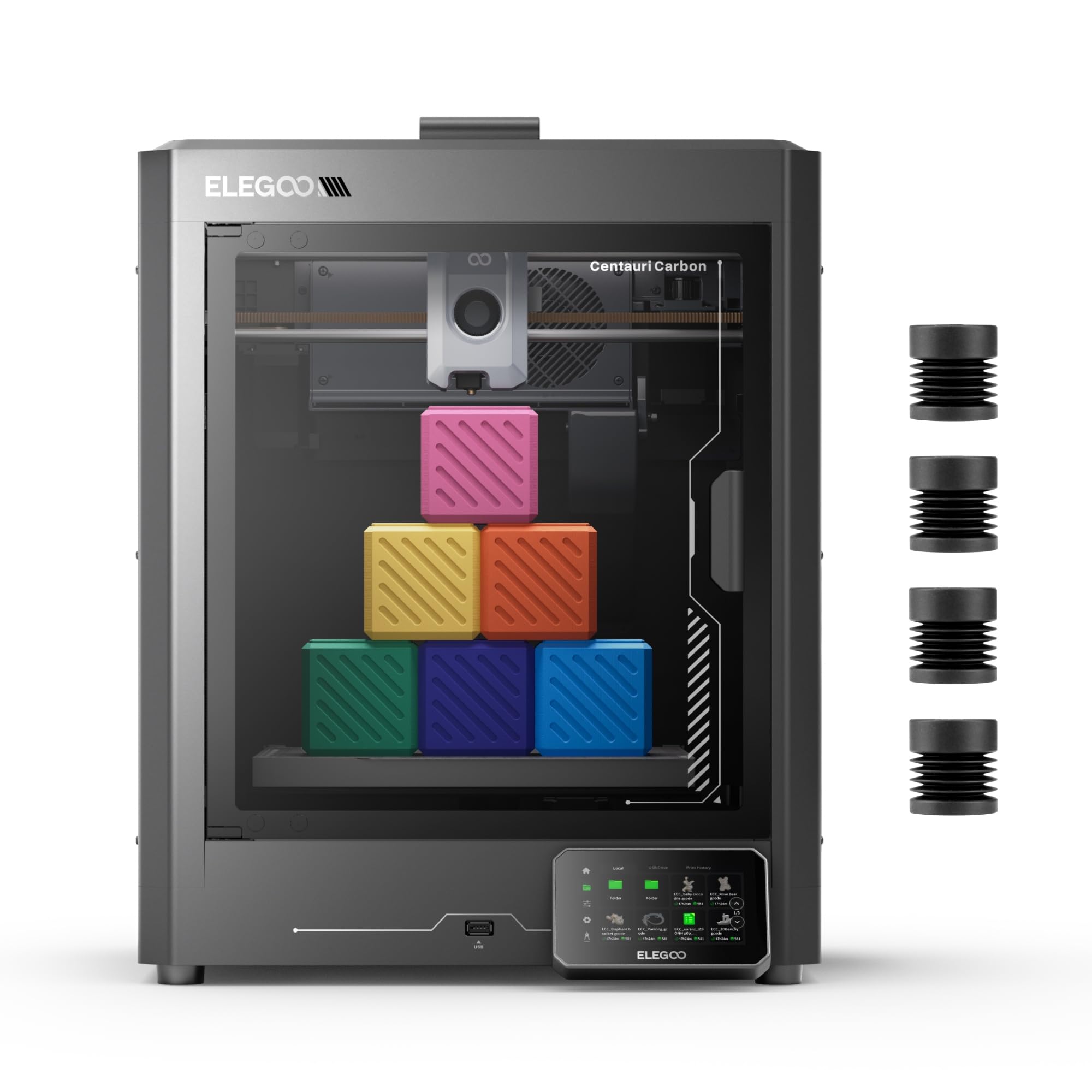
The ELEGOO Centauri Carbon arrives fully assembled and factory-calibrated, so the auto-leveling is ready from the first power-on. It uses a CoreXY structure with a die-cast aluminum frame that minimizes vibration, and the automatic vibration compensation plus pressure advance ensures the first layer mesh stays accurate even at 500mm/s and 20,000 mm/s² acceleration.
The 320°C brass-hardened steel nozzle opens up carbon-fiber reinforced filaments, and the enclosed chamber with enhanced cooling handles PLA with excellent adhesion on the included dual-sided plate. The built-in chamber camera and dual LED lights allow remote monitoring and time-lapse recording without opening the door and affecting chamber temperature.
Users consistently note that the Centauri Carbon prints a perfect first layer right out of the box. The ElegooSlicer software is intuitive and registers the printer via WiFi without manual IP configuration. Some reviewers experienced early hardware failures, but replacements were handled quickly. The solid 38-pound frame means placement on a stable surface is important for the auto-leveling to remain consistent over time.
Why it’s great
- Fully assembled with factory auto-level calibration
- 320°C hotend for carbon-fiber composites
- Rigid die-cast aluminum frame reduces vibration
Good to know
- Some units experience hotend comm errors
- Heavy build requires a sturdy workbench
7. Creality Ender-3 V3 KE

The Creality Ender-3 V3 KE brings the classic Ender family into the high-speed era with a CR Touch auto-leveling sensor as standard. The 16-point mesh mapping takes about a minute and is accurate enough for the 0.1mm printing accuracy. The Sprite direct extruder and 300°C hotend support PLA, PETG, ABS, and TPU, making this a versatile budget option for users who want to experiment.
The 500mm/s speed is driven by a lightweight X-axis carriage with ball bearings, and the smart algorithm compensates for vibration during fast travel moves. Dual fans cool the model rapidly, preserving detail on overhangs. Setup takes about 10 minutes thanks to the all-in-one design, and the filament detection and power-loss recovery work with the leveling data to resume prints at the correct Z height.
User feedback is mixed: many get excellent results immediately with the auto-leveling, but some units arrive with gantry alignment issues that require manual correction. The loud stock fans may be a nuisance in quiet spaces, and the power supply switch needs attention for US users. The huge community and open-source firmware make troubleshooting easier than most proprietary models.
Why it’s great
- CR Touch sensor for hands-off bed leveling
- 300°C Sprite direct extruder for flexible materials
- Fast 10-minute assembly for beginners
Good to know
- Loud stock fans during operation
- Occasional gantry squareness issues out of box
8. ELEGOO Mars 5 Ultra 9K

For resin printing, the ELEGOO Mars 5 Ultra uses a built-in smart mechanical sensor for one-click automatic leveling instead of the manual four-screw method. The sensor detects low resin, foreign objects, and high light board temperature, pausing the print to prevent a failed layer. Printing speed reaches 150mm/h with the Tilt Release mechanism that reduces Z-axis movement time.
The 9K LCD screen with 8520×4320 px resolution produces 18μm XY detail, capturing fine miniature features. The AI camera monitors for layer peeling or empty build plates, and time-lapse photography lets you review the print history. WiFi cluster printing supports controlling multiple Mars units on the same LAN without USB drives.
Users praise the detail reproduction and the ease of the auto-leveling system. The 7-inch monochrome LCD has a 9H tempered glass protector, and the COB light source provides 92% light uniformity for consistent curing. One common note is that resin and build plate must be warm (above 67°F) for reliable first-layer adhesion, so a space heater is helpful in cooler rooms.
Why it’s great
- Mechanical sensor-based one-click auto leveling
- 9K resolution for highly detailed miniatures
- AI camera and WiFi cluster control
Good to know
- Resin and build plate require warm ambient temperature
- Chitubox slicer has a learning curve
9. FLASHFORGE AD5M Pro (QuickSwap)

The FLASHFORGE AD5M Pro with the QuickSwap nozzle system changes from 0.4mm to 0.6mm in just 3 seconds without tools. The auto-leveling uses the same pressure-sensor technology as the original AD5M Pro but has been refined with a larger 25-point grid for tighter mesh resolution. The 220mm³ build volume and enclosed chamber with dual-layer filtration make it suitable for both prototyping and production runs.
The direct-drive extruder handles TPU smoothly, and the 280°C nozzle supports PLA, ABS, PETG, ASA, and even carbon-fiber variants. The built-in camera and Maker app provide real-time monitoring and remote control. Power-loss recovery and filament runout detection are integrated, so a paused print resumes at the exact layer without losing the leveling reference.
Reviews highlight the easy setup and fast print quality. The auto-leveling routinely produces perfect first layers with no manual Z-offset adjustments. Some users received units with missing hardware (screws), and customer service response times have been inconsistent. The software on the included USB drive is outdated and needs updating from the website for full compatibility with macOS Sequoia.
Why it’s great
- Tool-less 3-second nozzle swapping
- 25-point auto-leveling grid for precise first layers
- Enclosed with dual-layer HEPA and carbon filtration
Good to know
- Occasional missing hardware in packaging
- USB slicer software requires manual update
FAQ
Do I still need to manually level the bed on an auto leveling 3D printer?
Can auto-leveling fix a warped or damaged build plate?
Final Thoughts: The Verdict
For most users, the auto leveling 3d printer winner is the Bambu Lab P1S because it combines a fast, reliable leveling routine with an enclosed CoreXY frame that handles PLA, PETG, and ABS without extra tuning. If you want to print carbon-fiber composites at high speed, grab the Creality K1C. And for engineering-grade materials like PPS and PPA requiring a heated chamber, nothing beats the QIDI PLUS4.