
Our readers keep the lights on and the weekend projects moving. As an Amazon Associate, I earn from qualifying purchases.
Specs are compiled from manufacturer listings and verified buyer reviews and can change over time — please confirm the key details on the product page before buying.
The single biggest mistake people make with an auto polisher is grabbing a tool that is too aggressive for their skill level, then burning right through the clear coat in seconds — a repair that costs hundreds. You need a machine that matches both your paint condition and your experience, so you get a mirror finish instead of a costly error.
I’m Rikta — the founder and writer behind FitlyFast. This guide is built by comparing the manufacturers’ published specifications and the patterns across verified customer reviews, so you get each pick’s real strengths and trade-offs instead of marketing spin.
Whether you are a weekend waxer or a dedicated detailer, finding the right auto polisher depends on matching the tool’s power, pad size, and speed range to your actual paintwork and your comfort with the machine.
Quick Picks
- Griot’s Garage G9 Random Orbital Polisher 10901 — Best Overall
- Meguiar’s MT300 Variable Speed Dual Action Polisher — Pro Dual-Action
- Buffer Polisher, SPTA 7 Inch 180mm Rotary Polisher Car Polisher Electric Polisher RO Polisher — Value Rotary
- GEVEELIFE Buffer Polisher, 6 Inch/7 Inch 1600W Rotary Car Buffer Polisher — Light Rotary
- SPTA Cordless Mini Polisher, 12V Cordless Multi Polisher — Compact Detailer
- AVID POWER Buffer Polisher, 5-inch/6-inch Dual Action/DA Polisher for Car Detailing — Budget DA
- BATOCA 6 Dual Action Random Orbital Car Polisher, 700W Automotive Paint Buffer Kit — Complete Kit DA
How To Choose The Best Auto Polisher
Picking your first auto polisher means deciding between two main machine types first — Dual Action (DA, a tool that moves the pad in a random orbit so it barely burns paint) and Rotary (a tool that spins the pad in one direction for faster cutting). A DA polisher is nearly impossible to burn the paint with, so it is ideal for beginners and daily drivers. A rotary polisher cuts faster but carries a real risk of damaging the clear coat if you apply too much pressure in one spot.
Dual Action vs Rotary — Which one fits you?
If your goal is removing light swirls, applying wax, and keeping the paint safe while you learn, a dual action polisher like the Griot’s Garage G9 or the AVID POWER buffer is your safest choice. If you are tackling heavy oxidation, deep scratches, or neglected gel coat (the protective outer layer on a boat), a rotary machine such as the GEVEELIFE or SPTA 7-inch polisher cuts through that work much faster. Beginners should start with a DA; experienced detailers who need speed often keep both on hand.
Speed range and pad size
Most auto polishers offer variable speed control, and the range tells you what the machine can do. Low speeds around 1000-2000 RPM (revolutions per minute, how fast a rotary spins) or OPM (oscillations per minute, how many times a DA pad moves in its orbit) are for applying wax or polish gently. Mid-range handles general polishing and cleaning. High speeds above 3000 are for aggressive cutting and defect removal. Pad size matters too — a 5-inch or 6-inch pad is easier to control on curved panels, while a 7-inch pad covers larger flat areas faster but is tougher to maneuver around body lines. Pick a machine that lets you adjust speed in steps, so you are not locked into one setting for every job.
Ergonomics and runtime for real-world use
Detailing a full car takes hours. A polisher that is too heavy or vibrates hard will wear out your hands and arms before you finish. Look for a comfortable grip, a detachable side or D-handle for two-handed control, and a trigger lock so you do not have to keep squeezing. If you go cordless, check the battery capacity — the SPTA Mini Polisher reviewers noted 45-55 minutes per charge, which is enough for spot work but may need a second battery for a full car.
Quick Comparison
| Model | Best For | Power | Max Speed | Weight | Amazon |
|---|---|---|---|---|---|
| Griot’s Garage G9 | Safe correction & comfort | 1000 W | 6400 OPM | 5.25 lbs | Amazon |
| Meguiar’s MT300 | Professional dual action | — | — | 5.4 lbs | Amazon |
| SPTA 7-inch Rotary | Heavy cutting & volume | 1580 W | 3000 RPM | 6.6 lbs | Amazon |
| GEVEELIFE 1600W Rotary | Beginner rotary value | 1600 W | 3500 RPM | 4.5 lbs | Amazon |
| AVID POWER DA | Budget dual action kit | 5 Amps | 6500 OPM | — | Amazon |
| BATOCA 700W DA | Complete kit for beginners | 700 W | 3800 OPM | 9.2 lbs | Amazon |
| SPTA Cordless Mini | Detail & tight spaces | — | 4500 OPM | 3.01 kg | Amazon |
In‑Depth Reviews
1. Griot’s Garage G9 Random Orbital Polisher 10901

A premium dual-action buffer that balances power with beginner-friendly safety for paint correction.
The G9 is built for people who want professional-level results without the risk that comes with a rotary machine. It has a 1000-watt motor (that is about 8.5 Amps of current draw) and a 9mm orbit throw — the distance the pad travels in its random path — which gives it enough cut to remove swirls and light scratches while being safe enough for a first-time user. The six variable speed settings let you dial in from 2000 to 6400 OPM (oscillations per minute), so you can start slow for applying wax and speed up for defect removal.
Buyers report the double-shot rubber grip and contoured shroud make it comfortable to hold for long jobs, and the constant speed control keeps the buffer from bogging down when you press down on a curve. One owner mentioned the trigger lock design could be better, and the power cord plug may need trimming to fit some outlets, but the consensus is that the G9 runs cool and delivers low vibration during use. It accepts a 6-inch vented backing plate from the start, or you can swap to a 5-inch system for tighter control on smaller panels. Unlike the cheaper AVID POWER, this motor keeps speed steady even when you lean into a curve.
Smooth ergonomic operation
- 1000-watt motor keeps speed steady under load
- 9mm orbit provides a good balance of cut and safety
- Balanced ergonomics for extended detailing sessions
Slightly heavy design
- Trigger lock design is not ideal, per a reviewer
- Cord plug may need trimming for some outlets
- No removable right-angle handle for added control
Beginner-friendly: Anyone who wants a safe, powerful dual action polisher that can handle full paint correction on a daily driver without fear of burning the clear coat.
Pro buffing needs: You need a rotary for aggressive cutting on neglected paint or gel coat — the G9’s 9mm throw is not as fast as a direct-drive rotary for heavy oxidation.
2. Meguiar’s MT300 Variable Speed Dual Action Polisher

A pro-minded DA polisher that uses torque management to keep speed steady under pressure.
Meguiar’s MT300 targets the detailer who wants consistent cut without surprises. Its key feature is Digital Torque Management — an electronic system that adjusts torque (the twisting force that keeps the pad spinning) to keep the loaded speed level even when you press into the paint, so the pad does not stall on a curved surface. The soft start technology ramps up speed gradually when you pull the trigger, which prevents the compound from splattering everywhere on startup, something reviewers specifically mention as a welcome improvement over older models.
The Multi-Position D-handle improves comfort for both right- and left-handed users, and the billet counterweight keeps vibration down. One buyer with a detailing company reported that the MT300 corrected 9-year-old weathered clearcoat flawlessly, noting it felt lightweight and well-built compared to a high-speed rotary. A common wish among owners is for a longer power cord and a quick-lock handle, but overall the MT300 earns praise for making professional results achievable for enthusiasts. Note that it does not include a backing plate or pads — you need to buy those separately. That makes it less ready out-of-box than the Griot’s G9, which includes a backing plate.
Variable speed control
- Digital Torque Management keeps rpm steady under load
- Soft start reduces splatter on startup
- Comfortable multi-position handle for all-day use
Higher price point
- Backing plate and pads are sold separately
- Some owners mention vibration at full speed can cause hand numbness
- Cord could be longer for convenience
Versatile detailing: Experienced hobbyists and pros who want a reliable DA with smart electronics that compensate for pressure changes during correction work.
Budget constraints: You want a complete ready-to-use kit from the start — the MT300 leaves you to source your own backing plate and pads.
3. Buffer Polisher, SPTA 7 Inch 180mm Rotary Polisher Car Polisher Electric Polisher RO Polisher

A heavy-duty rotary that brings pro cutting power to enthusiasts who are ready for the next level.
This is a serious rotary polisher for when you need to remove deep scratches, heavy oxidation, or wet-sand marks — it runs a 1580-watt motor, versus the GEVEELIFE 1600W model above, and delivers six variable speeds from 500 to 3000 RPM. The digital speed display gives you a precise readout, so you are not guessing what speed you are running. The build is all ball-bearing construction, and customers note it feels like a tank — one owner said they used it consistently for about a year on big and small projects with no complaints.
The trade-off is weight: at 6.6 pounds versus the 4.5-pound GEVEELIFE rotary, a first-time user mentioned they felt like they were fighting it during a 4-hour Jeep detail. The kit is extremely generous, including three sizes of polishing pads (3-inch, 5-inch, 6-inch), wool pads, four backing plates, sandpaper, compounds, a wash dish brush, and an apron. Reviewers point out that the included rubbing compound works well, but one mentioned the polisher causes splatter — they suggested a soft rubber guard to keep compound from flying.
Powerful rotary action
- 1580W motor provides serious cutting power for heavy jobs
- Digital speed display for precise RPM selection
- Comprehensive kit with multiple pad sizes, wool pads, and compounds
Steep learning curve
- At 6.6 lbs, it is heavier than many rotary options
- May cause splatter without a guard, per a reviewer
- Speed controls take some getting used to for new users
Heavy correction: Detailers who need an affordable rotary with enough torque for full paint correction and like having every pad and backer included from the start.
Paint novices: You are new to rotary machines — the weight and learning curve make it better suited for someone with a few details under their belt.
4. GEVEELIFE Buffer Polisher, 6 Inch/7 Inch 1600W Rotary Car Buffer Polisher

A lightweight rotary that packs the highest wattage in this lineup without weighing you down.
That combination of high power and low weight is rare in a rotary polisher, and it makes a real difference when you are working overhead on a boat or holding the machine against vertical panels for extended time. The seven variable speed settings range from 1000 to 3500 RPM, and shoppers say the constant-power control board lets you run it for long hours without overheating.
Reviewers consistently praise the comfortable grip, low vibration, and solid build. One owner said the 1600W motor and 7-speed settings let them go from light polish to deep scratch removal without switching tools. The same buyer noted the included sponges break down quickly — they recommend buying better pads for serious work. The rotary action is excellent for cutting through oxidation and restoring fiberglass, as one owner demonstrated by restoring scratched boat fiberglass to like-new condition. It weighs 4.5 pounds versus the 6.6-pound SPTA 7-inch, which makes it less fatiguing on a full detail.
High torque output
- 1600W motor — the highest power in this roundup
- Weighs only 4.5 lbs for reduced fatigue
- 7-speed range (1000-3500 RPM) covers waxing to heavy cutting
Bulkier body
- Included pads break down fast, per reviewer feedback
- Short power cord requires an extension cord for most jobs
- Only accepts M14 thread pads, not 5/8-11
Large surfaces: You need a rotary that can tackle heavy oxidation without tiring you out — the power-to-weight ratio is tough to top at this level.
Tight spaces: You are a beginner who has never used a rotary polisher — the direct-drive action requires careful technique to avoid marring the paint.
5. SPTA Cordless Mini Polisher, 12V Cordless Multi Polisher
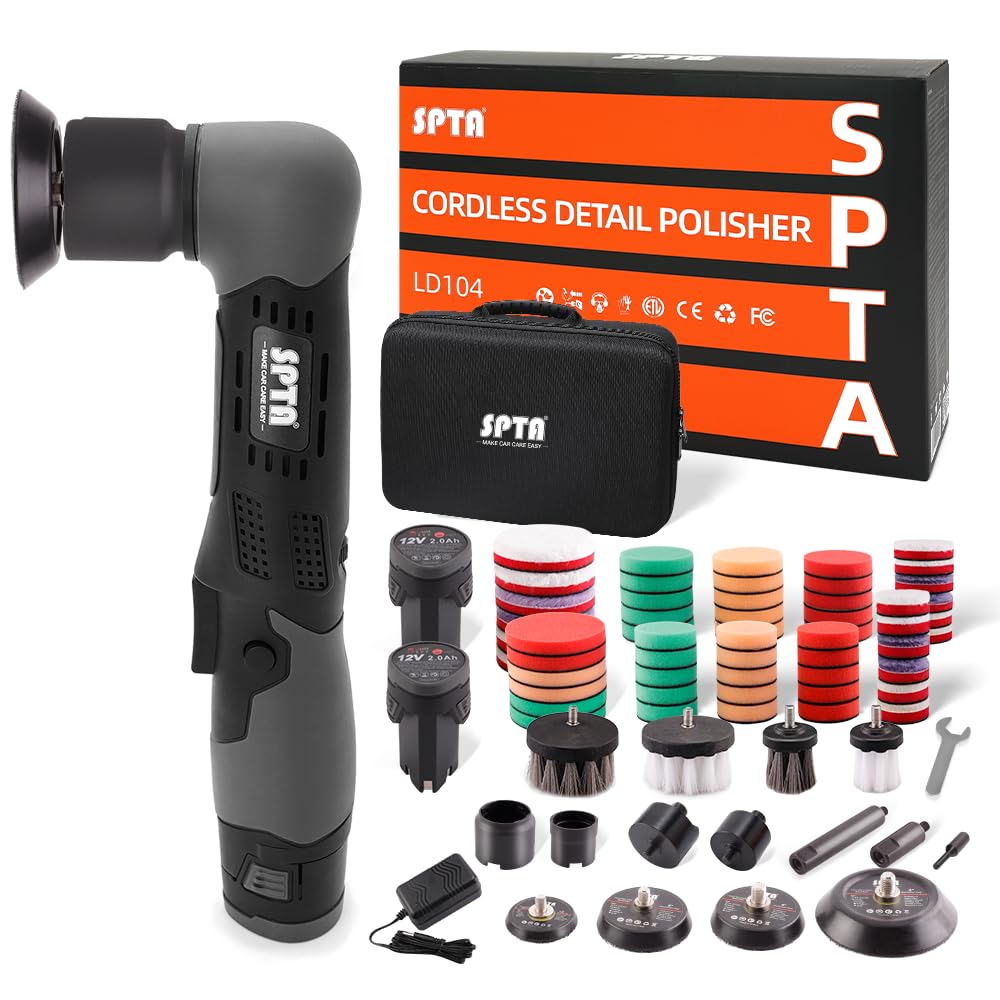
A tiny cordless DA that lets you reach tight spots no full-size buffer can touch.
This is not the tool for polishing a whole hood — it is built for the areas every other polisher misses: emblems, door jambs, side mirrors, body lines, and motorcycle parts. The 2000 mAh battery gives you about 45 to 55 minutes of run time per charge, and one automotive painter reviewer noted they used the 1.5-inch orbital attachment all day without draining a single battery bar while denibbing fresh paint. The speed range goes from 2000 to 4500 oscillations per minute, and the dual-action free-spinning rotation prevents holograms, which is a common issue with rotary tools on tight areas.
The kit is massive: two batteries, two extension shafts, two protective covers, multiple brushes, four backing plates in 25mm, 50mm, and 80mm sizes, plus 54 polishing pads in three sizes. One motorcycle owner said it was ideal for buffing light scratches and polishing chrome on their bike. The main complaint is that the included case is too small — you have to disassemble the tool to fit it inside. Some buyers also noted that the lock-on button can fail over time, and a few of the smaller pads shredded when used with thick compounds. If you need to detail a full car, the corded Griot’s G9 or the AVID POWER will finish the job in less time.
Compact cordless use
- Compact and cordless for hard-to-reach detailing spots
- Comes with two batteries and a huge assortment of pads
- Dual-action prevents holograms on tight curves
Limited battery life
- Case is too small to store the tool assembled
- Lock-on button durability concerns from some owners
- Not meant for full-panel work — slow on large areas
Quick touch-ups: Anyone who details motorcycles, does paint touch-ups, or needs a precision polisher for the nooks and crannies a big buffer cannot reach.
Full paint correction: You only need a main polisher for full-body car work — the mini lacks the pad size and battery runtime for large panels.
6. AVID POWER Buffer Polisher, 5-inch/6-inch Dual Action/DA Polisher for Car Detailing

An entry-level DA that delivers surprising value without intimidating a first-time user.
The AVID POWER buffer is the lowest-cost dual-action option here, but it still provides a speed range from 2700 to 6500 OPM (oscillations per minute) across six settings, and its random orbit action makes it nearly impossible to burn through paint — the main reason beginners should pick a DA over a rotary. The 5-amp motor is lower than the Griot’s 8.5-amp unit, but buyers find it adequate for waxing, light polishing, and swirl removal on daily drivers. One owner reported that they removed vinyl lettering from a 22-foot boat and restored the gel coat finish in three hours using deoxidizer and wax, calling it great value compared to a shop quote.
The kit includes two 5-inch foam pads, two 6-inch foam pads, two foam discs, and a detachable D-handle that adjusts to five positions for a comfortable grip. The rubberized body helps prevent the machine from rolling off your car or workbench. It is noticeably less aggressive than a rotary, which is the whole point for a beginner — you can learn proper technique with almost zero risk of damage. One reviewer with an 81-year-old father said he could handle it easily. For heavier correction like wet-sanding marks, you will want the GEVEELIFE rotary instead.
Affordable dual action
- Budget-friendly entry into dual action polishing
- Random orbit design is very safe for beginners
- Includes both 5-inch and 6-inch pads and backing plates
Moderate vibration
- 5-amp motor lacks the grunt for heavy correction work
- Less aggressive than a rotary — slower on deep scratches
- Build quality is entry-level, not pro-grade
Budget DIY: First-time buyers who want to learn paint correction on a budget without the risk of damaging their car’s clear coat.
Daily pro use: You need to cut through heavy oxidation or wet-sand marks — the low amp motor will struggle compared to the GEVEELIFE or SPTA rotary options.
7. BATOCA 6 Dual Action Random Orbital Car Polisher, 700W Automotive Paint Buffer Kit
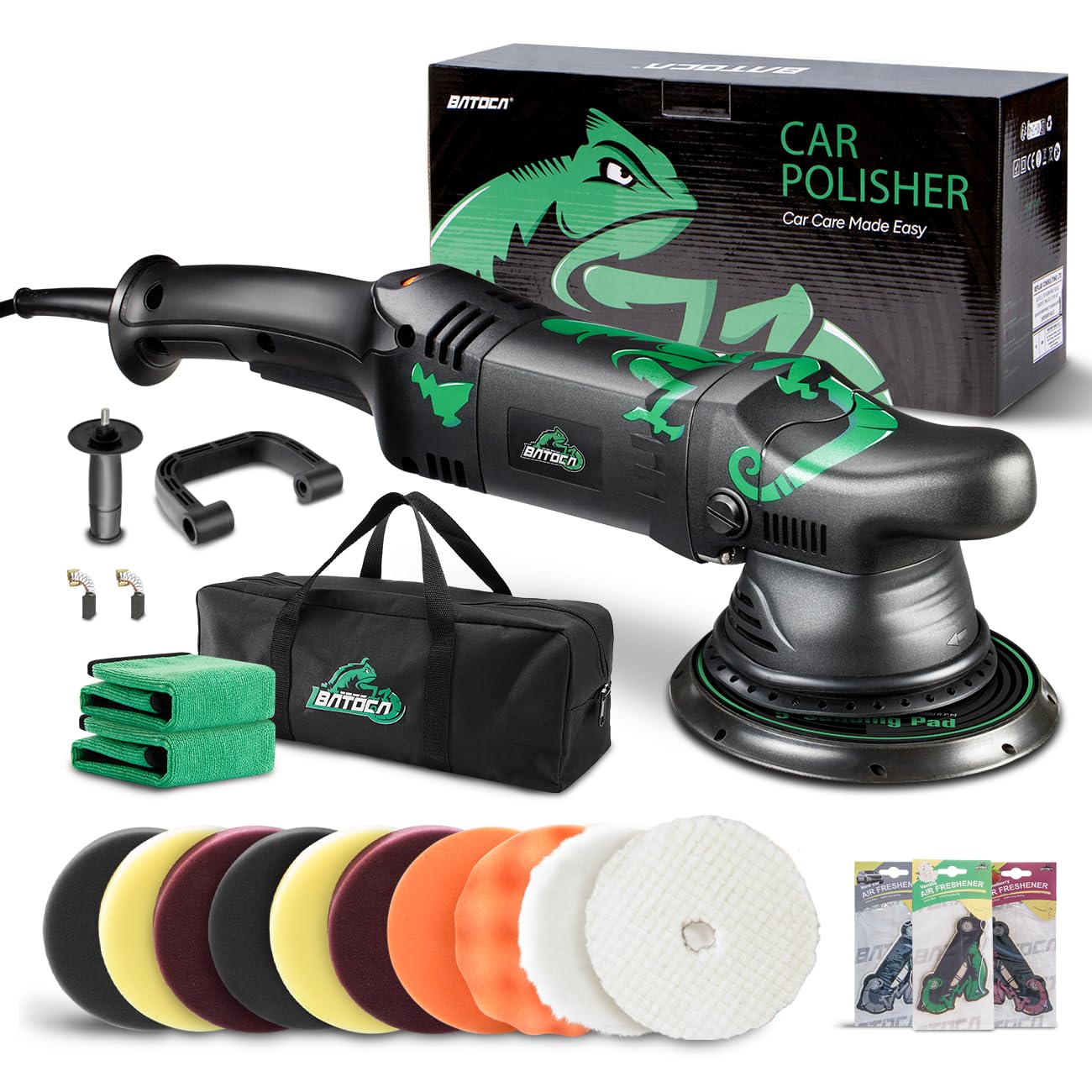
A full-kit DA that throws in everything including carbon brushes and gloves for the new detailer.
The BATOCA comes with a 700-watt motor and six variable speeds ranging from 1000 to 3800 OPM. It uses an eccentric shaft design for its dual action, which the maker says helps wax absorb deeper into the paint. The eccentric vibration is friendlier to beginners than a straight rotary and makes it hard to damage the clear coat. Buyers report the kit is generous — it includes 6-inch flat foam pads, wool pads, polishing bonnets, sanding papers, a microfiber towel, a tool bag, a pair of disposable gloves, and even a pair of carbon brushes for the periodic replacement the maker suggests at around 6-month intervals.
One experienced detailer reported that the pads feel stiff at first but work well after a brief break-in period, and that the polisher delivered excellent results that made their car look new. Another owner used it to detail three cars for a total of 8 hours and said it worked flawlessly the whole time. The main drawback is the weight — at 9.2 pounds versus the 4.5-pound GEVEELIFE rotary, it is the heaviest machine in this lineup. That extra heft will wear out your arms faster on a full detail, especially if you are working on vertical panels. If weight is a concern, the lighter Griot’s G9 at 5.25 pounds is a better fit.
Quiet operation
- Comes with nearly every accessory you need, including spare carbon brushes
- Dual action is safe for beginners
- Held up through 8 hours of continuous use, per a buyer
Lower max speed
- 9.2 pounds makes it the heaviest pick — fatiguing on long jobs
- Pads need break-in before they work well
- 700 watts is less powerful than the premium DA options
Gentle polishing: Beginners who want a single-box solution with everything needed to start detailing immediately, including replacement parts ready to go.
Aggressive cutting: You plan to detail multiple cars in one session — the weight becomes a real issue compared to lighter machines like the Griot’s G9 or the GEVEELIFE rotary.
Understanding the Specs
OPM vs RPM vs Orbital Throw
OPM stands for oscillations per minute — how many times the pad moves in a random orbit each minute. RPM stands for revolutions per minute — how many times a rotary pad spins in one direction. Dual action (DA) polishers use OPM because the pad moves in an elliptical pattern for safety. Rotary polishers use RPM because the pad spins directly. A higher OPM or RPM usually means faster cutting, but the orbital throw (the diameter of the random orbit, measured in millimeters) also matters — a longer throw, like 9mm or 15mm, covers more surface area per pass and cuts faster than a shorter throw.
Wattage and Amp Rating
A polisher’s power is measured in watts (W) or amps (A). More watts generally means more torque, which helps the machine maintain speed when you press into the paint. A 1600W rotary like the GEVEELIFE will cut through heavy oxidation faster than a 700W DA like the BATOCA. For daily waxing and light correction, lower wattage is fine. For heavy cutting, wet sanding, or restoring neglected gel coat on a boat, aim for at least 1200W to keep the motor from bogging down.
FAQ
What is the difference between a dual action and a rotary polisher?
Can I use a DA polisher for heavy cutting like wet sanding?
What size pads should I start with?
How do I prevent holograms and swirl marks when polishing?
Is a cordless polisher powerful enough for full car detailing?
What does the orbit throw length mean on a DA polisher?
Can I use an auto polisher on a boat or RV?
How do I clean and maintain my polisher pads?
Final Thoughts: The Verdict
For most people, the best auto polisher is the Griot’s Garage G9 because it balances a powerful 1000-watt motor with beginner-safe dual action operation and excellent ergonomics for long sessions. If you want the cutting speed of a rotary at a light weight, grab the GEVEELIFE 1600W. And for precision work in tight spots — emblems, bikes, door jambs — the standout is the portability of the SPTA Cordless Mini.
How We Picked
We do not accept paid placement. Every pick is matched to a real buyer and a real use-case; we do not hands-on test units.
Sources & Methodology
Specifications: manufacturer listings and product documentation. Review insights: verified customer reviews, as of July 2026. Pricing: not shown on this page (it changes often); check the current price via the retailer link.
As an Amazon Associate, FitlyFast earns from qualifying purchases. This does not affect which products we feature.