
Our readers keep the lights on and the weekend projects moving. As an Amazon Associate, I earn from qualifying purchases.
Choosing the wrong polishing pad is the fastest way to introduce micro-marring and holograms into your clear coat, turning a weekend paint correction into a costly respray. The foam density, cell structure, and diameter determine whether a pad cuts defects or simply smears them, which is why picking the right tool for each stage matters as much as the compound itself.
I’m Rikta — the co-founder and writer behind FitlyFast. My research for this guide involved analyzing hundreds of hours of user wear-testing data and foam-durability reports to isolate which pads deliver consistent cut without shedding fibers or delaminating from the backing plate.
Whether you are correcting deep scratches on a classic truck or applying a final wax on a daily driver, choosing the right set of auto polishing pads can mean the difference between a glass-like finish and a hazy disappointment.
How To Choose The Best Auto Polishing Pads
Selecting a polishing pad is about matching foam characteristics to the defect level you are addressing. A single-stage pad that tries to do everything often ends up doing nothing well. Focus on three factors: foam density, pad diameter, and the hook-and-loop backing system’s shear strength.
Foam Density and Cell Structure
Polyurethane foam used in buffing pads is graded by density — measured in pounds per cubic foot (PCF). Denser foam (50-60 PCF) transfers more orbital force to the paint, making it effective for cutting through heavy oxidation and 1000-grit sanding marks. Softer, open-cell foam (30-40 PCF) absorbs vibration and lets abrasives level the surface without leaving buffer trails, which is ideal for final polishing and wax application.
Pad Diameter and Backing Plate Match
A 6-inch pad on a 5-inch backing plate leaves a 0.5-inch overhang that can create chatter on curved body panels. The correct rule is to match the pad diameter to the plate within 0.5 inches. Smaller pads (3-inch) allow precise control on pillars and bumpers, while larger pads (6.5-8 inch) cover flat hoods and roofs faster, reducing the time the buffer rests in one spot and minimizes heat buildup.
Washability and Pad Longevity
Closed-cell foam resists absorbing compound residue but traps heat, which can cause the adhesive bond to fail between the foam and the hook-and-loop backing. Open-cell pads release heat more effectively but require thorough cleaning with a dedicated pad cleaner to prevent dried compound from hardening within the pores — a primary cause of premature pad glazing and reduced cut.
Quick Comparison
On smaller screens, swipe sideways to see the full table.
| Model | Category | Best For | Key Spec | Amazon |
|---|---|---|---|---|
| Adam’s Polishes Bundle | Premium Kit | Multi-stage correction | 3.5″ pads / Microfiber cutting | Amazon |
| 3M Perfect-It 05707 | Industrial Grade | Heavy compounding | 8″ double-sided foam | Amazon |
| Chemical Guys Buffing Kit | All-in-One | Beginner to pro correction | 5″ Hex-Logic / + cleaner | Amazon |
| Shurhold 3152 | Marine Duty | Wet buffing / boats | 6.5″ closed-cell foam | Amazon |
| Griot’s BOSS Correcting | Low-Profile | Defect removal | 5.5″ Euro-foam / center hole | Amazon |
| Griot’s Red Waxing Pads | Finishing Only | Streak-free waxing | 5.5″ beveled face | Amazon |
| SPTA Polishing Pads 6″ | Budget Variety | Entry-level DIY | 5-foam + 1 microfiber | Amazon |
In‑Depth Reviews
1. Adam’s Polishes Premium Polisher Pads Bundle

Adam’s Polishes built this bundle around a two-foam-plus-microfiber strategy that matches real-world multi-stage correction workflows. The microfiber cutting pad uses a dense woven fabric that bites into clear coat more aggressively than any open-cell foam, making it effective for scuff removal and light wet-sand refinement. The orange finishing foam pad, with a density around 50 PCF, refines the surface to a high gloss without leaving microfiber trails.
The 3.5-inch diameter of these pads is a deliberate choice for maneuverability. On a standard 5-inch backing plate, the smaller pad reduces orbital stalling on curves and lets the user work into door jambs and mirror housings without switching to a separate mini-polisher. After a ten-hour correction session reported by one user on a black truck, the pads cleaned up to near-new condition using a brush and Adam’s pad cleaner, indicating the foam does not break down under extended heat cycles.
Color coding is consistent across the bundle — green for heavy cut, orange for polishing, white for finishing — which eliminates guesswork during a multi-step session. The hook-and-loop backing is rated for high shear loads, so the pad stays centered on the plate even when working with a forced-rotation dual action polisher. For detailers who need a compact, high-efficiency set that covers correction and finishing in one purchase, this bundle is a top-tier choice.
Why it’s great
- Microfiber cutting pad removes defects faster than foam equivalents
- Small 3.5″ diameter gives precise control on tight body panels
- Cleans up almost like new after heavy use with proper maintenance
Good to know
- Not designed for 6-inch or larger backing plates — requires 3-4 inch plate
- Fanned edges on the microfiber pad may require caution on sharp body lines
2. 3M Perfect-It Foam Compounding Pad (05707)

The 3M 05707 pad uses a waffle-face foam surface that reduces contact friction, allowing the compound to float across the paint without generating the excess heat that causes pad glazing. At 8 inches in diameter, this is a production-oriented pad intended for flat, large panels like hoods, roofs, and RV sides. The double-sided design means you can flip it once the first face loads up with compound residue, effectively doubling its working time between cleaning cycles.
This pad works specifically with 3M’s Perfect-It machine polish system, where the medium-density foam (around 50-55 PCF) is tuned to the abrasive particle breakdown rate of 3M’s 06094 compound. Users report that the pad eliminates compounding swirls entirely when used with a variable-speed rotary polisher at 1200-1500 RPM, leaving a surface ready for the finishing pad without an intermediate step. The hook-and-loop grip uses 3M’s proprietary mushroom-stem fastener, which provides higher peel strength than standard J-hook loops — important on an 8-inch pad where centrifugal force at the edge is greater.
Despite its industrial designation, the pad is compatible with both pneumatic and electric polishers. The open waffle channels prevent compound from caking inside the foam, and the pad can be washed in warm water with mild detergent to restore its cut. Body shop owners and experienced detailers who need to move through heavy cutting jobs without swapping pads frequently will find this a durable, high-throughput tool.
Why it’s great
- Double-sided design doubles usable surface area between cleanings
- Waffle face reduces heat buildup during long compounding sessions
- Mushroom-stem hook-and-loop resists edge lift on 8-inch pad
Good to know
- 8-inch size requires a large backing plate — not for compact polishers
- Optimized for 3M compounds; may not perform identically with universal polishes
3. Chemical Guys 5.5″ Buffing Pad Sampler Kit

Chemical Guys designed the Hex-Logic surface with a geometric pattern that creates micro-channels across the pad face. Those channels give polish and compound somewhere to travel instead of pooling in the center, which reduces sling-off at higher polisher speeds and keeps the abrasives lubricated longer. The sampler kit includes three foam pads — orange (heavy cut), white (polishing), and black (finishing) — plus a dedicated pad cleaner, which together cover a full three-stage correction process.
At 5.5 inches, these pads pair with a 5-inch backing plate to leave minimal overhang, which prevents the edge from digging into adjacent panels during curved passes. The foam formulation is an open-cell polyester polyurethane that resists absorbing too much liquid, so the pad does not become waterlogged during cleaning. Users report that the pads held up through 15 cars with the only failures coming from excessive compound loading or contact with sharp panel edges — not from the foam itself delaminating from the loop backing.
The included 16-ounce pad cleaner is a notable addition because it uses a citrus-based solvent that breaks down cured polish residue without aggressive chemicals that can soften the foam structure. For someone entering paint correction for the first time, this kit removes the guesswork of which pad density to use on which defect level, and the cleaner extends the life of each pad past what dry brushing alone can achieve.
Why it’s great
- Hex-Logic surface improves compound distribution and reduces sling
- Three pads cover the full correction spectrum from cut to finish
- Included pad cleaner is effective on dried residue without damaging foam
Good to know
- One user reported a misshapen orange pad after light use
- Not a budget kit — premium price for the pad+cleaner combo
4. Shurhold 3152 6.5″ Polishing Pad (Set of 2)

Shurhold’s 3152 pad uses a closed-cell foam structure that limits liquid absorption during wet buffing applications, making it a go-to pad for gel coat work on boats and marine surfaces where water is part of the compound mixture. The black foam formulation is firm enough to transfer orbital energy to the surface without collapsing under the weight of a rotary polisher, yet it retains enough flexibility to follow the compound curve of a fiberglass hull.
At 6.5 inches, the pad fits a standard 5-inch backing plate with a 0.75-inch overhang, which some users have found creates a slight outer-edge contact issue on flat panels. However, the hook-and-loop system uses a high-temperature adhesive that resists failure even when the pad reaches 130-140°F during extended buffing sessions. Users who switched to Shurhold from Griot’s Garage pads reported that the backing stayed attached to the foam after multiple uses, whereas other pads had separated after fewer cycles.
The main longevity concern with this pad is moisture retention after washing. The closed-cell structure traps water in the surface pores, and if the pad is stored without air-drying for 48 hours, mold can develop within the foam itself. Washing with a mild detergent and squeezing out excess water, followed by hanging the pads in a ventilated area, prevents this issue and extends the usable life through multiple seasons of polishing.
Why it’s great
- Closed-cell foam design resists water absorption during wet buffing
- Backing stays bonded to the foam through heavy rotary use
- Fits Harbor Freight DA polisher backing plate without slippage
Good to know
- Outer pad face can compress unevenly over time
- Must be thoroughly dried after washing to prevent mold growth
5. Griot’s Garage 5.5″ BOSS Correcting Foam Pads
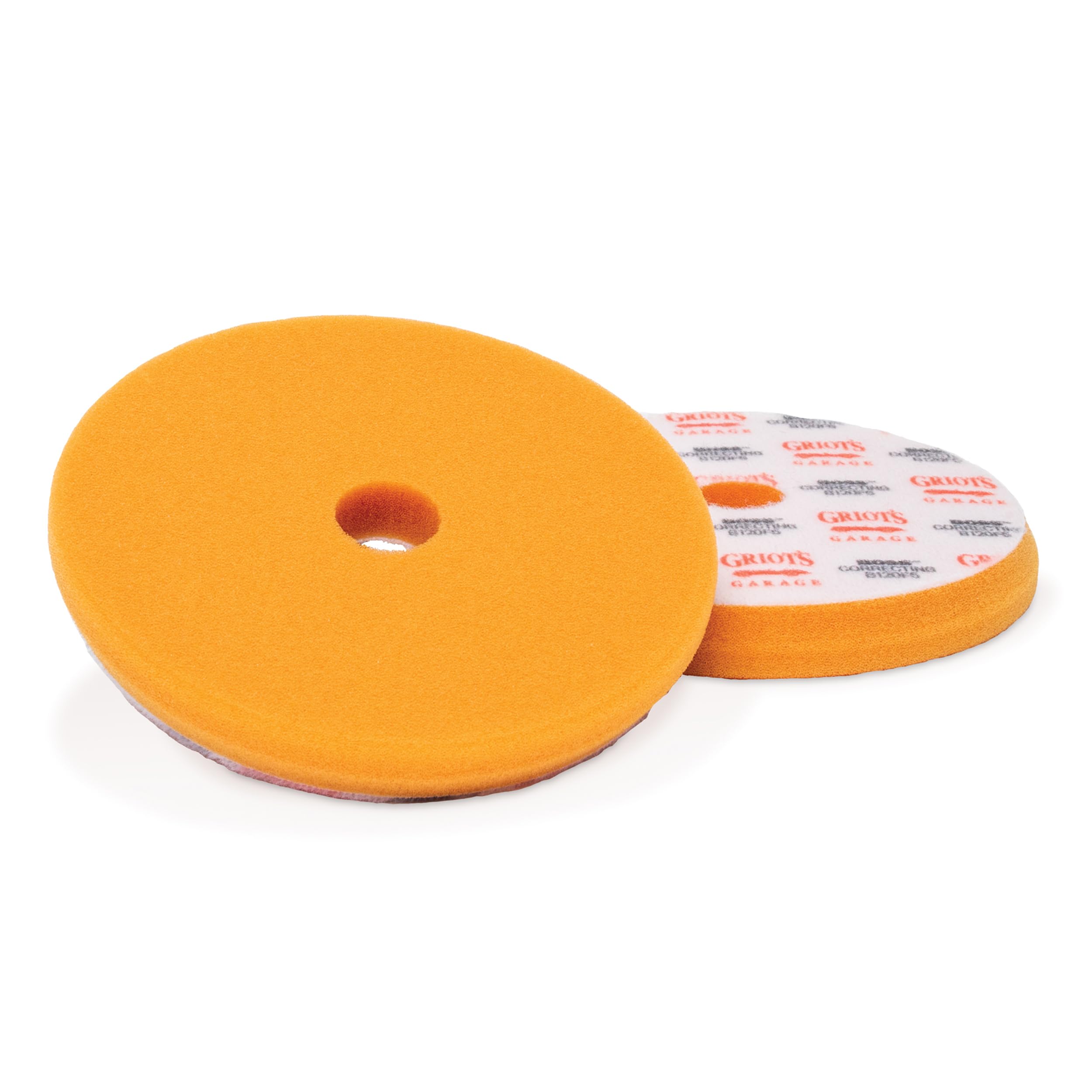
Griot’s Garage engineered the BOSS Correcting pad with a low-profile shape that sits closer to the backing plate than traditional pads, which reduces the lever arm of the foam during oscillation. This design principle means the orbital force generated by the polisher transfers more directly into the paint rather than being absorbed by the pad thickness, making it effective for removing 1200-1500 grit sanding marks and swirls without the user having to apply more downward pressure.
The Euro-foam construction has a density around 55 PCF, placing it in the firm-cutting category. A center intercooling hole runs through the pad to dissipate heat generated by the friction between the foam and the compound, which lowers the risk of the pad’s thermo-set bonding system failing from thermal stress. One detailing business owner reported that these pads survived daily use from January through October without the foam separating from the hook-and-loop backing, which indicates the adhesive bond is robust enough for commercial workloads.
The 5.5-inch diameter aligns with Griot’s own G9 and G15 polishers, but the pad also works on any 5-6 inch backing plate. The Boss system is designed to be used with Griot’s Boss Correcting Creams, but users have had success with third-party compounds. The pads are machine-washable, and the loop backing does not fray after repeated cleaning cycles. For a user prioritizing cut efficiency and pad longevity over foam thickness, this is a precise tool.
Why it’s great
- Low-profile design maximizes orbital force transfer for faster defect removal
- Center cooling hole reduces heat buildup during extended use
- Survived 10 months of commercial detailing without delamination
Good to know
- Thinner pad may feel less forgiving on uneven body panels to some users
- Optimized for Griot’s compounds to achieve full correction speed
6. Griot’s Garage 5.5” Red Foam Waxing Pads

The Red Waxing Pad from Griot’s Garage is a single-purpose finishing tool designed specifically for spreading waxes and paint sealants without absorbing too much product into the foam. The flat, beveled face spreads a thin, even layer of wax, which is essential for avoiding high spots that require manual buffing to level. The 150-grit fine foam has a closed-cell surface structure that does not trap wax particles, so each pad stroke deposits product onto the paint rather than holding it within the pad cells.
This pad works best with a random orbital polisher on speed setting 3-4 — high enough to spread the wax but low enough to prevent the pad from flinging product off the edge. The 5.5-inch diameter is slightly smaller than the standard 6.5-inch wax pad, which improves control around mirrors, door handles, and trim edges. Users who paired these pads with a 3-inch backing plate on a 6-inch Griot’s DA polisher reported even coverage and a significant reduction in the number of passes required to achieve a streak-free finish compared to other wax applicators.
The upgraded micro hook-and-loop system uses a smaller loop density than standard pads, which prevents the backing from grabbing loose fibers when the pad is moved across a dusty surface. After use, the pads clean easily with warm water and mild soap, and the thermo-set bonding resists the edge fraying that often occurs when machine-washing foam pads. For a detailer who finishes with a show-quality wax or sealant, this pad delivers consistent, clean application with minimal product waste.
Why it’s great
- Beveled face creates even wax layer with no high spots or streaks
- Closed-cell surface structure minimizes product absorption into foam
- Smaller diameter allows precise waxing on complex body contours
Good to know
- Not intended for cutting or polishing — one-purpose finishing tool
- Higher price per pad compared to generic wax applicator pads
7. SPTA 6″ Polishing Pads 5-Pack with Microfiber Pad
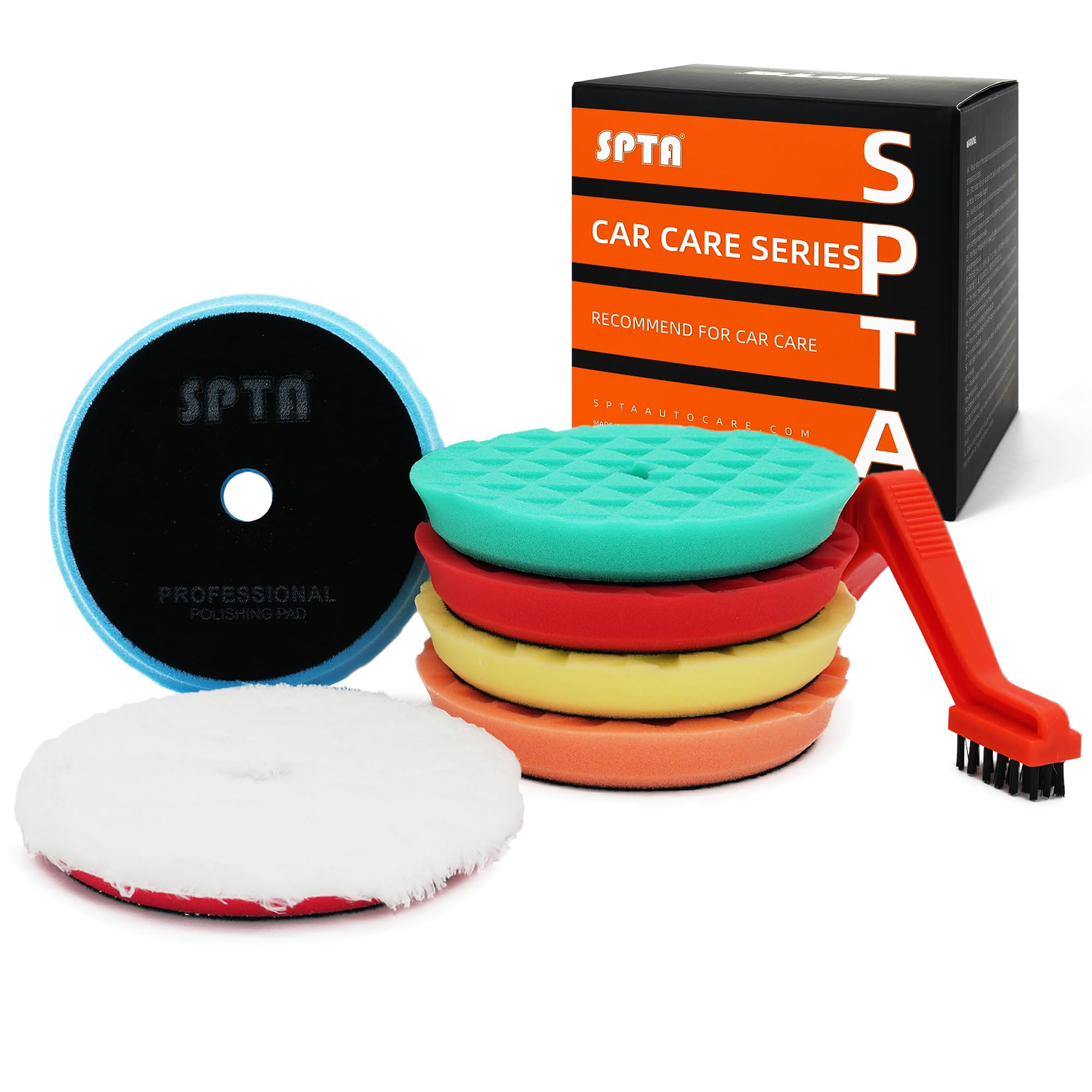
SPTA’s six-piece kit provides five foam pads with a hardness gradient — green and yellow for compounding, orange and blue for polishing, and red for finishing — plus a microfiber finishing disc for final wax removal. The foam is sourced from a German supplier and uses a polyester blend that maintains its shape under the high shear force of a dual-action polisher without tearing apart at the edges. Users reported that this set successfully removed surface scratches from a 26-year-old truck, demonstrating that the foam cut is sufficient for moderate paint correction work.
The 6-inch diameter pads fit the standard 5-6 inch backing plate configuration used by most hobbyist-grade random orbital sanders and polishers. The hook-and-loop backing uses a dense J-hook pattern that grips the plate firmly enough to prevent the pad from walking during orbital rotation, though a few users noted that the microfiber pad began fraying at the edges after the first heavy use on a full-size pickup. The hardness order is clearly marked by color, which simplifies the selection process for someone new to paint correction — green being the firmest (cutting) and red the softest (finishing).
The pads are washable and reusable with mild detergent, but the open-cell structure of the softer pads can accumulate compound residue if not cleaned immediately after use. For a beginner building their first detailing arsenal, this set provides enough variety to experiment with different pad-compound combinations without a large upfront investment, and the inclusion of a microfiber finishing disc adds a layer of gloss refinement that foam alone sometimes struggles to deliver.
Why it’s great
- Five foam densities cover compounding through finishing in one purchase
- German-made polyester foam resists tearing under high-speed dual-action use
- Microfiber finishing disc adds gloss refinement not possible with foam alone
Good to know
- Microfiber pad may delaminate at edges after heavy use on large vehicles
- Softest foam pads can load up with compound if not cleaned promptly
FAQ
What pad color corresponds to which correction stage?
Can I use 6-inch pads on a 5-inch backing plate?
How many cars can a foam polishing pad typically last?
Why does my pad create holograms even when using a finishing compound?
Final Thoughts: The Verdict
For most users, the auto polishing pads winner is the Adam’s Polishes Premium Polisher Pads Bundle because the combination of a microfiber cutting pad and color-matched foam densities covers full paint correction in a compact 3.5-inch package that handles tight spaces without losing cutting speed. If you need a heavy-duty pad for production compounding on large surfaces, the 3M Perfect-It Foam Compounding Pad (05707) delivers double-sided durability and efficient heat management for industrial-scale work. And for a beginner on a budget who wants to experiment with different correction stages, the SPTA 6″ Polishing Pads 5-Pack offers German-sourced foam that withstands moderate use without tearing.