
Our readers keep the lights on and the weekend projects moving. As an Amazon Associate, I earn from qualifying purchases.
A perfect paint job starts with a flawless foundation, and nothing kills a DIY restoration faster than primer that fails to bond, fills poorly, or clogs halfway through the can. The right spray can primer saves you hours of sanding and prevents your topcoat from peeling or chipping after a season of driving.
I’m Rikta — the co-founder and writer behind FitlyFast. I dissect aerosol chemistry, nozzle design, and real-world adhesion data to separate the body-shop professional formulas from the hardware-store fillers that simply don’t hold up on bare metal or plastic bumpers.
Whether you are restoring a classic fender, customizing a bumper, or sealing a 3D print for painting, finding the right auto primer in a spray can means matching your substrate to the correct etch, fill, or high-build formula for long-lasting results.
How To Choose The Best Auto Primer In A Spray Can
Picking the wrong primer chemistry for your surface is the most common DIY mistake. Bare steel needs an acid-etch reaction to bond, while plastic bumpers require a flexible bonding primer to prevent cracking. Spray can nozzle and filler content are just as critical as the chemical formula. Here are the three factors that determine whether your final paint job looks professional or needs rework.
Match the Primer Chemistry to Your Substrate
Self-etching primers contain phosphoric acid that chemically bonds to bare metal, making them ideal for steel, aluminum, and galvanized surfaces. Universal bonding primers use advanced adhesion promoters to grip plastic, fiberglass, and existing paint without sanding. High-build filler primers are thicker — they fill minor scratches, pinholes, and 180-grit sanding marks in a single coat, reducing prep time dramatically. Choosing a filler primer on a bare metal panel that requires etch bonding will lead to delamination.
Evaluate Nozzle Quality and Spray Pattern
Professional-grade aerosol cans use flat-fan high-atomization nozzles that deliver a consistent pattern with minimal overspray. Budget cans with round cone spray tips are harder to control and produce uneven film thickness, leading to orange peel or runs. Look for nozzles labeled “EZ Touch 360°” or “flat fan” — these allow you to hold the can at any angle and maintain coverage on vertical panels without sagging.
Check Dry Time, Sandability, and Film Build
A good spray primer should be dry to the touch in 30 minutes and ready for wet sanding within an hour. High-build formulas should lay down enough film thickness (4-6 mils) to fill 320-grit scratches without shrinking after curing. Thin primers may require multiple coats and extended flash times between layers. Always shake the can for a full two minutes — an internal mixing ball that rattles freely confirms the pigment hasn’t settled.
Quick Comparison
On smaller screens, swipe sideways to see the full table.
| Model | Category | Best For | Key Spec | Amazon |
|---|---|---|---|---|
| SEM 39673 Black Self Etching Primer | Self-Etching | Professional etch coating on raw aluminum & steel | 40-50 sq ft coverage per can | Amazon |
| Custom Shop 1K High Build Primer | High-Build Filler | Filling scratches & minor dents before color | 144 sq ft coverage per can | Amazon |
| Raptor Acid Etch Primer 1K Aerosol | Acid Etch | Heavy-duty anti-corrosion on bare metal | Flat-fan high atomization nozzle | Amazon |
| Seymour 20-1674 PBE Professional Primer | Filler Primer | Body shop-quality fill for deep scratches | Heat resistant up to 250°F | Amazon |
| VHT SP118 Flameproof Primer | High-Heat | Exhaust systems & brake caliper prep | Withstands 2000°F when cured | Amazon |
| Dupli-Color Multi-Purpose Self-Etching Primer | Self-Etching | Bare metal spot repairs & steel wheels | 15-20 sq ft coverage per can | Amazon |
| Rust-Oleum 286793 Universal Bonding Primer | Bonding | Plastic bumpers, trim & fiberglass | Dries to touch in 30 minutes | Amazon |
In‑Depth Reviews
1. SEM 39673 Black Self Etching Primer

The SEM 39673 is the gold standard for self-etching primers among professional body shops, and for good reason. Its phosphoric acid formula chemically bites into bare aluminum and steel, creating a corrosion-resistant barrier that topcoats can lock onto. The fine, even spray pattern from the nozzle lays down a thin film without runs or pooling — critical when you are working on complex suspension arms or frame sections where bolt holes must remain unclogged.
At 15.5 oz and covering 40-50 square feet, this can goes further than most competitors. Reviewers consistently note it dries quickly — three coats spaced 5-10 minutes apart are ready for color within an hour at 70°F. A few users report the can can fail halfway through the can’s life, so having a spare on hand is prudent for larger projects. It is not a filler primer, so you must have your metal already smooth before spraying.
For anyone restoring a classic car or prepping bare metal for a high-end urethane finish, this primer’s adhesion strength is unmatched. It leaves a factory-satin finish that is ideal for chassis components, engine bay parts, or any substrate that needs a thin, durable etch coat before the color layer.
Why it’s great
- Superior chemical etch adhesion on aluminum and bare steel
- Wide coverage per can reduces project cost
- Fast dry time enables same-day painting
Good to know
- Some cans may experience nozzle failure before empty
- Not a filler — requires pre-smoothed surface
2. Custom Shop 1K High Build Primer
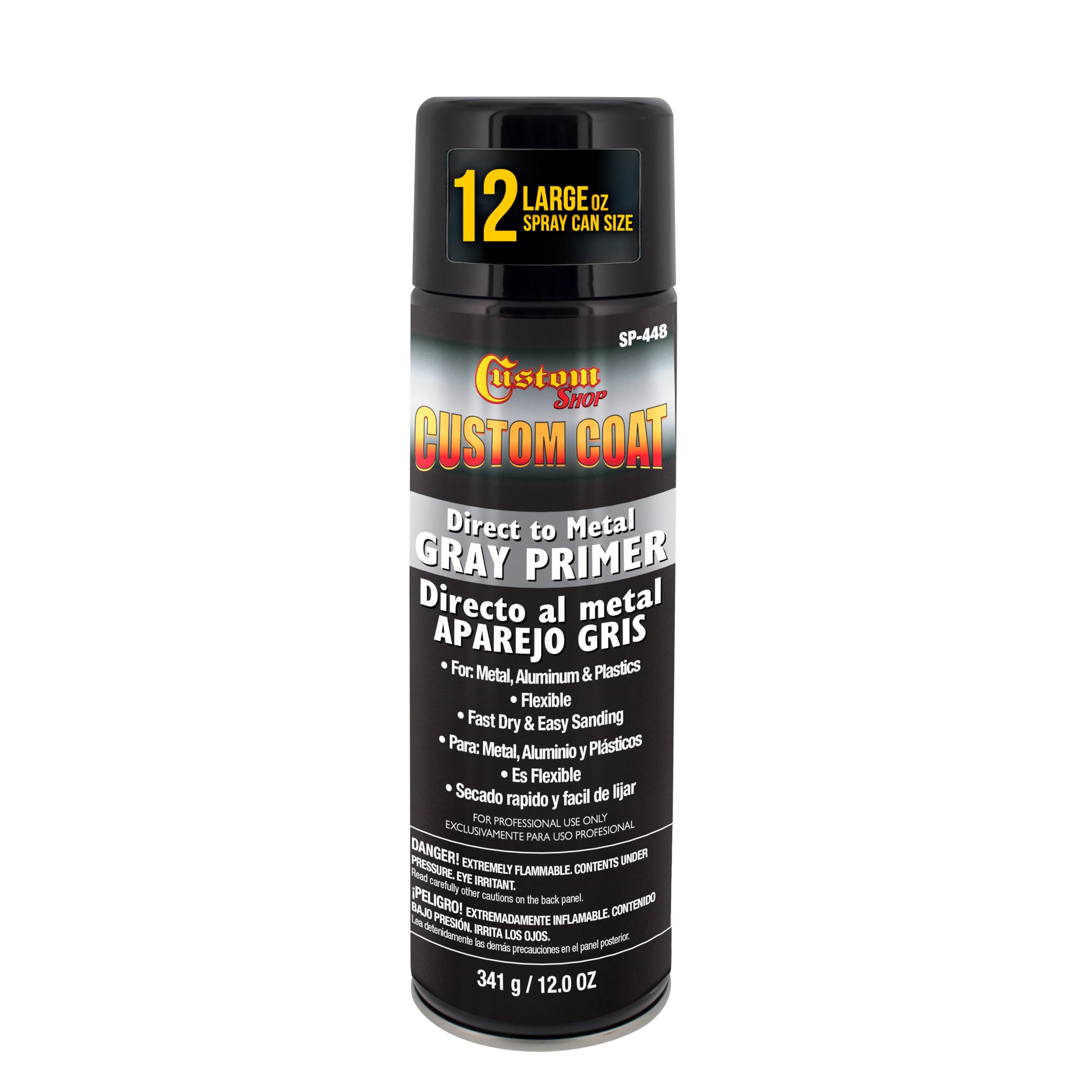
When you need a primer that actively fills 180-grit sanding scratches and minor surface imperfections without multiple coats, the Custom Shop 1K High Build Primer is the answer. Its thick formula lays down a substantial film build in a single pass, reducing your prep time significantly. The flat-fan high-atomization nozzle delivers excellent coverage across large panels like hoods and doors, with a pattern that is forgiving enough for DIY users.
Reviewers praise its sandability — it blocks out smooth with 400-grit without gumming up paper. The gray color provides an excellent neutral base for any topcoat, from solid whites to dark metallics. A handful of users reported spattering black chunks from certain cans, though the manufacturer’s customer support appears responsive with refunds. The formula works on steel, aluminum, fiberglass, and SMC, making it a true multi-substrate workhorse.
If your project involves repairing a dented fender or filling light rust pitting, this high-build surfacer saves you the step of using a separate glazing putty. Just ensure you shake thoroughly to prevent the occasional pigment separation issue. For the price point, its filling power is the best in this mid-range tier.
Why it’s great
- Excellent scratch-filling ability in one coat
- Sands smoothly without clogging paper
- Wide fan pattern speeds up large panel coverage
Good to know
- Quality control variability with occasional solids spattering
- Requires thorough shaking to prevent separation
3. Raptor Acid Etch Primer 1K Aerosol

Raptor’s Acid Etch Primer is engineered with a phosphoric acid ester formula specifically for tough-to-bond substrates like galvanized steel and aluminum. Unlike universal primers that rely solely on mechanical adhesion, this one-step formula chemically etches the surface, creating a micro-tooth that prevents topcoat delamination. The flat-fan high atomization nozzle delivers a large, even spray pattern that covers running boards, steel bumpers, and rock rails efficiently.
Customers who used it as a base for Raptor’s 2K bed liner report exceptional long-term adhesion, with no peeling after a full year of exposure. The matte finish accepts topcoats directly without sanding, which streamlines the process for DIY bedliner and undercarriage projects. Some users noted that the spray can be messy, so proper masking and protective gear are mandatory. The coverage area is not specified on the label, so expect to use one can per medium-sized panel.
If you are preparing steel wheels, trailer hitches, or off-road armor that demands corrosion resistance, this primer’s anti-rust barrier is a standout. It is specifically not recommended for non-metal surfaces or as a filler, so pair it with a high-build primer if your metal has pitting or deep scratches.
Why it’s great
- Chemical etch bonds aggressively to galvanized and aluminum
- Excellent long-term anti-corrosion performance
- Accept topcoat directly without sanding
Good to know
- Can be messy during application; mask thoroughly
- Not a filler primer — requires smooth base metal
4. Seymour 20-1674 PBE Professional Primer

Seymour formulated the PBE Professional Primer to meet the demands of collision repair shops, and its performance on plastic bumpers and metal panels proves it. The gray filler formula is thick enough to fill deep scratches and pinholes in one coat, yet it dries fast enough to sand within an hour. Reviewers highlight how effectively it minimizes the appearance of 180-grit scratches, cutting down the number of primer coats needed compared to thinner products.
The large sprayhead delivers a professional-looking application, but some users note the fan pattern is wide — not ideal for tight corners or small spot repairs without careful masking. It is heat resistant up to 250°F, making it suitable for engine bay components that see moderate thermal cycling. A few customers reported the mixing ball can be loose, but the product atomizes well with standard shaking. The coverage is approximately 10 square meters per liter, which is competitive for a filler primer.
For body shops and serious DIY restorers who regularly work with plastic repair and metal fill, this primer’s ability to bridge the gap between putty and paint is a time-saver. Apply it at 4-6 inches with 50% overlap, let it flash, and sand with 400-grit for a surface ready for base coat.
Why it’s great
- Fills deep scratches in a single coat
- Fast drying allows sanding within an hour
- Heat resistant to 250°F for engine bay use
Good to know
- Wide fan pattern not ideal for small spots
- Mixing ball may feel loose before use
5. VHT SP118 Flameproof Coating Primer

VHT’s Flameproof Coating primer is a category unto itself — a ceramic silicone base formulation designed to withstand extreme temperatures up to 2000°F when properly cured. This is not a general automotive primer; it is purpose-built for exhaust headers, manifolds, brake calipers, and other high-heat surfaces where standard primers would burn off. The white flat primer color provides an excellent base for bright topcoat colors like yellow or red caliper paint.
The spray pattern is functional but not as refined as the higher-end fan nozzles — some users note it is not perfectly even, so careful technique is required. The curing process is specific: after the final clear coat, the part must reach over 200°F through hard driving or oven baking to achieve full hardness. Reviewers who followed the VHT system (primer, color, clear) successfully reported durable finishes that resisted chipping and fading on daily-driven brake calipers.
If your restoration involves engine bay heat management or you are converting to bright caliper colors, this primer’s thermal endurance is non-negotiable. Do not substitute a standard primer on exhaust components — the heat will cause delamination within weeks. Pair it with VHT’s matching color and clear coat for a system that actually holds up above 500°F.
Why it’s great
- Ceramic silicone base withstands 2000°F cured
- White color great base for bright topcoats
- Proven durability on calipers and exhaust
Good to know
- Spray pattern not perfectly even; requires technique
- Requires specific heat-curing process for full hardness
6. Dupli-Color Multi-Purpose Self-Etching Primer
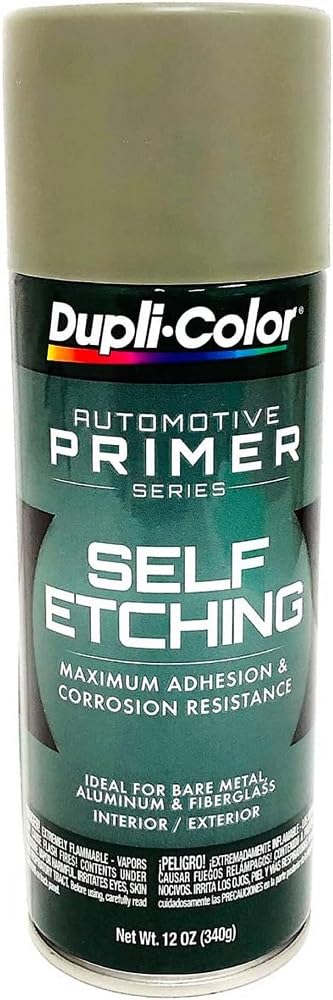
Dupli-Color’s self-etching primer is a budget-friendly workhorse that has been a staple in home garages for decades. It etches and primes bare metal in one step, using the same phosphoric acid chemistry as the premium brands but at a more accessible price point. The EZ Touch 360° Fan Spray Nozzle allows application from any angle, which is especially useful for painting steel wheels, suspension components, and underbody parts where you cannot always hold the can upright.
Coverage is rated at 15-20 square feet per can, which is adequate for spot repairs and small panels. Reviewers on classic car forums note it holds up well on 1970s steel wheels with no peeling after years of use. However, the can’s internal mechanism can be inconsistent — multiple verified reviews report cans that stop spraying with 75% of the product still inside. This is a known failure mode, so budget for potential waste. The primer dries to the touch in 30 minutes and handles in one hour, making it viable for multi-stage paint sessions.
If you are doing light restoration on a budget or need an etch primer for steel wheels, this formula delivers good adhesion at a low entry cost. Just buy an extra can to hedge against potential nozzle failure, and always use an organic vapor respirator during application.
Why it’s great
- Effective self-etching chemistry for bare metal
- 360° nozzle allows awkward-angle application
- Proven long-term adhesion on steel wheels
Good to know
- Can nozzle may fail before can is empty
- Coverage limited to 15-20 sq ft per can
7. Rust-Oleum 286793 Universal Bonding Primer

Rust-Oleum’s Universal Bonding Primer is the go-to choice when you are working with challenging non-metal surfaces like plastic bumpers, trim, fiberglass, or galvanized steel. Its professional-grade formula seals and protects while creating a tacky surface that topcoat paint can lock onto. The flat white finish covers 10-12 square feet and dries to the touch in 30 minutes — fast enough to apply two coats and sand within an hour for same-day painting.
This primer excels on chrome delete projects and plastic body cladding, where adhesion is often the biggest headache. Reviewers report excellent results on ABS plastic, with the primer bonding well and accepting paint without peeling. The spray pattern is small with heavy output, which means you must be careful to avoid runs on vertical panels. A few users noted a slightly textured finish that required light sanding before the topcoat, but the trade-off is a mechanical bond that holds up over time.
If you are painting plastic interior parts, exterior trim, or fiberglass repairs, this bonding primer saves you the cost and hassle of a separate adhesion promoter. Keep your spray distance at 8-10 inches and use light, overlapping passes to avoid pooling. It is not ideal for bare metal — for that, choose a self-etching formula instead.
Why it’s great
- Bonds effectively to plastic, fiberglass, and galvanized surfaces
- Dries fast for quick project turnaround
- Affordable entry point for multi-material projects
Good to know
- Small spray pattern prone to runs without careful control
- May leave a textured finish requiring light sanding
FAQ
Can I use a self-etching primer on plastic or fiberglass?
How long should I wait between primer coats before sanding?
Why does my spray primer leave a rough or textured finish?
Final Thoughts: The Verdict
For most users, the auto primer in a spray can winner is the SEM 39673 Black Self Etching Primer because it delivers professional-grade chemical adhesion on bare metal with the widest coverage and fastest dry time in its class. If you need heavy scratch-filling ability, grab the Custom Shop 1K High Build Primer. And for high-heat surfaces like exhaust and calipers, nothing beats the VHT SP118 Flameproof Coating Primer.