
Our readers keep the lights on and the weekend projects moving. As an Amazon Associate, I earn from qualifying purchases.
A multimeter that forces you to preset the voltage range before you can even probe a circuit is a tool that slows you down and invites mistakes. Auto-ranging eliminates that friction, letting the meter find the right scale instantly so you can focus on the fault, not the dial.
I’m Rikta — the co-founder and writer behind FitlyFast. My buying guides rely on hundreds of hours of cross-referencing real-world test results, spec sheets, and user feedback to separate tools that deliver reliable readings from those that introduce new problems.
After comparing seven models across entry-level, mid-range, and pro-grade price tiers, I’ve narrowed the field to the best auto ranging multimeter for every type of user, from weekend DIYers to industrial service technicians.
How To Choose The Best Auto Ranging Multimeter
Auto-ranging is a convenience feature, but it doesn’t stand alone. The right meter balances measurement accuracy, safety certification, build durability, and the specific functions you actually need for your work. Here are the three factors that matter most.
True RMS vs. Average-Responding Meters
Standard average-responding meters only give accurate AC readings on pure sine waves. Modern equipment — variable frequency drives, LED lighting, switching power supplies — produces distorted waveforms. A True RMS meter calculates the actual heating value of that signal, giving you correct voltage and current readings regardless of waveform shape. For any work beyond basic household outlets, True RMS is non-negotiable.
Safety Ratings (CAT III / CAT IV)
The International Electrotechnical Commission (IEC) classifies meters by where they can safely be used. CAT III covers distribution-level circuits like panelboards and appliance outlets; CAT IV covers utility-level service entrances. A meter rated CAT III 600V is safe for most residential and light commercial work. If you ever probe a main service panel, invest in a CAT IV 600V rated unit. Ignoring these ratings risks arc flash that can injure or kill.
Count Resolution and Sampling Speed
Counts indicate how finely the meter can resolve a measurement. A 4000-count meter displays readings up to 3.999, while a 6000-count unit reads to 5.999, offering finer precision on mid-range values. Sampling speed, measured in readings per second, matters when you’re looking for intermittent faults or capturing inrush current. Three samples per second is standard; faster meters catch glitches that slower ones miss entirely.
Quick Comparison
On smaller screens, swipe sideways to see the full table.
| Model | Category | Best For | Key Spec | Amazon |
|---|---|---|---|---|
| Fluke 87V | Industrial | Advanced troubleshooting | 20,000-count resolution | Amazon |
| Fieldpiece SC440 | HVAC Clamp Meter | HVACR diagnostics | Inrush current, µA DC | Amazon |
| Klein Tools MM700 | Professional | Commercial electrical work | LoZ mode, CAT IV 600V | Amazon |
| Fluke 17B+ | Bench/Service | Electronics bench & light industrial | ±0.5% DC accuracy | Amazon |
| KAIWEETS HT118A | Mid-Range | DIY & home auto repair | LED jack guidance lights | Amazon |
| Klein Tools CL120KIT | Clamp Meter Kit | Homeowner & handyman | 400A AC clamp, GFCI tester | Amazon |
| Proster T28B | Entry-Level | Budget & basic tasks | TRMS, magnetic back | Amazon |
In‑Depth Reviews
1. Fluke 87V Industrial Digital Multimeter

The Fluke 87V is the benchmark that all other handheld multimeters are measured against. Its 20,000-count resolution lets you see voltage fluctuations as small as 1 mV in the 6 V range, and the built-in low-pass filter delivers accurate frequency readings on variable frequency drives — a task that confuses meters without this feature. The Peak Capture function grabs transients as short as 250 microseconds, making it indispensable for catching intermittent faults in motor controls and industrial automation.
Durability is baked into every detail: the rubber holster absorbs a 3-meter drop, the input jacks accept a full seated probe without wobble, and the CAT III 1000V / CAT IV 600V safety rating means you can confidently use it on service entrances. The included TL75 leads, AC175 alligator clips, and 80BK temperature probe give you a complete troubleshooting kit out of the box. The display is readable from over 12 feet away with the backlight on — a small detail that matters when the meter is mounted on a panel door.
Is it expensive? Yes. But the 87V is not a purchase — it’s an investment. Users report these meters staying within spec for a decade or more, and Fluke’s support backs them with a limited lifetime warranty. For any professional who depends on accurate readings to diagnose costly equipment, the 87V pays for itself within the first few service calls.
Why it’s great
- 20,000-count resolution catches tiny signal changes
- Low-pass filter reads VFD frequency accurately
- 250 µs Peak Capture finds intermittent faults
Good to know
- Heavy at 1.3 lbs compared to mid-range meters
- Premium price demands a justified use case
2. Fieldpiece SC440 True RMS Clamp Meter

The Fieldpiece SC440 is engineered specifically for HVACR technicians, and its feature set reflects that focus. The inrush current measurement captures the starting current of compressors and motors — critical data for diagnosing hard-start issues that a standard clamp meter would miss. Microamp DC mode lets you test flame rectification on gas furnace ignitors, a niche capability that eliminates the need for a separate microammeter.
Build quality is robust: the meter survived daily use in commercial HVAC service vans, and the silicone test leads stay flexible even in cold weather. The included K-type thermocouple was accurate out of the box for duct temperature measurements, and the carrying case holds everything organized. The high-voltage LED and beeper provide an audible warning when you’re near energized circuits — a safety feature that’s especially welcome when working in tight mechanical rooms.
The trade-off is the user interface: after power-on, you must press the select button to access amp readings and continuity beep. It’s a minor step that becomes second nature, but field techs who switch between measurements frequently should note it. For dedicated HVACR work where you need temperature, capacitance, microamps, and inrush in one rugged package, the SC440 is the best choice in its class.
Why it’s great
- Inrush current and µA DC for HVAC-specific diagnostics
- Silicone leads stay flexible in cold conditions
- Includes accurate thermocouple and carrying case
Good to know
- Requires select button press after power-on for amp mode
- Not the best choice for general-purpose electronics bench work
3. Klein Tools MM700 Auto-Ranging 1000V Digital Multimeter

Klein Tools built the MM700 for electricians who face ghost voltages — those phantom readings that appear when a disconnected wire sits next to an energized conductor. The Low Impedance (LoZ) mode places a load on the circuit, draining stray capacitive coupling so you get a true zero reading on a dead wire. This single feature can save hours of chasing non-existent faults.
The True RMS engine handles distorted waveforms common in commercial lighting and motor drives, and the CAT IV 600V safety rating means you can use this meter at the service entrance without concern. It survived a 6.6-foot drop in testing, and the accessible battery and fuse compartment lets you swap components in the field without disassembling the entire case. Users consistently report accuracy within 0.1% of reference meters, which is exceptional for this price tier.
One quirk worth noting: the meter defaults to AC voltage measurement each time it powers on, so if you’re working in DC mode, you’ll need to toggle back after every shutdown. It’s a minor inconvenience, but pros who flip between AC and DC frequently should be aware. For commercial electricians who need a rugged, safe, accurate meter with ghost-voltage busting capability, the MM700 is a standout.
Why it’s great
- LoZ mode eliminates ghost voltage readings
- CAT IV 600V safety for service entrance work
- Drop-tested to 6.6 feet
Good to know
- Resets to AC mode on every power cycle
- Magnetic strap sold separately
4. Fluke 17B+ Digital Multimeter
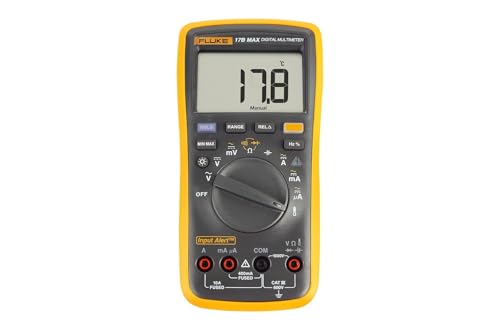
The Fluke 17B+ brings genuine Fluke build quality to a price point that’s accessible for serious hobbyists and electronics bench work. Its ±0.5% DC voltage accuracy is sufficient for most circuit debugging, and users have reported agreement within 0.005V of lab-grade meters like the Agilent U1273A. The large display makes it easy to read from a seated bench position, and the built-in stand angles the meter perfectly for hands-free probing.
Measurement coverage is comprehensive: AC/DC voltage to 1000V, current to 10A, resistance to 40 MΩ, capacitance, frequency, duty cycle, diode check, and continuity with a fast beeper. The K-type thermocouple covers –40°C to 400°C, useful for monitoring power supply temperatures or soldering iron calibration. The included TL75 leads and thermocouple mean you can start testing immediately without accessory purchases.
The CAT III 600V rating is appropriate for residential and light industrial environments — this is not a meter for utility service entrances, but it’s more than capable for panel work in homes and small shops. If you’re an electronics enthusiast or a light commercial technician who wants Fluke reliability without the 87V price, the 17B+ delivers where it counts.
Why it’s great
- Proven Fluke accuracy for bench and light industrial work
- Includes thermocouple and quality test leads
- Large display with built-in stand
Good to know
- CAT III 600V only — not for service entrance work
- No low-pass filter or advanced VFD capabilities
5. KAIWEETS HT118A Digital Multimeter TRMS 6000 Counts
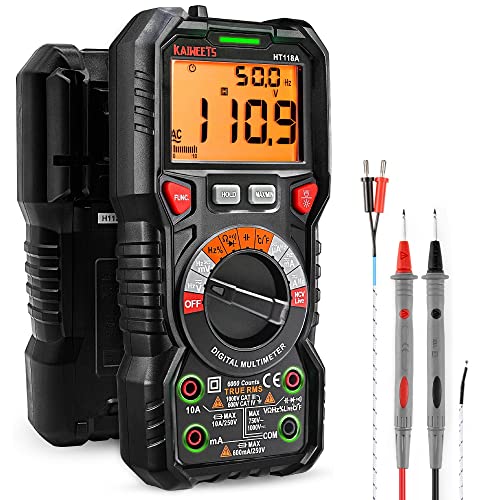
KAIWEETS designed the HT118A with a clever usability feature that sets it apart: when you rotate the dial to a measurement function, the corresponding input jack lights up with an LED. This visual guidance eliminates the confusion that beginners often feel about where to plug the leads — a small detail that makes a big difference when you’re learning or working in dim conditions. The True RMS 6000-count engine delivers accurate readings on non-linear loads, and the auto-ranging response is snappy at three samples per second.
The feature set covers everything a home DIYer or automotive enthusiast needs: AC/DC voltage to 1000V, current to 10A, resistance to 60 MΩ, capacitance, frequency, duty cycle, temperature with the included thermocouple, diode testing, and continuity with a loud beeper. The backlight is bright enough for dark cabinets, and the flashlight on the back of the meter is genuinely useful for illuminating your probe points. The Min/Max/Average function records signal fluctuations, which is helpful when checking battery charging systems for voltage ripple.
The weak point reported by multiple users is the test leads — they tend to fail after several months of use. This is a common issue at this price point, and the solution is to budget for aftermarket silicone leads. The IEC CAT III 1000V safety rating with double ceramic fuses provides genuine protection, and KAIWEETS backs the unit with a 36-month warranty. For the price, the HT118A offers an exceptional feature-to-cost ratio that’s hard to beat.
Why it’s great
- LED jack lights guide correct lead placement
- True RMS 6000-count for distorted waveforms
- Min/Max/Average recording for signal analysis
Good to know
- Included test leads are prone to early failure
- Not rated for CAT IV industrial environments
6. Klein Tools CL120KIT Clamp Meter Electrical Test Kit

The kit bundles the CL120 AC auto-ranging clamp meter with a GFCI receptacle tester and a line splitter, so you can measure current draw on a plugged-in device without splitting the power cord. The 400A AC clamp lets you check load balancing on split-phase 240V panels, and users have noted that rebalancing loads based on these readings can reduce electric bills.
The clamp meter itself measures AC current via the clamp, AC/DC voltage and resistance through the test leads, and includes a non-contact voltage tester integrated into the clamp jaw. The backlit display is clear, and the auto-ranging selection is responsive. The included magnetic hanger (Cat. No. 69445 or 69417) is sold separately, but the side-mounted test lead holder keeps probes organized during use. The GFCI tester detects open ground, reverse polarity, and other common wiring issues — a useful troubleshooting tool for any home inspection.
The limitation is that this is an AC-only clamp meter — it won’t measure DC current, so it’s not suitable for automotive battery drain testing or solar panel diagnostics. The CAT III 600V safety rating is appropriate for residential panels and appliance circuits. If your work revolves around household AC wiring, appliance repair, and outlet testing, the CL120KIT saves you from buying separate testers and is a solid value as an integrated kit.
Why it’s great
- Complete kit with GFCI tester and line splitter
- 400A AC clamp for panel load balancing
- Integrated NCV tester in the clamp jaw
Good to know
- Does not measure DC current — not for automotive use
- Magnetic hanger sold separately
7. Proster T28B Digital TRMS Multimeter
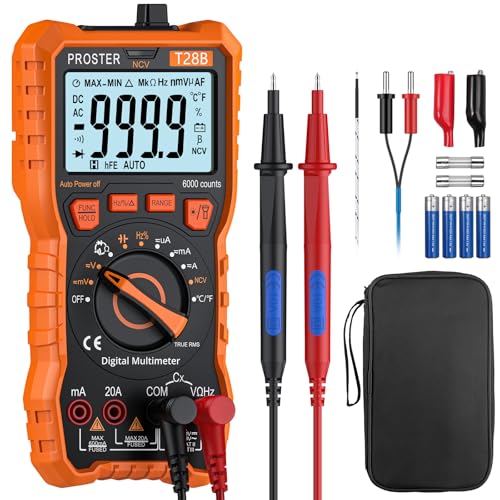
The Proster T28B proves that True RMS auto-ranging multimeters are no longer exclusive to the mid-range. At an entry-level price, it delivers a 6000-count TRMS engine, NCV detection, temperature measurement with the included K-type probe, and a built-in flashlight and backlight for dim workspaces. The magnetic back is a genuinely useful feature — stick the meter to a breaker panel or car chassis and keep both hands free for probing.
The accessory bundle is generous: test leads, alligator clips, a screwdriver for the fuse compartment, two spare fuses, four AAA batteries, and a soft cloth carrying bag. The CAT III 600V / CAT II 1000V safety rating with double fusing gives reasonable protection for home and light commercial use. The unit is built with GRS 4.0 certified recycled materials, which is an unusual and welcome sustainability touch in this price tier.
The primary area where cost savings show is in the test lead quality and the temperature probe. The leads feel thin compared to premium meters, and the thermocouple is flimsy enough that some users report it as borderline unusable for repeated industrial use. The manual is also printed in tiny font, which is frustrating when you’re in the field. For basic home troubleshooting, continuity checks, and occasional voltage measurements, the T28B performs well. Just factor in a set of aftermarket leads for long-term reliability.
Why it’s great
- True RMS at an entry-level price point
- Magnetic back for hands-free operation on metal surfaces
- Comes with alligator clips, spare fuses, and carrying bag
Good to know
- Test leads and temperature probe are low quality
- Manual has very small print, hard to read
FAQ
Can I use an auto-ranging multimeter on a car battery?
What is the difference between CAT III 600V and CAT III 1000V?
How important is temperature measurement in a multimeter?
Why does my multimeter show voltage on a wire that is disconnected?
Final Thoughts: The Verdict
For most users, the best auto ranging multimeter winner is the Klein Tools MM700 because it offers professional-grade safety ratings, LoZ ghost-voltage elimination, and True RMS accuracy at a price that working electricians can justify. If your primary need is advanced industrial troubleshooting with VFD-compatible filtering and microsecond transient capture, grab the Fluke 87V. And for HVACR-specific diagnostics including inrush current and flame diode testing, nothing beats the Fieldpiece SC440. Choose based on your daily circuits, and you’ll get decades of reliable service.