
Our readers keep the lights on and the weekend projects moving. As an Amazon Associate, I earn from qualifying purchases.
Manual scopes force you to fight with knobs and star charts, stealing the wonder of the night sky. An auto telescope ends that struggle—its motorized mount slews to celestial targets and tracks them automatically, letting you spend your time observing, not aligning.
I’m Rikta — the co-founder and writer behind FitlyFast. My research digs deep into the optical specifications, motorized mount accuracy, and light-gathering capabilities that separate a smart investment from a frustrating impulse buy.
From beginner-friendly GoTo mounts to advanced smart scopes with built-in astrophotography, this guide breaks down the best auto telescopes available so you can find the perfect match for your sky. best auto telescope
How To Choose The Best Auto Telescope
An auto telescope’s core value is its ability to find and track objects without manual intervention. Before you commit, focus on three pillars: mount type, optical design, and the compatibility of included electronics with your stargazing goals.
Mount Type: Alt-Azimuth vs. Equatorial
Motorized alt-azimuth mounts move up-down and left-right, making them intuitive for beginners and perfectly adequate for visual observation and smartphone astrophotography. Motorized equatorial mounts (EQ) rotate on a single axis aligned with Earth’s axis, compensating for rotation with a single motor — essential for long-exposure deep-sky imaging on a tracking platform. If you plan to capture nebulas and galaxies with exposures over 30 seconds, an EQ mount or a smart telescope with a built-in EQ mode is the better path.
Aperture and Focal Ratio: Light Gathering Power
The objective lens diameter (aperture) measured in millimeters dictates how much light the scope collects — a 90mm refractor gathers about 40% more light than a 70mm, while a 150mm reflector pulls in over 4x the light of an 80mm scope. For deep-sky objects like faint galaxies, aperture is king. For planetary detail at a fixed focal length, the focal ratio (f/number) matters — a faster f/5 or f/4 scope is better for wide-field astrophotography, while a slower f/10 provides higher contrast on planets with the same eyepiece.
Computerized GoTo and Object Database
A true auto telescope includes a motorized GoTo mount with a database of thousands of celestial objects. The on-board computer translates your alignment inputs — typically two or three stars — into a virtual sky model, then drives the motors to slew to any chosen target. The hand controller or mobile app is your interface; look for a clear screen, responsive buttons, and seamless Wi-Fi connectivity if you prefer app-based control. Budget-friendly GoTo mounts have databases of 4,000 objects, while premium models exceed 40,000 entries.
Smart Telescopes: All-in-One Astrophotography
A newer category — the smart telescope — replaces the eyepiece with a dedicated digital camera, an integrated computer, and a motorized mount. You control everything through a smartphone app: auto-alignment, GoTo slewing, image capture, and even live stacking of multiple frames. These systems are unmatched for ease of use and astrophotography results, but they sacrifice the traditional eyepiece view experience. If your primary goal is to see and photograph deep-space objects with family, a smart telescope is the most accessible route.
Quick Comparison
On smaller screens, swipe sideways to see the full table.
| Model | Category | Best For | Key Spec | Amazon |
|---|---|---|---|---|
| Celestron NexStar 6SE | Schmidt-Cassegrain | Versatile mid-level astronomy | 6-inch aperture, 1500mm f/10 | Amazon |
| Odyssey Unistellar | Smart Telescope | Premium app-based astrophotography | 85mm f/3.9, 64GB, 5h battery | Amazon |
| ZWO Seestar S30 Pro | Smart Telescope | Effortless deep-sky imaging | 4K dual camera, 160mm f/4 | Amazon |
| Vaonis Vespera Pro | Smart Observatory | Pro-level compact observation | Starvis 2 sensor, 120mm f/4 | Amazon |
| DWARFLAB Dwarf 3 | Smart Telescope | Ultra-portable dual-purpose | 4K auto-tracking, dual lens, 3lb | Amazon |
| DWARFLAB Dwarf Mini | Smart Telescope | Pocket-sized deep-sky imaging | 1.85lb, Sony IMX662, 90s exposure | Amazon |
| Celestron 114LCM | Newtonian Reflector | Entry-level computerized scope | 114mm aperture, GoTo mount | Amazon |
| MEEZAA 150EQ | Newtonian Reflector | Large aperture manual tracking | 150mm aperture, 650mm f/4.3 | Amazon |
| Hawkko 90mm | Refractor | Beginners on a budget | 90mm aperture, 900mm f/10 | Amazon |
In‑Depth Reviews
1. Celestron NexStar 6SE

The Celestron NexStar 6SE achieves an ideal balance of aperture, portability, and auto-tracking sophistication. Its 6-inch (150mm) Schmidt-Cassegrain optical tube gathers ample light to reveal Jupiter’s cloud bands, Saturn’s rings, and dozens of bright deep-sky objects, while the fully computerized GoTo mount effortlessly slews to any of 40,000 objects with SkyAlign technology requiring only three bright stars — no star charts needed.
At just over 30 pounds fully assembled, the 6SE is portable enough for quick backyard sessions yet capable enough to satisfy intermediate observers. The StarBright XLT multi-coating boosts light transmission, and the single-arm fork mount provides stable tracking for visual use. Users consistently report sharp, contrasty views straight out of the box with minimal collimation adjustment.
The primary limitation is the mount’s tracking accuracy over long periods — alignment may drift after hours of use — and the stock AC adapter rotates with the mount, which can be irritating. For astrophotography beyond short smartphone shots, a wedge and auto-guider are necessary, but for visual observation and family stargazing, the NexStar 6SE is the most fulfilling auto telescope at its price point.
Why it’s great
- Optical clarity and contrast are exceptional for a compact SCT
- SkyAlign makes setup fast and frustration-free even for beginners
- Large 40,000+ object database with Sky Tour feature
Good to know
- Mount tracking can drift over extended sessions
- Stock eyepieces are adequate but benefit from upgrades
2. Odyssey Unistellar Smart Telescope

The Unistellar Odyssey is a fully integrated smart telescope that eliminates eyepieces, polar alignment, and calibration. Its 85mm f/3.9 mirror and built-in Sony sensor deliver crisp deep-sky imagery to your smartphone in under two minutes from power-on — the automatic alignment and motorized Alt-Az mount handle everything. The 5,000+ object catalog combined with a 37-million-star database makes target selection intuitive.
Weighing only 6.5 kg for the scope and 2.5 kg for the premium tripod, this rig is genuinely portable. Users consistently praise the effortless setup and the quality of stacked images, with many reporting excellent results from urban Bortle 8 skies. The app-based interface is clean, and the ability to export RAW and FITS files appeals to astrophotographers wanting to post-process later.
The main drawback is the price, which places it firmly in the premium tier, and a small subset of users have reported intermittent Wi-Fi connectivity frustrations. There is no eyepiece, so you must view through a phone or tablet screen, which some traditionalists dislike. For those seeking a family-friendly, plug-and-play astrophotography station that requires zero technical knowledge, the Odyssey is a top-tier choice.
Why it’s great
- Effortless auto-alignment and GoTo in under two minutes
- Excellent deep-sky imaging from light-polluted cities
- RAW/FITS export for advanced processing
Good to know
- Premium price and no eyepiece for direct viewing
- Wi-Fi connection can be inconsistent for some users
3. ZWO Seestar S30 Pro
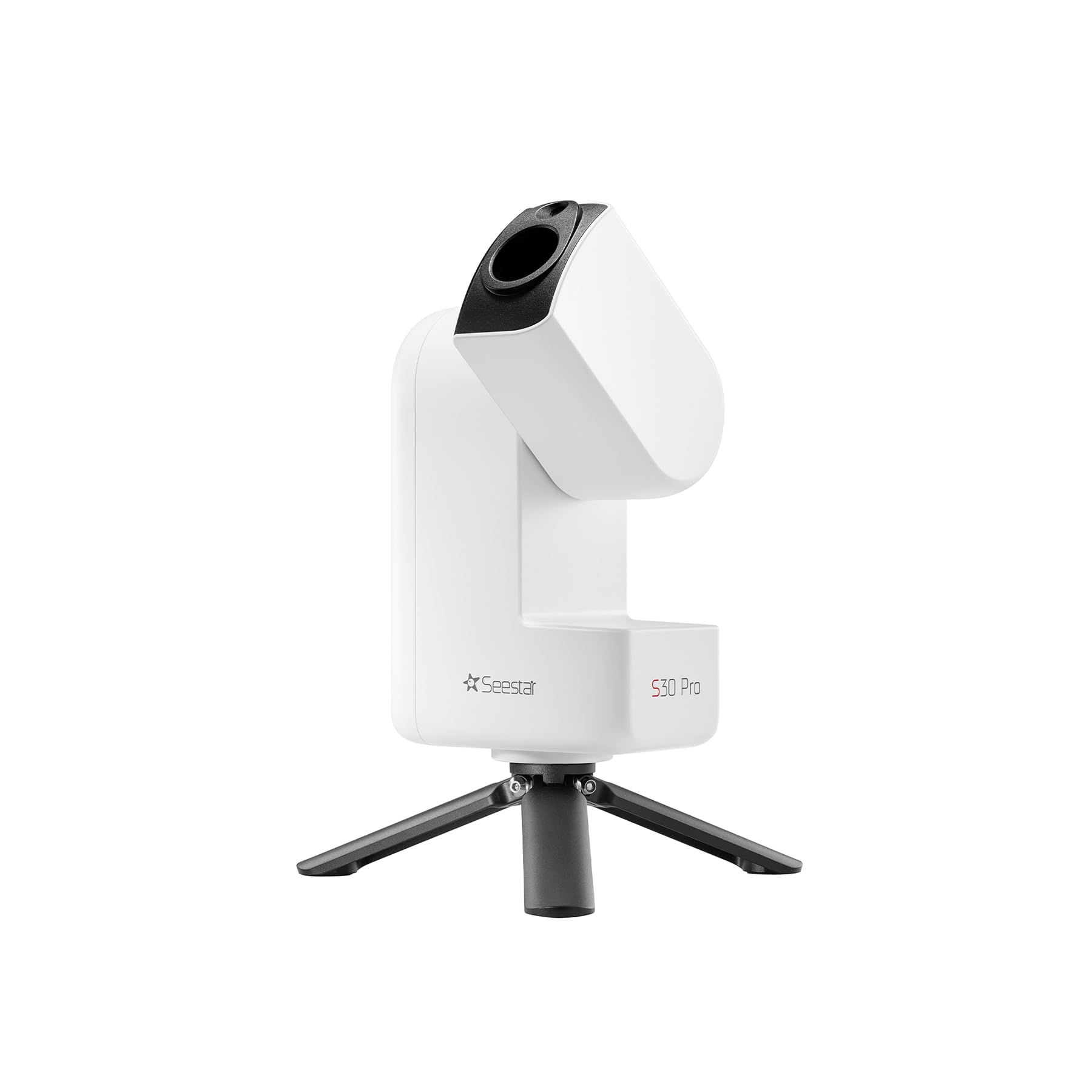
The ZWO Seestar S30 Pro packs a 4K dual-camera system into a compact, tripod-mounted smart telescope. The primary IMX585 telephoto sensor handles deep-sky objects while the secondary IMX586 wide-angle camera captures expansive Milky Way panoramas and star trails — automatically stitched into 8K mosaics. The integrated 4-element apochromatic lens minimizes chromatic aberration, producing sharp stars right to the edges of the field.
What sets the S30 Pro apart is the fully automated workflow: power on, connect the app, and it auto-aligns, slews, and begins live stacking immediately. Users report seeing detailed nebulas and galaxies within minutes, and the one-tap Milky Way mode makes wide-field landscape astrophotography accessible to anyone. The built-in light pollution filter helps cut through suburban sky glow, and the 128GB internal storage supports all-night imaging sessions.
On the downside, the field of view is relatively narrow for a dedicated wide-field scope, and the scenery photography mode for daytime birdwatching is less impressive than its deep-space capability. The image stacking process takes 10–30 minutes for a final result, which may test patience. Still, for the price, the Seestar S30 Pro delivers astonishing astrophotography results with minimal effort.
Why it’s great
- Exceptional deep-sky images with one-touch capture
- Automatic 8K mosaic stitching for Milky Way panoramas
- Built-in light pollution filter for suburban skies
Good to know
- Daytime scenery mode is not as strong as dedicated cameras
- Stacking takes time – expect 10–30 minutes per final image
4. Vaonis Vespera Pro
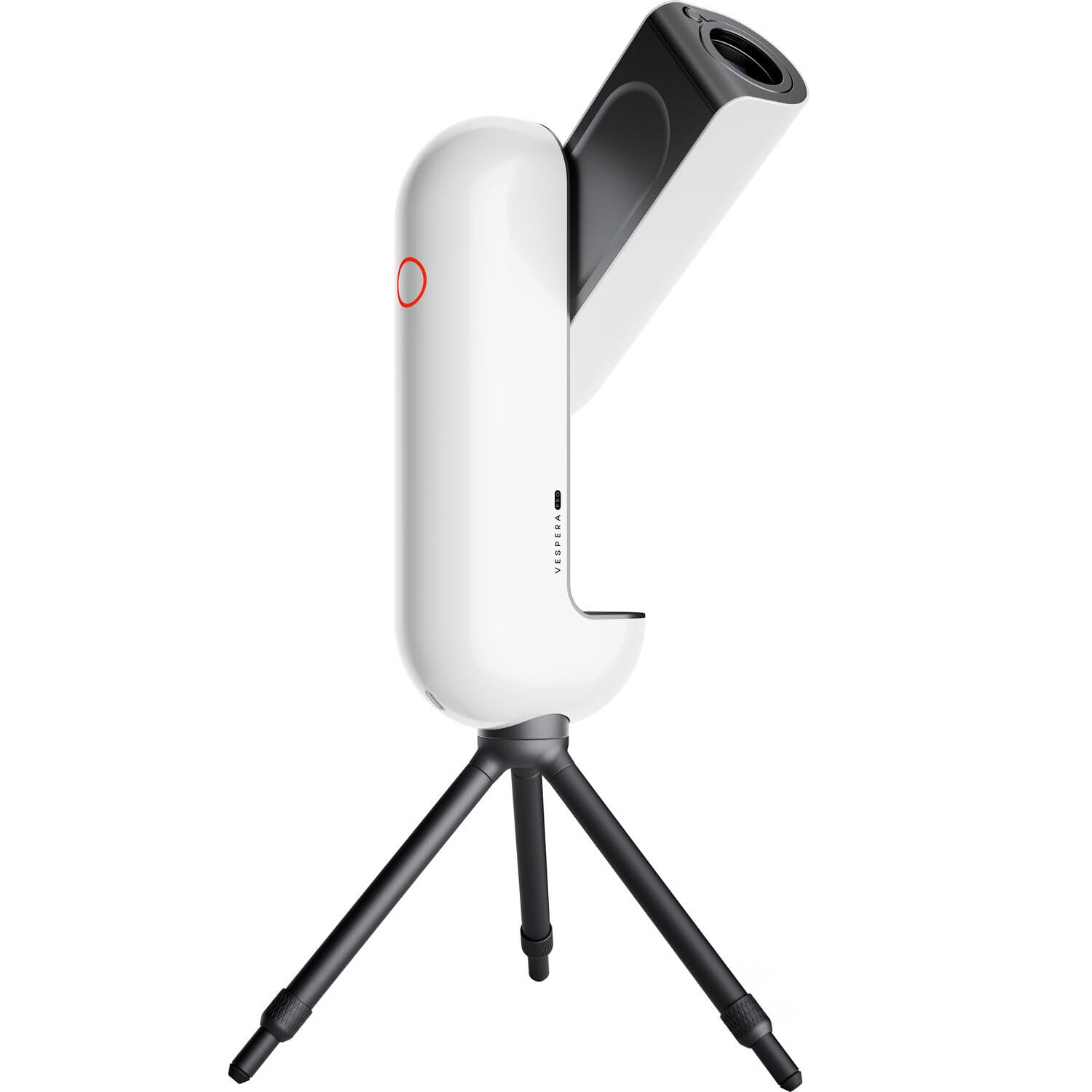
The Vaonis Vespera Pro is an observation station designed for serious astrophotographers who value automated, high-quality imaging above all else. Its Sony IMX676 Starvis 2 sensor — an ultra-high-sensitivity chip — paired with a 120mm f/4 apochromat and a custom field corrector produces fully corrected, sharp images across the entire sensor without stars becoming bloated at the edges. The CovalENS live panorama capture mode is exclusive to Vaonis and allows for real-time wide-field mosaics.
Expert Mode within the Singularity app unlocks fine control over gain, exposure, and filter settings for those who want to push beyond automatic mode. Automatic dark calibration frames are subtracted without user input, saving significant post-processing time. The included hard case and 9–10 hour battery (depending on model version) make it a capable field observatory.
The main downsides are the price — it sits at the very top of the consumer smart telescope market — and the requirement to connect directly via Wi-Fi rather than your home network, which some find inconvenient. FTP file transfer is slower than direct USB. For users prioritizing absolute image quality and a polished, integrated experience, the Vespera Pro justifies its premium position.
Why it’s great
- Highest quality Sony Starvis 2 sensor for low-noise images
- Automatic dark calibration and field correction
- Long battery life and rugged carrying case included
Good to know
- Premium price point; not budget-friendly
- Requires direct Wi-Fi connection, no home network
5. DWARFLAB Dwarf 3 Smart Telescope
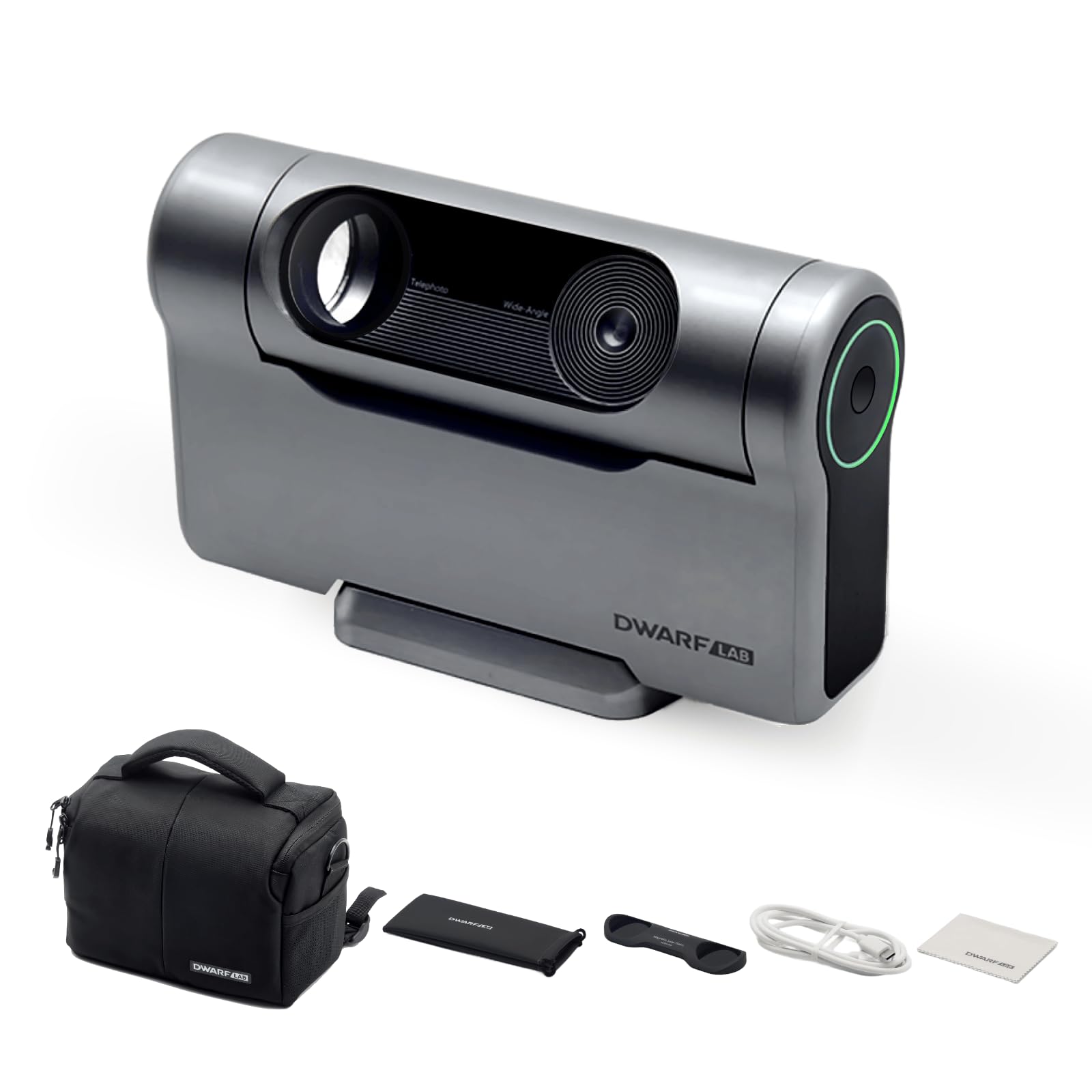
At just 3 pounds, the DWARFLAB Dwarf 3 is the world’s lightest dual-lens smart telescope. Its telephoto lens (for deep-sky and wildlife) and wide-angle lens (for Milky Way and star trail panoramas) operate through a single app interface that handles auto-tracking, image stacking, and post-processing in the cloud. The 4K auto-tracking system dynamically follows celestial and terrestrial subjects — a rare crossover capability.
Users consistently note the Dwarf 3’s excellent deep-sky results for its size: nebulas, galaxies, and star clusters are captured with surprising clarity. The app’s live stacking and denoising mean you get a shareable photo within minutes of setup. Its portability makes it the go-to for hikers and campers who want to pack a scope without sacrificing imaging quality.
The dual-lens system does introduce a compromise — each lens covers a narrower sweet spot than a single premium optic. The app, while intuitive, has occasional connectivity glitches and power drops during long processing sessions. For those prioritizing extreme portability and dual-purpose use (astronomy plus daytime telephoto), the Dwarf 3 is a standout.
Why it’s great
- Incredibly lightweight at 3 pounds — fits any backpack
- Dual lenses allow both deep-sky and daytime telephoto
- Cloud processing simplifies image enhancement
Good to know
- App can occasionally lose Wi-Fi connection during long stacks
- Each lens has a narrower high-performance range than single lens
6. DWARFLAB Dwarf Mini Smart Telescope
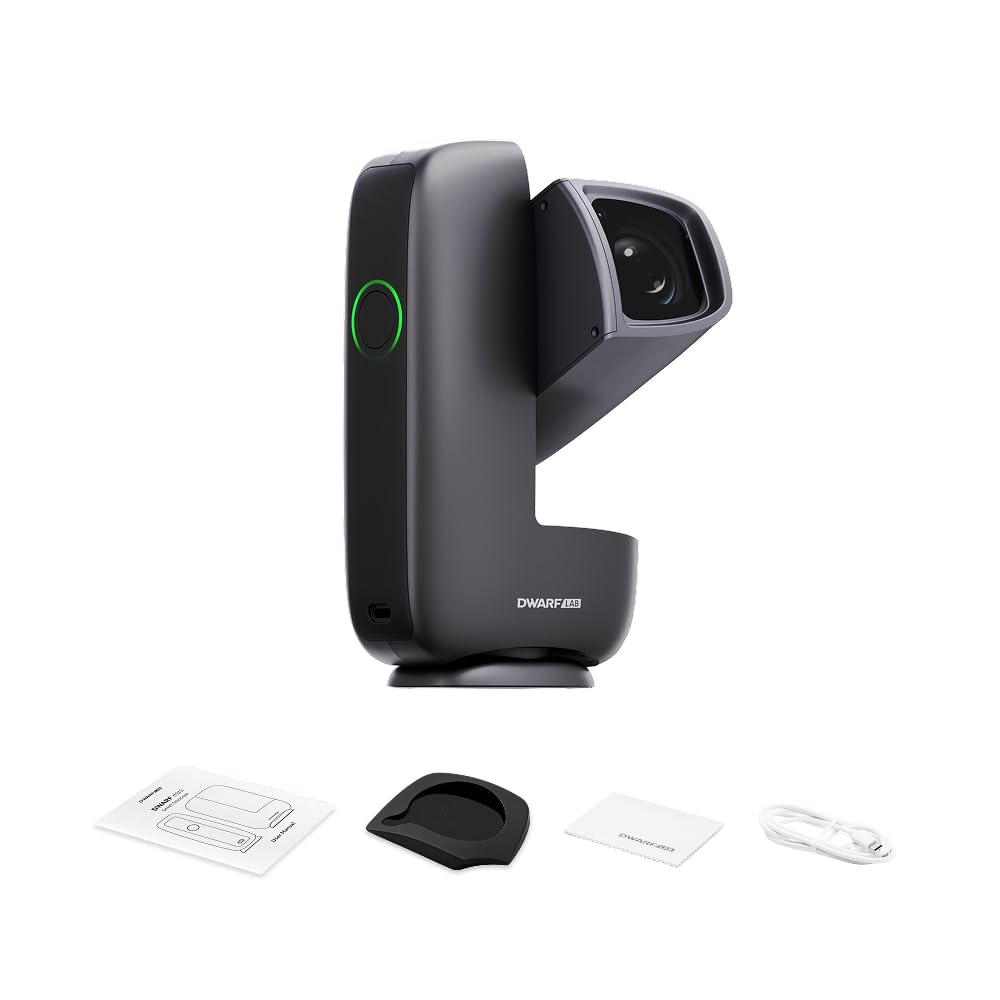
The DWARFLAB Dwarf Mini shatters expectations for what fits in a pocket. Weighing only 1.85 pounds, this smart scope incorporates a Sony IMX662 sensor, built-in light pollution filter, and dual AZ/EQ mount modes for both casual viewing and long-exposure deep-sky imaging. The auto GOTO and 360° pivot allow full-sky coverage despite its tiny footprint.
Setup is genuinely fast — users report going from unboxing to first shot in about three minutes. The app-based star map lets you select any target and the scope automatically slews and tracks. In EQ mode, the Dwarf Mini supports exposures up to 90 seconds, enabling rich captures of nebulas and star clusters that are astonishing for this size and price.
The limitations are clear: the wide field of view (2.45°) makes planetary detail impossible — Jupiter shows only as a bright blob with moons, and you won’t resolve Saturn’s rings. The small sensor and basic coating also mean it performs best under darker skies. For a grab-and-go astrophotography tool that disappears into a jacket pocket, the Dwarf Mini is unmatched.
Why it’s great
- Unbelievable portability at 1.85 pounds
- EQ mode supports 90-second exposures for nebulas
- 3-minute setup with intuitive app control
Good to know
- Wide field of view cannot resolve planetary detail
- Requires dark skies for best deep-sky results
7. Celestron 114LCM Computerized Newtonian
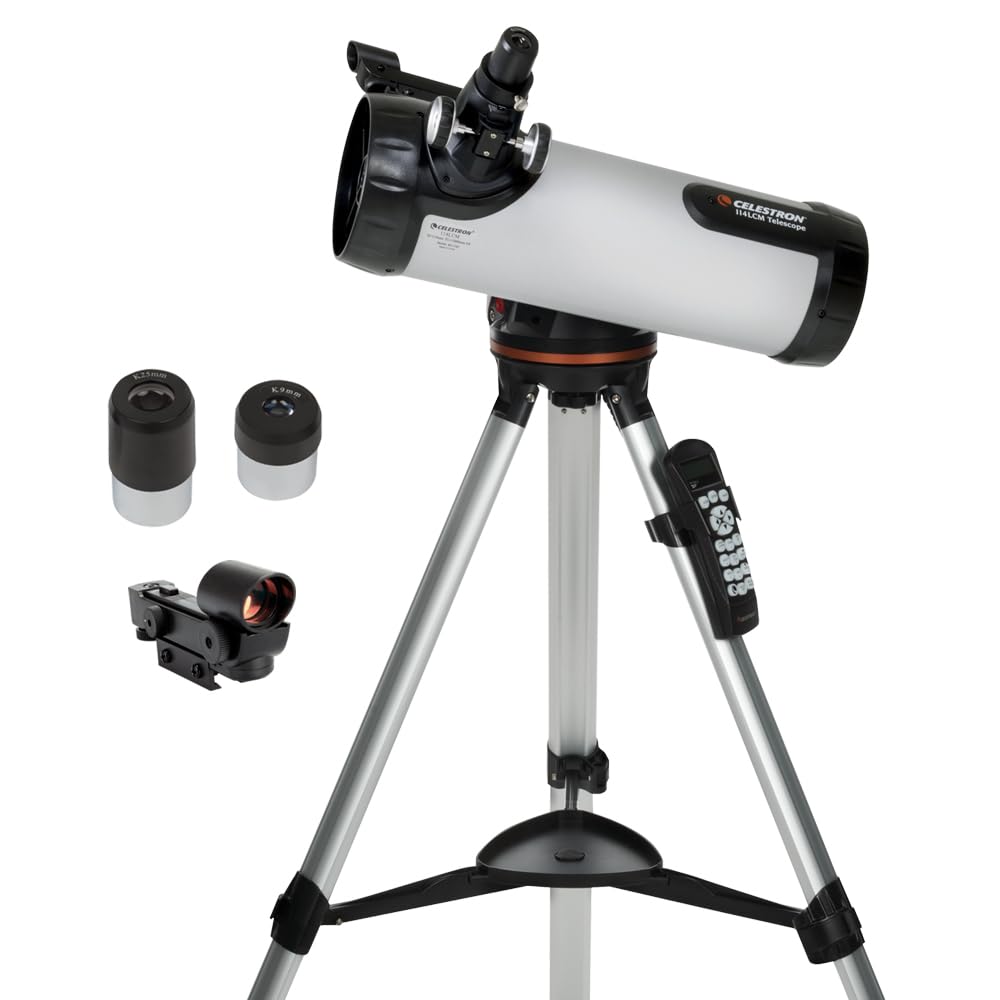
The Celestron 114LCM is a computerized Newtonian reflector designed to introduce beginners to automatic sky-surfing. Its 114mm aperture collects enough light for crisp views of the Moon, Jupiter’s moons, and bright globular clusters, while the motorized Alt-Az mount with Sky Tour button automatically generates a list of the best visible objects and slews to each one. The included StarPointer red dot finder simplifies rough aiming.
Assembly is straightforward at about five minutes, and the full-height tripod provides adequate stability. The hand controller’s 4,000-object database is more than enough for years of exploration, and the free Starry Night software adds planning capability. Users consistently report that the automated tracking works well for visual observation, making it easy to share views with family.
The 114LCM does use a Bird-Jones optical design — a spherical mirror with a corrector lens — which limits collimation flexibility and magnification potential to roughly 200x in practice. The finder scope is also awkward for taller users. Battery drain from the four AA cells is notable, and a power adapter is recommended. For a first computerized telescope on a modest budget, this is a solid entry point.
Why it’s great
- Easy assembly and intuitive GoTo for complete beginners
- Sky Tour feature removes decision paralysis
- Free Starry Night software included
Good to know
- Bird-Jones optical design limits magnification and upgrade options
- Battery-powered — AA batteries drain quickly
8. MEEZAA 150EQ Newtonian Reflector
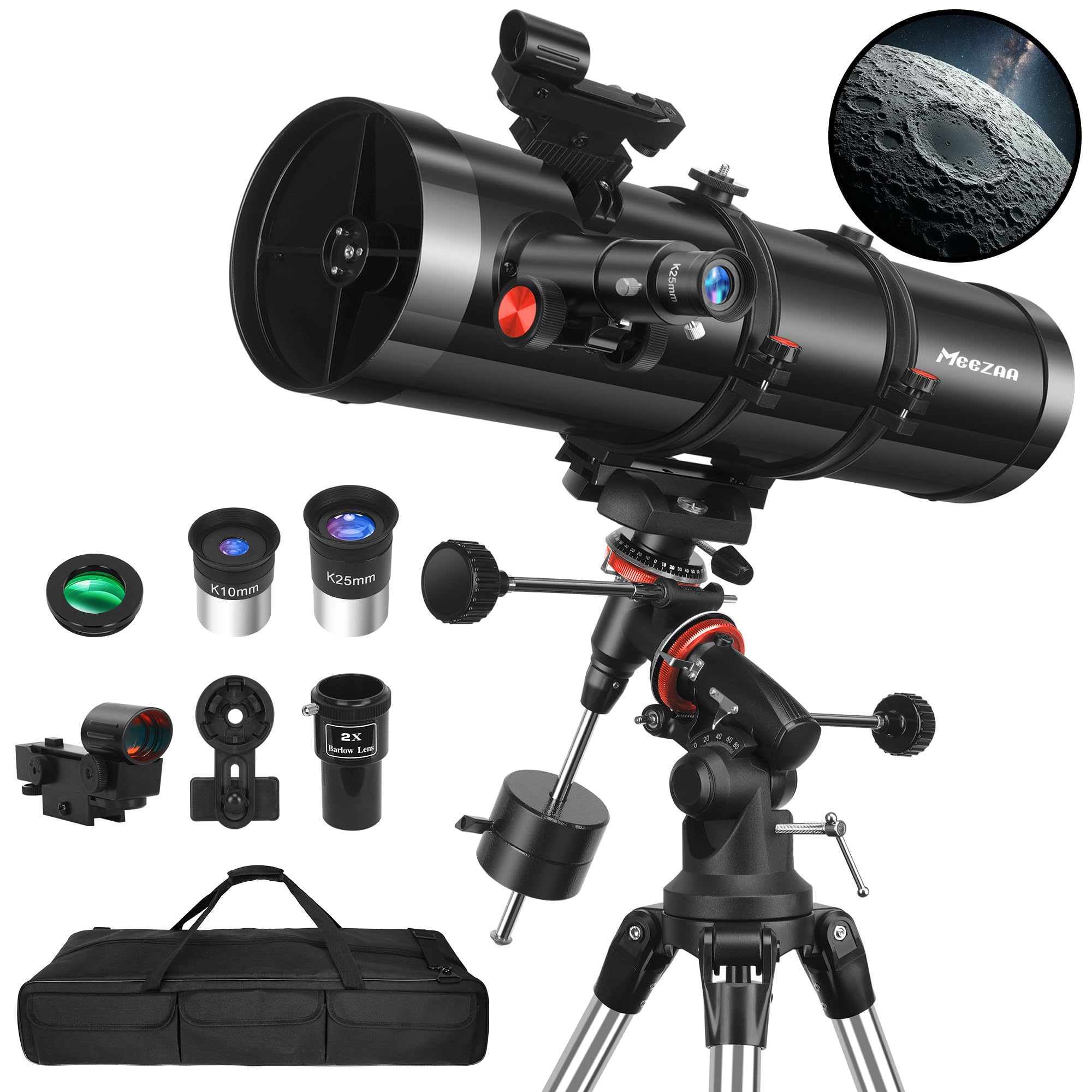
The MEEZAA 150EQ delivers the most raw aperture at its price point — a full 150mm (6-inch) parabolic mirror on a German Equatorial mount. At f/4.3, this scope is a true light bucket, pulling in detail on faint nebulas and globular clusters that smaller aperture scopes simply miss. The slow-motion control knobs on the EQ mount allow precise manual tracking once polar-aligned.
The heavy-duty stainless steel tripod and built-in accessory tray provide solid stability, and the carry bag means the entire rig can be stored and transported as a set. Users report impressive lunar and planetary clarity, with the 25mm and 10mm Kellner eyepieces offering a reasonable starting point. The included red dot finder speeds up target acquisition.
The EQ mount has a learning curve — polar alignment is required for optimal tracking, and assembly is more involved than a simple Alt-Az setup. The stock eyepieces are functional but the included Barlow lens adds noticeable softness at high power. Collimation of an f/4.3 Newtonian is also more critical than slower scopes. For users willing to learn equatorial operation, the 150EQ offers exceptional value in light-gathering capacity.
Why it’s great
- Large 150mm aperture reveals faint deep-sky objects
- German Equatorial mount provides accurate manual tracking
- Carry bag included for full kit portability
Good to know
- EQ mount requires polar alignment — steeper learning curve
- Stock eyepieces and Barlow are entry-level quality
9. Hawkko 90mm Refractor Telescope

The Hawkko 90mm refractor is a budget-conscious entry into astronomy that doesn’t skimp on the basics. Its fully multi-coated 90mm objective and 900mm focal length (f/10) deliver bright, sharp lunar and planetary views — users consistently report excellent moon crater detail and visible Jupiter cloud bands and moons. The included 25mm and 10mm Kellner eyepieces plus a 3x Barlow provide magnifications from 36x to 270x.
Assembly is remarkably simple at under 15 minutes, and the stainless steel AZ mount tripod offers smooth 360° rotation and height adjustment from 28 to 46 inches. The smartphone adapter works reliably for capturing moon and bright planet photos, and the carry bag makes transport straightforward. For absolute beginners, this kit removes most of the friction that stops people from observing.
The 90mm aperture is modest — you will see great lunar and planetary detail but faint nebulas will appear only as dim patches under suburban skies. The straight-through finder scope is less intuitive than a red dot finder, and the manual focuser can be slightly stiff until broken in. As a starter scope that lets you progress naturally, the Hawkko offers more real performance than many toy-level alternatives.
Why it’s great
- Clear, sharp lunar and planetary views with 90mm aperture
- Quick 15-minute assembly with complete accessory kit
- Included carry bag and phone adapter add real value
Good to know
- Small aperture limits deep-sky observation to brightest objects
- Straight-through finder is less beginner-friendly than red dot
FAQ
What aperture should I look for in a beginner auto telescope?
Do smart telescopes eliminate the need for a computer for astrophotography?
Can I use a GoTo telescope without a smartphone?
Final Thoughts: The Verdict
For most users, the best auto telescope winner is the Celestron NexStar 6SE because it combines proven Schmidt-Cassegrain optics with a reliable GoTo mount at a price that balances capability and value. If you want portable, app-based astrophotography with zero setup hassle, grab the ZWO Seestar S30 Pro. And for pocket-sized deep-sky imaging that rivals scopes ten times its weight, nothing beats the DWARFLAB Dwarf Mini.