
Our readers keep the lights on and the weekend projects moving. As an Amazon Associate, I earn from qualifying purchases.
If you have ever installed a pair of inexpensive car speakers and still found yourself turning the treble dial all the way down, the culprit is almost never the amplifier or the source file — it is the tweeter. A poor-quality dome or a misaligned crossover frequency produces a piercing, fatiguing “sssss” sound that ruins any listening experience. The right auto tweeters do the opposite: they present cymbals, hi-hats, and vocal sibilance with a natural sparkle that feels effortless, not aggressive.
I’m Rikta — the co-founder and writer behind FitlyFast. I have spent years analyzing driver materials, sensitivity ratings, and crossover slopes inside the car audio category, and I know exactly which build qualities separate a smooth high end from a harsh one.
This guide dissects seven very different pairs — from slim bullet designs to silk-dome reference speakers — so you can confidently choose the best auto tweeters for your specific vehicle and listening style.
How To Choose The Best Auto Tweeters
Every car audio upgrade starts with a single rule: the tweeter you pick must complement — not overpower — your woofers and the acoustic space inside your cabin. Here is exactly what to evaluate before clicking “buy.”
Diaphragm Material: Titanium, Silk, PEI, or Aluminum
The diaphragm material dictates the character of the high frequencies. Titanium and aluminum domes are loud and efficient, ideal for SPL competitions or systems that must cut through road noise in a convertible. Silk and PEI (polyetherimide) domes produce a warmer, more forgiving sound that reduces ear fatigue during long drives. For daily listening on a factory or mid-power system, silk or PEI is the safer choice unless you specifically need maximum output.
Sensitivity and Power Handling
Sensitivity (measured in dB at 2.83V) tells you how loud the tweeter gets with a given amount of power. A rating of 92 dB or higher will produce clean highs from a low-power radio, but it also makes system hiss more audible. Power handling — both RMS and peak — defines how hard you can drive the tweeter before distortion sets in. Look for an RMS rating of at least 30-40 watts for a standard aftermarket head unit, and 80-100+ watts if you pair the tweeter with an external amplifier.
Mounting Depth and Form Factor
Vehicle dashboards, sail panels, and A-pillars have very limited space behind the grille. A bullet tweeter like the PRV TW350Ti-4 Slim with a 1.32-inch mounting depth fits inside tight enclosures, while a larger dome tweeter with a deeper magnet may require custom pods or brackets. Always measure your available clearance before choosing between a surface-mount, flush-mount, or angle-mount design.
Quick Comparison
On smaller screens, swipe sideways to see the full table.
| Model | Category | Best For | Key Spec | Amazon |
|---|---|---|---|---|
| JBL Club 194T | Edge-Driven Dome | Reference clarity with factory integration | 19 mm edge-driven silk dome, 92 dB sensitivity | Amazon |
| Rockford Fosgate P1T-S | PEI Dome | Natural high-end with adjustable output | 1 inch PEI dome, 60W RMS, 12dB/octave crossover | Amazon |
| KICKER 46CST204 | Titanium Dome | Bright, detailed highs on factory power | 0.75 inch titanium dome, 6dB/octave inline crossover | Amazon |
| PRV AUDIO TW150SD-4 | Soft Dome | Critical listening, non-fatiguing sound | 32 mm silk dome, 94 dB sensitivity, neodymium magnet | Amazon |
| Pioneer TS-T110 | Hard Dome | Easy add-on to factory head units | 7/8 inch hard dome, 120W max, 2500-30kHz frequency range | Amazon |
| RECOIL TW250 | High-Compression Bullet | High SPL and loudness in competition builds | 1 inch aluminum diaphragm, 400W max pair, 1-inch Kapton voice coil | Amazon |
| PRV AUDIO TW350Ti-4 Slim | Slim Bullet | Ultra-slim mounting in shallow panels | 3.5 inch titanium bullet, 1.32 inch mounting depth, 4 ohm | Amazon |
In‑Depth Reviews
1. JBL Club 194T Edge-Driven Dome Tweeter

The JBL Club 194T uses an edge-driven silk dome design that allows the diaphragm to flex more freely than a conventional dome, producing exceptionally smooth off-axis response. With 92 dB sensitivity at 2.83V and a 50W RMS power rating, these tweeters deliver natural vocal presence without the metallic harshness common in cheaper designs. The 3 kHz crossover point is well-chosen for most component systems, preserving the upper midrange warmth while handing off the highest frequencies cleanly.
The standout feature here is the Starfish mounting system — six break-off tabs that pivot and snap into place, allowing the tweeter to sit behind factory grilles in a huge variety of vehicles. Combined with flush-mount, surface-mount, and angle-mount cups, this kit offers the most versatile install flexibility at this tier. The 3 ohm nominal impedance is slightly lower than standard 4 ohm tweeters, which may increase total system output slightly when paired with a compatible amplifier.
Real-world feedback confirms that the Club 194T is a transparent upgrade from stock Lexus and Toyota factory tweeters in everything from a 1999 4Runner to a 2007 Chrysler 300C. The silk dome prevents listener fatigue even at high volume, and the built-in inline crossover includes a pigtail that simplifies direct connection to factory wiring. The only note is that Amazon packaging has occasionally crushed the outer box, though the drivers themselves remain undamaged.
Why it’s great
- Edge-driven silk dome eliminates harsh, fatiguing highs
- Universal Starfish mounting system fits behind most factory grilles
- Complete mounting kit with flush, surface, and angle options
Good to know
- 3 ohm impedance requires compatible amplifier for optimal power transfer
- Packaging can be damaged in transit due to thin box
2. Rockford Fosgate P1T-S Punch Tweeter Kit

The Rockford Fosgate P1T-S Punch tweeter uses a 1-inch PEI dome diaphragm — a material that strikes a careful balance between the warmth of silk and the output of metal. The outboard crossover offers three attenuation settings (0 dB, -2 dB, and -4 dB), giving you fine control over how much treble reaches the dome. This is a feature usually reserved for much more expensive component sets, and it makes system tuning far easier than relying on an inline capacitor alone.
Power handling sits at 60 watts RMS and 120 watts peak, which is more than enough for a 50-75 watt RMS amplifier channel. The high-pass crossover is set at 3.5 kHz with a 12 dB per octave Butterworth slope — steep enough to protect the dome from damaging mid-bass energy while still allowing the upper midrange to breathe. Build quality is standard Rockford: die-cast aluminum frame, solid terminal tabs, and three mounting bezels (flush, surface, and angle) covered by a one-year warranty.
Users consistently report that the P1T-S “wakes up” the entire sound system, raising the soundstage from the footwells to ear level. In Ford F-150 and Toyota Tacoma installations, the -2 dB or -4 dB setting proved ideal for a natural, non-fatiguing sound that rivals more expensive tweeters. The trade-off is the physical size — the tweeter body is larger than a typical 1-inch dome, and fitting it into a factory dashboard hole often requires minor bracket modification or a small adapter plate.
Why it’s great
- Three-level output attenuation for precise system integration
- PEI dome delivers natural clarity without metallic harshness
- 12 dB/octave Butterworth crossover protects against distortion
Good to know
- Larger body may not fit factory slots without bracket modification
- Nominal 4 ohm rating measures slightly lower at DC resistance
3. KICKER 46CST204 CS-Series Tweeter

The KICKER CS-Series 46CST204 is a 0.75-inch titanium dome tweeter engineered for maximum detail retrieval. Titanium is stiffer than PEI or silk, which means it can reproduce high frequencies with exceptional transient speed — think fast hi-hats and sharp cymbal crashes. KICKER pairs the dome with a neodymium magnet that keeps the overall package lightweight while delivering the magnetic force necessary for high output even from a low-power factory head unit.
A built-in poly-switch protector adds a layer of safety: if you push the tweeter too hard, the switch opens to prevent voice coil damage, then resets automatically once the temperature drops. The 6 dB per octave inline crossover is simple but effective — it blocks frequencies below the crossover point without adding the insertion loss of a more complex network. This design keeps the tweeter compatible with almost any system that has a speaker-level output, including base-model radios without dedicated tweeter channels.
Real-world integration is straightforward in Honda Ridgelines, Ford trucks, and Toyota Tacomas, though the magnet and capacitor housing on some earlier versions required trimming the factory bracket for a clean fit. Once installed, the CS-Series adds the “air” and “sparkle” that stock speakers lack. The titanium character can become fatiguing if the tweeter is aimed directly at the listener at ear level — angling it slightly away or reducing treble on the head unit solves this easily.
Why it’s great
- Titanium dome reveals micro-details in cymbal and vocal sibilance
- Poly-switch protector prevents damage from accidental overpowering
- Neodymium magnet keeps weight low and sensitivity high
Good to know
- Titanium character can sound metallic if aimed directly at listeners
- Some vehicle brackets need modification to clear the magnet housing
4. PRV AUDIO TW150SD-4 Soft Dome Tweeter
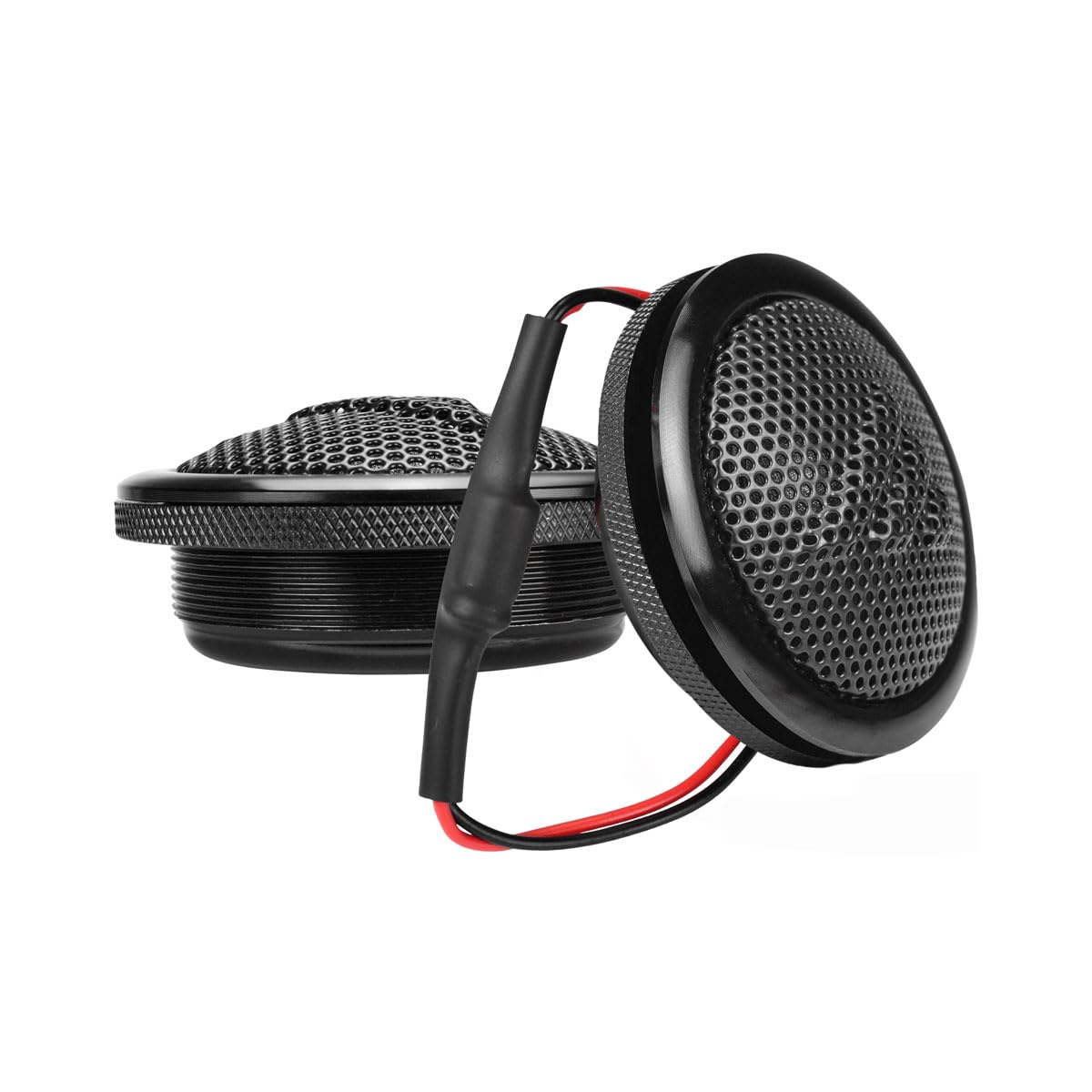
The PRV AUDIO TW150SD-4 is a 32 mm soft silk dome tweeter purpose-built for listeners who prioritize smoothness over sheer output. Its 94 dB sensitivity rating is among the highest at this price tier, meaning it produces clear, loud highs from even a modest 20-40 watt radio signal. The neodymium magnet keeps the entire driver shallow enough to fit inside factory 2-inch tweeter pods in vehicles that already have a dedicated tweeter location.
A built-in inline capacitor acts as a simple high-pass filter, rolling off low frequencies below approximately 2 kHz. This allows the tweeter to integrate with full-range speakers without an external crossover, though serious system builders will likely want to add a proper passive or active crossover for steeper filtering. The 240-watt power handling is generous for the driver size — you can feed these tweeters clean amplifier power well above 70 watts RMS before they begin to complain, as long as the crossover is set appropriately.
Veteran car audio enthusiasts with 35 years of experience have called the TW150SD-4 the best tweeter they have ever owned for critical listening. The silk dome produces a rounded, “liquid” high end that never sounds shrill, even with complex musical passages. The downside is the lack of gaskets and an exposed wire hole on the back, and two separate owners reported a loose wire from the factory — a quality-control variance that is worth checking immediately upon arrival.
Why it’s great
- Silk dome produces warm, non-fatiguing highs for long listening sessions
- Ultra-high 94 dB sensitivity works perfectly with low-power radios
- Shallow 2-inch form factor fits most factory tweeter locations
Good to know
- No gaskets or wire holes — may require sealing during install
- Intermittent quality control reports with loose wiring from the factory
5. Pioneer TS-T110 7/8″ Hard Dome Tweeter

The Pioneer TS-T110 is a 7/8-inch hard dome tweeter with a frequency response that extends from 2,500 Hz to 30,000 Hz — well beyond the 20 kHz hearing limit, which ensures the driver is operating well within its comfort zone for all audible high frequencies. The 90 dB sensitivity rating is slightly below the 92-94 dB range of more efficient options, but it pairs well with Pioneer’s own head units and amplifiers that can supply clean power above 20 watts RMS.
The mounting flexibility is a strong point for the TS-T110: flush-mount, surface-mount, and angled mounting hardware are included, along with the necessary fasteners and a basic inline capacitor for crossover duty. The package weight is only 4 ounces per pair, making these tweeters one of the lightest options available — ideal for applications where unsprung weight or panel reinforcement is a concern. The hard dome diaphragm is consistent and durable, but it does exhibit a mild break-in period of about two weeks during which the sound can initially seem subdued.
Real-world installations in Ford F-250 trucks and general DIY builds confirm that the TS-T110 adds a significant high-frequency extension over stock speakers without sounding tinny or brittle. The bundled inline capacitor allows a direct connection to any speaker-level output, eliminating the need for a separate crossover. The included mounting brackets and adhesive pads are serviceable, but the instructions are sparse — owners recommend planning a custom bracket if you want a perfect factory look.
Why it’s great
- Ultra-wide 30 kHz frequency response ensures clean high-end performance
- Light 4 oz pair weight is easy to mount without reinforcing panels
- Includes flush, surface, and angled hardware for flexible installation
Good to know
- 90 dB sensitivity requires more power than similarly priced options
- Initial sound is subdued; needs a two-week break-in for balanced output
6. RECOIL TW250 High-Compression Bullet Tweeter

The RECOIL TW250 is a high-compression bullet tweeter designed for one primary purpose: extreme loudness. The 1-inch aluminum diaphragm is coupled to a 1-inch high-temperature Kapton voice coil that handles 200 watts RMS and 400 watts peak per pair — numbers that would destroy a typical dome tweeter in seconds. This power handling, combined with the inherent efficiency of a compression driver, allows the TW250 to keep up with high-SPL subwoofer systems without breaking a sweat.
The die-cast aluminum frame reduces resonance and provides a rigid mounting platform. An included inline capacitor acts as a high-pass filter to block low frequencies and lower distortion, though at this power level a proper passive crossover or active DSP crossover is strongly recommended to set the correct high-pass slope. The 4 ohm impedance keeps the tweeter compatible with most car audio amplifiers, and the compact bullet shape makes aiming and locating the tweeter in kick panels or A-pillars straightforward.
Users who installed the TW250 in a 2024 Cadillac Escalade and a variety of competition builds confirm that these tweeters are “very loud” and “great” for the price. The high-frequency output is deliberate and forward — this is not a tweeter for someone who wants subtle, laid-back highs. The magnetic structure is powerful, so keep metal tools and debris away during installation. The voice control claim in the listing appears to be a metadata error; these are passive wired tweeters with no Bluetooth or voice functionality.
Why it’s great
- Massive 400W peak power handling for high-SPL competition systems
- High-compression bullet design delivers extreme output efficiency
- Die-cast aluminum frame minimizes flex and panel vibration
Good to know
- Very loud and forward — not suitable for listeners wanting relaxed highs
- Inline capacitor is minimal; a proper crossover is recommended for best sound
7. PRV AUDIO TW350Ti-4 Slim Bullet Tweeter

The PRV AUDIO TW350Ti-4 Slim is a 3.5-inch titanium bullet tweeter that solves the single biggest install problem in car audio: lack of depth. With a mounting depth of only 1.32 inches, this tweeter fits inside door panels, sail panels, and dashboard locations where a standard dome or bullet would simply not clear the window track or interior trim. The titanium diaphragm on a Kapton former delivers the crisp, articulate highs that PRV is known for, while the cast aluminum frame keeps structural resonance under control.
Despite the shallow profile, the TW350Ti-4 weighs only 1.14 pounds per tweeter and is rated for 240 watts of power handling — enough to keep up with an aggressive mid-bass setup. The 4 ohm impedance matches standard amplifier outputs, and the bullet waveguide provides focused, directional high frequencies that can be aimed directly at the listening position. This is a pro-audio application tweeter; it is designed to be loud, clear, and efficient, with no compromises for “smoothness” — it is a bullet tweeter, and it behaves like one.
Real-world reports from a 5th-gen Prius LE show that these tweeters can completely transform a factory sound system when added as a DIY component setup with separately mounted mid-bass drivers. Owners describe the sound as “loud and clear” and “super loud,” which is the expected character of a titanium bullet. The slim profile makes it a top choice for custom builds where space is at a premium, but the focused nature of the beam means that aiming is critical — a toe-in angle of 10-15 degrees toward the opposite seat often yields the best balance.
Why it’s great
- Ultra-slim 1.32-inch mounting depth fits tight door and dash panels
- Titanium diaphragm and Kapton former deliver high output and durability
- 240W power handling supports moderate amplifier power levels
Good to know
- Bullet design is directional — careful aiming is required for best soundstage
- Not designed for smooth or laid-back listening; it is focused and loud
FAQ
What is the difference between a bullet tweeter and a dome tweeter?
Can I install auto tweeters without an external crossover?
How do I choose the right impedance for my car audio tweeters?
Why do my new tweeters sound harsh or tinny?
Final Thoughts: The Verdict
For most users, the best auto tweeters winner is the JBL Club 194T because its edge-driven silk dome produces warm, non-fatiguing highs while the universal Starfish mounting system fits virtually any vehicle with minimal modification. If you want the ability to fine-tune your treble level with the turn of a switch, grab the Rockford Fosgate P1T-S and enjoy its adjustable outboard crossover. And for high-SPL systems where raw output is the priority, nothing beats the RECOIL TW250 — a true compression driver that keeps clean at competition-level volume.