
Our readers keep the lights on and the weekend projects moving. As an Amazon Associate, I earn from qualifying purchases.
The shift from a cafe’s back counter to your own kitchen counter used to mean accepting a steep drop in shot quality. Modern automatic commercial espresso machines now challenge that compromise, delivering dual boilers, PID precision, and programmable preinfusion in a footprint that fits under standard cabinets. The real decision is no longer whether the hardware can pull a balanced shot — almost all of them can — but which combination of workflow automation, repairability, and thermal stability matches your daily volume.
I’m Rikta — the founder and writer behind FitlyFast. I’ve spent years dissecting the internal architecture, pump specifications, and real-world durability data of pro-sumer espresso equipment to separate marketing gloss from genuine engineering.
This guide cuts through the noise to compare nine machines that define the current sweet spot of automatic commercial espresso technology. Whether you prioritize a dedicated touchscreen for milk-based drinks, a manual E61 group for total control, or a dual-grinder setup for households with different caffeine preferences, the following reviews break down exactly what each model delivers. Finding the right automatic commercial espresso machine means matching these specs to your real daily workflow, not just the highest PID number on the spec sheet.
How To Choose The Best Automatic Commercial Espresso Machine
Three variables separate a machine that becomes a daily workhorse from one that frustrates every morning: thermal control architecture, pump type, and the balance between automation and user control. Each directly impacts shot quality, maintenance frequency, and long-term durability in a commercial or high-end home setting.
Thermal Architecture: Heat Exchanger vs. Dual Boiler
A heat exchanger (HX) machine uses a single boiler to generate steam and a submerged tube that passes brew water through the steam boiler. This allows simultaneous brewing and steaming but creates thermal variability — the brew water temperature fluctuates based on the steam boiler’s state. Dual-boiler machines dedicate separate boilers for brew (typically 300ml–500ml) and steam (1L+). Each circuit uses an independent PID controller, delivering brew water temperature stability within ±1°F regardless of steam load. For volume above two to three milk drinks per session, dual-boiler architecture is the safer bet for reproducible shot quality.
Pump Type: Vibe vs. Rotary
Vibratory (vibe) pumps are compact, affordable, and standard in most entry-level pro-sumer machines. They produce a characteristic buzzing sound and typically deliver 15 bars of pressure. Rotary pumps are quieter, last significantly longer, and maintain consistent pressure across long extraction sequences. More importantly, a rotary pump allows the machine to be plumbed directly into a water line instead of relying on a refillable reservoir. For any installation serving more than ten shots per day, a rotary pump with plumbing capability reduces refill labor and extends service life.
Automation Level and Milk System
Fully automatic machines handle grinding, dosing, tamping, and extraction with a single button press, and many include an automatic steam wand that froths milk to a set temperature. This reduces the skill barrier but also removes the user’s ability to troubleshoot channeling or adjust preinfusion mid-shot. Semi-automatic and manual machines (often with an E61 group head) require the operator to dose, tamp, and start/stop the shot manually. For a commercial environment with rotating staff, full automation reduces training time. For a dedicated operator chasing nuanced espresso profiles, manual control offers superior adjustability.
Quick Comparison
On smaller screens, swipe sideways to see the full table.
| Model | Category | Best For | Key Spec | Amazon |
|---|---|---|---|---|
| Jura GIGA 10 | Fully Automatic | Cold brew & dual grind | Two 10-oz ceramic disc grinders | Amazon |
| Jura J8 twin | Fully Automatic | Two-bean flexibility | Two conical grinders, 31 beverages | Amazon |
| Rocket R58 Cinquantotto | Semi-Automatic | Plumbable dual boiler | Rotary pump, PID, heat exchanger | Amazon |
| Breville Oracle Touch BES990 | Super-Automatic | Automated tamp & froth | Auto dose/tamp, dual boiler, touchscreen | Amazon |
| Miele CM 6160 | Fully Automatic | OneTouch for two | 1.8L tank, WiFiConnect, 8-cup pot | Amazon |
| Rancilio Silvia Pro X | Semi-Automatic | Industrial build quality | Dual boiler, PID, programmable preinfusion | Amazon |
| Diletta Bello+ | Semi-Automatic | PID temp control | E61 group, PID, shot timer, eco mode | Amazon |
| Rocket Appartamento Nera | Semi-Automatic | Compact footprint | 1.8L HX boiler, vibration pump | Amazon |
| Breville Oracle Touch BES990D | Super-Automatic | Color & convenience | Auto dose/tamp, dual boiler, touchscreen | Amazon |
In‑Depth Reviews
1. Jura GIGA 10 Diamond Black

The GIGA 10 sits at the summit of Jura’s engineering, pairing two 10-ounce bean containers with electronically adjustable ceramic disc grinders — a level of redundancy that eliminates the need to empty and swap beans between caffeine and decaf or between different roast profiles. Each grinder uses Automatic Grinder Adjustment to maintain consistent particle size across the entire hopper drawdown, which is critical when the machine is serving 35 different beverage options including genuine cold brew via the Cold Extraction Process.
The 6.7-inch Panorama touchscreen streamlines selection across those 35 specialties, and the eighth-generation brew unit with 3D Brewing Technology saturates the puck more evenly than previous generations. Owners report exceptional durability, with some units exceeding 13 years of service before needing repair. The Pulse Extraction Process and Intelligent Preheating ensure that even the first shot of the morning lands at the correct brew temperature without a long warm-up flush.
For a commercial operation or a high-volume home kitchen serving multiple drink types daily, the GIGA 10’s dual independent grinders and cold-brew capability justify the investment. The primary limitations are its height — the display positioning can interfere with extra-tall tumblers like a 20-ounce Yeti — and the reality that high-end Jura repairs can be expensive once the warranty expires.
Why it’s great
- Two independent ceramic disc grinders with auto-adjustment for separate beans.
- Genuine cold brew via Cold Extraction Process, not just room-temperature water.
- 35 beverage options with large touchscreen interface.
Good to know
- Expensive out-of-warranty repairs reported by some owners.
- Spout clearance may not fit very tall cups or travel mugs.
- High initial investment compared to semi-automatic alternatives.
2. Jura J8 twin Diamond Black

The J8 twin is the first Jura to offer two separate conical grinders in a relatively compact chassis — each dedicated to its own bean hopper. This is the ideal solution for households or small offices where one person drinks caffeine and another needs decaf, or where a light roast and a dark roast live side by side. The Sweet Foam function creates a denser, microfoam-style milk texture than standard automatic frothers, and the Pulse Extraction Process squeezes more soluble solids from the puck without over-extracting.
The 6.7-inch Panorama touchscreen controls 31 beverage options, and the machine supports programmable grind consistency, strength, volume, and milk ratio per saved profile. Owners consistently rate the espresso quality as equal to or better than dedicated semi-automatic setups, and the dual-grinder flexibility is frequently cited as a game-changer for mixed-caffeine households. The unit’s footprint is surprisingly small for a twin-grinder machine, fitting under standard cabinets without issue.
The J8 twin does not include an auto-on timer — users must manually power it up or use an external smart plug. Maximum cup size is around 8 ounces for single beverages, so those who prefer large mugs will need to run a double shot or brew into a preheated cup. Long-term reliability is strong, with many owners citing 6–10 years of trouble-free use.
Why it’s great
- Two independent conical grinders for separate bean types.
- Sweet Foam function produces barista-quality milk texture automatically.
- Compact footprint for a twin-grinder fully automatic machine.
Good to know
- No built-in programmable auto-on timer.
- Max single cup volume around 8 ounces.
- Milk system requires dedicated chiller for fully closed operation.
3. Rocket Espresso R58 Cinquantotto Stainless Steel

The R58 Cinquantotto is engineered for the user who wants commercial-grade plumbing capability without the footprint of a full cafe machine. A rotary pump allows direct water line connection, eliminating the need to refill a reservoir — a decisive advantage for any location pulling more than 20 shots per day. Separate brew and steam boilers, each controlled by a dedicated PID, maintain temperature within ±1°F regardless of steam draw, something a heat-exchanger machine cannot match.
The detachable touchscreen PID is a thoughtful touch: you can adjust brew and steam temperatures without lifting the machine, and the mirrored shot timer is visible without breaking the classic Rocket aesthetic. The machine heats up in about 5 to 10 minutes, and the steam wand has the power to texture alternative milks (almond, oat, coconut) with ease — a detail that matters in mixed-diet commercial environments.
Some users report persistent black deposits from the boilers during the first few months, which Rocket attributes to factory residual testing water; the deposits typically clear with filtered water use. Brew head clearance is tight — a bottomless portafilter plus a scale may not fit simultaneously — and the stock preinfusion is hard-wired rather than fully adjustable. For plumbed-in installations where consistency and repairability matter more than programmability, the R58 is a standout.
Why it’s great
- Rotary pump with optional plumbing for direct water line connection.
- Independent dual boilers with individual PID control.
- Excellent steam power for alternative milks.
Good to know
- Limited brew head clearance for scale and bottomless portafilter.
- Hard-wired preinfusion — not user-programmable.
- Some units show initial black deposits from factory testing water.
4. Breville Oracle Touch BES990 (Damson Blue)

The Oracle Touch eliminates the two biggest variables that ruin home espresso: inconsistent dose weight and uneven tamping. Its integrated precision conical burr grinder automatically doses 22 grams into the 58mm portafilter and tamps with a consistent force every time. Combined with a dual-boiler PID system, the machine delivers brew water temperature stability that rivals much more expensive prosumer setups. The touchscreen interface walks the user through five pre-programmed favorites plus eight customizable profiles, covering espresso, long black, latte, flat white, and cappuccino with a single swipe.
The Over Pressure Valve caps extraction pressure to prevent bitterness, and the low-pressure preinfusion ramps up gradually to expand the coffee bed before full pressure hits — a sequence that minimizes channeling in medium to dark roasts. Owners consistently praise the speed: a single milk-based drink is ready in under one minute from cold start, helped by the auto-on timer. The automatic steam wand textures milk to a set temperature, producing microfoam sufficient for latte art, though some experienced baristas note it still falls slightly short of manual steaming density.
Reliability reports are mixed. While many owners report years of trouble-free use, a subset experiences pump rattle, boiler leaks, or touchscreen timeout issues within the first 18 months. Breville’s two-year warranty covers parts and labor, but some users report slow turnarounds on repairs. The drip tray has tight crevices that require careful cleaning, and the lack of a plumb-in option means the 67-ounce reservoir must be refilled manually. For the price, however, the combination of automated dosing, tamping, and steaming is unmatched in this class.
Why it’s great
- Automated grinding, dosing, and tamping for repeatable extraction.
- Dual-boiler PID provides temperature stability on par with higher-priced machines.
- Touchscreen saves up to eight personalized drink profiles for quick recall.
Good to know
- Some durability concerns with pump and boiler components over time.
- Not plumbable — relies on 67-ounce reservoir.
- Drip tray design has hard-to-clean corners.
5. Miele CM 6160 MilkPerfection Obsidian Black
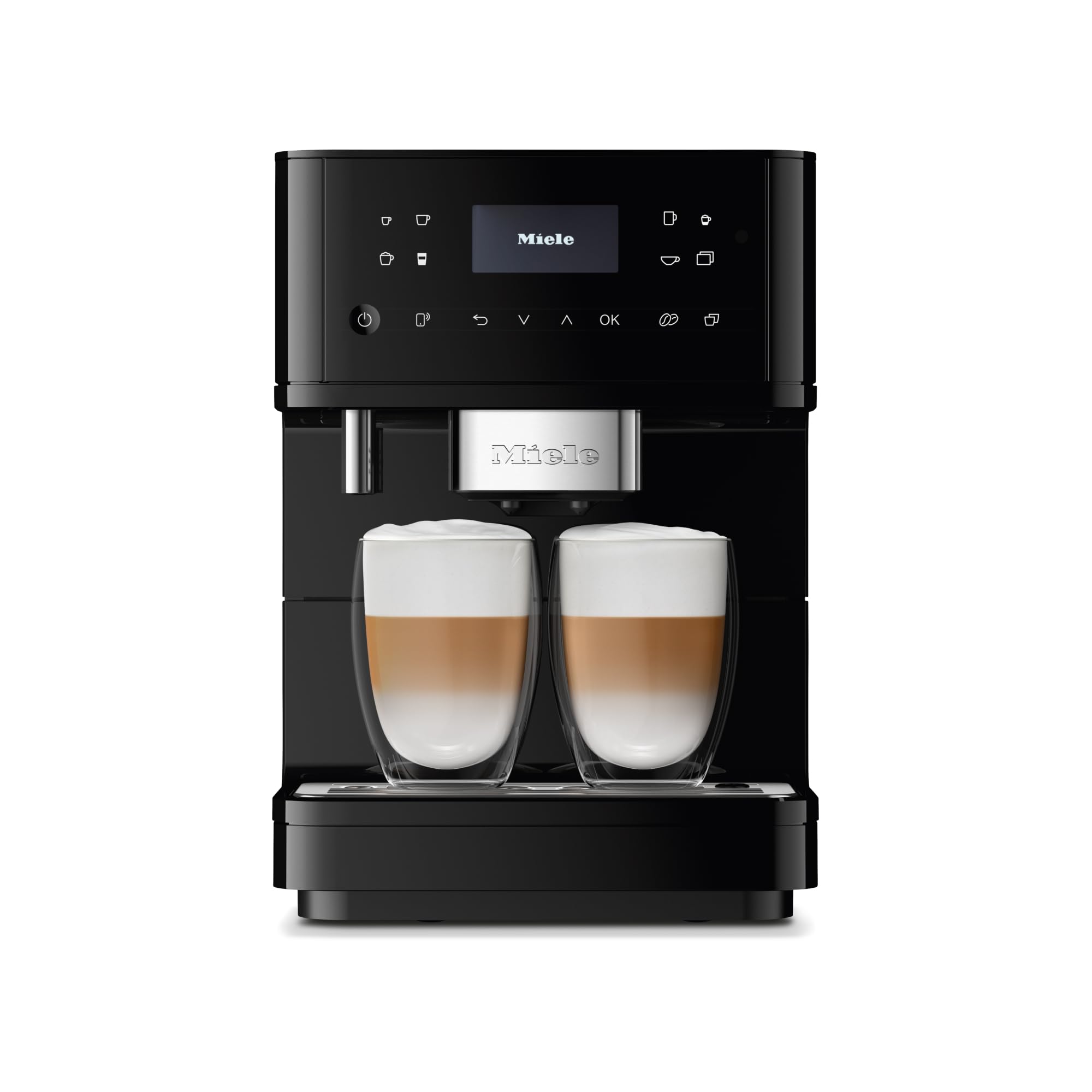
The CM 6160 is Miele’s fully automatic entry aimed at users who want reliable daily coffee without manual intervention. The AromaticSystem controls a wear-resistant steel grinder and dynamic brewing to maximize flavor solubles, while the OneTouch for Two function prepares two of any drink — espresso, cappuccino, latte macchiato — simultaneously. The WiFiConnect feature lets you schedule brewing from a smartphone, and the DoubleShot function doubles the volume of any single beverage without requiring a second cycle.
Milk foam quality is a highlight: the dual-pipe system delivers dense, consistent microfoam that outperforms most single-pipe automatic frothers. The machine can also brew up to eight cups using the optional coffee pot accessory, making it viable for small office settings. The 1.8-liter water tank is generous, and the self-cleaning milk circuit reduces daily maintenance to a quick rinse of the stainless steel straw.
Critical issues appear in a minority of units: some owners report persistent “close the door” error messages shortly after purchase, and Miele’s customer service requires a prepaid fee for in-warranty repairs. The machine’s height and design require pulling it out from under upper cabinets to access the top-fill water tank, which adds friction to daily use. For those who get a fully functional unit, the CM 6160 is a quiet, competent performer that pays for itself within a year compared to daily cafe visits.
Why it’s great
- OneTouch for Two makes efficient milk-based drink production.
- Superior dual-pipe milk frothing system for dense microfoam.
- WiFi connectivity for remote scheduling and monitoring.
Good to know
- Early software/design defects reported in some units.
- Miele support often requires upfront payment for diagnostics.
- Water tank access requires sliding the machine out from under upper cabinets.
6. Rancilio Silvia Pro X Stainless Steel

The Silvia Pro X is Rancilio’s answer to the dual-boiler prosumer segment, and it arrives with a build philosophy borrowed from the commercial Classe series. The 1-liter steam boiler and 300ml brew boiler operate independently, each governed by a dedicated PID. This means you can pull a shot while steaming milk without any temperature drift — a capability that was once limited to machines costing twice as much. The soft preinfusion is adjustable from 1 to 6 seconds, giving the operator control over how the water saturates the puck before full pressure hits.
The portafilter is the upgraded stainless steel model from the Rancilio Specialty line, with the same lugs and depth as the commercial parts — no proprietary sizing to complicate replacements. The solenoid valve leaves a dry puck after every shot, and the steam power is noticeably faster than the Gaggia Classic Pro or the base Silvia. Owners consistently describe the Pro X as a “buy-it-for-life” machine, with brass internal components, a stainless steel frame, and a simple service architecture that an experienced user can maintain without a dealer visit.
It does not include a rotary pump, so it cannot be plumbed in — you will refill the 1-liter brew boiler reservoir and the water tank manually. The auto-on timer is a timed countdown rather than a clock-based schedule, which limits flexibility for users with irregular morning routines. The machine also lacks a dedicated hot water spout, though the steam wand can be used to dispense hot water via a separate cycle. For the user who values repairable industrial build quality and PID-controlled dual boilers, the Pro X is the strongest value in its class.
Why it’s great
- Commercial-grade internal components — brass boilers, stainless steel frame.
- Adjustable 1–6 second preinfusion improves shot consistency.
- Rapid steam boiler with dedicated PID for on-demand milk texturing.
Good to know
- Vibe pump limits to tank-only operation — not plumbable.
- Auto-on uses a timed countdown, not a programmable clock.
- Lacks a dedicated hot water spout; must use steam wand cycle.
7. Diletta Bello+ Espresso Machine Black

The Bello+ marries a traditional E61 group head — the gold standard for thermal stability in semi-automatic machines — with a modern PID controller that displays and adjusts steam boiler temperature in real time. The front-facing PID screen doubles as a shot timer, helping the operator track extraction duration without a separate scale. Programmable preinfusion up to 10 seconds allows for gentle puck saturation before full pump engagement, which can significantly reduce channeling in lightly roasted or fresh coffees.
The machine is built by hand in Milan using a stainless steel frame, case, and boiler, and the cool-touch steam wands pivot through a wide arc for easy positioning. A new low-power eco mode drops the boiler temperature when idle while allowing faster recovery than a full cold start — a practical energy-saving feature for businesses that only serve coffee during certain hours. The standard 58mm portafilter and non-proprietary baskets mean replacement parts are easy to source.
The Bello+ is a heat-exchanger machine, not a dual boiler. The drip tray is relatively small and can overflow during extended backflushing. Owners report that pairing the Bello+ with a quality burr grinder and taking time to dial in the grind yields espresso that rivals machines in a higher price tier.
Why it’s great
- Hand-built E61 machine with PID temperature visibility.
- Programmable preinfusion up to 10 seconds for gentle puck saturation.
- Low-power eco mode saves energy without long warm-up recovery.
Good to know
- HX design requires cooling flush after idle periods for stable brew temps.
- Small drip tray prone to overflow during backflushing.
- Steep learning curve for beginners unfamiliar with E61 operation.
8. Rocket Espresso Appartamento Nera Black/White

The Appartamento Nera occupies the most space-efficient footprint in Rocket’s lineup — 10.5 inches wide by 17 inches deep — while retaining a full 1.8-liter heat-exchange boiler and an E61 group head. This makes it the best option for small counters, office pantries, or any location where every inch of surface real estate has a purpose. The heat exchanger allows simultaneous brewing and steaming, and the heated group head draws a small flow from the boiler to keep the brass mass warm between shots, improving thermal stability after a warm-up of roughly 20 minutes.
The machine comes with a stainless steel tamper, cleaning cloth, single and double spouted portafilters, and a full set of baskets — all packaged with a three-year warranty that covers parts and labor. The black powder-coat finish resists fingerprints and wipes clean easily. Owners who have used the machine for several years report that it produces espresso that exceeds the flavor of most third-wave cafes, provided the user has a quality grinder and exercises patience during the initial dial-in process.
Two common issues surface in long-term reviews. Factory brew pressure is set near 13 bars, well above the ideal 9 bars, requiring an OPV adjustment for balanced extraction. Some units also develop an odd smell or black specks in the water, attributed to residual Loctite in the group head assembly. Replacing the stock pressure stat with an aftermarket Campini unit () resolves overheating issues. For users willing to make a few modifications, the Appartamento Nera offers genuine commercial-drawer repairability in an entry-level package.
Why it’s great
- Compact dimensions fit tight counter and office spaces.
- Heat-exchanger boiler allows simultaneous brew and steam.
- Three-year parts and labor warranty included.
Good to know
- Factory brew pressure runs high (~13 bar); needs OPV adjustment for ideal 9 bar.
- Some units exhibit residual factory contamination in the water path.
- Requires a quality burr grinder — the included baskets cannot compensate for uneven grind.
9. Breville Oracle Touch BES990 (Brushed Stainless)

The brushed stainless steel Oracle Touch shares the same core hardware as the Damson Blue model: an integrated conical burr grinder that doses and tamps 22 grams automatically, dual boilers with PID temperature control, and a touchscreen that walks users through five pre-programmed drinks and eight customizable profiles. What distinguishes this variant is the finish — a brushed stainless steel exterior that blends into professional kitchen environments more naturally than colored panels, and a slightly older production run that some owners view as having better quality control.
In daily use, the machine’s main strength is consistency. The auto-dosing and auto-tamping remove the two most common failure points in home espresso, and the Over Pressure Valve prevents the bitter extraction that typically results from over-pressurization. The automatic steam wand heats and textures milk to one of three programmed temperatures, producing results that satisfy most drinkers even if they fall short of competition-level microfoam. The auto-on timer and front-fill water tank add convenience for early-morning schedules.
The same reliability concerns apply here as to the colored version. A subset of owners report pump rattle, boiler seal leaks, and touchscreen interface lag that worsens over time. The drip tray has internal corners that trap coffee oils and require disassembly for thorough cleaning. Breville’s two-year warranty is standard, but repair turnaround times have drawn complaints. For the user who prioritizes push-button consistency over manual control and is willing to accept higher maintenance overhead, the brushed stainless Oracle Touch still delivers the most automated workflow available in this price tier.
Why it’s great
- Fully automated dosing and tamping removes extraction inconsistency.
- Dual boiler PID ensures stable temperatures for simultaneous brewing and steaming.
- Brushed stainless finish suits professional kitchen aesthetics.
Good to know
- Reliability concerns include pump rattle, boiler leaks, and interface lag.
- Drip tray has hard-to-clean corners requiring frequent disassembly.
- Not plumbable — uses a 67-ounce reservoir that requires manual refilling.
FAQ
How many shots per day can an automatic commercial espresso machine handle before performance drops?
Can I use any brand of coffee beans in a super-automatic espresso machine?
What maintenance do automatic espresso machines require compared to semi-automatic models?
Final Thoughts: The Verdict
For most users, the automatic commercial espresso machine winner is the Jura GIGA 10 because its dual ceramic grinders, cold-brew capability, and 35-beverage range cover the widest variety of drink types with zero manual intervention. If you want the flexibility of switching between different beans without purging a hopper, grab the Jura J8 twin. And for a plumbable dual-boiler machine with commercial repairability, nothing beats the Rocket R58 Cinquantotto.