
Our readers keep the lights on and the weekend projects moving. As an Amazon Associate, I earn from qualifying purchases.
Dull knives make every slice a struggle, turning minutes of prep into a tedious chore that often ends in slips and nicks. A reliable electric sharpener restores a razor edge in seconds, eliminating the guesswork and inconsistency of manual rods or whetstones.
I’m Rikta — the co-founder and writer behind FitlyFast. I’ve spent years combing through abrasive material science, motor specs, and angle guide designs to understand exactly what separates a machine that hogs metal from one that delivers a lasting, polished edge.
This guide walks through the top models on the market to help you find the best automatic knife sharpener that fits your kitchen routine and blade collection without the steep learning curve.
How To Choose The Best Automatic Knife Sharpener
Not all electric sharpeners treat your blades the same. Some hog off too much steel, while others leave a burr that dulls after one meal prep. Understanding the abrasives, stage design, and angle system helps you pick a machine that maintains your knives rather than shortening their life.
Abrasive Material Matters Most
Diamond abrasives are the gold standard for electric sharpeners because they cut faster and last longer than bonded aluminum oxide or sapphirite wheels. Look for models that use 100% diamond-plated stages on the rougher grits — this ensures consistent stock removal without the wheel glazing over mid-job.
Stage Count Defines the Finish
A 2-stage system grinds and then hones, which is sufficient for everyday kitchen knives. A 3-stage system adds a polishing step that removes the micro-burr left by the hone, producing a smoother edge that holds sharpness longer. If you own high-carbon or ceramic blades, the extra polishing stage makes a noticeable difference.
Angle Guide Precision
Fixed-angle guides, typically set at 15° or 20°, eliminate the variable human hand motion that ruins edges on manual stones. A 20° edge is more durable and suited for heavy chopping, while a 15° edge yields a sharper, finer cut ideal for slicing. Some premium machines offer optional angle conversion kits for greater versatility.
Quick Comparison
On smaller screens, swipe sideways to see the full table.
| Model | Category | Best For | Key Spec | Amazon |
|---|---|---|---|---|
| Chef’sChoice 15XV | Premium | Professional home chefs | 15° Trizor XV edge, metal housing | Amazon |
| Work Sharp E5 | Premium | Belt-based precision | Flexible belts + built-in vacuum | Amazon |
| Work Sharp MK2 | Mid-Range | Multi-tool versatility | 2-speed, swappable belts | Amazon |
| Chef’sChoice UltraHone | Mid-Range | Trusted 2-stage simplicity | 100% diamond abrasives, 20° angle | Amazon |
| VIDOME 3-Stage | Mid-Range | 15° edge conversion | 100% diamond, elastic spring guide | Amazon |
| Anylot 3-Stage | Budget-Friendly | Beginners and arthritic hands | 3-stage diamond, 2800rpm motor | Amazon |
| Presto 08800 | Value | Budget-conscious home cooks | 2-stage Sapphirite wheels | Amazon |
In-Depth Reviews
1. Chef’sChoice 15XV Professional Electric Knife Sharpener

This 3-stage machine uses 100% diamond abrasives in the first two slots and a patented flexible stropping system in the third to produce a 15° Trizor XV edge. The brushed metal upper housing gives it the heft (5 pounds) and durability needed for daily professional use without sliding around the counter. First-time sharpening takes roughly one minute, while touch-ups require about ten seconds.
The EdgeSelect system lets you choose between rough grinding for nicked blades, honing for dull edges, and polishing for a mirror finish. Users report that it reprofiles hard German steel (Wusthof, Henckels) effectively and converts standard 20° factory edges to a finer 15° angle for slicing. The flexible spring guides automatically adjust to blade curvature, ensuring even contact along the entire length.
On the downside, the machine removes more material than some belt-based alternatives, so it is not ideal for thin or expensive Japanese blades that require minimal stock removal. The package may ship in a plain brown box without the retail packaging shown online, though the unit itself is authentic. For home cooks who want a fast, repeatable 15° edge on heavy Western knives, this remains a benchmark choice.
Why it’s great
- 100% diamond abrasives cut quickly on hard steel
- Metal housing provides stable, heavy-duty feel
- 3-stage system produces a polished, lasting edge
Good to know
- Aggressive stock removal may shorten thin blade life
- No 20° guide option for users who prefer a more durable edge
2. Work Sharp Professional Electric Culinary E5

The E5 stands apart because it uses flexible sharpening belts — the same method manufacturers use to grind factory edges — rather than rigid wheels or stones. This approach conforms to the blade’s geometry, so you get consistent contact from heel to tip without over-grinding any single spot. Pre-programmed cycles handle shaping, sharpening, and honing at the touch of a button, and the machine shuts off automatically in under 90 seconds.
A built-in vacuum collects metal dust and abrasive debris as you sharpen, keeping your countertop clean. The 20° fixed angle works well for most Western kitchen knives, and an optional upgrade kit adapts the machine for 15° or 17° edges. Users report that even severely dull Farberware knives pass the paper test after a single “Repair and Restore” cycle with the coarse blue belt.
The main drawback is that the fine belt selection is limited out of the box, and the 20° angle may feel too blunt for cooks who prefer a sharper 15° edge. The upgrade belt kit adds cost, pushing the total investment higher. Still, for someone who values minimal metal removal and a built-in cleanup system, this is a thoughtful, engineered solution.
Why it’s great
- Belt-based system mimics factory sharpening
- Built-in vacuum catches all metal dust
- Pre-programmed cycles remove user error
Good to know
- Only 20° angle without expensive upgrade kit
- Fine belt selection is sparse from the factory
3. Work Sharp MK2 Electric Knife Sharpener
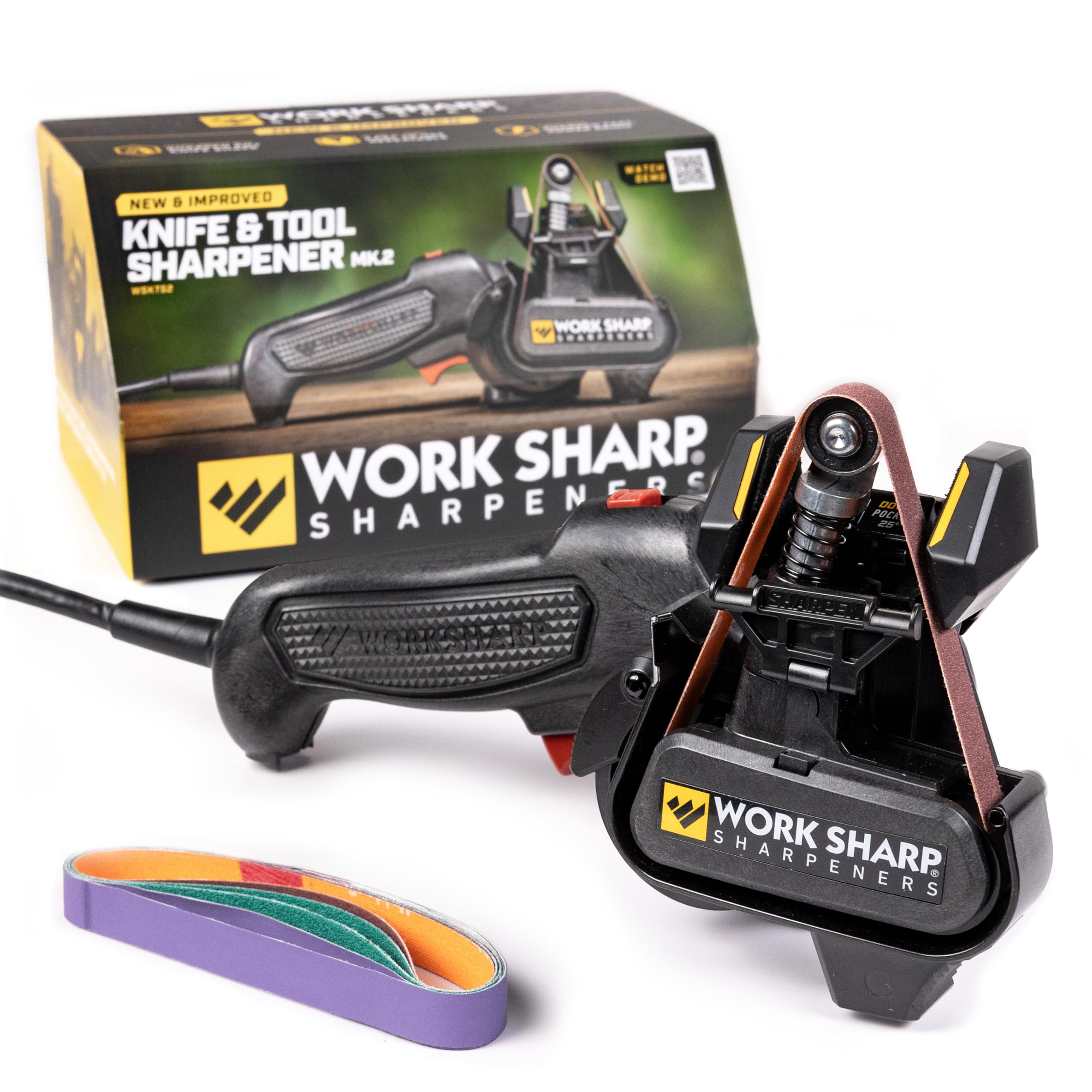
The MK2 is a compact, belt-driven system that tackles everything from kitchen knives and pocket knives to scissors, axes, and lawn mower blades. A two-speed motor gives you low torque for delicate edge work and high speed for aggressive grinding on thicker tools. The included assortment of replacement belts covers coarse grinding, medium sharpening, and fine honing, so you can adjust grit progression based on the blade’s condition.
The edge guide supports the knife all the way to the tip, preventing the uneven tip rounding that plagues cheaper sharpeners. Users report that a first-time user can sharpen ten knives in about 30 minutes with excellent results. The machine is lightweight (just over an ounce without belts) and small enough to store in a drawer, yet it handles heavy tasks like restoring a chipped lawn mower blade.
The belt-based design does wear out consumables faster than diamond wheels, and the small footprint means the platen is shorter than on larger rigs, requiring multiple passes for very long blades. It also lacks the auto-shutoff and vacuum features of the E5. However, for the home user who sharpens a wide variety of tools, the MK2 offers remarkable versatility at a mid-range investment.
Why it’s great
- Sharpens kitchen knives, scissors, and garden tools
- Two-speed motor suits delicate and heavy tasks
- Edge guide supports full blade length to the tip
Good to know
- Belt consumables need periodic replacement
- Short platen requires multiple passes on long blades
4. Chef’sChoice UltraHone 0312000

Chef’sChoice has a long track record with diamond abrasive sharpeners, and the UltraHone delivers a straightforward 2-stage process: Stage 1 uses coarse 100% diamonds for bevel shaping, while Stage 2 uses advanced micron-size diamonds for honing. The result is a 20° edge that is durable enough for heavy chopping and daily use. The machine weighs only one pound, making it easy to pull out and put away.
Users consistently praise its performance on hard German stainless steels — Wusthof and Henckels knives come back sharper than factory edges with just a few passes through each slot. Serrated blades also sharpen effectively, which is rare for electric sharpeners. The precision angle guides lock the blade at the correct angle, so there is zero guesswork even for a first-time user.
The trade-off is that there is no polishing stage, so the edge may retain a slight burr that wears off after the first few cuts. Some users note that the fine slot does not produce a shaving-sharp finish, though it is more than adequate for normal kitchen tasks. If you prefer a straightforward, no-frills machine that works reliably on Western knives, this is a solid choice.
Why it’s great
- 100% diamond abrasives cut hard steel effectively
- Sharpens serrated blades with ease
- Lightweight and simple to operate
Good to know
- No third polishing stage leaves minor burr
- Edge not as refined as 3-stage systems
5. VIDOME Professional Electric Knife Sharpener
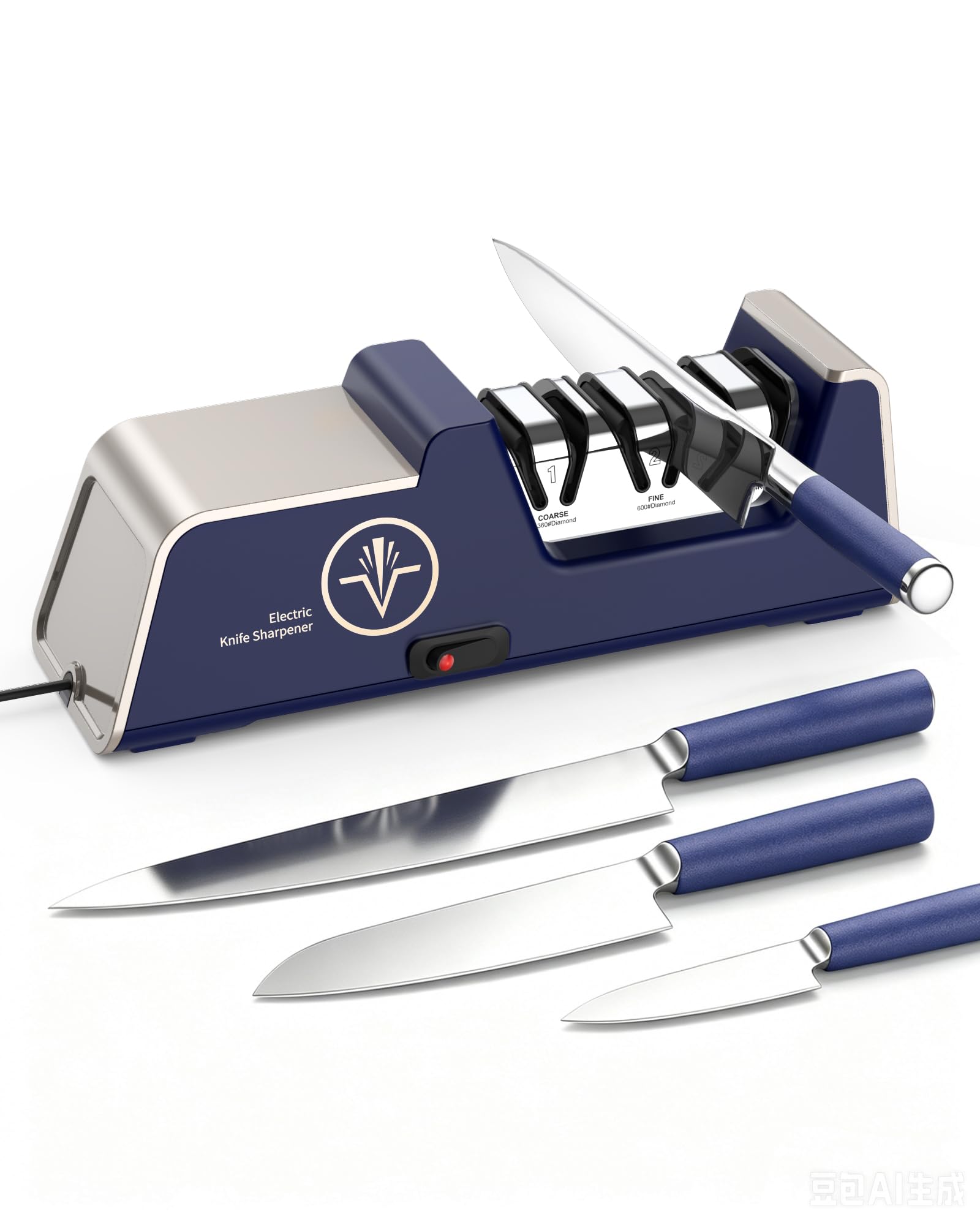
The VIDOME 3-stage sharpener uses 100% diamond abrasives in the first two stages and a stropping disk in the third to produce a 15° edge. The elastic constant-force spring guides hold the blade at the proper angle while allowing the edge to follow the blade’s natural curve, resulting in a longer arch-shaped bevel rather than a flat grind. The German-imported motor runs efficiently, and the magnetic chip collector snaps off for quick cleanup.
Customers report that dull steel kitchen knives reach a level where they can slice tomato paper-thin in about 60 seconds, and the machine can revive ceramic chef’s knives using the diamond stages. The compact champagne gold housing looks refined on the counter and takes up minimal space. First-time sharpening requires roughly 30 seconds per knife, while re-sharpening takes about 10 seconds.
The design has a limitation: the left side slot only works for Stage 3, and the right side only for Stage 1, so switching hands requires turning the whole unit around. Some users find the slots too narrow for larger knives, and the 15° edge, while very sharp, may chip more easily on hard chopping boards. For cooks who want a fine slicing edge and own primarily medium-hard steel, this is a capable pick.
Why it’s great
- Elastic guides create a uniform arch-shaped edge
- 3-stage system with stropping for a polished finish
- Works on both metal and ceramic blades
Good to know
- Slot orientation makes left-handed use awkward
- 15° edge less durable on hard chopping boards
6. Anylot 3-Stage Electric Knife Sharpener
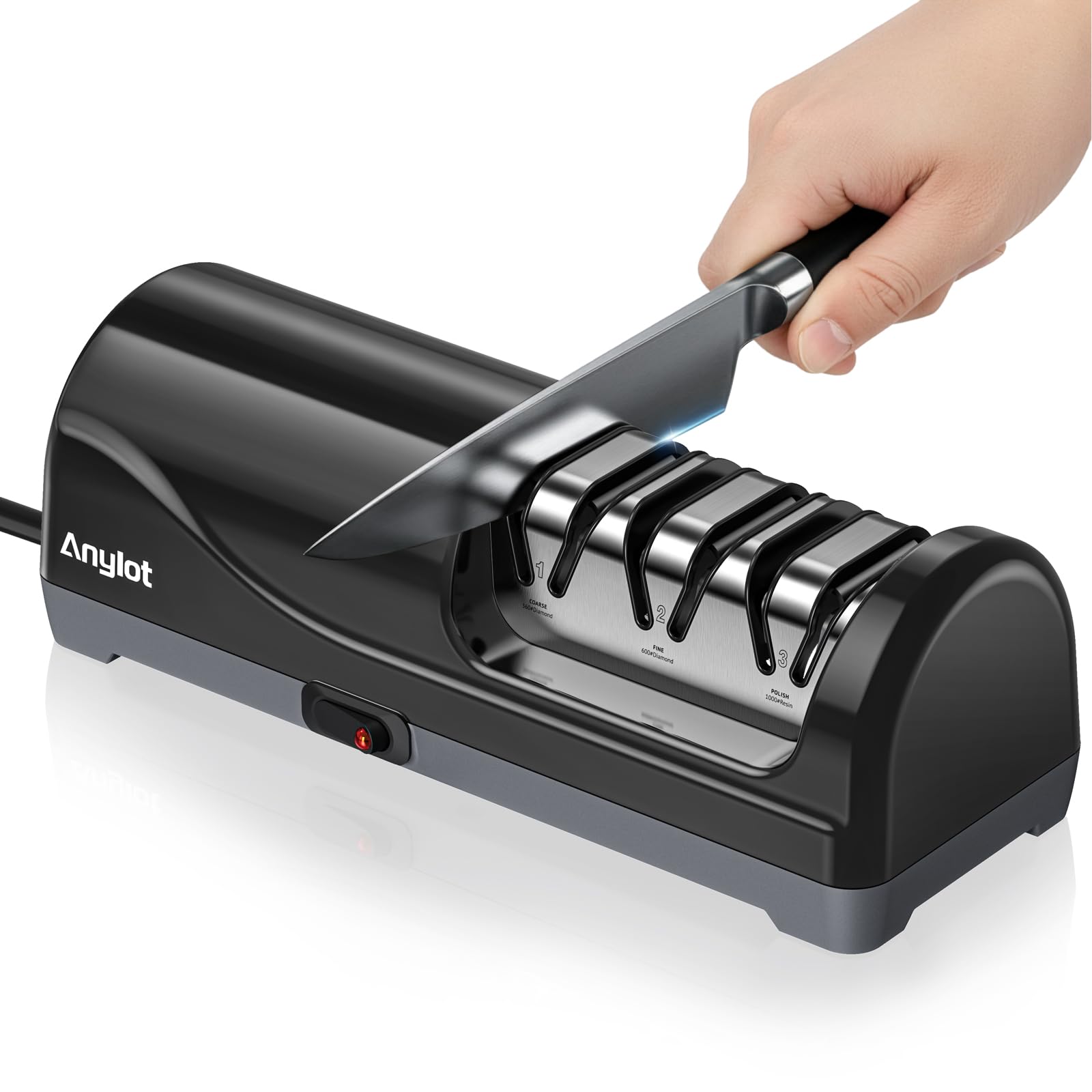
Built with absolute beginners in mind, the Anylot features a 3-stage system using 360# diamond wheels for repair, 600# diamond wheels for sharpening, and a 1000# resin wheel for polishing. The 20° fixed angle guide follows chef-recommended standards, so you simply pull the knife through without worrying about pressure or angle. The motor spins at a steady 2800rpm for consistent stock removal across all three slots.
Users with arthritis or hand weakness particularly appreciate the low-effort operation — no manual stone required. The ambidextrous design lets left-handed users rotate the unit 180 degrees for a natural pull motion. The snap-fit magnetic debris collector rinses clean under water, and the 55dB noise level is quieter than many competing models. The 2.5-pound build stays planted on the counter during use.
Some users note that the actual angle appears closer to 15° than the advertised 20°, and the resin polishing wheel is designed for metal blades only — ceramic knives should only use Stages 1 and 2. The edge produced is sharp but not as refined as what higher-priced diamond-stropping systems deliver. For a new cook or someone who wants a safe, foolproof introduction to electric sharpening, this offers strong value.
Why it’s great
- 3-stage diamond system for repair, sharpen, polish
- Ambidextrous design works for left-hand use
- Quiet 55dB operation with magnetic debris tray
Good to know
- Resin wheel not suitable for ceramic blades
- Angle may be closer to 15° than 20°
7. Presto 08800 EverSharp Electric Knife Sharpener

The Presto 08800 uses Sapphirite wheels — the same ultra-hard material found in professional sharpening shops — to grind and hone a 20° edge on non-serrated blades. The two-stage system is straightforward: the coarse wheel grinds a precise angle, and the fine wheel hones and polishes. Precision blade guides hold the knife at the correct angle automatically, eliminating the need for any manual adjustment.
Users consistently report that very dull knives become noticeably sharper after just one session, cutting through cardboard, carrots, and paper with ease. The suction cups on the base keep the unit secure during use, and the compact footprint stores easily in a drawer. Made in the USA, this model has been a reliable kitchen staple for years, with many households using it weekly without issue.
The Sapphirite wheels cannot be replaced when they eventually wear down, and the plastic housing feels less substantial than metal-bodied competitors. The 30-inch power cord is shorter than ideal for counter layouts with limited outlets. For the cook who wants a proven, low-cost solution for reviving a set of basic steel knives, this remains a functional and popular entry point.
Why it’s great
- Pro-grade Sapphirite wheels cut fast
- Suction cup base prevents sliding
- Made in the USA with a long track record
Good to know
- Wheels are not replaceable when worn
- Short power cord limits counter placement
FAQ
Can an automatic sharpener handle ceramic knives?
Why is the angle guide important on electric sharpeners?
Final Thoughts: The Verdict
For most users, the best automatic knife sharpener winner is the Chef’sChoice 15XV because its 3-stage diamond system, metal housing, and precise 15° edge deliver professional results at home. If you want belt-based precision with built-in vacuum cleanup, grab the Work Sharp E5. And for a budget-friendly entry that still offers three stages and diamond abrasives, nothing beats the Anylot 3-Stage.