
Our readers keep the lights on and the weekend projects moving. As an Amazon Associate, I earn from qualifying purchases.
Forgetting whether you already took your afternoon medication—or waking up at 2 AM wondering if you skipped the evening dose—is a daily source of anxiety for millions managing chronic conditions. An automatic pill dispenser replaces that mental burden with a timed, locked carousel that releases the correct dose only when it’s due, turning a guessing game into a quiet routine.
I’m Rikta — the co-founder and writer behind FitlyFast. I’ve spent hundreds of hours analyzing the hardware specifications, alarm decibel readings, lock mechanisms, and compartment capacities of the most popular automatic pill dispensers on the market to separate reliable models from the ones that jam or confuse users.
Whether you’re a caregiver managing multiple medications for a family member or a senior wanting to live independently, finding a reliable automatic pill dispenser comes down to understanding lock durability, alarm volume, and compartment size — three specs that define real-world dependability.
How To Choose The Best Automatic Pill Dispenser
Buying an automatic pill dispenser isn’t just about compartments—it’s about matching the device’s locking mechanism, alarm intensity, and capacity to the specific cognitive and physical abilities of the user. A machine that works smoothly for a moderately healthy adult might frustrate someone with arthritis or confuse a person with dementia. The following breakdown focuses on the four real-world factors that separate a daily helper from an expensive paperweight.
Lock Quality & Child Safety
The lock is the single most important safety feature because it prevents unauthorized access to medication. Look for a mechanical key lock with a solid metal pin rather than a plastic hex nut that can be opened with a pen. Some premium models now include a fingerprint sensor as a backup, which eliminates the risk of losing a key while keeping the unit secure against children or cognitively impaired users. A flimsy lock that breaks after a few months is a deal-breaker for anyone with dementia or young kids in the house.
Alarm Volume & Customization Options
If the intended user has hearing loss, a 75 dB beep from across the house won’t do any good. Check whether the dispenser has adjustable volume levels (high, low, and mute) and multiple ringtone options, or whether it relies solely on a fixed-pitch beeper. Light flash alerts are critical for visually impaired users and should be bright enough to be seen in daylight. A 30-minute snooze cycle that repeats the alarm is ideal because it gives the user time to complete what they’re doing without swallowing the missed-dose panic.
Compartment Size & Carousel Build Quality
Automatic pill dispensers have a reputation for jamming when pills are too large or when the device must be flipped upside down to dispense—which can cause pills to wedge between compartments. Look for a carousel with a tight tray-to-cover seal (less than 2 mm gap) and smooth gearbox rotation rated for thousands of cycles. Compartments should hold at least 20 aspirin-sized tablets each, and the dispense chute must be wide enough for standard fish oil capsules without crushing them. A detachable tray simplifies cleaning and reduces buildup of pill dust that can gum up the mechanism.
Battery Life & Rechargeability
Most automatic dispensers run on either AA/AAA batteries or a built-in rechargeable lithium-ion pack. Battery-powered units are portable but require regular swaps—low-battery icons can be missed by forgetful users. Rechargeable models with 1200 mAh or larger batteries typically last a full month on a single charge in low-power mode and eliminate the inconvenience of hunting for replacement batteries. If the user is prone to travel, a dispenser that can operate on batteries for a few weeks without charging is more reliable than one that needs a wall outlet.
Quick Comparison
On smaller screens, swipe sideways to see the full table.
| Model | Category | Best For | Key Spec | Amazon |
|---|---|---|---|---|
| PillCalendar Bluetooth Dispenser | Premium Smart | Tech-savvy caregivers & tracking | 31 slots + fingerprint unlock | Amazon |
| Betife Bluetooth Dispenser | Premium Smart | App-based logging & remote monitoring | Bluetooth 5.0 + 28 slots | Amazon |
| Betife 2nd Gen Dispenser | Mid-Range Locked | Durable gearbox & easy 6-button setup | 5,000-cycle gearbox rating | Amazon |
| Bloom Flower Locked Dispenser | Mid-Range Clear | Simple 28-day setup for dementia | 28 compartments with clear lid | Amazon |
| Leasoder Locked Dispenser | Mid-Range Locked | Customizable dose rings & 30-min alarm | 28 compartments + frosted lid | Amazon |
| EziMedPil 28-Day Dispenser | Entry-Level Locked | Large capacity on a budget | 672-pill total capacity | Amazon |
| e-Pill 7-Day Organizer | Manual Organizer | Weekly manual fill | 28 compartments with snap lids | Amazon |
In‑Depth Reviews
1. PillCalendar Bluetooth Automatic Pill Dispenser
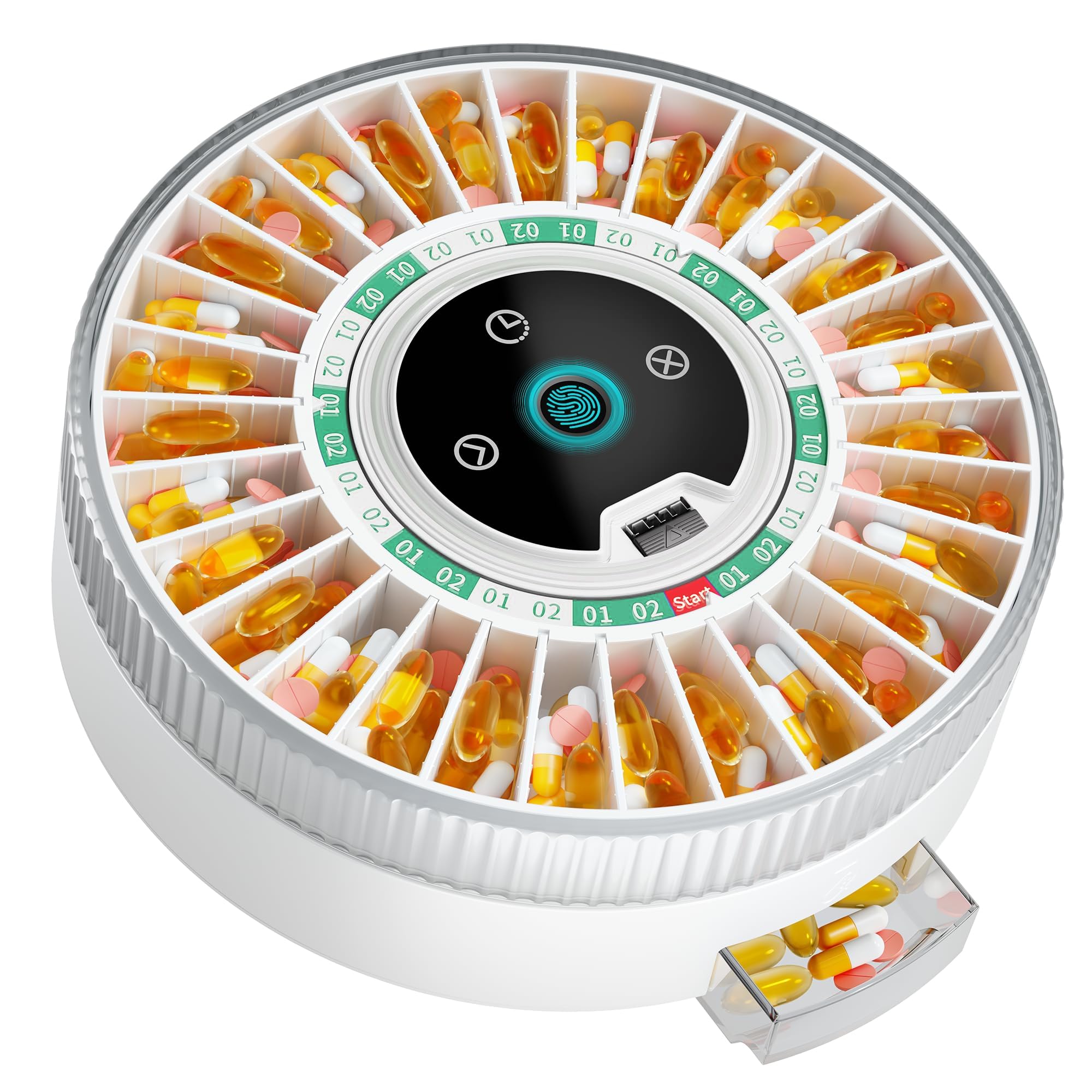
The PillCalendar dispenser stands out because it combines dual-lock security—fingerprint sensor plus a mechanical key backup—with a rechargeable 1200 mAh battery that lasts a full month on a single charge. The 31-slot carousel holds a month’s worth of daily medications, and the press-to-open chute eliminates the need to flip the entire unit upside down, which is a major design improvement for users with arthritis or limited hand strength.
Beyond the hardware, the custom recording feature lets family caregivers replace the standard beeping alarm with a personalized voice reminder—a small touch that makes a noticeable difference for dementia patients who respond better to familiar voices. Bluetooth connectivity via the free app adds medication logging, so caregivers can verify doses were taken even from a distance.
The main trade-off is that the fingerprint sensor requires initial calibration, and some users report that the app setup can be confusing if the manual isn’t followed step-by-step. However, the dual-lock system and rechargeable battery make this the most feature-complete dispenser on the list for remote family monitoring.
Why it’s great
- Fingerprint + key dual-lock safety
- Rechargeable battery lasts one month
- Custom voice recording for alarms
- Press-to-open chute avoids flipping
Good to know
- Fingerprint sensor needs careful calibration
- App setup has a learning curve
2. Betife Automatic Pill Dispenser (Bluetooth)
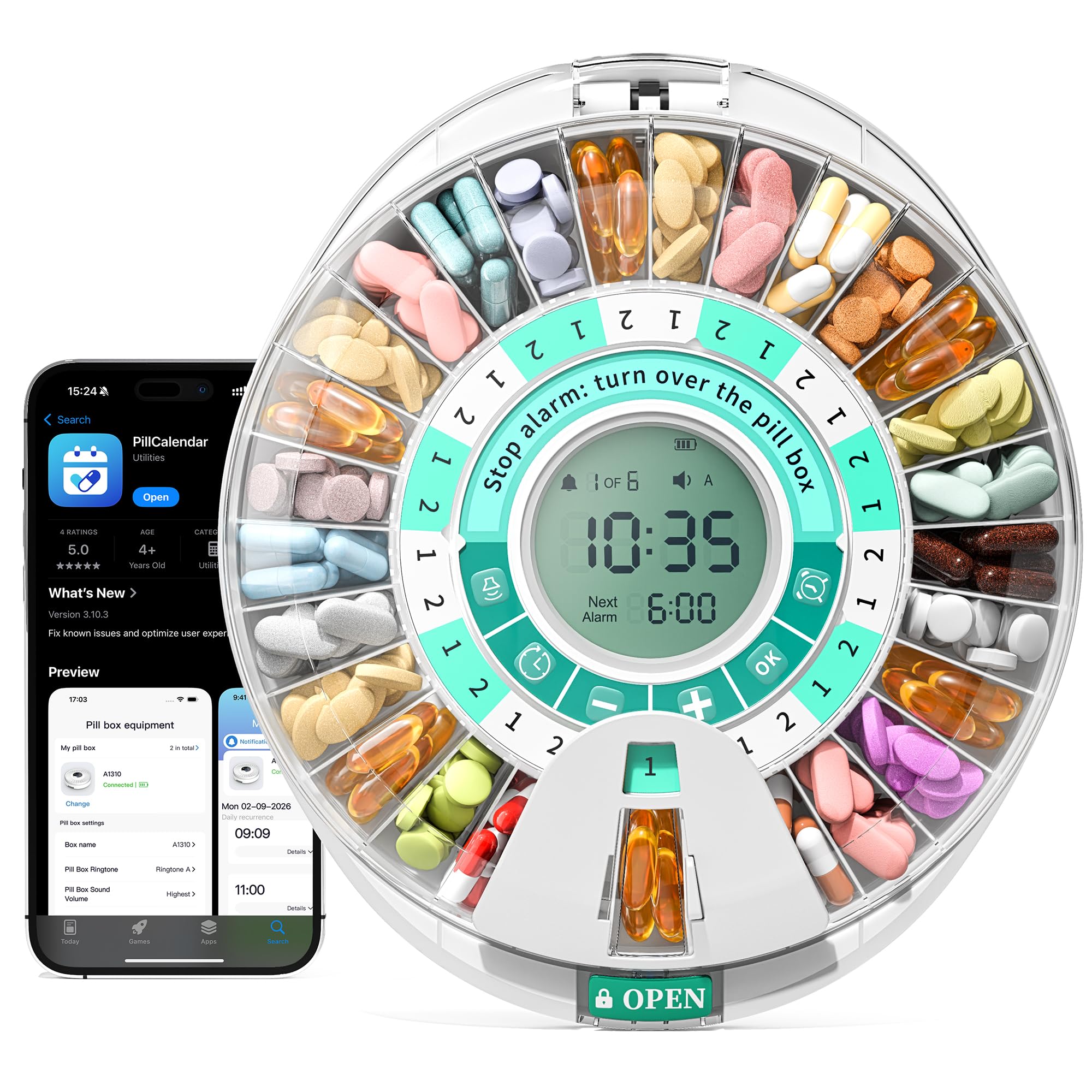
Betife’s Bluetooth model uses the Pillcalendar app to program up to six daily alarms, customize medication names, and upload pill images—giving caregivers visual confirmation that the right medication is loaded in each slot. The large LCD display uses eight intuitive icons so the user can check Bluetooth, alarm status, and battery level without opening the app.
On the hardware side, the 28-slot carousel is paired with a timed lock mechanism that prevents premature access, and the gearbox is lab-tested for more than 5,000 rotations. The device runs on four AAA batteries, which are included, but some users wish it had a rechargeable option for long-term cost savings.
The biggest practical weakness is that pills can occasionally jam if the user has to shake the unit to dispense—a design limitation shared by several models in this category. Despite that, the combination of Bluetooth logging and straightforward manual overrides makes this a strong mid-range pick for remote monitoring.
Why it’s great
- Medication logging via Bluetooth app
- 6 daily alarm slots with pill images
- 5,000-cycle gearbox durability
- Manual controls for non-app users
Good to know
- Runs on AAA batteries, not rechargeable
- Pills can jam if shaken to dispense
3. Betife 2nd Gen Automatic Pill Dispenser
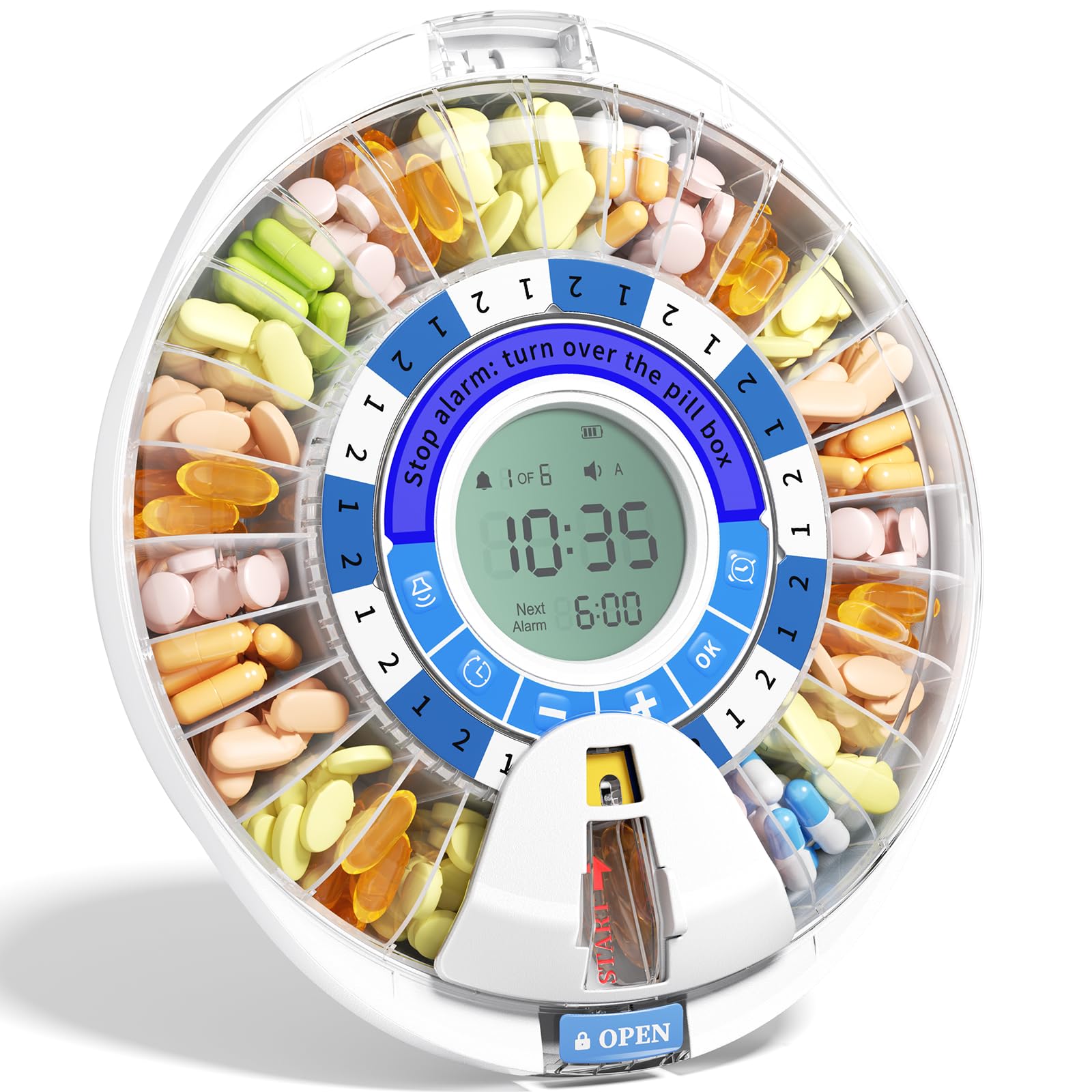
The Betife 2nd Gen is the best overall pick because it solves two of the most common failure points in this category: jamming and confusing setup. The tray-to-cover seal is engineered to less than 2 mm, which prevents pills from migrating between compartments, and the six-button console uses oversized icons with one function per key—no long-press combinations or hidden menus.
The lab-tested gearbox rated for over 5,000 carousel rotations translates to roughly four years of daily use without mechanical degradation. The extra-large LCD screen is genuinely readable from across the room, which helps users who don’t want to hunt for reading glasses just to check the time or alarm status. Six dosage rings allow flexible frequency adjustment from once to six times daily.
The only notable downside is that users sometimes report pills getting lodged in the top when the unit is flipped to stop the alarm—this can jam the mechanism and requires disassembly to clear. Still, for the balance of build quality, ease of setup, and long-term durability, this is the most reliable mid-range option for most households.
Why it’s great
- Sub-2 mm seal prevents pill mixing
- Simple 6-button interface
- 5,000-cycle gearbox for longevity
- XL LCD screen for easy reading
Good to know
- Pills can jam if flipped to dispense
- Requires 4 AAA batteries
4. Bloom Flower Locked Dispenser
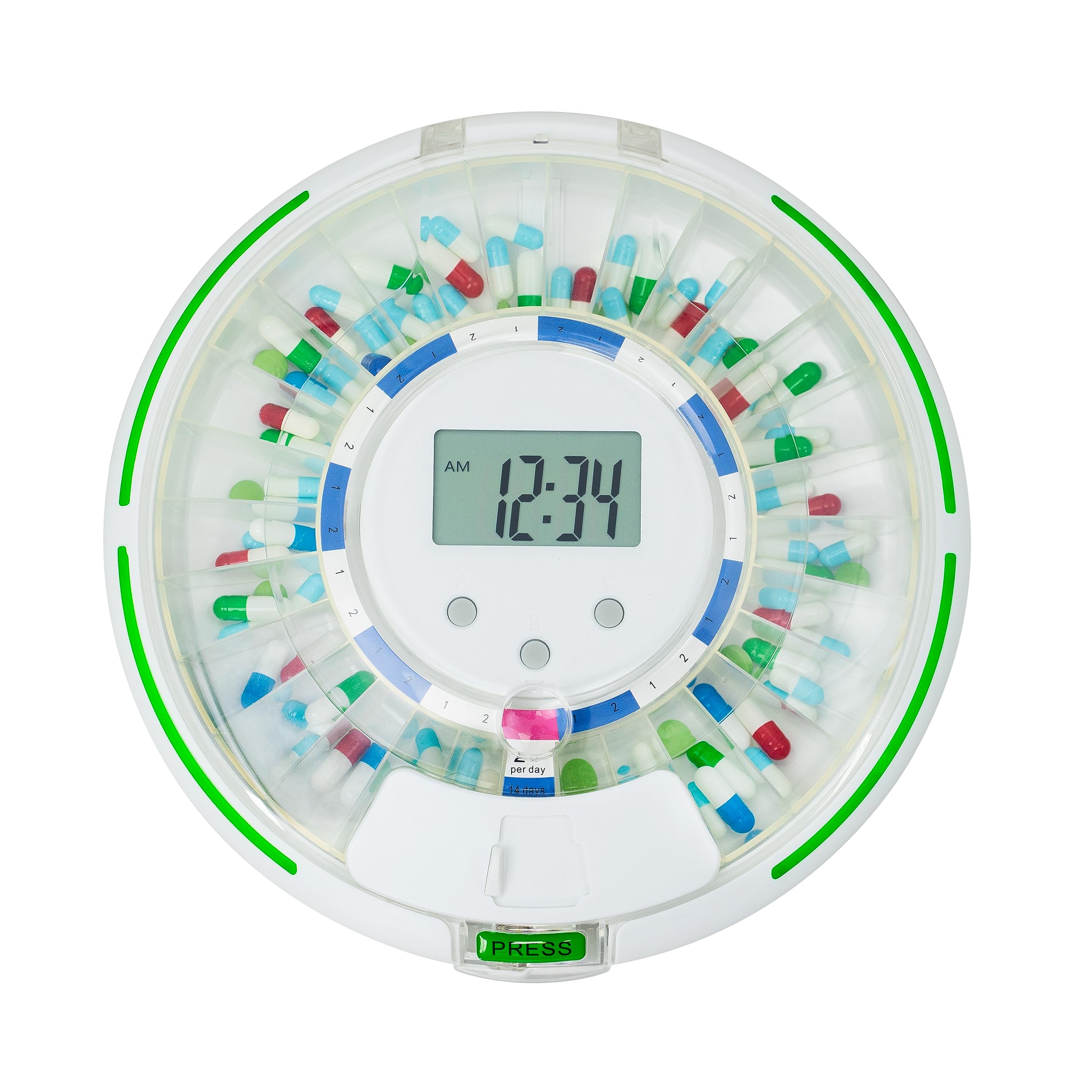
The Bloom Flower dispenser keeps things simple: a 28-slot carousel with a clear lid so users can see exactly how many doses remain without opening the lock. It supports 1 to 6 daily alarms with both sound and light alerts, and the mechanical key lock prevents unauthorized access without adding the complexity of fingerprint sensors or app pairing.
Users consistently report that this model is easy to program—just set the time and dose schedule, fill the compartments, and lock it. The alarm is loud enough for a typical living room, though one reviewer noted that if a dose is missed, there’s no way to manually dispense it without unlocking the entire carousel, which can be frustrating for users who aren’t 100% compliant.
At roughly the same physical size as the EziMedPil, the Bloom Flower dispenser feels slightly lighter at 1.87 pounds but still occupies a dinner-plate footprint. For families who prioritize simple programming over smart features, this clear-lid model is a reliable, no-fuss choice.
Why it’s great
- Clear lid for quick visual check
- Easy single-button programming
- Loud alarm with light flash
- Mechanical key lock is sturdy
Good to know
- No manual override for missed doses
- Plastic build feels less premium
5. Leasoder Locked Dispenser
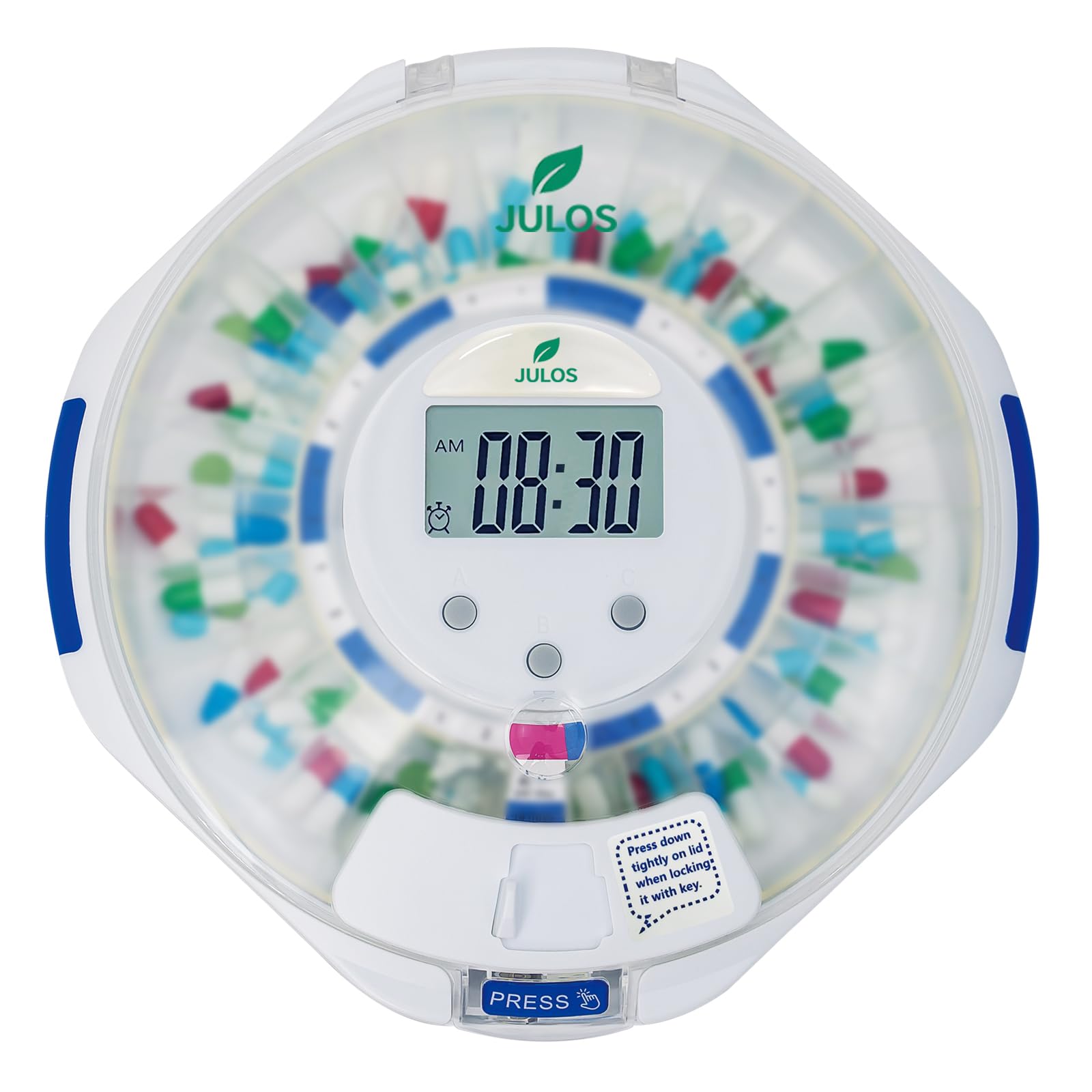
Leasoder’s dispenser focuses on dose customization with six interchangeable, color-coded dosage rings that allow flexible frequency adjustment from 1 to 6 times per day. The frosted lid provides privacy while still letting you see that doses are present, and the 30-minute alarm snooze with audible and visual options ensures a missed dose isn’t forgotten permanently.
The mechanism runs on 4 AA batteries and supports a timed lock that prevents double-dosing—once a compartment dispenses, the next slot won’t unlock until the programmed interval passes. Caregivers appreciate the straightforward three-button setup, though some users note the labeling on the buttons is sparse and can be confusing without the manual.
The main drawback is weight: at roughly 1.9 pounds, some frail elderly users find it heavy to tilt or flip, and the unlabeled buttons add friction during initial setup. For moderately healthy adults or caregivers who can assist with programming, however, the color-coded ring system makes this a very flexible mid-range option.
Why it’s great
- 6 color-coded dosage rings
- Timed lock prevents double-dosing
- 30-minute alarm snooze
- Frosted lid for privacy
Good to know
- Heavy for some elderly users
- Buttons lack clear labels
6. EziMedPil 28-Day Locked Dispenser

The EziMedPil dispenser delivers the largest capacity in this lineup—28 compartments that each hold up to 24 aspirin-sized tablets, for a total of 672 pills. That means fewer refill cycles, which is a meaningful time-saver for caregivers managing multiple medications for chronic disease patients. The lockable frosted lid protects privacy and prevents children or cognitively impaired users from accessing the supply.
A built-in mini magnifying glass helps users with poor eyesight read dosage labels, and the anti-slip grips on the back make it easier for arthritic hands to hold the device when flipping to dispense. The device runs on 4 AA batteries (included), and the low-battery icon on the LCD screen provides a clear warning before power runs out.
The most common complaint is that the mechanical lock uses a hex nut key that can work loose over time, and some users report that the key is so simple a child could open it with a pen. The alarm volume is also on the lower side, making it less suitable for users with significant hearing loss. Still, the sheer capacity and built-in magnifier make this a practical budget option.
Why it’s great
- 672-pill largest capacity on list
- Built-in magnifying glass for label reading
- Anti-slip grips for arthritic hands
- Low-battery LCD indicator
Good to know
- Hex nut key is not childproof
- Alarm volume is relatively low
7. e-Pill 7-Day Weekly Organizer
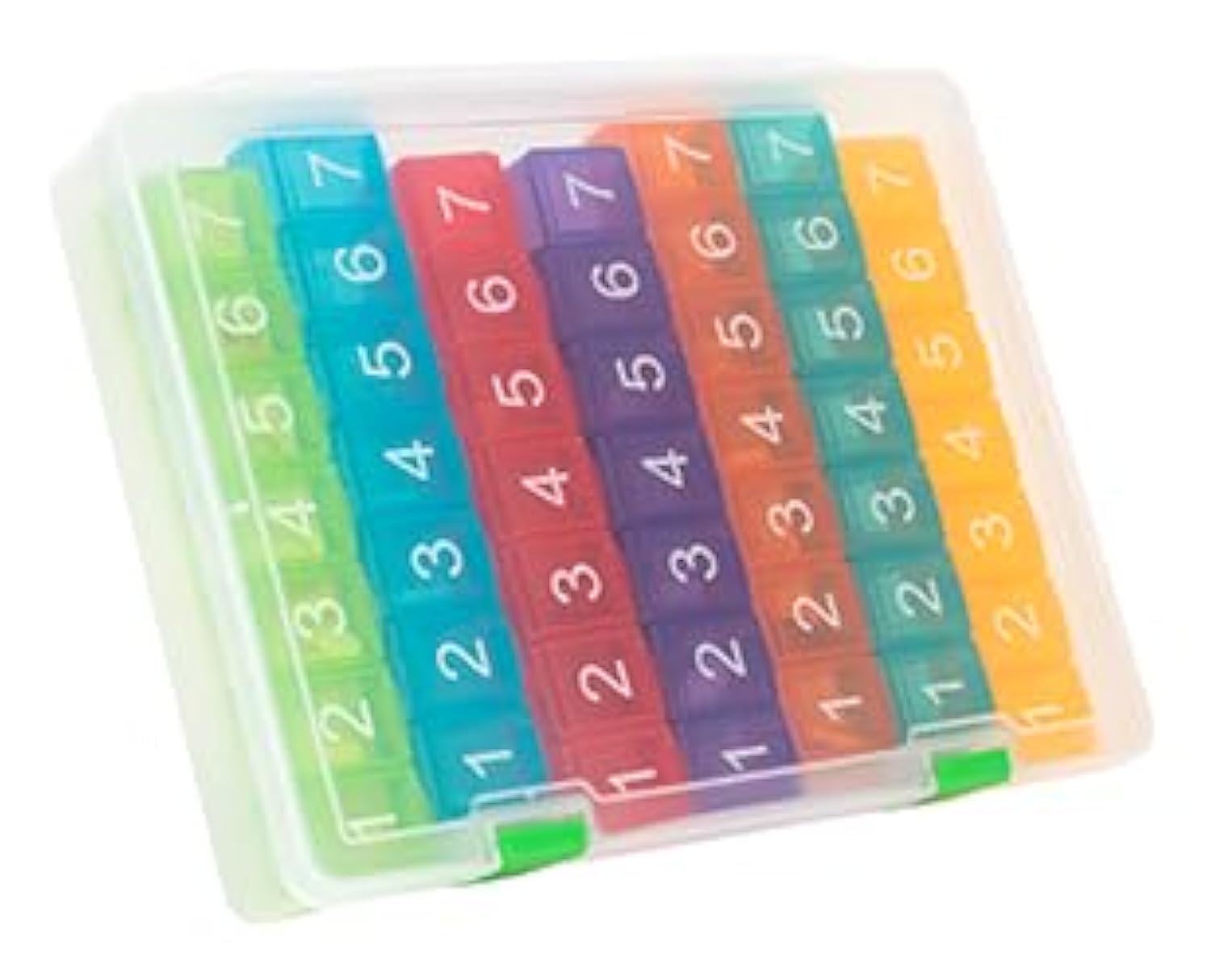
This is the only manual organizer on the list, and it belongs here because it solves a different problem: simple, portable weekly organization without batteries, alarms, or locks. The set includes seven daily boxes (labeled M through SU) with seven compartments each, for a total of 49 slots—enough to hold up to 28 aspirin-sized pills per compartment for a full week of morning, afternoon, and evening dosing.
The snap-tight lids are sturdy and won’t pop open in a purse or suitcase, and the clear storage case keeps everything together. Users consistently praise the build quality as far superior to cheaper drugstore organizers, and the lifetime warranty from e-pill (a Boston-based company operating since 1999) removes concerns about breakage.
The obvious limitation is that there’s no alarm or lock—this is simply a manual fill-and-carry system. It won’t prevent double-dosing or remind a forgetful user to take their meds. For caregivers looking for an affordable backup organizer for travel, or for someone whose medication schedule is stable and doesn’t need electronic reminders, this is the most durable, simplest option available.
Why it’s great
- Lifetime warranty from trusted brand
- 49 compartments hold very large pills
- Snap-tight lids prevent spills
- Compact for travel
Good to know
- No alarm or automatic dispensing
- No lock for child safety
FAQ
What happens if a dose is missed in an automatic pill dispenser?
Can automatic pill dispensers handle large pills or gel capsules?
Do I need Bluetooth and an app to use an automatic pill dispenser?
Final Thoughts: The Verdict
For most users, the automatic pill dispenser winner is the Betife 2nd Gen because it combines a durable 5,000-cycle gearbox with an extra-large LCD screen and a simple six-button interface that avoids the complexity of app-based systems. If you want Bluetooth logging and remote caregiver notifications, grab the Betife Bluetooth model. And for the highest security with fingerprint access and a rechargeable battery, nothing beats the PillCalendar Bluetooth Dispenser.