
Our readers keep the lights on and the weekend projects moving. As an Amazon Associate, I earn from qualifying purchases.
Specs are compiled from manufacturer listings and verified buyer reviews and can change over time — please confirm the key details on the product page before buying.
You know the feeling — you return from a short trip, and your fern looks like it belongs in a dried flower arrangement. An automatic plant waterer takes that worry off your mind by delivering a steady sip to your plants whether you are home, at work, or on vacation. The trick is matching the right style to your watering habits and plant collection.
I’m Rikta — the founder and writer behind FitlyFast. This guide is built by comparing the manufacturers’ published specifications and the patterns across verified customer reviews, so you get each pick’s real strengths and trade-offs instead of marketing spin.
Picking the right automatic plant waterer means deciding between gravity-fed bags, clay spikes, glass globes, and programmable timers — each with its own trade-off in capacity and ease of use. Here is how to match one to your habits and plant collection.
Quick Picks
- Moistenland WIFI Automatic Plant Waterer — Best Overall
- VIVOSUN Professional Automatic Drip Irrigation Kit — High Output
- Moistenland Automatic Watering System (WPS015) — Programmable Timer
- GARDENBRO 3pcs 16 Oz Plant Watering Globes — Elegant Glass
- Yimomoyi 5 Pcs 3.5L Plant IV Water Bag — Budget Choice
- Soilagua Large Terracotta Plant Watering Spikes — Simple Clay
How To Choose The Best Automatic Plant Waterer
The right automatic plant waterer depends entirely on how many plants you own, how long you plan to be away, and how much hands-on tinkering you enjoy. Here are the three factors that separate a reliable system from a soggy mess.
Water Delivery Method
Some waterers drip from a hanging bag using gravity, some use a porous clay spike that wicks moisture into the soil, and some use a pump with a timer you program. Gravity bags work well when you can hang them above the plant. Clay spikes need a recycled bottle screwed on top. Pump-based kits let you run lines to multiple pots, but they require a power source and a reservoir.
Drip Rate Adjustability
Not all plants drink the same amount. A succulent needs a tiny trickle, while a large fern might want a steady flow. Look for a stated drip-rate range — some bags let you adjust from 5 to 280 ml/h — so you can match the output to each plant’s needs without guessing.
Capacity and Duration
How long do you need the system to run unattended? A 3.5-liter bag might last a week for a small plant, while a pump with a large bucket can stretch much longer. Check the real-world test results from other buyers: one system passed a three-week vacation test with all seven plants healthy, which tells you it can handle extended travel.
Quick Comparison
| Model | Best For | Capacity | Drip Rate | Power Source | Amazon |
|---|---|---|---|---|---|
| Moistenland Wi-Fi Kit | Smart app control & logging | 15 pots | Programmable | USB / Battery | Amazon |
| VIVOSUN Drip Kit | High-output pump setups | 8 pots | 1000 L/H max | AC (15W pump) | Amazon |
| Moistenland Timer Kit | Programmable timer + 15 pots | 15 pots | Programmable | USB / 4xAA | Amazon |
| GARDENBRO Glass Globes | Elegant single-pot use | 3 x 16 oz | Passive (soil absorption) | None | Amazon |
| Yimomoyi IV Bags | Budget gravity-fed multiple pots | 5 x 3.5L | 5 to 280 ml/h | None | Amazon |
| Soilagua Clay Spikes | Simple bottle-based watering | 6 spikes | Passive (wicking) | None | Amazon |
In‑Depth Reviews
1. Moistenland WIFI Automatic Plant Waterer
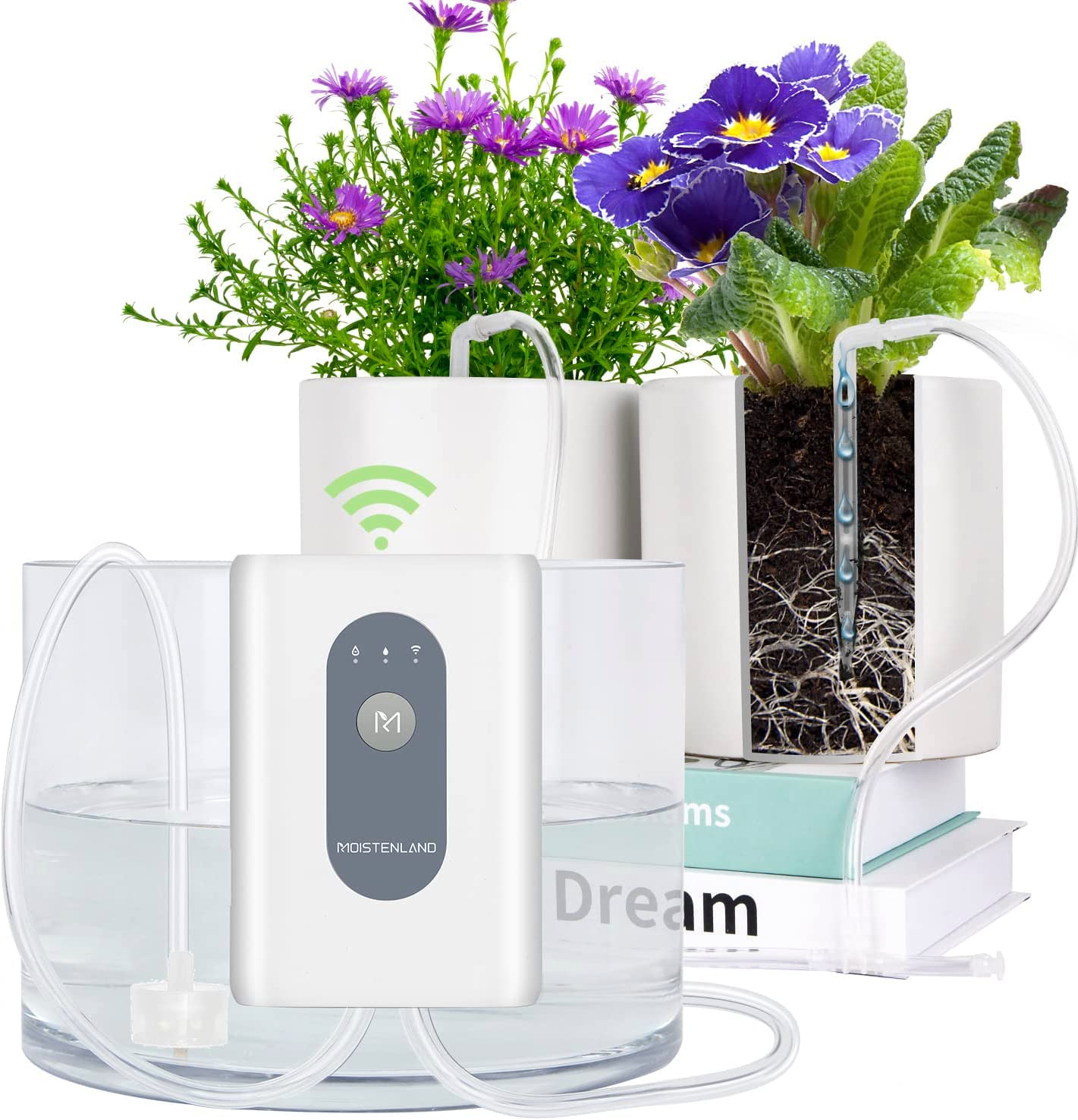
The smartest pick for anyone who wants to babysit their plants from another room — or another country.
The Moistenland Wi-Fi kit is the only pick here that alerts you if the water runs low, making it the top choice for frequent travelers. It sends a water-shortage alert directly to your phone through the Smart Life app, so you know before the plants get dry. You control up to 15 pots from the app, set multiple watering plans, and check a seven-day irrigation log that shows past cycles. It works with Google Home, Amazon Alexa, and Samsung SmartThings for basic on/off voice commands. Buyers report the app is easy to use and the system held up well during trips, especially when paired with a security camera for a visual check. One reviewer liked that you can set watering from a brief second up to a 30-minute session and schedule several cycles daily. The catch: the USB port is not weather-resistant — one user who placed it on a covered porch had the port melt when a tiny splash got inside. Unlike the VIVOSUN kit, this one runs on USB or battery, not AC, and only works on 2.4GHz Wi-Fi, not 5G, which a few reviewers flagged before setup.
Reasons to choose
- Full remote control and watering log via the Smart Life app
- Water-shortage alert notifies you before plants go dry
- Supports Google Home, Alexa, Samsung SmartThings, and IFTTT for voice or routine control
Watch out for
- Only works on 2.4GHz Wi-Fi, not 5G — check your router settings
- USB port is not weather-resistant; keep the device completely dry
Reach for this if: you want the confidence that comes from checking your plants’ watering schedule and getting low-water alerts from anywhere.
Think twice if: you plan to use it outside on a porch or balcony, because even a little moisture near the USB port can cause damage.
2. VIVOSUN Professional Automatic Drip Irrigation Kit

The grow-tent workhorse that pumps hard and stays quiet — if you take the time to set it up right.
The VIVOSUN kit uses a 15W submersible pump — a pump motor that sits in the water bucket — rated at a maximum flow of 1000 L/H (liters per hour, enough to fill a large bucket in seconds). It operates at a low noise level of 30 to 40 decibels (about as loud as a quiet room), so you barely hear it. It covers up to eight pots and works with soil, rockwool (a mineral fiber growing medium), clay pebbles, coco coir (coconut husk fiber), and other growing mediums. Unlike the Moistenland Wi-Fi kit, this one has no app control — you set the timer manually. Reviewers praise the reliable cycle timing: one buyer runs it for two minutes every hour without issue. Others say the flow regulators and anti-siphon hole (a small opening you cut in the tubing to stop water from siphoning out after the pump turns off) need careful attention — if you open the regulators too far or skip the anti-siphon step, you get leaks or flooding. At a 1.16-kilogram (about 2.6-pound) item weight, it is noticeably heavier than most plastic-based competitors like the Moistenland timer kit.
Pros at a glance
- 15W pump delivers 1000 L/H max flow for fast watering
- Operates at a quiet 30–40 dB; barely audible during use
- Bucket-based design lets you mix in fertilizer with no tap connection
Cons to consider
- Manual timer only — no smartphone app or Wi-Fi control
- Some owners mention uneven flow from the injection-molded splitters over time
Best suited for: serious plant growers who need a sturdy, high-flow pump for up to eight pots and are comfortable with a hands-on setup.
Less ideal for: travelers who want a zero-fuss system, because the anti-siphon hole and regulator adjustments take a bit of dialing in.
3. Moistenland Automatic Watering System (WPS015)
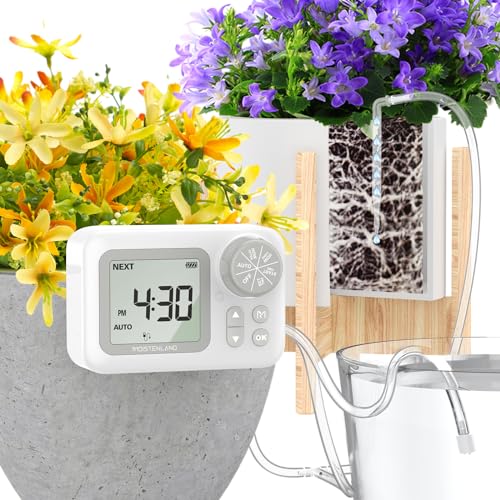
The balanced middle child — a digital timer with a long hose that covers a whole room of plants.
The Moistenland WPS015 kit covers 15 pots using a 33-foot hose, which is long enough to snake across a room or through a small greenhouse. Its programmable digital timer lets you set a start time and schedule using the internal clock and button controls. It runs on USB-C (a modern, reversible charging cable) or four AA batteries, and customers note the batteries last through extended vacations — a clear advantage over the VIVOSUN kit, which needs a wall outlet. The system delivers water directly to the root zone through drip emitters (small nozzles that let water out slowly), which minimizes evaporation compared to overhead watering. One reviewer used it for a year and found the setup easy, noting the kit works with standard aquarium air hose for custom extensions. Reviewers point out the system passed a three-week vacation test: all seven plants came back healthy with no dry soil or overwatering. One caution: the LCD display segments failed after two weeks on one unit, making schedule adjustments difficult, though the watering continued. Unlike the VIVOSUN kit, this one has no pump — it relies on gravity. The instructions warn you to keep the water source below all plants to prevent siphoning (the siphon effect, where water keeps flowing after the timer stops).
Strong points
- 33-foot hose reaches plants across a wide room or small greenhouse
- Runs on USB-C or 4 AA batteries for flexible power placement
- Verified to keep plants healthy during a three-week trip
Weak points
- Requires gravity — water source must sit below all plants to prevent siphoning
- A few units developed LCD display issues after a short period
Reach for this if: you want a reliable timer-based system for a large number of indoor pots and don’t mind a straightforward gravity-fed setup.
Look elsewhere if: you need a pump-driven system for improve plants or if the thought of routing hoses at low level sounds restrictive.
4. GARDENBRO 3pcs 16 Oz Plant Watering Globes
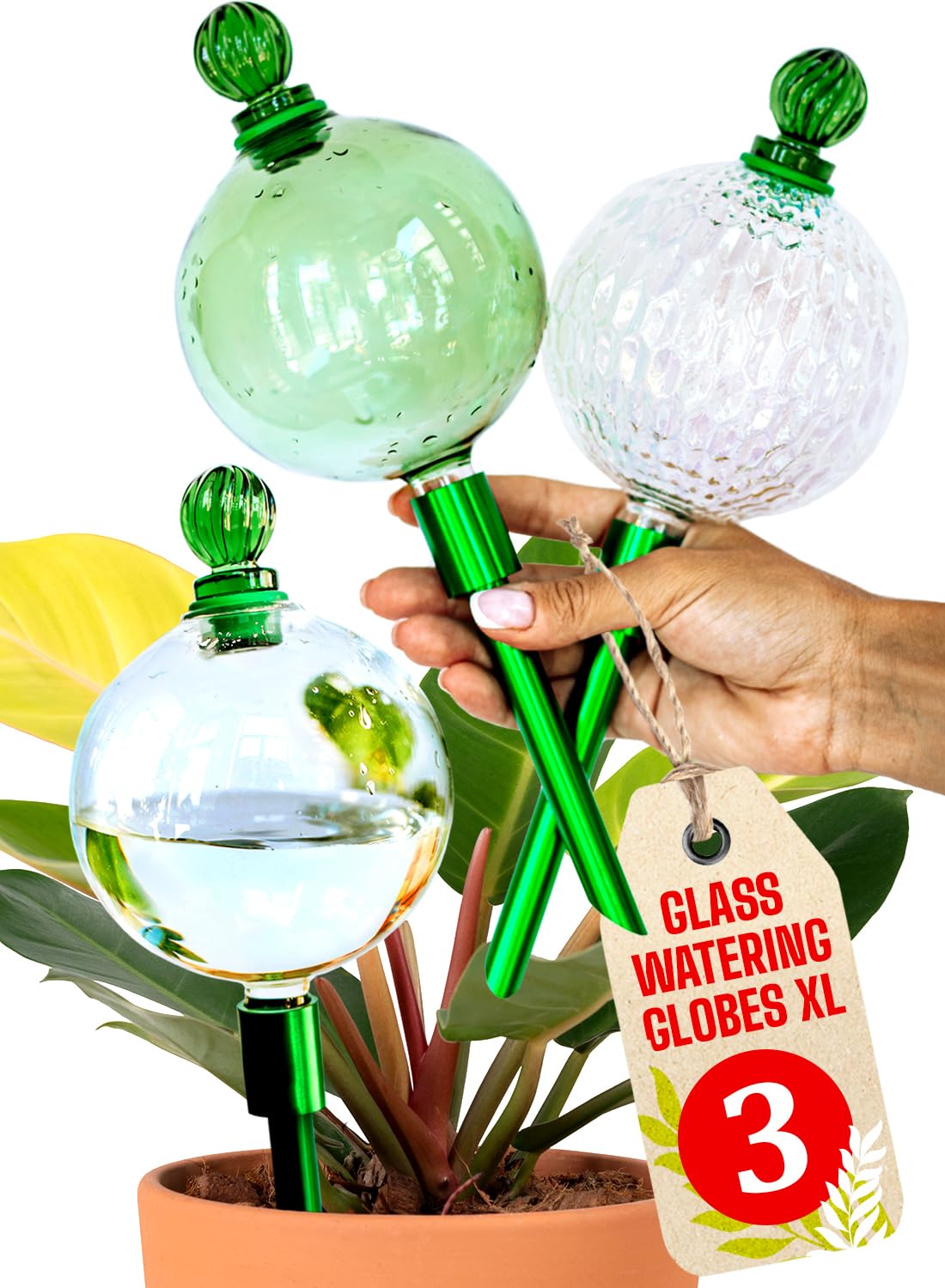
The beautiful glass option that looks great on a shelf — but only works in the right pot.
The GARDENBRO globes are three large, hand-blown glass vessels, each holding 16 ounces (473 milliliters, about the size of a soda can). You fill them through a top hole and push the stake into the soil, where it releases water gradually as the dirt dries out. At 2.2 pounds, these are heavier than the Soilagua clay spikes (1.9 pounds) and bulkier — the product dimensions are 7 x 4 x 4 inches per globe versus the Soilagua spikes at 2.1 x 2.1 x 7.1 inches. Reviewers report the globes keep plants watered for up to two weeks while traveling. But there is a catch: in pots with drainage holes, shoppers say the globe drains within 24 hours because the water runs straight through the loose soil and out the bottom. The globes work best in pots without drainage holes, where the moisture has nowhere to go but back into the soil. One reviewer also mentioned the tube can clog with dirt if the stake pushes into heavy soil, stopping the water flow completely. Compared to the Yimomoyi IV bags, which support 15 potted plants with adjustable drip rates, these globes cover just three plants with no flow adjustment.
What stands out
- Hand-blown glass looks more attractive than plastic alternatives
- Easy to refill through the top hole without pulling the stake out
- Keeps plants hydrated for up to two weeks with no power or batteries
What to watch for
- Drains too fast in pots with drainage holes — best for pots without them
- No adjustable drip rate; flow depends entirely on soil density
Reach for this if: you have a few medium-to-large houseplants in pots without drainage holes and want a decorative, no-power solution for trips.
skip it if: your plants are in standard pots with drainage or you need to cover more than three plants at once.
5. Yimomoyi 5 Pcs 3.5L Plant IV Water Bag

The cheap and cheerful gravity bag that hands you adjustable drip rates for a whole collection of pots.
For budget-minded plant owners, the Yimomoyi IV bags deliver the most capacity per dollar of any pick here, with five bags holding a total of 17.5 liters across all five — enough to keep a dozen plants happy during a week away. The design uses basic physics: hang the bag above the plant, and water flows by gravity through a tube into the soil. Buyers report the drip rate is adjustable from 5 to 280 ml/h (milliliters per hour, a unit that measures water flow), which is a wide enough range to go from a barely-there trickle for succulents to a steady stream for thirsty ferns. Reviewers who bought two packs say the setup takes time the first go-round, but then the bags work reliably for holidays. One reviewer noted the bag is larger than expected and feels heavy when full, so you need a sturdy hook or hanger. Unlike the GARDENBRO globes, these bags let you fine-tune the output per plant instead of relying on soil density. The only real limitation: the tube must hang vertically — if it bends or kinks horizontally, the flow stops completely.
Why it works
- Five 3.5L bags give you a large total capacity for multiple plants
- Drip rate adjusts from 5 to 280 ml/h so you match each plant’s needs
- Thickened plastic resists damage and stays reusable across seasons
What to plan for
- Tubes must hang vertically — a horizontal bend stops water flow
- Bags are heavy when full; needs a secure hook or hanger
Best for: budget-minded plant owners who want adjustable flow across many pots and don’t mind hanging bags above their plants.
Not for you if: you cannot find a spot to hang bags above each pot, or you prefer a system that sits at soil level.
6. Soilagua Large Terracotta Plant Watering Spikes

The lowest-tech option that turns empty wine bottles into a slow-release watering system.
The Soilagua spikes are the simplest pick for a weekend trip: six terracotta spikes, each measuring 2.1 x 2.1 x 7.1 inches — a smaller footprint than the GARDENBRO globes at 7 x 4 x 4 inches — and weighing 1.9 pounds total. You soak the clay in water for at least 15 minutes, then push one spike into the soil and screw a recycled wine or plastic bottle upside down onto the top. The porous clay wicks water into the dirt slowly and steadily (wicking is the natural movement of water through a material by capillary action, like a paper towel soaking up a spill). Owners mention this extends watering to 2 to 3 days with a single bottle — useful for weekend trips but shorter than the Yimomoyi bags or GARDENBRO globes. Multiple customers note the spikes reduce watering frequency to about once a week when used with larger bottles. One buyer in Central Florida reported watermelons thriving with a refill every 2 to 3 days. The simple design has no moving parts, no plastic parts to crack, and no batteries. The downside: one spike arrived broken in a second order for one reviewer, suggesting the packaging could be better. Also, the output is not adjustable — it depends on the clay’s permeability and the soil moisture — unlike the 5-to-280-ml/h range you get from the Yimomoyi IV bags.
Highlights
- Natural fired clay is organic and weather-resistant for outdoor use
- Works with recycled bottles — no special parts or power needed
- Delivers water directly to the root zone, not the soil surface
Limitations
- Extends watering only 2 to 3 days with a standard bottle — shorter than bag or pump setups
- No adjustable flow rate; speed depends on the clay and soil conditions
Reach for this if: you want a low-cost, no-power system for a few plants and have old bottles you can recycle into water reservoirs.
Pick something else if: you need a system that runs longer than a weekend without refilling or prefer adjustable drip rates for different plant types.
Understanding the Specs
Drip Rate
This number tells you how much water the system releases per hour, measured in milliliters per hour (ml/h). A range like 5 to 280 ml/h means you can dial it down for a succulent or up for a thirsty fern. A passive system — a glass globe or clay spike — has no adjustable drip rate, so the water flow depends on soil density and wicking action alone. If you mix plants with very different water needs, an adjustable drip rate gives you real control over each one.
Gravity vs Pump
A gravity-fed system (like a hanging bag or an inverted bottle) needs the water source to sit above the plant. A pump-based system pushes water through tubing regardless of height, which lets you place the reservoir on the floor. Gravity setups are simpler and quieter. Pump setups work for larger gardens and let you run longer hose distances, but they need power and have more parts that can fail.
FAQ
How long will an automatic plant waterer water my plants while I am away?
Can I use a clay watering spike with any bottle?
Do glass watering globes work in pots with drainage holes?
What does drip rate mean and why does it matter?
Will a Wi-Fi plant waterer work with any home network?
Can I add fertilizer to the water in a pump-based system?
What is the siphon effect and how do I avoid it?
Do automatic plant waterers need batteries or electricity?
Final Thoughts: The Verdict
For most buyers, the best automatic plant waterer is the Moistenland Wi-Fi Kit because it combines full app control, water-shortage alerts, and a seven-day watering log for up to 15 pots. If you want a high-flow pump system for a serious indoor garden, grab the VIVOSUN Drip Kit. And for a simple, budget-friendly solution that covers many plants with adjustable drip rates, the standout is the Yimomoyi IV Bags.
How We Picked
We do not accept paid placement. Every pick is matched to a real buyer and a real use-case; we do not hands-on test units.
Sources & Methodology
Specifications: manufacturer listings and product documentation. Review insights: verified customer reviews, as of July 2026. Pricing: not shown on this page (it changes often); check the current price via the retailer link.
As an Amazon Associate, FitlyFast earns from qualifying purchases. This does not affect which products we feature.