
Our readers keep the lights on and the weekend projects moving. As an Amazon Associate, I earn from qualifying purchases.
The hunt for an AV receiver under a grand is a battle against feature creep — too many models promise the moon but deliver muddled dialogue, finicky HDMI handshakes, and room correction that barely touches the bass boom. The real win is finding the channel count, power rating, and HDMI 2.1 support that actually match your speakers and screen without draining your wallet.
I’m Rikta — the co-founder and writer behind FitlyFast. I’ve spent years analyzing amplifier specifications, decoding customer durability reports, and cross-referencing measured output against claimed wattage to separate genuine performance from marketing noise.
After reviewing dozens of models, I’ve built a focused shortlist that balances certified room correction, modern gaming features, and proven long-term reliability. This is the av amp under $1000 guide that cuts through the spec clutter to give you a clear buying decision.
How To Choose The Best AV Amp Under $1000
Selecting an AV receiver in this bracket means prioritizing the features that actually improve your daily listening and viewing. Here are the key specs to weigh.
HDMI 2.1 Bandwidth and Gaming Features
If you own a PlayStation 5, Xbox Series X, or a high-refresh-rate TV, full 40Gbps or 48Gbps HDMI 2.1 inputs are non-negotiable. Look for support for 4K/120Hz, Variable Refresh Rate (VRR), Auto Low Latency Mode (ALLM), and Quick Frame Transport (QFT). Some receivers advertise “HDMI 2.1-ready” but only support 24Gbps, which limits 4K/120Hz to chroma subsampling 4:2:0.
Room Correction Quality
A receiver’s room correction system has a bigger impact on sound quality than raw wattage. Audyssey MultEQ XT (found on Denon models) and Dirac Live (found on Onkyo models) measure your speakers and compensate for room acoustics. Basic systems like YPAO work well for simple setups, but advanced room correction is critical for complex layouts with multiple subwoofers or challenging room dimensions.
Channel Count and Power Output
A 7.2-channel receiver (5.2.2 Dolby Atmos) is the sweet spot for most home theaters. A 9.2-channel unit allows for 5.2.4 or 7.2.2 setups, which add overhead rear speakers for a more immersive bubble. Pay attention to FTC-rated power at all channels driven — some receivers advertise high per-channel wattage but drop significantly when powering five or seven speakers simultaneously.
Quick Comparison
On smaller screens, swipe sideways to see the full table.
| Model | Category | Best For | Key Spec | Amazon |
|---|---|---|---|---|
| Onkyo TX-NR7100 | 9.2 Channel | Room correction enthusiasts | Dirac Live, THX Select | Amazon |
| Sony STR-AN1000 | 7.2 Channel | Sony ecosystem integration | 360 Spatial Sound Mapping | Amazon |
| Denon AVR-S970H | 7.2 Channel | Balanced all-around performance | 90W/ch, Audyssey MultEQ | Amazon |
| Denon AVR-S770H | 7.2 Channel | Reliable, warm sound | 75W/ch, Dolby Vision | Amazon |
| JBL MA710 | 7.2 Channel | Turntable integration | MM Phono Input, 8K | Amazon |
| Marantz NR1510 | 5.2 Channel | Compact living spaces | Slim 4-inch chassis | Amazon |
| Onkyo TX-NR6100 | 7.2 Channel | THX certified value | THX Select, 210W/ch | Amazon |
| Pioneer VSX-935 | 7.2 Channel | Budget Atmos entry | Height Virtualization | Amazon |
| YAMAHA RX-V6A | 7.2 Channel | Reliability and musicality | YPAO-RSC, MusicCast | Amazon |
| JBL MA310 | 5.2 Channel | Simple 5.1 setups | 60W/ch, Bluetooth 5.1 | Amazon |
| YAMAHA RX-V4A | 5.2 Channel | Budget-friendly entry | 4K120, YPAO calibration | Amazon |
In‑Depth Reviews
1. Onkyo TX-NR7100 9.2-Channel AV Receiver
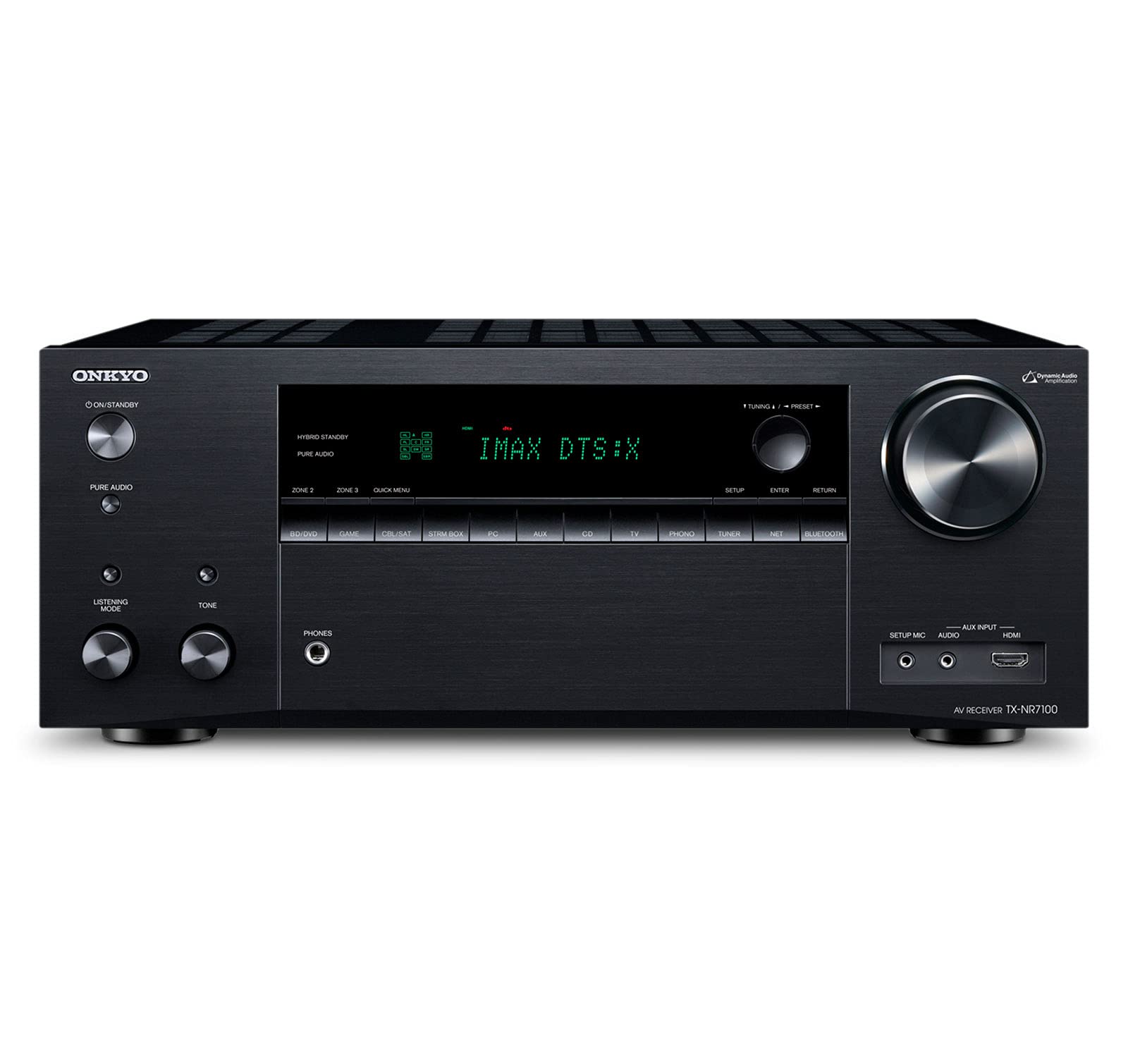
The Onkyo TX-NR7100 stands out in this price bracket because it brings Dirac Live room correction — a system typically reserved for much more expensive processors — straight out of the box. With 9 channels of processing (up to 5.2.4 Atmos), HDMI 2.1 at 40Gbps supporting 8K/60Hz and 4K/120Hz, and THX Select certification, it punches well above its tier.
Customer reviews consistently highlight the clean, dynamic soundstage and the significant improvement Dirac Live makes in taming bass modes and room reflections. The triple HDMI outputs allow for flexible multi-zone setups, including discrete Zone 2 HDMI switching. Build quality feels robust, though the unit does run warmer than some competitors.
The non-backlit remote is a minor annoyance in dark home theater rooms, and a small number of users report HDMI handshake glitches that require a quick reboot. But for the combination of professional-grade room correction, channel count, and certification, this receiver is the most future-proof option under a grand.
Why it’s great
- Full Dirac Live room correction included
- 9-channel processing for 5.2.4 Atmos
- THX Select and HDMI 2.1 with 40Gbps
Good to know
- Runs warmer than some rivals
- Remote lacks backlighting
- Occasional HDMI handshake quirks
2. Sony STR-AN1000 7.2 CH AV Receiver

Sony’s STR-AN1000 leverages their proprietary 360 Spatial Sound Mapping technology, which creates phantom surround speakers to widen the soundstage beyond the physical speaker layout. The Digital Cinema Auto Calibration IX (D.C.A.C. IX) system measures multi-point positions and calibrates both frequency response and time alignment with high precision. It also supports IMAX Enhanced and Dolby Vision.
Users report crisp, immersive surround effects with excellent dialogue clarity, especially when paired with a Sony TV that supports S-Center Sync for center-channel audio from the TV’s own speaker. The six HDMI inputs (two with HDMI 2.1) handle 4K/120Hz, VRR, and ALLM for gaming. Setup is guided by a clear on-screen graphical interface, and the smartphone app is reliable.
A known limitation is that the AN1000 currently does not pass Dolby Vision through from an Apple TV 4K, requiring a direct-to-TV connection for that signal path. The front-panel text for sound field modes is also very small. It lacks a phono input, so turntable users will need an external preamp.
Why it’s great
- 360 Spatial Sound Mapping creates immersive phantom channels
- Excellent D.C.A.C. IX calibration
- Works with Sonos system
Good to know
- No Dolby Vision passthrough from Apple TV 4K
- Small front-panel display text
- No built-in phono preamp
3. Denon AVR-S970H 8K 7.2 Channel Receiver

The Denon AVR-S970H delivers 90 watts per channel (FTC rated) with Audyssey MultEQ room correction, making it a strong all-around performer for medium-sized rooms. It includes three 8K HDMI 2.1 inputs with full 4K/120Hz support, VRR, ALLM, and QFT, covering all current gaming console requirements. The built-in HEOS platform allows multi-room audio streaming with other HEOS-compatible speakers.
Owner feedback highlights the receiver’s warm, musical sound signature and its ability to drive demanding tower speakers without strain. The phono input is a welcome addition for vinyl enthusiasts. Setup is straightforward via the on-screen assistant or the Denon app, and the unit runs cooler than Onkyo equivalents at around 80°F under load.
A key trade-off: using the powered Zone 2 output reduces the main listening area to 5.2 channels, so you lose rear surround channels when distributing audio to a second room. The remote also lacks a dedicated TV power button, which may complicate universal remote programming for some users.
Why it’s great
- 90W FTC-rated clean power delivery
- Audyssey MultEQ room calibration
- HEOS multi-room streaming and phono input
Good to know
- Zone 2 use drops main to 5.2 channels
- No physical manual included
- Remote lacks TV power button
4. Denon AVR-S770H 7.2 Ch Home Theater Receiver

The Denon AVR-S770H offers 75 watts per channel across 7 channels with Dolby Height Virtualization and DTS Virtual:X, creating an overhead sound stage without physical ceiling speakers. It supports 8K/60Hz and 4K/120Hz passthrough with full HDR10+, Dolby Vision, and Dynamic HDR compatibility. The built-in HEOS platform covers Spotify, TIDAL, and Pandora streaming.
Customers upgrading from soundbars or older receivers consistently note the dramatic improvement in dialogue clarity and surround depth. The setup wizard is beginner-friendly, and the Audyssey MultEQ calibration effectively tames boomy low frequencies. Multiple users report seamless auto-switching between inputs and reliable ARC/eARC communication with modern TVs.
A small percentage of users have experienced random volume drops or picture loss on startup, which are typically resolved with firmware updates. The remote has a learning curve, and the advanced menu system feels dense. For the price, however, the S770H delivers a genuinely warm and powerful sound that competes with units from higher tiers.
Why it’s great
- Virtual height channels without ceiling speakers
- Full 8K/60Hz and 4K/120Hz gaming support
- Easy on-screen setup assistant
Good to know
- Occasional firmware glitches reported
- Remote takes time to learn
- Advanced menus are not intuitive
5. JBL MA710 7.2 Channel 8K AV Receiver

The JBL MA710 delivers 110 watts per channel across 7 channels, making it one of the most powerful options in this price range. It supports Dolby Atmos and DTS:X up to 5.1.2 configurations, includes a moving magnet phono input for turntables, and offers 6 HDMI inputs (3 with 8K capability) plus eARC. The unit is notably shallow at 4.3 inches deep, fitting easily into tight AV cabinets.
Users praise the MA710’s ability to drive demanding speakers like Polk ES60 towers with ease, and the built-in Apple AirPlay 2 and Google Chromecast provide flexible streaming. The on-screen setup menu is clear, and the sound signature is well-regarded for both movies and music. Multiple reviews note the initial firmware update can be confusing.
The non-backlit remote has been a recurring complaint, especially for dark theater rooms, and the auto shut-off defaults to 20 minutes, requiring manual adjustment. Additionally, the unit does not downmix DTS-HD Master Audio to 2.1, which may be a limitation for pure stereo setups. JBL’s last firmware update was over a year ago.
Why it’s great
- High 110W per channel power
- Built-in MM phono input for vinyl
- Shallow 4.3-inch chassis fits tight spaces
Good to know
- Remote is not backlit
- No DTS-HD downmix for 2.1 setups
- Firmware updates have been infrequent
6. Marantz NR1510 Slim 5.2 Channel AV Receiver

The Marantz NR1510 stands at only 4 inches tall, making it the slimmest full-featured AV receiver on this list. Despite its compact size, it includes a 5-channel discrete power amplifier (50W per channel), an MM phono input, 6 HDMI inputs with HDCP 2.2, and built-in HEOS for multi-room audio. It supports Dolby TrueHD and DTS-HD Master Audio but caps video at 4K/60Hz without HDMI 2.1.
Customer reviews frequently mention the receiver’s superior stereo imaging and warm, detailed sound — many owners claim it made their existing speakers sound like new equipment. The setup assistant is easy to follow, and the compact size fits neatly into media consoles where standard-size receivers would not. Users report that the HDMI ARC feature works flawlessly for TV audio return.
This receiver does not support 8K or 4K/120Hz, so it is not suitable for next-gen gaming consoles at maximum refresh rates. The unit does get warm during extended use, requiring good ventilation. It also lacks Dolby Atmos and DTS:X, limiting its appeal for immersive surround sound enthusiasts.
Why it’s great
- Ultra-slim 4-inch design
- Warm, detailed Marantz sound signature
- Built-in phono preamp and HEOS streaming
Good to know
- No 4K/120Hz or 8K support
- No Dolby Atmos or DTS:X
- Runs warm; needs ventilation space
7. Onkyo TX-NR6100 7.2 Channel THX AV Receiver
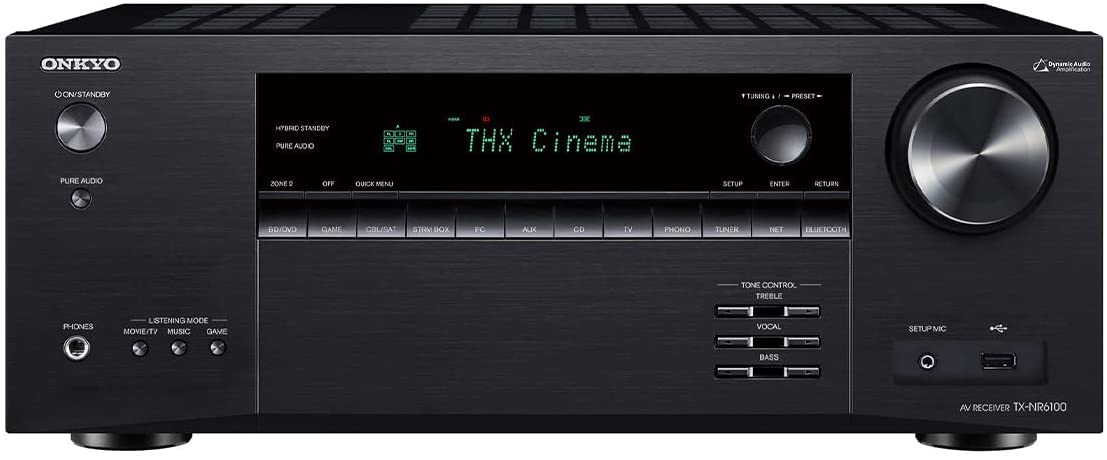
The Onkyo TX-NR6100 is a THX Select certified receiver, meaning it meets strict performance standards for reference-level playback in medium-sized rooms. It delivers a dynamic 210W per channel (single-channel rated) and supports 5.2.2-channel Dolby Atmos and DTS:X with HDMI 2.1 at 40Gbps across three inputs. The unit is also IMAX Enhanced compatible.
Users who pair it with Klipsch or similar high-efficiency speakers report explosive dynamic range and crystal-clear channel separation, even at high volumes. The Onkyo Controller app is well-regarded, and the multi-zone capability works well for distributing different audio sources to Zone 2. The heat management is better than previous Onkyo generations, according to owners.
Some customer reviews warn of HDMI 2.1 processor failure after extended use, with the receiver losing 4K/120Hz capability from consoles. The fan has been described as audible during long high-power sessions, and the remote is not backlit. Inputs 4 through 6 are limited to 4K/60Hz (not 4K/120Hz), which can be confusing when connecting multiple devices.
Why it’s great
- THX Select certification for reliable performance
- Powerful 210W dynamic output
- HDMI 2.1 with 40Gbps and eARC
Good to know
- Reports of HDMI 2.1 processor failure over time
- Audible fan under heavy use
- Inputs 4-6 limited to 4K/60Hz
8. Pioneer VSX-935 7.2 Channel Network Receiver
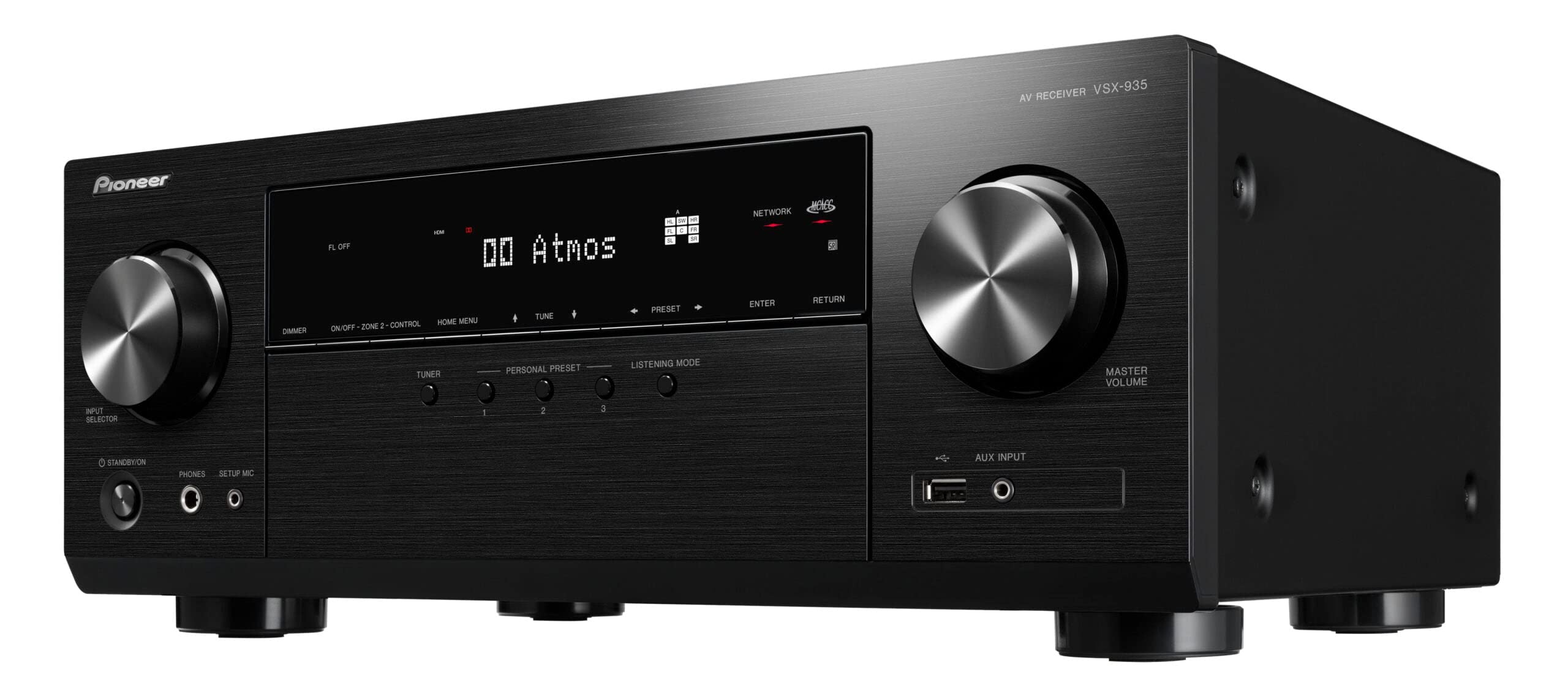
The Pioneer VSX-935 brings Dolby Atmos Height Virtualization to the table, creating a virtual surround and height effect without additional speakers. It includes HDMI 2.1 with 8K/60Hz and 4K/120Hz passthrough, making it gaming-ready. The unit connects to streaming services via Wi-Fi and supports AirPlay 2, Spotify Connect, and Chromecast built-in.
Users appreciate the clear, detailed sound at moderate volume levels, though many note that the audio quality requires manual tuning to dial in. The RF remote has good range, and the dual-zone output is useful for secondary audio. The front-panel controls are straightforward, and the display is easy to read from a distance.
Several reports indicate HDMI video signal issues when connecting a PC, including screen snow and blackouts, which suggests the HDMI handshake may be finicky with certain source devices. The receiver also lacks rear/surround sound output in some configurations, according to affected users. The firmware update process is limited to USB (no over-network updates), which is a notable inconvenience.
Why it’s great
- Dolby Atmos Height Virtualization for compact setups
- HDMI 2.1 with 8K/60Hz and 4K/120Hz
- RF remote with clear display
Good to know
- HDMI handshake problems with some PC sources
- Firmware updates via USB only
- Rear surround output issues reported
9. YAMAHA RX-V6A 7.2-Channel AV Receiver

The Yamaha RX-V6A is a 7.2-channel receiver featuring YPAO-RSC (Reflected Sound Control) with multipoint measurement for more accurate room calibration. It includes three 8K HDMI 2.1 inputs and four additional HDMI inputs (7 total), with support for Dolby Atmos, DTS:X, and Dolby Atmos Height Virtualization. The MusicCast platform allows wireless multi-room audio with other MusicCast devices.
Long-term Yamaha owners often replace their decade-old units with the RX-V6A, citing the brand’s legendary reliability and the noticeable improvement in sonic clarity thanks to the higher slew rate processing. The setup can be done without a smartphone app, and the menu system, while dense, is logical once you are familiar with it. Users also praise the vibrant 4K upscaling and the rich color reproduction.
Some users report a steep learning curve compared to competing brands, and the unit requires a firmware update immediately out of the box to resolve early HDMI handshake issues. The eARC implementation can be finicky — turning on the receiver may not automatically turn on the TV. The power output, while sufficient, is not as generous as some THX-certified competitors in the same price tier.
Why it’s great
- Proven Yamaha build quality and longevity
- YPAO-RSC with multipoint calibration
- 7 HDMI inputs with three 8K ports
Good to know
- Steep learning curve for setup
- eARC auto-power behavior can be inconsistent
- Needs immediate firmware update out of box
10. JBL MA310 5.2 Channel AV Receiver

The JBL MA310 is a 5.2-channel receiver (60W per channel) designed for straightforward 5.1 setups without the complexity of multi-channel Atmos configurations. It features 4 HDMI inputs with ARC, native Dolby and DTS decoding, and Bluetooth 5.1 with low-energy support. The chassis is shallow, fitting easily into smaller media consoles.
Users building their first home theater system appreciate the JBL MA310’s clean, uncluttered sound and its ability to drive bookshelf and tower speakers with ease. The HDMI ARC auto on/off functionality with the TV works reliably after the initial setup. The on-screen menu is displayed through HDMI, which simplifies configuration.
The remote is not backlit, which is a problem for dark rooms, and the auto shut-off default is a short 20 minutes. The unit lacks network streaming (Wi-Fi or Ethernet), so it relies on Bluetooth for wireless audio. The only way to adjust settings is through the TV screen, which can be disorienting for those who prefer front-panel control.
Why it’s great
- Simple, effective 5.2-channel power
- Shallow design fits tight media consoles
- Reliable HDMI ARC/eARC behavior
Good to know
- Remote is not backlit
- No Wi-Fi or network streaming
- Short 20-minute auto shut-off default
11. YAMAHA RX-V4A 5.2-Channel AV Receiver

The Yamaha RX-V4A is the most affordable entry point into modern AV, offering a 5.2-channel configuration with YPAO automatic room calibration, HDMI 2.1 with 4K/120Hz and 8K/60Hz, and full MusicCast multi-room streaming. It includes 4 HDMI inputs (HDCP 2.3) with eARC, support for Dolby Vision and HLG, and voice control via Alexa or Google Assistant.
Users in smaller rooms or apartments frequently praise the RX-V4A for delivering clean, precise power to their speaker systems without needing the higher channel counts of more expensive receivers. Spotify Connect and TIDAL integration work seamlessly through the MusicCast app, which many compare favorably to Sonos in terms of stability. The YPAO calibration effectively checks speaker wiring polarity and sets appropriate levels.
There are concerning reports of HDMI switching failures, where the receiver fails to pass 4K video signals or loses audio processing functionality. Several units exhibited non-functioning HDMI processing shortly after purchase, requiring returns. The remote control interface is also considered poorly laid out, with tiny buttons and confusing menu logic.
Why it’s great
- Best entry price for HDMI 2.1 and MusicCast
- YPAO calibration with polarity check
- Clean, precise amplification for small rooms
Good to know
- HDMI switching failures reported
- Confusing remote layout and menus
- Setup requires a TV screen for menus
FAQ
Do I need a 9.2-channel receiver or is 7.2 enough?
Does room correction really make a difference in sound quality?
Can I use a 5.2 receiver with a 7.1 speaker setup?
What does THX certification mean for an AV receiver?
Final Thoughts: The Verdict
For most users, the av amp under $1000 winner is the Onkyo TX-NR7100 because it brings professional-grade Dirac Live room correction and 9-channel processing together at a price where competitors offer less. If you want the warm, musical sound of a Denon with excellent streaming integration, grab the Denon AVR-S970H. And for a compact, stylish unit that fits tight spaces without sacrificing audio fidelity, nothing beats the Marantz NR1510.