
Our readers keep the lights on and the weekend projects moving. As an Amazon Associate, I earn from qualifying purchases.
Finding a home theater amplifier that delivers distinct surround channels, clear dialogue, and enough wattage for your speakers without draining your bank account is the core challenge of building a system under five hundred dollars. Many models promise multi-channel power but deliver muddled sound, noisy circuits, or limited connectivity for modern 4K sources. The difference between a frustrating setup and a genuinely immersive experience comes down to a few key specs often hidden behind marketing claims.
I’m Rikta — the founder and writer behind FitlyFast. I spend my time dissecting amplifier specifications, comparing DAC architectures, and analyzing real-world power output figures to separate the reliable receivers from the budget traps.
This guide focuses exclusively on the receivers that actually deliver clean amplification, useful HDMI connectivity, and room correction without wasted features. If you are shopping for a av amp under $500, these are the models worth your attention.
How To Choose The Best AV Amp Under $500
Selecting an AV receiver in this price range forces you to prioritize: channel count, HDMI capabilities, and room correction are the three pillars that define your experience. A model that looks feature-packed on paper can fall apart with poor amplification or confusing menus. Focus on these four areas to avoid wasted money.
Channel Configuration and Real Power
A 5.2-channel receiver is the most common and practical choice under $500. It supports a standard five-speaker setup with two subwoofer outputs, which covers the vast majority of home theater layouts. Some models offer 7.2 channels, but the extra two channels often require compromises in power supply quality or HDMI inputs at this budget. Pay attention to power measured at 8 ohms with two channels driven — that figure is far more honest than the inflated peak wattage numbers printed on the box. A receiver delivering 70 to 90 watts per channel is sufficient for most living rooms with moderate-efficiency speakers.
HDMI Version and Video Features
HDMI 2.1 support is becoming standard even in this price tier, bringing 4K at 120Hz pass-through and eARC for uncompressed audio from your TV. If you game on a modern console or PC, 4K 120Hz support is essential. For movie watchers, eARC simplifies audio return from streaming apps on your smart TV. Verify HDCP 2.3 compliance to ensure compatibility with the latest streaming devices and 4K Blu-ray players. Models with only HDMI 2.0 are still viable but limit your future-proofing for high frame-rate gaming.
Room Calibration and Sound Processing
Automatic room calibration (YPAO, Audyssey, or similar) adjusts speaker levels, distances, and equalization to match your room’s acoustics. This feature dramatically improves soundstage, dialogue clarity, and bass integration. A receiver with a well-executed calibration system often sounds better than a more expensive model without it, especially in irregularly shaped rooms. Look for a system that includes a measurement microphone and offers manual EQ adjustments for fine-tuning.
Streaming and Connectivity
Built-in Wi-Fi, Bluetooth, and multi-room support add convenience if you plan to stream music from services like Spotify, TIDAL, or AirPlay 2. Some receivers offer voice control via Alexa or Google Assistant, which can simplify input switching and volume adjustment. A phono input is an important checkbox if you own a turntable. Evaluate the mobile app experience as well — a well-designed app makes setup and daily use far less frustrating than a poorly translated one.
Quick Comparison
On smaller screens, swipe sideways to see the full table.
| Model | Category | Best For | Key Spec | Amazon |
|---|---|---|---|---|
| Yamaha RX-V385 | Mid-Range | Reliable 5.1 with YPAO | 5.1 ch, HDMI 2.0, YPAO | Amazon |
| Yamaha RX-V4A | Mid-Range | HDMI 2.1 gaming | 5.2 ch, HDMI 2.1, MusicCast | Amazon |
| JBL MA310 | Mid-Range | Simple 5.2 with Bluetooth | 5.2 ch, 60W/ch, Bluetooth 5.1 | Amazon |
| Sony STRDH590 | Mid-Range | Value 5.2 with S Force PRO | 5.2 ch, HDMI 2.0, 725W total | Amazon |
| Onkyo TX-8470 | Premium | High-fidelity stereo & vinyl | 2 ch, Wi-Fi, Phono MM/MC | Amazon |
| Pioneer VSX-935 | Premium | 7.2 with Dolby Atmos | 7.2 ch, HDMI 2.1, Dolby Atmos | Amazon |
| Denon AVR-X1700H | Premium | Best overall 7.2 with Audyssey | 7.2 ch, HDMI 2.1, Audyssey MultiEQ | Amazon |
| Denon AVR-S670H | Budget | Entry-level 5.2 with HEOS | 5.2 ch, 75W/ch, HEOS | Amazon |
| Pyle PT6060CHAE | Budget | Raw power & karaoke | 6 ch, 2000W peak, EQ | Amazon |
In‑Depth Reviews
1. Yamaha RX-V385 5.1-Channel 4K Ultra HD AV Receiver with Bluetooth

Yamaha’s RX-V385 is the benchmark entry-level receiver because it focuses on fundamentals that actually matter: clean amplification, reliable HDMI switching, and the YPAO auto-calibration system that corrects for speaker placement and room acoustics. Users report crisp dialogue and warm sound signature that outperforms similarly-priced Sony and Onkyo units. The 4K HDR10 and Dolby Vision pass-through handle modern streaming and Blu-ray sources without issue.
The back panel features four HDMI 2.0 inputs with HDCP 2.2, plus optical and coaxial digital inputs for legacy gear. Bluetooth streaming works consistently with no noticeable audio lag, making it simple to play music from a phone or tablet. The setup microphone and on-screen guide walk you through the calibration process, which owners consistently describe as straightforward despite the manual’s brevity.
At 5.1 channels, this receiver suits small to medium rooms. The power output (nominally 100W per channel at 8 ohms with one channel driven) drives most tower and bookshelf speakers without strain. Its lack of HDMI 2.1 and eARC means 4K 120Hz gaming consoles won’t get full bandwidth, but for movie-focused setups, this remains the most balanced value in the category.
Why it’s great
- YPAO calibration significantly improves soundstage and dialogue clarity without manual tuning.
- Warm, natural sound character that avoids the fatiguing brightness of some budget receivers.
- Plug-and-play Bluetooth pairing with reliable wireless performance.
Good to know
- Only four HDMI inputs, which may fill up fast with multiple sources.
- No eARC support, requiring separate optical cable for TV audio in some setups.
- Speaker binding posts use plastic inserts — careful with thick gauge wire.
2. Yamaha RX-V4A 5.2-Channel AV Receiver with MusicCast

The RX-V4A steps up with HDMI 2.1 inputs (4K120AB and 8K60B) and eARC, making it the go-to under-$500 option for gamers running an Xbox Series X or PS5. Owners driving those consoles report seamless 4K 120Hz pass-through with full 5.1 audio. The receiver also integrates MusicCast, Yamaha’s multi-room streaming platform, which supports Spotify Connect, TIDAL, Amazon Music HD, and AirPlay 2 for flexible whole-home audio.
YPAO calibration is included again, but this model adds a 5.2-channel configuration with two subwoofer outputs for more balanced low-end distribution. The Wi-Fi and Bluetooth connectivity are stable, and the mobile app receives positive feedback for its clean interface — especially compared to the clunky on-screen menus and tiny remote buttons that some users criticize. Voice control via Alexa or Google Assistant works reliably for input switching and volume.
Some early HDMI handshake issues were reported with certain displays, but firmware updates have resolved most of those problems. The 5.2-channel limit means you cannot add rear surrounds or height channels for a full Atmos layout, but for a living room 5.2.2 setup, the RX-V4A punches above its price tier in clarity and headroom, especially with high-efficiency speakers like Klipsch or JBL.
Why it’s great
- True HDMI 2.1 with 4K120Hz support for modern consoles and PC gaming.
- MusicCast multi-room streaming works seamlessly with a wide range of services.
- Excellent sound separation and imaging when paired with quality speakers.
Good to know
- On-screen setup menus feel sluggish and unintuitive compared to competitors.
- Remote control has very small, poorly differentiated buttons — the app is essential.
- Limited to 5.2 channels, so a full 7.1 Atmos setup is not possible.
3. JBL MA310 5.2 Channel (60 Watt x 5) 4K AV Receiver

JBL’s MA310 brings a refreshingly shallow chassis — it is significantly less deep than typical AV receivers, so it fits into TV stands and media consoles that reject full-size units. Despite its compact footprint, it delivers five channels at 60 watts each and supports 4K HDR pass-through over HDMI with ARC. Users connecting it to in-wall Polks and center channels report impressive clarity and no distortion at moderate volumes.
The Bluetooth 5.1 with Low Energy support streams reliably from phones, and the back panel includes four HDMI inputs, optical, and coaxial connections. Setup requires connecting to your TV screen for on-screen menus, which some found initially confusing until a firmware update resolved unresponsive behavior. Once configured, the MA310 provides automatic on/off with TV via ARC and displays a clean setup menu directly on your television for speaker level adjustments.
One notable limitation is the lack of DTS-HD Master Audio downmixing for 2.1 setups — JBL support confirmed only the MA710 supports this. Dolby TrueHD works fine, but if you watch DTS-HD Blu-rays on a two-channel system, this is a drawback. The non-backlit remote also frustrates in dark room settings. Still, for its size and affordable price, the MA310 is a strong option for those prioritizing form factor.
Why it’s great
- Exceptionally shallow depth fits easily in tight media consoles and shelves.
- Clean HDMI ARC integration with automatic TV control simplifies daily use.
- Surprisingly clean amplification for the size, driving moderately efficient speakers well.
Good to know
- Does not decode DTS-HD Master Audio in 2.1 mode — Dolby TrueHD only.
- Remote lacks backlighting, making dark-room operation frustrating.
- Firmware update process felt unresponsive for some users during initial setup.
4. Sony STRDH590 5.2 Channel Surround Sound Home Theater Receiver
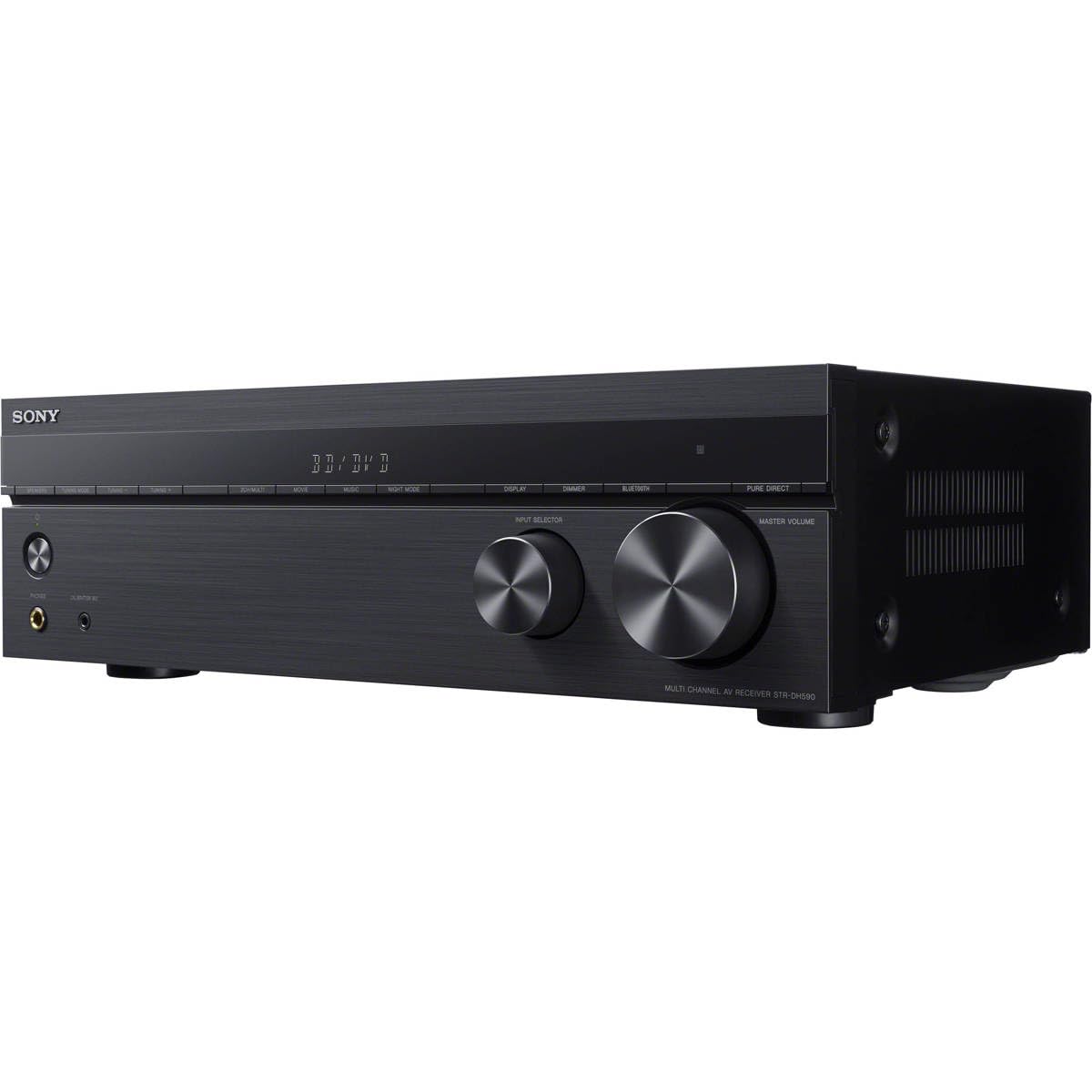
Sony’s STRDH590 is a workhorse budget receiver that does not try to do too much, and that focus pays off in reliability. The 5.2-channel configuration includes S Force PRO virtual surround for two-channel sources and a straightforward auto-calibration microphone that sets speaker levels and distances. Users driving older high-end speakers like KEF Carina 2 report clean, detailed sound that breathes new life into vintage systems.
Connectivity covers four HDMI 2.0 inputs with HDCP 2.2, optical, coaxial, and FM radio. The Bluetooth streaming feature supports Bluetooth Standby, which turns on the receiver from your phone — a convenience rarely seen at this price. The slim chassis runs cooler than many competitors, thanks to efficient amplifier design. The remote is simple and functional, with dedicated buttons for FM, TV, and Bluetooth sources.
The main tradeoffs are the absence of HDMI 2.1, eARC, and any phono input. It also lacks A/B speaker routing, which may matter if you want to switch between two speaker pairs. Some users find the initial setup menu complex, but the on-screen guidance and auto-calibration simplify it. For a straightforward 5.1 home theater without fancy streaming extras, the STRDH590 delivers exceptional reliability.
Why it’s great
- Proven reliability with clean, stable amplification across a wide speaker range.
- Bluetooth Standby feature wakes the receiver from your phone, adding convenience.
- Compact and cool-running design reduces heat buildup in enclosed cabinets.
Good to know
- No HDMI 2.1 or eARC, limiting future-proofing for gaming and 4K streaming.
- No phono input, so turntable users need an external preamp.
- Speaker connectors for center and rear use spring clips, not binding posts.
5. Onkyo TX-8470 2 Channel Stereo Receiver with Wi-Fi, Bluetooth, Phono

The Onkyo TX-8470 is not a surround receiver — it is a two-channel stereo amplifier that prioritizes audio fidelity over channel count. This is the right choice if your primary use is music listening, especially vinyl. It features a dedicated MM/MC phono stage with isolated circuitry that preserves delicate phono signals, plus a gold-plated terminal and audio-grade capacitors for a clean signal path. Owners driving Klipsch floor-standing speakers report powerful, detailed sound with excellent imaging.
Built-in Wi-Fi with AirPlay 2, Spotify Connect, and Roon Ready support make it a capable streaming hub. The Onkyo Controller app manages inputs and volume, though initial Wi-Fi setup requires pressing a front-panel button before the app recognizes the receiver — a step many users miss. Voice control via Alexa and Google Assistant is supported. The large remote includes tiny buttons that some find overwhelming, but the core amplification is undeniably solid.
At this price, you are paying for higher-quality components rather than multi-channel processing. The TX-8470 runs cool thanks to its Class G amplifier design, and it includes HDMI ARC for TV audio connection. If your goal is a serious stereo system for music and movies without surround channels, this Onkyo outperforms every multi-channel receiver in the same price bracket for pure sound quality.
Why it’s great
- High-quality MM/MC phono stage that surpasses typical budget receiver inputs.
- Roon Ready and AirPlay 2 support for high-resolution audio streaming.
- Class G amplifier runs cool while delivering clean, high-current power.
Good to know
- Two-channel only — no surround sound processing for multi-speaker setups.
- Wi-Fi setup requires a specific front button press before the app connects.
- Remote buttons are small, densely packed, and lack intuitive labeling.
6. Pioneer VSX-935 7.2 Channel Surround Sound Network Receiver
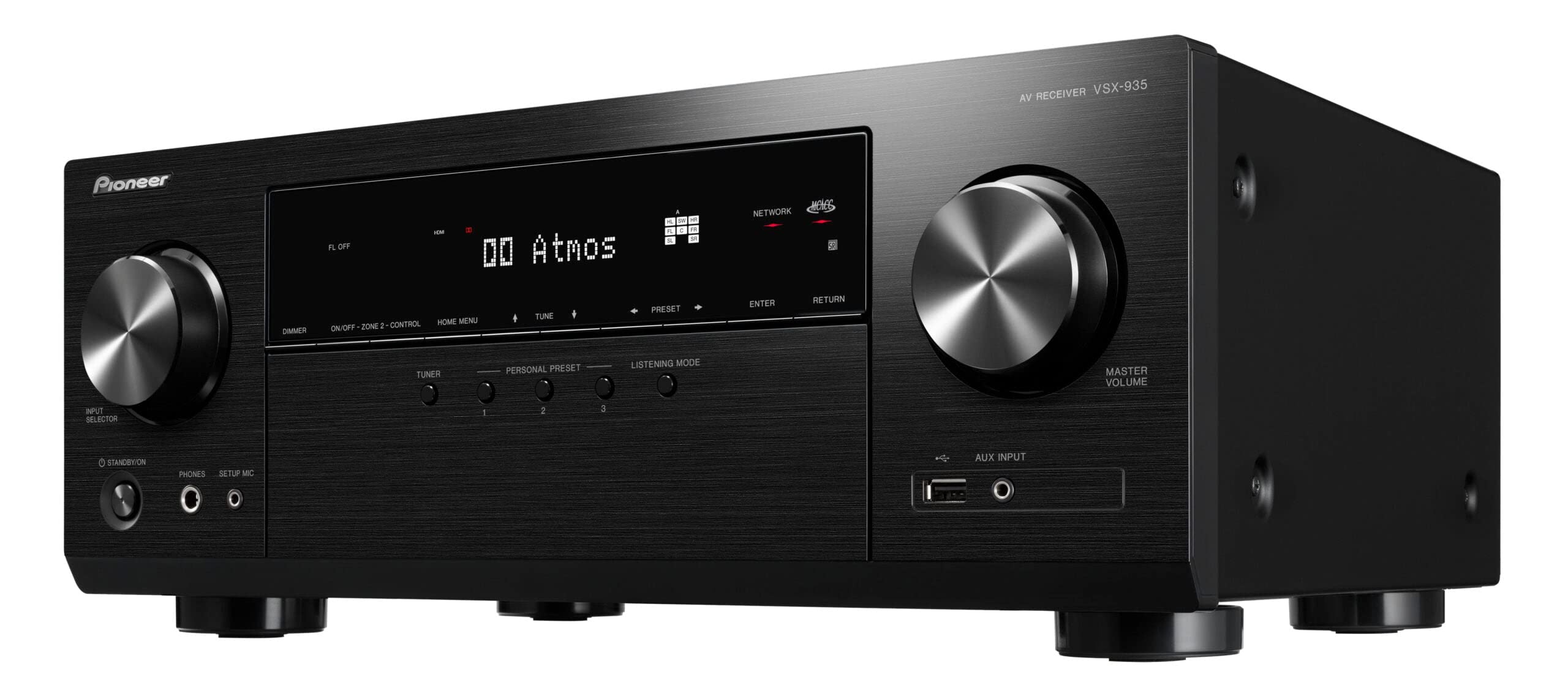
The Pioneer VSX-935 delivers a full 7.2-channel layout with HDMI 2.1 pass-through and Dolby Atmos support, which is rare at a price point that can stretch close to five hundred. This makes it an exceptional choice if you plan to build a system with height channels for immersive object-based audio. Users report that after manual adjustment (the auto-setup is considered mediocre), the sound becomes crisp, clear, and loud enough to fill a large room.
Connectivity includes six HDMI inputs (all HDCP 2.3), dual subwoofer pre-outs, and front-panel USB. The receiver supports streaming via built-in Wi-Fi, AirPlay 2, and Bluetooth, and it integrates with voice assistants. The remote is RF-based, which works through cabinets, and the front display includes a dimmer for dark rooms. Dual-zone support allows a second audio feed to another room.
Some reliability complaints exist — a portion of units arrive DOA or develop HDMI handshake issues with computers. Firmware updates require USB, not network updates, which several owners find tedious. The auto-calibration microphone produces inconsistent results, so manual configuration is recommended. Despite these quirks, the VSX-935 offers the highest channel count and the most complete Atmos feature set in this price neighborhood.
Why it’s great
- Full 7.2 channels with Dolby Atmos height virtualization for a true 3D soundstage.
- HDMI 2.1 with 8K pass-through and enhanced gaming features for modern consoles.
- RF remote operates through obstructions, and front display has adjustable brightness.
Good to know
- Firmware updates require a USB drive — no network update capability.
- Auto-setup calibration is unreliable; manual configuration yields better results.
- Some units have quality control issues, including DOA or HDMI handshake problems.
7. Denon AVR-X1700H 7.2 Channel AV Receiver – 80W/Channel, 8K HDMI

Denon’s AVR-X1700H is widely regarded as the best all-around performer in the sub- space, often found on sale below the five-hundred-dollar threshold. It delivers 80 watts per channel across seven channels with Audyssey MultiEQ room calibration, which does a noticeably better job than YPAO or Pioneer’s MCACC at taming room modes and dialogue intelligibility. Users pairing it with Klipsch or KEF speakers consistently describe the sound as clean, powerful, and immersive.
The HDMI section features three 8K inputs (8K60/4K120 pass-through) with HDCP 2.3, eARC, and support for HDR10+, Dolby Vision, and Dynamic HDR. Gaming features include VRR, ALLM, and QFT for tear-free, low-latency gaming. The HEOS multi-room platform supports Spotify, TIDAL, Amazon Music HD, and AirPlay 2, and the mobile app is mature and reliable. The inclusion of a phono input (MM) is a bonus for turntable users.
Setup is guided by an award-winning on-screen assist that walks through speaker connection and calibration. Some users find the initial configuration time-consuming (about an hour), but the results justify the effort. The remote is decent but many owners rely on the Denon app. At its price, the AVR-X1700H offers the most complete package of sound quality, future-proofed video handling, and streaming versatility.
Why it’s great
- Audyssey MultiEQ calibration delivers superior room correction for balanced, clear sound.
- Full HDMI 2.1 support with 8K/60Hz and 4K/120Hz gaming features.
- Built-in phono input and HEOS multi-room streaming expand versatility.
Good to know
- Setup takes about an hour with guided menus — not a 10-minute process.
- Audyssey microphone cable is short, limiting placement in large rooms.
- Denon app provides better control than the physical remote.
8. Denon AVR-S670H 5.2 Ch Home Theater Receiver, 8K HDMI

Denon’s AVR-S670H is a slimmed-down entry point into the brand’s ecosystem, offering 75 watts across five channels with 8K upscaling and eARC support. This makes it a strong choice if you want Denon’s reliable build quality and guided setup but only need a 5.1 system. Owners moving from older receivers praise the straightforward setup — one user replaced a two-decade-old unit and had the system configured in under 30 minutes.
The HDMI inputs include HDCP 2.3, support for HDR10+, Dolby Vision, and Dynamic HDR, plus VRR and ALLM for gaming. The HEOS platform is included for multi-room music streaming, and voice control works with Alexa, Google Assistant, and Siri. The S670H also includes a phono input for turntables, a feature usually reserved for more expensive models. The on-screen speaker calibration guides you through level and distance settings without confusion.
As an entry-level Denon, it lacks the Audyssey MultiEQ found in the X-series, relying on a simpler calibration routine. The plastic front panel and smaller power supply feel less premium than the X1700H. Some users report HEOS Wi-Fi connection drops, especially with busy 2.4 GHz networks. For a basic 5.2 system with future-proofed HDMI and easy setup, the S670H delivers solid Denon DNA at a more accessible price.
Why it’s great
- Simplified guided setup is beginner-friendly, with clear on-screen instructions.
- 8K upscaling and HDMI 2.1 features keep the receiver relevant for years.
- Phono input included, a rare find at this tier in Denon’s lineup.
Good to know
- Lacks Audyssey MultiEQ — room calibration is more basic than the X-series.
- HEOS Wi-Fi streaming can occasionally disconnect on crowded networks.
- Build feels slightly lighter and less rigid than the step-up X1700H.
9. Pyle Bluetooth Hybrid Home Amplifier – 6-Channel 2000W Rack Mount
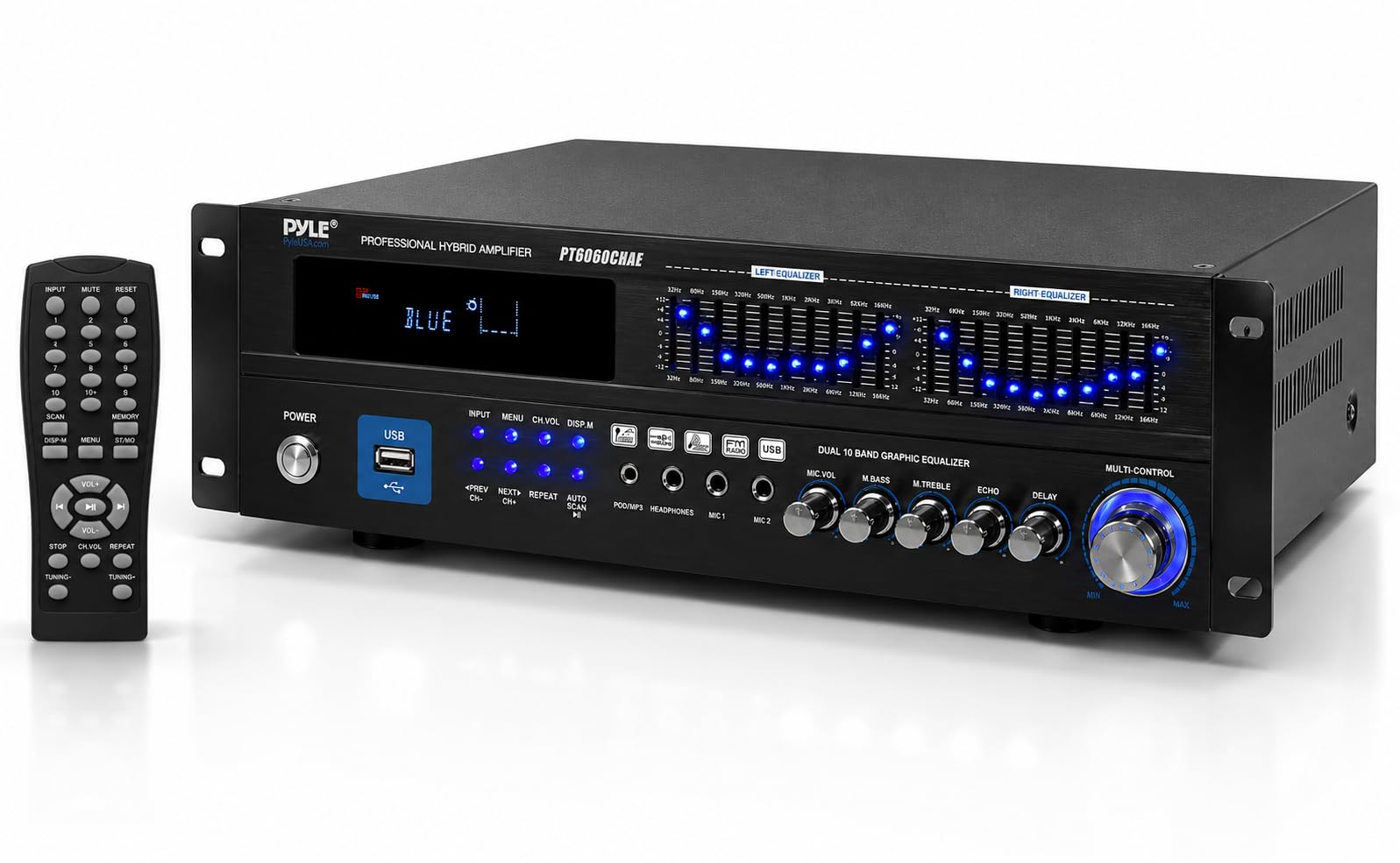
The Pyle PT6060CHAE is an unconventional choice — a six-channel hybrid amplifier with a peak power rating of 2000 watts, designed for karaoke, public address, and high-volume home theater. Owners report that it drives four Klipsch towers with authority, and the dual 10-band equalizer allows fine-tuned frequency adjustment. The front panel includes VFD display, microphone inputs with echo control, and rotary knobs for treble, bass, and master volume.
Input options are extensive: Bluetooth, USB, AUX, optical, coaxial, HDMI, AC-3, and DVD inputs cover nearly every source you might own. The rack-mount chassis with built-in cooling fan makes it suitable for equipment racks. The remote control works for basic functions, though it lacks a power button. For the price, it offers massive raw power that can drive passive subwoofers hard — one user reported blowing out an 8-inch passive sub with ease.
Quality control is the primary concern. Multiple reviews mention that units fail within a year, emitting a burnt smell before dying. Constant hissing at low volume is a common complaint, audible in quiet listening environments. The unit defaults to DVD input on power-up, requiring manual re-selection of optical each time. This is a budget unit that rewards those who need brute force and don’t mind some noise. It is not a refined home theater component.
Why it’s great
- Extreme peak power output for driving multiple high-demand speakers or passive subs.
- Dual 10-band EQ provides granular control over frequency response.
- Comprehensive input selection including optical, coaxial, and HDMI.
Good to know
- Reliability issues with reported failures after one year of use.
- Audible hiss at low volume levels, which may be distracting in quiet rooms.
- Unit defaults to DVD input on power-up, requiring manual input switching.
FAQ
Should I get a 5.1 or 7.1 receiver at this price point?
Can I use a stereo receiver instead of an AV amp for home theater?
What does YPAO or Audyssey calibration actually do?
Is HDMI 2.1 necessary for movies or just gaming?
Why does my receiver sound hissy at low volume?
Final Thoughts: The Verdict
For most users, the av amp under $500 winner is the Yamaha RX-V385 because it combines reliable 5.1 amplification, effective YPAO room calibration, and clean HDMI 2.0 video handling at a price that leaves room for quality speakers. If you need HDMI 2.1 for gaming, grab the Yamaha RX-V4A. And for pure stereo fidelity with vinyl support, nothing beats the Onkyo TX-8470.