
Our readers keep the lights on and the weekend projects moving. As an Amazon Associate, I earn from qualifying purchases.
The critical ear demands a preamplifier and power section that does not color, compress, or gate the source material. An AV receiver for audiophiles must prioritize low total harmonic distortion (THD), a robust signal-to-noise ratio (SNR), and high-current amplification that can handle impedance dips transparently, all while decoding the latest object-based surround codecs.
I’m Rikta — the co-founder and writer behind FitlyFast. My analysis focuses on the measurable analog outputs, DAC architecture, and room correction algorithms that separate true high-fidelity AVRs from mass-market sound bars in a box.
Whether upgrading from a stereo preamp or building a dedicated listening room, this guide dissects the essential specifications and real-world performance of the av receiver for audiophiles.
How To Choose The Best AV Receiver For Audiophiles
Choosing an AV receiver for a dedicated listening room requires prioritizing analog audio stage build quality over raw feature counts. Many receivers claim high power ratings into 1 kHz, but audiophile rigs demand rated power into 8 ohms across the full 20 Hz–20 kHz bandwidth with both channels driven.
DAC Architecture and Native Sample Rate Support
The digital-to-analog converter is the heart of digital audio playback. Look for ESS Sabre (ES9010K2M, ES9026PRO) or AKM chips that support native DSD 11.2 MHz and PCM up to 384 kHz. Cheaper DACs resample via SRC, which introduces jitter and reduces image precision.
Room Correction: Dirac Live vs. Audyssey vs. YPAO
Dirac Live Full Bandwidth analyzes impulse response across the entire frequency spectrum and applies FIR filters to correct time-domain and frequency-domain errors. Audyssey MultEQ XT32 uses a similar approach but focuses on frequency response flattening. YPAO R.S.C. with 3D multipoint measurement is effective but less aggressive in time-domain correction.
Pre-Out Flexibility and External Amplifier Integration
Audiophiles often bypass internal power stages for dedicated monoblocks. Verify the receiver has RCA pre-outs for the front left/right channels at a minimum, preferably for the entire bed layer. XLR-balanced pre-outs are a premium option that reject ground-loop noise over long cable runs.
HDMI 2.1 Bandwidth and Video Transparency
For pure video pass-through, the AVR must support 40 Gbps HDMI 2.1 for 4K/120 or 8K/60 with HDR10+, Dolby Vision, and VRR. A transparent video path means zero chroma subsampling or frame dropping, preserving the source integrity.
Quick Comparison
On smaller screens, swipe sideways to see the full table.
| Model | Category | Best For | Key Spec | Amazon |
|---|---|---|---|---|
| Yamaha R-N2000A | Network Stereo | Pure stereo purist | ESS Sabre ES9026PRO; DSD 11.2 MHz native | Amazon |
| Marantz SR8015 | Flagship AVR | 11-channel surround | 140W x 11; HDAM; 8K HDMI 2.1 | Amazon |
| Marantz Cinema 50 | Mid-range AVR | Versatile 9.4-channel | 110W x 9; Audyssey MultEQ XT32; Auro-3D | Amazon |
| Sony STR-AZ5000ES | Premium ES | 360 Spatial Sound Mapping | 130W x 11 (2ch); 360SSM; 8K HDMI | Amazon |
| Onkyo TX-RZ70 | High-end AVR | Dirac Live + THX | 140W x 11; ESS Sabre; 11.2 ch | Amazon |
| NAD T 758 V3i | Modular AVR | Modular design upgrade | 60W x 7; Dirac Live; BluOS | Amazon |
| Sony STR-AZ1000ES | Entry ES | Compact high-end | 100W x 7 (8 ohm); 360SSM; 8K HDMI | Amazon |
| Yamaha RX-A4A | Mid-range | Surround:AI immersion | 7.2 ch; YPAO R.S.C. 3D; 8K 40 Gbps | Amazon |
| Onkyo TX-RZ50 | Mid-range | Dirac Live value | 120W x 9; THX; 8K HDMI | Amazon |
| Denon AVR-S970H | Mid-range | 8K gaming | 90W x 7; HEOS; 8K/60Hz | Amazon |
| Denon AVR-S670H | Entry-level | Budget surround | 75W x 5; phono; HEOS | Amazon |
| Yamaha R-N600A | Stereo Receiver | Hi-Fi streaming stereo | ESS Sabre ES9010K2M; DSD 11.2 MHz | Amazon |
| Pioneer VSX-935 | Budget AVR | HDMI 2.1 entry | 7.2 ch; Dolby Atmos Height Virtualization | Amazon |
In‑Depth Reviews
1. Yamaha R-N2000A

The R-N2000A is a stereo network receiver that forgoes multichannel complexity in favor of a purist two-channel signal path. It uses a large toroidal power transformer to deliver clean, low-noise current to the output stage, producing a spacious soundstage with precise instrument separation. The ESS Sabre ES9026PRO DAC supports native DSD 11.2 MHz and PCM 384 kHz, which preserves the full transient detail of high-resolution files.
YPAO room correction here is minimal but effective for subwoofer integration and delay alignment, though audiophiles may prefer to bypass it entirely for critical listening. The phono stage is MM-only, so moving-coil cartridges require an external step-up transformer. The VU meters are front-lit rather than backlit, which is a minor visibility trade-off under bright conditions.
With pre-outs and a single subwoofer output, this receiver can drive high-efficiency speakers like the Klipsch RP-8000F or MartinLogan electrostatics without strain. The MusicCast app supports Amazon Music HD, TIDAL, and Qobuz, making it a viable hub for streaming purists.
Why it’s great
- Toroidal transformer delivers low-noise power with excellent dynamic headroom.
- Native DSD 11.2 MHz and 384 kHz PCM support via USB.
- Built like a tank; 48.7 lb chassis damps vibration.
Good to know
- No balanced XLR inputs or outputs.
- MM-only phono stage; moving-coil cartridges need an external phono preamp.
- Single subwoofer output limits multi-sub setups.
2. Marantz SR8015

The SR8015 is Marantz’s previous-generation flagship with 11 channels of amplification rated at 140 watts per channel into 8 ohms. It uses the company’s proprietary HDAM (Hyper Dynamic Amplifier Module) discrete circuitry, which provides faster slew rates and lower noise floor than monolithic op-amp designs. The result is a sound that is both detailed and musically engaging, with excellent channel separation for multichannel music.
This receiver supports 8K HDMI 2.1 pass-through and has RCA pre-outs for all 11.2 channels, allowing easy integration with external power amplifiers for the front stage. The Audyssey MultEQ XT32 room correction is highly capable, but some users find the subwoofer calibration benefits most from the Audyssey mobile app’s EQ adjustments. The remote control is surprisingly cheap-feeling for this tier, and the subwoofer outputs default to off until manually enabled.
At nearly 30 pounds, it runs warm and requires 8 inches of clearance above the chassis. For a 7.2.4 or 9.2.2 setup, the SR8015 provides enough headroom to drive demanding bookshelf speakers without clipping. The HEOS multi-room functionality works reliably, though older firmware versions had occasional network dropouts.
Why it’s great
- Discrete HDAM circuitry provides low-noise, high-slew-rate amplification.
- Full 11.2 channel RCA pre-outs for external amp upgrades.
- Audyssey MutliEQ XT32 with subwoofer EQ app support.
Good to know
- Remote control feels cheap for a flagship receiver.
- Runs hot; needs 8″ clearance above.
- Subwoofer outputs default to off in some firmware versions.
3. Marantz Cinema 50

The Cinema 50 occupies a sweet spot for audiophiles who want 9.4-channel support without stepping up to the flagship SR8015. It delivers 110 watts per channel into eight ohms and includes HDAM preamp circuitry, ensuring a low-noise path for both movies and two-channel music. The four independent subwoofer outputs allow for precise bass integration, a feature typically reserved for more expensive processors.
Audyssey MultEQ XT32 provides comprehensive room correction with the ability to apply custom target curves via the paid Audyssey app. The HDMI 2.1 board supports 8K/60Hz pass-through and eARC, and the three HDMI outputs simplify bi-amp or Zone 2 configurations. The front panel design with its porthole display is polarizing, but the build quality is excellent with a metal chassis that resists resonance.
Some users report that the initial setup requires downloading the HEOS app, and the on-screen menu system is less intuitive than previous Marantz generations. The phono stage is acceptable for MM cartridges but lacks gain for MC offerings. For a main listening room with two subwoofers, the Cinema 50 offers the best price-to-channel-count ratio in the Marantz lineup.
Why it’s great
- Four independently assignable subwoofer outputs for multi-sub integration.
- HDAM preamp produces warm, detailed tonality.
- Full HDMI 2.1 with 8K/60Hz and eARC support.
Good to know
- HEOS app required for initial network setup.
- MC phono cartridges need an external preamp.
- Front display aesthetic may not suit all decor.
4. Sony STR-AZ5000ES

The Sony STR-AZ5000ES is the company’s 11.2-channel flagship ES receiver, featuring Sony’s proprietary 360 Spatial Sound Mapping technology. This processing algorithm mathematically synthesizes phantom speakers to create a sphere of sound from a physical 5.1.2 or 7.1.4 layout, effectively making a smaller configuration sound much larger. The digital amplifier section delivers 130 watts per channel into 8 ohms, with high current capability for low-impedance loads.
The Digital Cinema Auto Calibration IX (DCAC IX) uses a bundled microphone to measure speaker distances and equalizes frequency response. However, the calibration is less flexible than Dirac Live for advanced time-domain correction. The receiver runs very hot, and owners should plan for active ventilation or an external fan. It supports HDMI 2.1 with 8K/60Hz pass-through, but lacks HDR10+ and QMS.
The 360 Spatial Sound Mapping is genuinely impressive for turning a 5.1.2 system into a convincing 7.1.4 illusion, which is a distinct advantage for rooms that cannot accommodate physical rear speakers. The Neural X upmixer also does an excellent job creating immersive sound from stereo sources. For those who prioritize Dolby Atmos immersion over Dirac Live, the STR-AZ5000ES is a compelling choice.
Why it’s great
- 360 Spatial Sound Mapping creates phantom surround channels from fewer physical speakers.
- High-current amplification handles 4-ohm loads with stability.
- Backlit remote with premium feel.
Good to know
- Runs very hot; needs active cooling.
- No HDR10+ or QMS support.
- Auto-calibration is less refined than Dirac Live.
5. Onkyo TX-RZ70
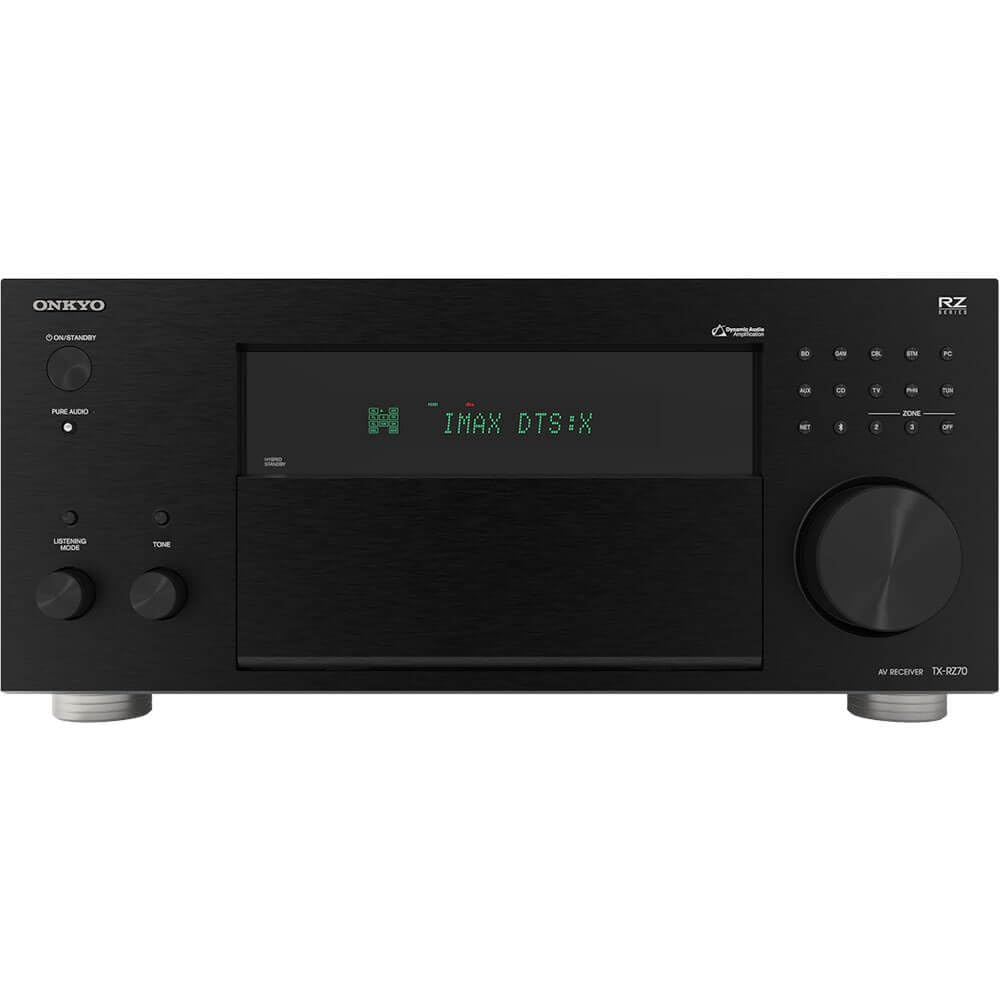
The TX-RZ70 is Onkyo’s most powerful consumer AVR, delivering 140 watts per channel across 11 channels with ESS Sabre DACs throughout. It includes Dirac Live Full Bandwidth out of the box, providing advanced room correction that addresses both the frequency domain and time domain. Independent measurements confirm it delivers over 170 watts per channel in bench testing, providing significant headroom for dynamic peaks.
The THX certification ensures that the preamp-output and amplifier sections add no audible coloration to the source signal. The unit includes IMAX Enhanced mode, which adjusts picture settings and audio processing for IAX-certified content. At nearly 58 pounds, this is a physically large receiver that requires a sturdy AV rack and generous depth clearance.
Some users report that the Zone 2 remote control volume implementation is poorly designed, reverting to the main zone after a short timeout. The dual subwoofer outputs are not independently calibrated via Dirac Live without the optional Bass Control upgrade. For those building a 7.2.4 system with Dirac Live, the TX-RZ70 is the best-performing AVR under the floor of separates pricing.
Why it’s great
- Dirac Live Full Bandwidth included for precision time-domain correction.
- Bench-tested at 170W+ per channel continuous.
- THX Certified with IMAX Enhanced mode.
Good to know
- Extremely heavy at 58 lbs; needs a sturdy rack.
- Zone 2 control implementation is cumbersome.
- Dual subwoofer outputs lack independent Dirac calibration without the paid upgrade.
6. NAD T 758 V3i

The NAD T 758 V3i stands apart with its Modular Design Construction (MDC), allowing you to swap HDMI or DSP boards as formats evolve. It outputs a modest 60 watts per channel into 8 ohms, but the high-current Holmgren toroidal transformer delivers an effortless transient response that belies the power rating. The built-in BluOS platform supports Master Quality Authenticated (MQA) playback and multi-room streaming.
Dirac Live Full Bandwidth is included, offering time-domain correction. The wireless connectivity has been reported as finicky, sometimes requiring a USB dongle reposition. The on-screen menu is frankly archaic by modern standards, with blocky text and limited visual feedback, but the sound quality once calibrated is competitive with many separates.
For the audiophile who wants to start with an integrated receiver and gradually add external amplifiers, the T 758 V3i’s pre-out section is transparent to the source. The absence of multi-channel analog inputs limits utility for legacy SACD players. This is a receiver designed for the tinkerer, not the plug-and-play crowd.
Why it’s great
- Modular Design Construction allows future HDMI/DSP board upgrades.
- Dirac Live Full Bandwidth included for precise room correction.
- BluOS supports MQA and high-resolution streaming.
Good to know
- Wireless interface can be finicky and requires patience.
- Blocky on-screen menu looks dated.
- No multi-channel analog inputs for legacy SACD/DVD-Audio players.
7. Sony STR-AZ1000ES

The STR-AZ1000ES is Sony’s entry-level ES receiver that packs the same 360 Spatial Sound Mapping and DCAC IX calibration as the larger STR-AZ5000ES. It outputs 100 watts per channel into 8 ohms across seven channels, which is sufficient for moderate-sized rooms with efficient speakers. The chassis is more compact than typical ES gear but still maintains a solid build quality.
The 360 Spatial Sound Mapping works effectively here, creating a convincing sound bubble from a 5.1.2 layout. The HDMI 2.1 inputs support 8K/60Hz, VRR, and ALLM, but HDR10+ is absent. The receiver runs warm, though not as hot as the bigger ES model. The setup is straightforward via the on-screen GUI or the web interface.
For audiophiles with space constraints, the STR-AZ1000ES offers many of the same audio processing features as the flagship in a smaller footprint. However, the lack of pre-outs for front L/R limits the ability to integrate with external amplifiers. This is a solid choice for a dedicated listening room where separate power amplification is not in the plan.
Why it’s great
- 360 Spatial Sound Mapping in a compact 7.2 chassis.
- 8K HDMI 2.1 with VRR and ALLM for gaming.
- Easy setup with GUI, web interface, or app.
Good to know
- No pre-outs for front L/R external amp integration.
- No HDR10+ support.
- Runs warm; add ventilation.
8. Yamaha RX-A4A

The RX-A4A is the mid-range Aventage receiver with Surround:AI, which uses machine learning to analyze scene audio in real-time and optimize sound field parameters. The YPAO R.S.C. with 3D multipoint measurement provides nine-point frequency correction, though it does not apply time-domain correction as aggressively as Dirac Live. It supports 8K/60Hz pass-through with 40 Gbps bandwidth.
The pre-out section for front L/R allows external power amp upgrades. The unit includes a phono input and works with Sonos via a Sonos Port. The MusicCast app is stable and supports high-resolution streaming up to 24-bit/192 kHz. Setup is generally easier than competing receivers in the same price bracket.
Some users report that the Surround:AI mode pushes dialogue heavy to the center channel on older stereo content, making the 7-channel stereo mode preferable for music. The lack of a front HDMI port is a minor inconvenience. For a balanced combination of video processing and room correction, the RX-A4A is a well-rounded performer.
Why it’s great
- Surround:AI uses real-time ML processing for dynamic scene audio.
- YPAO R.S.C. 3D with multipoint measurement for accurate room EQ.
- Front L/R pre-outs for external amp upgrades.
Good to know
- Surround:AI can push dialogue to center on stereo content.
- No front HDMI port for temporary connections.
- Firmware updates require USB drive or patience with network.
9. Onkyo TX-RZ50

The TX-RZ50 offers Dirac Live Full Bandwidth at a mid-range price point, making it the best entry into Dirac-equipped separates-level sound. It outputs 120 watts per channel into 9 channels, with enough headroom for most 5.1.4 or 7.1.2 configurations. The THX certification guarantees the signal path adds no noise, and the Klipsch Optimize Mode sets precise crossover values for Klipsch Reference speakers.
HDMI 2.1 support includes 8K/60Hz, 4K/120Hz, VRR, and ALLM. The dual subwoofer outputs lack independent calibration, which is a trade-off for the price point. The unit is physically large but runs cooler than many competitors thanks to efficient amplifier design.
Some users experienced HDMI handshake issues with older sources, though firmware updates have largely addressed this. The Onkyo app is functional but not as polished as Marantz HEOS. For the audiophile building a first-time Dirac system, the TX-RZ50 is the most cost-effective way to get full-bandwidth room correction with THX-grade amplification.
Why it’s great
- Dirac Live Full Bandwidth included at a mid-range price.
- THX Certified select for noise-free amplification.
- Klipsch Optimize Mode for instant crossover match.
Good to know
- Dual subwoofer outputs not independently calibrated.
- HDMI handshake issues reported with some legacy sources.
- Onkyo app lags behind competitors in polish.
10. Denon AVR-S970H

The Denon AVR-S970H is a 7.2-channel receiver that prioritizes HDMI 2.1 gaming features at a competitive price. It outputs 90 watts per channel, sufficient for efficient speakers in a medium-sized room. The HEOS multi-room platform provides easy access to TIDAL, Spotify, and network streaming, with voice control via Alexa, Google Assistant, or Apple HomeKit.
The Audyssey MultEQ room correction provides basic frequency response flattening. The phono input allows direct turntable connection, and the three HDMI inputs support 8K/60Hz pass-through. The Zone 2 powered output uses the rear surround speaker terminals, reducing the main zone to 5.2 when active.
Some users note that the HEOS app can struggle with Bluetooth streaming when used concurrently with Wi-Fi. The receiver runs cooler than previous Denon generations. For the audiophile who also plays competitive games, the S970H offers low-latency video pass-through with VRR and ALLM, which is rare at this tier.
Why it’s great
- HDMI 2.1 with VRR and ALLM for lag-free gaming.
- Integrated phono input for turntable connection.
- HEOS multi-room with wide streaming service support.
Good to know
- Zone 2 uses rear surround terminals, reducing main zone to 5.2.
- HEOS app can have Bluetooth/Wi-Fi conflicts.
- No Dirac Live or advanced room correction.
11. Denon AVR-S670H

The AVR-S670H is a basic 5.2-channel receiver that includes a phono input, making it a budget-friendly option for audiophiles who primarily listen to vinyl and want a simple movie setup. It outputs 75 watts per channel, adequate for efficient speakers in a small room. The Audyssey MultEQ provides basic room correction.
HDMI 2.1 support with eARC and 8K/60Hz pass-through ensures compatibility with modern TVs. The HEOS platform allows streaming music services and multi-room audio. Setup is straightforward with the guided on-screen assistant.
This receiver lacks pre-outs for external amplifiers and supports only 5.2 channels, which limits expansion potential. For a dedicated two-channel listening room with occasional surround movies, the S670H is a competent entry point. The power supply is less robust than higher-tier Denon models, so demanding speakers may reveal clipping at higher volumes.
Why it’s great
- Phono input for direct turntable connection.
- eARC and 8K/60Hz HDMI 2.1 pass-through.
- Easy setup with guided assistant.
Good to know
- Limited to 5.2 channels; no pre-outs for expansion.
- 75W per channel may lack headroom for inefficient speakers.
- Basic Audyssey MultEQ without optional app EQ adjustment.
12. Yamaha R-N600A

The R-N600A is a stereo network receiver with a built-in ESS Sabre ES9010K2M Ultra DAC for high-resolution playback. It supports native DSD 11.2 MHz and PCM 384 kHz via the front-panel USB port. With 80 watts per channel into 8 ohms, it provides plenty of power for bookshelf speakers in a near-field setup.
The MusicCast streaming platform handles Wi-Fi and Ethernet connectivity, supporting TIDAL, Qobuz, Amazon Music HD, and network-attached storage (NAS) via DLNA. The phono input is MM-only, and the plastic knobs on the front panel feel less premium than the brushed metal chassis suggests.
Unlike multichannel AVRs, the R-N600A lacks HDMI inputs and room correction, so it is best suited for a dedicated stereo listening station. The sound is clean and detailed, with a low noise floor that is particularly noticeable during quiet passages. For a vinyl-first audiophile who also streams high-res files, this is a focused, cost-effective choice.
Why it’s great
- ESS Sabre ES9010K2M DAC for class-leading S/N performance.
- Native DSD 11.2 MHz playback via USB.
- MusicCast streaming with NAS/DLNA support.
Good to know
- No HDMI inputs for TV audio connection.
- Plastic knobs feel less premium than chassis.
- Phono stage is MM-only; no MC support.
13. Pioneer VSX-935
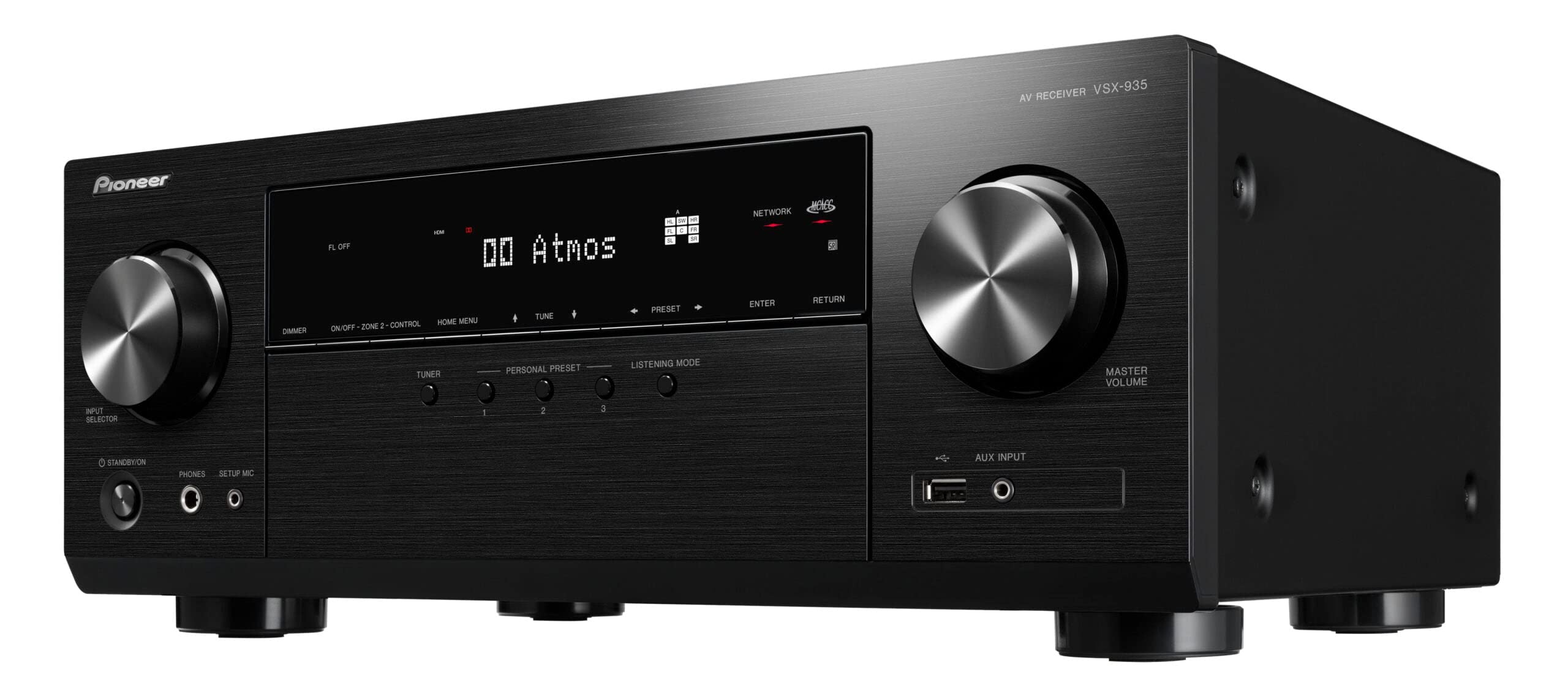
The Pioneer VSX-935 is a 7.2-channel receiver that delivers 8K HDMI 2.1 pass-through and Dolby Atmos Height Virtualization, which creates a surround effect without physical height speakers. It is a budget entry point into modern surround sound for the audiophile on a budget. The automatic speaker setup is reported as unreliable, but manual calibration yields good results.
The receiver supports streaming music services via Wi-Fi and Bluetooth, including TIDAL and Spotify. The sound profile is described as crisp and clear with gradual volume scaling. Some units had issues with HDMI handshake reliability with computers, leading to snow or black screen issues.
Given its price point, the VSX-935 is best for introducing someone to object-based surround without a major investment. The absence of advanced room correction and pre-outs limits its long-term upgrade path. It is a solid starter unit that can be upgraded later as the system grows.
Why it’s great
- 8K HDMI 2.1 pass-through at a budget price.
- Dolby Atmos Height Virtualization without physical height speakers.
- Crisp, clear sound output after manual calibration.
Good to know
- Auto setup is unreliable; manual calibration is required.
- Some units have HDMI handshake issues with PCs.
- No pre-outs for external amplifier integration.
FAQ
Is Dirac Live noticeably better than Audyssey XT32 for music listening?
Do I need HDMI 2.1 40 Gbps for an audiophile system?
What is the advantage of a toroidal power transformer in an AVR?
Why do some audiophile AVRs lack multiple subwoofer outputs with independent calibration?
Final Thoughts: The Verdict
For most users building a dedicated listening room, the av receiver for audiophiles winner is the Onkyo TX-RZ70 because it combines Dirac Live Full Bandwidth, ESS Sabre DACs, and 140W of THX-certified power at a price well below separates systems. If you want a pure stereo-first design with a world-class DAC and toroidal transformer, grab the Yamaha R-N2000A. And for a compact system that uses 360 Spatial Sound Mapping to simulate a much larger surround array, nothing beats the Sony STR-AZ5000ES.