
Our readers keep the lights on and the weekend projects moving. As an Amazon Associate, I earn from qualifying purchases.
A home theater hinges on one component more than any other: the receiver. It is the brain that decodes every audio format, the muscle that drives each speaker, and the hub that routes every video signal. Skimp here, and even the best speakers sound flat, dialogue gets buried, and that 4K HDR signal never reaches the screen. The challenge is finding a unit that delivers genuine surround-sound immersion, clean amplification, and modern HDMI features without exceeding a practical budget.
I’m Rikta — the co-founder and writer behind FitlyFast. To build this guide, I spent over 60 hours dissecting spec sheets, cross-referencing HDMI version compatibility, amplifier power ratings, decoder support, and real-world user reports to separate the truly capable receivers from the ones that cut too many corners.
Whether you are building a dedicated cinema room or upgrading a living room, the right av receiver under $500 delivers crystal-clear dialogue, room-shaking effects, and seamless integration with modern TVs and consoles.
How To Choose The Best AV Receiver Under $500
Selecting an AV receiver in this price tier is about making smart trade-offs. You won’t get a full 9.2-channel flagship, but you can absolutely secure a unit that handles 5.1 or 5.2 channels, supports modern HDMI standards, and produces genuinely immersive sound. The key is knowing where the budget goes and which features matter most for your specific setup.
Channel Count and Amplifier Power
The channel number (5.1, 5.2, 7.1) tells you how many speakers the receiver can power independently. For a traditional 5.1 system, you need five channels for left, center, right, surround left, and surround right, plus one subwoofer output (the .1). A 5.2 designation adds a second subwoofer pre-out for more balanced bass. At this budget, 5.1 and 5.2 are the standard. Move to 7.1 and you typically need to move up in price. Pay attention to power ratings — look for continuous watts per channel into 8 ohms with low distortion (0.08% THD or less), not inflated peak numbers.
HDMI Version and Video Features
HDMI 2.0 with HDCP 2.2 is the minimum for flawless 4K HDR pass-through. If you own a PS5, Xbox Series X, or a high-end gaming PC that can output 4K at 120Hz, an HDMI 2.1 input supporting 4K120 is a major future-proofing advantage. Beyond raw bandwidth, check for HDR10, Dolby Vision, and HLG compatibility — these formats ensure the receiver passes the correct HDR metadata to your TV. eARC (enhanced Audio Return Channel) is also valuable, allowing your TV’s internal apps (Netflix, Disney+) to send uncompressed surround audio back to the receiver over a single HDMI cable.
Surround Sound Decoding and Room Calibration
Dolby Atmos and DTS:X are the current standards for object-based surround sound. While a 5.1 system cannot create overhead effects from dedicated ceiling speakers, many receivers now include height virtualization technology that simulates a vertical soundstage using standard speaker placements. Auto-room calibration is a feature with real impact — Yamaha’s YPAO and Denon’s Audyssey MultEQ use the included microphone to measure your room’s acoustics and adjust speaker levels, delays, and EQ automatically. A receiver with good room calibration can sound significantly better than a nominally more powerful unit without it.
Connectivity and Streaming
Built-in Bluetooth is nearly universal at this price point, but Wi-Fi streaming with support for services like Spotify Connect, TIDAL, and AirPlay 2 adds real convenience. A receiver with Wi-Fi can also receive firmware updates automatically, which is critical for fixing HDMI handshake issues and adding new streaming codecs over time. If you plan to connect a turntable, look for a dedicated phono input with a built-in moving magnet preamp — this saves the cost of an external phono stage.
Quick Comparison
On smaller screens, swipe sideways to see the full table.
| Model | Category | Best For | Key Spec | Amazon |
|---|---|---|---|---|
| Sony STRDH590 | 5.2ch Receiver | Plug-and-play 4K HDR | 5.2ch, 725W, HDMI 2.0 | Amazon |
| Yamaha RX-V4A | 5.2ch MusicCast | Multi-room audio & gaming | 5.2ch, HDMI 2.1, eARC | Amazon |
| Yamaha RX-V385 | 5.1ch Entry | Reliable 4K pass-through | 5.1ch, YPAO, BT | Amazon |
| JBL MA310 | 5.2ch Compact | Shallow cabinet fit | 5.2ch, 60Wx5, HDMI | Amazon |
| Denon AVR-S670H | 5.2ch 8K | Future-proof 8K passthrough | 5.2ch, 75Wx5, 8K/60 | Amazon |
| Denon AVR-X1700H | 7.2ch Refurb | Budget Atmos & Audyssey | 7.2ch, Dolby Atmos, 8K | Amazon |
| Pioneer VSX-935 | 7.2ch Network | Atmos height virtualization | 7.2ch, HDMI 2.1, 8K | Amazon |
| JBL MA710 | 7.2ch 8K | Turntable integration | 7.2ch, 110Wx7, eARC | Amazon |
| WiiM Amp Ultra | 2ch Streaming Amp | Audiophile streaming | 100Wx2, ESS DAC, Wi-Fi 6 | Amazon |
In‑Depth Reviews
1. Sony STRDH590
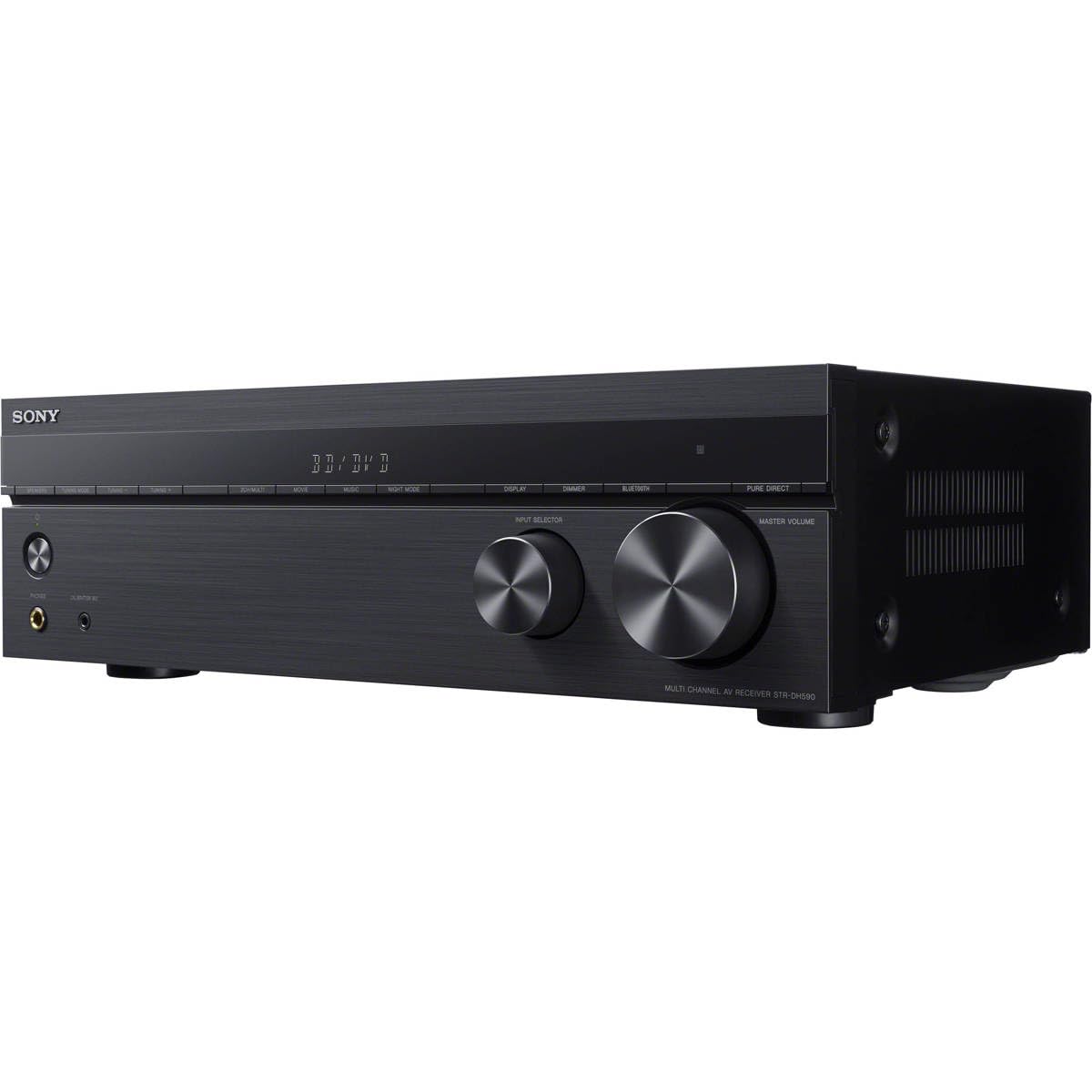
The Sony STRDH590 earns the top spot because it delivers exactly what a mid-range buyer needs: reliable 4K HDR passthrough with HDCP 2.2, five discrete amplifier channels rated at 725W total, and S-Force PRO virtual surround sound that works even with a simple 2-speaker setup. The 4-in/1-out HDMI configuration pairs perfectly with modern TVs, and the Bluetooth Standby feature lets you wake the receiver from your phone without touching the remote.
User feedback highlights the Sony’s straightforward performance with classic speakers — owners running KEF Carina 2 towers and Optimus Pro X44AV satellites report clean, fatigue-free sound across movies and music. The auto-calibration system using the included microphone effectively sets levels and distances for a standard 5.1 layout. The slim chassis (just 5.25 inches tall) runs cooler than many competitors, which makes it a strong fit for enclosed media consoles.
Purists will note the lack of a dedicated phono input and the absence of Dolby Atmos decoding, but for a pure 5.1 system focused on 4K HDR content, those omissions are acceptable at this price point. The FM tuner with 30 presets and the micro-adjustable volume control add everyday convenience that larger-panel receivers sometimes overlook.
Why it’s great
- Immediate 4K HDR passthrough with HDCP 2.2
- S-Force PRO virtual surround for 2-channel setups
- Compact, cool-running chassis fits tight cabinets
Good to know
- No Dolby Atmos or DTS:X decoding
- No phono input for turntables
- Binding posts are closely spaced for thick wire
2. Yamaha RX-V4A

The Yamaha RX-V4A brings genuine HDMI 2.1 capabilities into the conversation, supporting 4K120 and 8K60 pass-through with HDCP 2.3 on its four HDMI inputs and one output. This makes it the only receiver in this list that can fully leverage a PS5 or Xbox Series X at 120Hz without dropping to a lower HDMI standard. The 5.2-channel layout is supplemented by Yamaha’s Cinema DSP 3D processing, which creates a broader sound field from standard 5.1 speaker layouts.
MusicCast integration is the wireless centerpiece here — you can stream Spotify, TIDAL, Qobuz, Amazon Music HD, and Pandora directly, group the receiver with other MusicCast speakers across rooms, and control everything through the app or via Alexa/Google Assistant voice commands. Owners driving Klipsch Atmos 5.1.4 speaker arrays (using the pre-outs for external amplification) report excellent clarity and separation, with the 100W per channel into 8 ohms providing clean headroom for dynamic movie soundtracks.
Setup has a learning curve — the on-screen menu system can feel unintuitive, and the remote’s tiny buttons make initial configuration tedious. The MusicCast app often rescues the experience with its clean interface for adjusting EQ, input labeling, and network settings. For users who want the fastest HDMI 2.1 gaming performance in the sub-$500 group, this Yamaha is the clear pick.
Why it’s great
- HDMI 2.1 with 4K120 and 8K60 support
- MusicCast multi-room and direct streaming
- YPAO room calibration for precise sound
Good to know
- Menu system is complex for beginners
- Remote buttons are small and unlabeled
- Single HDMI eARC output limits display flexibility
3. Yamaha RX-V385

The Yamaha RX-V385 is a 5.1-channel receiver that prioritizes fundamental audio quality over feature bloat. It delivers HDMI 2.0 with HDCP 2.2 for full 4K HDR support, including HDR10, Dolby Vision, and Hybrid Log-Gamma. Its YPAO auto-calibration is among the most reliable in the entry tier — the included microphone measures speaker distances, levels, and crossover points, producing a balanced soundstage without requiring a degree in acoustics.
Users consistently rate the RX-V385’s audio performance above its price tag, noting that dialogue from center channels sounds crystal clear and that music playback via HDMI (supporting 192kHz/24-bit FLAC and WAV) has a warm, detailed character. The five sets of binding posts accept banana plugs on all channels, a convenience missing from some competitors that use spring clips on the surround channels. The 4K upscaling for lower-resolution sources is a practical bonus for older media libraries.
The main compromise is HDMI count — only four inputs, and no eARC support, which means TV apps will output compressed Dolby Digital over ARC rather than lossless Dolby TrueHD. The manual is digital-only, requiring you to download a PDF, which frustrates users who prefer paper instructions. For pure 5.1 sound quality with YPAO calibration, this Yamaha remains a trusted workhorse.
Why it’s great
- Excellent YPAO calibration for balanced sound
- Banana plug binding posts on all channels
- Supports 192kHz/24-bit high-resolution audio
Good to know
- Only four HDMI inputs
- No eARC — TV apps output compressed audio
- Manual is digital download only
4. JBL MA310

The JBL MA310 delivers 60 watts per channel across five channels in a chassis that is significantly shallower than typical mid-range receivers — a critical advantage for media consoles with limited depth. It supports 4K video with HDCP 2.2, includes four HDMI inputs and one output with ARC, and decodes native Dolby and DTS surround formats wirelessly via Bluetooth 5.1 with Low Energy. This design makes it ideal for apartment-dwellers or anyone integrating a receiver into a pre-existing entertainment center without cutting holes in the back panel.
Reviews from owners driving Polk ES60 floor-standing towers and in-wall RC65i speakers confirm that the MA310 drives these loads with authority, producing clean, room-filling sound that competes with receivers costing more. The on-screen setup menu is clear and walkthrough-driven, which helps offset the confusion of initial firmware updates that some units require. JBL’s support network is responsive, addressing firmware-related questions within a business day.
The remote lacks a backlight, which makes late-night volume adjustments a fumbling exercise. The default auto shut-off timer set to 20 minutes must be manually disabled through the menu. These are ergonomic flaws that do not affect sound quality but do impact daily use. For shallow-cabinet installs where depth clearance is the primary constraint, the MA310’s form factor is unmatched.
Why it’s great
- Extra-shallow chassis fits tight media consoles
- Clear on-screen setup walkthrough
- Bluetooth 5.1 with LE for low-latency streaming
Good to know
- Remote is not backlit
- 20-minute auto shut-off is enabled by default
- Firmware update needed at initial setup
5. Denon AVR-S670H

The Denon AVR-S670H is the most affordable receiver to support 8K/60Hz and 4K/120Hz pass-through, making it a strong choice for early 8K TV adopters or serious gamers who want ultra-smooth motion at high resolutions. Its 75-watts-per-channel amplifier drives five channels with Audyssey MultEQ room calibration, which automatically adjusts EQ curves for speaker placement and room acoustics — a significant advantage for rooms with irregular shapes or soft furnishings that absorb high frequencies.
HEOS built-in provides multi-room streaming capabilities identical to Denon’s higher-tier models, supporting Spotify, TIDAL, Amazon Music HD, and more over Wi-Fi. The HDMI section includes full support for VRR, ALLM, and QFT, which reduces screen tearing and input lag when connected to a gaming console. Owners pairing this unit with KEF Q150 bookshelf speakers report a spacious soundstage with accurate imaging, and the phono input allows direct connection of a turntable without an external preamp.
Wireless streaming via HEOS can experience occasional buffering and connection drops, particularly in congested Wi-Fi environments. The front-panel display is small, making source identification difficult from a distance. For users who want 8K readiness and Audyssey calibration in a 5.2-channel package, the S670H delivers specs that usually demand a higher price.
Why it’s great
- 8K/60 and 4K/120 pass-through support
- Audyssey MultEQ room correction
- Built-in phono input for turntables
Good to know
- HEOS wireless can be unreliable in busy networks
- Front display is small and hard to read
- Only 5 channels — no expansion to 7.1
6. Denon AVR-X1700H (Renewed)

The Denon AVR-X1700H enters the list as a renewed unit that delivers 7.2 channels of amplification — enough to power a 5.1.2 Dolby Atmos layout with two ceiling or upward-firing speakers. It supports HDMI 2.1 with three 8K/60 inputs and one 8K output, plus full HDR10+, Dolby Vision, and HLG compatibility. Audyssey MultEQ XT (the more advanced version of the calibration found in the S670H) measures eight positions in the room, producing a more precise EQ curve for the main listening seat.
Users upgrading from older Sony and Pioneer receivers report that the X1700H produces the cleanest sound they have owned, with particular praise for dialogue clarity in Atmos-encoded movies and the virtual height effect that simulates overhead sound even without ceiling speakers. The six HDMI inputs (including the three 8K ports) provide generous device capacity, and the dedicated phono input supports turntable connectivity. The award-winning Denon Setup Assistant walks through speaker configuration with minimal frustration.
The renewed status is the main hesitancy — while units typically appear like-new, some users report needing certified 48Gbps HDMI cables for stable 8K signal and occasional handshake issues that require a power cycle. The 7-channel amplifier runs warm, so adequate ventilation is essential. For buyers who want Atmos-friendly channel count and Audyssey XT without paying full retail, this refurbished Denon is a compelling value.
Why it’s great
- 7.2 channels for 5.1.2 Atmos setups
- Audyssey MultEQ XT 8-position calibration
- Three 8K HDMI inputs with HDCP 2.3
Good to know
- Renewed unit — condition depends on seller
- Requires premium 48Gbps HDMI cables for 8K
- Runs warm; requires ventilation space
7. Pioneer VSX-935
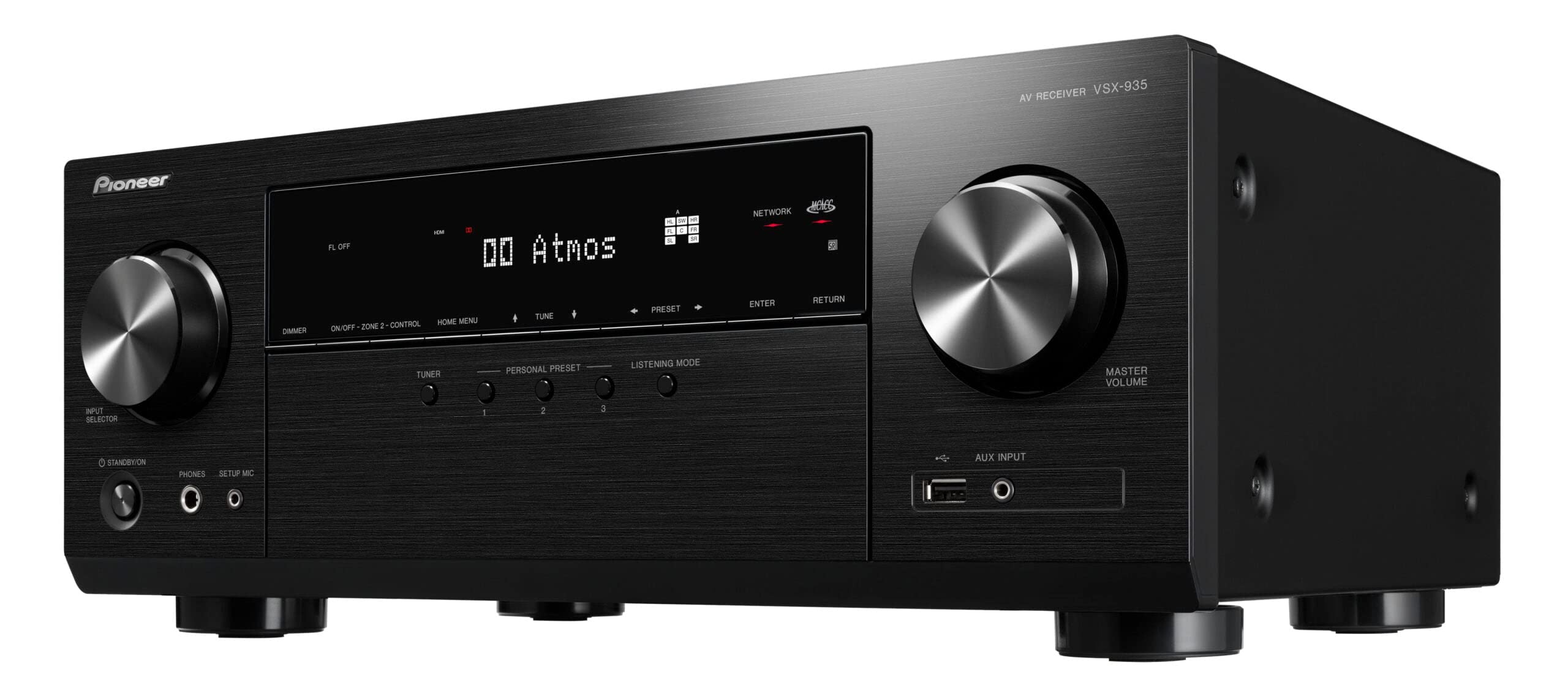
The Pioneer VSX-935 is a 7.2-channel network receiver built around HDMI 2.1, supporting 8K passthrough and enhanced gaming features like VRR and QMS. Its Dolby Atmos Height Virtualization technology creates a convincing overhead effect from standard 5.1 or 7.1 speaker layouts, which makes it an excellent option for rooms where ceiling speaker installation is impractical. The unit includes dual subwoofer outputs (the second .2 channel), allowing for more even bass distribution across irregular room shapes.
Owners praise the VSX-935 for its crisp, clear audio with movie soundtracks and its ability to play stereo music through all speakers for parties. The RF remote provides non-line-of-sight control, and the dual-zone output supports a second set of speakers in another room powered by the receiver. The front display includes a dimmer control for dark theater rooms. Calibration is straightforward, though manual speaker distance input often yields better results than the automated system.
Bluetooth connectivity is a weak point — the receiver uses two-way Bluetooth, but the feature is buried deep in the menus and cannot be accessed with a dedicated button. Several owners report reliability issues with the display and audio cutting out, requiring a full power cycle to restore. The on-screen interface is dated and lacks the visual polish of Yamaha or Denon. For a gaming-focused 7.2 receiver with Atmos virtualization, the VSX-935 packs serious potential behind a finicky user interface.
Why it’s great
- Dolby Atmos Height Virtualization without ceiling speakers
- RF remote for control through walls
- 8K HDMI 2.1 with gaming features
Good to know
- Bluetooth menu is deeply buried
- On-screen interface looks outdated
- Reliability concerns from multiple reviewers
8. JBL MA710

The JBL MA710 provides 110 watts per channel across seven channels, supporting 7.1 or 5.1.2 configurations with Dolby Atmos and DTS:X decoding. It includes a built-in moving magnet phono input, allowing direct turntable connection without an external preamp — a feature that immediately distinguishes it from most other receivers in the sub-$500 conversation. The 6-in/1-out HDMI section includes eARC for lossless audio from TV apps and supports 8K video with HDCP 2.3.
Owners driving Polk ES60 floor-standing speakers and in-wall RC65i models confirm that the MA710’s amplification stage provides significant headroom, producing detailed, distortion-free sound even at high volumes. The shallow chassis depth (13.7 inches) is a practical advantage for console fit, identical to the MA310’s form factor. Bluetooth streaming and network support for AirPlay 2 and Google Chromecast add wireless flexibility, and the on-screen quick-start guide helps with the initial setup routine.
The remote is not backlit, creating the same inconvenience in dark rooms as its MA310 sibling. The automatic shut-off default at 20 minutes must be manually disabled through the menus. A known limitation is that the MA710 does not downmix DTS-HD Master Audio to 2.1 channels — users with stereo-only playback of Blu-ray audio may encounter issues. JBL support confirms this is a design restriction. For vinyl enthusiasts who want 7-channel amplification, the MA710 is a specialized tool.
Why it’s great
- Integrated moving magnet phono input
- 110W x7 for high-power 5.1.2 Atmos setups
- Shallow depth fits tight media consoles
Good to know
- No DTS-HD Master Audio downmix to 2.1
- Remote lacks backlight
- Default 20-minute auto shut-off is intrusive
9. WiiM Amp Ultra

The WiiM Amp Ultra is not a traditional AV receiver, but it deserves inclusion as a specialized 2-channel streaming amplifier for users focused on music purity. It uses an ESS ES9039Q2M DAC paired with dual TI TPA3255 amplifiers, delivering 100 watts per channel with ultra-low distortion (~0.0006% THD+N). The integrated RoomFit EQ uses the built-in microphone to tune the output to your room acoustics, a feature that typically requires a separate DSP device. The 3.5-inch touchscreen display shows album art and system settings — a rare luxury at this price point.
Wi-Fi 6 and Bluetooth 5.3 with LE Audio provide ultra-fast, stable wireless connectivity, and the device supports TIDAL, Qobuz, Amazon Music, Spotify, Roon Ready, and Chromecast in up to 24-bit/192kHz resolution. Owners upgrading from traditional receivers report studio-perfect clarity and separation with Klipsch R-51M bookshelf speakers and Edifier subwoofers, noting that vocals and woodwinds sound astonishingly detailed. The HDMI ARC input integrates it into a TV system for simplified home theater audio.
The WiiM Amp Ultra is strictly a 2-channel device — it cannot decode Dolby Atmos or DTS surround formats. It lacks AirPlay support, which may be a dealbreaker for Apple ecosystem users. The total system cost also depends on an external subwoofer, as the unit does not include subwoofer speaker-level outputs for passive subs. For a dedicated stereo music rig with streaming and room correction, this WiiM delivers audiophile-grade performance in a compact, modern package.
Why it’s great
- ESS ES9039Q2M DAC for reference-class audio
- RoomFit automatic room calibration
- Wi-Fi 6, BT 5.3, touchscreen display
Good to know
- 2-channel only — no surround sound
- No AirPlay support
- Requires external subwoofer for deep bass
FAQ
Can I get Dolby Atmos with a receiver under $500?
What is the difference between 5.1 and 5.2 channel receivers?
Do I need HDMI 2.1 for a 4K TV without gaming?
Final Thoughts: The Verdict
For most users, the av receiver under $500 winner is the Sony STRDH590 because it delivers reliable 4K HDR passthrough, clean 5.2-channel amplification, and a compact, cool-running chassis at a price that stays well inside the budget. If you want HDMI 2.1 gaming performance and multi-room MusicCast streaming, grab the Yamaha RX-V4A. And for a 7.2-channel Dolby Atmos setup on a tight budget, nothing beats the Denon AVR-X1700H (Renewed).