
Our readers keep the lights on and the weekend projects moving. As an Amazon Associate, I earn from qualifying purchases.
Nothing kills a campfire rhythm faster than a dull, bouncing blade that sticks halfway through a split. An axe for camping sits right where survival tool meets campsite comfort — you need it light enough to pack, sharp enough to bite clean, and balanced enough to swing all afternoon without tearing up your palms.
I’m Rikta — the co-founder and writer behind FitlyFast. I’ve spent years studying bushcraft hardware, heat-treat specs, head geometry, and handle ergonomics across dozens of brands to understand exactly what makes a camp axe stop working before you do.
Shaving ounces off your kit without sacrificing bite depth is the real challenge, and finding the right axe for camping changes your entire evening — from fighting with wet logs to feeding a fire that just works.
How To Choose The Best Axe For Camping
Picking a camp axe is not about grabbing the cheapest steel-on-a-stick. You need a blade that holds a decent edge through a weekend of splitting knotty pine, a handle that does not transmit every shock into your elbow, and a total package short enough to lash to a pack without poking your neck. The three factors below separate a campsite workhorse from a frustrating wedge.
Blade Steel, Grind, and Edge Geometry
The steel type determines how often you reach for a sharpening stone. High-carbon alloy steel (common on forged heads) takes a razor edge but needs oil to resist rust in damp packs. Stainless blades like 3Cr13 resist corrosion but do not hold a working edge as long under heavy batoning. Grind is equally important — a tall, convex grind pushes wood apart while reducing friction, whereas a flat grind bites deeper but sticks more on green timber. For a camping axe, look for a head around 1.5 pounds with a medium-to-high bevel that balances chopping efficiency with edge toughness.
Handle Material and Shock Transfer
Your handle is your shock absorber. Hickory handles (used on premium Swedish and American axes) feel warm in the hand and flex slightly to dampen vibration, but they require periodic oiling and can crack if left wet. Composite handles made from fiberglass-reinforced nylon or DuraFrame are virtually indestructible, never splinter, and weigh less — but some transmit more vibration on heavy strikes. The best camping axe handles also feature an ergonomic grip contour; a straight cylindrical handle that twists in a sweaty palm is a safety hazard, not a feature.
Head Weight and Overall Balance
A camping axe between 14 and 20 inches long with a head weight of 1.0 to 1.5 pounds offers the best balance of portability and cutting power. Heavier heads (over 1.6 pounds) generate momentum for splitting large rounds but fatigue your arm after thirty swings. Lighter heads (under 0.8 pounds) are fine for limbing but lack the mass to bite into dense hardwoods. The balance point should sit just behind the head — that forward weight concentration lets the blade do the work while your wrist guides the arc.
Quick Comparison
On smaller screens, swipe sideways to see the full table.
| Model | Category | Best For | Key Spec | Amazon |
|---|---|---|---|---|
| Husqvarna Hatchet | Premium Traditional | Traditional feel, bushcraft purists | 1.32 lb hand-forged head, hickory handle | Amazon |
| Fiskars 28″ Chopping Axe | Long-Handle Workhorse | Heavy splitting, basecamp wood prep | 28″ handle, 3.5 lb head, low-friction coating | Amazon |
| Gerber Gear Pack Hatchet | Ultra-Compact | Backpacking, ultralight shelter building | 9.46″ overall, 20.8 oz, full tang | Amazon |
| ESTWING Sportsman’s Axe | USA Forged | Rugged durability, one-piece steel | 14″ length, forged one-piece, leather grip | Amazon |
| Schrade Delta Class Bedrock | Survival Hybrid | Emergency prep, integrated fire starter | 3.8″ stainless blade, ferro rod in handle | Amazon |
| LEXIVON V18 Chopping Axe | Budget Composite | Cost-conscious campers, first-time buyers | 18″ fiberglass handle, Grade-A carbon steel | Amazon |
| Fiskars 14″ Hatchet | Value Hatchet | Kindling splitting, lightweight pack carry | 14″ DuraFrame handle, 0.68 kg head | Amazon |
In‑Depth Reviews
1. Husqvarna Hatchet
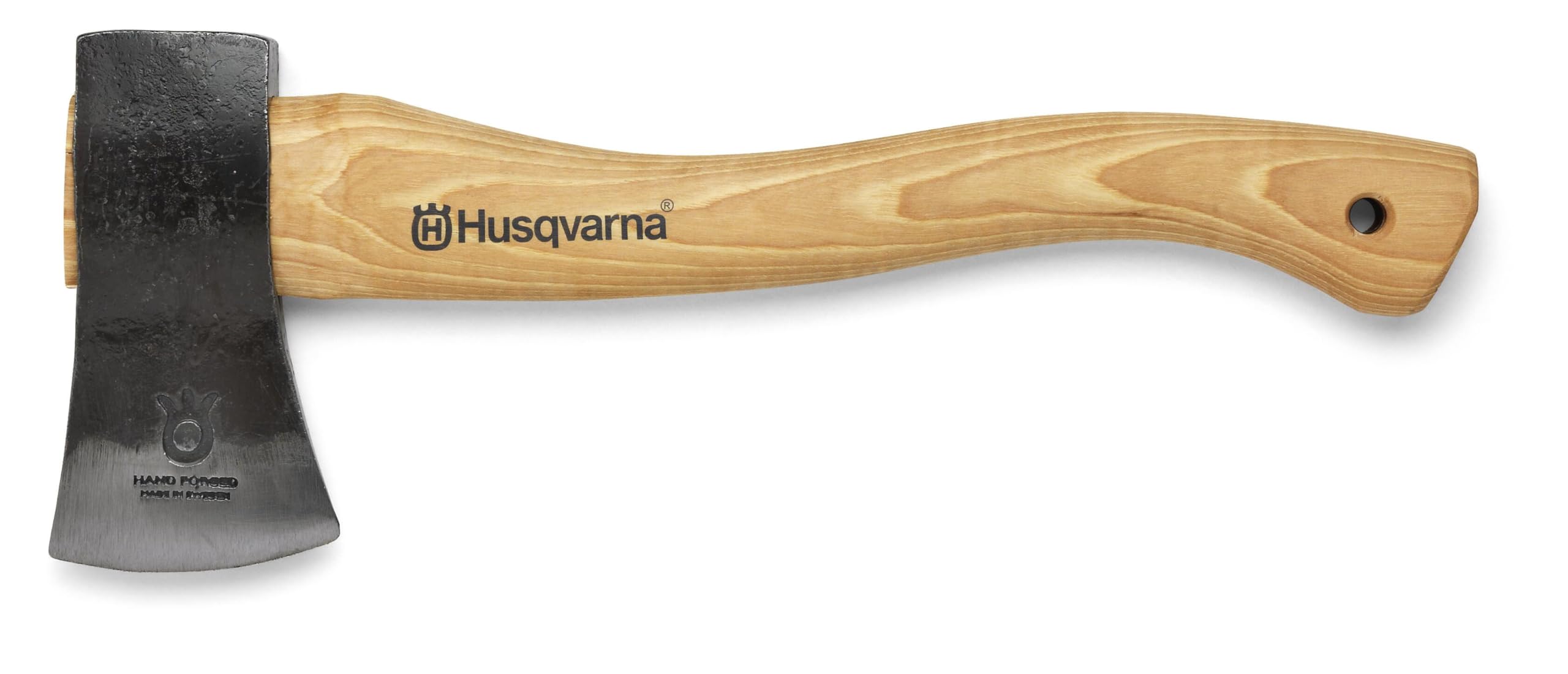
Husqvarna’s hatchet carries a pedigree you can feel the minute you pick it up — the head is hand-forged from Swedish alloy steel at the Hultafors foundry, and the handle is American hickory with a grain orientation that resists splitting under repeated shock. At 14.97 inches overall with a 1.32-pound head, it fits the classic bushcraft sweet spot: short enough for one-handed limbing but heavy enough to split shoulder-width rounds with two hands. The factory edge is ground thin for slicing cuts, but several owners note it benefits from a quick touch-up on a puck stone before the first swing.
The leather sheath is top-grain with brass rivets — not a flimsy nylon sleeve — and it wraps the edge securely without adding bulk. The handle arrives coated in a clear lacquer that many users sand off and replace with boiled linseed oil for a tackier, weather-resistant grip. The steel takes a keen edge quickly on a fine stone and holds it through a weekend of processing dry fir and birch. For someone who values traditional materials and is willing to spend an hour dialing in the fit and finish, this hatchet rewards you with decades of service.
The head-to-handle fitment is near perfect on most units — the wedge is driven deep and the hang angle aligns the blade naturally for a chop that lands flat. The hammer poll on the back is solid enough for tapping in tent stakes or driving a wooden wedge. If you prefer a modern composite handle or an edge that arrives screaming sharp out of the box, you may need to do some tuning, but the steel and geometry here are legitimately premium.
Why it’s great
- Hand-forged Swedish steel head holds a working edge exceptionally well
- Thick, grain-oriented hickory handle dampens vibration naturally
- Full-grain leather sheath with brass rivets is durable and attractive
- Traditional wedge-and-eye head attachment enables easy re-hanging
Good to know
- Factory edge is often ground asymmetrically and needs hand sharpening
- Lacquered handle can feel slippery; many users strip and oil it
- Leather sheath snaps may loosen over time; consider a cord tie
- Not ideal for wet climates without periodic handle oil maintenance
2. Fiskars 28″ Chopping Axe
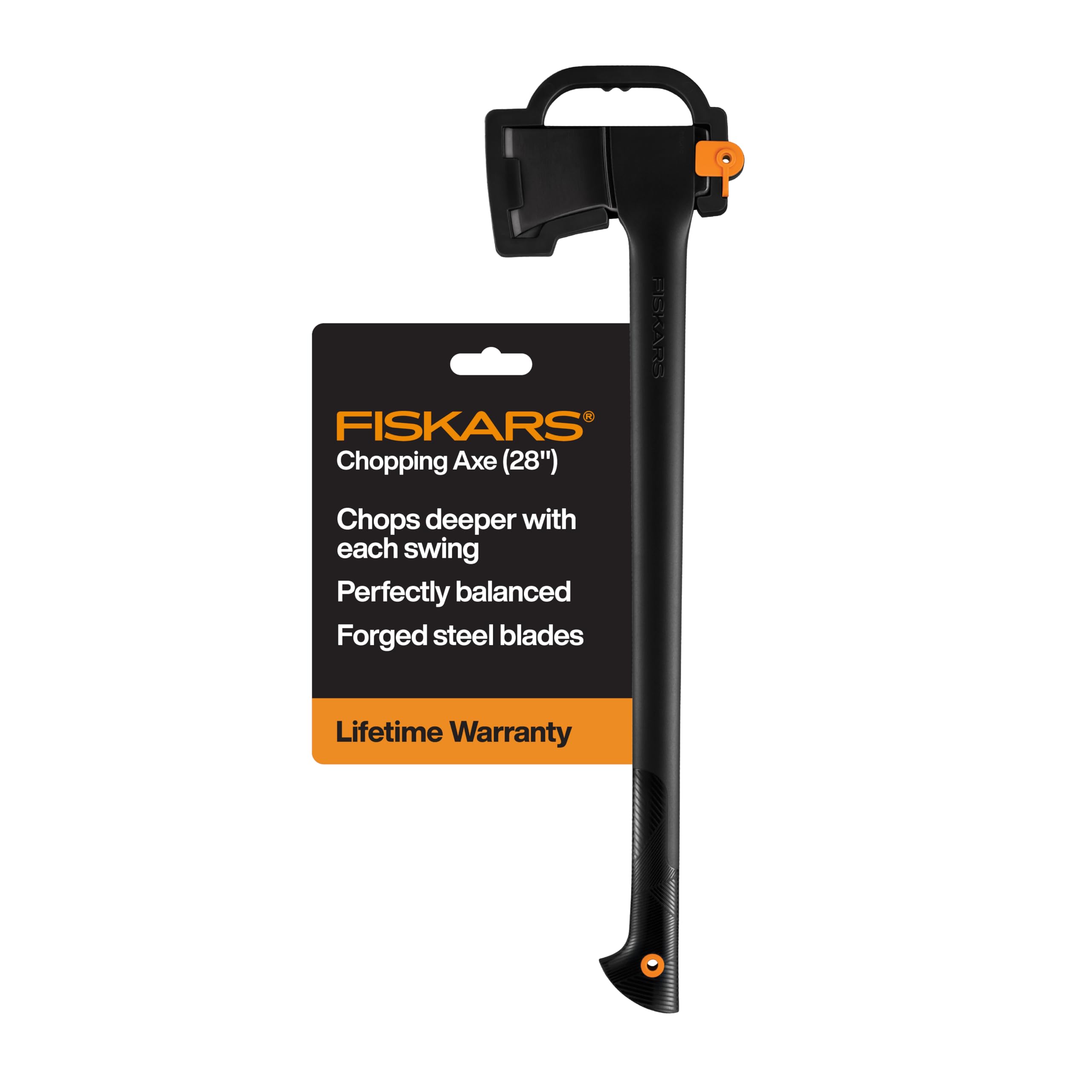
Fiskars has dominated the mid-range axe market for years, and the 28-inch chopping axe is a refined iteration of that formula. The head is precision-ground from hardened alloy steel with a non-stick coating that reduces drag through the cut — this matters most in resinous softwoods where uncoated blades glue themselves into the kerf. At 3.5 pounds, it is heavier than a hatchet and requires two hands, but the balance is shifted forward to let the head do the accelerating. The DuraFrame handle is a hollow composite shell reinforced with glass fiber, which keeps weight down and eliminates the possibility of a snapped wooden haft.
The shock absorption is surprisingly good for a composite handle. Fiskars molds a rubberized over-grip into the handle contour near the head and at the base, which gives you a secure purchase even when your hands are sweaty or gloved. The blade arrives shaving sharp from the factory — you can carve curls off a pine stick right out of the sheath. The low-friction coating also helps the axe slide free after a deep bite, which speeds up your splitting rhythm significantly when you are processing a pile of campfire rounds.
This is not a pack axe — 28 inches is too long to lash to a daypack without sticking out dangerously. But for basecamp setups where you drive to your site and process wood for a weekend fire, this axe outperforms hatchets that are half its length. The Lifetime warranty is a genuine safety net; if the handle cracks or the head loosens, Fiskars replaces it. The sheath is a molded plastic friction-fit guard that works but feels cheap compared to the rest of the tool.
Why it’s great
- Blade arrives screaming sharp with no break-in sharpening needed
- Low-friction coating prevents sticking in green or resinous wood
- Composite handle is virtually indestructible and backed by a lifetime warranty
- Excellent weight-forward balance for two-handed splitting efficiency
Good to know
- Too long for backpack carry; best for car camping or basecamp use
- Plastic edge guard is functional but feels flimsy
- Hollow handle can amplify stick vibration if you miss the cut
- Not suitable for one-handed limbing or detail work
3. Gerber Gear Pack Hatchet
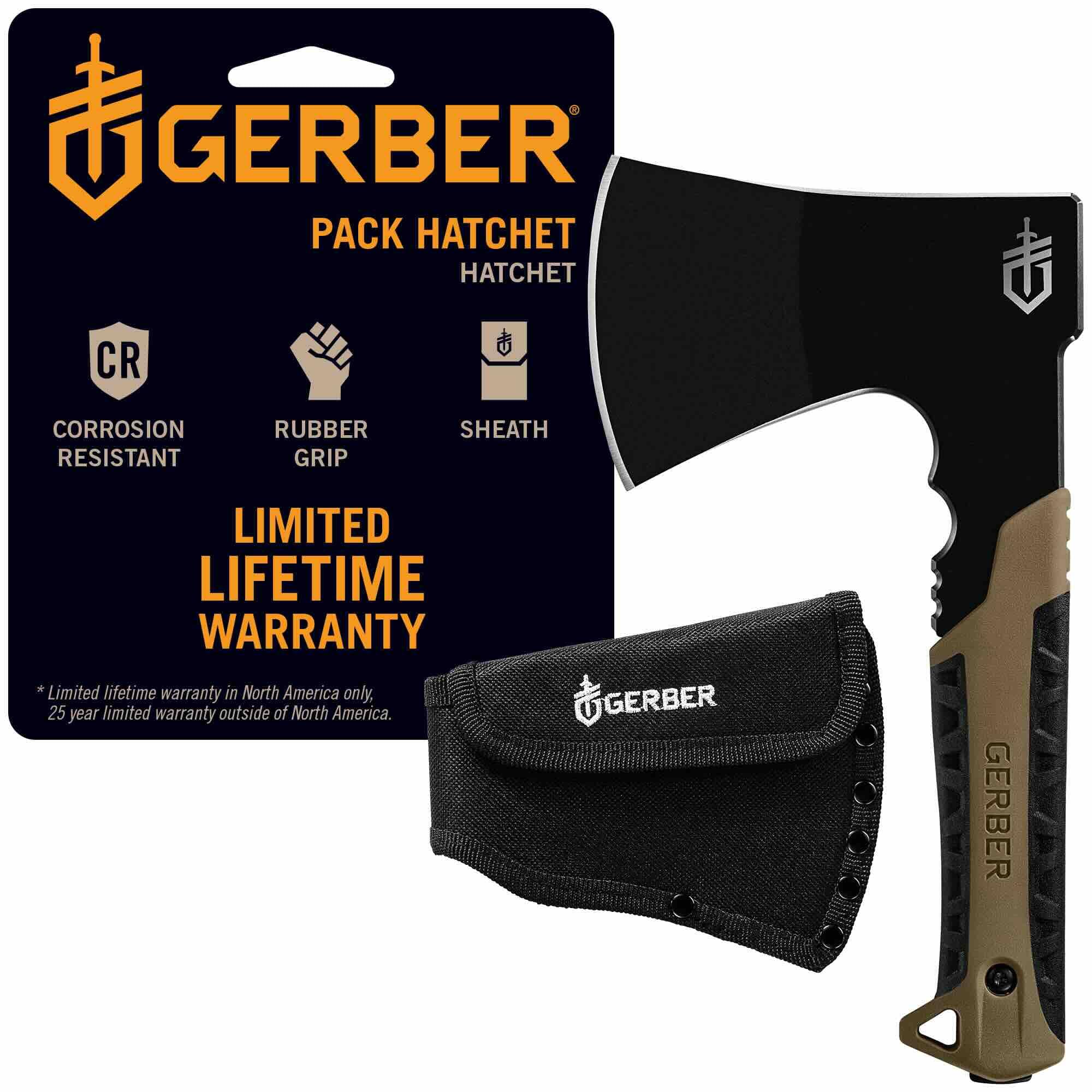
Gerber’s Pack Hatchet collapses the distinction between a heavy knife and a light axe. At just over 20 ounces with a 9.46-inch overall length, it is shorter than many bushcraft knives, yet the 3.5-inch full-tang stainless blade with a tall grind delivers real chopping authority on branches and kindling. The corrosion-resistant black oxide coating is a practical touch for damp packs where high-carbon heads would flash rust overnight. The rubber over-mold grip wraps around the full tang and includes finger grooves that lock your hand in place during overhead swings.
The removable nylon sheath is a clever piece of engineering — it mounts horizontally or vertically to a pack strap or belt via Molle-style loops, keeping the hatchet accessible without swinging loose. The set screw that secures the handle scales adds a potential failure point if you lose the tiny hex wrench, but in practice the screw stays tight under normal use. The blade is sharp enough out of the box to carve feather sticks and shave bark, and the stainless steel edge sharpens easily with a diamond rod when it dulls.
This is not the tool for splitting a full armload of logs at a group campsite. Its short handle limits leverage, so you need to swing harder to drive the blade deep. But for a solo backpacker who needs to process twigs for a cooking fire, hammer in stakes, and perform light batoning for shelter poles, the weight savings over a full-size hatchet are significant. The rubber handle also stays grippy when wet, which is a safety advantage over wood handles in rain.
Why it’s great
- Extremely compact and ultralight for backpack carry
- Full tang stainless steel resists rust in wet environments
- Molle-compatible sheath offers flexible pack mounting
- Rubber grip stays secure even in rain or with wet hands
Good to know
- Short handle limits leverage for splitting larger rounds
- Set screw handle fixation can loosen without thread locker
- Blade length is too short for serious batoning of thick logs
- Sheath retention can loosen after extended use
4. ESTWING Sportsman’s Axe

Estwing has been forging one-piece steel tools in Rockford, Illinois since 1923, and the Sportsman’s Axe embodies that uncomplicated philosophy — no separate head to loosen, no wooden handle to split, just a solid bar of American alloy steel with a leather grip riveted on. The 14-inch length and 1.8-pound weight put it squarely in the camp axe category, with a 3.25-inch cutting edge that arrives sharp enough for limbing and small splits. The forged construction means zero risk of head separation, a genuine safety advantage when you are swinging hard in cold weather.
The genuine leather handle is sanded and lacquered for a smooth feel, but many owners find the factory varnish too slick and strip it to apply neatsfoot oil, which gives a tackier, more absorbent surface. The steel head transfers more shock to your hand than a hickory-handled axe does, though the thick leather washer stack absorbs some of that vibration. The included ballistic nylon sheath is rugged and features a belt loop, but it is not a custom-fit leather scabbard; the blade slides in and out easily.
The eye of the axe head doubles as a nail puller, and the flat poll works well for driving stakes. The steel is hard enough to hold an edge through a season of weekend camping, but it will chip if you hit rocks or gravel — Estwing trades some edge toughness for impact resistance in the forging process. For someone who wants a no-maintenance tool that will never need re-hanging and can survive being used as a hammer, this axe delivers rugged consistency.
Why it’s great
- One-piece forged steel eliminates risk of head loosening or handle breakage
- Genuine leather grip provides comfort and control with oil treatment
- Proudly made in the USA with American-mined steel
- Integral nail puller and hammer poll add campsite versatility
Good to know
- Steel transmits more shock to the hand than wood-handled axes
- Factory varnish on leather is slippery; needs sanding and oiling
- Brittle edge can chip if struck against rocks or frozen wood
- Heavier than composite-handled hatchets of similar length
5. Schrade Delta Class Bedrock Axe

Schrade’s Bedrock Axe is built for the prepper and survivalist who wants a single tool that chops and starts fire. The 3.8-inch blade is forged from 3Cr13 stainless steel with a titanium nitride coating that resists rust and reduces friction. The total package is 11.8 inches long and weighs 1.4 pounds, which makes it compact enough for a bug-out bag or a vehicle emergency kit. The glass-fiber-filled PA handle is reinforced with TPR rubber at the grip, and the finger grooves help you maintain control during wet or cold conditions.
The standout feature here is the hammer pommel at the butt end — a flat steel face that lets you drive tent stakes or crack nuts without flipping the tool around. Inside the hollow handle shaft sits an extra-large ferrocerium rod with a striker that tucks away securely when not in use. Users report that the rod throws a hot shower of sparks even when wet, which is exactly what you need for emergency ignition. The included belt sheath is black thermoplastic that covers the blade securely and provides a loop for belt carry.
Edge retention is adequate for light to moderate use, but the 3Cr13 stainless steel cannot hold a razor edge as long as high-carbon alloy heads. Several owners note the blade arrived with a serviceable edge that needed a few passes on a ceramic rod to reach shaving sharpness. The rubber grip surface also doubles as a comfortable handle for chopping and for choked-up carving. For campers who want fire-starting backup without carrying a separate rod, this axe consolidates two tools into a compact, corrosion-resistant package.
Why it’s great
- Integral ferro rod in the handle provides reliable emergency fire starting
- Hammer pommel adds campsite utility for stakes and light demolition
- Stainless blade with titanium coating resists rust in humid packs
- Compact size and ergonomic rubber grip suit pack carry well
Good to know
- 3Cr13 steel is softer; edge degrades faster on abrasive hardwoods
- Ferro rod can loosen over time if not seated firmly
- Plastic sheath provides basic coverage but lacks retention adjustability
- Blade may arrive with a dull edge requiring immediate sharpening
6. LEXIVON V18 Chopping Axe

LEXIVON’s V18 targets the entry-level market with a forged Grade-A carbon steel head bonded to an injected fiberglass composite handle. The 18-inch length gives you more reach than a 14-inch hatchet while keeping the tool manageable for backpack carry. The aggressive blade angle is optimized for efficiency — the head geometry is designed to bite deep with less effort, which helps when you are working through a pile of kindling after a long day of hiking. The handle features a reinforced back spine to absorb extreme impact without snapping.
Many budget axes arrive with a blunt edge, and the V18 is no exception — several users report needing 20 to 30 minutes with a sharpening puck to get the blade to paper-cutting sharpness. Once dialed in, the carbon steel holds an edge respectably for a tool at this price point. The balance point is engineered close to the head, which gives the axe a forward-heavy feel that helps the blade carry momentum through the cut. The black and yellow color scheme improves visibility if you set the axe down in brush or leaves.
The protective carrying sheath is a hard plastic friction-fit sleeve that covers the edge but does not secure to the handle with any straps. Some users report the sheath arriving cracked, and the belt loop is narrow. The hollow fiberglass handle has a rubberized TPR grip section that feels comfortable but lacks the texturing of premium handles for sweaty conditions. For a first-time camper who needs a functioning axe without spending top dollar, the V18 offers usable performance with the understanding that you will need to invest time in edge preparation.
Why it’s great
- 18-inch length offers a good balance of reach and packability
- Carbon steel head sharpens to a keen edge with a few minutes of work
- Fiberglass composite handle is durable and weather resistant
- Aggressive blade angle reduces effort on kindling and small splits
Good to know
- Factory edge is often blunt and requires immediate sharpening
- Plastic sheath is low quality and may arrive damaged
- Hollow handle produces more vibration on heavy strikes
- TPR grip lacks aggressive texture for wet hand conditions
7. Fiskars 14″ Hatchet

The Fiskars 14-inch hatchet is arguably the most recognized camp axe on the market, and for good reason — the proprietary blade grinding technique produces a sharper-than-average edge from the factory, and the low-friction coating helps the head slide through wood instead of sticking. At just 1.5 pounds with a 14-inch DuraFrame handle, it disappears into a pack and is comfortable enough for extended sessions of splitting kindling. The molded head design is fused directly into the handle, so there is no eye to loosen and no wedge to back out over time.
The shock-absorbing handle material is marketed as stronger than steel, and in practice it holds up well to overstrike damage — if you miss the wood and hit the handle on a log, it flexes rather than snapping. The blade is made from hardened alloy steel that holds a working edge through several camping trips before needing a touch-up. The included nylon sheath has a belt loop and a snap closure that keeps the blade covered during transport. Many users report using this hatchet continuously for years without any degradation in performance.
The biggest limitation is the short handle length. At 14 inches, you lose leverage compared to an 18-inch or 28-inch axe, so splitting larger rounds requires more swings and more force. The handle is also on the thinner side, which some users with large hands find less comfortable during extended use. But for its intended role — processing kindling, trimming branches, and light splitting for a campfire — this hatchet delivers consistent, low-hassle performance at a price that makes it a low-risk purchase for any camper.
Why it’s great
- Exceptionally sharp factory edge reduces effort on kindling
- Low-friction coating prevents blade sticking in softwoods
- DuraFrame handle is lightweight, durable, and overstrike resistant
- No head loosening over time due to molded construction
Good to know
- Short handle limits leverage for splitting large-diameter logs
- Thin handle profile may not suit users with larger hands
- Cannot be re-hung if the handle eventually fails
- Nylon sheath is functional but not as durable as leather options
FAQ
How do I maintain the edge on my camping axe in the field?
Why does my hatchet keep sticking halfway through a split?
Is a wooden handle better than a composite handle for camping?
Final Thoughts: The Verdict
For most users, the axe for camping winner is the Husqvarna Hatchet because it combines a hand-forged Swedish steel head with a premium hickory handle that can be maintained for decades. If you want a virtually indestructible tool that never needs re-hanging, grab the ESTWING Sportsman’s Axe. And for ultralight backpackers who need a compact chopper that fits on a pack strap, nothing beats the Gerber Gear Pack Hatchet.