
Our readers keep the lights on and the weekend projects moving. As an Amazon Associate, I earn from qualifying purchases.
A dull axe is a dangerous tool — it glances off wood and requires twice the force, increasing the risk of injury and fatigue. Restoring a clean, sharp edge demands a sharpener that matches the specific geometry and steel hardness of an axe head, not a generic knife stone repurposed for the job.
I’m Rikta — the founder and writer behind FitlyFast. I’ve spent hundreds of hours analyzing edge-retention curves, grit-compatibility tables, and field-durability reports across dozens of puck, file, and bench stone models to find the sharpeners that actually deliver consistent results for bushcraft, splitting, and felling axes.
This guide compares seven top contenders by their material composition, dual-grit range, portability, and handling ergonomics, so you can pick the tool that matches your blade steel and sharpening style. Your best axe sharpener depends on whether you prioritize rapid material removal in the field or precise finishing at the workbench.
How To Choose The Best Axe Sharpener
Picking the right sharpener for your axe isn’t about buying the most expensive stone — it’s about matching the abrasive material, grit sequence, and form factor to your axe’s steel hardness and your typical sharpening environment. Three factors separate a useful field tool from a frustrating mistake.
Form Factor: Puck, File, or Bench Stone
An axe edge has a convex bevel, not a flat V-grind like a kitchen knife. Puck-shaped stones (often 3 to 3.8 inches in diameter) let you follow that curve naturally without digging in at the heel. Files work well for aggressive reprofiling but require a steady angle and a clamp. Bench oil stones are best for workshop-only sharpening where portability doesn’t matter. For most users, a puck delivers the best control per minute of use.
Abrasive Material and Grit Range
Three common abrasives dominate this category. Silicon carbide (found in Norton and Helko Werk pucks) cuts fast on carbon steel and releases fresh grit as it wears, but requires oil or water to prevent loading. Diamond-coated stones, like the SHARPAL 216N, cut up to five times faster and work dry — ideal for high-alloy steels but expensive if dropped. High-carbon steel files, like the Helko Werk compact file, remove material aggressively on nicks but require a separate finishing stone for a polished edge. Look for a coarse grit between 120 and 220 for reshaping, and a fine side between 280 and 600 for honing. A single dual-grit stone that covers both ranges saves weight in your pack.
Edge Protection and Handling Safety
A sharpener that doesn’t protect your fingers is a liability. Look for designs with a contoured grip, a finger notch (SHARPAL 216N has this), or a leather sheath (Angerstone includes one). The best models let you maintain consistent pressure without your hand slipping toward the blade. Avoid stones with sharp edges or no handle — a 3-inch puck is already small; a 1-inch bench stone is harder to control on a moving axe head.
Quick Comparison
On smaller screens, swipe sideways to see the full table.
| Model | Category | Best For | Key Spec | Amazon |
|---|---|---|---|---|
| Helko Werk Dual Grit Stone #22100 | Puck | Field sharpening with included oil | 120 / 320 grit, 3 in diameter | Amazon |
| SHARPAL 216N Diamond Stone | Puck | Fast dry sharpening, hard steels | 220 / 600 grit diamond plate | Amazon |
| Helko Werk Compact File #22101 | File | Reprofiling and nick removal | 9 in length, single/double cut | Amazon |
| SHARPAL Combo Gift Pack | Multi-tool | All-in-one kit for multiple tools | 8 sharpening parts, 5 angle slots | Amazon |
| Norton Combination Oil Stone | Bench Oil Stone | Workshop honing with oil | 100 / 280 grit, 8 x 2 x 1 in | Amazon |
| Angerstone Oversized Puck | Puck | Larger surface for stable strokes | 3.8 in diameter, 180 / 320 grit | Amazon |
| Norton Crystolon Puck | Puck | Budget-friendly dual-grit economy | 3 in diameter, coarse / fine silicon carbide | Amazon |
In‑Depth Reviews
1. Helko Werk Dual Grit Sharpening Stone #22100
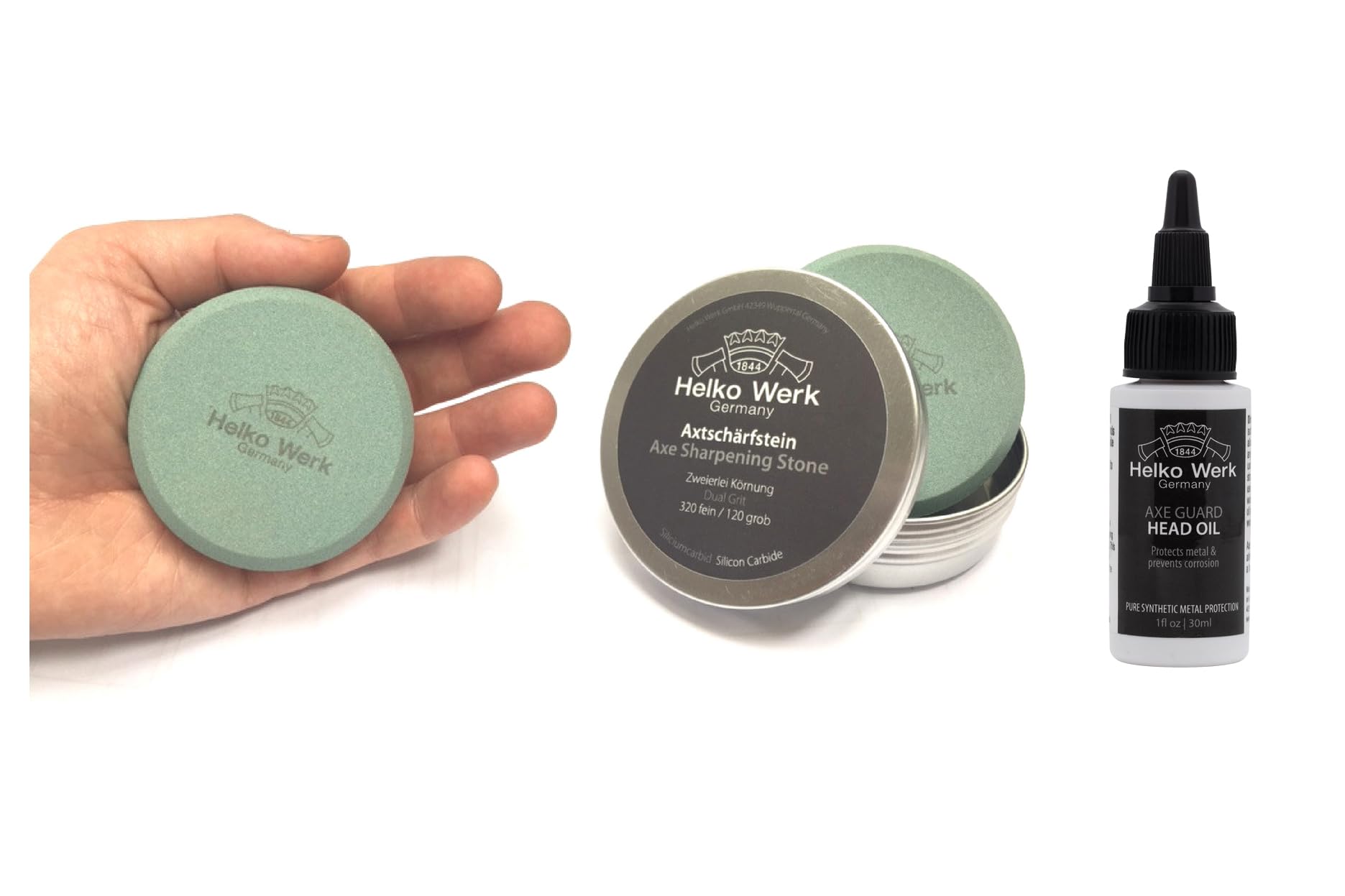
The Helko Werk puck nails the ideal grit pairing for axe maintenance: a 120-grit coarse side that eats through rolled edges and small nicks, and a 320-grit fine side that leaves a working-polished edge without over-honing. Made in Germany from ceramic silicon carbide, it wears evenly and releases fresh abrasive consistently — you won’t hit a glazed patch mid-stroke like you can with cheaper bonded stones.
At 3 inches in diameter with a 1-inch thickness, the contoured shape fits securely in the palm, allowing safe, controlled strokes along the convex axe bevel. Unlike flat bench stones that risk edge digging at the corners, the puck’s rounded profile follows the blade curve naturally. Helko includes a small bottle of Axe Guard Head Oil, which doubles as honing oil and keeps the silicon carbide cutting efficiently without metal loading.
The aluminum protective case is a worthwhile addition for field carry — it prevents the stone from chipping against other gear and keeps oil residue off your pack. Users report that pairing this puck with the Helko file (reviewed below) brings a dull camp axe to a hair-shaving edge in about twenty minutes. For anyone who wants a single puck that handles both restoration and finishing, this is the gold standard.
Why it’s great
- Ceramic silicon carbide cuts fast on carbon axe steel and releases fresh grit without glazing.
- Included Axe Guard Head Oil and protective aluminum case add genuine field-ready value.
- Contoured 3-inch profile is easy to grip and follows convex bevels safely.
Good to know
- Premium price — costs more than commodity pucks like the Lansky or Norton.
- Oil or water lubricant is required for best performance; dry use slows cutting noticeably.
2. SHARPAL 216N Dual-Grit Diamond Sharpening Stone

The SHARPAL 216N is the fastest cutting tool in this lineup — its electroplated monocrystalline diamond surface removes metal up to five times quicker than oil or water stones of equivalent grit. The 220-grit side (60 micron) re-shapes damaged edges in minutes, while the 600-grit side (25 micron) refines a working edge without the slurry mess of silicon carbide stones. Because diamond is harder than any abrasive particle used in bonded stones, the plate stays flat and cuts at the same rate from first use to last.
You use this stone dry — no oil, no water, no soak time. That alone makes it the most convenient option for field sharpening: pull it from your pack, run ten strokes per side, and your axe is ready. The stainless steel base is rust-resistant, and the ergonomic handle includes a finger protection notch that keeps your knuckles clear of the blade. The snap-in grit disc is held by a magnet, so swapping sides is instant.
Some users note the 220-grit coarse side feels almost too aggressive for thin-bladed camp hatchets — it can leave deep scratch marks if you use too much pressure. But for standard felling axes with thicker edge geometry, that aggression is exactly what makes it effective. The carrying pouch is basic but functional. If you sharpen multiple tools in one session and hate dealing with lubricants, this is the sharpener to grab.
Why it’s great
- Diamond grit cuts faster than any abrasive stone in this comparison — no oil or water needed.
- Magnetic snap-in disc design makes switching between 220 and 600 grit instant and secure.
- Finger protection notch improves safety during aggressive sharpening strokes.
Good to know
- Diamond plate is brittle if dropped on concrete — treat it with more care than a solid stone puck.
- 220-grit coarse side leaves a rougher finish than a silicon carbide 120-grit, requiring more fine-side work.
3. Helko Werk Compact Axe Sharpening File #22101

When your axe edge has a visible ding or a rolled burr, a puck alone is too slow for efficient reprofiling. The Helko Werk compact file is made from German C125W2 high-carbon tool steel — a grade that holds its tooth geometry longer than generic hardware-store files. The top side uses a single-cut fine tooth pattern for finishing strokes; the bottom side uses a double-cut pattern that removes material aggressively enough to plane a factory-dull hatchet edge into shape in under five minutes.
At 9 inches long and only 3.9 ounces, this file is light enough to carry in a daypack but long enough to apply consistent pressure along the entire axe bevel. The edges are safe — no teeth on the sides — so you won’t accidentally gouge the cheek of the axe head during tight strokes. The flat handle includes a hanging hole for workshop storage and fits neatly into Helko’s maintenance kits alongside the dual-grit puck.
Reviewers consistently mention that this file works well on mower blades and machetes too, but its primary strength is metal removal speed on hardened axe steel. One catch: it does skip over small nicks on very hard Craftsman-grade axe heads (over 55 HRC), requiring the finer single-cut side to finish. For routine touch-ups, you’ll still need a stone or strop after filing. But for the initial heavy lifting, this file is unmatched in its size class.
Why it’s great
- German C125W2 high-carbon steel maintains sharp tooth geometry far longer than budget files.
- Safe edges prevent accidental damage to the axe cheek during reprofiling strokes.
- Lightweight and compact — easy to add to any field maintenance kit.
Good to know
- Not a standalone finishing tool — you need a puck or strop to polish after filing.
- Skips or slides on very hard alloy steels above 58 HRC without extra pressure.
4. SHARPAL Combo Gift Pack L1113H

The SHARPAL Combo pack is not a single sharpener — it’s a full kit built around a 6-in-1 pocket sharpener and a separate universal tool sharpener with carbide, ceramic, and diamond rod abrasives. The pocket sharpener includes preset angle slots for straight and serrated edges, a fire starter rod, and an emergency whistle. The larger tool sharpener handles axe, mower blade, pruner, and shear edges with its dedicated carbide notches.
For axe work specifically, the pack’s strength is convenience: the carbide notch on the larger sharpener removes metal fast on a dull edge, and the ceramic slot hones the burr without needing a separate stone. The diamond rod is useful for touching up the axe tip or sharpening gut hooks on a hunting knife. The kit passes a 10,000-use field test on the abrasives, so durability is solid for the price.
That said, the preset angle slots are optimized for knife edges (around 20 degrees per side), not the 25-to-35-degree convex bevel typical of a felling axe. You can still get a sharp edge, but the geometry won’t be as efficient as using a freehand puck. Users who want a single tool for both kitchen knives and camp axes will appreciate the all-in-one approach, but dedicated axe users should treat this as a backup or travel kit rather than a primary sharpening solution.
Why it’s great
- Everything needed for edge maintenance on multiple tools — axe, mower blade, pruners, knives — in one box.
- Carbide, ceramic, and diamond abrasives cover coarse repair through fine honing without needing oil or water.
- Includes a greeting card and fire starter, making it a practical gift for outdoor enthusiasts.
Good to know
- Preset angle slots are designed for knife V-grinds, not the convex bevel of an axe edge.
- Bulkier than a single puck or file — not the most packable option for ultralight trips.
5. Norton Combination Oil Stone 61463685565

The Norton combination oil stone is a traditional bench stone made from corundum (aluminum oxide), with a 100-grit coarse side for repairing damaged edges and a 280-grit fine side for maintaining a razor edge. Unlike modern diamond plates, this stone is pre-filled with oil at the factory, which keeps lubricant on the surface during sharpening and prevents the metal swarf from clogging the pores immediately. The 8 x 2 x 1-inch dimensions provide a stable, wide platform that works well for longer blades and axe heads when used on a workbench.
Oil stones have a slower cutting action than diamond stones, but the trade-off is a more refined surface finish. The 280-grit side on this Norton produces a polished edge that many traditionalists prefer for woodworking axes — it leaves a smooth bevel that reduces friction during the cut. Users report that the coarse side removes material efficiently with a few drops of kerosene or mineral oil, and the stone does not require flattening as frequently as water stones of similar grit.
This is not a field sharpener. At 1.5 pounds, it stays on the bench. The fine side is coarser than a typical 1000-grit water stone — it’s about a 320-equivalent in feel — so you cannot get a mirror polish directly off this stone. For axe work, that’s actually ideal: a 280-grit edge holds up better under heavy chopping than a shaving-sharp edge that rolls on the first knot. If you sharpen axes at home and want a hard-wearing stone that doesn’t need soaking, this Norton is a reliable classic.
Why it’s great
- Factory pre-filled with oil reduces metal loading and ensures consistent lubrication on first use.
- Corundum abrasive is harder than silicon carbide, providing a longer usable life before replacement.
- 100/280 grit pairing matches the needs of axe repair and working-edge finishing without over-polishing.
Good to know
- Requires oil lubricant — not compatible with water without significant performance loss.
- At 8 inches long, it’s too short for long mower blades and too heavy for a field pack.
6. Angerstone Axe Sharpener 3.8-Inch Puck
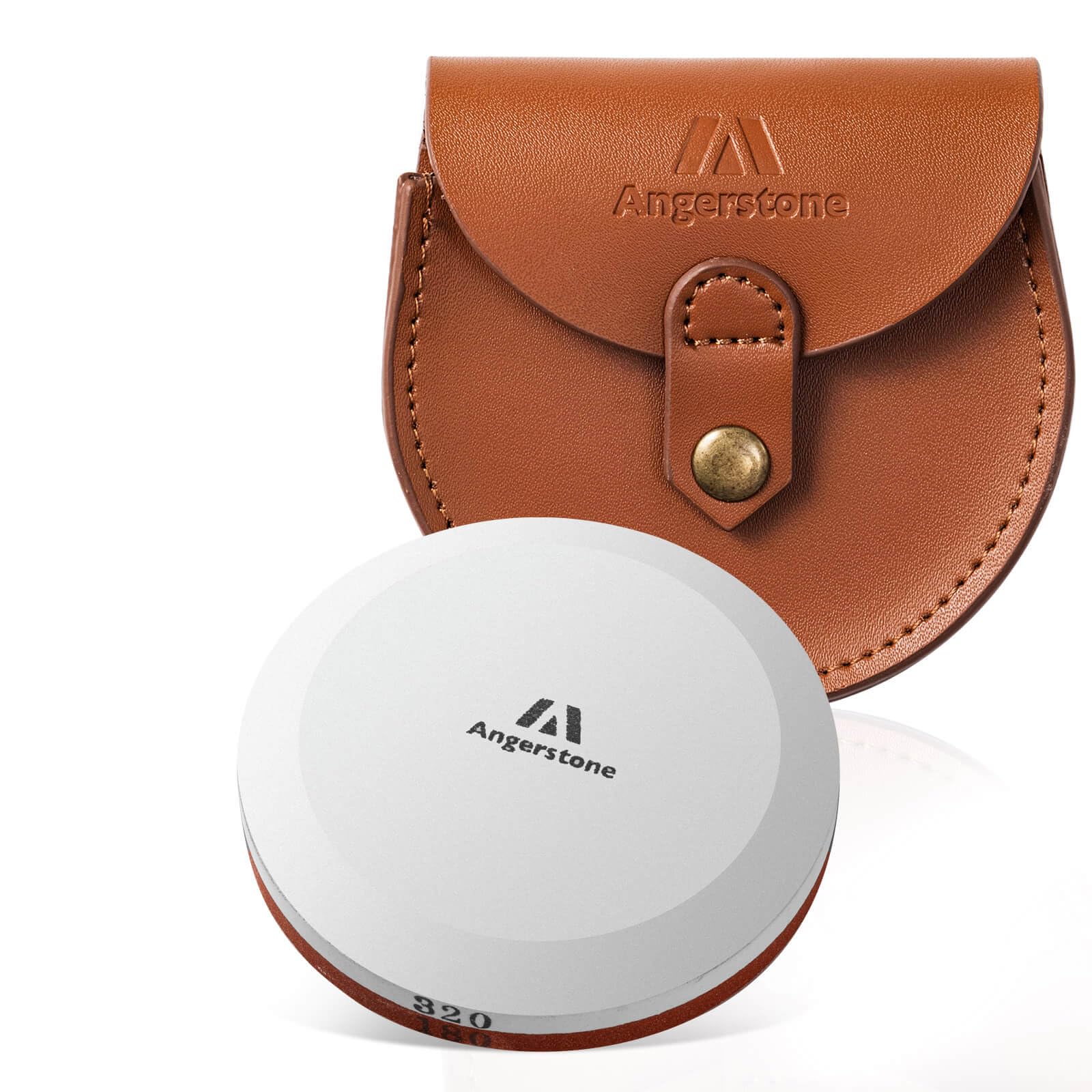
The Angerstone puck is 3.8 inches in diameter — noticeably larger than the standard 3-inch pucks from Norton and Helko Werk. That extra 0.8 inch provides a wider, more stable sharpening surface, which is especially helpful for beginners who struggle to maintain a consistent angle on a smaller stone. The abrasive is white corundum fired at high temperature, offering a good balance between cutting speed and wear resistance. The dual grit pairing — 180 coarse and 320 fine — is well-suited for axe work, with the coarse side taking down nicks efficiently and the fine side leaving a clean working edge.
The genuine cowhide leather sheath is a standout feature at this price tier. It’s reinforced with copper rivets and a snap closure, and it includes a belt loop for field carry. Unlike the basic nylon pouches that come with cheaper pucks, this sheath feels substantial and protects the stone from chipping when tossed in a pack with other gear. The set also includes finger sleeves to protect your digits during sharpening, a thoughtful addition for less experienced users.
One trade-off: the stone sheds a fair amount of fine dust during use, especially when used dry. The manufacturer recommends submerging the stone for 3-4 minutes before sharpening — this reduces dust and prevents metal loading, but it adds a step that field sharpeners may find inconvenient. The 180-grit side is milder than a 120-grit puck, so reprofiling a heavily damaged edge takes more strokes. For routine maintenance sharpening on a camp axe, though, the larger surface and comfortable sheath make this a solid mid-range choice.
Why it’s great
- Larger 3.8-inch surface area improves stability and angle control for less experienced sharpeners.
- Genuine cowhide leather sheath with copper rivets and belt loop is better quality than any other sheath at this price.
- 180/320 grit pairing covers both repair and finishing needs for standard carbon steel axes.
Good to know
- Sheds fine dust when used dry — pre-soaking for 3-4 minutes is recommended for cleaner operation.
- 180-grit coarse side is less aggressive than 120-grit options, requiring more strokes for deep nicks.
7. Norton Crystolon Axe & Hatchet Puck 85316

The Norton Crystolon puck is the entry-level benchmark in this category. Made from silicon carbide abrasive bonded with a ceramic matrix, it offers a coarse side for fast stock removal and a fine side for sharpening — all in a compact 3-inch diameter, 4.96-ounce package. It is pre-filled with oil and works best with Norton’s sharpening oil or honing oil to prevent metal loading. At this price point, it’s the go-to choice for anyone who needs a functional dual-grit sharpener without a premium investment.
Customer reports consistently note that the coarse side raises a burr quickly on standard carbon steel axes and hatchets. The fine side, while not as refined as a 320-grit stone, leaves a sharp enough edge for efficient wood cutting. Several long-time bushcraft users keep one of these as a backup puck because it’s inexpensive enough to replace without regret if chipped or lost in the field. The stone works wet under a faucet, which helps control dust and improve cutting speed.
The main compromise is consistency: the grit rating is not printed on the stone, and some users report that the fine side is coarser than expected — closer to a medium grit than a true finishing stone. It also requires a lubricant to perform at its best; dry use leads to rapid loading and glazing. For a first-time axe owner who wants a simple, low-risk sharpening tool, or for an experienced user who needs a camp beater stone, this Norton puck delivers reliable function at a very accessible entry point.
Why it’s great
- Silicon carbide abrasive cuts fast on carbon steel with minimal pressure — ideal for quick field maintenance.
- Lightweight at under 5 ounces and small enough to fit in any pocket or pack pouch.
- Pre-filled with oil and works well with water in a pinch, giving flexibility in lubricant choice.
Good to know
- Grit not published on the stone — the fine side feels closer to a medium grit than a true finishing stone.
- Requires oil or water to prevent metal loading; dry use causes rapid glazing and reduces cutting speed.
FAQ
Can I use a standard knife sharpener on my axe head?
How often should I sharpen my axe in the field?
Should I use oil or water on my axe sharpening stone?
Final Thoughts: The Verdict
For most users, the best axe sharpener winner is the Helko Werk Dual Grit Stone #22100 because its 120/320 grit pairing, ceramic silicon carbide build, and included oil and case deliver the most complete field-ready package for both repair and finishing. If you want a dry-sharpening diamond puck that cuts faster than any stone and never needs lubrication, grab the SHARPAL 216N. And for heavy reprofiling work where a puck alone is too slow, nothing beats the controlled aggression of the Helko Werk Compact File #22101.