
Our readers keep the lights on and the weekend projects moving. As an Amazon Associate, I earn from qualifying purchases.
When a baby’s hips are not properly supported during carrying, the risk of hip dysplasia — a condition where the hip joint develops abnormally — increases significantly. A carrier that forces a baby’s legs to hang straight down rather than supporting a natural, knee-to-hip “M” position can undo months of healthy development. This guide focuses exclusively on carriers tested or designed for proper femoral head seating, ensuring your little one’s hips are cradled in a stable, ergonomic posture from newborn to toddler.
I’m Rikta — the co-founder and writer behind FitlyFast. I’ve spent years analyzing pediatric orthopedics research, hip-healthy certification standards, and structural engineering in soft goods to separate marketing fluff from genuine developmental support in baby carriers.
Whether you are treating hip dysplasia or simply preventing it, the right carrier can support healthy joint alignment from day one. In this guide, I break down the best options on the market for a baby carrier for hip dysplasia.
How To Choose The Best Baby Carrier For Hip Dysplasia
Not every carrier labeled “ergonomic” actually meets the rigorous standards for hip dysplasia. The key differentiator is the carrier’s ability to maintain the hip joint in a flexed, abducted position — meaning the baby’s thighs should be spread apart with the knees higher than the bottom. This requires a specific seat width that widens as the child grows. Look for IHDI recognition, adjustable seat panels, and a waistband that supports the caregiver’s posture for extended carrying.
The “M” Position – Why It’s Non-Negotiable
The “M” position places the baby’s hips in a squat-like posture — knees above the bum, thighs supported from knee to knee across the carrier seat. This encourages the femoral head to seat deeply in the acetabulum, reducing pressure on the developing hip joint. A carrier that allows the baby’s legs to dangle or forces them inward is not safe for hip dysplasia.
IHDI Certification – What It Really Means
The International Hip Dysplasia Institute evaluates carriers based on pelvic tilt and adductor balance. Certified products must support at least one-third of the baby’s thigh, maintain a neutral spine tilt, and allow the knee-to-knee width to expand as the baby grows. If a carrier does not carry this certification, it should be avoided for dysplasia treatment.
Caregiver Ergonomics – Preventing Your Own Pain
If the carrier forces you into a poor posture, you will not be able to wear it long enough for the baby to benefit. Look for a padded, contoured waistband that transfers weight to your hips, crossable shoulder straps to avoid neck digging, and a lumbar support panel. A carrier that hurts you will end up unused, defeating the entire purpose.
Quick Comparison
On smaller screens, swipe sideways to see the full table.
| Model | Category | Best For | Key Spec | Amazon |
|---|---|---|---|---|
| Baby Tula Explore | Premium Soft-Structured | Newborn to toddler (7-45 lbs) | IHDI Certified, adjustable seat width | Amazon |
| WildBird Aerial Buckle | Premium Linen | Breathable all-day wear (7-45 lbs) | IHDI Certified, lumbar support panel | Amazon |
| MiaMily Hipster Plus | Hip Seat Hybrid | Parents needing lumbar relief | Built-in hip seat, lumbar support belt | Amazon |
| Mabē Monarch | Cotton Soft-Structured | Everyday versatility (7-35 lbs) | Cotton-linen blend, deep M-position seat | Amazon |
| Beco Toddler Carrier | Toddler Specific | Children 24-48 months (up to 55+ lbs) | 100% cotton, extra-wide seat panel | Amazon |
| Momcozy 2-in-1 Hip Seat | Hip Seat Hybrid | Active babies over 5 months (up to 44 lbs) | 10mm cushioned seat, 3D air mesh | Amazon |
| Baby Tula Lite Ripstop | Lightweight Travel | Hot climates & packable use (12-30 lbs) | Quick-dry ripstop, packs into waist pouch | Amazon |
In‑Depth Reviews
1. Baby Tula Explore Cotton Carrier (Tula Coast)

The Baby Tula Explore is the benchmark for hip-healthy carriers because its seat width is fully adjustable via snap buttons, allowing you to widen the panel as your baby grows from 7 to 45 pounds without needing an infant insert. The padded adjustable neck support pillow cradles the head while the 3D mesh torso panel keeps the spine cool and dry — a critical feature for summer wear when overheating can cause fussiness and early termination of carrying sessions.
Reviewers consistently report zero back or shoulder pain even after hours of use with a 16-pound baby, thanks to the lumbar support panel and padded waistband. The carrier allows front-facing-out, front-facing-in, and back carry positions, all of which maintain the deep M-position seat. The sun shield is a practical bonus for outdoor outings, although the mesh material feels slightly less plush against the skin compared to full-cotton carriers.
The only area where the Explore sacrifices is the warmth of the fabric — the 3D mesh is intentionally breathable, which means it can feel cool in air-conditioned spaces. However, for hip dysplasia treatment where long, consistent daily wear is typically recommended by orthopedists, the temperature regulation makes it easier to use year-round. The waistband fits XS-4X, accommodating a wide range of caregiver body types without an extender.
Why it’s great
- Adjustable seat width grows with baby from newborn without insert
- Excellent lumbar support for long carrying sessions
- IHDI recognized with three carrying positions
Good to know
- Mesh material feels less soft than cotton on bare baby legs
- Hood attachment can be finicky for some users
2. WildBird Aerial Buckle Carrier

The WildBird Aerial is constructed from breathable linen, which offers a crisp, structured feel that softens with each wash while retaining its shape. This is important for hip dysplasia because a carrier that sags over time can lose the knee-to-knee support depth required to maintain femoral head seating. The cross-back strap design pulls the shoulder blades together, naturally opening the chest and distributing the baby’s weight — up to 45 pounds — across the caregiver’s upper back rather than digging into the neck.
Reviewers highlight the lumbar support panel as a standout feature, with many reporting that it eliminates the lower back strain they experienced with other premium carriers. The adjustability between caregivers (one reviewer’s 108-pound frame and 190-pound partner both found a comfortable fit) is a practical advantage for families sharing carrying duties. The fabric is machine-washable and dries quickly without pilling, which is critical for a carrier used daily.
The major limitation is the absence of a forward-facing carry position. If your baby demands to look outward during walks, you will need a different carrier for that specific use case. Also, there are no built-in storage pockets, so you will need a separate diaper bag for essentials. These trade-offs are acceptable if your priority is a pristine, apron-style M-position seat that stays supportive over years of use.
Why it’s great
- Premium linen fabric is breathable and ages beautifully
- Cross-back straps eliminate neck strain
- Excellent lumbar support for extended wear
Good to know
- No forward-facing carry position available
- No built-in storage pockets for essentials
3. MiaMily Ergonomic Hip Seat Carrier (Hipster Plus)
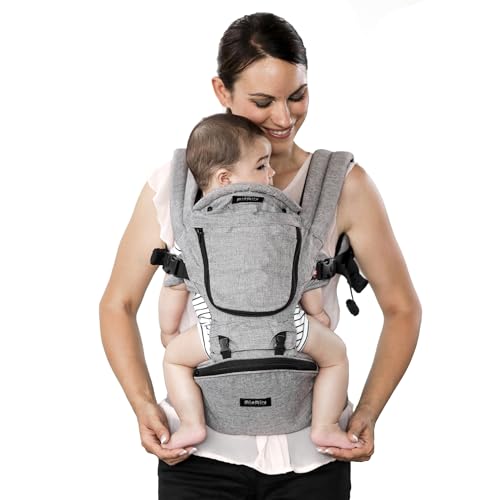
The MiaMily Hipster Plus is a hybrid carrier that combines a rigid, contoured hip seat with a detachable soft-structured upper. This design is uniquely effective for caregivers who have pre-existing back conditions because the hip seat shifts the baby’s weight directly onto the caregiver’s hip bones rather than the lumbar spine. For hip dysplasia, the wide, firm seat creates an unshakeable platform that encourages the baby’s knees to fall into a natural M-position without the seat fabric collapsing inward — a common problem in all-soft carriers after months of use.
Reviewers with spinal damage or chronic back pain report that this carrier is the only one that allows them to walk for hours without discomfort, with one user explicitly stating it solved severe back pain that other carriers exacerbated. The 6-in-1 carrying positions include forward-facing, inward, hip, back, and cradle modes, making it the most versatile option on this list for growing children up to 44 pounds. The hollow hip seat doubles as a small storage compartment for keys or a phone, which adds convenience during outings.
The trade-off is that the hip seat adds bulk — this carrier does not collapse as small as a simple buckle carrier, so it takes up more space in a diaper bag. Also, the Velcro waistbelt can wear out over years of use, and some users report the seat-clip mechanism requires a deliberate push to secure fully. But for caregivers who prioritize hip-healthy alignment above all else, the structural rigidity of the seat is a feature, not a flaw.
Why it’s great
- Firm hip seat maintains M-position without collapsing
- Excellent lumbar support reduces back strain
- Six carrying positions adapt to baby’s growth stages
Good to know
- Bulky design does not pack down small
- Velcro waistbelt may degrade over years of heavy use
4. Mabē Monarch Ergonomic Baby Carrier
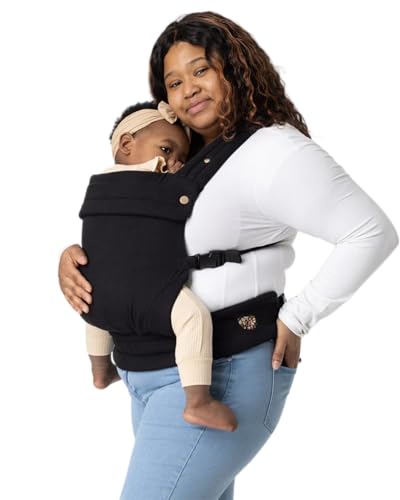
The Mabē Monarch is a mid-range soft-structured carrier that punches above its weight in terms of fabric quality — the 90% cotton and 10% linen blend is soft against the baby’s skin while providing enough structural grip to keep the seat panel from slipping during front-outward carries. The deep M-position seat is reinforced at the edges, creating a cupped cradling effect that stabilizes the baby’s pelvis even during active movement like walking up stairs. This is critical for hip dysplasia: a sliding seat can gradually adduct the thighs, defeating the purpose of the carrier.
Reviewers consistently mention that the Monarch is more user-friendly than brands like Ergobaby or Infantino, with easier self-buckling and on-the-go adjustments. The shoulder straps are thickly padded without being stiff, and they do not dig into the neck — a common failure point in less expensive carriers. The fabric is breathable enough for air travel and warm weather, though it is not as airy as the 3D mesh panels found in the Baby Tula Explore.
The weight limit tops out at 35 pounds, which is lower than some competitors, meaning you will need a toddler-specific carrier eventually if your child is on the larger side. Additionally, the waistband is not as wide as the WildBird’s lumbar panel, so caregivers with a history of lower back pain may find the MiaMily or Tula Explore more supportive over multi-hour sessions. But for daily walks and household carrying from newborn up to age two, the Monarch delivers a solid, hip-healthy experience at a very fair price point.
Why it’s great
- Soft structured design with deep, cupped M-position seat
- Easy self-buckling and one-person adjustment
- Cotton-linen blend is gentle on baby’s skin
Good to know
- Weight limit of 35 lbs is lower than other options
- Less lumbar support than premium padded waistbands
5. Beco Toddler Carrier
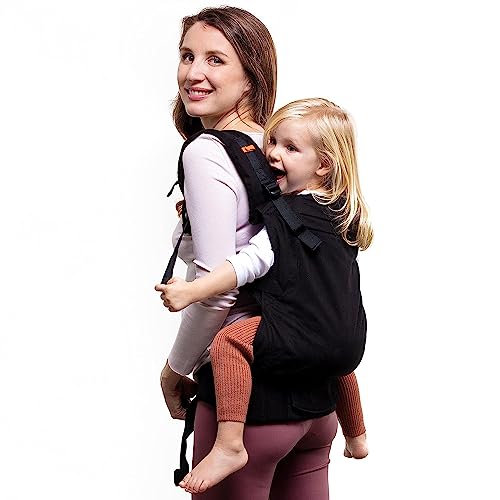
The Beco Toddler Carrier is built exclusively for children aged 24 to 48 months, filling a gap that most soft-structured carriers ignore — older toddlers who still need carrying for hikes or long walks. The extra-wide seat panel is designed to accommodate the wider hip base of a toddler, ensuring that even a 48-pound, 4-year-old can sit in a supported M-position rather than dangling. For hip dysplasia treatment that extends into toddlerhood, this specific geometry prevents the carrier from becoming a hammock that pulls the legs inward.
Reviewers have successfully used this carrier with children up to 55 pounds on back-carry hikes, reporting that the fully adjustable shoulder straps and lumbar support distribute weight well. The 100% cotton fabric is soft and breathable, and it machine-washes easily — a necessity for muddy outdoor adventures. The detachable hood provides shade or nursing coverage, though reviewers note the hood becomes too small for older toddlers above 40 pounds.
The downsides are that the shoulder seams can compress under heavy loads — one reviewer with a 30-pound child found the thin foam padding caused pressure points after 30 minutes. This carrier is not ideal for front-outward facing carries (it supports only inward-facing and back carry), and the seat panel does not tighten further once the toddler reaches the panel’s maximum width. If your child’s hip dysplasia diagnosis requires ongoing M-position support beyond age three, this is one of the few carriers that can accommodate that need at a reasonable price.
Why it’s great
- Extra-wide seat designed for toddler hip suspension
- Sturdy enough for 50+ lb children on hiking terrain
- Simple to clean and durable for outdoor use
Good to know
- Thin shoulder padding can compress with heavier loads
- Only two carry positions, no front-outward option
6. Momcozy 2-in-1 Baby Carrier with Hip Seat

The Momcozy 2-in-1 carrier uses a detachable hip seat system: the 10mm thick cushioned seat can be worn independently as a simple hip seat (like a Tushbaby) for quick ups, or you can clip the padded upper carrier on top for weight-distributed hands-free support. The wide, firm seat platform provides a stable base for the baby’s M-position, and the X-structure design allows the caregiver to put the carrier on independently without help — a crucial feature for a carrier used multiple times daily during hip dysplasia treatment.
Reviewers praise the breathability of the 3D air mesh, which keeps both baby and caregiver cool in summer heat, and the contoured waist support that evenly distributes pressure across the abdomen instead of concentrating it on the lower back. The 6-way rotating positions (including cradle, hip, forward-facing, inward, and back carry) make it adaptable from 5 months through 44 pounds, though the manufacturer recommends using the waist seat alone in cradle mode for children under 5 months rather than the full carrier setup.
The primary reliability concern is that some reviewers report the snap buttons on the seat connection can pop loose, causing the zipper to slide down during use — a safety issue that should be checked before each outing. Also, the waist belt is designed for users with a waist size up to 45 inches; caregivers above that range will need to look elsewhere. Given the aggressive price point, the Momcozy delivers impressive structural support for hip dysplasia prevention, but it does not match the durability of the premium options over multi-year use.
Why it’s great
- Detachable hip seat provides flexible carry options
- Highly breathable 3D air mesh for hot weather
- One-person instant wear with X-structure design
Good to know
- Snap buttons on seat connector can loosen over time
- Waist belt maxes out at 45-inch waist size
7. Baby Tula Lite Ripstop Carrier

The Baby Tula Lite is a travel-oriented, ultra-lightweight carrier made from ripstop nylon — the same material used in outdoor sportswear — that packs itself into its attached waistband, forming a small pouch you can wear cross-body or around your waist. For hip dysplasia, the key question is whether a packable carrier can maintain an M-position — and the answer is yes, because the seat panel retains its width and stiffness despite being lightweight. The waistband is supportive enough for a baby up to 30 pounds, and the padded shoulder straps prevent the carrier from digging in during extended airport or festival use.
Reviewers repeatedly describe this as the carrier they reach for in hot climates because the ripstop fabric does not retain heat or sweat like cotton or synthetic blends. The UPF 50+ hood provides sun protection for naps during outdoor adventures, and the integrated hip pouch can hold a phone, diaper, or wipes, reducing the need for a separate bag. Back carry and inward-facing front carry are supported, but forward-facing is not available — a limitation for babies who want to look around.
This carrier is not intended for newborns (minimum weight is 12 pounds with head and neck control), so it cannot serve as a single carrier from birth. The fabric is thin by design, so while it is durable, it does not feel as plush against the baby as a cotton carrier. However, if you live in a hot, humid area or need a second carrier that lives in the diaper bag for on-the-go use, the Baby Tula Lite delivers hip-healthy support without adding bulk — a rare combination that makes it the perfect supplement to a heavier primary carrier.
Why it’s great
- Packs into a small waist pouch for travel
- Ripstop fabric is breathable and quick-drying
- Hip-healthy seat panel maintains M-position despite light weight
Good to know
- Not suitable for newborns (requires head control)
- Thin fabric feels less cushioned than cotton options
FAQ
Can I use any baby carrier for a baby diagnosed with hip dysplasia?
How do I know if the M-position is properly achieved in my carrier?
Is forward-facing carry safe for a baby with hip dysplasia?
Do I need a carrier with a hip seat for hip dysplasia?
Final Thoughts: The Verdict
For most users, the baby carrier for hip dysplasia winner is the Baby Tula Explore because its adjustable seat width and IHDI certification provide safe, growing support from the newborn stage through toddlerhood without requiring a separate infant insert. If you need maximum lumbar relief for long hikes or chronic back pain, grab the MiaMily Hipster Plus with its built-in seat and lumbar belt. And for a travel-ready, packable backup carrier that handles hot climates without compromising hip-healthy positioning, nothing beats the Baby Tula Lite.