
Our readers keep the lights on and the weekend projects moving. As an Amazon Associate, I earn from qualifying purchases.
The first spoonful of baby oatmeal can be a win or a messy rejection. Texture, iron content, and ingredient transparency separate the bowls that get eaten from those that end up on the floor. The category is crowded with pouches, powders, and pre-mixed blends, and not all of them deliver the nutritional density a growing infant actually needs.
I’m Rikta — the co-founder and writer behind FitlyFast. I’ve spent years analyzing infant cereal formulation, iron fortification levels, and organic certification standards to help parents cut through the marketing noise.
This guide breaks down seven top contenders by ingredient quality, texture control, and real-world feeding convenience so you can confidently choose the best baby oatmeal for your little one’s first solid-food transition.
How To Choose The Best Baby Oatmeal
Baby oatmeal is not a uniform product. The differences between a powdered multi-grain cereal and a pre-filled fruit-oatmeal pouch affect everything from iron absorption to the baby’s willingness to eat. Here are the three factors that separate smart buys from expensive pantry waste.
Iron Fortification and Bioavailability
Infants deplete their stored iron around 4–6 months, making iron-fortified cereal a pediatrician-recommended first solid. Check that the cereal lists ferrous sulfate or electrolytic iron on the label and delivers at least 45% of the Daily Value per serving. Non-fortified fruit puree pouches with oatmeal do not count as a primary iron source.
Texture Control and Feeding Stage
Powdered cereals let you dial in the thickness — thin for a Stage 1 bottle-fed introduction, thicker for spoon-feeding a Stage 2 sitter. Pre-made pouches lock in a single consistency, which can be too runny for babies learning to chew or too thick for early spoon-feeders. Choose the format that matches your baby’s oral motor development.
Certification and Contaminant Testing
Organic certification eliminates synthetic pesticides, but it does not guarantee low heavy metals. Brands that third-party test for lead, cadmium, arsenic, and mercury and publish results (like Amara) offer an extra safety layer. Biodynamic certification (Holle) adds soil health standards. For daily feeding, a brand with transparent testing protocols is worth the premium.
Quick Comparison
On smaller screens, swipe sideways to see the full table.
| Model | Category | Best For | Key Spec | Amazon |
|---|---|---|---|---|
| Earth’s Best Organic Multi-Grain | Powder | Iron-fortified first solids | Iron: 45% DV per serving | Amazon |
| Holle Organic 4-Grain | Powder | Biodynamic multi-grain variety | Demeter Biodynamic certified | Amazon |
| Gerber Grain and Grow Oatmeal Banana | Powder | Toddler portion control | 5 individual 8 oz boxes | Amazon |
| Amara Oats and Berries | Freeze-Dried Powder | Heavy-metal tested travel cereal | 3rd-party heavy metal tested | Amazon |
| Beech-Nut Breakfast Favorites Variety | Pouch | Self-feeding toddlers 12m+ | No artificial preservatives | Amazon |
| Gerber WonderFoods Banana Blueberry Oatmeal | Pouch | On-the-go pouch feeding | 18mg DHA per pouch | Amazon |
| Nestle Nestum Oat Rice & Prune | Powder | Constipation relief + probiotics | Probiotics + high fiber | Amazon |
In‑Depth Reviews
1. Earth’s Best Organic Whole Grain Multi-Grain Baby Cereal
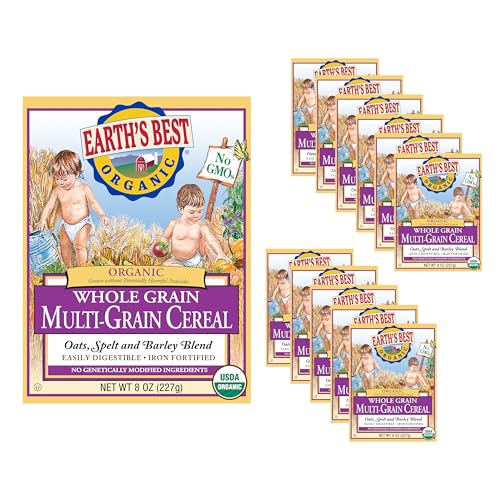
Earth’s Best hits the sweet spot where nutrition, cost-per-serving, and clean ingredients converge. The multi-grain blend — oat, spelt, and barley — provides a broader amino acid profile than single-grain oatmeal while remaining gentle on a 4-to-6-month-old’s digestive system. Each ¼-cup serving delivers 45% of the Daily Value for iron, making it a legitimate first-solid choice rather than a filler.
The powder mixes smoothly with breast milk, formula, or water, thinning down easily for bottle beginners and thickening up for spoon practice. Parents of multiples especially appreciate the 12-box bulk format: each box yields roughly 15 servings, so one case covers nearly two months of daily breakfast. The organic certification eliminates synthetic pesticide residue concerns, and the neutral oat flavor accepts fruit puree additions without clashing.
Some caregivers note that the spelt component gives a slightly earthier taste than plain oatmeal, but most babies adapt within a few feedings. The boxes are standard 8 oz cardboard cartons — not resealable — so transferring to an airtight container prevents humidity clumping. For a foundational cereal that pulls triple duty (iron source, texture trainer, and mixing base), Earth’s Best is the benchmark.
Why it’s great
- Iron-fortified at 45% DV per serving
- Three whole grains for diverse nutrition
- Bulk 12-pack reduces per-serving cost
Good to know
- Cardboard boxes not resealable
- Earthier taste than plain oat cereal
2. Holle Organic 4-Grain Baby Cereal

Holle brings European baby-food rigor to the American shelf with a four-grain cereal (oat, spelt, corn, and wheat) that carries both USDA Organic and Demeter Biodynamic certifications — a standard that regulates farm biodiversity, soil health, and animal welfare beyond basic organic rules. The grains are sourced from Demeter-certified farms that have followed biodynamic practices for decades, which matters for parents who view food as part of a larger ecological system.
The texture is fine and light, mixing into a smooth porridge with a single stir. Because it contains wheat and gluten, it is a good choice for families who do not avoid gluten and want to introduce those grains early. The 6-pack format gives you six individual 8 oz boxes, each lasting about a week of daily feedings. Babies tend to digest this cereal quickly, and reviewers note it pairs well with fruit purees or can be used as a thickener for thinner jarred foods.
The main drawback is the packaging: the cardboard boxes lack a resealable closure, and the fine powder can spill if the box tips over. Store opened boxes in a sealed container. Also, the corn content means the cereal is slightly sweeter than plain oats, which most babies love but some parents prefer to avoid as an early flavor profile. For environmentally conscious families willing to pay for biodynamic sourcing, Holle is unmatched in this category.
Why it’s great
- Demeter Biodynamic + USDA Organic certified
- Four whole grains in one blend
- Mixes instantly to smooth consistency
Good to know
- Contains wheat and gluten
- Box packaging spills fine powder
3. Gerber Organic Grain and Grow Toddler Oatmeal Banana
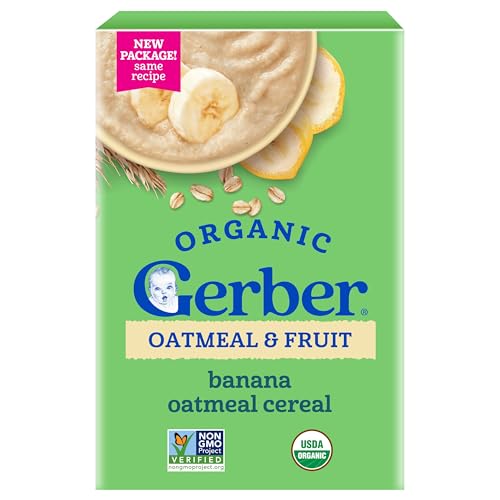
Gerber’s Grain and Grow line is formulated specifically for toddlers 12 months and up, meaning the oat flakes are slightly coarser and the iron level is tuned for older babies moving toward table food. The banana flavor is natural enough to eliminate the need for added sweeteners — the dried banana powder provides sweetness without high-fructose syrup or cane sugar.
The 5-box format (each 8 oz) is a smart middle ground: enough to establish a morning routine without committing to a 12-pack, and the individual boxes are easier to store in a crowded pantry. The oatmeal cooks quickly — just add warm liquid and stir — and the banana scent is pleasant enough that even picky toddlers rarely refuse it. Parents transitioning from pouch feeding report that the thicker texture helps babies practice chewing and swallowing more complex consistencies.
The trade-off is that this cereal is not suitable for Stage 1 beginners (the flake size is too large for bottle feeding). It also lacks the multi-grain variety of the Earth’s Best or Holle options. If you have a toddler who loves banana and you need a reliable, organic breakfast option at a fair per-serving price, this is the most practical pick in the mid-range tier.
Why it’s great
- Natural banana sweetness, no added sugar
- Individual boxes for portion control
- Organic and SNAP eligible
Good to know
- Not suitable for babies under 12 months
- Single-grain oatmeal, no variety
4. Amara Organic Oats and Berries Baby Cereal
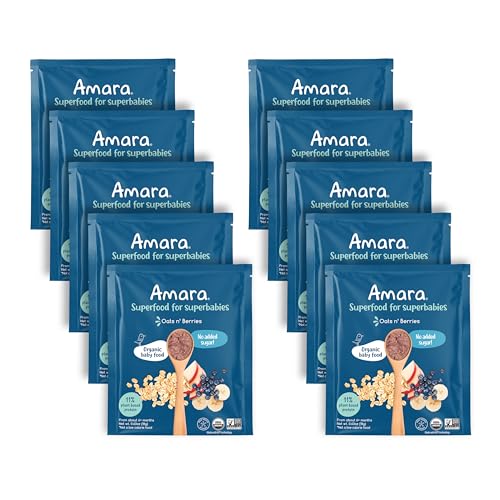
Amara solves a specific problem: how to feed a baby a hot, fresh-tasting cereal when you are away from the kitchen. The freeze-dried oat and berry powder rehydrates with water, breast milk, or formula directly in the pouch, creating a customizable texture in under a minute. The ingredient list is remarkably short — organic oats, organic apple, organic banana, and organic blueberries — with no added starches or preservatives.
What sets Amara apart is its third-party heavy metal testing. In a category where rice-based cereals have been flagged for arsenic, Amara’s Clean Label Project recognition and published test results give parents concrete data about lead, cadmium, and mercury levels. The nutrients are also better preserved because the freeze-drying process avoids the repeated high heat used in traditional jarred baby food.
The per-pouch cost is higher than powdered cereal in bulk, and each pouch yields only one serving (about 3.5 oz rehydrated). For daily feeding, this becomes expensive. But for travel, daycare emergency stash, or camping trips, the convenience is unbeatable. The berry flavor is tart rather than sugary, which some babies need a few tries to accept. If heavy-metal transparency matters more than cost-per-ounce, Amara earns its spot.
Why it’s great
- Third-party tested for heavy metals
- Freeze-dried preserves nutrient density
- Customizable texture, mixable in pouch
Good to know
- Higher cost per serving
- Tart berry flavor not universally loved
5. Beech-Nut Breakfast Favorites Fruit & Yogurt Pouches
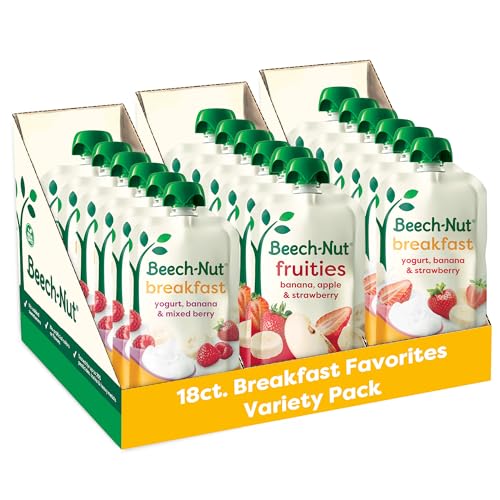
Beech-Nut’s Breakfast Favorites line shifts the format from cereal powder to ready-to-eat yogurt-oatmeal pouches aimed at children 12 months and older. The variety pack includes three flavor rotations — yogurt, banana & strawberry; yogurt, banana & mixed berry; and banana, apple & strawberry — which helps combat the boredom that leads to pouch rejection. The texture is smooth but thicker than Stage 2 fruit purees, sitting closer to a thin yogurt consistency that works for self-feeding.
Beech-Nut tests its suppliers’ ingredients and finished products for heavy metals, a step not all mainstream baby food brands take. The pouches are also free of artificial preservatives, colors, flavors, gluten, nuts, and soy, making them a safe option for daycare lunchboxes or diaper-bag backups. The 18-pack provides a solid variety rotation for roughly two to three weeks of breakfasts.
The critical limitation: these are not an iron-fortified primary food. They are a convenient breakfast or snack, but parents relying on them as the main iron source will need to supplement with fortified cereal or meat purees. Also, the whole milk yogurt base means dairy-sensitive babies may react. For toddlers who are already eating a varied diet and need a quick, pourable breakfast, Beech-Nut delivers consistent quality.
Why it’s great
- Three flavor variety in one pack
- Heavy metal tested ingredients
- Smooth texture for self-feeding
Good to know
- Not a primary iron source
- Contains dairy (whole milk yogurt)
6. Gerber Organic WonderFoods Banana Blueberry Blackberry Oatmeal
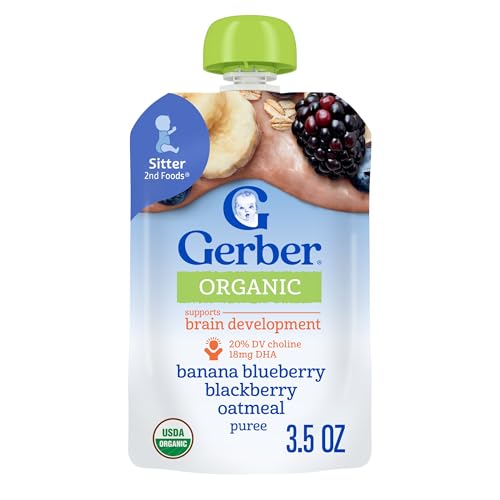
Gerber’s WonderFoods pouches pack 18 mg of DHA and 20% of the Daily Value for choline per pouch, making them one of the few oatmeal blends designed specifically to support brain development during the critical 6-to-9-month window. The banana-blueberry-blackberry flavor is the most popular in the range — it balances sweetness with enough tartness to keep babies interested without becoming cloying.
Each 3.5 oz pouch is an appropriate single-serving size for a Stage 2 eater, and the 12-pack lasts about two weeks if used once daily. The texture is smooth enough for early spoon feeding but thick enough to stay on the spoon without dripping. Busy parents report that this is the pouch they grab when leaving the house because it requires no mixing, no warm water, and no cleanup beyond the cap.
The sacrifice is that this is a puree, not a textured oatmeal — there are no visible oat flakes or chewable pieces, so it does not build chewing skills. It also contains 25% of the Daily Value for potassium but only minimal iron (the DHA and choline are the headline nutrients). For a parent who needs a nutritionally boosted, zero-prep pouch that counts as a fruit-oatmeal serving, the WonderFoods line is hard to beat.
Why it’s great
- 18 mg DHA plus choline for brain support
- No added sweeteners or artificial colors
- Zero-prep, portable pouch format
Good to know
- Low iron content
- Smooth puree, no chewable texture
7. Nestle Nestum Oat Rice & Prune Cereal
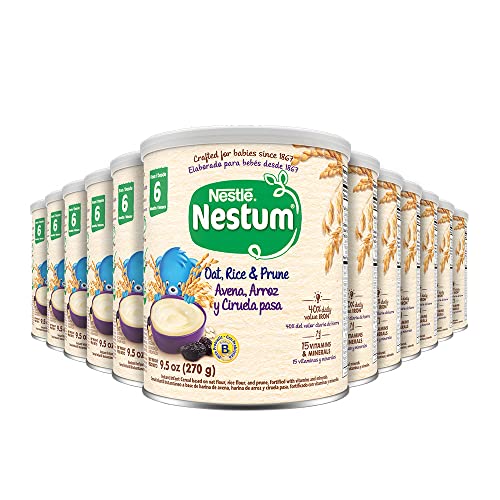
Nestum stands apart because it addresses a specific physiological need: constipation relief. The oat-rice-prune blend delivers soluble fiber from oats plus the natural laxative effect of prunes, while added probiotics (specific strains not listed on the label) support gut microbiome health. For babies who struggle with hard stools during the transition to solids, this cereal can be a dietary intervention that avoids the need for medication.
The 12-can format is built for long-term use — each 9.5 oz can yields roughly 15 servings, giving you about three months of cereal at one can per week. The texture cooks into a very smooth cream, similar to cream of wheat but with a mild prune sweetness. Caregivers often mix it with mashed banana for extra flavor and potassium. The packaging is bilingual, reflecting its strong following in Latin American and Caribbean communities.
The main complaint is an artificial-sweetener aftertaste from the added vitamins, which some babies reject. A few reviewers note that the iron taste can be overpowering if the cereal is mixed with water instead of milk or formula. Also, the rice content raises the same heavy-metal concerns as any rice-based baby food — the brand does not publish third-party metal test results. If your baby has chronic constipation and you are okay rotating this with oat-only cereals, Nestum is a targeted tool rather than an everyday staple.
Why it’s great
- Prune fiber for constipation relief
- Added probiotics for gut health
- Bulk 12-can supply lasts months
Good to know
- Metallic iron aftertaste in water
- Contains rice (heavy metal concerns)
FAQ
Can I mix baby oatmeal with breast milk instead of water?
How do I know when my baby is ready for multi-grain oatmeal instead of single-grain?
Final Thoughts: The Verdict
For most users, the best baby oatmeal winner is the Earth’s Best Organic Multi-Grain Cereal because it delivers 45% DV iron, organic whole grains, and a versatile powder format at a per-serving cost that works for daily feeding. If you want biodynamic sourcing and a four-grain blend, grab the Holle Organic 4-Grain Cereal. And for heavy-metal transparency and travel-friendly portability, nothing beats the Amara Oats and Berries.