
Our readers keep the lights on and the weekend projects moving. As an Amazon Associate, I earn from qualifying purchases.
You’re waking up in a sweat, not from the heat but from the silence — the terrifying stillness of a baby asleep. You reach for a finger to feel a pulse, then spend the next hour staring, waiting for the next breath. That nightly panic is not sustainable, and it’s why a reliable monitor is the only bridge between anxious parenting and actual sleep. The wrong device, however, will give you false alarms or miss critical dips entirely, making the situation worse.
I’m Rikta — the co-founder and writer behind FitlyFast. I’ve spent hundreds of hours dissecting clinical accuracy reports, sensor types, FDA clearance pathways, and overnight data-logging capabilities specifically for infant pulse oximeters so you don’t have to gamble with your baby’s health data.
This guide separates the medical-grade trackers from the wellness gadgets that could leave you guessing, so you can finally trust the numbers and rest. Here are the only devices that meet the standard for a baby pulse oximeter for overnight monitoring that actually keeps you informed and calm.
How To Choose The Best Baby Pulse Oximeter For Overnight Monitoring
Selecting a monitor for an infant is not like picking one for yourself. The sensor must stay securely on a tiny, moving foot or finger without causing discomfort, and it must log data continuously without interruption. Here are the three most critical specifications to evaluate before you buy.
Sensor Type: Transmissive vs. Reflective PPG
The accuracy of any pulse oximeter depends on how the light passes through tissue. Transmissive PPG sends light directly through the appendage and reads it on the opposite side — this is the gold standard for infant socks and finger clips because it measures actual blood flow. Reflective PPG bounces light off the skin and is common in smartwatches and rings; it is far less reliable when a baby moves or shifts during sleep. For overnight monitoring, you want a transmissive sensor.
Real-Time Alarms and Data Logging
A monitor that only shows a number on a screen is useless at 3 AM. The device must have configurable audible alarms that trigger if SpO2 drops below 90% or heart rate falls outside a safe range. Even better are vibration alerts that won’t startle the baby. Equally important is internal data storage of at least 8-10 hours per session, so you can review trends in the morning and share PDF reports with your pediatrician.
FDA Clearance vs. General Wellness
Many devices prominently display pulse oximetry readings, but only a handful have been reviewed by the FDA for medical accuracy. Devices labeled “not a medical device” are cleared for sports and aviation, meaning their accuracy standards are lower. If you are monitoring a baby’s oxygen levels out of genuine concern — especially for conditions like bronchiolitis, apnea, or post-surgical recovery — choose a monitor with FDA clearance or at minimum one validated against clinical-grade reference monitors.
Quick Comparison
On smaller screens, swipe sideways to see the full table.
| Model | Category | Best For | Key Spec | Amazon |
|---|---|---|---|---|
| Owlet Dream Duo (Gen 3) | FDA-Cleared Sock | Medical-grade overnight peace of mind | FDA-cleared pulse oximetry, real-time alerts, 2K camera | Amazon |
| Philips Avent Premium Connected | Camera + Breathing | Wearable-free breathing motion tracking | SenseIQ pixel-analysis for breathing rate | Amazon |
| Sense-U Smart Sock Shoe 2 | Transmissive PPG Sock | Battery life and value for 1-12 months | Transmissive PPG sensor, 2-night battery | Amazon |
| Wellue O2Ring-S | Finger Ring Monitor | High-resolution overnight data curves | 200Hz sampling, 24h battery, vibration alerts | Amazon |
| Vibeat WearO2 Ring | Continuous Ring | Comfortable 12-hour overnight tracking | Silicone ring sensor, 12-16 hour battery | Amazon |
| HOLFENRY Rechargeable Handheld | Probe System | Family multi-user with adult + baby probes | Dual probes (adult finger + foot wrap) | Amazon |
| Manhero Continuous Pulse Oximeter | Budget Probe System | Entry-level continuous monitoring at home | 2.4-inch screen, 500 data storage sets | Amazon |
In‑Depth Reviews
1. Owlet Dream Duo (Gen 3)

The Owlet Dream Duo is the only all-in-one bundle that pairs an FDA-cleared pulse oximetry sock with a 2K HD camera, giving you both physiological data and visual confirmation in a single app. The Dream Sock uses medical-grade pulse oximetry to track pulse rate and oxygen level, and it sends real-time alerts if readings fall outside preset safe zones. This is the same technology used in hospital neonatal units, adapted for home use.
The sock fits babies from 6 to 30 pounds (1-18 months) and includes four fabric sock sizes plus ASTM safety-certified cable guards. The sensor is transmissive PPG, which means it shines light through the foot and reads blood oxygen saturation directly. The 94% of parents reporting improved sleep is not a marketing gimmick — the Predictive Sleep Technology helps establish wake windows that actually lead to longer consolidated nighttime sleep for both baby and parent.
The downside is the price: this is the most expensive option on this list, and the proprietary base station is required for the sock to function, limiting range. Some users report connectivity issues when the base is placed too far from the nursery, and the sock can cause mild discomfort for some babies if not fitted perfectly. However, for parents who want FDA-cleared accuracy and refuse to compromise, the Owlet sets the current gold standard.
Why it’s great
- FDA-cleared medical-grade pulse oximetry sensor
- Combined 2K HD video camera for complete room view
- Predictive Sleep Technology helps normalize family sleep patterns
- Four sock sizes included for proper fit up to 18 months
Good to know
- High cost requires real budget commitment
- Range limited by base station placement
- Occasional connectivity drops reported when moving between floors
2. Philips Avent Premium Connected Baby Monitor

If you want to avoid putting any wearable sensor on your baby, the Philips Avent uses SenseIQ Technology to track breathing motion through the camera itself. It analyzes millions of pixels per second to detect the tiniest rise and fall of your baby’s chest, calculating a breathing rate without any sock, ring, or clip. This is ideal for parents who are concerned about SIDS but also worry about the comfort or safety of a wearable device.
The camera delivers 1080p video with night vision and connects to a dedicated 5-inch HD parent unit or your smartphone app. The cry detection and translation feature uses a scientifically validated algorithm to identify five distinct cry types — hunger, tiredness, discomfort, and more — which can be genuinely helpful for first-time parents. The 2-in-1 wall and crib mount makes positioning flexible, and the Secure Connect System encrypts the video link for privacy.
The breathing tracking, however, is not as precise as a pulse oximeter. It can miss subtle breaths during deep sleep or when the baby is swaddled tightly, and the cry translation is often inaccurate enough that reviewers call it useless. This is a premium camera with breathing analytics, not a medical-grade pulse oximeter. For parents who simply want an extra layer of reassurance without a sock, it is excellent — but it does not replace direct SpO2 monitoring for high-risk infants.
Why it’s great
- Completely wearable-free breathing motion tracking
- Sharp 1080p video with excellent night vision
- Dedicated 5-inch parent unit plus smartphone app
- Certified secure encrypted video connection
Good to know
- Breathing tracking less precise than a direct pulse oximeter
- Cry translation feature frequently reported as inaccurate
- Highest price point without actual SpO2 measurement
3. Sense-U Smart Sock Shoe 2
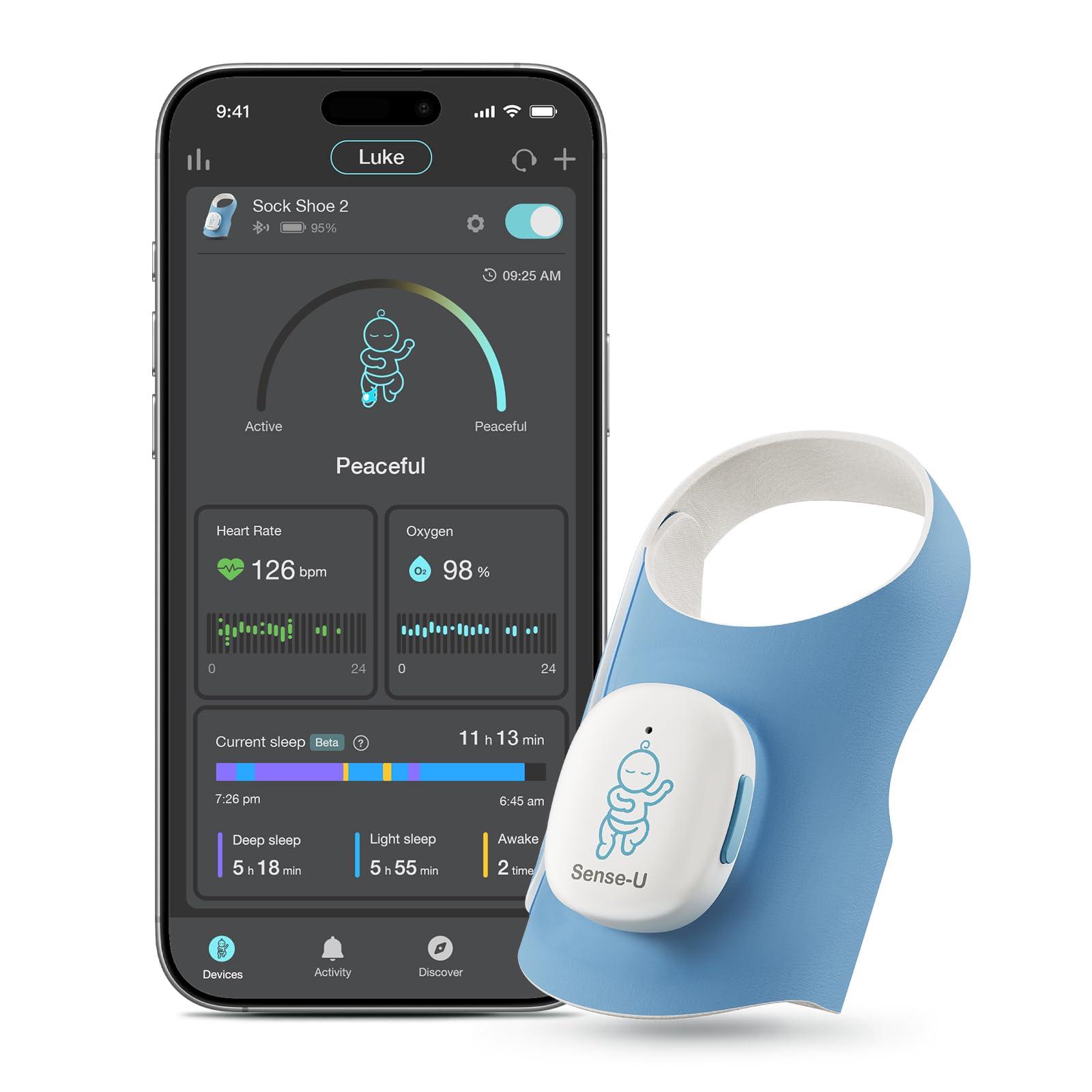
The Sense-U Smart Sock Shoe 2 uses transmissive PPG sensing technology — the same type of sensor found in medical pulse oximeters — to track heart rate and sleep patterns. The key difference from first-generation baby socks is the shoe-style design that stays on active babies better than a simple sock band. It fits babies 1-12 months and comes in two size options, made from soft breathable fabric that does not irritate sensitive skin.
Battery life is a standout feature: it lasts two full nights per charge, which is significantly better than most competitors that require daily charging. The on-device light indicator and built-in audible alerts mean you do not need the app running to be notified of an event. Pair it with the Sense-U Baby App and you get deep/light sleep breakdowns, nap tracking, and wake time analytics — data that helps you understand your baby’s sleep architecture over time.
The limitation is the age range: it only works for babies 1-12 months, so you cannot continue using it into the toddler years. The magnetic charger is prone to popping off if the sock is shifted during sleep, and the sock cannot alternate between feet. But for the price, it delivers transmissive PPG accuracy and sleep analytics that rivals the more expensive Owlet without the FDA clearance or camera integration.
Why it’s great
- True transmissive PPG sensor for accurate heart rate tracking
- Two-night battery life reduces nightly charging hassle
- App provides deep/light sleep and wake time analytics
- Soft, breathable fabric comfortable for 8+ hour wear
Good to know
- Limited to babies 1-12 months only
- Magnetic charger disconnects easily during movement
- No camera or temperature/humidity sensor included
4. Wellue O2Ring-S

The Wellue O2Ring-S is not designed for infants, but it deserves mention here for older children (6+) and adults who need overnight monitoring alongside their baby. It samples data at 200Hz, which translates to 36,000 data points per report — that is clinical-grade resolution. The ring form factor is comfortable enough for all-night wear, and the 24-hour battery life means you can track continuously without having to remember to charge it every night.
The vibration reminder is adjustable and can be set to alert if SpO2 drops below a user-defined threshold or if heart rate goes out of range. It logs up to 4 sets of 10-hour data internally, automatically syncing to the ViHealth app and O2 Insight Pro software when you open the app. You can export detailed graphic PDF reports to share with your doctor, including oxygen desaturation index graphs and pulse rate trend lines.
The ring fits finger perimeters from 2.17 to 3.15 inches (55-80mm), which means it will not work on an infant or toddler. Additionally, the proprietary USB-C cable is required for charging and data transfer — losing it means you cannot use the device. The silicone outer can catch on bedsheets and cause false readings. However, for a parent who wants their own medical-grade SpO2 tracking while also monitoring their baby, this is the best wearable ring on the market.
Why it’s great
- 200Hz sampling provides high-resolution overnight data curves
- 24-hour battery life enables multi-night tracking without charging
- Vibration alerts are silent and won’t disturb sleeping baby
- Free PC software for detailed clinical-grade report generation
Good to know
- Not sized for infants or toddlers under 6 years
- Proprietary USB-C cable is difficult to replace if lost
- EMF emissions from continuous Bluetooth concern some users
5. Vibeat WearO2 Ring

The Vibeat WearO2 is a continuous tracking ring designed with a soft silicone sensor that wraps comfortably around the finger, eliminating the soreness and numbness often caused by rigid plastic fingertip clips. It tracks blood oxygen saturation, heart rate, and body motion continuously for 12-16 hours on a single charge, which comfortably covers a full night’s sleep plus morning review time. The built-in memory stores up to 4 sessions of 10 hours each, operating without needing a phone nearby.
The adjustable vibration reminder is a key feature for overnight use: you can set a custom SpO2 threshold, and the ring will vibrate silently if your level drops below it. The free Vihealth app shows graphic trends of O2, heart rate, and motion, and you can export a PDF report to share with your healthcare provider. It also integrates with Apple Health, so data flows into your existing health dashboard.
As with many wellness rings, this is explicitly not a medical device — it is labeled for sports and aviation use. A reviewer flagged an accuracy discrepancy where the ring read 87% SpO2 while a fingertip clip read 92%, a critical difference if you are relying on the absolute numbers. Additionally, some units failed after 3 months of use. It is best suited for trend tracking rather than alarm-dependent medical monitoring.
Why it’s great
- Soft silicone ring design prevents finger soreness during all-night wear
- 12-16 hour battery covers full sleep session plus next morning
- Vibration alert is silent and adjustable for low SpO2
- Apple Health integration for unified data dashboard
Good to know
- Not cleared as a medical device — accuracy variance reported
- Durability concerns with some units failing after a few months
- Requires warm, still hand placement for reliable readings
6. HOLFENRY Rechargeable Handheld Pulse Oximeter
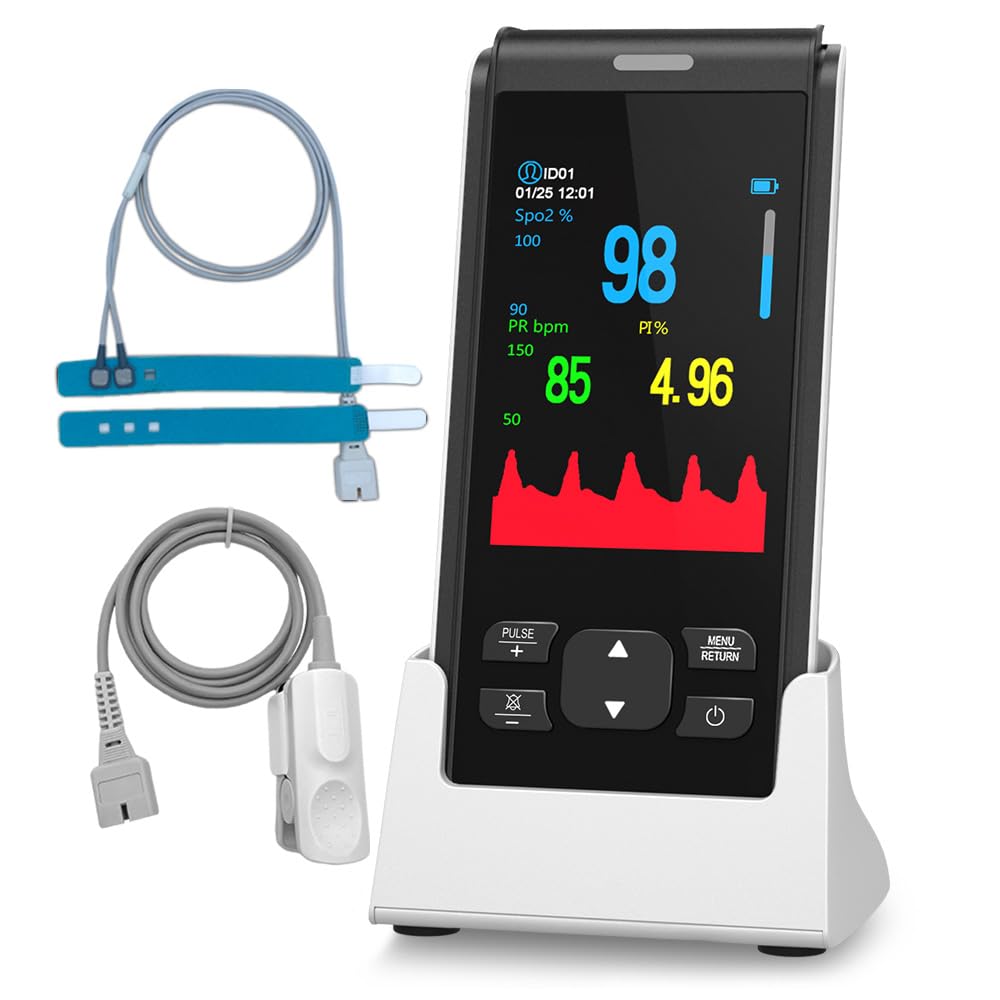
The HOLFENRY system is unique because it includes both an adult finger probe and a foot wrap probe specifically designed for babies. This makes it a practical choice for parents who want to monitor their own oxygen levels during sleep as well as their infant’s, all from one base unit. The SpO2 accuracy is rated to 1% between 70-100% and heart rate to 1 bpm, which is competitive with many clinic-grade fingertip devices.
The device supports up to 10 user IDs, each storing 300 data sets independently. You can switch between spot-check mode and trend-record mode depending on whether you want a quick reading or extended overnight logging. The USB-C rechargeable battery is advertised at 18 hours, though real-world testing reports closer to 8.5 hours of continuous use. You can also run it plugged in for 24-hour uninterrupted monitoring, which is useful for a sick child or post-surgery recovery.
The main weakness is the baby probe itself: several reviewers report that it slips off the foot easily during sleep, and the alarm does not sound when the probe disconnects. This means you could have a false sense of security if the probe falls off mid-night. The device also has a small screen that is hard to read from across the room. For families who want a multi-user system with both adult and baby probes, it works, but the baby probe reliability is not ideal for unattended overnight use.
Why it’s great
- Includes dedicated baby foot wrap probe plus adult finger probe
- Multi-user system supports 10 IDs with independent data storage
- USB-C rechargeable with option for continuous plugged-in use
- High accuracy rating of 1% SpO2 and 1 bpm heart rate
Good to know
- Baby probe can slip off without triggering an alarm
- Real-world battery life significantly lower than claimed 18 hours
- Small screen hard to read without approaching the device
7. Manhero Continuous Pulse Oximeter
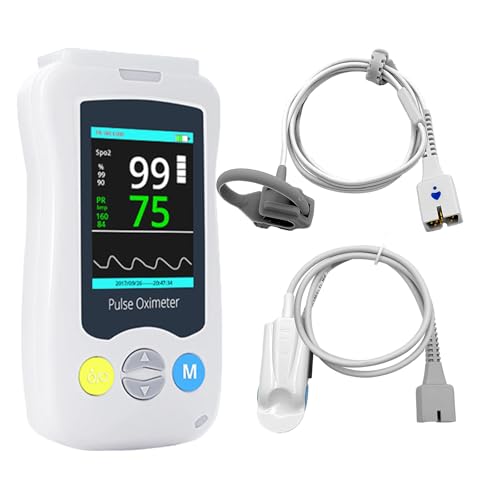
The Manhero Continuous Pulse Oximeter is positioned as a budget-friendly entry point for families who want overnight monitoring without the premium price tag. It comes with two probes — one for adult fingers and one for infant feet — and features a 2.4-inch high-definition screen with nine-level brightness adjustment so you can see the numbers clearly in a dark nursery. The SpO2 measurement range is 70-99% with an accuracy of 2%, and heart rate range is 30-240 bpm accurate to 1 bpm.
The alarm function triggers automatically when SpO2 drops below 90% or heart rate falls below 50 bpm, and you can customize these thresholds. It stores up to 500 data sets internally, which is generous for this price tier, and runs on either 3 AAA batteries or a micro USB cable for pass-through power. Being able to plug it in continuously is a real advantage for overnight use, since battery-only operation drains a full set of batteries within 24 hours.
The build quality is the main compromise. The finger stick probe plug falls out of the socket easily, and the included USB cord is too short to reach many nightstands without an extension. The battery drain is significant — one reviewer reported going through a full set of batteries in under a day. For the price, it is a functional starter unit, but the reliability issues mean it is best suited as a backup monitor or for daytime spot checks rather than a primary overnight device.
Why it’s great
- Very accessible price point for a continuous monitoring system
- Large 2.4-inch screen with adjustable brightness for night use
- Accepts AAA batteries or USB power for flexible setup
- 500 data set internal storage for trend review
Good to know
- Probe plug disconnects easily, losing monitoring contact
- Battery life drains rapidly in battery-only mode
- Included USB cable is too short for typical nursery setups
FAQ
Can a baby pulse oximeter replace a medical monitor in a hospital setting?
Will wearing a pulse oximeter sock overnight bother my baby’s sleep?
What is a dangerous SpO2 level for a baby during sleep?
How accurate are continuous fingertip monitors compared to hospital fingertip clips?
Final Thoughts: The Verdict
For most users, the baby pulse oximeter for overnight monitoring winner is the Owlet Dream Duo (Gen 3) because it is the only system that combines FDA-cleared pulse oximetry with a high-definition camera in one seamless app, giving you both direct SpO2 data and visual confirmation. If you want a wearable-free solution that still tracks breathing motion, grab the Philips Avent Premium Connected. And for the best balance of transmissive PPG accuracy and battery life at a reasonable price, nothing beats the Sense-U Smart Sock Shoe 2.