
Our readers keep the lights on and the weekend projects moving. As an Amazon Associate, I earn from qualifying purchases.
Watching a preemie sleep is a mix of joy and raw anxiety. Every breath looks too shallow, every pause feels too long. Standard audio monitors and video feeds only tell you what you can see or hear — they can’t measure the vital signs that matter most to parents of a fragile newborn. A dedicated wearable monitor gives you real-time feedback on heart rate, oxygen levels, and breathing motion, bridging the gap between instinct and data.
I’m Rikta — the co-founder and writer behind FitlyFast. After weeks of cross-referencing clinical specs, customer feedback patterns, and safety certifications for infant wearable monitors, I’ve zeroed in on the devices that balance accurate sensing, preemie-friendly fit, and dependable low-energy connectivity.
Whether you are preparing for NICU discharge or just want an extra safety net during naps, this guide cuts through the noise to help you find the baby sock monitor for preemies that fits your baby’s unique needs and your peace of mind.
How To Choose The Best Baby Sock Monitor For Preemies
Selecting a monitor for a preemie is different from buying one for a full-term infant. The sensor technology, the sock’s weight, the minimum recommended age and weight, and the type of data tracked all play a decisive role. Below are the three specifications you need to prioritize.
Sensor Type: Transmissive PPG vs. Reflective Optical vs. Movement
Transmissive PPG sensors shine an LED light through the baby’s skin to measure blood volume changes — the same clinical method used in hospital pulse oximeters. This gives the most accurate heart rate and SpO2 data for preemies, whose small, low-perfusion feet can produce unreliable readings with reflective sensors. Movement-based monitors (clip-on or diaper sensors) track abdominal breathing motion but do not provide oxygen saturation data, which is critical for preemies at risk of apnea or bradycardia.
Fit and Weight Minimums
Most sock-style monitors state a minimum weight of 6 or 8 pounds and a minimum age of 1 month. For preemies born at 32–36 weeks, these thresholds matter. The sock must sit snugly against the foot without slipping, and the sensor housing must not press uncomfortably against the ankle bone. Look for monitors that include multiple sock sizes — ideally a preemie-specific size — and a sensor pod that is low-profile enough to fit under a sleep sack or swaddle.
Alert System Latency and False Alarm Rate
No monitor is perfect, but for preemies, the delay between a reading leaving the safe zone and an actual alert matters. The best monitors trigger an audible alarm within 10–15 seconds of detecting a low heart rate or desaturation. A high false-alarm rate from motion artifacts (kicking, rolling, loose fit) will erode trust and disrupt sleep. Look for user feedback specifically about false alarms during active sleep stages — the quietest monitors have algorithms tuned to differentiate movement from genuine distress.
Quick Comparison
On smaller screens, swipe sideways to see the full table.
| Model | Category | Best For | Key Spec | Amazon |
|---|---|---|---|---|
| Owlet Dream Sock | Smart Sock | Accurate O2 and Pulse for Preemies | SpO2 + Pulse Rate, 1–18 mo | Amazon |
| Sense-U Smart Sock Shoe 2 | Smart Sock | Long Range Heart Rate Monitoring | Transmissive PPG, 1–12 mo | Amazon |
| Philips Avent Premium Connected | Camera + Sensor | Wearable-Free Breathing Tracking | SenseIQ Pixel Analysis, 1300ft Range | Amazon |
| Wellue Checkme O2 Max | Finger Ring | Continuous SpO2 Monitoring at Home | 72hr Battery, 30–250 bpm | Amazon |
| Sense-U Pro Baby Monitor | Clip-On Tracker | Breathing Movement & Rollover Alerts | BLE, 50ft Range, 7+ Day Battery | Amazon |
| Comfyer BM01 | Video Monitor | Split-Screen Video for Multi-Room | 7″ 720p, 6000mAh Battery | Amazon |
In‑Depth Reviews
1. Owlet Dream Sock

The Owlet Dream Sock is the most widely adopted smart sock monitor on the US market and for good reason. It uses a transmissive PPG sensor to track both pulse rate and oxygen saturation in real time — the exact two vitals that give parents of preemies the most actionable feedback. The base station and app both sound alerts when readings exit the preset safe zones, and the sock fabric is soft and breathable, designed for babies 6–30 pounds.
Multiple parent reports confirm that once the sock is positioned correctly, false alarms are rare and usually triggered only by the sock slipping during active movement. The included four sock sizes allow the same sensor to grow with the baby, and the 16-hour battery lasts through overnight use and most of the next day. The Predictive Sleep Technology in the app also provides wake-window suggestions, which can help establish feeding and nap routines for a preemie adjusting to life at home.
It is worth noting that the Owlet is not a medical device and requires a 2.4 GHz Wi-Fi connection for the full app experience. Some users report connectivity hiccups if the base station is placed too far from the router. However, the clinical-grade accuracy of the SpO2 readings and the responsive customer support make it the top pick for parents who want the most complete picture of their preemie’s vital signs during sleep.
Why it’s great
- Tracks both heart rate and oxygen saturation with transmissive PPG sensor
- Four sock sizes included for newborn-to-toddler growth
- Predictive Sleep Technology helps establish healthy routines
Good to know
- Requires 2.4 GHz Wi-Fi; not compatible with 5 GHz networks
- Base station is not portable and must remain plugged in
- Cannot be used under 1 month or below 6 pounds
2. Sense-U Smart Sock Shoe 2
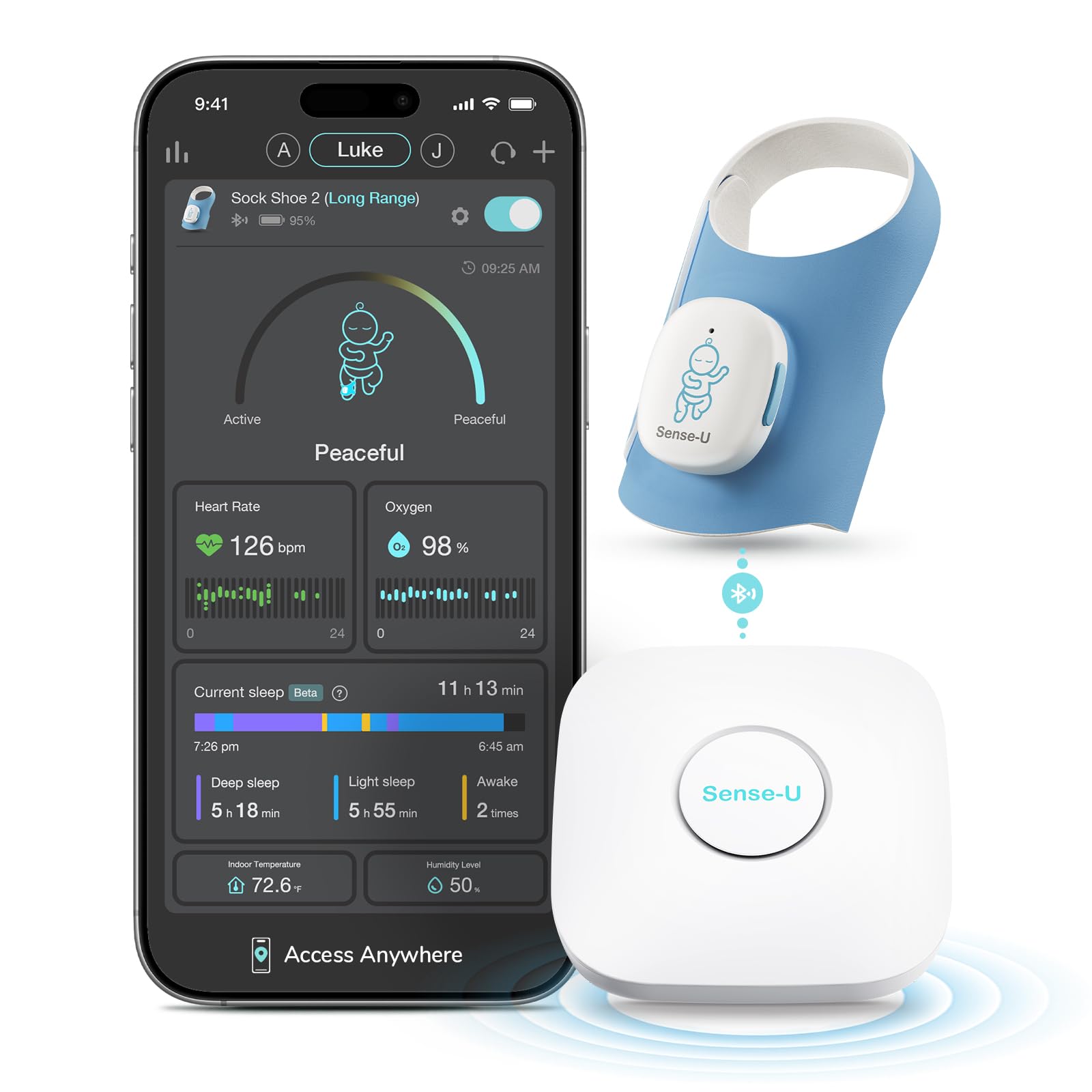
The Sense-U Smart Sock Shoe 2 is the newest iteration of Sense-U’s wearable lineup and it brings transmissive PPG sensing to a sock form factor — a significant upgrade over the reflective sensors found in earlier models. The shoe-style sock design uses soft, breathable fabric and includes two size options to fit babies from 1 to 12 months. The long-range base station connects to your home Wi-Fi, allowing you to check heart rate and sleep patterns from anywhere.
Parents report that the sock stays put during sleep and that the baby seems unaware of wearing it. The on-device sleep status indicator and base station lights and sounds provide immediate feedback without needing to open the app. When used with the companion app, the system pushes notifications for low heart rate alerts and provides detailed sleep stage breakdowns (deep/light sleep, nap tracking, sleep efficiency). The battery lasts through the night and recharges quickly.
One limitation is that the sock does not track oxygen saturation — it only reports heart rate and sleep patterns. Some users also mention that the alarm for sock removal is delayed by several minutes, which means a loose sock may not trigger an immediate alert. For parents who prioritize heart rate tracking over SpO2, this is a strong contender, especially given the comfortable fit for smaller feet.
Why it’s great
- Transmissive PPG sensor for accurate heart rate tracking
- Soft, breathable shoe-style fit designed for small babies
- Long-range base station with Wi-Fi connectivity for remote access
Good to know
- Does not track oxygen saturation, only heart rate
- Alarm for sock removal can be delayed by several minutes
- Minimum age of 1 month; best suited for babies over 5 lbs
3. Philips Avent Premium Connected

The Philips Avent Premium Connected monitor takes a completely different approach: there is no sock, no sensor to clip, and no wearable at all. Instead, the 1080p camera uses SenseIQ technology to analyze millions of pixels per second, tracking the tiniest chest and belly movements to calculate breathing rate. For parents who feel anxious about putting a sock on a fragile preemie’s foot or who worry about pressure points, this wearable-free option eliminates those concerns entirely.
The parent unit comes with a 5-inch HD screen that delivers crystal-clear video even at night, and the secure WiFi connection encrypts the feed through multiple layers. The cry detection and translation feature uses a scientifically validated algorithm to identify five distinct cry patterns, which can be helpful for new parents learning to interpret their preemie’s signals. The included 2-in-1 wall and crib mount makes positioning easy, and the 1300-foot range ensures a stable connection throughout the home.
Some users note that the cry translation feature can be unreliable, especially in cribs with motion like the Snoo, and the breathing tracking algorithm may occasionally produce static readings when the baby is very still. The premium price reflects the advanced camera technology and the app’s sleep diary, but for parents who want to avoid any physical contact with the baby’s skin during monitoring, this is the most elegant solution on the market.
Why it’s great
- No wearable required — ideal for sensitive preemie skin
- 1080p camera with excellent day/night video quality
- Breathing rate tracking via pixel motion analysis
Good to know
- Cry translation feature can be inaccurate in motion cribs
- Premium price point compared to sock-based monitors
- Breathing rate readings may appear static during very quiet sleep
4. Wellue Checkme O2 Max

The Wellue Checkme O2 Max is a finger-ring pulse oximeter that continuously records oxygen saturation and heart rate, storing up to 72 hours of data on the device. While it is marketed for sports and aviation use — and explicitly disclaims medical certification — its PPG sensor technology is identical to the clinical-grade sensors used in hospital pulse oximeters. For parents who want to run overnight SpO2 trend reports and share them with a pediatrician, the free Vihealth app and O2 Insight Pro software provide detailed CSV and graph exports.
The soft silicone ring sensor is designed to prevent finger numbness and slippage, and it fits comfortably on small digits. The smart vibration and audio alert triggers when SpO2 falls below a user-defined threshold, which can be set to 92% or 90% for preemie monitoring. Battery life is rated at 72 hours per charge, and the device stores four groups of 10-hour data — enough for several nights of continuous monitoring before needing to upload.
The biggest drawback is that this is not a wearable intended for constant infant use. The ring design is better suited for older babies or toddlers who can tolerate a finger sensor, and the app alarm does not work in the background on iOS — the device must be connected to a phone that stays awake. The customer reviews also note that the PC software for data download can be unreliable. For dedicated spot-checks or supervised monitoring, it is a capable tool, but not a replacement for a purpose-built infant sock.
Why it’s great
- Accurate SpO2 and heart rate tracking with hospital-grade PPG sensor
- 72-hour battery life with data storage for multiple nights
- Vibration and audio alerts for low oxygen saturation
Good to know
- Not designed for continuous infant wear; better for supervised spot-checks
- App alarm fails if phone screen turns off or app runs in background
- Finger sensor may not fit preemie-sized digits comfortably
5. Sense-U Pro Baby Monitor
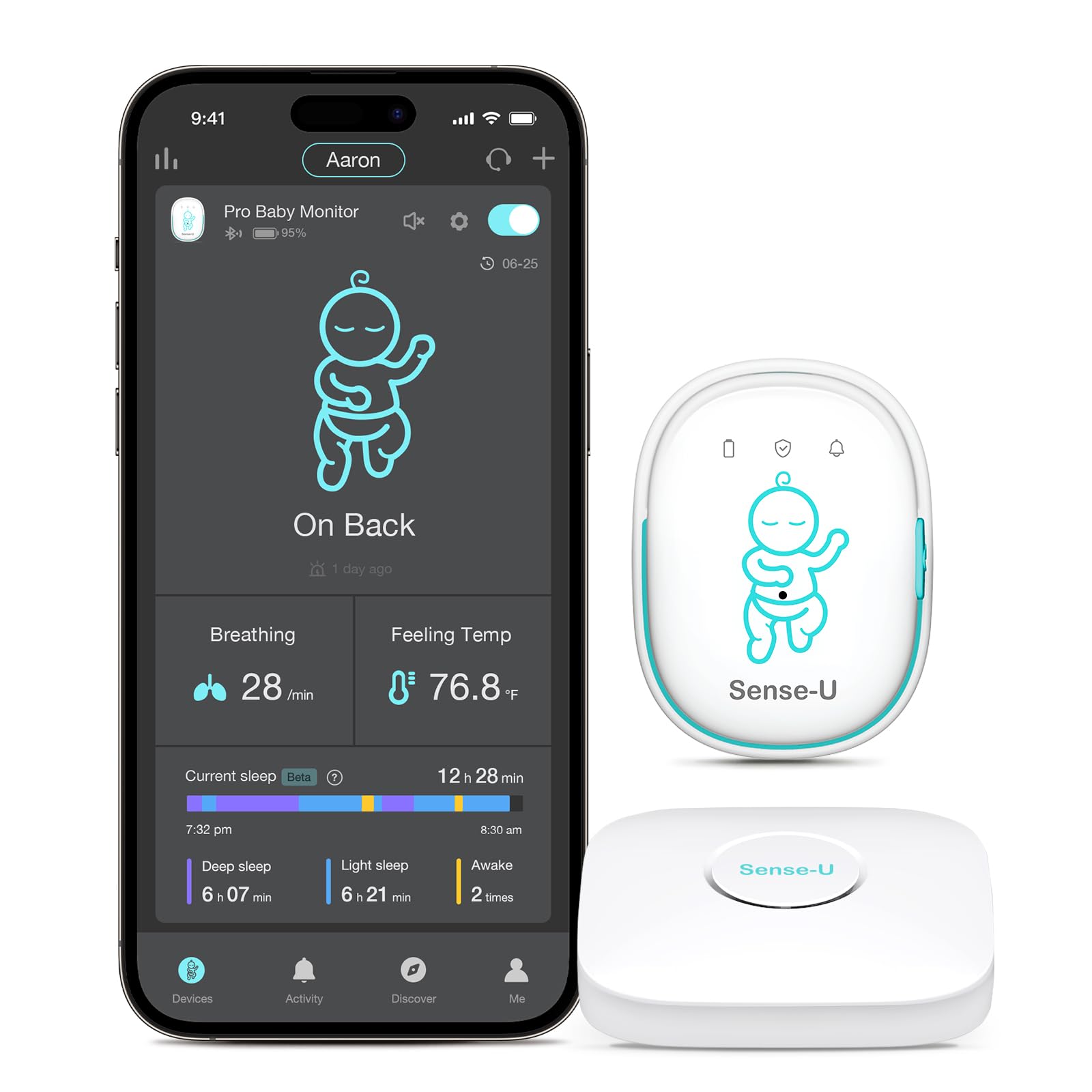
The Sense-U Pro Baby Monitor clips directly onto the baby’s diaper and detects abdominal breathing movement, rollover position, and room temperature. Unlike sock monitors that measure heart rate or oxygen, this device focuses entirely on physical motion — specifically the rise and fall of the belly during breathing. If no abdominal movement is detected for 15 seconds, the device vibrates gently to stimulate the baby, and if movement is still absent, it triggers an audible alert and a smartphone notification.
Parents report that the clip is easy to attach and surprisingly unobtrusive — babies do not seem to notice it during sleep. The base station provides audible and visual alerts, and the app allows you to customize which triggers (slow breathing, stomach sleeping, overheating) generate notifications. The long-range Bluetooth connection works reliably up to 50 feet, and the rechargeable battery lasts over 7 days on a single charge. The device is also FSA/HSA eligible, which makes it a more accessible option for budget-conscious families.
The clear limitation is that the Sense-U Pro does not measure heart rate or oxygen saturation — it only detects movement. For preemies who are at risk of bradycardia or desaturation events that do not necessarily involve a cessation of breathing movement, this blind spot is significant. Some users also mention that false alarms can occur during diaper changes if the clip is not removed first. It is best used as a secondary monitor alongside a video camera for full context.
Why it’s great
- Monitors actual abdominal breathing movement, not just pulse
- Gentle vibration can stimulate baby before sounding alarm
- Long battery life (7+ days) and FSA/HSA eligible
Good to know
- Does not track heart rate or blood oxygen level
- Clip must be removed during diaper changes to avoid false alarms
- Best used as a secondary monitor alongside a video system
6. Comfyer BM01
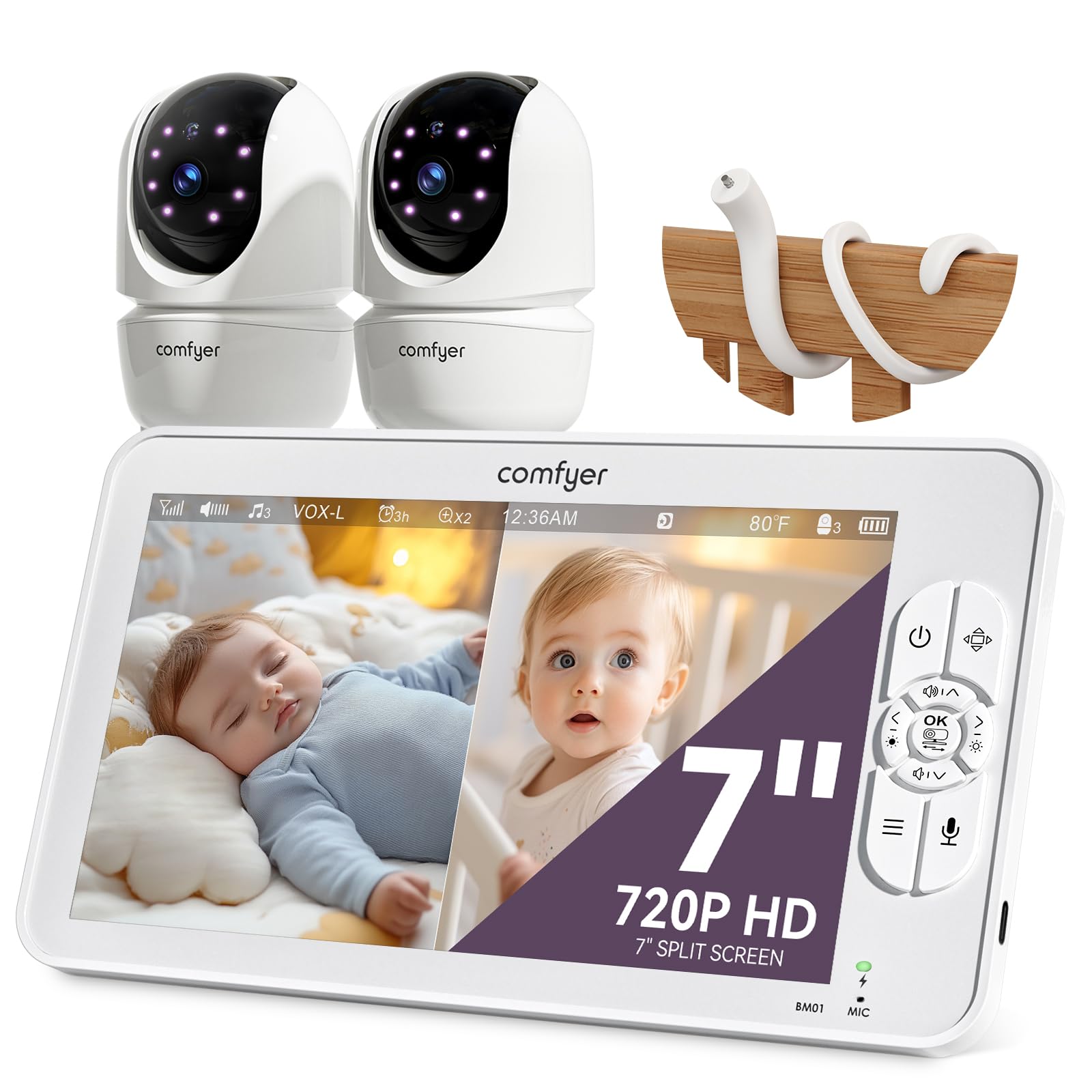
The Comfyer BM01 is a high-resolution 7-inch baby monitor with two 1080p cameras that can be used together in split-screen mode. It is a dedicated non-WiFi monitor that uses 2.4 GHz FHSS encrypted transmission, which means there is zero risk of remote hacking — a real concern for parents who are already on high alert with a preemie. The large 720p display shows sharp, clear video both day and night, and the remote pan, tilt, and 4X zoom give you full control over the camera angle.
The flexible silicone bracket that comes with the kit wraps securely around a crib rail or shelf without requiring drilling or screws, making it easy to position the camera for the best view of the baby’s face and chest. The 6000mAh battery delivers up to 13 hours of continuous video or 2 days of audio-only VOX mode, so you can keep the monitor running all night without worrying about a dead battery. Built-in temperature sensors and soothing sound options round out the feature set.
This monitor does not include any wearable sensor — it is purely a video system. For parents who need to visually confirm breathing and movement without the complexity of a smart sock, the Comfyer BM01 is a reliable workhorse. The split-screen support for two cameras is useful for families with twins or for alternating between a nursery camera and a separate preemie bassinet view. The lack of Wi-Fi means no app alerts or remote viewing, but it also removes any latency or connectivity frustration.
Why it’s great
- No Wi-Fi, encrypted 2.4 GHz connection for maximum privacy
- Large 7-inch screen with split-screen support for two cameras
- Flexible crib mount and long 6000mAh battery
Good to know
- No wearable sensor — cannot track heart rate or oxygen
- Split-screen view reduces individual camera resolution
- No app or remote monitoring away from home
FAQ
Can I use a baby sock monitor on a preemie under 6 pounds?
Does the Owlet Dream Sock provide medical-grade SpO2 readings?
How do I stop false alarms from waking my preemie or me?
Final Thoughts: The Verdict
For most users, the baby sock monitor for preemies winner is the Owlet Dream Sock because its transmissive PPG sensor gives the most accurate readings of both heart rate and blood oxygen, plus the four sock sizes ensure a good fit as your baby grows. If you want a comfortable sock that prioritizes heart rate tracking and long-range Wi-Fi connectivity at a slightly more accessible price, grab the Sense-U Smart Sock Shoe 2. And for a completely wearable-free monitoring experience that eliminates any risk of pressure points or sensor slippage, nothing beats the Philips Avent Premium Connected with its camera-based breathing tracking.