
Our readers keep the lights on and the weekend projects moving. As an Amazon Associate, I earn from qualifying purchases.
Your one-year-old is changing daily — going from unsteady first steps to a curious explorer who wants to touch, stack, sort, and mimic everything they see. The right toy at this stage doesn’t just occupy them; it builds motor control, introduces cause and effect, and rewards their growing independence with sounds and movement that make sense to a developing brain.
I’m Rikta — the co-founder and writer behind FitlyFast. I’ve spent countless hours analyzing the engineering, material safety, and developmental alignment of infant toys to separate the truly engaging from the forgettable clutter.
This guide breaks down the best options available right now for your toddler’s growth stage, helping you choose with confidence among sensory toys, walkers, and electronic learning tools. Here is everything you need to know to pick the best baby toys for 1 year old children that actually support their development.
How To Choose The Best Baby Toys For 1 Year Old
The market is stuffed with plastic things that blink and beep, but not all of them serve your child’s actual developmental needs. Before you add anything to your cart, think about your toddler’s current motor stage, attention span, and the toy’s material safety. The best choices encourage repetition, reward curiosity, and survive being thrown, dropped, and mouthed without breaking or becoming unsafe.
Match the Toy to the Motor Stage
At twelve months, many children are cruising or walking while others are still perfecting their pincer grasp. A sit-to-stand walker supports the child ready to take steps, while a pounding bench or set of stacking rings builds the fine motor control needed for future tasks like using utensils. Know where your toddler is physically and buy for the stage ahead, not the stage behind.
Prioritize Durability and Safety
One-year-olds have no concept of gentle. Toys will be dropped from high chairs, chewed on, and banged against furniture. Look for solid construction — think smoothly sanded wood, thick plastic without sharp seams, and non-toxic finishes. Any electronic toy should have a secure battery compartment that requires a screwdriver to open, preventing access to coin cells that are a choking and burn hazard.
Look for Open-Ended Play Potential
The toys that stay interesting longest are the ones that let your child decide how to play. A set of blocks can be stacked, knocked down, sorted by color, or used as pretend food. A musical chair with multiple modes adapts as the child grows from pressing buttons to sitting independently and role-playing. The best toys evolve with your child rather than delivering the same single interaction every time.
Quick Comparison
On smaller screens, swipe sideways to see the full table.
| Model | Category | Best For | Key Spec | Amazon |
|---|---|---|---|---|
| VTech Sit-to-Stand Walker | Activity Walker | First steps & balance | Detachable panel, 2-speed control | Amazon |
| Fisher-Price Learning Chair | Interactive Chair | Sit-down learning & pretend play | 3 play modes, seat-activated sounds | Amazon |
| Joyreal Wooden Montessori Toy | Multi-Activity Set | Fine motor & problem-solving | Wood construction, 4 activities | Amazon |
| JoySpark Musical Crawling Crab | Sensory Crawling Toy | Encouraging crawling & chasing | 50 songs, rechargeable, voice record | Amazon |
| VTech Turn and Learn Driver | Pretend Play Wheel | Role-play & cause-effect | 3 modes, 60+ songs/phrases | Amazon |
| LeapFrog 100 Words Book | Electronic Learning Book | Vocabulary & bilingual exposure | 100+ words, English & Spanish | Amazon |
| Fisher-Price Blocks & Stacker Set | Classic Sorting Set | Sorting, stacking, early problem-solving | 10 blocks, 5 stacking rings | Amazon |
In‑Depth Reviews
1. VTech Sit-to-Stand Learning Walker
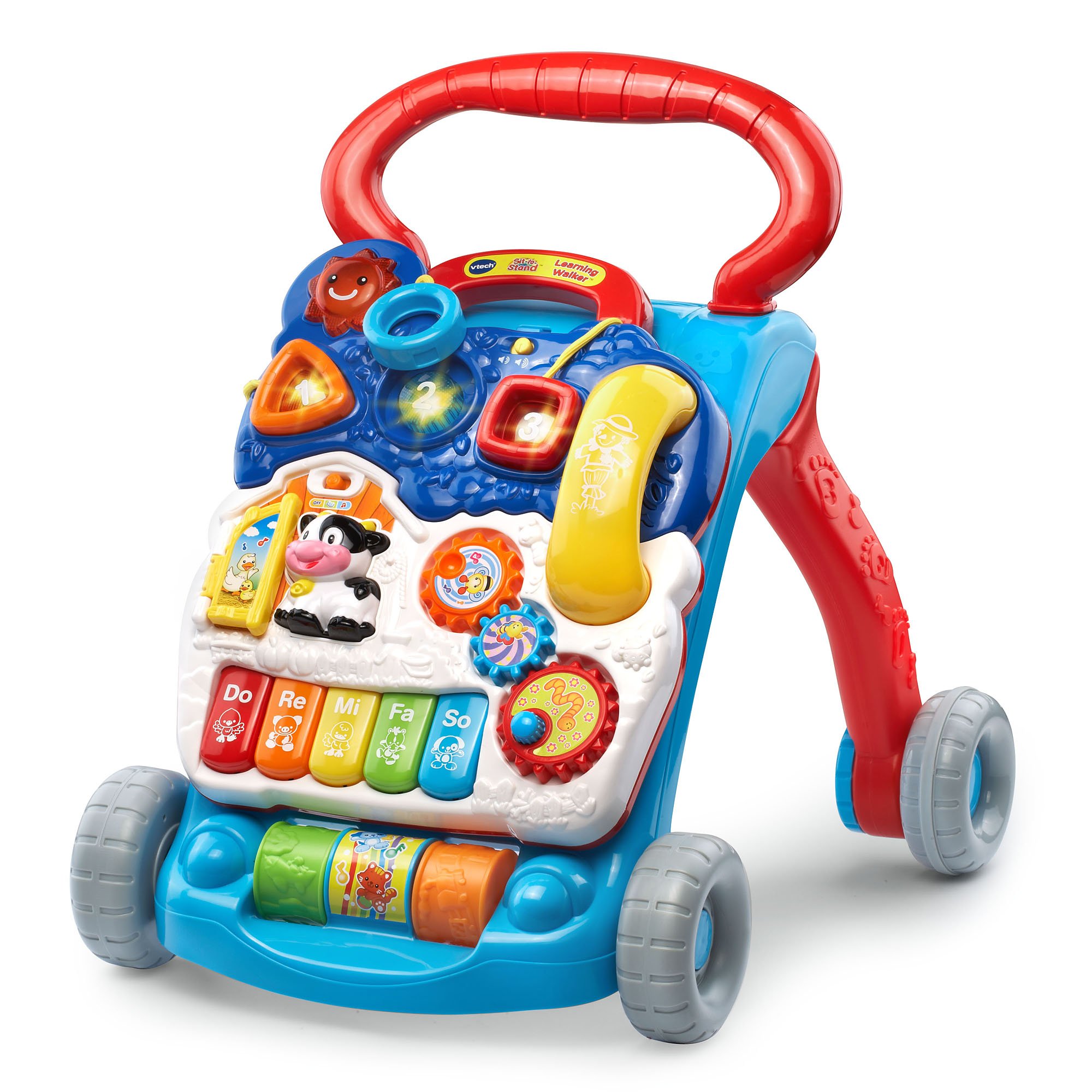
This walker earns the top spot because it genuinely grows with your child. The removable activity panel works for floor play with a baby who is sitting independently, then re-attaches to the walker frame when they are ready to cruise. The two-speed control switch lets you adjust resistance so a brand-new walker doesn’t suddenly shoot forward and lose confidence — a detail most competing walkers ignore entirely.
The panel itself is dense with purposeful features: five piano keys that play notes, a telephone handset for role-play, three shape sorters, light-up buttons, and colorful spinning rollers. Each element targets a different skill — fine motor, cause and effect, auditory recognition — without overwhelming the child. The wide wheelbase prevents tipping, and the stoppers on the back wheels keep the walker from rolling on carpet until the child actually pulls it forward.
At roughly four and a half pounds, the walker is stable enough to lean on but light enough for a toddler to push across the room. Parents consistently report that the panel alone keeps their child occupied for long stretches, and the walker function remains useful well into the second year. This is the one toy that bridges the gap between stationary play and independent walking better than anything else in the category.
Why it’s great
- Detachable panel works as a standalone floor activity center
- Two-speed control prevents frustrating roll-away for beginners
- Wide base and wheel stoppers add stability and safety
Good to know
- Assembly required, though instructions are straightforward
- Some parents wish the panel offered more volume levels
2. Fisher-Price Laugh & Learn Song & Story Learning Chair

This chair uses a clever trick that toddlers find irresistible: the seat itself triggers songs and phrases every time the child sits or stands. That simple cause-and-effect loop encourages them to practice the squat-to-stand motion repeatedly, building leg strength and balance without any coaxing from you. The seat is sized for children from twelve months up to about six years, so it earns its place in a corner of the room for years.
Beyond the movement reward, the chair offers three distinct play modes — Learning, Music, and Imagination — that teach alphabet, numbers, colors, and opposites through songs and short stories. The activities mounted on the sides include a light-up lamp that turns on and off, a set of musical crayons that each play a different note, and a flipbook with pages that trigger a narrated story. These keep little hands busy while the chair’s core function reinforces gross motor development.
The unit is solid and stable, with no sharp edges or unstable wobble when a toddler climbs on or off. Assembly takes about ten minutes and requires a Phillips screwdriver, but once built it holds up well to daily use. Parents report that the toy works especially well for encouraging independent play — the child can entertain themselves by switching between the crayons, the book, and the sit-stand game without needing an adult to reset anything.
Why it’s great
- Seat-activated response rewards standing practice
- Three play modes teach a broad range of early concepts
- Sturdy construction suited for daily toddler use
Good to know
- Requires assembly, and the chair is bulky once built
- Batteries included, but you will need to replace them fairly often with heavy use
3. Joyreal Wooden Montessori Toys for 1 Year Old
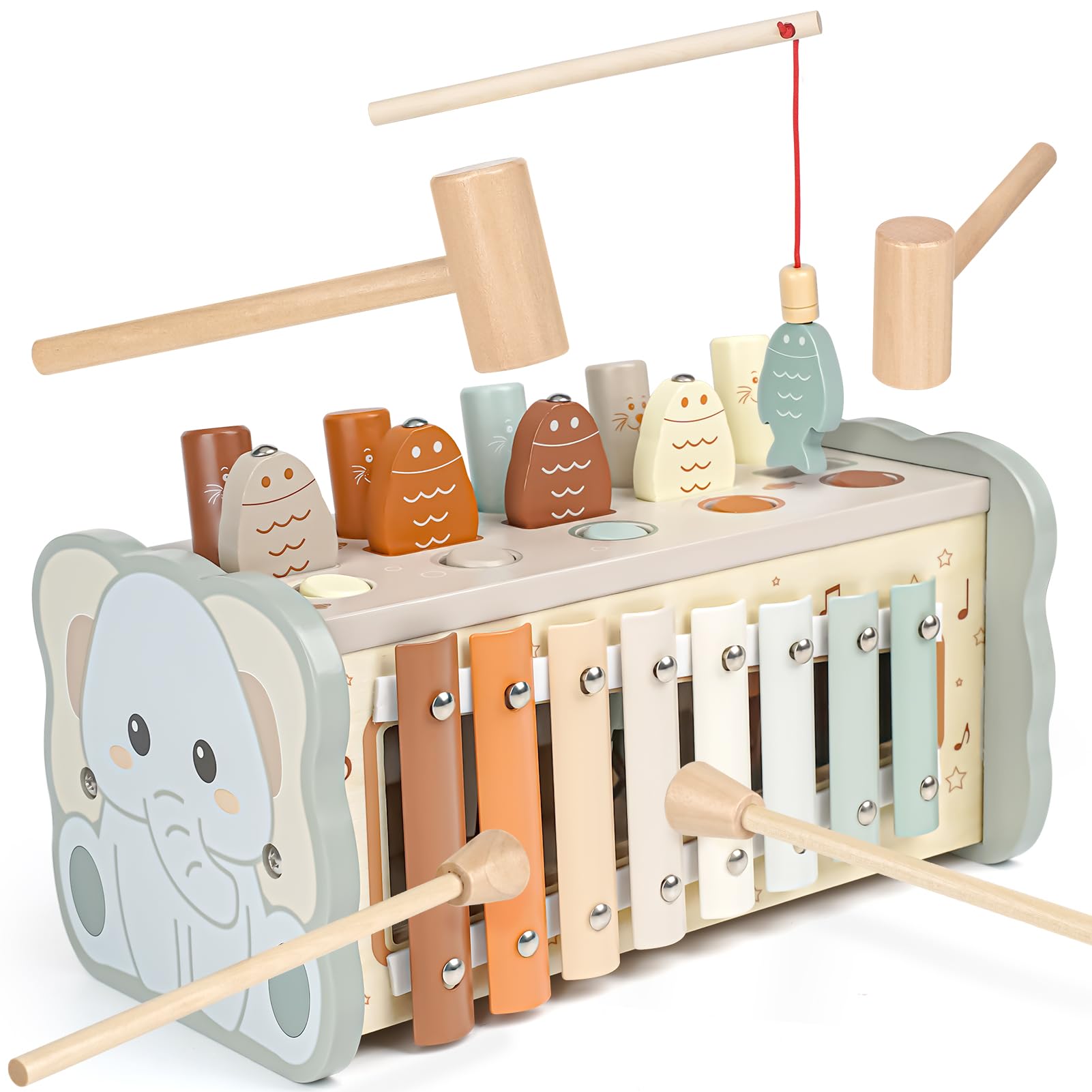
This set stands apart from the electronic-heavy competition by offering four distinct activities — a pounding bench with hamsters, a removable xylophone, a magnetic fishing game, and gear-spinning knobs — all made from sanded natural wood with a calm, neutral color palette. The lack of harsh, overstimulating colors is intentional; the muted tones help toddlers focus on the mechanics of each action rather than just reacting to visual noise.
The pounding bench uses a wooden mallet to drive pegs through holes, popping the attached hamsters up on the other side — a simple, satisfying loop that strengthens arm muscles and teaches cause and effect. The xylophone bars produce clear, pleasant notes, and the fishing game requires steady hands and concentration to land the magnetic fish. Each activity targets a slightly different skill: gross motor for the hammering, fine motor for the fishing, and sensory exploration for the gears and xylophone.
Because the set includes two mallets, it works well for sibling play or parent-child interaction without fighting over the tool. The wood is smoothly polished with no splinters, and the non-toxic water-based paint holds up to chewing and dropping. This is an excellent choice for parents who want to limit screen-based or battery-operated toys and prefer open-ended activities that encourage real problem-solving rather than passive button-pushing.
Why it’s great
- Four Montessori-aligned activities in one compact set
- Neutral colors reduce visual overstimulation
- Durable wood build with safe, smooth edges
Good to know
- Smaller than some parents expect from the photos
- Fishing game requires adult supervision with the magnetic pole
4. JoySpark Toys Musical Crawling Crab
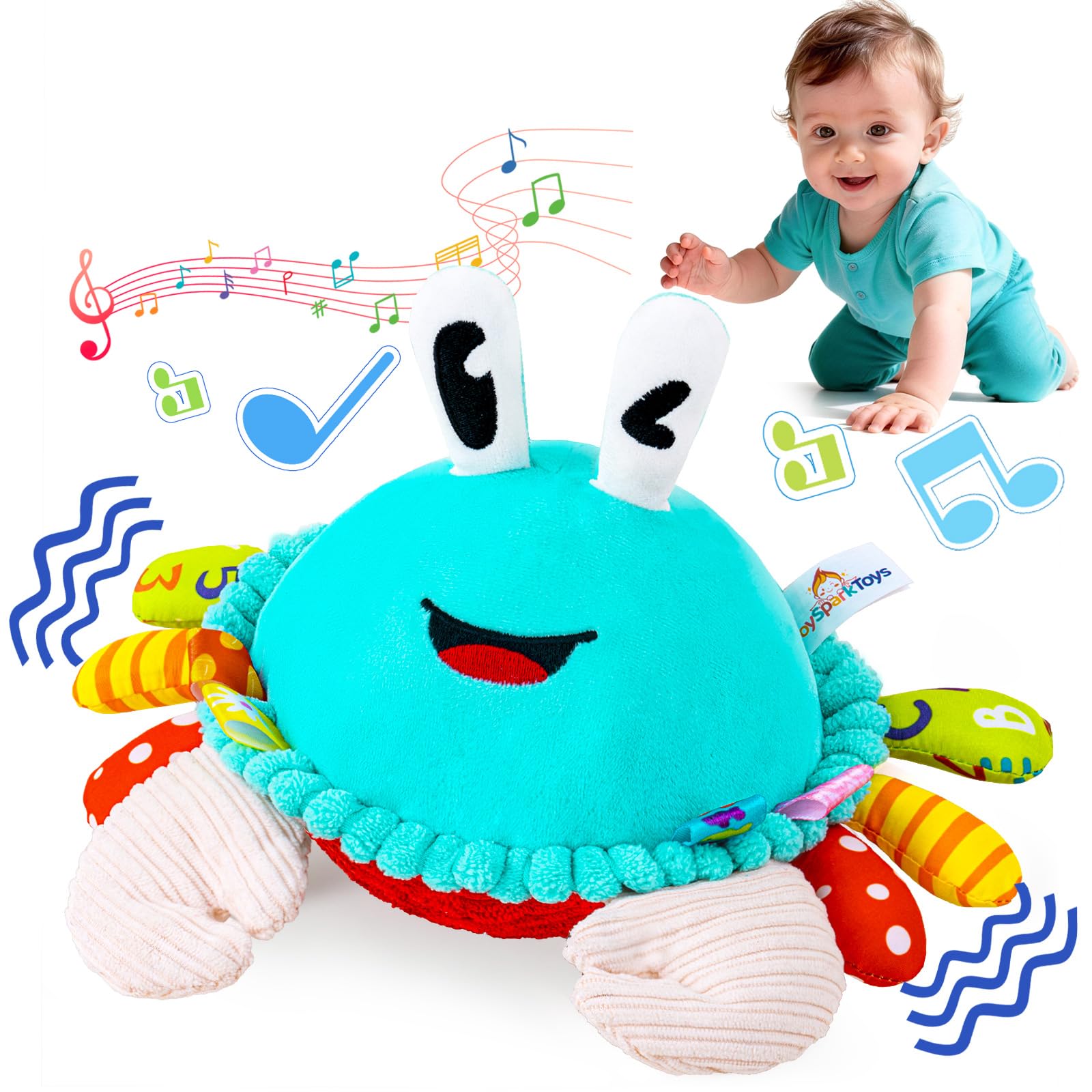
This soft plush crab scoots across the floor while playing fifty different songs, and its unpredictability — it bounces, shakes, and changes direction — encourages babies to chase it, which directly strengthens crawling skills and gross motor coordination. The built-in recording feature adds a layer of surprise: the crab repeats whatever the child says in a funny, bouncy voice, which delights one-year-olds and motivates them to babble more.
The body combines multiple textures — crinkly paper inside the shell, soft plush fabric, and squeaker elements — giving the child tactile variety during play. The two modes switch based on interaction: clap to wake it up into music mode, then it automatically cycles back to voice-repeating mode after the song ends. This simple interaction teaches toddlers that their actions produce predictable but fun responses, which is a foundational cause-and-effect lesson at this age.
Unlike toys that chew through AA batteries weekly, this one charges via USB-C, and a full charge delivers several hours of play. The outer shell is removable and machine-washable, which matters because floor toys collect dust and drool quickly. Reviewers consistently note that even reluctant crawlers will chase this crab across the room, making it a practical tool for parents working on physical milestones.
Why it’s great
- Voice recording feature encourages language experimentation
- USB-C rechargeable, no battery replacement hassle
- Texture variety and unpredictable movement engage sensory seekers
Good to know
- Crab movement can be startling for very timid babies
- Plush material shows dirt quickly, though it is washable
5. VTech Turn and Learn Driver
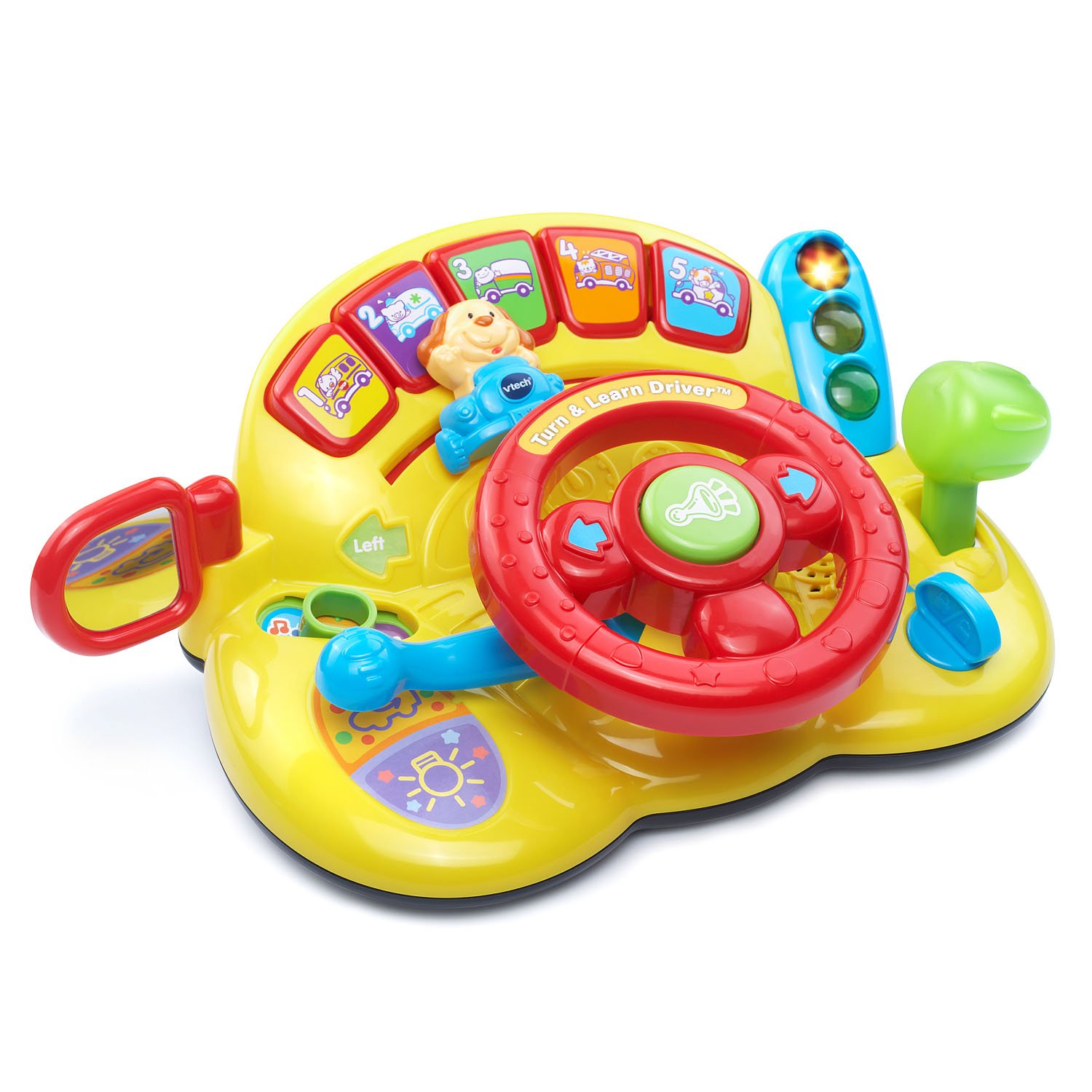
This interactive steering wheel gives one-year-olds a taste of pretend play without requiring the floor space of a full ride-on toy. The wheel turns smoothly in both directions, and each twist triggers sounds, songs, and phrases that teach animal names, vehicle sounds, and directional words like “left” and “right.” The three modes — Animal, Driving, and Music — keep the toy fresh by changing what happens when the child presses the horn or turns the signal lever.
The design includes a gear shifter, a rearview mirror, a turn signal, and a dashboard with light-up buttons, all sized for small hands. The horn button introduces road safety concepts by associating colors with action: red means stop, yellow means slow, green means go. This is a subtle but effective way to embed early learning into a game the child already enjoys. The wide base keeps the unit stable even when the child yanks the wheel aggressively, which one-year-olds are prone to do.
The two volume levels give parents some control over noise output, and the battery compartment is secured. At roughly one and a half pounds, the driver is light enough to move from room to room but substantial enough to stay put during play. The sweet spot for this toy seems to be around fourteen to nineteen months, when children begin actively mimicking adult behaviors like driving.
Why it’s great
- Smooth steering and responsive buttons satisfy cause-and-effect curiosity
- Three modes prevent boredom and extend useful life
- Compact footprint fits in small play areas
Good to know
- Some children find it more engaging after 14 months than at 12 months
- No real walking support — it stays stationary
6. LeapFrog Learning Friends 100 Words Book

This electronic book introduces over one hundred age-appropriate words spread across categories like pets, food, opposites, and outside activities, with the twist that every word is available in both English and Spanish. The three animal guides — Turtle, Tiger, and Monkey — appear on every page, and touching a picture plays the word aloud, often followed by a relevant sound effect or a short fun fact. This dual-layer interaction moves beyond simple labeling into contextual learning.
The pages are thick, board-book style and resist tearing, which matters because one-year-olds have not yet learned to turn pages gently. The audio is crisp and clear — something budget electronic books often get wrong — and the light-up star button on the side plays the Learning Friends theme song and a rotating “My Favorite Word” feature. The toy also includes a music mode that plays songs related to the page’s theme, adding variation to how the child engages with the same pictures.
The recommended age starts at eighteen months, but many parents report that their twelve-month-old enjoys pressing the buttons and hearing the sounds, even if the vocabulary lessons come later. The bilingual capability is a genuine educational bonus, not a gimmick — the switch flips between languages easily, so a child can learn both sets of vocabulary from the same toy. For screen-free language exposure during car rides or quiet time, this book is hard to beat.
Why it’s great
- Full bilingual audio in English and Spanish
- Sturdy board pages resist tearing and bending
- Clear audio and responsive touch sensors on every page
Good to know
- Best vocabulary benefit comes closer to 18 months
- Some parents find the content repetitive after extended use
7. Fisher-Price Baby’s First Blocks & Rock-a-Stack Set

This two-in-one bundle pairs two of Fisher-Price’s most enduring designs: the Rock-a-Stack ring stacker and the Baby’s First Blocks shape sorter with ten colorful blocks and a bucket. The Rock-a-Stack features a curved, wobbling base that challenges toddlers to balance the five rings in order, and the blocks set includes a shape-sorting lid that fits onto the storage bucket, so cleanup doubles as an activity. Both toys have been in production for decades because the core mechanics — stacking, sorting, and fitting shapes — are precisely what one-year-old brains are wired to practice.
The rings are sized for small grips: the largest ring is easy to grab, and the smallest requires a more precise pincer movement, so the child naturally progresses through difficulty levels. The blocks are hollow and lightweight, which means they do not hurt when thrown, and the bucket lid has cutouts for a circle, square, triangle, star, and other common shapes. Neither toy requires batteries, so there is nothing to break or replace, and both can be wiped clean with a damp cloth after inevitable floor time.
The frustration-free packaging means you spend less time wrestling with plastic clamshells, and the set arrives ready to play immediately. These toys work best when an adult models the stacking or sorting first, then lets the toddler mimic and experiment. This is the strongest entry-level choice for parents who want simple, proven, screen-free play without any learning-mode menus or volume buttons to manage.
Why it’s great
- Battery-free, minimal parts, virtually unbreakable
- Progressive difficulty within the same toy set
- Bucket doubles as storage and shape-sorting game
Good to know
- May be too simple for toddlers who are already stacking consistently
- Blocks are basic shapes — no letters or numbers
FAQ
Should I buy electronic toys or stick with simple wooden blocks for a one-year-old?
How do I know when a toy has become too advanced or too simple for my toddler?
What battery safety features should I check before giving an electronic toy to a one-year-old?
How many toys does a one-year-old actually need at once?
Final Thoughts: The Verdict
For most users, the baby toys for 1 year old winner is the VTech Sit-to-Stand Learning Walker because it bridges the gap between stationary play and first steps more effectively than any other option, with a detachable panel that keeps the child engaged at every stage. If you want a quiet, screen-free, Montessori-aligned set that builds fine motor skills through open-ended play, grab the Joyreal Wooden Montessori Toy. And for encouraging crawling and language experimentation with a toy that genuinely entertains, nothing beats the JoySpark Musical Crawling Crab.