
Our readers keep the lights on and the weekend projects moving. As an Amazon Associate, I earn from qualifying purchases.
That forward slump at the desk, the rounded shoulders creeping in during a long drive—it’s not just about looking tired. Chronic poor posture pulls your spine out of its natural curve, tightening chest muscles while weakening your upper back. A dedicated back brace does more than remind you to sit up straight; it physically trains your shoulders to retract and your thoracic spine to extend, building the muscle memory needed to hold proper alignment on your own.
I’m Rikta — the founder and writer behind FitlyFast. I’ve spent years analyzing biomechanics research and sorting through the hardware specs of posture support devices to separate the ones that genuinely correct from those that merely compress.
This guide breaks down the top-tier, mid-range, and budget-friendly options to help you find the durable, effective back posture corrector for men that fits your routine and body type.
How To Choose The Best Back Posture Corrector For Men
Picking the wrong brace is like wearing shoes that don’t fit—you end up with more pain than you started with. Men typically have broader shoulders and a longer torso, so the corrector’s strap length, chest circumference range, and lumbar anchor point matter more than a one-size-fits-all claim. Focus on these three factors to nail your selection.
Fit Range and Adjustability
A corrector that digs into your armpits or rides up your spine won’t deliver consistent correction. Look for models that offer separate adjustment for the shoulder loops and the waist belt. The best units let you dial in tension independently, so you can pull your shoulders back without cinching your midsection too tight. Check the stated chest or waist circumference range against your own measurements—most braces list a size guide based on inches around the ribcage or just below the bust line.
Support Structure: Straps vs. Rods
Some correctors use a simple figure-eight strap system that passively reminds you to straighten up. Others incorporate removable plastic or metal support rods along the spine that actively push against your back to maintain extension. Rod-based designs offer more rigid correction for pronounced hunching or thoracic kyphosis, but they can feel bulky under a dress shirt. Strap-only units are lighter and more discreet, making them better for daily office wear, though they require more conscious engagement from your own muscles.
Breathability and Material Quality
You’ll likely wear this thing for hours under clothing, so the fabric’s ability to wick moisture and resist odor is non-negotiable. Mesh panels, perforated neoprene, and lightweight polyester blends keep airflow moving and prevent that clammy feeling. Also pay attention to the padding on the shoulder straps and underarm area—thin, rough edges can cause chafing within thirty minutes, while contoured foam cushions distribute pressure evenly across the trapezius.
Quick Comparison
On smaller screens, swipe sideways to see the full table.
| Model | Category | Best For | Key Spec | Amazon |
|---|---|---|---|---|
| BackEmbrace | Premium | All-day comfort under shirts | Split-strap design, 1mm thin fabric | Amazon |
| BIGROSE DualGuard | Mid-Range | Full back support with lumbar stability | Dual-layer lumbar support belt | Amazon |
| STALLY ONE | Mid-Range | Dynamic traction with dual support bars | 2-in-1 with removable support rods | Amazon |
| KNXWALT | Mid-Range | Ventilated mesh with 4 support rods | Four reinforced removable rods | Amazon |
| LifeLove | Mid-Range | Tall users needing extended strap length | 105cm shoulder loops, 115cm waist | Amazon |
| ComfyBrace | Budget-Friendly | Lightweight daily reminder to straighten | Polyester, 0.13 kg weight | Amazon |
| SNUSIM | Budget-Friendly | Affordable entry-level correction | Chest sizes 28″ to 48″, breathable | Amazon |
In‑Depth Reviews
1. BackEmbrace Posture Corrector

The BackEmbrace stands apart because of its incredibly low-profile build—the custom-woven nylon material measures just 1 mm thick, meaning it disappears under a T-shirt or dress shirt without any visible ridge. Rather than a bulky corset feel, the split-strap design wraps across your clavicles and shoulder blades separately, allowing you to adjust the retraction force on each side independently. Users consistently report that the gentle, constant pull is comfortable enough for eight-hour workdays, even for professionals like surgeons and manicurists who lean forward for hours.
This corrector uses a dual-band tension system: one band sits across the upper shoulders while the second loops under the armpits, distributing the load evenly so no single pressure point gets irritated. The hook-and-loop closure at the front lets you fine-tune the tightness without twisting the fabric. At 0.27 pounds, it’s one of the lightest options here, and the machine-washable material holds up well to weekly cleaning. The short break-in period—about 20–30 minute sessions initially—helps your body adjust gradually rather than forcing an uncomfortable stretch.
Men with a chest measurement over 40 inches or height above 5’10” should order the M/L or XL, as the XS/S runs petite and may pull too tight across a broader frame. The lack of rigid support rods means it won’t force your spine into extension passively; you have to engage your core for the best results. For a balance of discretion, durability, and customizable tension, this remains the top choice for daily wear.
Why it’s great
- Ultra-thin, seamless profile hides under any clothing
- Dual-band strap system prevents armpit digging
- Machine washable without losing elasticity
Good to know
- Runs small—most men need M/L or XL
- No rigid support rods for passive correction
- Premium price point for a strap-only design
2. BIGROSE DualGuard Full-Back Support Pro
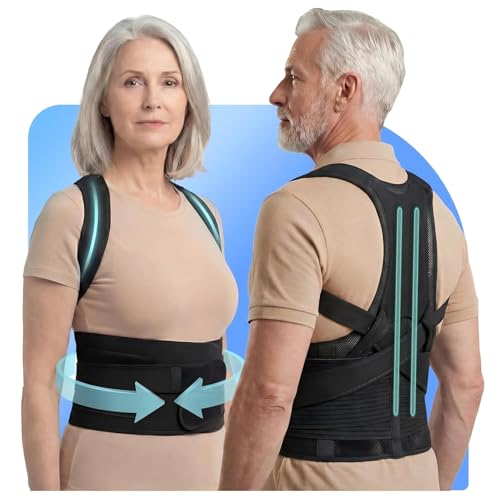
The BIGROSE model targets a different problem than most upper-back braces: it combines a shoulder pull-back system with a wide dual-layer lumbar belt, so you get support from the base of your spine all the way up to your shoulder blades. The open-back construction allows the shoulder straps to retract your shoulders without compressing the mid-back, while the lower wrap stabilizes the pelvis and lower lumbar region—an important distinction for men who experience lower back fatigue along with forward head posture.
Material-wise, the brace uses a high-strength mesh that stays breathable even when cinched tight. The underarm cutouts are contoured to prevent the rubbing that often happens with shorter torso lengths, and the waist belt secures with industrial-grade hook-and-loop that doesn’t slip during bending or twisting. User feedback highlights how the brace provides immediate lower back relief during long sitting sessions, with several desk workers and tradespeople noting better stability when lifting or standing for extended periods.
Because this is a fuller coverage brace, it feels warmer than a minimalist strap system and may show a slight outline under a slim-fit polo. It also requires a bit more effort to put on by yourself—the rear straps need a good pull to seat properly against the shoulder blades. If your primary need is upper-back hunch correction alone, a lighter option may suit you better, but for combined thoracic and lumbar support, this delivers sturdy guidance.
Why it’s great
- Combines shoulder retraction with lumbar stabilization
- Contoured underarm design minimizes chafing
- Strong Velcro stays secure through movement
Good to know
- More coverage means less breathability on hot days
- Requires help or practice to fasten independently
- Shows slightly under form-fitting clothing
3. STALLY ONE Dynamic Traction Posture Corrector
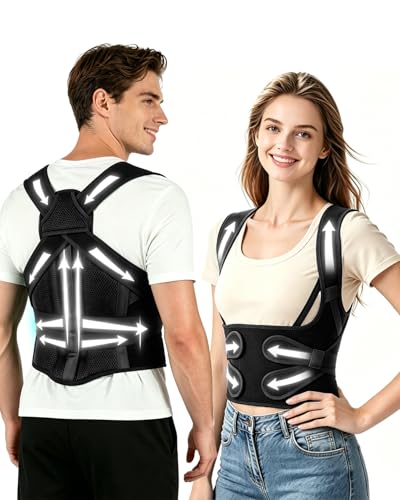
The STALLY ONE bridges the gap between a simple strap and a full orthopedic brace by incorporating two internal support bars that run along either side of the spine. These rods are removable, which means you can start with the rigid correction to retrain your posture and eventually switch to a strap-only mode as your muscles develop the right memory. The bars provide a noticeable tactile cue—every time you try to slouch, the rods press gently against your back, reinforcing the upright position without relying solely on shoulder tension.
Fit adjustment is handled through both shoulder straps and a secondary waist cinch, giving you independent control over the upper and lower tension zones. The material is a breathable polyester mesh that ventilates well during moderate activity like walking or light stretching. Reviews consistently mention that the brace feels supportive without being restrictive—users at desks and in warehouses report reduced upper back fatigue after a few days of wear, and the dual support bars stay in place without poking through the fabric.
The medium size accommodates waist measurements from 35 to 41 inches, which covers a large portion of average male builds. However, the rods do add a bit of bulk, so wearing this under a thin dress shirt may create a visible line down the back. For men who want graduated correction—starting with firm support and weaning down—this offers a versatile path that simpler braces cannot match.
Why it’s great
- Removable support rods allow progressive training
- Independent shoulder and waist adjustment
- Breathable mesh reduces sweat buildup
Good to know
- Rods create a visible ridge under fitted shirts
- Medium size maxes out at 41-inch waist
- Slightly heavier than strap-only models
4. KNXWALT Posture Corrector with 4 Support Rods
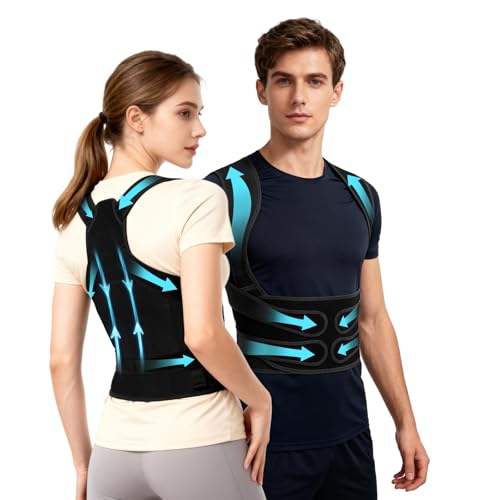
The KNXWALT stands out in the mid-range bracket by pairing four flexible support rods with an open, ventilated mesh body that keeps air moving across the back. Instead of two rigid bars, the four rods fan out to follow the natural curve of the thoracic spine, distributing the corrective force more evenly and reducing hot spots. The waist belt uses a wide hook-and-loop panel that wraps around the midsection securely, giving you a planted anchor point so the rods don’t shift out of alignment during the day.
Users appreciate how lightweight the entire assembly feels—the mesh material cuts down on heat retention significantly compared to neoprene or thick polyester alternatives. Adjustability comes from a front closure that is easy to reach and modify without removing the brace, plus shoulder straps that can be loosened independently. Wearers report that the four-rod configuration provides a more graduated correction than two-bar designs, making it easier to tolerate for extended hours, especially if you have mild to moderate thoracic kyphosis.
The unit is labeled for youth as well as adults, so sizing may run slightly smaller than expected for a full-grown man with a broader ribcage. Double-check the waist circumference chart before ordering; some feedback suggests ordering one size up if you are over 40 inches around the belly. For the price, you get a robust rod-based system without jumping to the top of the price range—ideal if you want structured support without a bulky feel.
Why it’s great
- Four rods distribute pressure more evenly
- Highly breathable mesh prevents overheating
- Front-adjustable for easy on-the-go tweaking
Good to know
- Youth sizing may run small for larger frames
- Rods are removable but not individually adjustable
- Sizing guidance requires careful measurement
5. LifeLove Adjustable Posture Support Brace
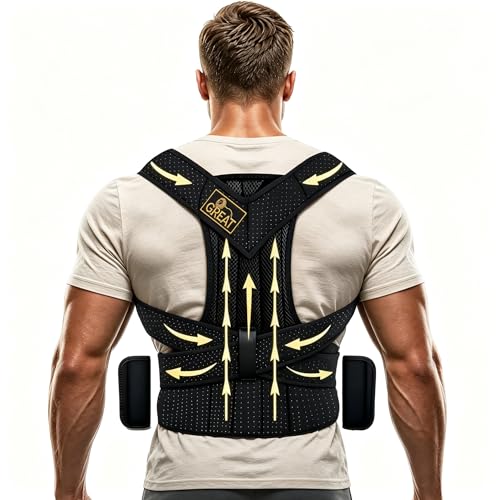
The LifeLove brace solves a specific fit challenge: accommodating taller men with longer torsos. The shoulder loops measure 105 centimeters and the waist band extends to 115 centimeters, giving you enough strap length to avoid that pulled-up feeling that shorter braces create. The central back panel spans 40 centimeters, which provides coverage from mid-scapula down to the lower lumbar, ensuring the correction isn’t just targeting the upper traps but also the mid-back muscles that often weaken with prolonged slouching.
Construction uses a blend of neoprene, nylon, and spandex that offers a good amount of stretch while still holding its shape over time. Two detachable underarm cushions are included to prevent friction where the straps cross the axilla—a common pain point in many all-in-one designs. The hook-and-loop waist closure wraps fully around the midsection and stays locked during bending and twisting, which is a practical advantage for men who need to move around rather than sit static at a desk.
This is not a subtle, invisible corrector—the black-gold color scheme and wider strap profile mean it looks like a piece of fitness gear if worn over a shirt. It’s better suited for home wear, outdoor walks, or light exercise sessions than for a buttoned-up office environment. The one-size-fits-most approach works well for the intended height range, but men with a very narrow or very broad skeletal frame may find the fit less precise than a model with multiple size options.
Why it’s great
- Extra-long straps suit taller body types
- Detachable underarm cushions reduce chafing
- Stretchy fabric blend allows natural movement
Good to know
- Bolder design looks less discreet under clothes
- One-size approach may not fit all frames perfectly
- Neoprene blend can trap heat during prolonged wear
6. ComfyBrace Posture Corrector

The ComfyBrace is the classic figure-eight posture corrector that focuses on shoulder retraction without adding bulk to the mid or lower back. Weighing only 0.13 kilograms, it feels nearly weightless once on, and the all-polyester construction keeps it from getting sticky during warmer months. The hook-and-loop closures at both the front chest strap and the back adjuster give you two points of tension control, so you can dial in a snug fit without the loops sliding out of position.
Users with desk-bound jobs report that the brace provides a reliable tactile reminder to straighten up—every time the shoulders roll forward, the straps tighten slightly against the collarbones, prompting a correction. Several long-term wearers mention that after a few weeks, their muscles began holding the position even without the brace, which indicates effective muscle memory training. The 30-to-43-inch chest range covers most average male builds, and the soft edges avoid the sharp digging that cheaper straps cause.
This is a passive reminder rather than an active correction device, meaning it won’t physically pull your spine into extension if you have significant thoracic stiffness. The straps can also irritate the underarm area during extended wear if you have a broader shoulder width, as the adjusters sit close to the armpit. For a lightweight, affordable introduction to posture training, it’s a solid starting point—just don’t expect the same level of support as a rod-braced system.
Why it’s great
- Extremely lightweight at just 0.13 kg
- Dual adjusters for precise tension control
- Helps build muscle memory over consistent use
Good to know
- Can irritate armpits on broader-shouldered men
- No spinal support rods for passive extension
- Best for mild slouching, not severe kyphosis
7. SNUSIM Posture Corrector

The SNUSIM is the most budget-friendly entry in this lineup, but it doesn’t skip the essentials: a breathable fabric body, adjustable shoulder straps, and a wide chest band that accommodates sizes from 28 to 48 inches. The construction uses a soft foam pad on each shoulder loop to spread the pulling force across a larger surface area, which helps prevent the thin-strap pinch that cheap braces often produce. The magic-tape closure system allows tool-free adjustment, so you can quickly loosen or tighten it without wrestling with buckles.
First-time users should start with 30-minute sessions, as the strap tension can feel unfamiliar on the collarbones. The brace is designed to be invisible under loose clothing, and several reviewers note that it works well for light activity like walking or yoga. The environmental-friendly material mark suggests the fabric is free from harsh chemical finishes, which is a plus for anyone with sensitive skin or allergies to synthetic dyes.
Durability is the main trade-off at this level—the hook-and-loop may lose grip after several months of daily use, and the stitching along the shoulder straps can fray if over-tightened repeatedly. It’s also a purely strap-based system without any spinal reinforcement, so it functions as a posture reminder rather than a corrective splint. For someone who wants to test whether a posture corrector fits their lifestyle before investing in a pricier model, this is a low-risk trial.
Why it’s great
- Very broad size range suits most body types
- Soft foam shoulder pads reduce pressure points
- Easy magic-tape adjustment, no complicated straps
Good to know
- Hook-and-loop may weaken after regular use
- No support rods for passive correction
- Stitching can fray under heavy tension
FAQ
Can I sleep in a back posture corrector?
How long will it take to see permanent improvement?
Will a posture corrector help with lower back pain too?
Final Thoughts: The Verdict
For most users, the back posture corrector for men winner is the BackEmbrace because it pairs a discreet, ultra-thin profile with a split-strap design that lets you retrain your shoulders without bulk or skin irritation. If you want rigid support with removable rods for graduated training, grab the STALLY ONE. And for combined thoracic and lumbar support during long workdays or for taller frames, the BIGROSE DualGuard delivers the most comprehensive coverage.