
Our readers keep the lights on and the weekend projects moving. As an Amazon Associate, I earn from qualifying purchases.
A tight lower back doesn’t just hurt—it pulls your entire body out of alignment, limiting your daily movement and making every sit-to-stand transition a grimace. The right tool applies targeted pressure to your lumbar curve, gently separating the vertebrae to relieve nerve impingement and relax the overly tight muscles that wrap your spine.
I’m Rikta — the co-founder and writer behind FitlyFast. I’ve analyzed the materials, air-cell mechanisms, foam densities, and frame capacities across this category to identify which tools deliver real, measurable decompression versus just a soft place to lie down.
Whether you suffer from chronic sciatica, a herniated disc, or just desk-chair stiffness, finding the best back stretcher machine means understanding which build actually targets your specific spinal curves rather than just applying generic pressure.
How To Choose The Best Back Stretcher Machine
The back stretcher market is split between passive foam devices that provide a static arch under your spine and active traction units that use airbags or mechanical levers to create movement. The best choice depends on your specific condition, pain level, and whether you need a gentle daily stretch or a more aggressive decompression session.
Foam vs Airbag vs Inversion
Foam stretchers work best for mild stiffness and posture correction. They require no power, are portable, and cost less. Airbag-based mats provide dynamic stretching and heating for moderate to serious back tension but require an outlet and have height restrictions. Inversion tables provide the most aggressive decompression for users with herniated discs or chronic nerve pain, but they take up significant space and involve a higher initial investment.
Build Quality and Material Density
Foam density is the single most important metric for static stretchers. Low-density foam compresses completely under your body weight, offering zero meaningful decompression. A specialized polyurethane memory foam with enough rebound to maintain its C-curve under load is essential. For airbag units, the material of the bag and the seal quality determine long-term reliability—PU leather is easier to clean and holds air better than fabric-based chambers.
Height and Weight Compatibility
Active traction mats and inversion tables have strict height ranges. Most airbag stretchers fit users between 5’1″ and 6’0″, and exceeding those limits means the stretch points miss your spine entirely. Inversion tables list a maximum weight capacity—look for steel frames rated above 300 pounds for durability. Always check the user height range before purchasing, as misalignment can cause more harm than good.
Quick Comparison
On smaller screens, swipe sideways to see the full table.
| Model | Category | Best For | Key Spec | Amazon |
|---|---|---|---|---|
| Posture Pump 4100-D | Dual Traction Pump | Severe disc issues & posture | Inflatable air pouches for cervical & lumbar | Amazon |
| Comrelax 3D Stretching Mat | Airbag Stretching Mat | Dynamic full-body traction | Airbags for stretch, twist, and heat | Amazon |
| Comrelax Airbag Massage Mat | Airbag Massage Mat | Quiet home decompression | 22 inner airbags + 3 heat levels | Amazon |
| HARISON Inversion Table | Inversion Table | Full inversion decompression | 350 lbs steel frame, 180° tilt | Amazon |
| Teclor Inversion Table | Inversion Table | Mid-range inversion therapy | 350 lbs capacity, padded ankle holders | Amazon |
| RESTCLOUD Back Stretcher | Foam Arch Cushion | Daily passive stretching | Memory foam, 16 massage bars | Amazon |
In‑Depth Reviews
1. Posture Pump Dual Deluxe Full Spine Traction Device Model 4100-D

The Posture Pump 4100-D uses expanding air pouches to create targeted separation between vertebrae, mimicking the traction applied during a chiropractic session. Unlike foam arches that only provide a static curve, this device actively inflates to apply gentle, controlled pressure along the full spine—from the cervical curve down to the lumbar area. The dual-unit design allows simultaneous decompression of the neck and lower back, which is particularly useful for users with herniated discs or forward head posture.
The build quality reflects its medical-grade intent. The air chambers are housed in durable materials, and the manual pump gives you precise control over the degree of pressure. Users with severe disc conditions report that the Posture Pump provides more effective relief than inversion tables because the traction is localized rather than relying on gravity to create separation. The unit is compact and folds for storage, though the pump mechanism requires some upper-body strength to operate effectively.
The learning curve is real—positioning the cervical and lumbar units correctly takes a few sessions. However, once you find the right placement, the results are repeatable and consistent. This is not a relaxing massage mat; it is a therapeutic device designed for specific rehabilitation goals. Follow-up reports mention improved sitting posture, reduced leg numbness, and better range of motion after consistent use.
Why it’s great
- Targeted cervical and lumbar decompression using inflatable air pouches
- Compact and travel-friendly compared to inversion tables
- Built in the USA with durable materials designed for daily use
Good to know
- Manual inflation requires effort and proper technique
- Setup and positioning take practice to align correctly
- Premium price reflects its specialized medical-grade application
2. Comrelax Full Body Massage Mat with 3D Stretching & Lumbar Traction
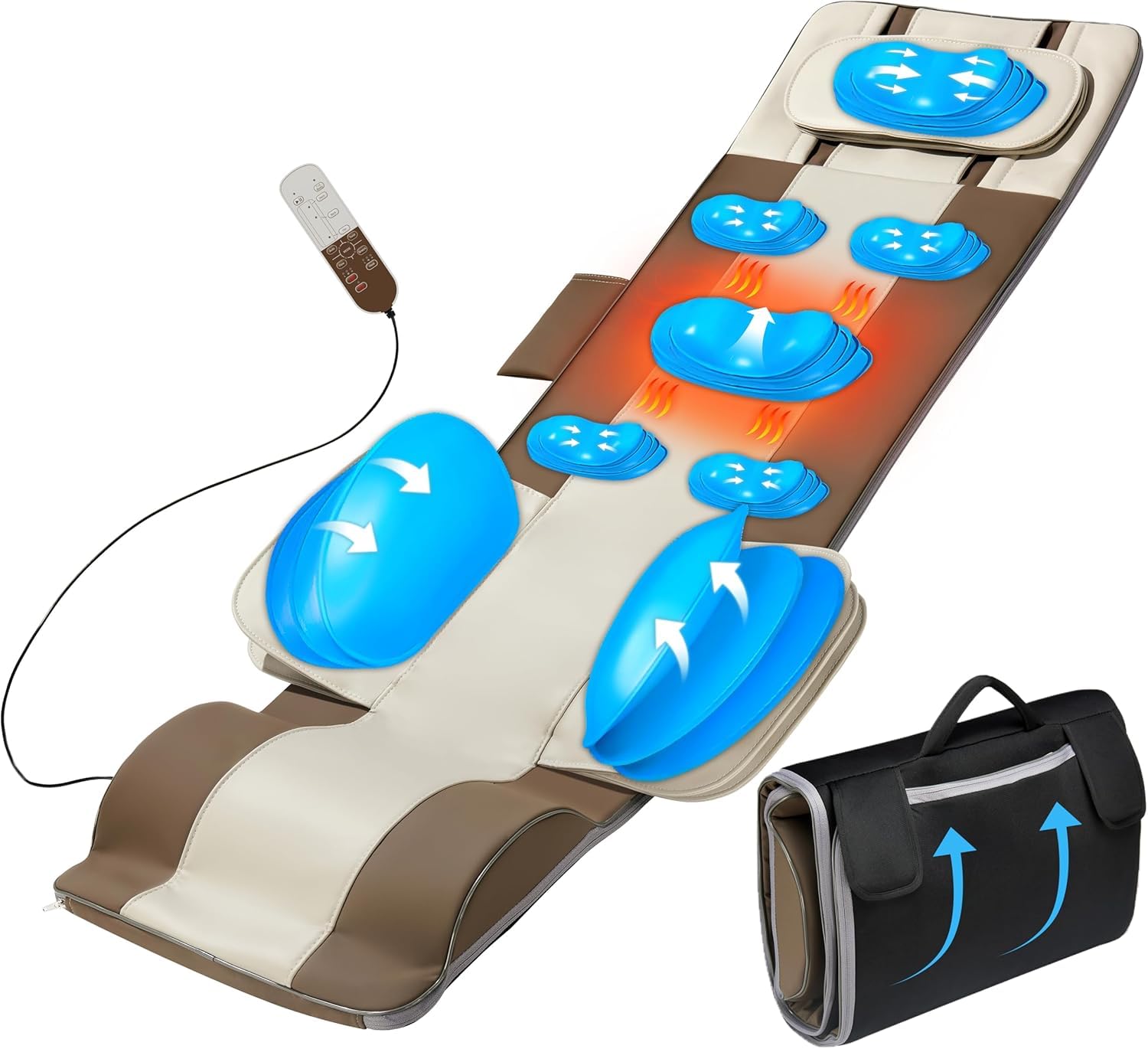
This mat uses airbag inflation to create three-dimensional movement—stretching your body upward, twisting side to side, and arching the lumbar curve. The stretching is gentle compared to a shiatsu roller but far more effective than a static foam block. The heat function reaches up to 149°F, which helps relax tight muscles before the traction sequence begins, making the decompression more effective for chronic tension.
The memory foam padding and PU leather cover make it comfortable enough for daily use on a bed, sofa, or floor. The controller is intuitive, offering four modes and three intensity levels. Users who spend eight hours at a desk find the combination of lumbar lifting and side twisting releases the SI joint stiffness that accumulates from prolonged sitting. The calf and thigh air compression pads provide a secondary benefit by reducing fluid retention in the legs.
Height compatibility is the main limiting factor—it works best for users between 5’1″ and 6’0″. Those at the taller end of the range may find the neck support doesn’t align perfectly. The unit is relatively quiet, but the air pump is audible during inflation cycles. The 20-minute auto shutoff is a welcome safety feature that prevents overuse, though some users wish the timer were longer.
Why it’s great
- Three-dimensional stretching provides dynamic decompression beyond static foam
- Three heat levels up to 149°F for muscle relaxation before stretching
- Foldable design with carry handle for easy storage and portability
Good to know
- Only fits users between 5’1″ and 6’0″ tall
- Air pump noise is noticeable during inflation cycles
- Not suitable for use on chairs or recliners
3. Comrelax Full Body Massage Mat with Airbags Stretching & Heating

This version of the Comrelax mat focuses on airbag-based stretching with 22 internal airbags that inflate and deflate to create a full-body traction experience. The lumbar lifting mechanism is notably strong—it can elevate your hips several inches off the surface, effectively decompressing the lower spine. The neck and hip airbags provide a gentle stretch that feels less aggressive than the 3D model, making it a better choice for users recovering from injury or with limited flexibility.
The PU leather surface is simple to clean and holds up well to daily folding and unfolding. The heating element sits specifically in the lumbar area and reaches three temperature levels. Users with sciatica report that the combination of lumbar lift, heat, and gentle twisting provides relief that persists for hours after a session. The adjustable pillow allows fine-tuning of the neck position, which improves the alignment of the stretch.
The height range is more restrictive than the 3D model—this unit fits users between 5’1″ and 5’9″. The leg massage function is noticeably lighter than the back segments, which some users find underwhelming. The twisting function can feel uncontrolled at higher intensities, so starting on the lowest setting is advisable. The three-year warranty provides solid peace of mind for a machine that uses moving parts and air seals.
Why it’s great
- 22 airbags create comprehensive full-body traction and stretching
- PU leather cover is easy to clean and durable for daily folding
- Three-year warranty offers strong long-term protection
Good to know
- Height limit of 5’9″ excludes taller users
- Leg airbag pressure is significantly lighter than back sections
- Twisting function may feel uncontrolled at higher intensity settings
4. HARISON Inversion Table for Back Pain Relief
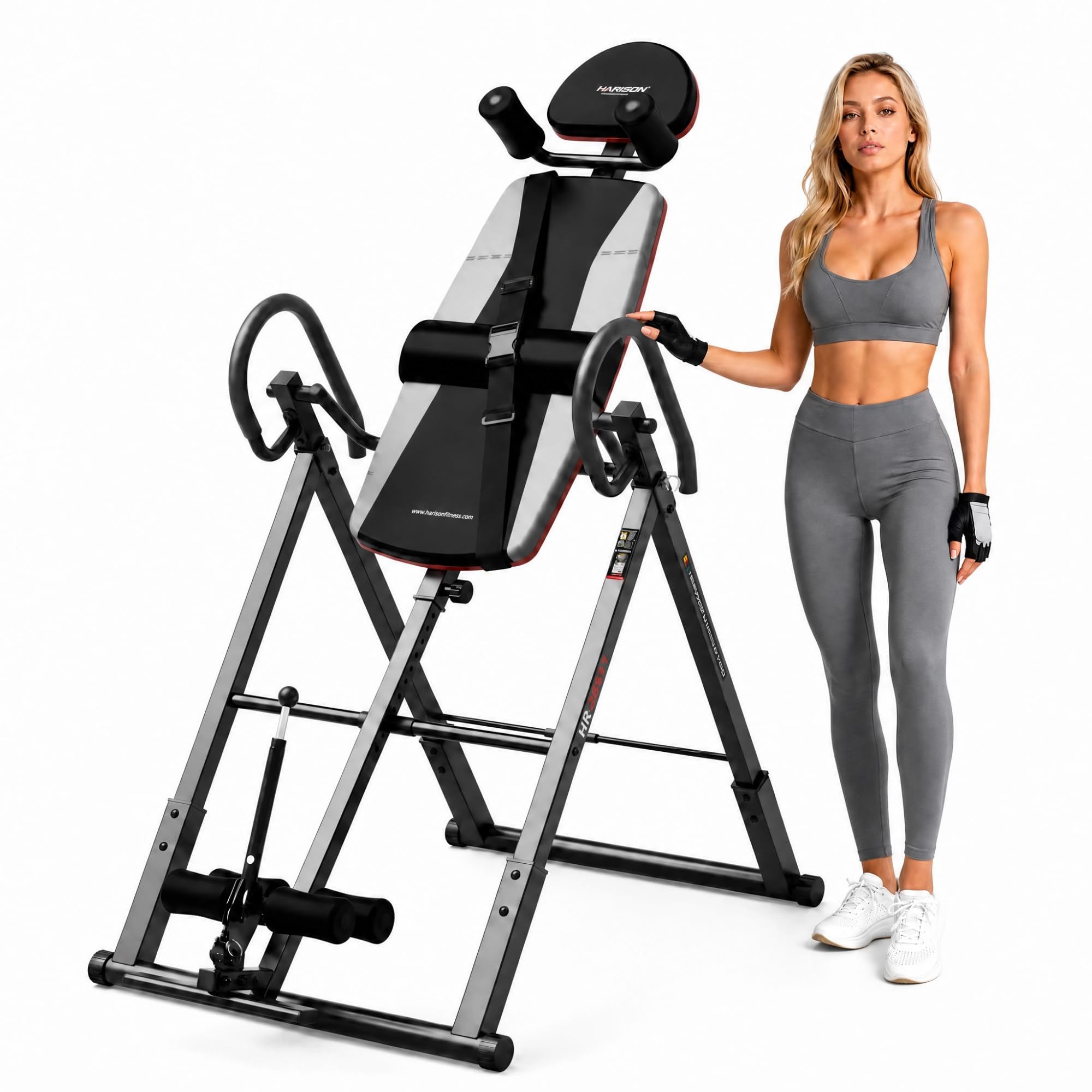
The HARISON inversion table uses gravity-based decompression to separate the vertebrae along the entire spine. The steel frame supports up to 350 pounds and provides a stable platform for inversion up to 180 degrees. The four-position side pin system lets you select your angle precisely—starting at 20 degrees for gentle decompression and progressing to full inversion as your tolerance builds. This is a different mechanism than foam or airbag stretchers, relying on your body weight rather than air pressure to create traction.
The ankle holders are ergonomically shaped to avoid pressure points, and the safety belt adds a layer of security that beginners appreciate. The backrest is padded with a 3D memory foam cover that provides comfort during prolonged sessions. Assembly requires about an hour, and the unit arrives 80% pre-assembled. Users over 6 feet tall report that the frame accommodates their height without issue, which is a common pain point with cheaper inversion tables.
The biggest trade-off is footprint and noise. The unit takes up significant floor space even when folded, and the metal construction is heavy at over 50 pounds. The inversion mechanism is smooth but not silent—you will hear the metal on metal as you tilt. Users with high blood pressure or glaucoma should consult a doctor before using inversion therapy. For those cleared to use it, the decompression effect is immediate and pronounced.
Why it’s great
- 350-pound steel frame provides stable, gravity-based spinal decompression
- Four-position side pins for precise angle control from 20 to 180 degrees
- Fits users up to 6’5″ with ergonomic ankle supports
Good to know
- Large footprint requires dedicated floor space even when folded
- Assembly takes approximately one hour with multiple steps
- Not safe for users with high blood pressure or glaucoma without medical clearance
5. Teclor Inversion Table for Back Pain Relief

The Teclor inversion table offers a solid steel frame with a 350-pound capacity at a price point that undercuts many competitors while still delivering functional inversion therapy. The backrest is wider and longer than many budget tables, measuring 30.3 inches long and 15.3 inches wide, providing full back support during inversion. The ratchet-style ankle closure system is straightforward and holds securely, which is critical for safety when hanging upside down.
The height adjustment mechanism accommodates users from 4’3″ to 6’8″, making it one of the most versatile options for households with multiple users of different statures. The folding frame reduces the storage footprint, though it still requires a wall or storage closet. Assembly is straightforward but takes about 45 minutes, and the instructions require some interpretation on the safety strap routing. The lumbar support pad lacks a hook-and-loop attachment, which means it can shift during use.
Users report that the table provides noticeable relief from lower back tension and sciatic pressure after just a few sessions. The padded foam on the ankle supports is comfortable for most, though larger users may feel the foam compressing more than expected. The safety belt works but feels less robust than more expensive units. For those who want to test whether inversion therapy works for them without a major financial commitment, this table delivers the core function effectively.
Why it’s great
- Wide backrest at 30.3 inches provides excellent full-spine support
- Height adjustment from 4’3″ to 6’8″ suits a broad range of users
- Folding frame reduces storage footprint for home use
Good to know
- Assembly instructions require careful interpretation on belt routing
- Lumbar pad lacks secure hook-and-loop attachment, can shift during use
- Safety belt feels less robust compared to premium inversion tables
6. RESTCLOUD Back Stretcher for Back Pain Relief

The RESTCLOUD back stretcher uses a dense polyurethane memory foam shaped into a C-curve that mirrors the natural lordotic curve of the lumbar spine. Unlike dynamic airbag units, this is a passive device—you lie on it for 5 to 10 minutes and let the foam gently stretch the lower back muscles and ligaments. The 16 massage bars and 8 massage nodes align along the paraspinal muscles, providing a light acupressure effect that enhances blood flow to the area.
The foam density is the key differentiator here. It is firm enough to hold its shape under body weight, unlike cheaper memory foam cushions that flatten completely and offer no stretch. The removable massage ball allows you to adjust the intensity—removing it reduces the arch for a gentler stretch, while inserting it increases pressure on specific trigger points. The foam is wrapped in a removable, washable blue cover that keeps hygiene manageable with daily use.
Users with spinal stenosis and sciatica report that regular use helps reduce referred pain down the leg by opening the lumbar neural foramen. The device is lightweight and portable, making it easy to use on the floor, a yoga mat, or even on a firm bed. The initial sessions can feel intense—the foam pushes firmly against the vertebrae—but most users adapt within a week. This is an entry-level solution that works best for mild to moderate back stiffness rather than acute disc conditions.
Why it’s great
- Specialized memory foam holds its C-curve shape under body weight for proper decompression
- Removable massage ball allows intensity adjustment for different comfort levels
- Lightweight and portable for daily use on floor or yoga mat
Good to know
- Passive design cannot match the dynamic traction of airbag or inversion systems
- Initial sessions may feel uncomfortably intense until the spine adapts
- Best suited for mild stiffness rather than herniated discs or acute conditions
FAQ
Can I use a back stretcher machine if I have a herniated disc?
How long should I use a back stretcher machine per session?
Is a back stretcher machine safe for older adults with osteoporosis?
Final Thoughts: The Verdict
For most users, the back stretcher machine winner is the Comrelax 3D Stretching Mat because its dynamic airbag system provides customizable full-body traction that outperforms static foam without the space requirements of an inversion table. If you want targeted clinical decompression for herniated discs, grab the Posture Pump 4100-D. And for gravity-based decompression that delivers immediate spinal relief, nothing beats the HARISON Inversion Table.