
Our readers keep the lights on and the weekend projects moving. As an Amazon Associate, I earn from qualifying purchases.
Lower back stiffness, sciatica flares, and the constant ache between your shoulder blades don’t just limit your mobility — they dictate your daily life. The right back stretching equipment can mean the difference between waking up stiff and starting your day feeling loose, aligned, and ready to move.
I’m Rikta — the co-founder and writer behind FitlyFast. I’ve spent years analyzing physical therapy device specs and decoding how spinal decompression mechanics, foam density, and node placement translate into real pain relief for readers dealing with herniated discs, spinal stenosis, and general back tightness.
Whether you need passive lumbar traction, a hyperextension bench for strengthening, or a full-length acupressure spine stretcher, this guide breaks down which back stretching equipment actually holds up to daily use and which specs separate real relief from gimmicks.
How To Choose The Best Back Stretching Equipment
Not all back stretchers work the same way. Some passively cradle your spine while you lie down, others require active effort on a hyperextension bench. The key is matching the device type to whether you need gentle decompression, deep acupressure release, or progressive strengthening.
Passive vs. Active Devices
Cushion-style stretchers (like the RESTCLOUD) are passive — you lie back and let the foam curve stretch your spine. They work best for daily maintenance and mild discomfort. Roman chairs (like the Marcy or SUCXDZQ) are active — you control the motion, which builds muscle support around the spine. If you have an acute injury, start passive. If you need long-term core and back strength, go active.
Node Pressure and Body Length
Acupressure spine stretchers use firm plastic or rubber nodes to dig into muscle knots. The Halo Spine Stretcher uses 24 tennis-ball-size nodes — effective but intense. Shorter users may find a 42-inch device covers their entire spine, while taller users above six feet need a full-length model to hit the lower back. If you’re sensitive to pressure, look for adjustable node height or removable massage balls.
Weight Capacity and Build Stability
For Roman chairs and hyperextension benches, check two numbers: your body weight relative to the weight limit, and the base footprint. A 250-pound capacity bench may wobble if the base is narrow. Foldable models save space but often sacrifice stance width. Foldable benches like the FITKS360 trade some base width for portability — steady, slow motion during reps keeps them planted.
Quick Comparison
On smaller screens, swipe sideways to see the full table.
| Model | Category | Best For | Key Spec | Amazon |
|---|---|---|---|---|
| RESTCLOUD Back Stretcher | Passive Cushion | Sciatica & herniated disc relief | Memory foam, 16 massage bars | Amazon |
| Lo-Bak TRAX (EZ-Bak) | Traction Device | Spinal decompression at home | Patented non-powered traction | Amazon |
| Halo Spine Stretcher | Acupressure Mat | Deep tissue & full spine release | 42-inch length, 24 massage nodes | Amazon |
| ProStretch CoreStretch | Multi-Position Stretcher | Upper back & shoulder flexibility | 360° rotating handles, 10 height settings | Amazon |
| Marcy Hyperextension Bench | Hyperextension Bench | Lower back strengthening | 308 lb capacity, iron frame | Amazon |
| FITKS360 Roman Chair | Foldable Bench | Space-saving home gym | 330 lb capacity, lifetime warranty | Amazon |
| SUCXDZQ Roman Chair | Dual-Adjust Bench | Angle & height optimization | Carbon steel, 275 lb capacity | Amazon |
In‑Depth Reviews
1. RESTCLOUD Back Stretcher

The RESTCLOUD uses a memory foam C-shaped curve designed to sync with your spine’s natural lordotic curvature. Eight massage nodes and sixteen massage bars run along both sides of the vertebrae — not directly on the bone — to relax paraspinal muscles and improve circulation. The foam compresses just enough to feel supportive without bottoming out, and the removable massage ball at the opening lets you dial in intensity from gentle to firm.
The manufacturer positions this as a daily 5-minute routine intended to help with posture and general back tightness, and markets it toward people dealing with sciatica-type discomfort and disc-related stiffness — though individual results vary and it is not a substitute for medical treatment. The 12.6 x 12.4 x 4-inch footprint is compact enough to slide under a couch or bed. Because it’s entirely passive, there’s no learning curve — lie back, breathe, and let the foam relax your erector spinae.
The foam is intentionally firm rather than soft, since a softer foam would compress too easily under body weight to hold a consistent stretch. Expect a break-in period before the firmness feels comfortable. If you have a diagnosed spine condition such as a herniated disc or spinal stenosis, talk to a doctor or physical therapist before adding this to your routine.
Why it’s great
- C-Shaped memory foam matches natural spine curve
- 16 massage bars target muscles alongside vertebrae
- Removable ball adjusts stretch intensity
Good to know
- Firm feel may require break-in period
- Not designed for upper back or neck stretch
2. Lo-Bak TRAX (EZ-Bak)

The Lo-Bak TRAX is a non-powered traction device that mimics the mechanical force of a professional decompression table by using your own body weight to gently separate the lumbar vertebrae. It’s a single-piece rigid plastic frame with padded contact points — no batteries, no pumps, no noisy motors. The patented shape lets you lie back and control the traction angle by shifting your hips, making it one of few at-home devices specifically targeting intradiscal pressure reduction.
The manufacturer markets this device for herniated discs, sciatica, and scoliosis-related compression, though anyone with a diagnosed spine condition should check with a physician or physical therapist before use. The included instructional DVD and bonus stretch DVD guide you through proper positioning and recovery habits like applying heat and hydrating after use. At just 2.5 pounds, it packs flat for travel.
The trade-off is that it addresses only the lumbar region, not the full spine. Some users report the padded surface feels less cushioned than foam-based alternatives, but the trade-off is a more direct, measurable traction effect. For chronic lower back compression that hasn’t responded to stretching alone, the Lo-Bak TRAX delivers targeted relief that passive cushions cannot replicate.
Why it’s great
- Mimics professional spinal decompression at home
- Lightweight and portable for travel
- Includes instructional DVD for proper form
Good to know
- Lumbar-only — does not address upper back
- Padded surface may feel firm for some users
3. Halo Spine Stretcher

The Halo Spine Stretcher spans 42 inches — long enough to cover the entire spine from the sacrum up through the thoracic region, including users over six feet tall. Twenty-four ergonomic massage nodes are positioned in two parallel rows to apply acupressure along the multifidus and erector spinae muscles. This is not a gentle stretch; the tennis-ball-size nodes deliver deep, targeted pressure that releases fascial adhesions and trigger points.
Ten minutes daily is the recommended starting point. Lying on the nodes feels intense initially — many new users drape a towel between their back and the device to ease into the pressure. Over time, the body may acclimate and the sensation can shift from uncomfortable to more tolerable. The manufacturer markets it for general back pain relief and mobility; if you have a serious spine condition, check with a doctor before using firm acupressure devices like this one.
The fabric sleeve is durable but not removable for washing, so placing a thin sheet over the device before use helps keep it clean. Because it’s a flat mat with no moving parts, there’s zero setup and no risk of mechanical failure. If you can tolerate firm acupressure, this is one of the most effective full-spine myofascial release tools available at this price tier.
Why it’s great
- Full 42-inch length covers entire spine
- 24 firm nodes for deep trigger point release
- No assembly, batteries, or maintenance
Good to know
- Very intense pressure — not for low-pain-tolerance users
- Fabric cover is not removable for washing
4. ProStretch CoreStretch

The ProStretch CoreStretch is an adjustable aluminum frame with cushioned pads for your forearms and a push-button height selector offering ten sizing positions. What sets it apart is the 360-degree rotating upper handles — you can stretch forward, twist side to side, or lean backward while maintaining a stable base. This multi-axis movement targets the lumbar spine, thoracic extension, hamstrings, hips, and even shoulder external rotation in a single device.
The manufacturer positions the CoreStretch as a physical-therapy-style tool, and its adjustable height lets users of different statures share the same device — but if you’re recovering from surgery or managing scoliosis, use it only under guidance from your physical therapist or physician. The collapsible frame folds flat for storage between a mattress and box spring or in a gym bag. At roughly 2.6 pounds, it’s one of the lightest full-body stretching tools available — ideal for traveling athletes who need to maintain hip and spine mobility on the road.
Some users find the quadriceps pads uncomfortable during longer holds, and the aluminum frame, while functional, does not feel as premium as steel alternatives. However, the combination of shoulder rotation capability and multi-plane back stretching makes the CoreStretch a unique pick for anyone whose tightness spans the entire posterior chain rather than just the lower back.
Why it’s great
- 360° rotating handles enable multi-axis stretching
- 10 height settings fit a wide range of users
- Folds flat for easy travel storage
Good to know
- Quad pads can feel firm during extended sessions
- Aluminum frame lacks heft of steel models
5. Marcy Adjustable Hyperextension Bench

The Marcy Adjustable Hyperextension Bench (model JD-3.1) is a hyperextension station built from heavy-duty iron tubing with a powder-coated finish and a 308-pound user capacity. It targets the posterior chain — lower back extensors, glutes, and hamstrings — through controlled forward bends and raises, and can also be used for ab and core work by flipping your position on the station.
The frame measures roughly 27.5 x 43.5 x 37.5 inches, with two adjustable, padded leg holders and high-density foam padding on the main support pad. Marcy is an established fitness equipment brand, and this bench carries a 4.4-star rating across thousands of verified buyer reviews on Amazon, with the listing showing strong recent sales volume.
At about 42 pounds, it’s heavier than compact folding benches, which generally means a sturdier, less wobbly base for hyperextension and reverse-hyperextension movements. Because it’s built as a stationary Roman chair rather than a folding travel unit, it suits a dedicated home gym corner better than a space where you need to put the bench away after each use.
Why it’s great
- 308 lb capacity and iron frame provide solid stability
- Established brand with a large, strongly-rated review base
- Doubles for ab, glute, and hamstring work beyond back extensions
Good to know
- Not a folding design — needs dedicated floor space
- At 42 lbs, less convenient to move between rooms than lighter benches
6. FITKS360 Roman Chair Hyperextension Bench
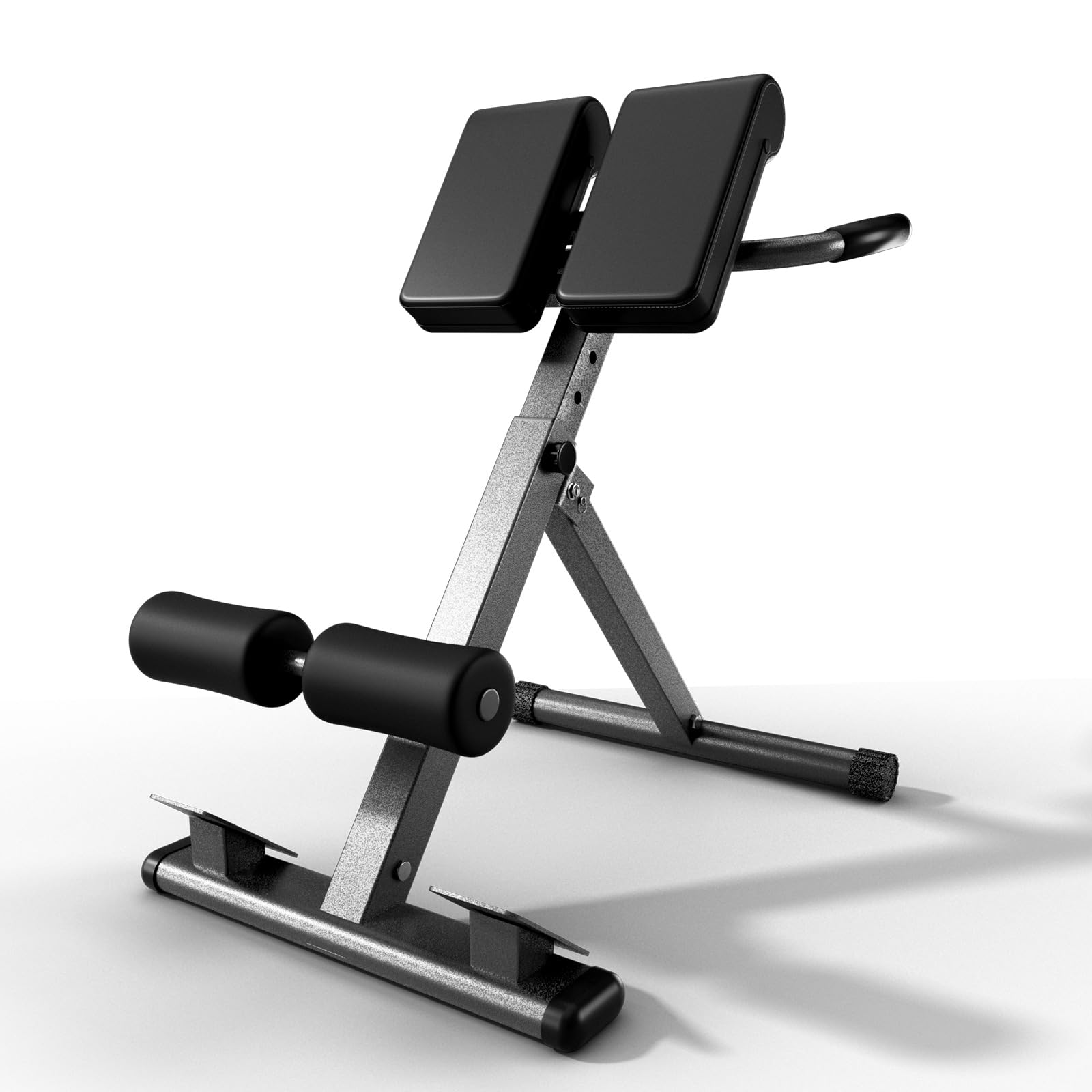
The FITKS360 Roman Chair supports up to 330 pounds and folds flat for storage, making it a strong pick for home gyms where floor space is at a premium. The frame uses alloy steel with padded foam rollers. Adjustment posts accommodate users from 5 feet to 6 feet tall, and the angle of the pad platform can be set to target slightly different segments of the back and glutes.
The lifetime warranty signals confidence in the build quality — a notable differentiator in this price tier where most benches carry only a one-year frame warranty. Assembly takes about 30 minutes, and the included tools are sufficient without needing external wrenches. The bench also works for decline sit-ups and push-up variations, adding versatility beyond back extension.
A foldable base is inherently narrower than a fixed one, so use slow, controlled motion rather than fast, ballistic reps to keep the bench stable during use. For standard controlled hyperextensions, the FITKS360 folds away when you’re done and stores compactly.
Why it’s great
- 330 lb capacity accommodates a wide range of users
- Folds flat for minimal storage footprint
- Lifetime warranty backs the build quality
Good to know
- Foldable base is narrower than a fixed-frame bench — avoid fast, ballistic reps
- Inspect the frame on arrival before assembly, as with any flat-packed equipment
7. SUCXDZQ Roman Chair Back Extender
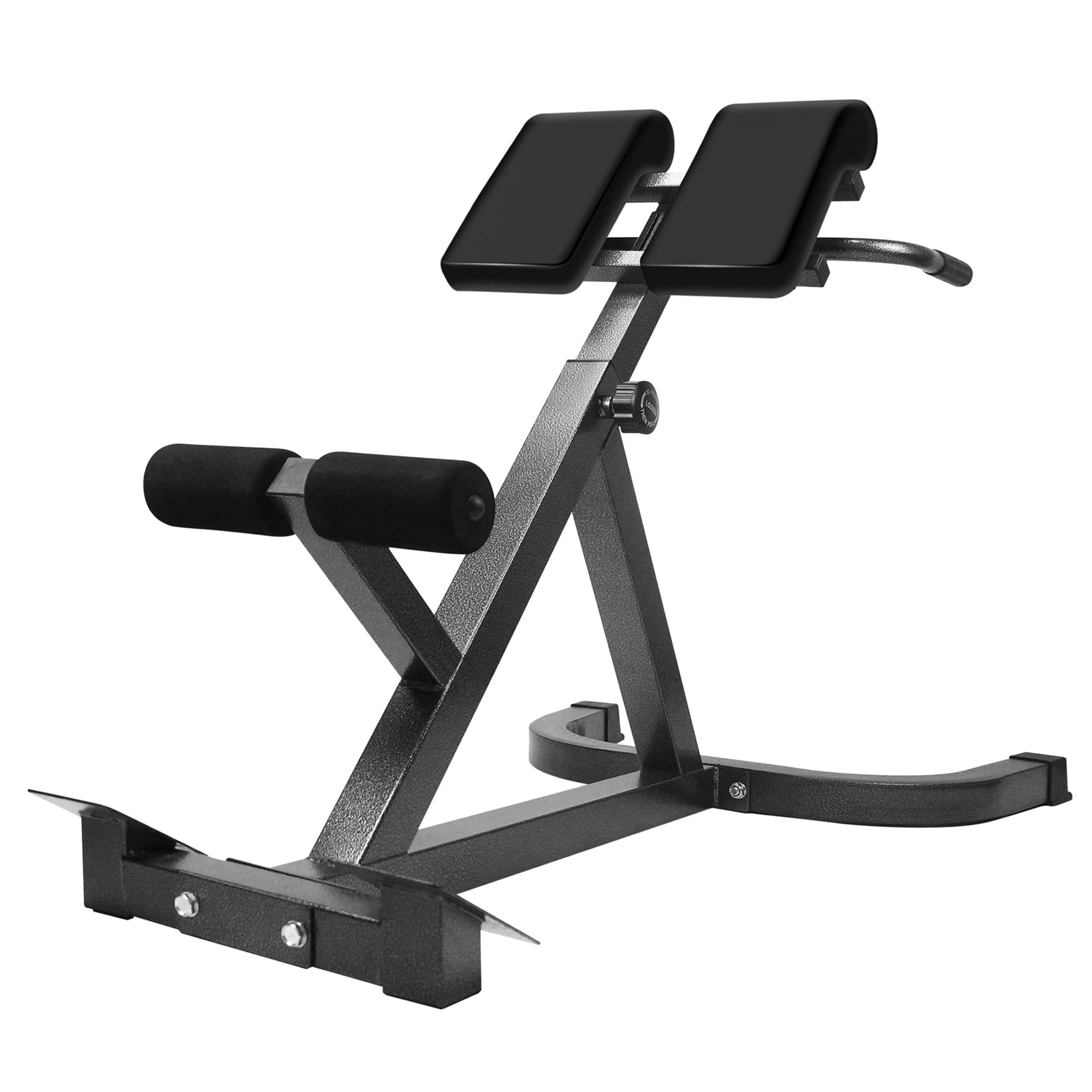
The SUCXDZQ Roman Chair offers dual adjustment — both the height of the hip pad and the angle of the foot platform can be set independently. This level of customization matters when you need to isolate specific portions of the erector spinae or shift emphasis toward the glutes. The 45-degree ergonomic design is standard for hyperextension, but the ability to fine-tune the angle lets you progress through different movement planes as you get stronger.
The frame uses high-strength carbon steel with an anti-abrasive coating rated to 275 pounds. Foam padding is thick enough for comfortable holds, and the compact 46 x 27 x 40-inch footprint fits into tight home gym corners. Assembly takes roughly 30 minutes, and all hardware is included with labeled parts.
The dual adjustment and coated steel frame make this bench a solid option for users who want precise ergonomic positioning for their back training. As with most flat-packed hyperextension benches, inspect the frame for shipping damage and double-check hardware against the included manual before assembly.
Why it’s great
- Independent height and angle adjustment for precise targeting
- Anti-abrasive carbon steel frame resists wear
- Thick foam padding supports extended sessions
Good to know
- Inspect packaging and hardware on arrival, as with any flat-packed bench
- Compact footprint means a narrower base than full-size gym equipment
FAQ
Can I use a back stretcher if I have a herniated disc?
How long should I lie on a back stretching cushion each day?
What is the difference between a lumbar traction device and a back roller?
Do Roman chairs help with sciatica nerve pain?
Final Thoughts: The Verdict
For most users, the back stretching equipment pick is the RESTCLOUD Back Stretcher because its memory foam C-shape delivers consistent passive spinal traction with adjustable pressure for daily posture and mild tightness maintenance. If you need deep acupressure release for full-spine myofascial tightness, consider the Halo Spine Stretcher. And for active strengthening of the lower back and glutes, the dual-adjust SUCXDZQ Roman Chair is a solid option for precise, progressive resistance training. As with any back-focused equipment, check with a doctor first if you have a diagnosed spine condition.