
Our readers keep the lights on and the weekend projects moving. As an Amazon Associate, I earn from qualifying purchases.
The moment a ridgeline or a canyon swallows your cell signal, the link to your group disappears. In the backcountry, a radio isn’t a gadget—it’s the difference between knowing your partner made the crossing safely and a long, silent wait at the tree line.
I’m Rikta — the co-founder and writer behind FitlyFast. I’ve spent countless hours dissecting transmitter power ratings, battery endurance figures, and waterproofing certifications across dozens of models to build a guide that focuses on what actually matters when you’re miles from the nearest road.
The goal is to cut through the exaggerated mile claims and find the units that deliver clear audio across real terrain. After filtering through specs and user field reports, this guide to the best backcountry radios lands on seven models that earn their place in an adventure pack.
How To Choose The Best Backcountry Radios
Picking a backcountry radio means matching power, durability, and battery life to how you actually move through the outdoors. A summit climber needs something different from a family group spread across a trail system. Here’s what separates a reliable field radio from a toy.
Power Output and Range Reality
The maximum range claim on the box is almost always measured over flat water with zero obstructions. In the backcountry, expect 1 to 5 miles depending on foliage, ridges, and weather. FRS radios are capped at 2 watts and require no license. GMRS radios can transmit at up to 5 watts, offering better penetration through dense forest and hills, but they require a simple FCC license that covers your entire family for ten years.
Battery Endurance in Cold Weather
Lithium-ion batteries lose capacity when temperatures drop below freezing. A radio that lasts three days in summer might die halfway through day two in winter. Look for a model with a replaceable battery or a high-capacity cell rated for cold performance. A radio with a 1800 mAh battery and low-power mode gives you a safety margin when the mercury plummets.
Durability and Weather Sealing
A backcountry radio will get rained on, covered in snow, and dropped on rocks. IP56 offers splash and snow resistance for most conditions. IP67 adds full dust protection and the ability to survive submersion in a meter of water for 30 minutes. A shatterproof display and a rubberized housing also matter when the radio bounces down a talus slope.
Quick Comparison
On smaller screens, swipe sideways to see the full table.
| Model | Category | Best For | Key Spec | Amazon |
|---|---|---|---|---|
| Rocky Talkie Expedition 5 Watt | Premium GMRS | Multi-day expeditions | 5W / 1800 mAh / IP67 | Amazon |
| Rocky Talkie Mountain Radio | Premium FRS | Alpine climbing | 2W / 1550 mAh / IP56 | Amazon |
| BTECH GMRS-PRO | Feature-Rich GMRS | Tech-savvy groups | 5W / 2600 mAh / IP67 | Amazon |
| BCA BC Link 2.0 | Snow-Sport FRS | Skiing and snowmobiling | 2W / 80 hr battery | Amazon |
| Midland T290VP4 | Mid-Range GMRS | Budget-conscious groups | 2W / 6x AAA | Amazon |
| Rugged Radios GMR2 Plus | Entry-Level GMRS | Off-road trail runs | 2W / Built-in Li-ion | Amazon |
| Eartec UL2S | Full-Duplex Headset | Close-proximity teams | DECT / 6 hr talk | Amazon |
In‑Depth Reviews
1. Rocky Talkie Expedition 5 Watt Radio
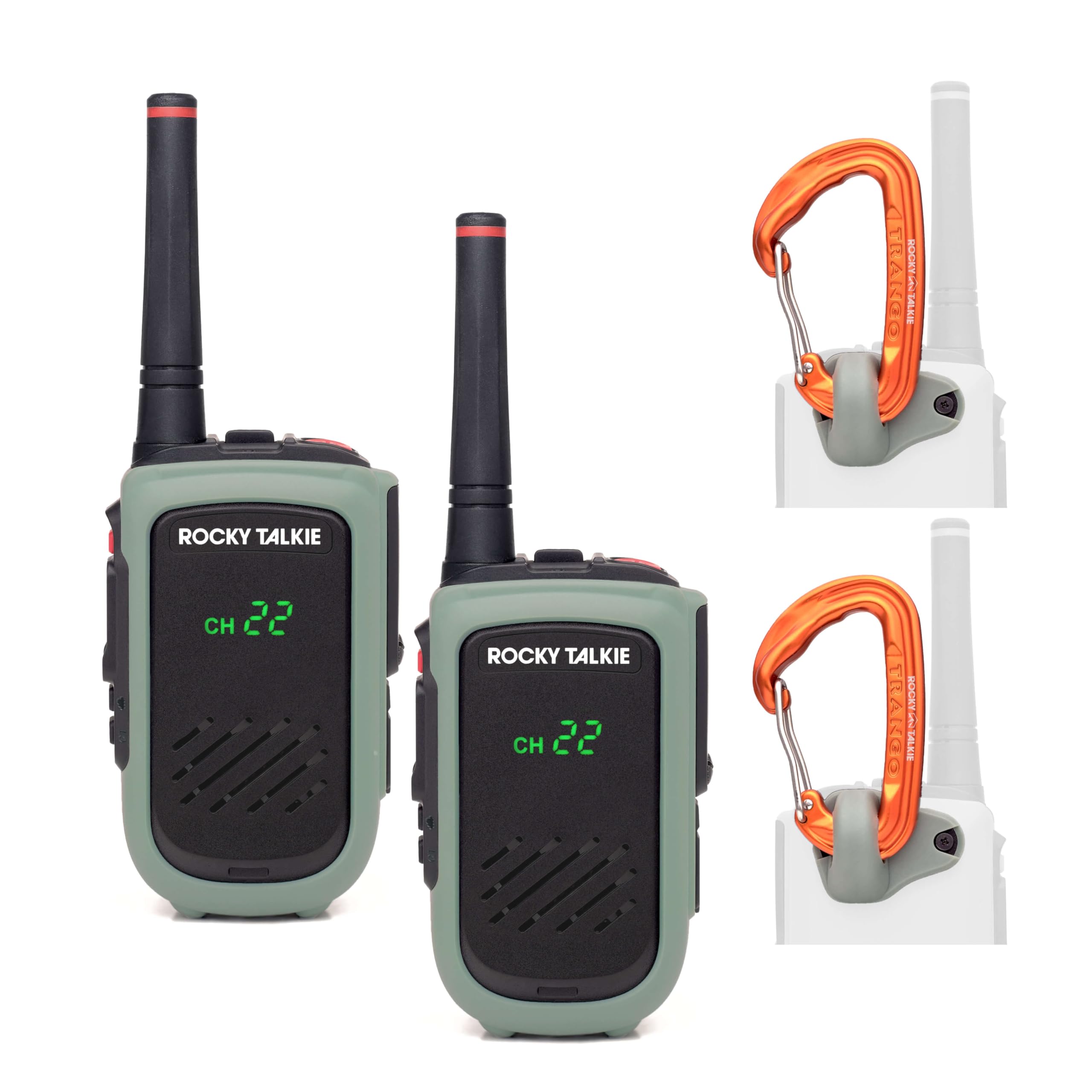
The Expedition delivers the maximum handheld GMRS power at 5 watts, paired with a removable antenna for upgrades and an 1800 mAh battery that field reports confirm lasts a full five days in cold weather. The IP67 rating means it survives accidental submersion in a creek or snowmelt, and the climbing-rated carabiner and steel-gator clip keep it secure on a pack strap or harness during a scramble.
In real-world use, testers report reliable communication across 2-3 miles of dense, flat timber and clear audio over several ridges in ski terrain. The dual-channel monitoring lets you scan for NOAA weather alerts while staying on your group channel, and the bright display remains readable in harsh sunlight. The build quality feels substantial without being heavy, and the steel-reinforced thermoplastic loop inspires confidence on exposed ridges.
The flip side is that you need a GMRS license ( for ten years, no test) to legally use the 5-watt power and repeater channels. The price is the highest on this list, but the combination of power, battery endurance, and genuine waterproofing justifies the investment for serious expedition users.
Why it’s great
- 5W output with upgradeable antenna for extended repeater range
- IP67 waterproof certified for full submersion
- 5-day battery life holds up in freezing conditions
Good to know
- Requires a GMRS license for legal operation
- Premium price point for a 2-pack
2. Rocky Talkie Mountain Radio
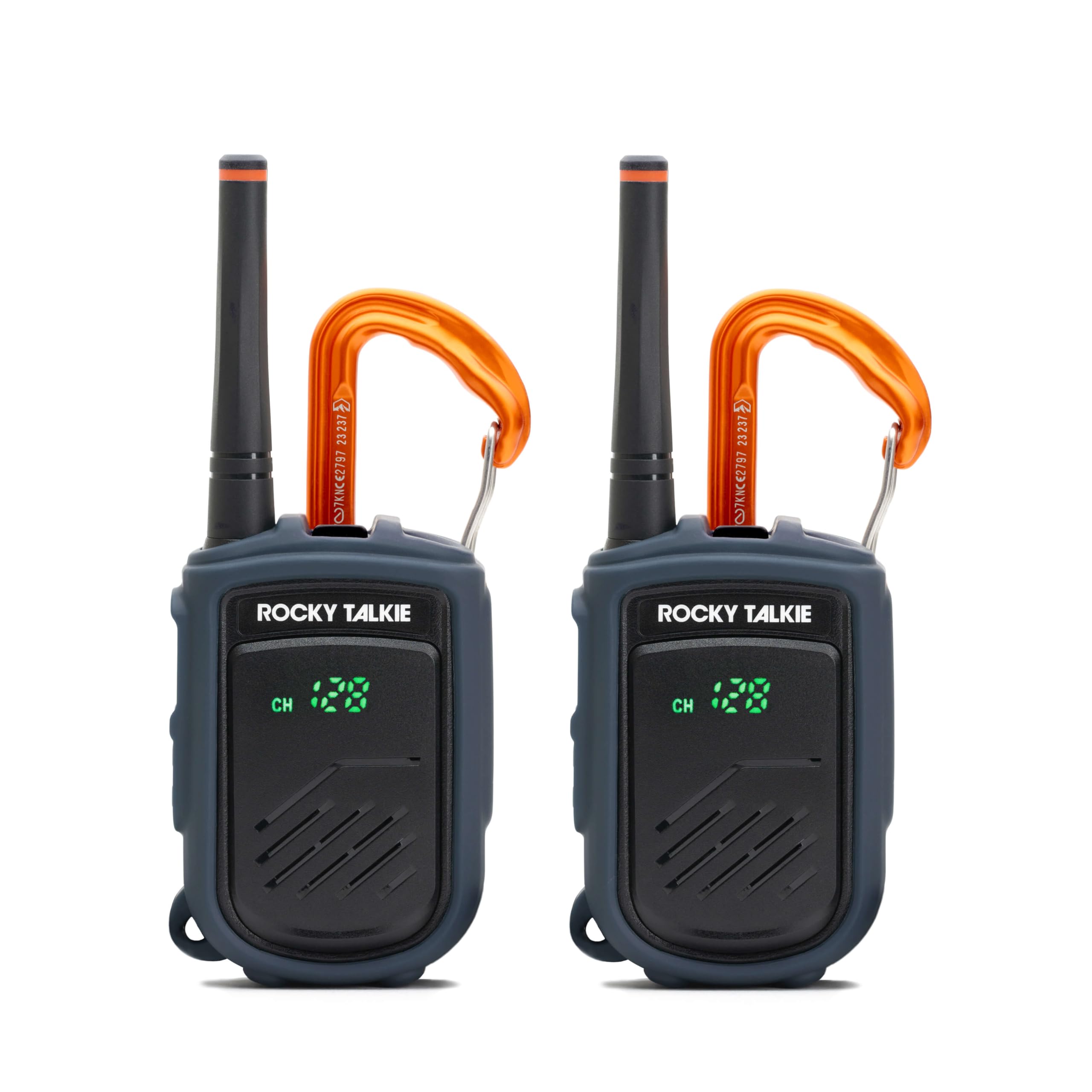
The Mountain Radio runs on FRS at the full legal 2-watt limit, which means zero licensing required. It uses a 1550 mAh lithium-ion battery that delivers a claimed four days of life—users regularly confirm three full days of hard use with power to spare. The shatterproof LCD screen and thermoplastic rubber armor give it the toughness to survive drops on granite, and the IP56 rating handles sustained rain and snow without issue.
The genius of this design is the attachment system. Instead of a plastic belt clip that snaps under tension, you get a climbing-rated carabiner and a metal-reinforced backup leash. Climbers and skiers use it to clip directly to a harness or pack loop with one hand. The five-button interface is intentionally simple, so you never have to scroll through menus with cold fingers. Range hits 1-5 miles in typical terrain and stretches over 25 miles on open water.
The catch is that you’re limited to 2 watts, which means less penetration through dense forest compared to a 5-watt GMRS unit. The battery is replaceable, but it’s proprietary to Rocky Talkie. If you want a no-license radio that’s purpose-built for alpine environments and doesn’t sacrifice durability, this is the leader.
Why it’s great
- License-free FRS operation simplifies group use
- Carabiner and steel leash prevent accidental loss on climbs
- Reliable 4-day battery life in cold conditions
Good to know
- Lower wattage than GMRS competitors
- Proprietary battery limits field replacement options
3. BTECH GMRS-PRO

The GMRS-PRO packs a 5-watt transmitter into a chassis that also manages Bluetooth pairing, GPS location sharing, and text messaging via a phone app. This is the only radio on the list that lets you send a text with your GPS coordinates to another user without a cell tower. The 2600 mAh battery provides a solid 14-hour runtime, and the IP67 rating seals it completely against dust and water.
The app integration is what sets it apart. You can program channels, sync contacts, and manage settings from your phone rather than wrestling with menu buttons. The GPS lets other users in your group see your position on a map, which is invaluable for spread-out hunting parties or trail running. Users consistently report hitting repeaters 20+ miles away with clear signal, and the NOAA scan locks onto the strongest weather channel quickly.
The downsides are mostly convenience-related. The belt clip is notoriously difficult to install without a magnetic screwdriver, and the scan function can lag. The build quality, while solid, doesn’t match the rugged armor of the Rocky Talkie units. For a group that values connectivity features and doesn’t mind some menu complexity, this is an exceptional mid-range option.
Why it’s great
- Bluetooth app integration for texting and GPS location sharing
- IP67 waterproofing and 2600 mAh battery
- Repeater-compatible for extended range beyond 20 miles
Good to know
- Difficult belt clip installation
- Menu interface has occasional lag in scanning
4. Backcountry Access BC Link 2.0

BCA built the BC Link 2.0 specifically for the snow sports crowd. The 2-watt FRS transmitter keeps it license-free, and the battery life is the standout spec here—up to 80 hours on a single charge, which translates to three or more days of riding without hunting for a charging cable. The rubberized housing and gold-plated accents aren’t just for looks; they help the radio survive repeated immersion in wet snow.
The interface is streamlined for use with gloves on. The large central knob and raised buttons are easy to manipulate even with thick mitts, and the audio output is loud enough to hear over wind and engine noise. The 22 channels plus 121 sub-channels give you plenty of privacy options in crowded resort-adjacent backcountry zones. Users on snowmobiles and in ski tours consistently praise the clarity and the fact that the radio doesn’t lose charge in single-digit temps.
The main complaints center on the micro-USB charging port—it’s outdated and can be finicky in the field. The lack of a frequency display or a dedicated antenna port limits advanced users who want to hook up an external antenna. For backcountry skiers and snowmobilers who prioritize battery life and cold-weather reliability above all else, this is the proven standard.
Why it’s great
- Industry-leading 80-hour battery life for multi-day trips
- Glove-friendly controls and loud audio in windy conditions
- Rugged build tested in snow immersion and vehicle rollovers
Good to know
- Uses micro-USB instead of modern USB-C
- No external antenna port for range upgrades
5. Midland T290VP4
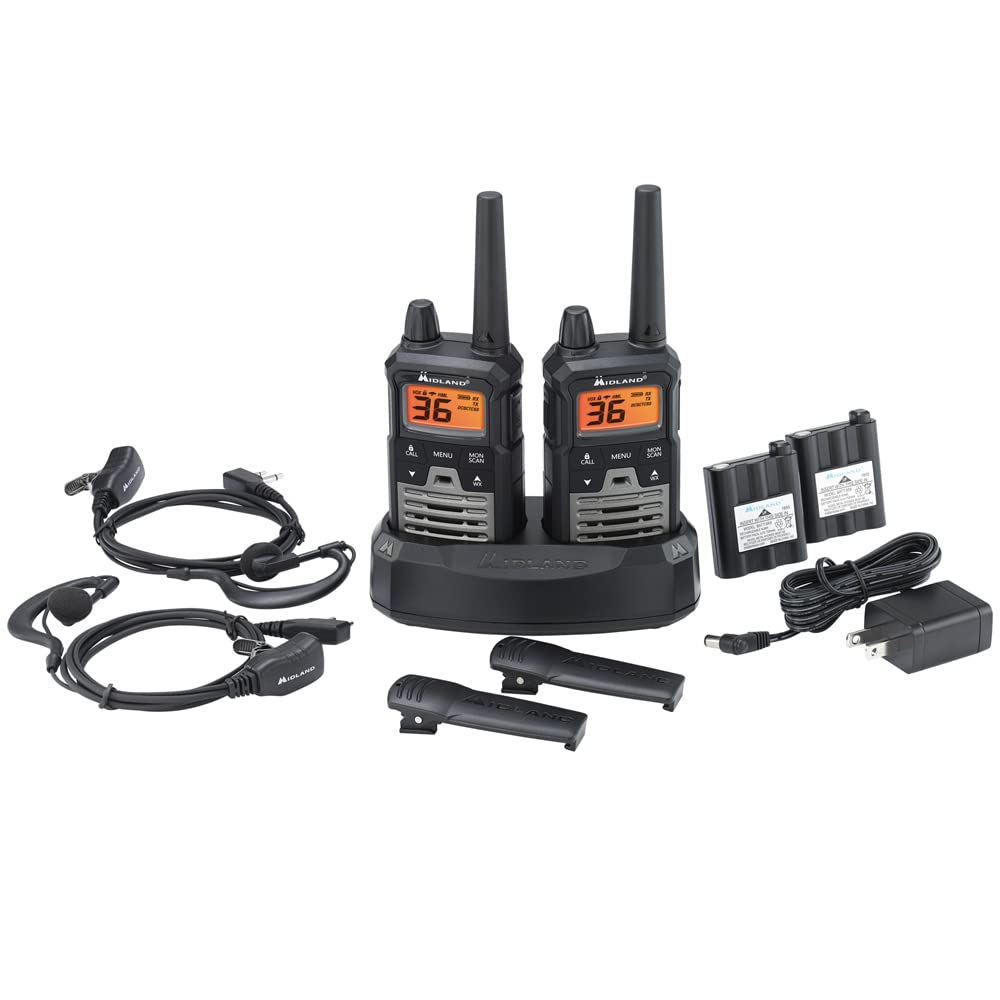
The T290VP4 is the most approachable GMRS radio on this list. It delivers roughly 2 watts of power and features 36 channels with 121 privacy codes to block out chatter. The NOAA weather scan is automatic—the radio locks onto the strongest weather band channel without any menu digging, and the alert function sounds a loud alarm if severe weather is detected in your area.
Users who tested this across mountain ridges in Moab report crisp, clear audio and a range that easily covers a mile over obstructions. The eVOX hands-free mode lets you transmit without pushing a button, and the flush buttons prevent accidental transmissions when the radio is stuffed in a pack pocket. The size is compact enough to slide into a hip belt, and it runs on 6 AAA batteries, which means you can carry spares without worrying about a proprietary charger dying.
The battery life on AAA cells is decent but not exceptional—expect to change them daily with heavy use. The 40-mile range claim is wildly optimistic for backcountry terrain; real-world performance tops out around 1-2 miles in hilly woods. If you want an affordable entry point into GMRS with reliable NOAA alerts and don’t need multi-day battery endurance, this is a solid choice.
Why it’s great
- Affordable entry into GMRS with NOAA weather alert
- Compact and lightweight, fits easily in a pack
- Runs on standard AAA batteries for easy field replacement
Good to know
- AAA battery life is limited compared to lithium-ion units
- Advertised range is unrealistic in forested terrain
6. Rugged Radios GMR2 Plus

The GMR2 Plus from Rugged Radios brings GMRS communication to a more accessible price tier without sacrificing the core features. It covers 22 GMRS channels with 121 privacy codes, and the bundled NOAA weather channels give you emergency weather access without an extra device. The included rechargeable lithium-ion battery, charging cradle, and belt clip make it ready for off-road duty right out of the box.
Field reports from the off-road community highlight the solid audio clarity and the build quality that holds up to dust and vibration. The intuitive button layout and easy-to-read LCD screen keep operation simple, and the built-in flashlight is a practical bonus for camp setups or vehicle repairs after dark. The universal compatibility with any GMRS/FRS radio means it works seamlessly with the radios your group already carries.
The main trade-off is the battery—it’s built-in and not user-replaceable, which means you need access to the charging cradle or a USB source for multi-day trips. The range is limited to about a mile in hilly terrain, so it works best for trail convoys and close-proximity groups rather than spread-out expeditions. For off-roaders and casual hikers who want a reliable GMRS radio at a budget-friendly price, this is a strong value.
Why it’s great
- Affordable GMRS radio with NOAA weather channels
- Clear audio and intuitive interface for simple operation
- Built-in flashlight adds utility for campsite tasks
Good to know
- Non-replaceable battery requires cradle charging
- Range is limited in dense or hilly terrain
7. Eartec UL2S Ultralite HD

The UL2S is a completely different tool from the handheld radios above. It’s a full-duplex wireless intercom headset system, meaning both users can speak and listen simultaneously—like a phone call, not a walkie-talkie. This is ideal for two-person teams working closely together, such as film crews, boat operators, or search-and-rescue pairs who need continuous, hands-free conversation.
The DECT 6.0 technology operates on a dedicated 1.9 GHz band that avoids interference from Wi-Fi and Bluetooth. The range hits 1,000 feet line-of-sight, and users report perfectly clear communication through concrete walls and over engine noise. The single-ear design keeps one ear free for environmental awareness, and the noise-cancelling microphone auto-mutes when pivoted upward. The system pairs instantly out of the box with no programming required.
The battery life is the main limitation at about 6 hours of talk time per charge, and the slave unit lacks a true on/off switch, requiring you to remove the battery to prevent drain. This system is not meant for general group coordination across a ridge. For teams that need real-time, hands-free communication within a close proximity, the UL2S is a professional-grade solution that outperforms traditional push-to-talk radios.
Why it’s great
- Full-duplex communication allows natural, simultaneous conversation
- DECT band avoids interference from Wi-Fi and other radios
- Single-ear design maintains situational awareness on site
Good to know
- Limited 6-hour talk time for extended missions
- Slave unit requires battery removal to power down fully
FAQ
Do I need a license to use backcountry radios?
Why does my radio lose range in the mountains?
What is the difference between FRS and GMRS radios?
How important is an IP waterproof rating for a backcountry radio?
Final Thoughts: The Verdict
For most users, the backcountry radios winner is the Rocky Talkie Expedition 5 Watt because it combines the highest legal handheld power with a cold-weather 5-day battery and full IP67 protection in a package purpose-built for the mountains. If you want a license-free, carabiner-clipped radio for alpine climbing, grab the Rocky Talkie Mountain Radio. And for tech-savvy groups who want GPS tracking and text messaging in the field, nothing beats the BTECH GMRS-PRO.