
Our readers keep the lights on and the weekend projects moving. As an Amazon Associate, I earn from qualifying purchases.
That stream you’re looking at might look crystal clear, but it’s a gamble. Making the wrong choice on a backcountry water filter means either drinking heavy chemical-tasting water, carrying a bulky pump, or worse—risking a gut-wrenching illness miles from the trailhead. The right filter disappears into your pack until you need it, then delivers clean water fast without a second thought.
I’m Rikta — the co-founder and writer behind FitlyFast. I’ve spent hundreds of hours analyzing the flow rates, micron ratings, filter lifespans, and field durability of these systems to cut through the marketing noise and give you a straight answer.
Whether you’re a thru-hiker, weekend warrior, or building an emergency kit, finding the best backcountry water filter comes down to matching your specific trip style to the right technology.
How To Choose The Best Backcountry Water Filter
Choosing your filter starts with knowing where you’re going. A weekend trip in the Sierras with known, clear creeks demands a different setup than a two-week international trek where you’re filling up from livestock troughs. The four key specs you need to understand are the filter’s micron rating, its media type, its flow rate, and its total capacity before replacement.
Micron Rating vs. Pathogen Removal
A 0.1-micron absolute filter is the gold standard. It traps bacteria (like E. coli and salmonella) and protozoa (like giardia and cryptosporidium) with high reliability. If you’re traveling to regions with viral risks (rotavirus, norovirus), you need a filter that either has a finer pore size or ships with chemical purification tablets. Most hollow fiber filters at 0.2 microns handle bacteria and protozoa but will let viruses pass through.
Filter Type: Squeeze, Gravity, Pump, or Bottle
Each form factor changes how you camp. Squeeze filters (like the Sawyer Squeeze or Platypus Quickdraw) force you to manually push water through—fast and light but requires a dirty bag and a clean bottle. Gravity systems (like the Katadyn BeFree 3L) hang from a tree branch and fill themselves while you set up camp—ideal for groups. Pump filters (like the MSR MiniWorks) are durable and field-serviceable but reward only the most patient users. Bottle-style filters (like the GRAYL UltraPress) offer the fastest per-serving speed but limit your water storage.
Filter Lifespan and Field Maintenance
Look for filters rated in thousands of liters, not hundreds. A higher capacity means fewer replacement cartridges over the years. More importantly, check if the filter can be backflushed in the field—a simple syringe or shake-to-clean mechanism that restores flow rate when it starts slowing down. Filters that require tools or disassembly to clean are harder to maintain during a long trip.
Quick Comparison
On smaller screens, swipe sideways to see the full table.
| Model | Category | Best For | Key Spec | Amazon |
|---|---|---|---|---|
| Platypus Quickdraw 1L | Squeeze/Gravity | Ultralight backpacking | 3 L/min flow rate, 95 g weight | Amazon |
| Katadyn BeFree 3L | Gravity | Group basecamps | 2 L/min gravity, 3L capacity | Amazon |
| Sawyer Squeeze System | Squeeze/Bottle | Versatility & lifespan | 0.1 micron, 100,000 gal capacity | Amazon |
| MSR TrailShot | Sip/Squeeze | On-the-go solo use | 1 L/min, 5 oz weight | Amazon |
| GRAYL UltraPress 16.9oz | Purifier Bottle | International travel | 10 sec filtration, removes viruses | Amazon |
| LifeStraw Personal | Straw Filter | Emergency & backup | 0.2 micron, 4,000L capacity | Amazon |
| MSR MiniWorks EX | Pump Purifier | Heavy-duty & disaster kits | 1 L/min, ceramic/carbon filter | Amazon |
In‑Depth Reviews
1. Platypus Quickdraw Ultralight 1 Liter System

The Platypus Quickdraw hits the sweet spot for most backpackers. At only 3.3 ounces, it’s among the lightest full filtration systems on the market, yet it delivers a remarkably fast 3 liters per minute when squeezed and a respectable 1.75 L/min when set up as a gravity system. The included ConnectCap threads directly onto standard 28mm soda or smartwater bottles—eliminating the need for a dedicated clean bottle and cutting your pack weight further.
Field cleaning is genuinely tool-free. A simple shake or backflush restores flow without needing a syringe, and the hollow fiber filter meets both NSF and EPA P231 standards for bacteria and protozoa removal. Users consistently report that the taste is better than the Katadyn BeFree, with only a minor chemical note during the first few liters that clears quickly.
The design is cleverly rugged. The wide mouth on the dirty reservoir makes filling from a shallow stream easy, and the secure flip-top cap and protective cover keep the clean side from contamination. One caveat: like all hollow fiber filters, the membrane cannot freeze, so you need to sleep with it in your bag during cold weather trips.
Why it’s great
- Exceptionally light at 3.3 oz with fast flow
- Universal bottle adapter saves buying extra bottles
- Tool-free cleaning with shake or backflush
Good to know
- Membrane is freeze-sensitive—must keep warm
- Squeeze flow is slightly slower than a dedicated gravity system
2. Katadyn BeFree Gravity 3L

The BeFree Gravity 3L is the ultimate handsfree solution for camp. You fill the collapsible bag, hang it from a tree branch or pole, and gravity does the rest—pushing water through the 0.1-micron EZ-Clean hollow fiber filter at up to 2 liters per minute. Users report filling a Nalgene in under 20 seconds during the filter’s prime, and the 3-liter capacity is perfect for two people at a basecamp.
Cleaning is as simple as swishing or shaking the filter in water—no disassembly, and no syringe required. Katadyn backs this with a nearly century-long reputation in water treatment. The 1,000-liter filter lifespan is lower than the Sawyer’s, but the tradeoff is the fastest gravity flow in this class and a packable form factor that flattens when empty.
Be aware that the bag itself is the weak point. The TPU material is lightweight, but multiple users report punctures if you’re not careful with it against sharp rocks or crampons. The fill opening is also a scoop-style mouth rather than a full rear opening, which can be annoying in shallow creeks.
Why it’s great
- True hands-free gravity operation sets up in seconds
- Fastest flow rate for a gravity system—2 L/min
- EZ-Clean membrane restores flow with a simple shake
Good to know
- Filter lifespan is 1,000L (less than squeeze competitors)
- Bag is somewhat prone to punctures from sharp gear
3. Sawyer Squeeze Water Filtration System

The Sawyer Squeeze is the standard by which all other backpacking filters are measured, and for good reason. Its 0.1-micron absolute hollow fiber membrane is thicker than typical hollow fiber walls, making it more durable and resistant to clogging. The insane 100,000-gallon capacity means you’ll probably replace your pack before you replace this filter—making it the most cost-effective option per trip in this lineup.
The included CNOC 2-liter bladder with a wide-mouth opening makes filling from any source quick, and the system weighs under 6 ounces. It’s versatile enough to use as a squeeze filter directly into a bottle, or as a gravity system when hung. Every unit is individually tested three times to performance standards at the factory, and the cleaning syringe is included for easy backflushing in the field.
Flow rate out of the box is slower than the Platypus Quickdraw—users note it can be sluggish initially, but it speeds up after a few uses. The taste is neutral, and the filter handles everything from mountain streams to tap water in developing countries. Sawyer also has a strong humanitarian mission, donating filters to communities without clean water access.
Why it’s great
- Ultra-long 100,000-gallon filter lifespan
- 0.1-micron absolute rating for reliable protection
- Doubles as squeeze or gravity system with included bladder
Good to know
- Initial flow rate is slower than some competitors
- Requires syringe cleaning for best long-term flow
4. GRAYL UltraPress 16.9 oz
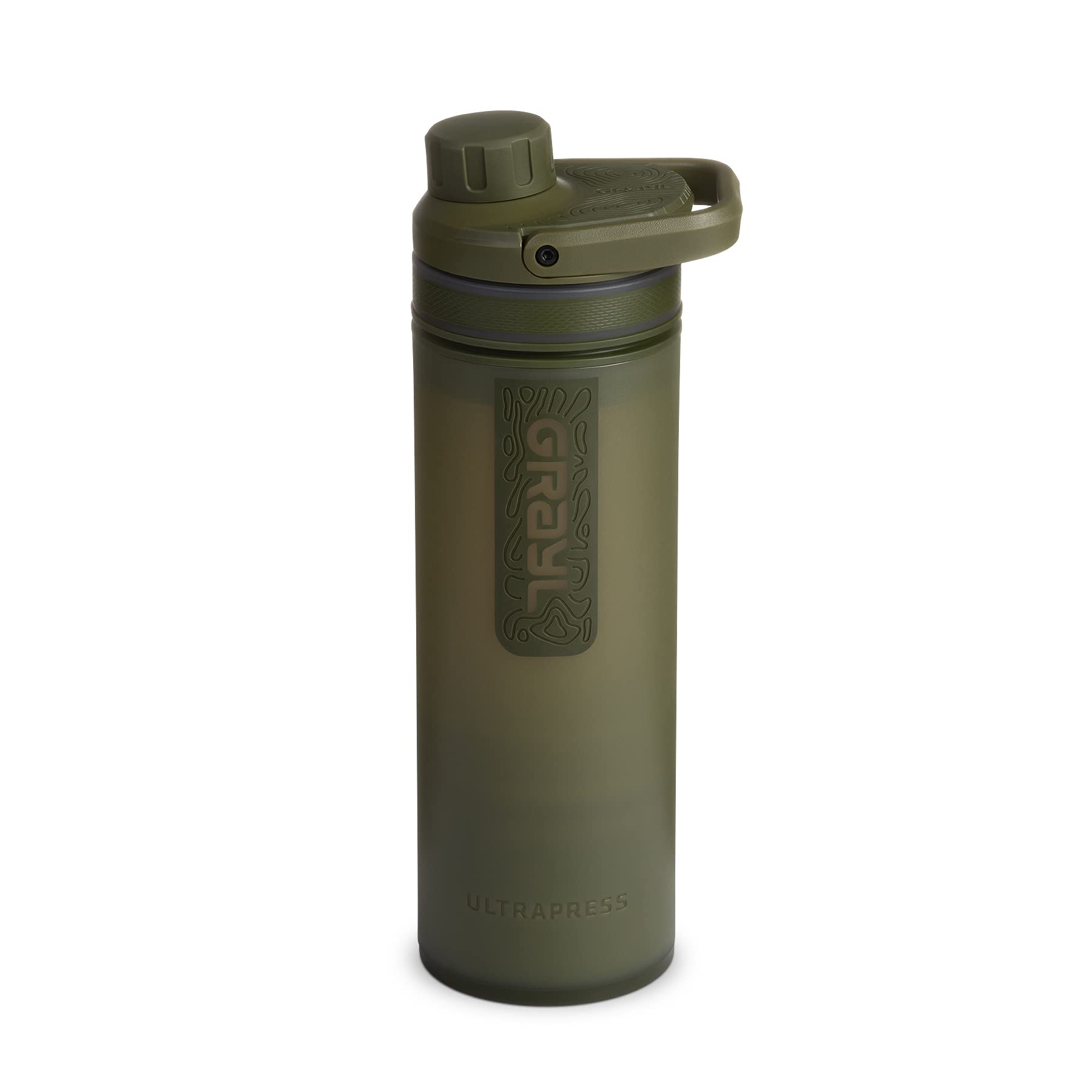
The GRAYL UltraPress is the speed king. Fill the outer cup from any source—river, faucet, even a puddle—then press the inner plunger down, and in roughly 10 seconds you have 16.9 ounces of purified water. This is a true purifier, not just a filter. It removes 99.9% of viruses (rotavirus, norovirus, hepatitis A), 99.9999% of bacteria, and 99.9% of protozoan cysts, along with particulates, microplastics, VOCs, PFAS, and heavy metals via its activated carbon core.
This makes it the only device in this list suitable for international travel to regions with viral contamination in the water supply. The one-way drink mix valve also allows you to add electrolyte powders without compromising the clean side. The BPA-free polypropylene body is robust and fits in a standard backpack side pocket.
The catch is the 16.9-ounce per-press capacity—you’ll need multiple presses to fill a larger hydration bladder. The unattached drinking cap is also a common complaint; it’s easy to misplace. Users also note that the filter can leak if laid on its side until the inner components break in. Despite these quibbles, for someone who values absolute viral protection and speed per serving, this is an unbeatable travel companion.
Why it’s great
- Fully purifies water including viruses in 10 seconds
- Adsorbs heavy metals, PFAS, and VOCs via carbon
- Compact bottle form fits in standard pack pockets
Good to know
- Only 16.9 oz per press—not ideal for group use
- Drinking cap is unattached and easy to lose
5. MSR TrailShot

The MSR TrailShot is designed for the soloist who wants to drink directly from the source or fill a bottle without wrestling with a separate dirty bag. At 5 ounces and 6 inches long, it’s compact enough for a hip holster or stash pocket. The one-handed squeeze operation filters a liter in about 60 seconds, and the included intake hose lets you reach into shallow streams without dunking the whole unit.
The hollow fiber technology removes 99.9999% of bacteria and 99.9% of protozoa, with a 2,000-liter filter lifespan. Backflushing in the field is simple—no syringe required—and users consistently praise how fast the flow stays even after multiple trips. The water taste is generally described as neutral, with some noting it actually improved the flavor from cold mountain sources.
The rubber intake hose is the only notable weak point—it can nick against sharp rocks, and there’s no dedicated storage sack included. The hose length also isn’t long enough to comfortably sit and filter from a deeper pool, but for quick pit stops on a trail run or day hike, it’s the most convenient option in this list.
Why it’s great
- One-handed operation for direct drinking or bottle fill
- Ultra-compact at 5 oz for trail running
- Easy field backflush without tools
Good to know
- Rubber intake hose can nick on rocks
- No dedicated storage bag included
6. LifeStraw Personal Water Filter (4-Pack)

The LifeStraw is the original personal sip filter and remains the best choice for emergency preparedness and backup use. This four-pack gives each family member their own straw, with each unit rated for an incredible 4,000 liters (1,000 gallons) of filtered water. The microfiltration membrane removes 99.999999% of bacteria and 99.999% of parasites, plus microplastics down to 1 micron.
At only 0.1 pounds per straw, it virtually disappears in a pack or emergency kit. It requires no pumping, no bottle threading, and no batteries—you simply stick the bottom end into the water and sip. LifeStraw also operates a charitable program where every purchase provides a school child safe drinking water for a school year.
The major limitation is that it’s a straw—not a water storage or bottle-filling device. You cannot filter large quantities for cooking or group use, and it’s inconvenient to use with hydration bladders. It also does not improve taste, and some users report a mild plastic flavor initially. For its intended use as an emergency lifeline or a solo emergency backup, it’s unmatched in simplicity.
Why it’s great
- Ultra-light at 0.1 lb per straw
- Massive 4,000-liter filter lifespan per unit
- No moving parts—always works when you need it
Good to know
- Straw-only design—can’t fill bottles or cook
- Does not improve taste or remove chemical odors
7. MSR MiniWorks EX Purifier

The MSR MiniWorks EX is the choice for the backcountry traditionalist who values durability above all else. This pump-style purifier uses a replaceable ceramic and carbon element that removes bacteria (99.9999%), protozoa (99.9%), and organic compounds while improving taste. The included 50 Aquatabs provide viral protection, making this a complete water treatment solution for areas with unknown contamination.
The ceramic element is field-serviceable—you can scrub it clean to restore flow without needing a spare cartridge. The pump body is built like a tank; one user reported it surviving a 50-foot drop onto rock (only the ceramic broke, and it was replaceable). The 2,000-liter filter lifespan is solid, and the pump head threads onto standard wide-mouth Nalgene bottles for a secure seal.
The tradeoff is weight and speed. At 1 pound and pumping at roughly 1 liter per minute, it’s the heaviest and slowest option in this list. It’s overkill for a fast-and-light trip, but for a basecamp or disaster preparedness kit where you’re willing to carry weight for absolute reliability, the MiniWorks EX is the most field-serviceable system available.
Why it’s great
- Field-serviceable ceramic element can be scrubbed
- Includes chemical tablets for full viral protection
- Extremely durable build—survives serious abuse
Good to know
- Heavy at 1 lb and slow at 1 L/min
- Overkill for ultralight or fast-moving trips
FAQ
Can a backcountry water filter remove viruses?
How do I clean a hollow fiber filter in the field?
What does “0.1 micron absolute” mean for a water filter?
Can my water filter freeze, and how do I protect it?
Final Thoughts: The Verdict
For most users, the best backcountry water filter winner is the Platypus Quickdraw 1L because it combines the lightest weight with the fastest flow rate in a versatile squeeze-or-gravity system that cleans in seconds without tools. If you need a group-ready gravity setup that runs itself while you pitch camp, grab the Katadyn BeFree 3L. And for international travel where viral protection is non-negotiable, nothing beats the speed and purification power of the GRAYL UltraPress.