
Our readers keep the lights on and the weekend projects moving. As an Amazon Associate, I earn from qualifying purchases.
A wet shower pan that fails within a year is the kind of nightmare that starts with saving a few dollars on the waterproofing layer. The membrane or sheet you place between the cement board and the tile dictates whether your renovation ends with a dry, solid floor or a slow, ceiling-destroying leak. This guide breaks down the materials, thicknesses, and installation realities so you pick the right barrier for your specific build.
I’m Rikta — the co-founder and writer behind FitlyFast. I’ve spent countless hours cross-referencing manufacturer spec sheets, analyzing customer installation photos, and comparing the real-world performance data of every tile underlayment and waterproofing membrane on the market to build this focused guide.
The right material creates an impenetrable seal against moisture and vapor, and after a deep dive into tensile strength, fleece adhesion, perm ratings, and seam overlap requirements, I’ve assembled the definitive list of the best backer board for shower waterproofing solutions available today.
How To Choose The Best Backer Board For Shower
Selecting the right waterproofing layer for your shower backer board involves understanding three core variables: the application method (sheet vs. liquid), the material thickness, and the specific bond requirements of your tile substrate. The wrong choice leads to delamination, thinset failure, or hidden water migration behind the tile.
Sheet Membrane vs. Liquid-Applied Membrane
Sheet membranes like Schluter Kerdi and the MAXWAVE uncoupling fabric provide a uniform thickness barrier that is physically separate from the substrate. They excel in large, flat areas and provide inherent crack isolation. Liquid-applied membranes, such as RedGard and USG DUROCK, form a monolithic, seamless layer that bonds directly to the backer board, making them superior for complex corners, niches, and around plumbing penetrations where sheet overlaps can fail. Your choice depends on whether you prioritize speed on flat walls or foolproof sealing around irregular shapes.
Thickness and Permeability Rating
Thickness is measured in mils (thousandths of an inch). Standard entry-level sheet membranes are around 8 mils thick, while premium or heavy-duty rolls and liquid-applied products can reach 20 to 30 mils. A thicker membrane offers higher tear resistance and better vapor retardation. The permeability rating (perms) tells you how much water vapor passes through. For a standard shower, a rating under 1.0 perm is ideal. For a steam shower, you need a true vapor retarder with a rating below 0.1 perms, which necessitates a thicker, dedicated sheet membrane or a liquid system applied at a specific dry film thickness.
Fleece Anchoring and Thinset Compatibility
Sheet membranes rely on a non-woven polypropylene fleece layer on both sides. This fleece locks into the unmodified thinset mortar. The density and quality of this fleece directly affect the peel strength of the bond. A weak fleece can separate from the polyethylene core during troweling, leading to air pockets and water channels. Always confirm that your chosen membrane is explicitly compatible with the specific brand of thinset you plan to use, as some modified thinsets require a curing period that can be disrupted by the membrane’s vapor retardance.
Quick Comparison
On smaller screens, swipe sideways to see the full table.
| Model | Category | Best For | Key Spec | Amazon |
|---|---|---|---|---|
| Schluter Kerdi | Sheet Membrane | Premium vapor barrier | 8 mil PEVA core, 108 sq ft | Amazon |
| RedGard | Liquid-Applied | Seamless corner application | 1 gallon, multiple coats | Amazon |
| USG DUROCK Liquid | Liquid-Applied | Low perm rating (0.38 perms) | 20 mil dry thickness | Amazon |
| Muzata Membrane | Uncoupling Sheet | Wide coverage, fewer seams | 23.6 mil thick, 125 sq ft | Amazon |
| Laticrete Fabric | Reinforcement Fabric | Crack isolation up to 1/8″ | 37.5 sq ft roll | Amazon |
| MAXWAVE Uncoupling | Uncoupling Sheet | High-volume projects | 20 mil, 212.5 sq ft roll | Amazon |
| UCANVIN Band Roll | Seam Tape | Economical seam sealant | 30 mil thick, 5″ x 98.5 ft | Amazon |
In‑Depth Reviews
1. Schluter Kerdi Membrane

The Schluter Kerdi system is the gold standard in bonded sheet waterproofing. Its modified polyethylene core is sandwiched by a dense, non-woven polypropylene fleece that locks aggressively into unmodified thinset. At 8 mils, it’s not the thickest option, but the consistency of the manufacturing process and the quality of the fleece bond means you get a uniform, vapor-retardant barrier that has been proven in thousands of wet-area installations over decades.
Installation demands attention to detail — you must use a specific unmodified thinset and properly overlap seams by at least 2 inches. The included 33-foot length covers a standard shower stall with exactly enough material to wrap corners and the shower pan. The 10-year limited warranty against manufacturing defects provides additional peace of mind when building a high-end custom shower.
Where Kerdi truly shines is in steam shower applications where a low perm rating is non-negotiable. The sheet form eliminates the risk of pinholes that can plague liquid-applied membranes, making it the preferred choice for contractors who require absolute vapor control. The trade-off is a steeper learning curve compared to paint-on systems.
Why it’s great
- Industry-standard vapor retardant performance
- Dense fleece provides superior thinset bond
- Backed by a 10-year manufacturer warranty
Good to know
- Requires specific unmodified thinset for proper installation
- Thin at 8 mils, less tear-resistant than thicker options
- Higher cost per square foot than generic alternatives
2. RedGard Waterproofing

RedGard is the most widely recognized liquid-applied membrane for a reason. It goes on as a bright red liquid using a roller or brush, and cures into a flexible, monolithic rubber-like layer that bonds directly to cement backer board. The ability to see your coverage (red means done) eliminates the guesswork of whether you missed a spot — a critical advantage for DIYers and pros alike.
You need multiple coats to reach the necessary dry film thickness. For a standard shower, three coats applied with a 3/8-inch nap roller are typically sufficient, and the total dry time is about 24 hours before tiling. Because it forms a seamless membrane, water cannot migrate through corners, niches, or around plumbing protrusions where sheet membrane overlaps might fail.
The workable pot life is generous, and the material cleans up with water before it cures. It is compatible with cement backer board, existing tile, and even plywood. The cured membrane is tough enough to resist minor substrate movement, though it does not provide the same level of crack isolation as a dedicated sheet system over large gaps.
Why it’s great
- Monolithic, seamless waterproofing layer
- Visual coverage indicator with bright red color
- Easy application with standard roller or brush
Good to know
- Requires multiple coats, increasing total dry time
- Not a true vapor retarder for steam showers
- Can stain clothing permanently if not handled carefully
3. USG DUROCK Liquid Waterproofing
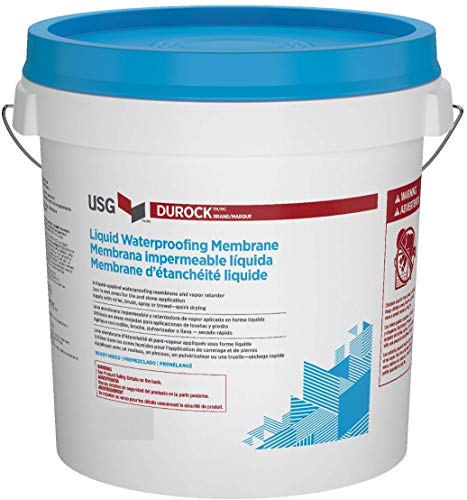
USG DUROCK Liquid Waterproofing Membrane delivers a low perm rating of 0.38 perms at a 20-mil dry thickness, a spec that rivals many sheet membranes. This makes it one of the few liquid-applied systems that can legitimately function as a vapor retarder, giving you the seamless application of a liquid with the vapor control of a dedicated sheet product.
Application can be done by rolling, brushing, or troweling, and the fast-drying formula allows a second coat in as little as 2 to 4 hours under normal conditions. A gallon covers approximately 75 square feet at the recommended 20-mil dry thickness, which is adequate for a standard shower alcove. The anti-fracture capability handles cracks up to 1/8-inch, protecting the tile from shrinkage cracks in the substrate below.
User reports consistently praise the ease of application and the lack of strong odor during curing. The material is thicker than some competing liquids, so a roller is strongly recommended over a brush for even distribution. The trade-off is that the thicker formulation requires slightly more effort to spread across the backer board.
Why it’s great
- Low perm rating (0.38 perms) suitable for vapor control
- Fast drying time between coats
- Roller, brush, or trowel application flexibility
Good to know
- Thicker consistency requires more effort to spread
- Coverage is lower than standard liquid membranes per gallon
- Must achieve full 20 mil dry thickness for perm rating
4. Muzata Waterproofing Membrane

The Muzata membrane comes in a 3.77-foot-wide roll, making it substantially wider than the standard 3.3-foot Kerdi roll. This extra width translates to fewer seams and less overlap work when covering large backer board surfaces. At 23.6 mils thick, it is nearly three times the thickness of basic 8-mil sheet membranes, providing exceptional tear resistance during installation and long-term durability.
The high-density polyethylene material cuts easily with standard scissors and folds neatly into inside corners, eliminating the need for separate corner pieces. The fleece layer is designed to bond with standard modified thinset mortars, though some users have noted the fleece can be slightly less dense than the Kerdi equivalent. Using a quality, well-mixed thinset mitigates this concern.
At 125 square feet per roll, this membrane covers a larger shower floor and walls in fewer pieces, speeding up the overall installation. The extra thickness also provides better protection against punctures from dropped trowels or sharp tile edges that can occur during the tiling process. This is a strong mid-range alternative for anyone wanting thicker material without the premium price.
Why it’s great
- Wider roll (3.77 ft) reduces seam count
- Substantial 23.6 mil thickness resists punctures
- Easy to cut and fold into corners
Good to know
- Fleece density may be lower than premium brands
- Requires careful thinset selection for optimal bond
- Additional overlap tape needed for large seams
5. Laticrete Waterproofing Fabric

The Laticrete Anti-Fracture Fabric Membrane is not a standalone waterproofing sheet. It is a reinforcement fabric designed to be embedded within a liquid-applied membrane like Laticrete Hydro Ban, RedGard, or other elastomeric coatings. Its primary job is to span and isolate cracks up to 1/8 inch while adding tensile strength to the liquid membrane at joints and corners.
Users consistently report that this fabric works flawlessly when used with compatible liquid systems. The white, non-woven fabric absorbs the liquid membrane on both sides, creating a reinforced, monolithic barrier that is stronger than either component alone. It is particularly effective over large gaps in the backer board or where the substrate has existing hairline cracks that could transfer to the tile.
The roll covers 37.5 square feet, which is enough to reinforce the seams, corners, and pan liner of a standard shower. One critical detail: the fabric must be fully saturated with the liquid membrane. If a pocket forms where the center of the fabric remains dry, it can create a failure point under hydrostatic pressure. Ensure you work the material into the fabric with a brush to achieve full penetration.
Why it’s great
- Excellent crack isolation for up to 1/8-inch gaps
- Compatible with most liquid waterproofing systems
- Reinforces liquid membranes at high-stress points
Good to know
- Not a standalone membrane; requires liquid coating
- Thick fabric can be difficult to fully saturate
- Small roll size limits use to seam reinforcement only
6. MAXWAVE Uncoupling Membrane
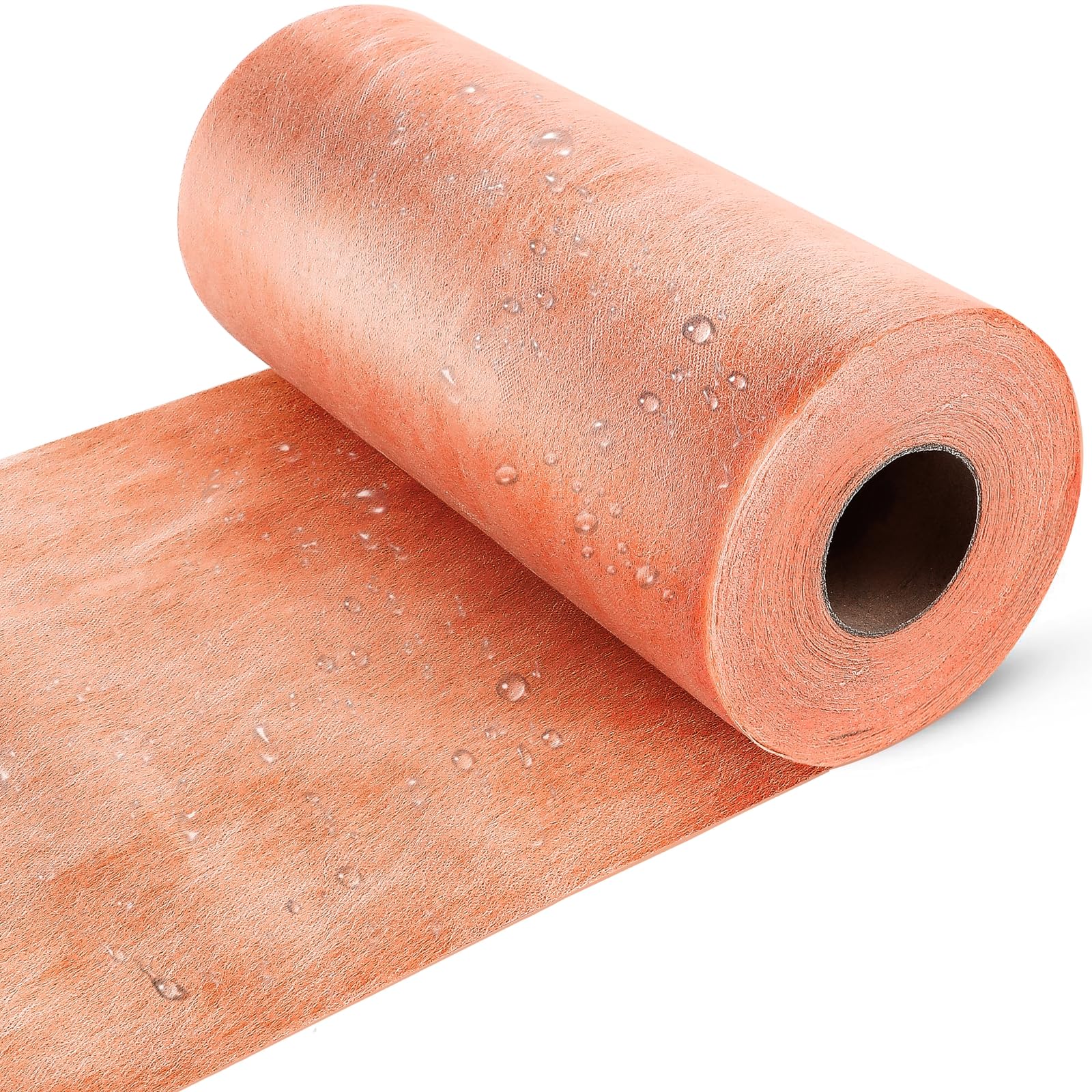
The MAXWAVE 17-inch by 150-foot roll delivers 212.5 square feet of uncoupling membrane, making it the highest-volume sheet option in this list. The 20-mil thickness provides a substantial barrier that is easy to cut with scissors and folds cleanly into corners. The high-density polyethylene core is reinforced with continuous filament fiber on both sides, giving it excellent tensile strength for a mid-range sheet product.
One of the standout features is the rough surface texture, which is engineered to maximize the mechanical bond with thinset mortar. Users report that it adheres well to cement backer board with standard unmodified thinset. The extra width of the 17-inch sections allows for effective coverage of larger wall areas without requiring multiple horizontal seams.
The material is also suitable for use as a vapor retarder in high-humidity areas like steam rooms, thanks to its low water vapor permeance. For large-scale projects where budget and coverage area are primary concerns, this roll offers the best square footage per dollar. The trade-off is that the fleece can be slightly less dense than the Kerdi product, so ensure you back-butter the membrane properly for a full bond.
Why it’s great
- Massive 212.5 sq ft roll for large projects
- Rough surface enhances thinset bond strength
- Suitable as a vapor retarder in steam rooms
Good to know
- Fleece density is lower than premium options
- 17-inch width may require more seams on tall walls
- Thinset back-buttering recommended for full adhesion
7. UCANVIN Waterproofing Band Roll

The UCANVIN Waterproofing Membrane Band Roll is a 5-inch-wide, 98.5-foot-long seam tape designed specifically for sealing joints and corners where two sheets of backer board meet. At 30 mils thick, it is significantly beefier than most standard seam tapes, providing an extra layer of protection at the most vulnerable points in the waterproofing envelope.
Users consistently compare this product favorably to the more expensive Schluter Kerdi Band, noting that the material feels and performs identically in real-world applications. The polyethylene and polypropylene construction is flexible enough to conform to inside and outside corners without tearing, yet rigid enough to hold its shape during thinset application. Multiple reviewers have passed 24-hour flood tests in shower pans using this tape exclusively.
This is a niche product that is best used as a complement to a full waterproofing system, not a replacement for a main sheet or liquid membrane. Use it to reinforce the seams of your main membrane or to seal the gap between the backer board and the shower pan liner. The 98.5-foot length provides ample material for multiple shower stalls or a large bathroom floor.
Why it’s great
- Thick 30 mil material provides robust seam protection
- Familiar feel and performance comparable to premium Kerdi band
- Sufficient length for multiple projects
Good to know
- Only 5 inches wide, limited to seam reinforcement
- Not a standalone waterproofing solution
- Requires compatible thinset for proper bond
FAQ
Should I use a liquid membrane or a sheet membrane on my shower backer board?
What thickness is required for a steam shower backer board waterproofing?
Can I apply tile directly over a waterproofing membrane on backer board?
How do I know if my liquid membrane is thick enough after application?
Can I use a waterproofing membrane over painted drywall in a shower alcove?
Final Thoughts: The Verdict
For most users, the best backer board for shower waterproofing winner is the RedGard Waterproofing because it combines a seamless, foolproof application with excellent performance at a mid-range investment, making it the most versatile option for DIYers and pros alike. If you want a vapor-tight barrier with a proven track record for a steam shower, grab the Schluter Kerdi Membrane. And for the largest coverage area with thick puncture resistance on a budget, nothing beats the MAXWAVE Uncoupling Membrane.