
Our readers keep the lights on and the weekend projects moving. As an Amazon Associate, I earn from qualifying purchases.
That sharp lower back pinch thirty minutes into a trail with your toddler will ruin the whole day. The frame geometry, the hip belt wrap, and how the child’s weight sits relative to your center of mass define whether your next hike feels like exploration or punishment.
I’m Rikta — the co-founder and writer behind FitlyFast. I’ve spent hundreds of hours combing through detailed customer load-testing reports and comparing frame suspension systems, torso adjustability ranges, and storage configurations across the most popular child carrier models on the market.
This guide distills that research into a practical comparison of today’s strongest contenders so you can confidently pick the best backpack baby carrier suited to your family’s specific terrain and travel style.
How To Choose The Best Backpack Baby Carrier
The wrong carrier shifts the child’s weight away from your hips, forcing your lower back and shoulders to do all the stabilizing work. The right carrier locks that load into your pelvis so your legs carry the miles. Before you look at pocket count or color, focus on the frame and the suspension system.
Frame Stiffness and Child Seat Position
An aluminum roll cage or a one-piece molded frame holds the child’s seat at a fixed distance from your back. A flimsy or poorly joined frame lets the child sag away from you, creating a torque lever that fatigues your lower back quickly. Look for a carrier where the seat platform keeps the child close enough to your spine that you don’t feel them pulling backward on every step.
Torso Length and Hip Belt Adjustment
A single torso setting fits exactly one body type. A carrier with at least four inches of torso adjustment lets you and your partner share the load without one person bearing all the discomfort. The hip belt should wrap fully around your iliac crest — not sit above it — and should have enough padding to distribute the weight without digging in after two miles.
Kickstand and On-Off Convenience
A folding kickstand that locks into place lets you load and unload a sleeping toddler without needing a tree stump or a second person. The best designs have a wide enough footprint that the carrier doesn’t tip when your child leans to one side. Test the kickstand release before you buy — a stiff or fiddly lever adds frustration at every trailhead.
Quick Comparison
On smaller screens, swipe sideways to see the full table.
| Model | Category | Best For | Key Spec | Amazon |
|---|---|---|---|---|
| Deuter Kid Comfort | Premium | Long technical hikes, steep elevation | Load capacity up to 52.9 lbs | Amazon |
| Osprey Poco LT | Premium | Travel, airports, compact storage | Folding frame, 5.56 lb weight | Amazon |
| Kelty Journey Signature | Premium | All-day comfort, multi-user families | PerfectFIT suspension, 6 in torso range | Amazon |
| Kelty Journey PerfectFit | Mid-Range | Moderate hikes, zoo trips, daily walks | Aluminum roll cage, 48.5 lb max load | Amazon |
| besrey Baby Backpack Carrier | Mid-Range | Flat terrain, adjustable height seat | 3-height seat, 5.5 lb frame weight | Amazon |
| ClevrPlus Urban Explorer | Budget-Friendly | Family day hikes, budget starter pack | Removable mini backpack, 7.2 lb | Amazon |
| ClevrPlus Canyonero Camping | Budget-Friendly | Cost-conscious families, casual trails | One-piece frame, 6.5 lb weight | Amazon |
In‑Depth Reviews
1. Deuter Kid Comfort Child Carrier

The Deuter Kid Comfort earns the top spot because it handles the highest load capacity in this lineup — up to 52.9 pounds — while maintaining a ventilated mesh backpanel that keeps your back from soaking through on sustained climbs. Serious hikers report carrying toddlers on 10 to 20 mile Grand Canyon treks without debilitating fatigue, which speaks directly to the frame’s ability to keep the child’s mass locked against your spine. The side-entry panel makes loading a sleeping child easier than top-loading designs, and the adjustable torso range accommodates wearers from roughly 5’2” to 6’4”.
The storage volume sits at 14 liters, enough for a packed lunch, diapers, layers, and a first aid kit, but less cavernous than some of the budget-friendly options. The sunshade stores in a pocket that several users mention is tight to close, and the shade itself can rest against the child’s forehead if not adjusted carefully. The kickstand provides solid stability, though some owners find it stiff to deploy at first.
If your weekly mileage includes steep, technical terrain and you plan to use this pack for multiple seasons as your child grows, the Deuter Kid Comfort justifies its position at the top. It is the closest thing to a dedicated backpacking pack adapted for a child carrier.
Why it’s great
- Highest weight ceiling (52.9 lb) for long-term use through toddler years
- Ventilated mesh and air gap keep parent’s back cool on sustained climbs
- Side loading panel makes child entry and exit easier than top-loading designs
Good to know
- Sunshade pocket is tight and shade can press on child’s forehead
- Storage volume (14L) is smaller than several lower-priced competitors
- Kickstand can be stiff to engage for new users
2. Osprey Poco LT Lightweight Child Carrier

The Osprey Poco LT solves the problem that no other carrier in this list addresses directly: fitting into an airport overhead bin or a car trunk without disassembly. Its stainless steel folding frame collapses flatter than any competitor, making it genuinely travel-friendly for families who navigate airplanes, rental cars, and crowded urban spaces. The frame still locks securely once deployed, and the ventilated AirScape backpanel with deep ridged foam keeps airflow moving on warm days.
Six inches of torso adjustment let two caregivers of very different heights share the carrier without compromising comfort. The integrated UPF 50 sunshade deploys from a zippered pocket and offers reliable protection, though the toggle and velcro fastening system feels less refined than the snap closures found on some premium competitors. The foot straps are the one component that reviewers consistently flag as feeling less durable than the rest of the pack.
At 5.56 pounds, the Poco LT is among the lightest framed carriers here, but the weight savings come with a slightly narrower hip belt and less aggressive load transfer than the Deuter. For families who prioritize compact storage and frequent travel over maximum load-carrying capability, this is the strongest choice.
Why it’s great
- Folding frame fits overhead bins and compresses for car storage
- Six inches of torso adjustment handles multiple caregivers seamlessly
- UPF 50 sunshade provides reliable integrated protection
Good to know
- Foot straps feel less robust than the rest of the pack construction
- Hip belt is narrower than full-suspension competitors like Deuter
- Velcro torso adjustment mechanism is tedious to change mid-hike
3. Kelty Journey Signature Child Carrier

The Kelty Journey Signature refines the popular PerfectFIT suspension system with a padded aluminum roll cage and a wider seat base that mirrors a child’s natural rest posture. Reviewers consistently note that transitions between a 5’10” parent and a 4’11” parent take seconds — the torso adjustment mechanism works smoothly and locks positively, a detail that matters when you’re swapping carriers at the trailhead. The sunshade deploys from a dedicated pocket and provides full coverage that experienced users in sunny climates call essential.
The multiple grab handles around the frame make lifting and settling the carrier onto your back safer than designs with a single top handle. The washable drool pad can be repositioned to cushion a sleeping toddler’s head against the frame, a small touch that matters on long afternoons. The main storage compartment includes internal stretch pockets that keep layers and toys organized, and the hip belt pockets hold a phone and snacks without bulging uncomfortably.
The carrier weighs 7.13 pounds, which places it on the heavier side of this group, and the padding where the child sits is not removable for cleaning — only the bib detaches. For families who need a premium fit that adapts instantly between two very different bodies and who value integrated sun protection, the Kelty Journey Signature delivers.
Why it’s great
- Quick torso adjustment between drastically different caregiver heights
- Padded aluminum roll cage provides stable, confidence-inspiring frame
- Washable drool pad is repositionable for head support when child sleeps
Good to know
- Heavier than many competitors at 7.13 pounds
- Seat padding is not removable for cleaning; only the bib detaches
- Bulky size makes storage and transport less convenient than Osprey Poco LT
4. Kelty Journey PerfectFit Child Carrier

The Kelty Journey PerfectFit strips away some of the Signature’s premium trim while retaining the core PerfectFIT suspension that makes the platform so adaptable between users. The aluminum roll cage frame provides the same stability as its higher-end sibling, and the 5-point safety harness adjusts smoothly to keep your child snug at any seated height. The fold-out aluminum kickstand makes unloading a sleeping toddler a one-person operation, a feature that budget-tier carriers frequently get wrong with narrow or unstable stands.
The large zippered main compartment holds enough gear for a moderate day hike or a long zoo outing, and the hip belt pockets keep your phone and snacks accessible without stopping. At 5 pounds 6 ounces, the PerfectFit is significantly lighter than the Signature, making it a strong middle-ground option for parents who want the Kelty suspension system without the weight penalty. The torso adjustment range stretches from 15.5 to 21 inches, covering most adult frames comfortably.
The carrier is best suited for moderate terrain — flat trails, paved paths, and well-groomed nature walks — rather than steep, technical backcountry routes where a higher load capacity and more aggressive hip belt would help. If your typical outing is two to four miles on maintained trails, this is the sweet spot of the Kelty lineup.
Why it’s great
- Same PerfectFIT suspension as the Signature at a lower weight (5.4 lb)
- Aluminum kickstand folds out easily for one-person child loading
- 5-point harness adjusts smoothly and inspires confidence on the trail
Good to know
- Best suited for moderate, non-technical terrain
- Maximum load of 48.5 lb is lower than Deuter’s 52.9 lb ceiling
- Storage volume is adequate but not generous for long all-day treks
5. besrey Baby Backpack Carrier

The besrey Baby Backpack Carrier introduces a three-height adjustable seat that lets you raise the sitting platform as your child grows, maintaining an ergonomic sightline without needing to upgrade carriers mid-toddlerhood. The frame weighs only 5.5 pounds, making it one of the lighter options here, which reduces fatigue during longer outings on relatively flat terrain. The 5-point seat belts use super soft material against the child’s skin, and the padded shoulder straps and waist belt distribute weight across your hips rather than your shoulders.
The storage layout includes pockets on the waist belt, space under the seat, and a detachable storage bag for bulkier items. The detachable sunshade protects against both sun and light rain, though some users report that the plastic components of the shade frame are not detachable from the carrier, which can make storage awkward. The kickstand works well on level ground but can tip if your child leans aggressively to one side.
Frequent users note that the adjustable straps tend to loosen after every few trips and need re-tightening, and the waist strap can chafe on longer hikes. The child’s seat sits slightly farther from your back than premium competitors, which creates a mild backward torque that becomes noticeable after three miles. For families sticking to flat, well-maintained paths, the besrey offers strong value and a thoughtful growth-friendly seat design.
Why it’s great
- Three-height adjustable seat adapts to your child’s growth
- Very lightweight at 5.5 pounds, reducing fatigue on long walks
- Generous pocket layout with waist belt storage and detachable bag
Good to know
- Straps loosen incrementally and need frequent re-tightening mid-hike
- Child sits farther from back, creating torque on steep or uneven terrain
- Kickstand is prone to tipping if child shifts weight suddenly
6. ClevrPlus Urban Explorer Child Carrier
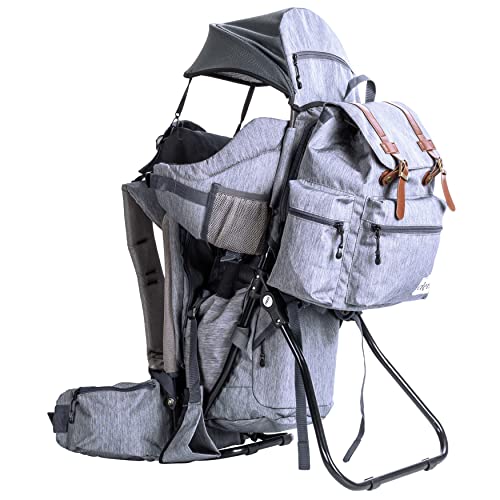
The ClevrPlus Urban Explorer stands out for its removable mini backpack, which can be worn by the toddler for independent carrying or attached to the main frame for extra storage capacity. The one-piece frame design eliminates assembly hassle and provides a stable foundation that feels confident when you first lift the carrier onto your back. The included sun canopy and rain cover make this kit ready for unexpected weather without buying accessories separately, and the washable drool pad keeps the cockpit clean after sweaty naps.
The waistband extends to approximately 60 inches, accommodating larger body types comfortably, and the padded hip belt transfers weight reasonably well for a carrier at this tier. The storage compartments are spacious enough for diapers, snacks, bottles, and a changing pad, and the insulated back pocket keeps drinks cool during warm hikes. Reviewers praise the ease of adjustment between very different-sized parents, with one family reporting successful use by both a 5-foot and a 6’2” adult.
The sun shade canopy has a tendency to cave in and rub against the child’s head, which can be uncomfortable during long naps. The carrier also lacks a dedicated hydration bladder sleeve, a notable omission for parents who prefer hands-free water access. For day hikes and family outings where full technical performance is not required, the Urban Explorer delivers solid function at a reasonable entry point.
Why it’s great
- Detachable mini backpack adds versatile storage and toddler engagement
- Full weather kit included (sun canopy and rain cover) out of the box
- Waistband extends to 60 inches, fitting a very wide range of body sizes
Good to know
- Sun shade canopy caves in and can rub against the child’s head
- No hydration bladder sleeve or pocket for hands-free water access
- Overall cushioning and build refinement lower than Kelty or Deuter
7. ClevrPlus Canyonero Camping Baby Backpack
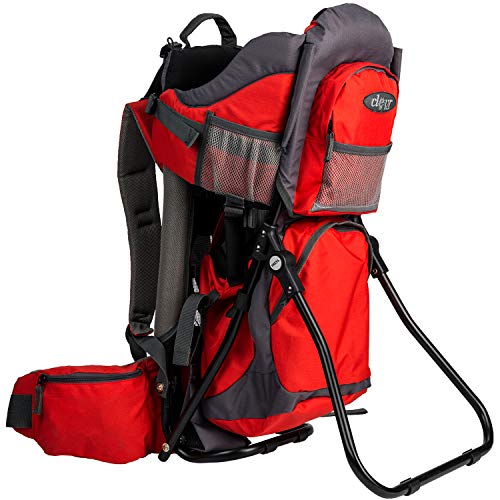
The ClevrPlus Canyonero is the most affordable framed carrier in this lineup, and it earns its place by doing the basics competently for families who want a functional carrier without spending at the premium tier. The one-piece frame avoids the wobbly joints that plague ultra-budget carriers, and at 6.5 pounds it is light enough for afternoon hikes and fairground visits. The included changing pad, sun canopy, and rain cover give you a complete kit from the first use, and the insulated back pocket keeps snacks cool during warm weather outings.
The adjustable seat accommodates children from 9 to 48 months up to 42 pounds, which covers the full usable window of a child carrier investment. Reviewers note that the carrier remains comfortable for both short and tall wearers, with one family successfully using it for over 100 hiking miles with only minor wear showing. The storage compartments are ample for a day’s supplies, though there is no dedicated location to stow the sun shade when not in use.
The hip belt and lumbar padding provide noticeably less support than mid-range and premium competitors, and users report that the buckles can be stiff and hard to see when adjusting on the move. The return process has been flagged as difficult by multiple buyers, so confirm sizing and fit before purchasing. If your budget requires a carrier under this threshold, the Canyonero is a solid gateway into framed hiking backpacks.
Why it’s great
- Lowest entry price in this comparison for a framed carrier with accessories
- Includes changing pad, sun canopy, and rain cover — complete out of box
- One-piece frame avoids assembly and stays rigid over repeated use
Good to know
- Hip belt and lumbar padding offer less support than Kelty or Deuter
- No dedicated storage compartment for the sun shade when folded
- Return process is reportedly difficult — confirm fit before purchase
FAQ
What is the safest age to start using a backpack baby carrier?
How do I know if the hip belt fits my torso correctly?
Final Thoughts: The Verdict
For most users, the best backpack baby carrier winner is the Deuter Kid Comfort because its high load capacity, ventilated backpanel, and side-entry design make it the most capable option for sustained technical hiking across multiple toddler seasons. If you want compact storage for frequent travel and airport navigation, grab the Osprey Poco LT. And for a budget-friendly entry into framed carriers without giving up weather protection or storage, nothing beats the ClevrPlus Canyonero.