
Our readers keep the lights on and the weekend projects moving. As an Amazon Associate, I earn from qualifying purchases.
A backpack first aid kit isn’t just a zippered pouch of bandages — it’s a mobile trauma station you strap on and carry into terrain where every second and every ounce count. Whether you’re guiding a group through rocky trails or prepping a vehicle for remote travel, the difference between a good kit and a bad one comes down to organization density, weight distribution, and the actual medical capabilities you’re hauling.
I’m Rikta — the co-founder and writer behind FitlyFast. I’ve spent years analyzing the layout logic, material specs, and compartment engineering that separate a professional-grade response system from a glorified cosmetics bag you wouldn’t trust in a real bleed.
Below, I break down seven serious contenders that won’t waste your space, your time, or your trust. This is the definitive analysis of the best backpack first aid kit for anyone who treats preparedness as a non-negotiable.
How To Choose The Best Backpack First Aid Kit
Selecting a backpack first aid kit requires matching the kit’s supply depth and carry system to the environment you operate in, the number of people you’re covering, and the level of injury you’re realistically prepared to manage. A kit built for a day hike is a different beast than one meant for a multi-day group expedition or a vehicle response bag.
Match the Kit to Your Mission Duration and Group Size
A kit designed for two people over two days is fundamentally different in volume and supply density from a 500-piece unit meant for a family vehicle or a base camp. Shorter missions allow ultralight, compact kits like the Adventure Medical Kits Hiker that prioritize mobility. Longer trips or larger groups demand the capacity and refillable space of a backpack like the Ergodyne Arsenal 5244 or the GEVOKE 500-piece system.
Prioritize Organizational Logic Over Total Piece Count
In a real emergency, digging through a loose pile of supplies costs critical seconds. The most effective backpack first aid kits use labeled compartments, color-coded pouches, or function-based organization (wound care, tools, trauma, medications) so you can grab the right intervention without thought. Products like the SurviveX kit with its color-coded system or the Lightning X with separate trauma and airway pouches demonstrate this principle well.
Assess Material Durability and Attachment Versatility
A backpack first aid kit that lives in a car trunk has different stress requirements than one strapped to a tactical vest or a hiking pack. Look for 600D or higher ripstop polyester, heavy-duty zippers, and reinforced stitching. MOLLE compatibility allows you to attach the kit to larger packs or vehicle panels, while handles and D-rings improve grab-and-go speed. The Ergodyne Arsenal, with its tarpaulin-reinforced base and padded shoulder straps, is designed for hard daily use.
Quick Comparison
On smaller screens, swipe sideways to see the full table.
| Model | Category | Best For | Key Spec | Amazon |
|---|---|---|---|---|
| SurviveX Large FAK | Premium Medical | Group expeditions, severe wounds | Zip Stitch wound closures, color-coded organization | Amazon |
| Ergodyne Arsenal 5244 | Professional Backpack | Workplace, long-duration carry | ANSI Class A supplies, tarpaulin base, MOLLE | Amazon |
| Lightning X EMS Backpack | EMS/Trauma Response | First responders, serious trauma | Over 250 items, dedicated trauma/airway pouches | Amazon |
| GEVOKE 500 Piece | Large Capacity | Home, car, base camp coverage | 500 pieces, 1680D polyester, MOLLE system | Amazon |
| Besst Survivor Trauma | Trauma Specialized | Tactical, vehicle, adventure trauma | 265 pieces, includes Israeli bandage, 600D polyester | Amazon |
| Pasenhome Compact | Everyday Carry | Daily commuter, short hikes | 20 labeled compartments, 600D ripstop, 1.3 lb | Amazon |
| Adventure Medical Hiker | Ultralight Summit | Day hikes, ultralight backpackers | 7.2 oz, Easy Care system, wilderness guide included | Amazon |
In‑Depth Reviews
1. SurviveX Large First Aid Kit
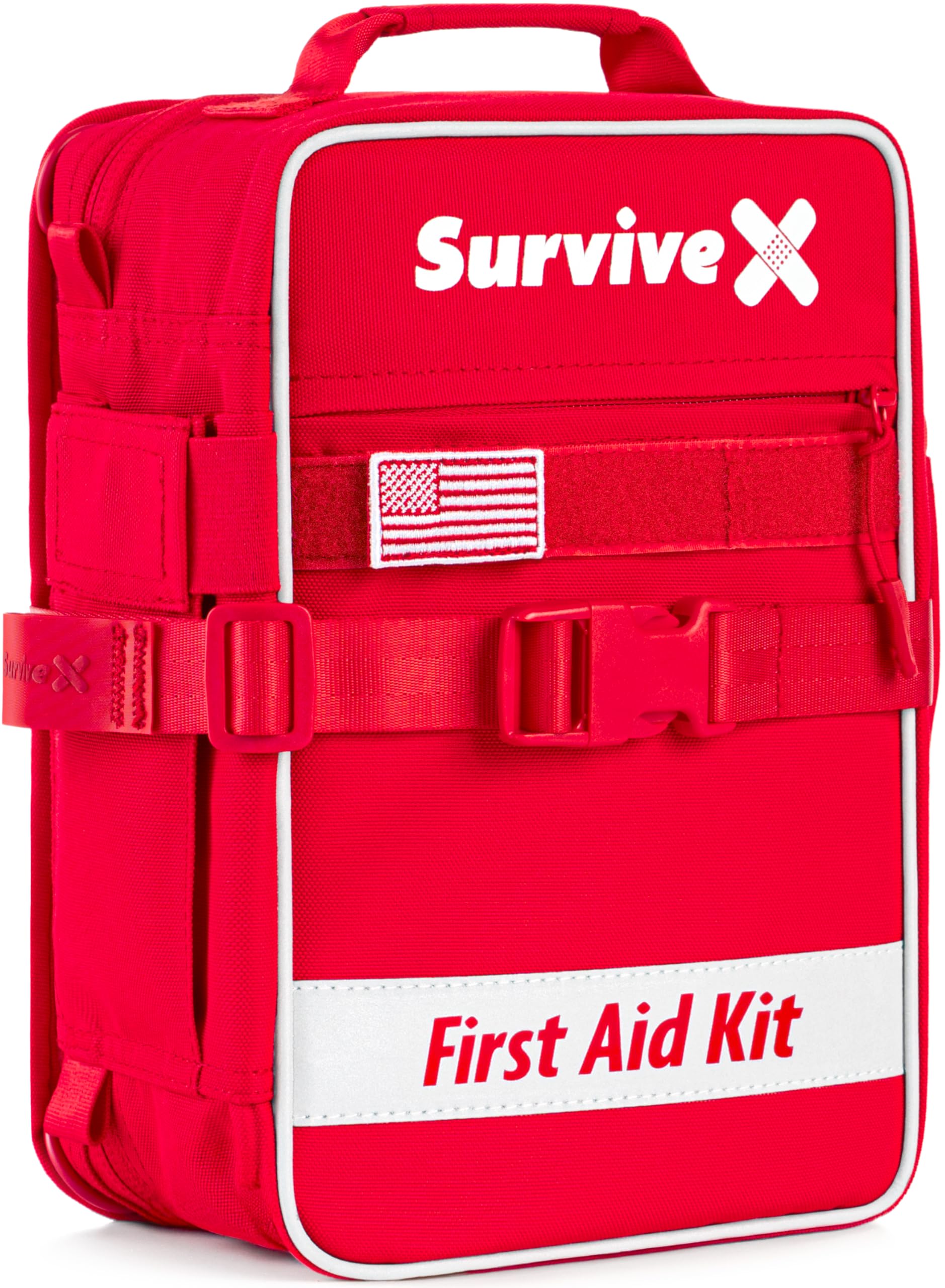
The SurviveX kit occupies the sweet spot where serious capability meets practical carry. Its defining feature is the inclusion of zip-style wound closure strips — a professional-grade tool for closing lacerations without stitches, rarely found in consumer kits. The color-coded, labeled organization system separates supplies by function (wound, hygiene, tools, personal), which shaves critical seconds off response time when you’re managing a bleed on a mountain trail or in a woodworking shop.
Packaged in a 2.78-pound MOLLE-compatible bag measuring 7.28 x 6.69 x 10.4 inches, it carries efficiently for its depth. The contents go beyond basic bandages to include supplies for burns, fractures, sprains, hypothermia, and insect bites — making it a self-contained system for multi-day group trips. The bag’s mounting options let you attach it to a backpack, vehicle headrest, or wall panel without risking detachment on rough terrain.
The trade-off is that the included kit leaves limited extra space for adding bulky personal gear like mass trauma dressings or an oversized airway kit. For most users though, the balance of professional-grade trauma supplies and organized, carry-ready packaging makes this the single most versatile option in this lineup.
Why it’s great
- Zip Stitch wound closures for serious laceration management
- Color-coded compartments reduce fumbling under stress
- MOLLE and mounting hardware for vehicle, pack, or wall attachment
Good to know
- Limited internal expansion room for very large personal add-ons
- Designed for preparedness, not ultralight day hiking
2. Ergodyne Arsenal 5244 Responder Backpack

The Ergodyne Arsenal is built for abuse. Its 600D polyester shell is reinforced by a tarpaulin bottom with molded feet that let you set it down on wet concrete, gravel, or mud without soaking the contents. This is a true backpack form factor — not a sling bag or a pouch — with cushioned mesh padding on the shoulders and back for comfortable all-day wear, making it an ideal choice for job sites, security details, or long wilderness patrols.
The included first aid supplies meet the ANSI/ISEA Z308.1-2015 Class A standard, which means it covers the required minimums for workplace compliance. Inside, the pack opens flat for full visibility, and the large main compartment offers ample space to reorganize or add your own gear. The bright orange color improves visibility in an emergency — a small detail that matters when seconds count.
Users have reported this bag surviving full hockey seasons and heavy daily contract work without zipper failures or fabric tears. The included items are a solid starting point, but serious responders will want to supplement the kit with personal trauma gear. The trade-off is weight: fully loaded, it’s heavier than a summit-style kit but far more capable for sustained operations.
Why it’s great
- Tarpaulin-reinforced base with molded feet for extreme durability
- True backpack harness with padded straps for long carry comfort
- Opens flat for full inventory visibility
Good to know
- Heavier than ultralight options when fully loaded
- Included supplies are a starting point, not a final kit
3. Lightning X Stocked EMS/EMT Trauma & Bleeding First Aid Responder Medical Backpack

The Lightning X backpack is the closest thing in this lineup to a true EMS response bag. At 18 pounds fully stocked with over 250 items, it’s heavy — but every ounce is accounted for with purpose. The bag includes separate dedicated compartments for airway management, trauma/bleeding control, and first aid, plus a rear velcro panel and MOLLE loops throughout for attaching additional pouches like a pulse oximeter or a CPR mask.
Former EMTs contributed to the kit design, which shows in the composition. Rather than padding the piece count with hundreds of tiny bandages, the kit includes real-world items: multiple trauma pads, a SAM splint, elastic bandages, nitrile gloves, burn dressings, a cold pack, eye wash, a CPR barrier, and diagnostic tools like a blood pressure cuff and stethoscope. The pack measures 13 x 9 x 18 inches — large enough to serve as a central response kit for group outings, schools, or volunteer EMS.
The bag’s water-resistant fabric and military-grade zippers hold up to rough field conditions. The trade-off is space: some users note that fitting items like a pulmonary resuscitator alongside the included stethoscope and BP cuff can be tight. If you need a fully self-contained medical station in a wearable backpack for serious trauma response, this is the choice.
Why it’s great
- True compartmentalization for airway, trauma, and first aid
- Includes diagnostic tools (BP cuff, stethoscope) out of the box
- MOLLE loops and rear panel for extensive customization
Good to know
- Very heavy at 18 pounds — not for ultralight hiking
- Limited spare space for very large additional equipment
4. GEVOKE Professional 500 Piece First Aid Kit

The GEVOKE 500-piece kit is built for stationary or vehicle-based coverage where weight isn’t your primary constraint. Measuring 6.29 x 11.8 x 7.88 inches and weighing 3.92 pounds, this kit uses a premium 1680D polyester fiber shell with a water-resistant coating — a notably higher denier than the 600D materials commonly found in this category. The result is a tougher exterior that shrugs off abrasion and moisture better than most.
Organization is a strong suit here. The internal compartments are clearly labeled, and the bag opens fully to reveal every section without digging. The MOLLE system on the exterior is compatible with shoulder straps and snap buckles, and the addition of reflective strips improves low-light visibility — a smart safety feature for roadside or evening emergencies. The double-zippered compartments also include extra space for refilling supplies as they run out.
The kit is designed to handle minor to moderate injuries across cuts, burns, scalds, and abrasions with its extensive assortment of bandages, gauze, wipes, and tools. It’s not a trauma-focused kit like the Lightning X or SurviveX — you won’t find chest seals or wound closure strips here. For a family vehicle, home closet, or base camp where you need broad coverage at a glance, this kit delivers massive piece count without sacrificing build quality.
Why it’s great
- Heavy-duty 1680D polyester shell with water-resistant finish
- Labeled compartments and reflective strips for emergency visibility
- Large refillable interior with MOLLE attachment capability
Good to know
- Not designed for advanced trauma management
- Heavier and bulkier than backpack-style units
5. Besst Survivor Professional Trauma First Aid Kit

The Besst Survivor kit prioritizes severe trauma management without blowing past a mid-range footprint. At 2.8 pounds and 7.2 x 4.2 x 10 inches, it’s compact enough to fit in a daypack or behind a car seat, yet it includes supplies rarely found in kits of this size: an Israeli bandage, compressed gauze, and a full range of trauma dressings alongside standard bandages, splints, and burn treatment.
The organization system is one of the best in its class. Every compartment inside the 600D ripstop polyester case is labeled not just with the item name but with a brief note on its typical use — which reduces hesitation when a non-medical person is trying to help. The removable MOLLE system attaches securely to tactical vests, backpack straps, or vehicle panels, and the case opens flat for full access.
Users consistently praise the kit’s inclusion of tools like a tourniquet-compatible trauma shears and the high-quality zippers that withstand repeated opening in rough conditions. It’s not a comprehensive EMS backpack — you won’t get airway kits or diagnostic tools — but for an adventure-ready trauma kit that can handle bleeding, fractures, and burns without being oversized, this is a standout option.
Why it’s great
- Includes Israeli bandage and compressed gauze for serious bleeds
- Labeled compartments with use-case notes for quick identification
- Compact 2.8-pound footprint with MOLLE attachment
Good to know
- Bag is not fully waterproof for canoe or heavy rain submersion
- No included diagnostic tools or advanced airway supplies
6. Pasenhome Compact Rapid-Response First Aid Kit

For the daily carry crowd, the Pasenhome kit is hard to beat in terms of weight-to-organization ratio. Weighing just 1.3 pounds and measuring 7.9 x 5.9 x 3.6 inches, it fits inside a glove compartment, a backpack side pocket, or a dorm drawer without stealing space from other essentials. The bag uses 600D ripstop polyester with strong two-way zippers that hold up to repeated use.
The standout feature is the 20 labeled compartments, each with a brief note on what’s inside and how to use it. This is a deliberate design choice that pays off when someone unfamiliar with the kit needs to find an eye pad or a triangular bandage in a hurry. The interior layout also leaves a small pocket of room for personal additions — a few extra pain relievers or an EpiPen can slide in easily.
The included supplies cover everyday preparedness: adhesive bandages in multiple sizes, trauma pads, gauze, tape, scissors, tweezers, gloves, cotton swabs, an emergency blanket, a whistle, and a first aid guide. It’s not designed for severe trauma — you won’t find tourniquets or chest seals here. For hikers, commuters, and families who want a grab-and-go kit that’s actually organized, this is a smart budget-friendly choice.
Why it’s great
- Extremely lightweight at 1.3 lb for easy daily carry
- 20 clearly labeled compartments with use notes
- Extra interior room for personal medications or small tools
Good to know
- Not rated for heavy trauma response
- Bandage assortment is for minor-to-medium injuries only
7. Adventure Medical Kits Mountain Series Hiker

If weight is your primary variable — and for many backpackers, it is — the Adventure Medical Kits Hiker is the lightest fully functional kit in this review at just 7.2 ounces. Designed for two people for two days, this is a summit-ready unit that fits into the pocket of a down jacket or the top lid of an ultralight pack. The Easy Care organization system uses clearly labeled pockets inside a water-resistant bag so you don’t waste time rummaging.
The kit punches above its weight in wound care capability. It includes a trauma pad for severe bleeding control, an elastic bandage for sprains and stabilization, and a wilderness first aid book that provides treatment guidance when you’re out of cell range. The contents also cover medicines, blisters, and minor wound care — everything you realistically need for a weekend trail mission without the bulk.
The trade-off is simple: it’s not expandable, and it won’t support a large group or a long expedition. The compartment room is tight, and you won’t fit bulky custom gear beyond a few flat items. For day hikers, fast-packers, and anyone who refuses to leave safety behind but refuses to carry extra pounds, this is the definitive lightweight choice.
Why it’s great
- Incredibly lightweight at 7.2 oz — fits any pack
- Easy Care labeled organization for quick retrieval
- Includes trauma pad and wilderness medicine guide
Good to know
- Limited to 2 people for 2 days — not for groups
- Very little extra room for custom additions
FAQ
What is the difference between a first aid pouch and a backpack first aid kit?
How many people should a backpack first aid kit support?
Can I add my own supplies to a pre-stocked backpack first aid kit?
Final Thoughts: The Verdict
For most users, the best backpack first aid kit winner is the SurviveX Large because it delivers professional-grade wound closure capability and color-coded organization in a MOLLE-ready, carry-friendly package that covers both minor and moderate trauma without the bulk of an EMS bag. If you want a rugged, ANSI-compliant backpack for workplace or long-duration carry, grab the Ergodyne Arsenal 5244. And for an ultralight summit kit that won’t weigh you down on the trail, nothing beats the Adventure Medical Kits Hiker.