
Our readers keep the lights on and the weekend projects moving. As an Amazon Associate, I earn from qualifying purchases.
That persistent ache in your shoulders after mile twelve isn’t a sign of weakness — it’s a sign your pack’s load transfer system isn’t working. A proper internal-frame backpack transfers 80% of the weight from your shoulders to your hips, turning a punishing trudge into a balanced, efficient stride. The wrong one leaves you fighting your gear every step of the way, robbing you of energy you need for the trail ahead.
I’m Rikta — the co-founder and writer behind FitlyFast. I’ve spent countless hours analyzing suspension designs, frame materials, torso-adjustment mechanisms, and real-world durability reports to separate the packs that actually support a heavy load from those that just look the part on a shelf.
This guide breaks down the critical specs behind a truly capable backpack for long distance hiking so you can invest in gear that carries its weight well beyond the trailhead.
How To Choose The Best Backpack For Long Distance Hiking
Selecting a pack for multi-day distances means prioritizing load management and torso fit above every other feature. A 65-liter bag with a poor suspension will feel heavier at mile five than a properly fitted 55-liter pack with a good frame. Focus on these three pillars before you look at pocket count or color options.
Frame Type and Load Transfer
The frame is the structure that bridges your body to the load. Perimeter wire frames with a central aluminum stay provide a stable, close-to-body carry that tracks well on rocky descents. Stamped sheet frames are lighter but can twist under loads exceeding 35 pounds. Look for a frame that includes a rigid stay or hoop that terminates into the hip belt — that connection is what prevents the pack from sagging onto your shoulders.
Hip Belt and Torso Adjustment
A padded hip belt with contoured wings is the single most important comfort feature on a long-distance pack. The belt should wrap your iliac crest without gaping and carry roughly 80% of the pack’s weight. Adjustable torso length (a sliding ladder system on the shoulder straps) is non-negotiable — a fixed torso length forces you to adapt your body to the pack instead of the reverse. Most brands offer models with at least 4 inches of torso range.
Volume vs. Carry Weight Rating
Liter capacity tells you how much gear fits, but the carry weight rating tells you how it will feel. A budget pack might hold 65 liters but only carry 35 pounds comfortably. Premium packs with denser foam and stiffer frames can handle 45 to 50 pounds without the hip belt collapsing. Match the pack’s comfortable carry weight to your actual base weight plus food and water — not just the biggest number on the tag.
Quick Comparison
On smaller screens, swipe sideways to see the full table.
| Model | Category | Best For | Key Spec | Amazon |
|---|---|---|---|---|
| Mardingtop 65L+10L | Budget Military | Rugged brush use | 5.4 lb / MOLLE webbing | Amazon |
| TETON Sports Explorer 65L | Entry-Level | First-time backpackers | 5 lb / Multi-position torso | Amazon |
| High Sierra Pathway 2.0 75L | General Use | Youth trips / travel | Heavyweight polyester / Hydration sleeve | Amazon |
| Kelty Asher 55L | Lightweight | Efficient multi-day | 3 lb 2 oz / Fit Pro torso | Amazon |
| North Face Women’s Terra 55 | Women-Specific | Women’s fit comfort | 4 lb / U-zip access | Amazon |
| North Face Terra 55 | Unisex Mid-Range | Thru-hiking value | 5 lb / Removable frame sheet | Amazon |
| Osprey Rook 65L | Premium Light | Vented carry | 3.7 lb / AirSpeed suspension | Amazon |
| Osprey Renn 65L Women’s | Women’s Premium | Women’s ventilation | 3.6 lb / AirSpeed women’s fit | Amazon |
| Osprey Kestrel 68L | Heavy-Duty | High load stability | 4.95 lb / AirScape backpanel | Amazon |
In‑Depth Reviews
7. Osprey Rook 65L Men’s Backpacking Backpack

The Osprey Rook 65L delivers the brand’s proven AirSpeed suspension — a tensioned mesh backpanel that keeps your spine away from the pack fabric, creating a continuous airflow channel that dramatically reduces sweat buildup on hot climbs. The LightWire frame transfers the load directly to the hip belt so your shoulders carry almost nothing when the belt is properly cinched.
The hip belt is generously padded with the same contouring found on Osprey’s premium Aura and Atmos lines, supporting loads up to 35 pounds without pressure points. A built-in, stowable rain cover eliminates the need to pack a separate one, and the floating divider on the sleeping bag compartment lets you organize gear by weight rather than just volume.
Reviewers consistently note the comfort at mile 20 with loads around 25 to 30 pounds, and the angled water bottle pockets allow one-handed access without removing the pack. The main trade-off is the lack of a large external mesh pocket for stuffing a wet shell, but the integrated cover compensates for wet-weather scenarios.
Why it’s great
- Ventilated backpanel reduces sweat on long days
- Integrated rain cover keeps contents dry
- LightWire frame transfers load efficiently to hips
Good to know
- No large front mesh pocket for quick stowage
- No back panel access to main compartment
9. Osprey Kestrel 68L Men’s Backpacking Backpack

The Osprey Kestrel 68L is built for the hiker who carries a heavier base weight — the injection-molded AirScape backpanel provides a close-to-body carry that keeps the load stable even when scrambling over boulders or crossing talus fields. The Fit-on-the-Fly hip belt allows tool-free adjustment so you can fine-tune the fit mid-trail as layers change.
Trekking pole attachment loops are integrated into the compression system, and the integrated rain cover is stored in a dedicated zippered pocket so you don’t lose it in camp. The main compartment opens from the top only, but the large zippered lid pocket and under-lid mesh pocket with key clip keep small essentials organized and accessible.
Reviewers pushing loads up to 50 pounds report the Kestrel maintains its shape and comfort, a direct result of the denser foam in the hip belt and the stiffer frame sheet. The front daisy chain lashing points offer external attachment options for a foam pad or tent, but the pack lacks a dedicated sleeping bag strap on the bottom, which some users find limiting.
Why it’s great
- Stable close-to-body carry for technical terrain
- Fit-on-the-Fly hip belt adjusts without tools
- Integrated rain cover with dedicated pocket
Good to know
- No bottom sleeping bag compression strap
- Top-loading only; no panel zipper access
8. Osprey Renn 65L Women’s Backpacking Backpack

The Osprey Renn 65L is the women’s counterpart to the Rook, sharing the same AirSpeed suspension architecture but with a women’s-specific torso length range (15 to 18 inches), narrower shoulder straps, and a curved hip belt designed to fit the iliac crest geometry of female hikers. The result is a pack that eliminates the gap at the lower back common when a women wears a unisex pack.
The tensioned mesh backpanel provides the same ventilation advantage as the Rook, and the integrated rain cover is included. Reviewers between 5’1” and 5’3” report the fit works well without the shoulder straps pulling into the armpits — a common complaint with unisex models sized down. The floating divider in the sleeping bag compartment allows separation of wet and dry gear.
The main trade-off is that smaller-framed women below 5’0” may still need a dedicated extra-small pack, as the Renn’s minimum torso length of 15 inches won’t tighten enough for a very short torso. The hip belt pockets are small but fit a phone and snacks, and the compression straps keep the load stable even at lighter carry weights around 20 pounds.
Why it’s great
- Women’s-specific torso and hip belt geometry
- Ventilated backpanel keeps you cool
- Integrated rain cover for wet weather
Good to know
- May not fit very short torsos under 15 inches
- No large front mesh pocket
6. The North Face Terra 55 Backpack (Unisex)
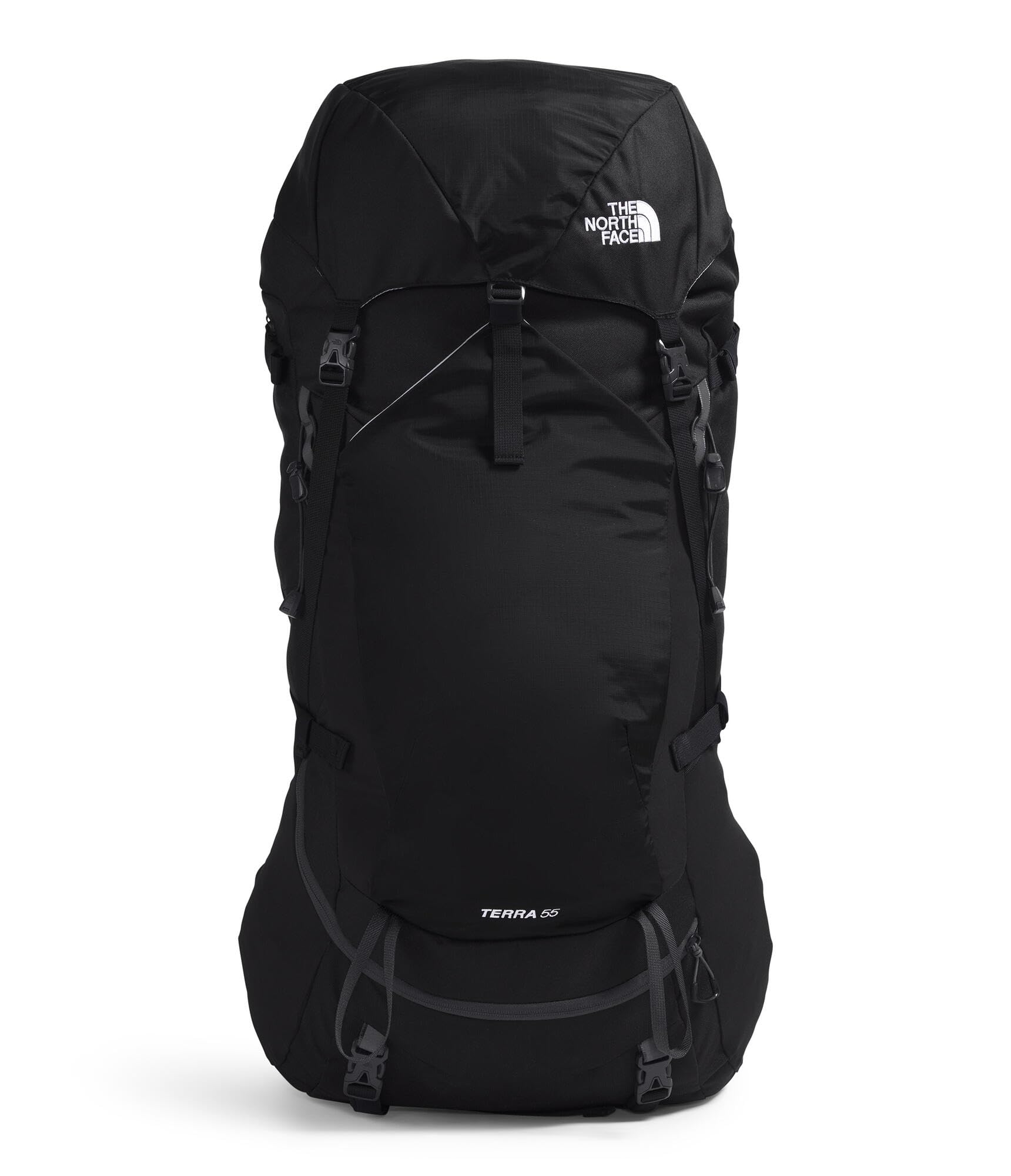
The North Face Terra 55 offers a unique combination of a cinch-top main compartment and a full-length two-way U-zipper that lets you access gear from the top, side, or bottom without unloading everything. That feature alone saves time and frustration in camp when you need to grab a jacket or repair kit buried at the bottom of the pack.
The removable frame sheet provides a good balance of load transfer and flexibility, and the padded hip belt with load lifter straps allows fine-tuned weight distribution. The dual stretch mesh water bottle pockets fit Nalgene-sized bottles, and the hiking pole and ice axe attachments are included on the front daisy chain loops.
Reviewers appreciate the lightweight feel at just over 4 pounds for the 53-liter version, but note the frame sheet is less rigid than a dedicated wire frame, making it better suited for loads under 35 pounds. The removable lid with internal pocket and key hook is convenient for day hikes when you want to strip weight, and the stuff-it pocket on the front works well for a wet shell.
Why it’s great
- Full-length U-zipper for easy gear access
- Removable lid for weight reduction on day trips
- Dual stretch mesh bottle pockets
Good to know
- Frame sheet less stable than wire frame at heavy loads
- No integrated rain cover included
5. The North Face Women’s Terra 55 Backpack (Women-Specific)
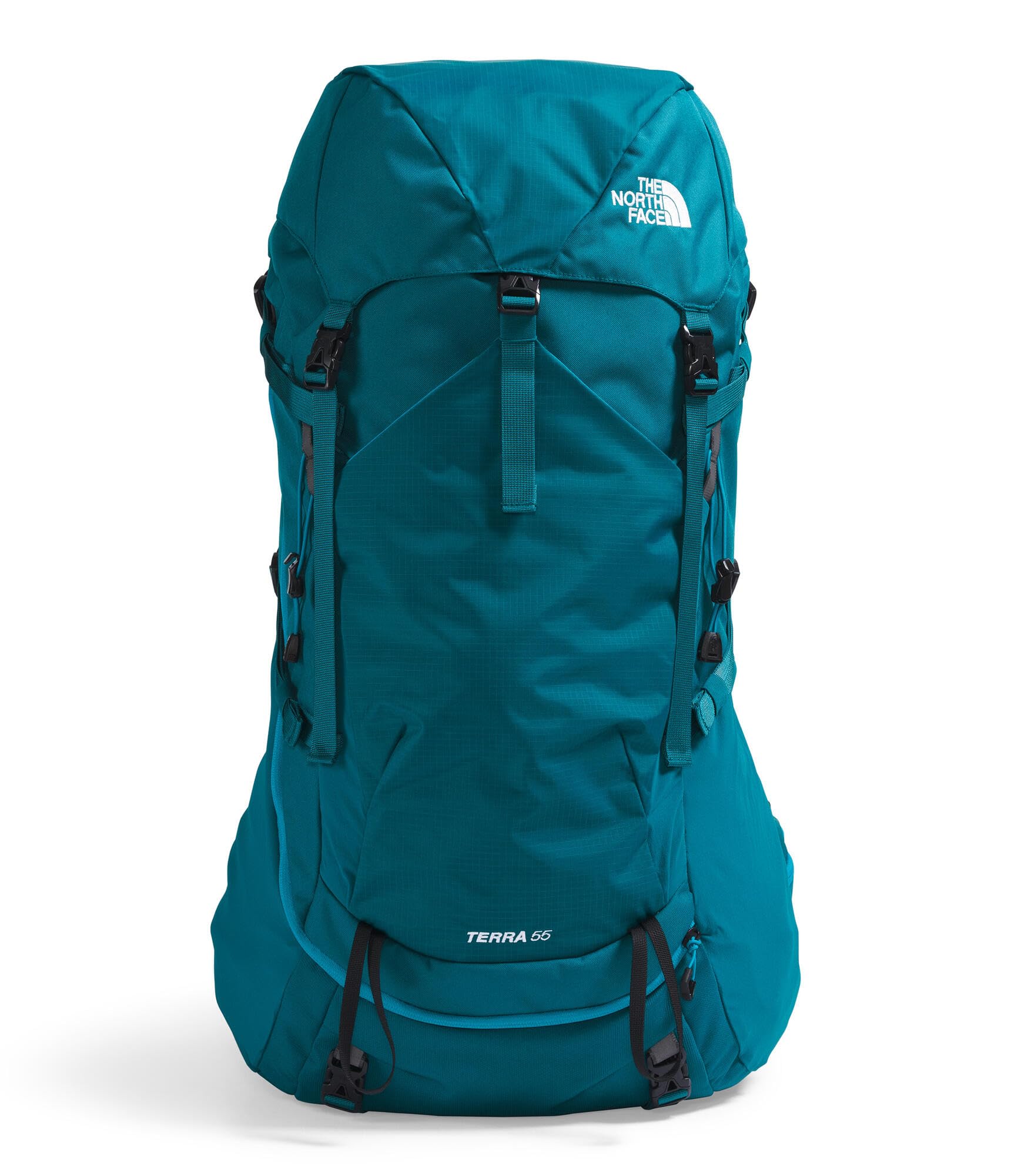
The women’s version of the Terra 55 uses a women-specific back panel shape and narrower shoulder straps with a more pronounced S-curve, along with a padded hip belt that contours at a different angle than the unisex model. These adjustments eliminate the shoulder-blade pinch that many women experience with unisex packs, especially at carry weights under 30 pounds.
The full-length U-zipper is identical to the unisex model, providing the same easy access to gear in the main compartment. The cinch-top closure with a removable lid gives you the option to go lidless for weight savings, and the bottom and side compression straps work well to stabilize a light load or lash a sleeping pad externally.
Reviewers note that taller women with longer torsos (over 19 inches) may find the medium/long size just barely adequate due to the limited adjustment range in the removable frame sheet. The hip belt pockets are sized for phones and energy bars, and the hydration sleeve fits up to a 3-liter bladder. No integrated rain cover is included, so plan accordingly for wet climates.
Why it’s great
- Women-specific back panel and shoulder straps
- Full-length U-zipper for bottom access
- Removable lid for weight reduction
Good to know
- Frame sheet adjustment range limited for long torsos
- No rain cover included
4. Kelty Asher 55L Backpack
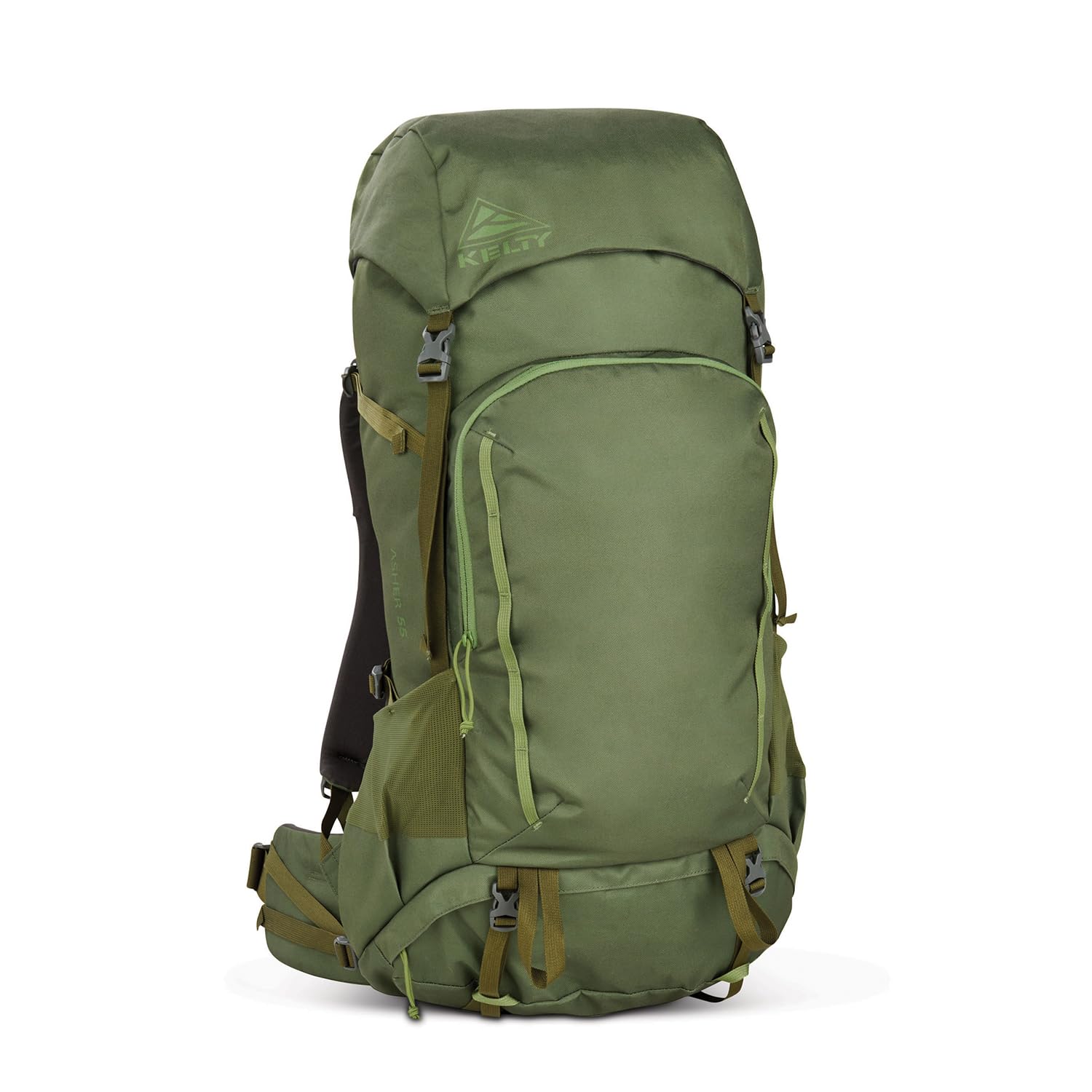
The Kelty Asher 55L strips weight aggressively — at just 3 pounds 2 ounces, it’s over a pound lighter than most 55-liter packs in its class. The weight savings come from a simplified perimeter frame with a single aluminum stay rather than a full wire hoop, combined with a minimalist harness that still includes load lifter straps and a padded hip belt.
The Fit Pro adjustment system uses a ladder-style torso length adjustment that can be set on the fly, accommodating torso lengths from 15.5 to 21 inches. The Amp Flow ventilated back panel uses a mesh trampoline design that keeps the pack off your lower back, providing airflow that rivals premium brands at a fraction of the weight.
Reviewers find the pack comfortable up to about 30 pounds, but the single-stay frame starts to flex noticeably above 35 pounds. The hip belt foam is less dense than Osprey or North Face models, which means it may compress over a multi-day trip with a heavy load. The sleeping bag compartment is separate with a floating divider, and the side mesh pockets are tight but secure for standard water bottles.
Why it’s great
- Ultralight at 3 lb 2 oz for a framed backpack
- Fit Pro torso adjustment is quick and easy
- Ventilated backpanel keeps you cool
Good to know
- Single-stay frame flexes over 35 lb loads
- Hip belt foam less dense than premium competitors
2. TETON Sports Explorer 65L Internal Frame Backpack
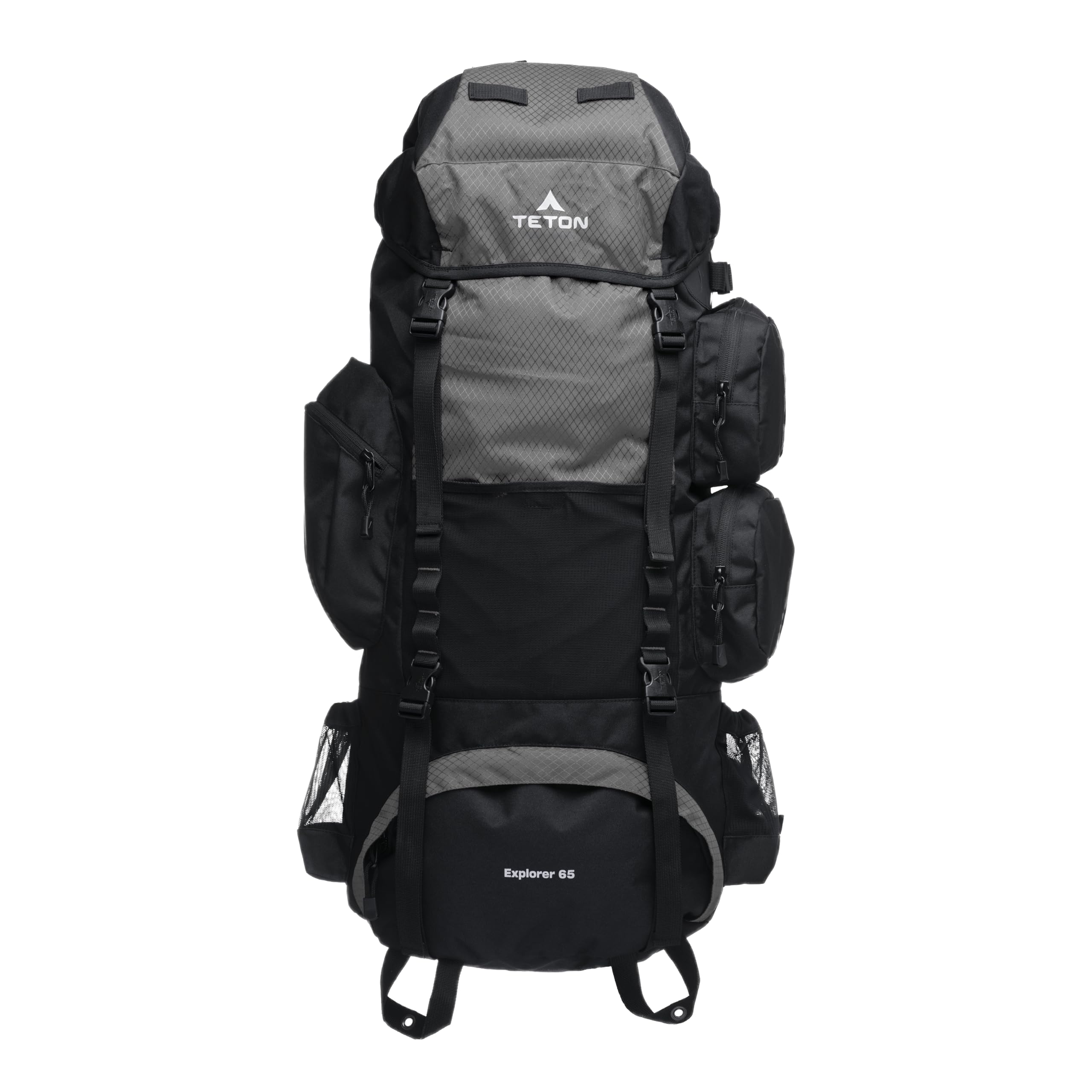
The TETON Sports Explorer 65L is the pack many first-time backpackers reach for, and for good reason — the multi-position torso adjustment system lets you dial in the fit across a wide range of body sizes, and the open-cell foam lumbar pad with molded channels provides a surprising level of back ventilation for a budget-priced pack. It comes in three volume options (55L, 65L, 75L) to match trip duration.
The internal frame uses a spring steel perimeter stay, which is more rigid than the flat sheet found on cheaper packs. This allows the Explorer to handle loads up to 40 pounds without the frame twisting. The included rain cover fits over the pack securely and stores in its own pocket, though the fabric is 600-denier polyester, which is heavier but more abrasion-resistant than the 100-denier nylon used on ultralight packs.
Reviewers highlight the comfortable carry at weights around 30 pounds, and the organization is solid — a large sleeping bag compartment with floating divider, multi-directional compression straps, and accessible zippered pockets. The hip belt lacks gear pockets, a common omission at this price point, and the mesh side pockets are on the small side for large water bottles.
Why it’s great
- Multi-position torso fits a wide range of sizes
- Included rain cover with dedicated pocket
- Spring steel frame handles loads up to 40 lb
Good to know
- Hip belt lacks gear pockets
- Mesh side pockets too small for large bottles
3. High Sierra Pathway 2.0 75L Backpack
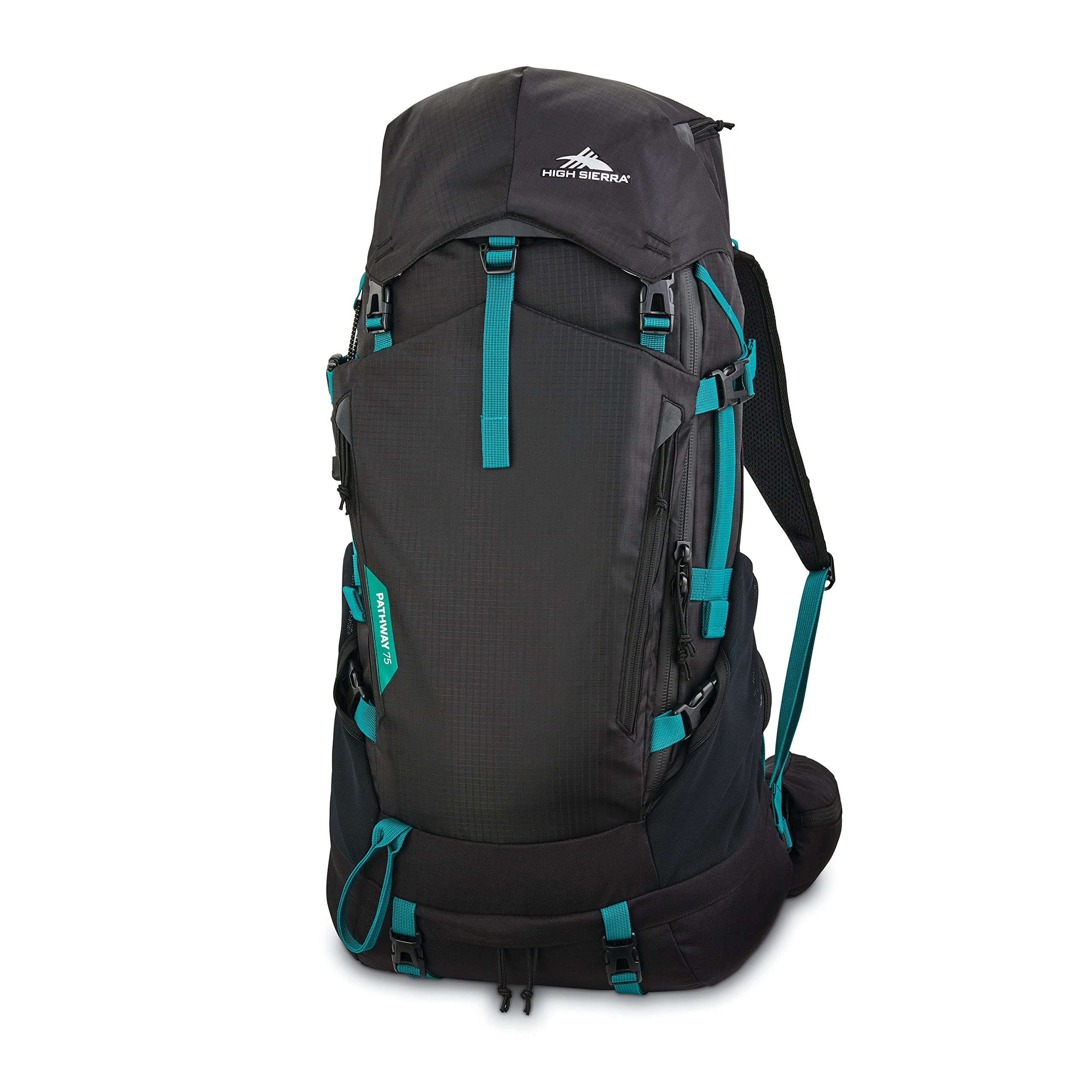
The High Sierra Pathway 2.0 75L prioritizes volume over weight — the large 75-liter capacity is ideal for youth groups, canoe trips, or multi-day hikes where pack weight is not the primary constraint. The EVA-molded and Airmesh back panel provides decent comfort, and the hydration sleeve with Velcro hanger accommodates a bladder up to 3 liters (not included).
The water-repellent coating on the exterior polyester fabric offers basic rain resistance, and the multiple exterior pockets including a front stuff pocket and two zippered pockets provide accessible storage. The stretch mesh water bottle pockets are generously sized, fitting a 32-ounce Hydro Flask.
Reviewers note the pack is best suited for loads under 25 pounds, as the suspension system lacks the rigid frame of dedicated backpacking packs. The hip belt is padded but thin, limiting load transfer effectiveness. This pack is a practical choice for short trips where comfort is less critical than sheer capacity, but it will not perform well for long-distance hiking with a heavy load.
Why it’s great
- Massive 75L capacity for group gear
- Stretch mesh pockets fit large water bottles
- Hydration sleeve with Velcro hanger
Good to know
- Suspension not designed for loads over 25 lb
- Hip belt is thin and limits load transfer
1. Mardingtop 65L+10L Internal Frame Backpack
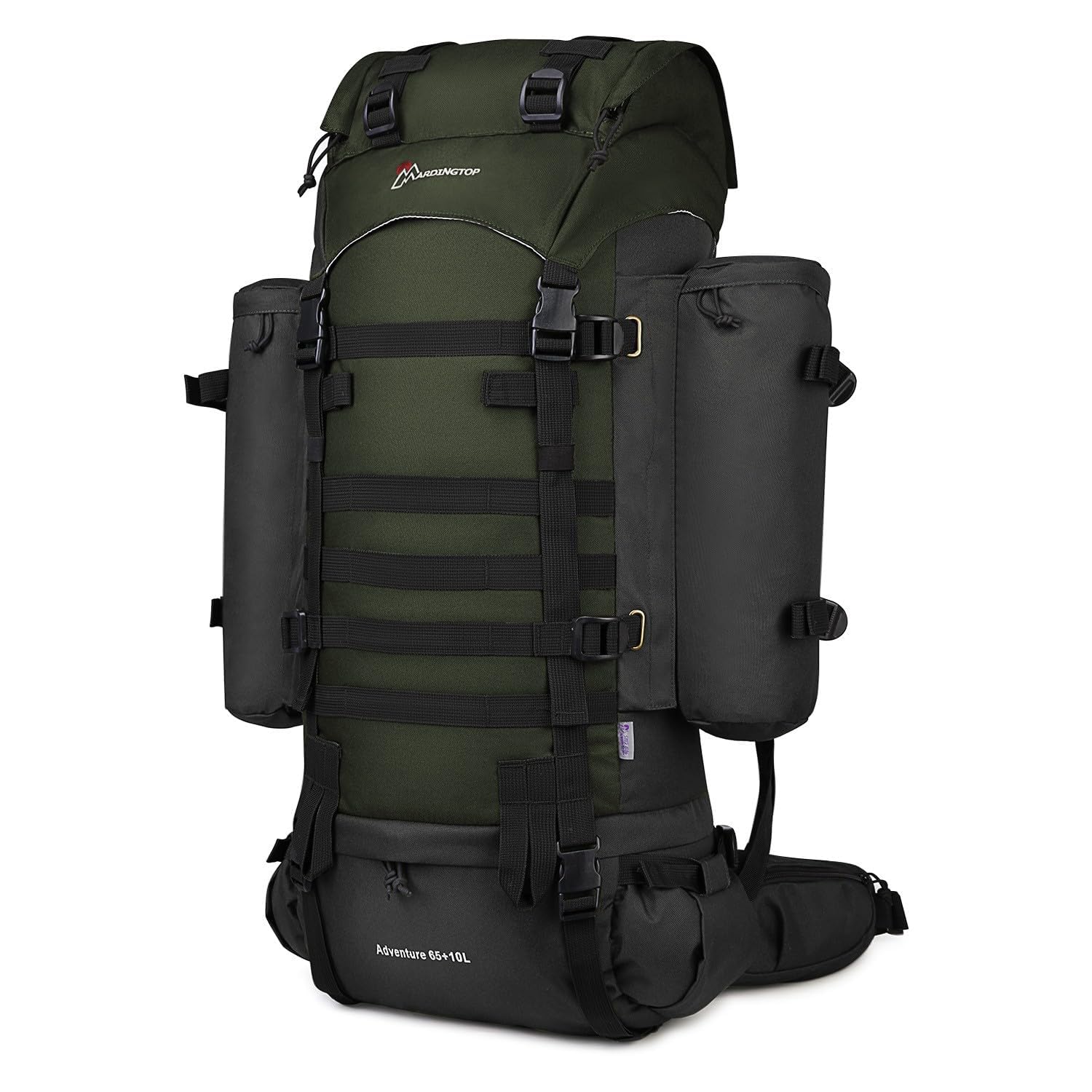
The Mardingtop 65L+10L adopts a military-style design with extensive MOLLE webbing on the front and sides, allowing attachment of external pouches for specialty gear. The fabric is a heavy-denier polyester that resists tearing well in brushy conditions, and the internal frame uses a metal perimeter stay that provides structure for loads up to 35 pounds.
The detachable side pouches add 10 liters of expandable volume and use a combination of Velcro and zipper attachment methods. The main compartment has an internal drawstring closure that helps separate the gear load from the pack liner, and the included rain cover provides basic wet-weather protection, though several reviewers mention the pouch zippers can shift open under heavy tension.
Reviewers report the pack holds up well over years of heavy use, with the single-stitch seams holding due to heavy thread gauge. The shoulder straps have a tendency to slip under very heavy loads (over 40 pounds), and the waist belt lacks the dense foam required to transfer load effectively. This pack is a solid budget option for moderate-load trips where MOLLE customization is a priority.
Why it’s great
- MOLLE webbing for extensive external customization
- Heavy fabric resists tearing in brush
- 10L detachable side pouches for expansion
Good to know
- Shoulder straps slip under heavy loads
- Side pouch zippers can unzip under tension
FAQ
Should I get a pack with an adjustable torso or a fixed-length pack?
What volume do I need for a multi-day hike?
Do I really need an internal frame for hiking?
Final Thoughts: The Verdict
For most users, the backpack for long distance hiking winner is the Osprey Rook 65L because it combines a proven ventilated suspension, integrated rain protection, and a comfortable 35-pound carry limit at a price that undercuts competitors. If you want a more stable frame for heavier loads over technical terrain, grab the Osprey Kestrel 68L. And for an ultralight option that still provides an adjustable torso and ventilated backpanel, nothing beats the Kelty Asher 55L.