
Our readers keep the lights on and the weekend projects moving. As an Amazon Associate, I earn from qualifying purchases.
Specs are compiled from manufacturer listings and verified buyer reviews and can change over time — please confirm the key details on the product page before buying.
You want to keep your phone, camera, and GPS alive on a multi-day hike or a long travel day, without hunting for an outlet. A backpack solar panel turns your pack into a portable charging station, but the real question is if you need a built-in battery or just a direct panel, how many watts are enough, and how the bag itself feels on your back for hours. This guide cuts through the marketing to help you pick a backpack solar panel that actually works for the way you move.
I’m Rikta — the founder and writer behind FitlyFast. This guide is built by comparing the manufacturers’ published specifications and the patterns across verified customer reviews, so you get each pick’s real strengths and trade-offs instead of marketing spin.
Below you’ll find in-depth reviews of six different backpack solar panel models, from budget-friendly daypacks to premium multi-day setups, all chosen for their real-world performance and build quality.
Quick Picks
- Voltaic Systems OffGrid Solar Backpack Charger with V50 Battery Power Bank — Best Overall
- Outdoor Tech Mountaineer Solar Backpack — Versatile Workhorse
- Voltaic Systems Converter Solar Backpack Charger — Smart Value
- Solar Backpack 7W Solar Panel ECEEN (50L) — Max Capacity
- MWS-ForCamping Solar Panel Travel Backpack (Fits 15.6 Inch) — Travel Tech Pack
- Solar Backpack Foldable Hiking Daypack ECEEN (30L) — Ultra Light
How To Choose The Best Backpack Solar Panel
The right backpack solar panel is about matching wattage (how much power it can produce per hour), storage capacity (whether it has a built-in battery to store that power), and if you need a battery. Here are the critical decisions to make before you buy.
Panel Wattage and Real-World Output
Wattage (W) tells you the maximum power the solar panel can produce under ideal sun. But real-world output is almost always lower. For example, a 6.5W panel might deliver 6-7W (4.8V 1.4A) in optimal conditions, as one MWS-ForCamping reviewer noted. You need enough wattage to overcome the intermittent sunlight on a moving backpack.
Built-in Battery vs. Direct Charge
A solar backpack without a battery stops charging the moment you walk into shade or the panel isn’t angled at the sun. Worse, it can even drain your device. A built-in battery pack, like the Voltaic V25 or V50, stores energy so you can charge your phone later, even after the sun dips behind a ridge.
Backpack Capacity and Comfort
Storage volume (measured in liters) determines whether this is a daypack or a multi-day trekking bag. A 20L pack is fine for a laptop and lunch, while a 50L bag can hold gear for a weekend. But more liters usually means more weight, so balance your needs with the pack’s overall weight and strap comfort.
Quick Comparison
| Model | Best For | Wattage | Capacity | Weight | Amazon |
|---|---|---|---|---|---|
| Voltaic Systems OffGrid | Serious multi-day charging with battery backup | 10 Watts | — | 4.16 lbs | Amazon |
| Outdoor Tech Mountaineer | Rugged day hikes and outdoor adventures | 6.5W | 40L | 3 lbs | Amazon |
| Voltaic Systems Converter | Everyday carry with a reliable solar charge | 5 Watts | 20L | 2.4 lbs | Amazon |
| Solar Backpack 7W ECEEN | High-capacity 50L pack with detachable panel | 7 Watts | 50L | 1.83 lbs | Amazon |
| MWS-ForCamping Solar Tech Backpack | TSA-friendly tech travel with a large panel | — | — | — | Amazon |
| Solar Backpack Foldable ECEEN | Ultra-light daypack for short trips | 6.5 Watts | 30L | 1.19 lbs | Amazon |
In‑Depth Reviews
1. Voltaic Systems OffGrid Solar Backpack Charger with V50 Battery Power Bank

The serious traveler’s solar rig with a built-in battery that stores power for cloudy moments.
This is the pick when you need a reliable charge even after the sun goes down. The OffGrid includes a V50 power bank (a 10000mAh+ battery pack), so it stores energy from the sun and delivers it to your phone, tablet, or USB devices at full speed, even in the shade. The 10-watt panel is the highest wattage in this group, and it’s made from monocrystalline cells that the maker claims can charge most smartphones completely in 3.5 hours of direct sunlight.
Reviewers consistently praise the build quality — one owner says it’s their third Voltaic backpack over 15 years and calls it a “high-quality material” bag that’s still a functional daily driver after a month. Another notes it’s comfortable for commuting, hiking, and biking in San Diego, charging an iPad Pro 12.9, AirPods, and an iPhone 7 Plus. The backpack weighs 4.16 lbs and is made from recycled PET material. At this wattage and with the integrated battery, it beats the 7W ECEEN below for consistent real-world charging, but the trade-off is a higher upfront cost and a heavier pack.
Performance highlights
- 10-watt monocrystalline solar panel charges a phone in about 3.5 hours of direct sun.
- Included V50 power bank (a battery pack) lets you charge devices later, away from direct sunlight.
- 2-year warranty on the solar panel and 1 year on the battery pack.
- Padded sleeve fits up to a 15-inch laptop.
Trade-offs to know
- At 4.16 lbs, it is the heaviest backpack here — noticeably heavier than the 1.83 lb ECEEN.
- One reviewer felt the solar panel might not work, so test before a long trip.
Grab it for: Multi-day trips where you need stored power after sunset, or if you want a rugged bag with a proven solar setup.
Look elsewhere: If you need an ultra-light daypack or are on a tight budget.
2. Outdoor Tech Mountaineer Solar Backpack

A rugged daypack with a detachable 6.5W panel made for actual outdoor use.
The Mountaineer is built for hiking, camping, and fishing with a 40-liter capacity and a flexible, detachable 6.5W solar panel. The panel can operate in temperatures from -20 to 80 degrees Celsius, so it handles extremes, but it charges slowly — one reviewer noted it charged a phone 10% in 35 minutes when laid flat in direct sun. The backpack itself is made from 100% ripstop nylon and weighs 3 lbs (1.4 kg).
Reviewers appreciate the multiple tech organization pockets and a bottom pocket that’s ideal for camera gear. Buyers report the panel is best used when the bag is stationary and flat, as the angle drops when worn. Unlike the Voltaic OffGrid, this pack has no built-in battery, so you’ll need a separate power bank to store that slow trickle of energy, which is a key trade-off for this pick.
What stands out
- Detachable 6.5W panel — you can leave the panel behind when you don’t need it.
- 40 liters of storage and 3 compartments with dividers for organization.
- Padded laptop slot that fits up to a 15-inch laptop.
Watch out for
- No built-in battery — the panel charges directly to a device and may drain it in shade.
- Zippers are not waterproof and some buyers found them prone to stripping.
- One buyer mentioned the item didn’t work at all.
Best suited for: Day hikers and campers who already own a power bank and want a versatile, spacious pack with a removable solar panel.
Not ideal for: Anyone who needs reliable stored power without carrying extra gear.
3. Voltaic Systems Converter Solar Backpack Charger

A compact, well-built 20L pack that includes a V25 power bank for evening charging.
If you need a solid daily carry that can also top off a phone during a hike, the Converter packs a lot of thought into a small frame. It includes a V25 power bank (a 4000mAh battery) that stores solar energy, so you can charge your phone later, even if the sun disappears behind a building or a tree. The 5-watt monocrystalline panel is lower wattage than others here, but paired with the battery, it delivered consistent charges for travelers — one owner reported it saved them “soooo many times” on trips.
The backpack itself is fully padded with a dedicated laptop sleeve fitting up to a 15-inch laptop, and the bag is made from waterproof fabric (recycled soda bottles). At 2.4 lbs, it’s lighter than the OffGrid, but one owner noted the zippers are tight and the water bottle holder is too snug for a standard Klean Kanteen. The panel is permanently attached, unlike the Mountaineer’s detachable panel, so you can’t separate the charging part from the bag.
What we like
- Includes a V25 power bank with the backpack — charges directly from the panel.
- Waterproof fabric made from recycled materials.
- Fits a 15-inch laptop and a 10-inch tablet.
The catch
- 5W panel is lower wattage than the 7W ECEEN or 10W OffGrid — slower charging in direct sun.
- Tight zippers and a snug water bottle pocket were common complaints in reviews.
- Comes with a micro-USB angled plug that may block other ports on your own battery pack.
Perfect for: Urban commuters or travelers who want a sleek, waterproof everyday bag with the security of a built-in battery backup.
skip it if: You need a large daypack (50L+) for multi-day gear or a detachable panel.
4. Solar Backpack 7W Solar Panel ECEEN (50L)

A massive 50L pack with a removable 7W panel, but no battery for cloudy days.
If you need to carry gear for a week-long trip and want a solar panel on top, this ECEEN backpack offers the most storage — 50 liters, which is 67% more capacity than the 30L foldable daypack below. The 7W panel is detachable via clips and can be hung separately, making it versatile for campsite charging. At just 1.83 lbs, it’s impressively light for a 50L bag.
Owners mention the bag itself is well-made with tight seams and good zippers, but the solar charger is a major point of contention. One customer observed it “wasn’t strong enough to charge my iPhone 6 and GoPro fast” and warned that if the sun isn’t angled correctly, the panel will drain whatever you’re trying to charge. This is a direct consequence of not having a battery buffer — a problem the Voltaic Converter (with its V25 battery) avoids, although the Converter carries far less gear.
Strong points
- 50-liter capacity fits a 17-inch laptop and multi-day gear.
- Detachable 7W solar panel can be used separately or on other bags.
- Weighs only 1.83 lbs — lighter than the 40L Mountaineer.
Weak points
- No battery — the panel can drain your device when shade hits.
- Customers note the 7W panel charges extremely slowly in real use.
Choose this if: Storage space is your top priority and you plan to keep devices plugged into a separate power bank, not directly to the panel.
Avoid if: You expect the solar charger to reliably top off a phone without a battery pack.
5. MWS-ForCamping Solar Panel Travel Backpack (Fits 15.6 Inch)
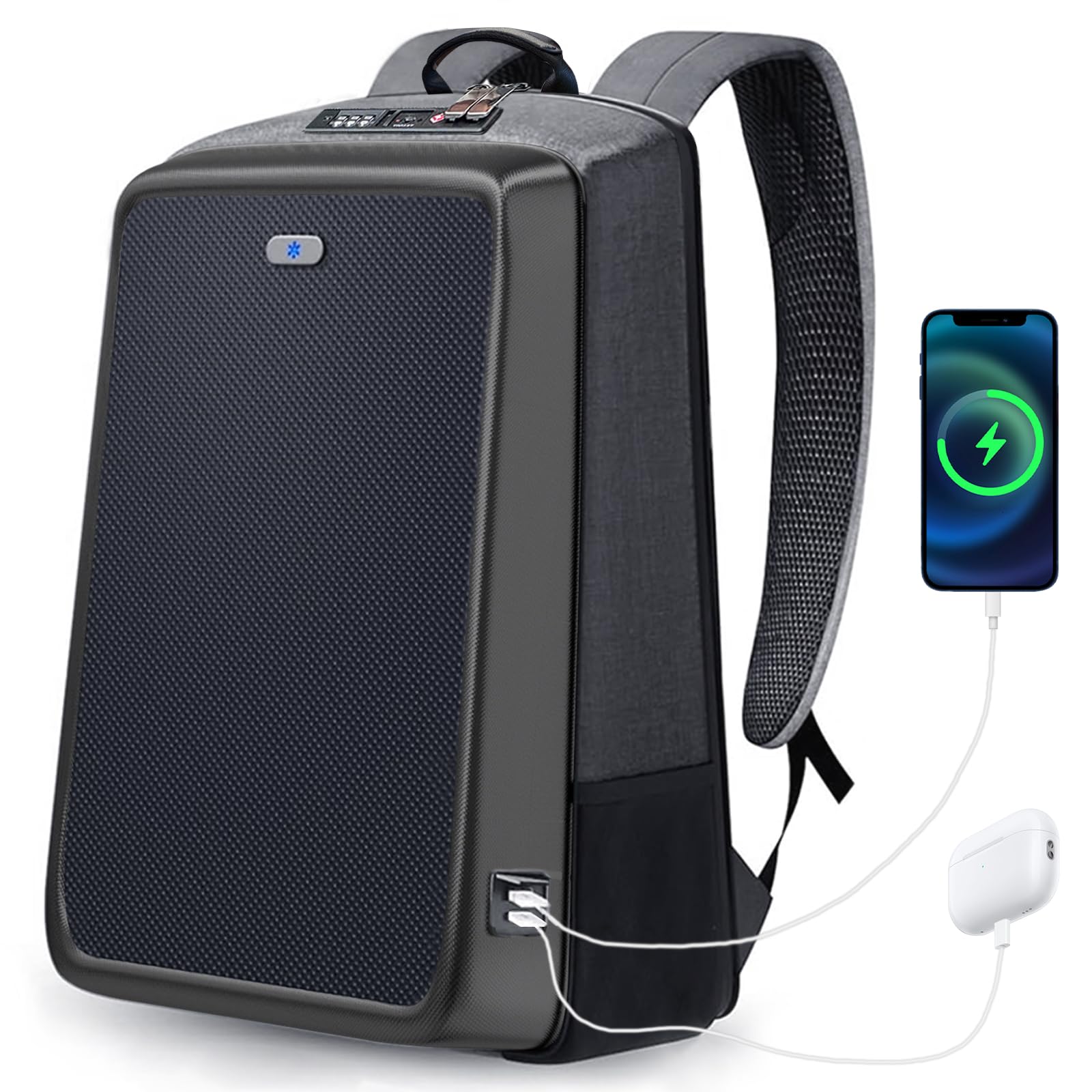
A professional-looking tech backpack with a TSA lock and a large rigid monocrystalline panel.
Designed for college students and business travelers, this backpack prioritizes security and a sleek look with a resettable TSA-friendly lock and a 1680D polyester shell. The integrated solar panel is a rigid monocrystalline silicon type, which one reviewer measured at 6-7W (4.8V 1.4A) in optimal conditions — comparable to the ECEEN’s 7W panel but in a non-removable form.
Reviewers highlight the convenience of USB and USB-C ports on the bag and note it fits two laptops and a portfolio. However, there are two significant trade-offs. First, the rigid panel can crack if the bag is overstuffed, and there’s no access for repairs. Second, one user highlighted the charging feature “did not work in any test, including direct sunlight,” and said the materials felt cheap. The real-world output is solid when it works, but consistency is a concern here. Unlike the Voltaic bags, this one lacks an included battery pack, so you must connect it to a power bank inside the zippered pocket.
Notable features
- TSA-friendly combination lock secures your laptop compartment.
- Fits two laptops (one slim 9.5″ and one up to 12″) and has 4 pockets for organization.
- Monocrystalline silicon solar panel rated for 25-30 years of use.
Caveats to consider
- Rigid panel can crack if the pack is overstuffed — no repair access.
- Side pockets are too small for a standard 12oz water bottle.
- One shopper added the charging feature didn’t work at all, and another found the materials and stitching cheap.
Good match for: Style-conscious travelers who need a lockable, TSA-compliant bag and are willing to add their own power bank.
Not for: Anyone who wants a detachable or flexible solar panel, or who needs reliable charging straight from the bag.
6. Solar Backpack Foldable Hiking Daypack ECEEN (30L)

The featherweight daypack that folds into a sandwich-sized pouch for packing away.
If you need a backup bag or an ultra-light day hike solution, this 1.19 lb pack is the lightest option here. It folds into a compact size of 7.5 x 1.96 x 12.2 inches, so you can stuff it into a larger suitcase or the 50L ECEEN above and pull it out for day trips.
Reviewers point out the bag is compact and lightweight, but the solar charging capability is weak. One reviewer noted, “I haven’t been able to really make good use of the solar charging, needs constant direct sunlight to work and even when it does, it charges very slowly.” The material is also described as “very thin” with uncomfortable straps, so don’t expect it to carry heavy loads. This makes it a very budget-friendly entry point for someone who mostly needs a daypack and sees the solar panel as a bonus, not a primary feature.
Why it’s useful
- Folds to a tiny size (7.5 inches long) for easy storage in a larger bag.
- At 1.19 lbs, it is 0.64 lbs lighter than the 50L ECEEN pack.
- Two open-mesh side pockets for water bottles.
The trade-offs
- Thin material and uncomfortable straps — not for heavy loads.
- Solar charging is very slow and requires constant direct sunlight, as shoppers say.
- Only one USB port.
Best for: Minimalist packers who want a collapsible daypack as a backup, or someone just dipping into solar charging on a budget.
Not suited for: Anyone who needs sturdy build quality or expects the solar panel to reliably charge devices during a hike.
Understanding the Specs
Wattage (W) and Real-World Output
Wattage measures the maximum power the solar panel can produce under ideal sunlight. More watts generally mean faster charging, but real-world output is always lower due to angle, clouds, and heat. A 7W panel typically delivers 6-7W in perfect conditions, as measured by an MWS-ForCamping reviewer, and the charge time for a phone can be 6-10 hours from a flat panel.
Battery vs. No Battery
A solar backpack without a built-in battery will charge your device only when the panel is in direct sunlight. If clouds pass or you walk into shade, the charging stops and can even drain your device. A bag with an integrated battery pack (like the Voltaic V25 or V50) stores the solar energy and delivers it at a steady rate to your phone, regardless of sunlight availability.
FAQ
Will a backpack solar panel charge my phone while I’m hiking?
Do I need a solar backpack with a battery?
How many watts do I need to charge a phone?
Can I use a separate power bank with a solar backpack that has no battery?
Are solar backpacks waterproof?
Can I remove the solar panel from the backpack?
How long does a solar backpack panel last?
Will a solar backpack fit a 17-inch laptop?
What is a TSA-friendly lock on a backpack?
Is a 50L solar backpack too heavy for day hiking?
Final Thoughts: The Verdict
If you want one dependable pick, the best backpack solar panel winner is the Voltaic Systems OffGrid because its 10-watt panel and V50 battery pack provide the most reliable charging across different weather conditions. If you want a more affordable everyday bag with a built-in battery, grab the Voltaic Systems Converter. And for a rugged daypack with a detachable panel, the Outdoor Tech Mountaineer is a strong choice for those who need to remove the panel when not hiking.
How We Picked
We do not accept paid placement. Every pick is matched to a real buyer and a real use-case; we do not hands-on test units.
Sources & Methodology
Specifications: manufacturer listings and product documentation. Review insights: verified customer reviews, as of July 2026. Pricing: not shown on this page (it changes often); check the current price via the retailer link.
As an Amazon Associate, FitlyFast earns from qualifying purchases. This does not affect which products we feature.