
Our readers keep the lights on and the weekend projects moving. As an Amazon Associate, I earn from qualifying purchases.
The most maddening thing about backpacking photography is how a sub-3-pound tripod often turns your sharp alpine vista into a blurry mess the second a gust hits. You need something that disappears in your pack but still locks down a long exposure, and the trade-offs between leg section count, tube diameter, and center-column design make that hunt surprisingly technical.
I’m Rikta — the founder and writer behind FitlyFast. I’ve spent years digging through carbon-fiber layup specs, comparing Arca-swiss plate tolerances, and filtering out the tripods that simply rattle apart after a few miles of trail abuse.
This guide breaks down the specific load ratings, folded lengths, and leg-lock reliability that matter when your camera gear is the only thing between you and a once-in-a-lifetime shot. Here is my curated selection of the backpacking camera tripod options that actually handle the trail.
How To Choose The Best Backpacking Camera Tripod
Selecting a tripod for the trail means obsessing over three competing variables: total weight, deployed stability, and how neatly it stows inside or on your pack. A full-size studio tripod that weighs five pounds is dead weight after ten miles, but a noodle-legged ultralight model will ruin every long exposure you attempt. The decision comes down to tube-wall thickness, leg-section math, and the ball head’s ability to lock without drifting.
Carbon Fiber vs Aluminum — The Real Weight Impact
Carbon fiber offers roughly a 30–40 percent weight reduction over aluminum at the same leg diameter, but not all carbon is equal. Cheaper carbon-fiber legs often use a lower strand count or weaker resin, which introduces micro-flex under load. Look for 8- to 10-layer carbon weave and a minimum leg diameter of 22mm at the top section if you plan to support a full-frame DSLR with a 70-200mm lens. Aluminum is heavier but can be significantly cheaper and more impact-resistant if you tend to bash your gear against rocks.
Leg Sections and Folded Length — The Trade-Off
A 5-section tripod collapses smaller than a 4-section model, often to around 16 inches or less, which slides easily into a water bottle pocket or the side of a 40L pack. The penalty is that more sections mean more joints, more potential for vibration, and a slightly narrower bottom leg diameter (sometimes as small as 10mm). A 4-section tripod with a 28mm top tube will be stiffer but fold closer to 21 inches — a meaningful difference if you are trying to fit it inside your main compartment.
Ball Head Basics — Arca-Swiss, Load Rating, and Damping
The ball head is where many budget tripods fail. An oil-free damping mechanism provides smooth resistance when you tilt the camera, preventing sudden drops. A 28mm or larger ball diameter gives enough surface area to lock a 5-pound rig without creep. The Arca-Swiss quick-release standard is the most universal across plate designs — proprietary plates are a headache to replace if you lose one on the trail.
Quick Comparison
On smaller screens, swipe sideways to see the full table.
| Model | Category | Best For | Key Spec | Amazon |
|---|---|---|---|---|
| K&F CONCEPT A255C2+BH-36L | Carbon Fiber | Serious hikes, full-frame gear | 1.34 kg / 5-section legs | Amazon |
| NEEWER N55CR | Carbon Fiber | Tall users, 6ft+ | 80.7″ max height / 28mm column | Amazon |
| K&F CONCEPT T254A7+BH-28L | Carbon Fiber | Overhead & low-angle shoots | 90″ max / 28mm center column | Amazon |
| SIRUI AM-223+B-00K | Mini Carbon | Ultra-compact, low-angle hiking | 1.62 lbs / 16″ max height | Amazon |
| NEEWER TP17B | Carbon Fiber | Phone + camera hybrid use | 64″ max / includes phone mount | Amazon |
| Pivo Extendable Tripod | Alloy | Content creation, Pivo users | 63″ max / 11 lbs load | Amazon |
| SIRUI AM-223+SL-100 | Mini Carbon | Budget hikers, GoPro/compact cam | 1.46 lbs / 26″ max height | Amazon |
In‑Depth Reviews
1. K&F CONCEPT A255C2+BH-36L

This K&F model hits the sweet spot for backpackers who need a full-height tripod without the bulk. The aerospace-grade carbon fiber brings the total weight to just 2.9 pounds, and the 5-section legs collapse to 19.2 inches — short enough to fit vertically inside most carry-on luggage or a pack’s side pocket. The 35mm ball head handles up to 33 pounds of load with oil-free damping, so your long exposures stay crisp even when you tilt the camera to an extreme angle.
The center column inverts for macro or low-angle work, dropping the camera close to the ground without needing to spread the legs unnaturally wide. I appreciate the removable monopod feature here because it gives you a secondary support for waterfall shots or panned video sequences. The metal knob locks on each leg section feel precise; they don’t bind even after exposure to trail dust.
One thing to note: at the shortest folded position of 18.8 inches, this tripod is still too tall for a water-bottle pocket that holds a standard liter bottle. It belongs strapped to the outside or packed vertically. The 5-section design means the bottom leg tubes are a bit thin — around 16mm — so in high wind you will want to hang your pack from the center hook for extra mass.
Why it’s great
- 33-pound load capacity in a sub-3lb package
- Inverted center column for ground-level macro shots
- Detachable monopod converts in seconds
Good to know
- Folded length (19.2″) may not fit small side pockets
- Bottom leg sections are thin; wind stability needs added weight
- Ball-head swivel can drift slightly with very heavy telephoto lenses
2. NEEWER N55CR

If you are over six feet tall and tired of stooping over your tripod, the N55CR extends to 80.7 inches without the center column feeling wobbly. The 28mm diameter center column and 4-section legs give it a rigidity that stands out in its weight class. The 36mm ball head offers 360-degree panning with separate locking knobs, so you can frame a panorama without the camera tilting mid-sweep.
The tripod-to-monopod conversion is straightforward: twist off the center column, detach one leg, and you have a walking stick that adjusts from 22.2 to 83.8 inches. On the trail, that dual-purpose design saves you from carrying a separate trekking pole. The weight hook underneath the center column accepts a carabiner or small sandbag, which helps when you shoot in conditions that would otherwise vibrate the frame.
Some users report that the ball head exhibits slight wander when a 2.5-pound mirrorless body is attached. The twist locks on the legs release easily but require a full rotation to lock tight, which slows setup compared to flip locks.
Why it’s great
- Exceptional height (80.7″) for tall photographers
- 28mm center column reduces vibration
- Converts to a functional monopod/walking stick
Good to know
- Ball-head wander with lightweight mirrorless bodies
- Twist locks need full rotation — slower than flip locks
- Folded size (22″) is on the longer side for packing
3. K&F CONCEPT T254A7+BH-28L

The T254A7 is the tallest tripod on this list at 90 inches, and its patent gimbal-style head allows the center column to tilt 0-180 degrees and rotate 360. That means you can shoot straight down at a product on the ground or aim upward at a canyon wall without repositioning the legs. The 28mm diameter center column and 4-section legs hold a 22-pound load, making this a viable option for heavier spotting scopes or DSLR rigs with battery grips.
For backpackers who do tabletop or overhead macro work, the ability to extend one leg out horizontally and invert the column is a rare feature. The detachable monopod extends to a usable height for candid street photography or quick trail-side shots. The leg locks are paddle-style flip locks, which snap open and closed faster than twist locks — a real advantage when you are rushing to catch changing light.
The trade-off is weight: at 4.4 pounds, this unit is noticeably heavier than the sub-3-pound options. It also folds to 21.3 inches, which is borderline for interior pack storage. Consider this tripod if you drive to trailheads or do day hikes with a dedicated camera bag; it is less ideal for multi-day thru-hikes where every ounce matters.
Why it’s great
- 90-inch maximum height for elevated perspectives
- Gimbal-style head allows horizontal center column positioning
- Quick-action flip locks for fast setup
Good to know
- 4.4 lbs — heavier than other backpacking tripods
- Folded length (21.3″) may not fit small packs
- Some leg push-in locks can require extra force to retract
4. SIRUI AM-223+B-00K

This SIRUI mini tripod is for backpackers who shoot from ground level — think foreground-interest landscapes, low-angle creek shots, or fungi close-ups. At 1.62 pounds and a folded length of 12.1 inches, it disappears into almost any pack compartment. The 10-layer carbon fiber legs support up to 33 pounds, which is absurdly overbuilt for a tripod this small, but it means you can trust it with a heavy DSLR and a telephoto lens without worrying about collapse.
The B-00K ball head includes an Arca-Swiss quick release plate and offers 360-degree panning. The legs flatten to nearly 180 degrees, so you can set the camera just inches above the dirt. SIRUI includes a storage bag, an adjustment wrench, and metal spikes for icy terrain — a thoughtful addition for winter hikers.
The limitation is obvious: maximum height is only 16 inches. You will be crouching or lying down to compose every shot. Some users note that the tightening screw on the B-00K head can dig into the plate if over-torqued, leaving small gouges. Use the included hex key for gentle adjustments rather than forcing the knob by hand.
Why it’s great
- Ultra-compact folded size (12.1″) for tight pack fits
- 33-pound capacity far exceeds its size class
- Legs lie flat for extreme low-angle shots
Good to know
- Max height of 16″ requires ground-level shooting
- Ball-head tightening screw can mar the plate if overtightened
- Not suitable as a primary tripod for standing-height work
5. NEEWER TP17B
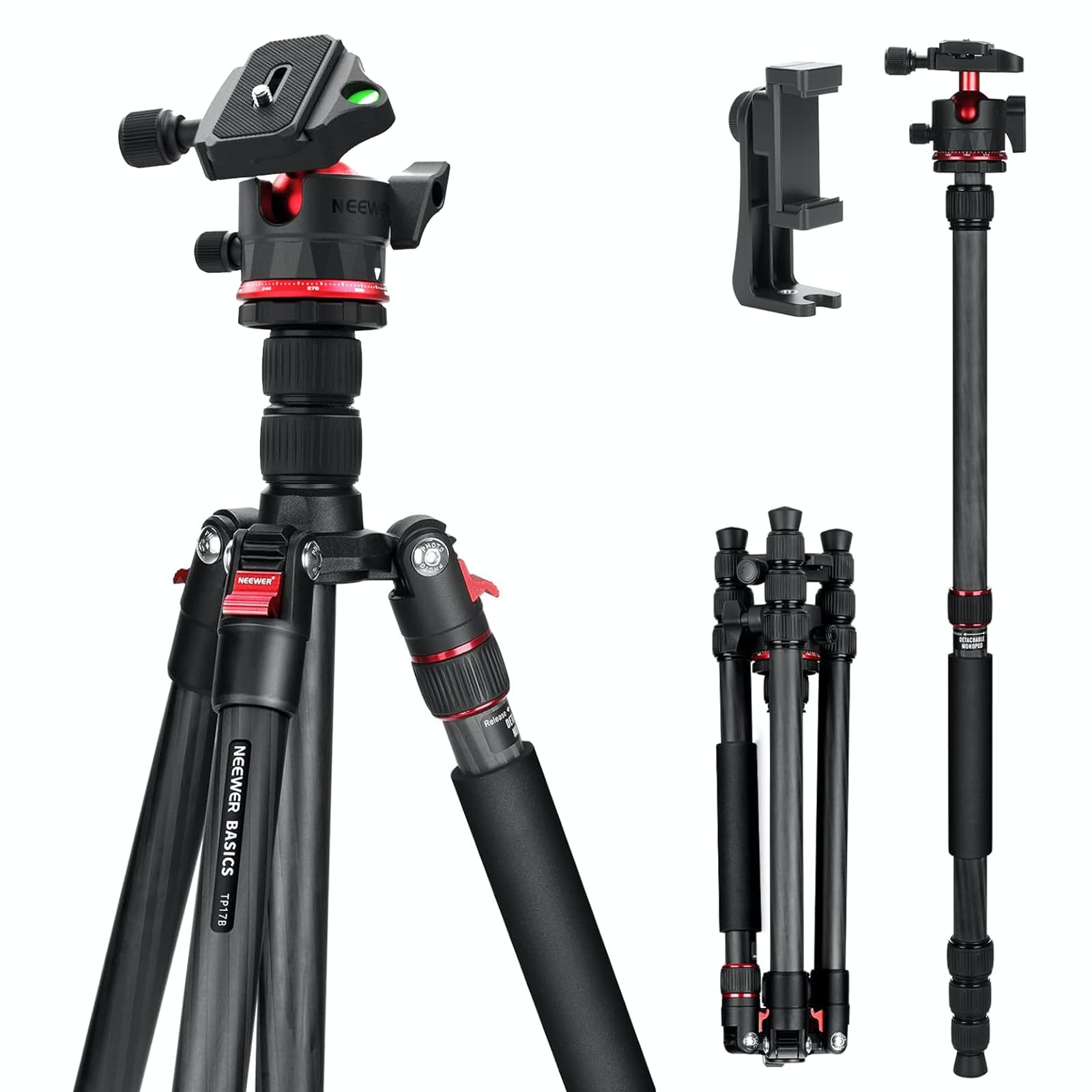
The TP17B bridges the gap between lightweight DSLR support and smartphone content creation. It comes with a built-in cellphone holder, so you can swap between a Canon DSLR and an iPhone without buying extra adapters. The carbon fiber legs support 13.2 pounds and extend to 64 inches, and the 360-degree ball head tilts 90 degrees for portrait-mode video. Reversible legs fold to 16.3 inches, making it a practical travel companion for both photographers and vloggers.
Setup is fast: the leg angle selector lets you choose from three positions, and the twist locks are smooth enough to adjust with one hand. The monopod conversion works by removing the center column and one leg, giving you a secondary shooting stick that extends past 60 inches. For the price, the build quality is solid — the carbon weave is clean, and the metal components show no sharp edges.
The ball head works fine for lighter mirrorless bodies, but the included quick release plate lacks the precision of a true Arca-Swiss standard. If you plan to attach a 5-pound rig, the head can drift slightly when locked. The phone holder feels secure but uses plastic clamps that may wear out after repeated use over several seasons.
Why it’s great
- Phone mount included for hybrid photo/video work
- Compact folded length (16.3″) fits carry-on luggage
- Monopod conversion adds versatility on the trail
Good to know
- Quick release plate is not genuine Arca-Swiss
- Ball head may drift with heavier lenses
- Phone holder clamps feel somewhat plasticky
6. Pivo Extendable Tripod

This tripod is specifically designed to work with the Pivo tracking device, making it a dedicated solution for solo content creators who want hands-free video capture. The universal clamp holds both the Pivo unit and your phone, while the 1/4-inch thread on top accommodates a DSLR or action camera. The legs include an adjustable hook at the base for hanging a weight bag, which helps stabilize the frame when you are recording outdoor interviews or workout routines.
The telescopic neck rotates 360 degrees and extends to 63 inches, and the folded size is 16 inches — small enough for a gym bag or daypack. The build leans toward lightweight alloy rather than carbon fiber, so the overall weight is reasonable at about 1.8 pounds. For backpackers who also produce fitness or travel content, the ability to film hands-free is a clear advantage.
Durability is a concern: multiple users report that the plastic leg-angle clip can break after a year of use, causing one leg to no longer lock in the open position. The Pivo mount itself also requires the separate Pivo device to function, so this tripod is less useful as a standalone photography tool. If you do not own a Pivo, the universal clamp still works, but the locking mechanism is not as robust as dedicated tripods at this price point.
Why it’s great
- Optimized for Pivo auto-tracking content creation
- Folds to 16″ — good for daypacks and gym bags
- Weight hook improves stability in windy conditions
Good to know
- Plastic leg clip may fail over extended use
- Not a standalone photography solution without Pivo
- Load capacity (11 lbs) limits heavier lens setups
7. SIRUI AM-223+SL-100
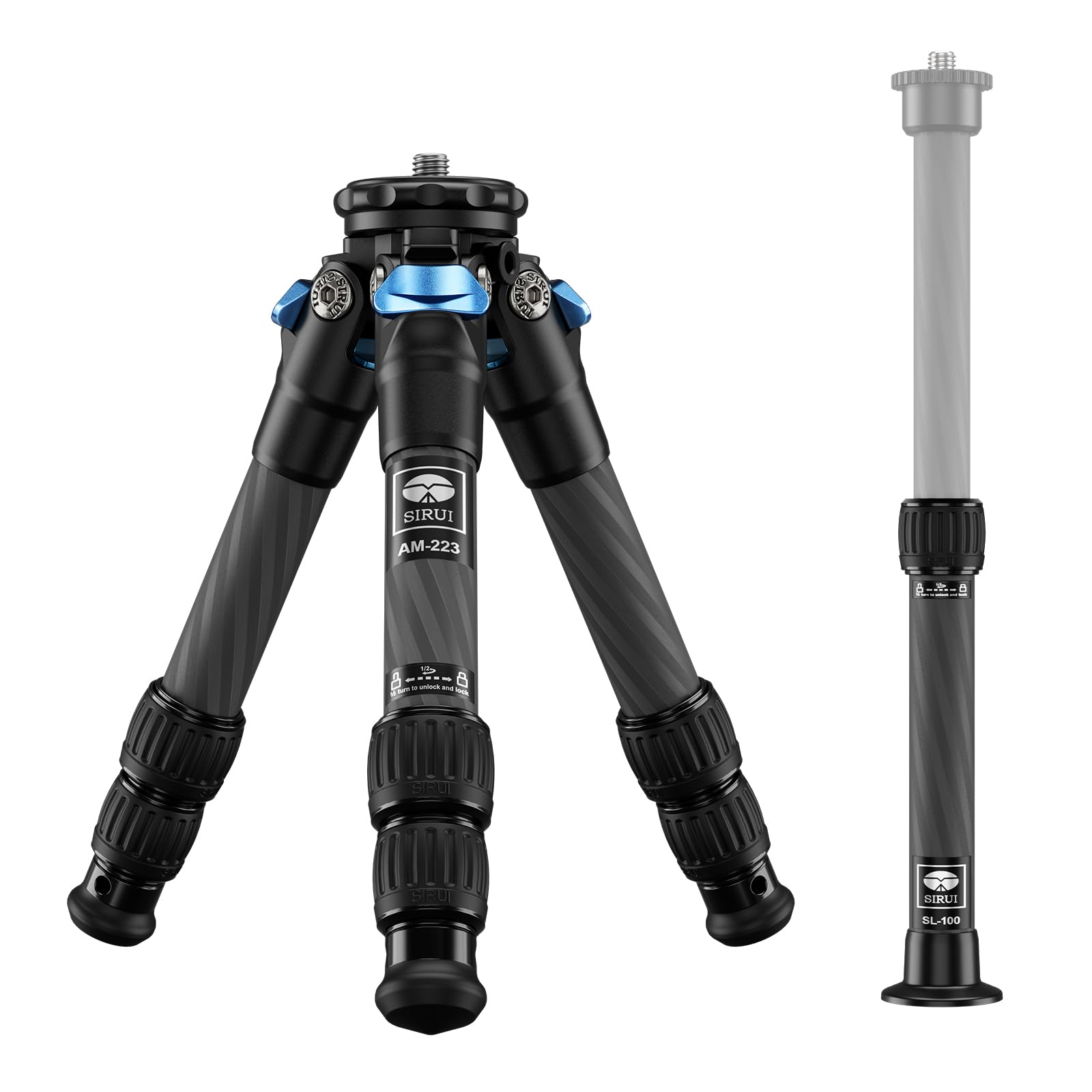
The AM-223+SL-100 is the lightweight mini that started the trend. At 1.46 pounds total, it is the lightest tripod on this list, and the detachable two-section center column adds 12.2 inches of extra height when you need it. Without the column, the tripod collapses to just 8.5 inches — small enough to fit inside a jacket pocket or a small pouch. The 22mm carbon fiber legs support up to 22 pounds, which is more than enough for a mirrorless camera or a compact DSLR with a standard zoom.
The three-position leg angle adjustment (22°, 55°, 85°) lets you set up on uneven terrain, and the rubber feet double as metal spikes when you twist them off. The 1/4-inch accessory port on the center column allows you to attach a microphone or a small light without a separate clamp. For budget-conscious hikers who want to step up from a gorillapod, this SIRUI offers genuine rigidity at a fraction of the cost of premium mini tripods.
The biggest limitation is the maximum height: even with the center column attached, you only reach 26 inches. You will be shooting from a seated or kneeling position for nearly every shot. The ball head is not included — you buy the legs and column as a set, and must supply your own head or use the built-in 1/4-3/8 convertible screw. The carrying sleeve is snug and does not accommodate a mounted ball head, so you will have to disassemble the head each time you pack it.
Why it’s great
- Extremely lightweight (1.46 lbs) and packable (8.5″ folded)
- Detachable center column adds 12.2″ of adjustable height
- Metal spikes included for icy or loose terrain
Good to know
- Max height of 26″ requires low shooting positions
- No ball head included — must purchase separately
- Carrying sleeve too short to store head attached
FAQ
Can I use a 5-section backpacking tripod in wind?
What is the ideal folded length for a backpacking tripod?
Should I choose a ball head with an Arca-Swiss plate?
Final Thoughts: The Verdict
For most backpackers who shoot full-frame or high-end mirrorless gear, the best backpacking camera tripod winner is the K&F CONCEPT A255C2+BH-36L because it balances a 2.9-pound weight with a 33-pound load capacity and folds to a pack-friendly 19.2 inches. If you need eye-level height for tall terrain or wildlife compositions, grab the NEEWER N55CR. And for ultralight fast-packers who shoot from ground level, nothing beats the compact SIRUI AM-223+B-00K.