
Our readers keep the lights on and the weekend projects moving. As an Amazon Associate, I earn from qualifying purchases.
A backpacking cooking system is the single most important gear decision you make before a multi-day trip. The wrong setup leaves you eating cold food, wasting fuel, and hauling unnecessary weight. The right one delivers hot meals in minutes, packs down to the size of a water bottle, and lets you focus on the trail instead of the cookfire.
I’m Rikta — the co-founder and writer behind FitlyFast. I’ve spent hundreds of hours analyzing burn rates, fuel efficiency, packed volumes, and boil times across the current market to separate the systems that actually perform in real alpine conditions from those that fail the moment a gust of wind hits them.
Every system here has been vetted for trail-readiness. This guide breaks down seven of the most capable backpacking cooking system options available right now, cutting through marketing claims to help you choose the one that matches your style.
How To Choose The Best Backpacking Cooking System
An integrated cooking system pairs a burner, pot, and often a heat exchanger into one unified unit. Unlike a standalone stove where you carry a separate pot and lid, these systems are designed for maximum thermal efficiency and minimal weight. The key factors to evaluate before buying are boil speed, wind resistance, fuel type compatibility, and how the system nests together in your pack.
Boil Time and Fuel Efficiency
The time it takes to boil half a liter of water is the most frequently quoted spec, but fuel efficiency tells the real story. A system that boils water in two minutes but burns through a canister in three meals is less useful than one that takes three minutes but delivers four extra boils per canister. Look for FluxRing or heat exchanger designs that channel heat into the pot walls rather than letting it escape from the bottom.
Wind Resistance
Wind is the number one enemy of stove efficiency on exposed ridgelines or alpine lakeshores. Standard open-flame burners lose enormous heat to even a mild breeze. Systems with a radiant burner, like the MSR WindBurner, enclose the flame entirely, while others use a pot lip design that shields the burner. If you often cook in open terrain, prioritize a system that does not require a separate windscreen.
Packed Weight and Volume
Integrated systems nest the burner, fuel canister, and pot into one compact cylinder. The Jetboil Stash packs the entire system into an 0.8L pot that stands just over five inches tall. If you are crossing long distances where every cubic inch counts, a system that swallows a 100g canister inside the pot saves critical space. For shorter trips or group cooking, a larger pot with multiple pieces may be acceptable.
Fuel Type
Most integrated systems use isobutane-propane canisters because they light easily and burn cleanly. Liquid fuel stoves like the MSR Dragonfly burn white gas, kerosene, or unleaded gasoline, which is essential for winter expeditions or international travel where canisters are unavailable. Canister stoves are lighter and simpler, while liquid fuel stoves offer better cold-weather performance and refueling flexibility.
Quick Comparison
On smaller screens, swipe sideways to see the full table.
| Model | Category | Best For | Key Spec | Amazon |
|---|---|---|---|---|
| Jetboil Flash | Integrated Canister | Fast solo boil | 16 oz in 2 min | Amazon |
| MSR WindBurner Personal | Radiant Burner | Windy alpine conditions | Radiant burner | Amazon |
| Jetboil Stash | Ultralight Integrated | Ultralight solo trips | 7.1 oz total | Amazon |
| MSR Dragonfly | Liquid Fuel | Winter & group cooking | Multi-fuel | Amazon |
| Stanley Adventure Camp Pro | Modular Set | Car camping & basecamp | 4-person capacity | Amazon |
| Odoland Heat Exchanger Set | Budget Integrated | Entry-level backpacking | 9-piece set | Amazon |
| Odoland 18-Piece Large Set | Group Cook Set | Car camping groups | 4.3L hanging pot | Amazon |
In‑Depth Reviews
1. Jetboil Flash Portable Fast Boil Stove
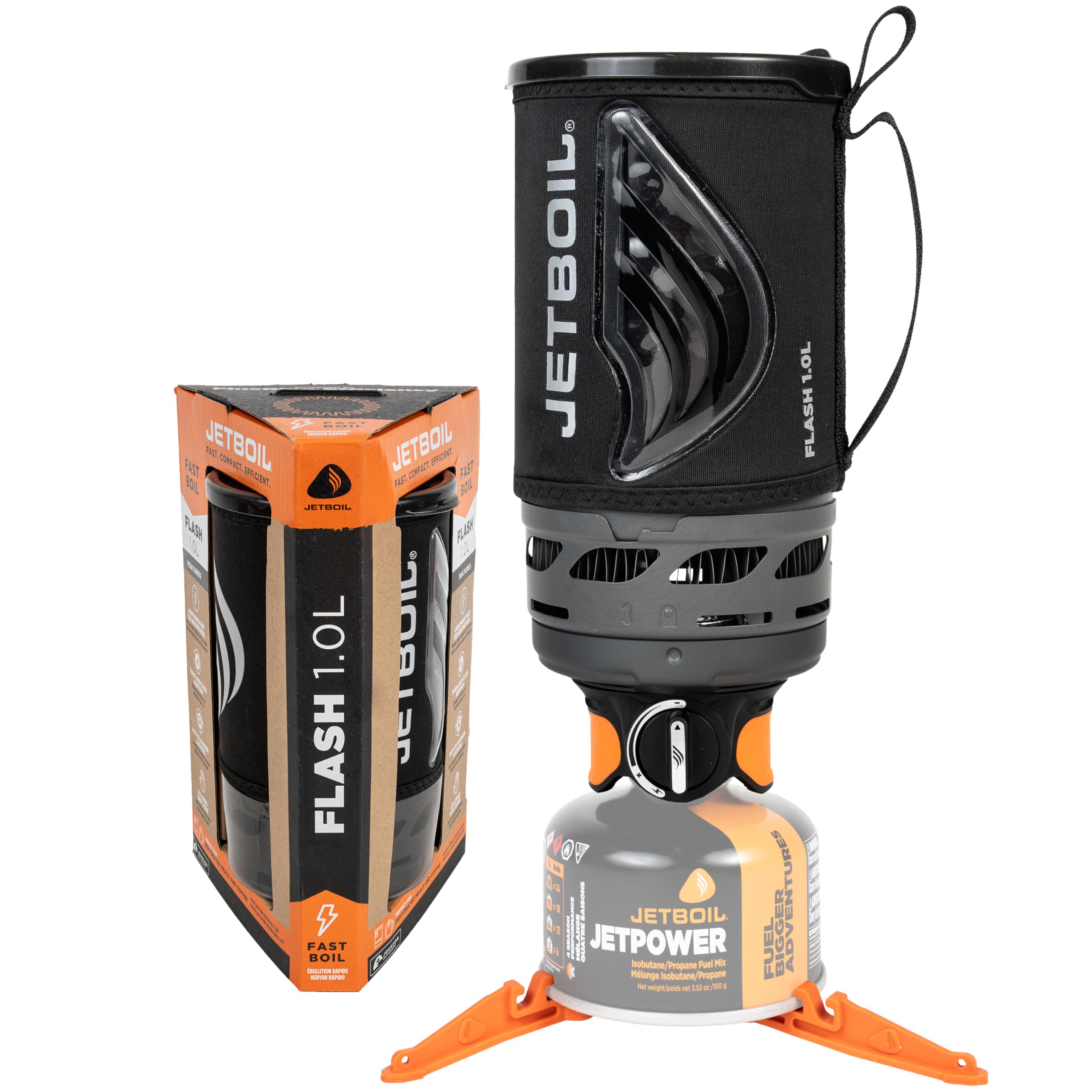
The Jetboil Flash is the benchmark for solo backpacking stoves. Its FluxRing heat exchanger transfers heat directly into the pot walls, achieving a 16-ounce boil in roughly two minutes. The one-step auto-ignition knob eliminates the need for a separate lighter, and the full-color thermochromatic indicator on the cozy turns red when the water is near boiling — a small touch that saves you from guessing.
What makes the Flash stand out is how well the components pack together. The burner, a 100g fuel canister, and the canister stabilizer all fit inside the 1-liter cooking cup. The bottom cup doubles as a measuring cup or a bowl, and the lightweight cozy insulates the pot so your water stays hotter longer after the flame goes out. At 0.82 pounds total, it shaves ounces compared to modular setups.
The locking system uses three points with visual indicators, so the pot connects securely to the burner. The rubberized, color-coded Safe-Touch zone stays cool during operation, giving you a comfortable grip area. Wind performance is decent for an open-flame burner, though it benefits from a natural windbreak in exposed conditions. This is the system to buy if you want the fastest, most streamlined boil for one person.
Why it’s great
- Boils 16 oz of water in under two minutes
- Reliable auto-ignition that works in cold temps
- Compact nesting design fits canister and burner inside pot
- Thermochromatic indicator confirms boil without removing lid
Good to know
- Not designed for simmering or frying
- Wind performance is average; needs wind protection
- Fuel canister sold separately
2. MSR WindBurner Personal Stove System
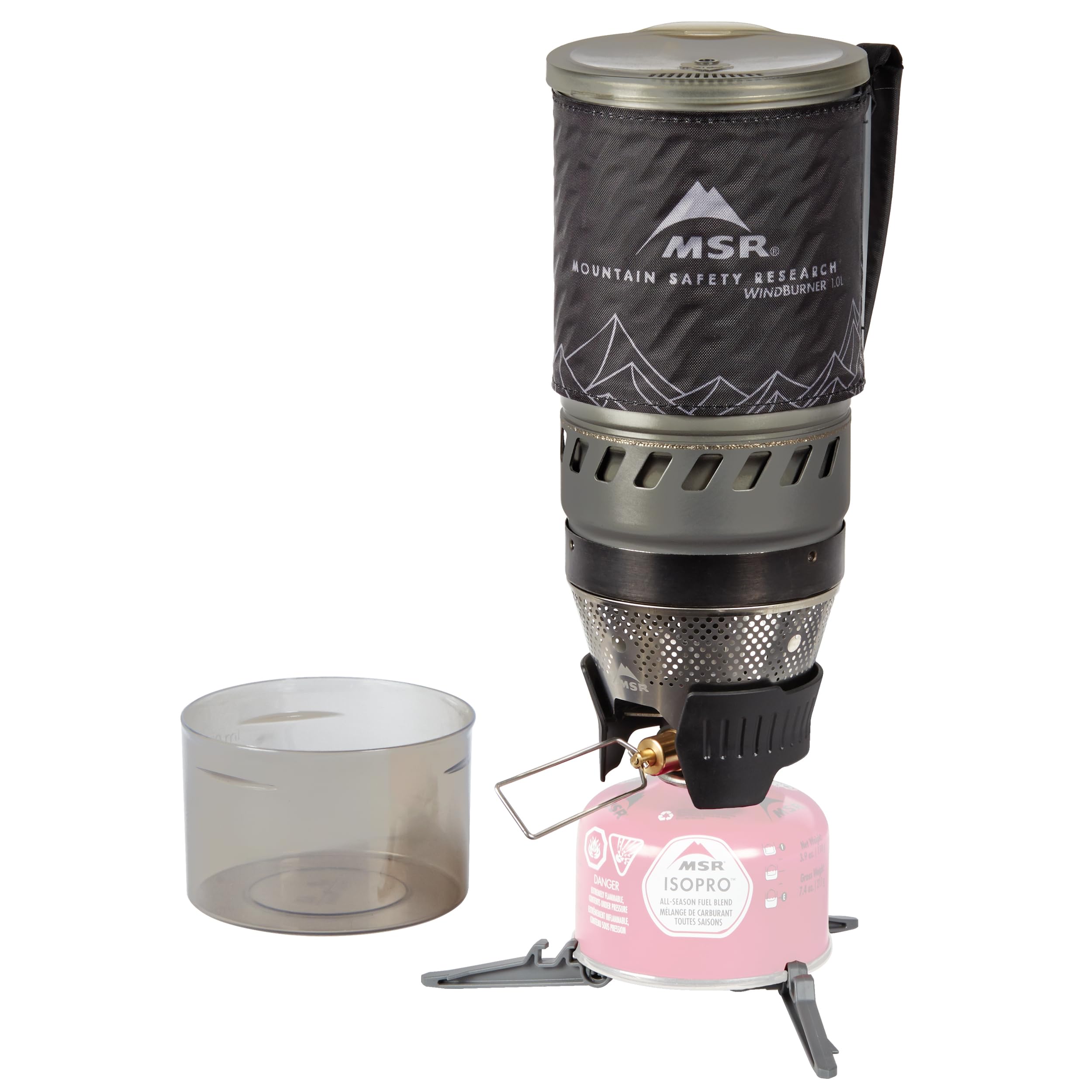
The MSR WindBurner solves the single biggest problem with canister stoves: wind. Its radiant burner encloses the flame completely, so a 20-mph gust has almost no effect on boil time. Where open-burner stoves can double their boil time in moderate wind, the WindBurner delivers consistent half-liter boils in under two minutes regardless of conditions. The pressure regulator also maintains performance as the canister cools in cold weather.
The 1.0-liter pot has a hard-anodized aluminum body that resists scratches and distributes heat evenly. The BPA-free lid doubles as a strainer, and the PFAS-free cozy keeps contents hot. An integrated 0.5-liter bowl snaps onto the outside of the pot, giving you a two-person capacity without increasing packed volume. The pot locks directly onto the burner and canister, creating a stable platform that resists tipping even on uneven ground.
The WindBurner does not include a piezo igniter, so you need a separate sparker or lighter. Simmering is limited — the burner has three effective heat settings — but for rehydrating meals and boiling water, it is the most reliable system in windy conditions. The fuel efficiency advantage in wind means you carry fewer canisters on multi-day trips. If your campsites are frequently exposed, this is the system to beat.
Why it’s great
- Radiant burner is virtually windproof
- Pressure regulator maintains performance in cold temps
- Stable lock-on design prevents tipping
- Excellent fuel efficiency in real-world windy conditions
Good to know
- No built-in igniter; requires separate lighter
- Limited simmer control
- Only works with MSR WindBurner cookware
3. Jetboil Stash Ultralight Cooking System

The Jetboil Stash is the lightest integrated system Jetboil makes, tipping the scales at just 7.1 ounces. The secret is a titanium burner that shaves nearly two ounces off the Flash without sacrificing the FluxRing heat exchanger. Despite the weight reduction, it still boils half a liter in around 2.5 minutes — fast enough for a quick breakfast before breaking camp.
The nesting design is where the Stash really excels. The titanium burner, its storage pouch, and the fuel stabilizer all fit neatly inside the 0.8-liter FluxRing pot. The snap-on lid includes an integrated pour spout and a storage compartment for a 100g JetPower canister and a mini-lighter. The total packed height is just 5.1 inches, which slides into side pockets or the bottom of a frameless pack with ease.
The Stash lacks a built-in igniter, so you must carry a separate lighter. The 0.8-liter pot is tight for two-person meals but perfect for solo use. The FluxRing does improve fuel efficiency compared to a bare pot, but the open flame is still susceptible to wind. For thru-hikers and fast-and-light travelers who count every gram, the Stash delivers integrated system performance in an ultralight package.
Why it’s great
- Total system weight of only 7.1 ounces
- Compact 5.1-inch packed height
- FluxRing provides good fuel efficiency
- Stores fuel canister and lighter inside pot
Good to know
- No integrated igniter
- 0.8L capacity is small for two people
- Wind performance is average
4. MSR Dragonfly Liquid Fuel Stove

The MSR Dragonfly is the stove for expeditions where conditions and fuel availability are unpredictable. Its dual-valve design provides real simmer control, from a gentle flame for scrambled eggs to a full roar for melting snow. It burns white gas, unleaded gasoline, kerosene, and even diesel and jet fuel with the appropriate jet swap, making it usable anywhere in the world.
The wide pot supports accommodate pans up to ten inches in diameter, giving you the stability needed for group cooking. The stove folds down to roughly one-third of its operating size for storage inside a two-liter pot. The included windscreen and heat reflector improve efficiency in exposed conditions, and the Shaker Jet technology allows field cleaning without disassembly.
The Dragonfly is heavier than canister stoves at 14.1 ounces, and it is louder at full output — comparable to a jet engine at full blast. The startup procedure requires priming the fuel line, which takes about two minutes of practice to master. For serious backpackers, mountaineers, and international travelers who need a stove that performs in subzero temperatures and runs on whatever fuel is available, the Dragonfly is the workhorse choice.
Why it’s great
- True simmer control for gourmet backcountry meals
- Accepts multiple fuel types for global travel
- Stable with large pots up to ten inches
- Field-serviceable without tools
Good to know
- Heavier than canister integrated systems
- Loud at full output
- Requires priming before each use
5. Stanley Adventure Even-Heat Camp Pro Cookset

The Stanley Adventure Even-Heat Cookset is a modular pot set designed for groups of four at basecamp or car-camping sites. The 2.6-quart pot is built from 18/8 stainless steel that will not rust or break, with a locking handle that secures the lid during transport. The nesting system accommodates a small fuel canister inside the pot, keeping the kit compact for its capacity.
The set includes bowls, sporks, and a serving utensil for four people, along with a strainer lid that makes draining pasta simple. The stainless steel construction distributes heat evenly across the bottom, which matters when cooking meals that require simmering rather than just boiling. Stanley backs the set with a lifetime warranty, reflecting confidence in the build quality.
At 1.9 pounds, this is not an ultralight system for thru-hiking. The included sporks are functional but basic, and some users find the spoon too shallow for thick stews. The set works best with a canister stove or over a campfire using the locking handle to hang the pot. For family camping trips where you want one durable pot that feeds everyone, this is a solid mid-range option.
Why it’s great
- Durable 18/8 stainless steel construction
- Lifetime warranty from Stanley
- Strainer lid built into the pot
- Nests compactly for its group capacity
Good to know
- Too heavy for backpacking
- Included sporks are low-quality
- Not compatible with all integrated burners
6. Odoland Camping Pots with Heat Exchanger Set

The Odoland 9-piece set brings heat exchanger technology to an entry-level price point. The included 1300W burner and two aluminum pots (0.6L and 0.8L) nest together with a mug, foldable utensils, and a canister stabilizer into a package that weighs just 1.5 pounds. The heat exchanger fins on the pot bottoms increase boil efficiency by roughly 30%, bringing half a liter to a boil in about two minutes.
The pots are made from precision aluminum with anti-slip, heat-resistant handles that protect your hands. The mug and utensils are BPA-free, and the entire set packs into a mesh bag with a packed size of 4.9 inches in diameter by 6.6 inches tall. The windproof design helps maintain consistent flame performance at higher altitudes and in colder conditions.
The foldable spoon and fork are functional but not comfortable for stirring — most users replace them. The auto-igniter can be unreliable, so carrying a backup lighter is wise. The cup lip can melt if placed too close to the flame. For the price, this set delivers genuine heat exchanger performance and is an excellent entry point for new backpackers who want a complete system without spending premium money.
Why it’s great
- Heat exchanger fins improve boil efficiency by 30%
- Complete 9-piece set at an entry-level price
- Lightweight at 1.5 pounds total
- Compact nesting design packs small
Good to know
- Foldable utensils are flimsy for stirring
- Auto-igniter is inconsistent
- Small butane canister does not fit inside despite package claims
7. Odoland 18-Piece Large Hanging Cookware Set

The Odoland 18-piece cookware set is designed for basecamp cooking where weight is less of a concern. It includes a 2L pot, a 2.9L pot, a 4.3L hanging pot, a fry pan, a 1.1L kettle, two plastic plates, five plastic bowls, a soup spoon, a bamboo spatula, a cleaning sponge, and a mesh bag. This is a full kitchen kit for groups of four to six people.
The pots and fry pan are made from hard-anodized aluminum with a non-stick coating for easy cleaning. All handles fold for compact storage and are thermally isolated to prevent burns. The large hanging pot can be suspended over a fire or placed on a grate, making it useful for cooking larger meals like chili or stew. The included kettle is a nice addition for boiling water for coffee or tea.
At 4.19 pounds, this set should not be carried into the backcountry. The non-stick coating is prone to scratching, and food — especially eggs — can stick badly despite oil. The plastic bowls and plates are functional but not durable for long-term use. For car campers who want a single purchase that covers cookware for everyone, this set provides good coverage, but serious backpackers should look at the integrated systems above.
Why it’s great
- Comprehensive 18-piece set for group cooking
- 4.3L hanging pot works over fire or stove
- Non-stick coated pots are easy to clean
- Folding thermally isolated handles prevent burns
Good to know
- Too heavy for backpacking at 4.19 pounds
- Food sticks to non-stick coating despite oil
- Plastic components are low durability
FAQ
What is the difference between an integrated cooking system and a full cook set?
Can I use standard cookware with an integrated stove system like the Jetboil Flash?
How does altitude affect the performance of a backpacking stove?
What fuel type should I choose for winter backpacking?
Final Thoughts: The Verdict
For most users, the backpacking cooking system winner is the Jetboil Flash because it delivers the fastest boil time, the most convenient all-in-one nesting design, and a reliable auto-ignition system for the widest range of solo backpackers. If you cook in consistently windy alpine environments, grab the MSR WindBurner Personal for its unmatched wind resistance and fuel efficiency in exposed conditions. And for ultralight thru-hikers who count every gram, nothing beats the Jetboil Stash at 7.1 ounces total.