
Our readers keep the lights on and the weekend projects moving. As an Amazon Associate, I earn from qualifying purchases.
An axe is overkill for the trail. For the weight of a single water bottle, a modern backpacking saw lets you process wrist-thick to thigh-thick firewood in minutes, with precise control and zero risk of glancing blows. The difference between a good saw and a bad one comes down to blade steel, tooth geometry, and how the tool packs when you aren’t using it.
I’m Rikta — the co-founder and writer behind FitlyFast. I’ve spent years analyzing outdoor tool engineering, from blade hardening methods to folding mechanism durability, so you can skip the trial and error on gear that has to perform when you’re miles from a hardware store.
These seven models represent the strongest options on the market right now, ranging from ultra-compact folding blades to full-frame bow saws that break down flat. Whether you need to clear trail blowdowns or prep a weekend’s worth of campfire fuel, this guide to the best backpacking saw will help you match the right design to your specific carry weight and cutting demands.
How To Choose The Best Backpacking Saw
A backpacking saw is a trade-off between blade length for cutting capacity and folded size for packability. Three factors separate a tool you’ll actually use from one that stays strapped to your pack: the blade’s cutting geometry, the locking mechanism’s reliability, and the total weight penalty relative to your trip length.
Blade Length and Cutting Capacity
Blades between 7 and 9.5 inches handle branches up to 4 inches in diameter efficiently. If you regularly need to process logs 6 to 8 inches thick, a frame-style saw with a 12- to 21-inch blade delivers faster cuts but adds significant packed volume. Match blade length to the typical fuelwood size in your camping region.
Tooth Configuration and Cutting Direction
Japanese-style pull-cut saws (Silky brands) use aggressive impulse-hardened teeth that cut only on the pull stroke, leaving a clean kerf. European-style blades cut on both push and pull strokes, which is slower per stroke but more intuitive if you’ve used a standard handsaw. Teeth per inch (TPI) around 6 to 7 offer the best balance between speed and surface finish for green wood.
Locking Mechanism and Handle Ergonomics
A saw that folds open accidentally in your pack is a safety hazard and a gear-destroyer. Look for dual-action locks that secure the blade in both open and closed positions. The handle should provide a full four-finger grip with a textured surface that stays secure when your hands are sweaty or wet.
Quick Comparison
On smaller screens, swipe sideways to see the full table.
| Model | Category | Best For | Key Spec | Amazon |
|---|---|---|---|---|
| Silky Gomboy 240mm Outback | Folding Pull-Cut | Ultra-fast limbing | 9.5″ blade, 6.8 TPI, impulse-hardened | Amazon |
| Gerber Freescape Camp Saw | Folding Frame Saw | Larger logs, packability | 12″ blade, 16oz total weight | Amazon |
| Corona RS 7041 Razor Tooth | Folding Blade | Everyday carry, light pruning | 7″ blade, SK5 Japanese steel, 6 TPI | Amazon |
| Bahco Laplander 396-LAP | Folding Blade | Bushcraft, compact carry | 7.5″ blade, 7 TPI, dual locks | Amazon |
| Nordic Pocket Saw | Pocket Chainsaw | Ultralight, large logs | 25.6″ chain, 33 teeth, 4.66 oz | Amazon |
| Silky PocketBoy 170mm | Folding Pull-Cut | Precision cuts, small limbs | 6.7″ curved blade, 6.8 TPI | Amazon |
| Agawa BOREAL21 Tripper | Folding Bow Saw | Heavy processing, spare blade | 21″ blade, aluminum frame, 2 blades | Amazon |
In‑Depth Reviews
1. Silky Professional Gomboy Curve 240mm Outback Edition

This is the gold standard for backpacking saws. The 9.5-inch impulse-hardened blade uses Silky’s patented taper-grind and Mirai-Me cutting technology, which means four distinct cutting angles along the tooth line for rip-cutting, cross-cutting, and slant-cutting in a single pass. The arbor composite handle gives you a secure grip even when wet or cold, and the black nickel-tin plating extends blade life significantly beyond non-coated steel.
The pull-cut design removes material on the return stroke, leaving a kerf so clean it could pass for a planed surface. Testers consistently report cutting through 4-inch hardwood limbs in under 20 seconds with minimal arm fatigue. The Outback Edition adds a premium dark-brown handle and a custom carrying case, making it the most refined package in this category.
No other folding saw at this blade length matches the sharpness retention and cutting speed. The limited lifetime warranty on materials and construction backs a tool that serious backpackers, hunters, and trail crews have trusted for decades. If you want one saw to cover every backcountry cutting task, this is it.
Why it’s great
- Impulse-hardened teeth stay sharp three times longer than standard blades
- Arbor composite handle provides excellent grip in wet or cold conditions
- Cuts 4-inch hardwood limbs in under 20 seconds with minimal effort
Good to know
- Pull-stroke only requires proper technique for efficient cutting
- Premium price reflects the advanced blade technology and Japanese manufacturing
2. Gerber Freescape Camp Saw
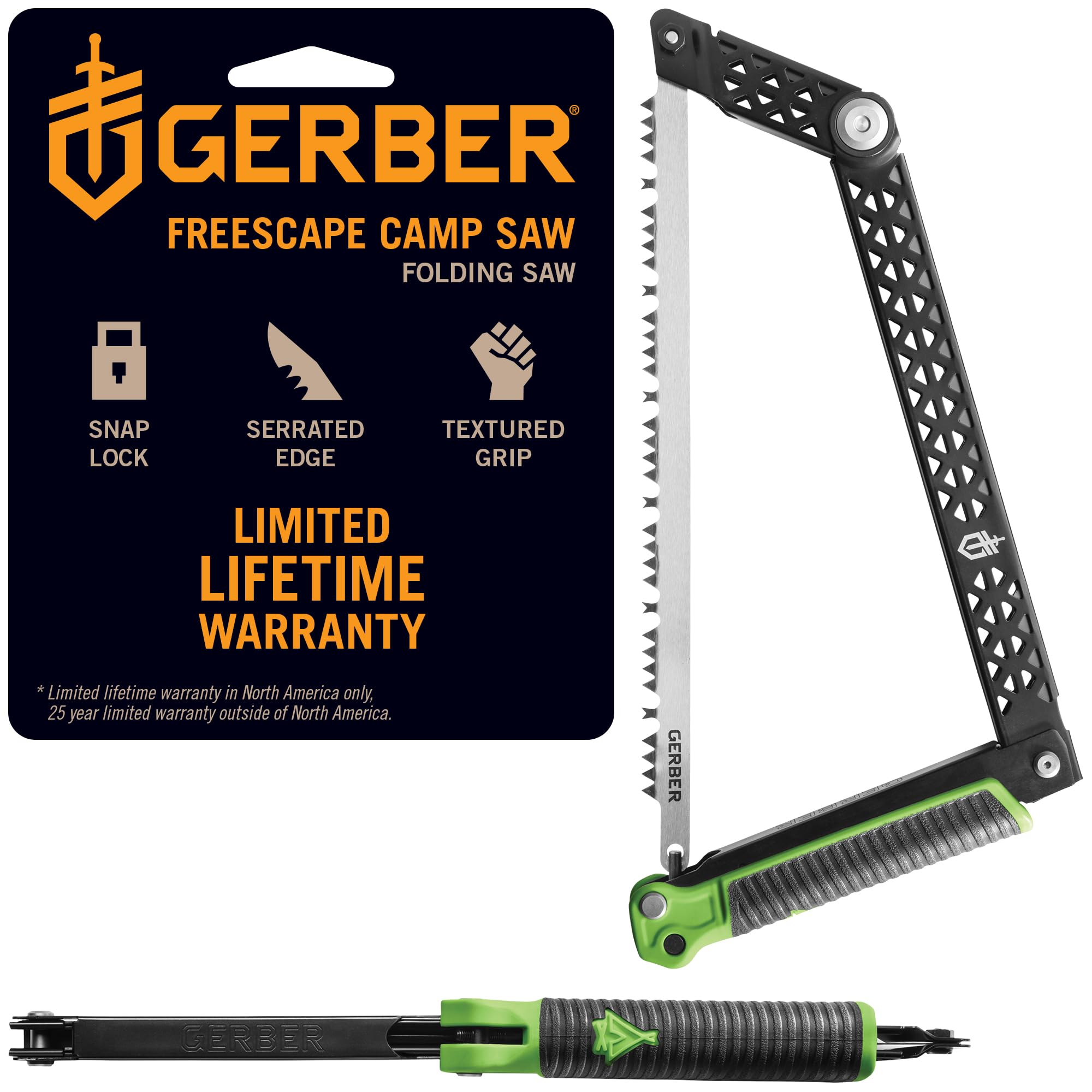
The Freescape solves the biggest problem with frame saws: packed volume. Instead of a fixed triangular shape, the 12-inch blade folds completely flat against the rubberized handle using four pivot points, sliding into a package roughly the size of a large folding knife. At 16 ounces it is heavier than a folding blade saw, but the frame design provides significantly more leverage for cutting logs up to 8 inches in diameter.
The textured rubber handle inspires confidence when your hands are wet or cold, and the bright green accent color makes it easy to spot in a cluttered pack. Gerber uses standard 12-inch replacement blades, so you can carry spares and swap them in the field. Testers note that the included blade has a relatively low TPI, requiring more effort per stroke, but aftermarket blades solve that immediately.
For backpackers who need to process larger firewood without carrying a full bow saw, this is the most packable frame design on the market. It straddles the line between a folding blade and a full-size frame saw, offering the best compromise for multi-day trips where firewood size varies.
Why it’s great
- Folds completely flat for minimal pack volume despite the 12-inch blade
- Frame design provides leverage for cutting logs up to 8 inches thick
- Standard replacement blades are easy to find and swap in the field
Good to know
- Included blade has a low TPI requiring more effort per stroke
- At 16 ounces, it’s heavier than folding blade saws
3. Corona RS 7041 Razor Tooth Folding Saw

The Corona RS 7041 earned its reputation the hard way — through rigorous testing and years of field use. The 7-inch blade is made from SK5 high-carbon Japanese steel, the same alloy used in premium chef knives, and it arrives shaving-sharp. With 6 teeth per inch and an aggressive tooth geometry, it chews through branches up to 3 inches in diameter with surprising speed for its compact size.
The ergonomic co-molded handle covers the blade when folded, protecting both the teeth and your gear. A pistol-grip shape with rubberized inserts mitigates hand slippage, and the easy-to-latch blade lock prevents accidental opening or closing. At 7.5 ounces it disappears in a pack pocket or on a belt.
Independent tests from Project Farm ranked this saw at the top of its class, beating models costing twice as much. The thin blade can bind in larger cuts if you twist during the stroke, but for the weight and price it delivers disproportionate cutting power. The replaceable blade design means the handle outlasts multiple blades.
Why it’s great
- SK5 Japanese steel blade holds a razor edge through heavy use
- Pistol-grip handle with rubberized inserts prevents slipping
- Lifetime manufacturer warranty backs a proven design
Good to know
- Thin blade can bind in larger cuts if twisting pressure is applied
- 7-inch blade limits maximum cutting diameter to about 3 inches
4. Bahco Laplander Folding Saw

The Laplander is a Nordic classic purpose-built for wildlife enthusiasts, hunters, and bushcrafters. The 7.5-inch blade cuts on both the push and pull strokes, making it more intuitive for anyone accustomed to a standard handsaw. The two-component plastic handle provides a secure grip even in cold weather, and the integrated leather strap adds a traditional touch while offering a wrist lanyard option.
The dual-action safety lock secures the blade in both the open and closed positions, eliminating accidental deployment or folding during transport. At just over half a pound, it’s light enough to live permanently in a daypack or hunting haversack. The blade material is high-speed steel with 53 teeth arranged at 7 TPI, delivering a fast cut with reasonable surface finish.
Field reports consistently highlight the saw’s durability — one reviewer left it outside under a bush for two months and reported it looked brand new after a rinse. The push/pull cutting action is slower per stroke than a dedicated pull-cut saw like the Silky, but the technique requires less adjustment for occasional users. It’s a reliable, no-surprises tool for the regular backpacker.
Why it’s great
- Dual lock secures blade in both open and closed positions
- Push/pull cutting action is intuitive for traditional handsaw users
- Proven durability with excellent corrosion resistance
Good to know
- Push/pull action is slower than dedicated pull-cut saws
- Handle material is plastic rather than rubberized for wet-weather grip
5. Nordic Pocket Saw

The Nordic Pocket Saw redefines lightweight cutting. Weighing less than 5 ounces and packing down smaller than a wallet, this pocket chainsaw uses a 25.6-inch chain with 33 bidirectional teeth to cut in both directions. Each link features a cutting tooth, making it faster per stroke than competitor chains that place teeth on alternating links. It handles logs up to 8 inches in ideal thickness, with the capability to manage 18-inch logs with extra effort.
The nylon handle loops are large enough to accommodate gloved hands, and the saw comes with a small pouch that includes a belt loop. Maintenance is minimal — sharpen 2 to 3 times a year with a standard 11/64-inch round file and occasional lubrication with chainsaw oil. The high-carbon steel chain holds an edge well and can be resharpened repeatedly.
This tool demands more technique than a folding saw. The chain can bind near the end of a cut, and you must maintain consistent tension with both hands to avoid pinching. It also requires significant cardio effort, especially on larger logs. But for ultralight backpackers who count every gram, nothing else gives you this cutting capacity for this little weight.
Why it’s great
- Extremely lightweight at 4.66 ounces with minimal pack volume
- Bi-directional teeth cut on both strokes for faster material removal
- Can handle logs up to 18 inches thick with proper technique
Good to know
- Requires practice to maintain consistent chain tension during cuts
- Chain can bind near the end of a cut, requiring prying to free
6. Silky Professional PocketBoy Curved 170mm

The PocketBoy is Silky’s entry-point into their professional line, and it punches far above its size. The 6.7-inch curved blade combines pull-cut technology with an aggressive tooth pattern that cuts 15-20 percent faster than straight-blade PocketBoys. The curved profile concentrates cutting force at the center of the blade, reducing binding and producing an exceptionally clean kerf on green wood.
The blade material is impulse-hardened steel with taper-ground teeth that reduce resistance through the cut. At 10.4 ounces with the included hard plastic belt case, it’s heavier than some competitors in this blade length, but the cutting speed justifies the weight. The yellow and silver color scheme is highly visible if you set the saw down in the backcountry.
The main trade-off is the belt case — several users report the scabbard clip slips off belts easily and the closure can be damaged. The saw itself, however, is universally praised as one of the fastest cutting folding blades available. For precise limbing, shelter building, and processing small to medium firewood, the PocketBoy’s curved blade offers an unmatched speed-to-weight ratio.
Why it’s great
- Curved blade cuts 15-20% faster than straight-blade alternatives
- Impulse-hardened teeth stay sharp through extensive use
- Taper-grind reduces resistance for smoother, easier cuts
Good to know
- Included belt scabbard has a weak clip and closure mechanism
- Thin blade can bend if pinched during aggressive cuts
7. Agawa BOREAL21 Tripper Kit
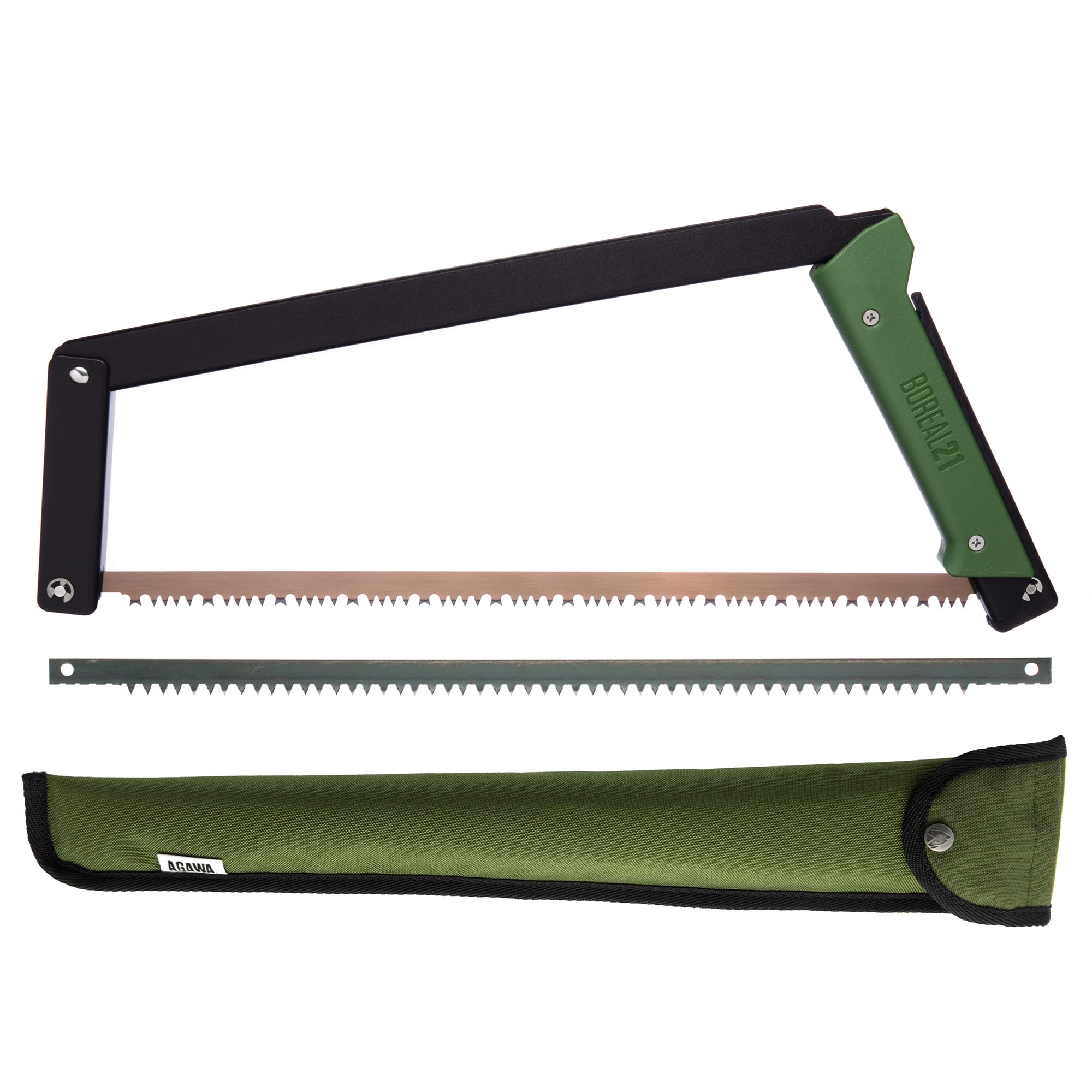
If your backpacking involves processing serious firewood — logs 6 to 12 inches in diameter — the BOREAL21 is purpose-built for the task. The 21.5-inch blade is tensioned automatically within a high-strength 6063 aluminum frame, requiring no manual tightening or loose parts. The frame unfolds and locks in seconds, and when you’re done it collapses flat into a compact package that straps easily to a backpack.
The Tripper Kit includes two blades: an All-Purpose blade with a double-pointed rake for dry, hard, and soft woods, and an Aggressive blade designed for plowing through larger timber quickly. Both blades feature a rust-protective coating and hardened points. The fibreglass-reinforced nylon handle cover and stainless steel hardware ensure the frame won’t rust, warp, or crack under exposure.
At 1.4 pounds, this is the heaviest saw in the lineup, and the folded size is larger than any folding blade. But it’s also the only one that can process a 12-inch diameter log in minutes without exhausting the user. The automatic blade tensioning system is a genuine innovation — no fumbling with wing nuts or screw tensioners. For basecamp trips or winter camping where large firewood is essential, the BOREAL21 is the definitive tool.
Why it’s great
- Automatic blade tensioning requires no manual adjustment
- Includes two blades for different wood types and cutting conditions
- Aluminum frame and stainless steel hardware resist corrosion
Good to know
- At 1.4 pounds, it’s the heaviest option and requires dedicated pack space
- Frame has two pinch points during assembly that require careful handling
FAQ
What is the best blade length for a backpacking saw?
How do I maintain a backpacking saw in the field?
Are pull-cut saws better than push-pull saws for backpacking?
Can I use a backpacking saw as a survival tool?
Final Thoughts: The Verdict
For most users, the best backpacking saw winner is the Silky Gomboy 240mm Outback Edition because it delivers professional-grade cutting speed in a compact folding package that fits any backpack. If you want a more packable frame design that can handle larger logs, grab the Gerber Freescape Camp Saw. And for the ultralight backpacker who counts every gram, nothing beats the cutting capacity per ounce of the Nordic Pocket Saw.