
Our readers keep the lights on and the weekend projects moving. As an Amazon Associate, I earn from qualifying purchases.
Checking on a rear-facing infant while driving by craning your neck or relying on a blurry mirror reflection is a safety gamble no parent should take.
I’m Rikta — the founder and writer behind FitlyFast. After analyzing dozens of backseat camera kits across resolution tiers, IR types, and vehicle compatibility, I focus on the specs that actually matter for distraction-free driving.
Whether you drive a compact sedan or a three-row SUV, finding a reliable backseat camera for baby means choosing between screen size, resolution clarity, night vision quality, and whether you need to watch one child or two at once.
How To Choose The Best Backseat Camera For Baby
A backseat camera eliminates the dangerous habit of turning around to check on your child, but the wrong unit can introduce glare, shaky video, or setup frustration that defeats the purpose. These are the four criteria that separate a useful tool from a dashboard distraction.
Resolution — 1080P Is The Floor, 1440P Is The Ceiling
Standard 720P monitors produce grainy images that make it hard to see whether a pacifier has fallen or a harness strap is twisted. A true 1080P (1920×1080) sensor is the baseline for catching facial expressions and breathing movement. Some premium units now offer 1296P or 1440P, which deliver roughly 25-50% more pixel density. That extra detail matters most when your child is in a dimly lit car at dusk and you need to confirm chest rise at a glance.
Night Vision Type — 940nm Invisible IR vs 850nm Glow
Cheaper cameras use 850nm infrared LEDs that emit a visible red glow. That glow can wake a sleeping infant or create dashboard glare on the windshield. Higher-end models employ 940nm invisible IR — the human eye sees no light, but the sensor captures a clean grayscale image. If nighttime drives are routine or your baby is a light sleeper, 940nm IR is the only acceptable choice.
Single Camera vs Dual-Camera Split Screen
A single camera mounted on the middle headrest covers the entire back row if you have one child in a rear-facing seat. For families with two kids in different rows, or a toddler in the middle plus an infant in the third row, a dual-camera system with a 7-inch split-screen monitor lets you watch both simultaneously without toggling. The trade-off is screen real estate — each side of a split screen shows roughly half the resolution of a full-screen single view.
Installation Method and Cable Management
Most systems use Velcro straps around the headrest and a wired connection from the camera to the dashboard monitor. Look for kits that include cable clips or adhesive cable guides to tuck the wire along the door seal and under the floor mat — dangling cords near the rear seat pose a strangulation risk for toddlers. USB-powered units are simpler to route than those requiring a hardwired 12V connection, but monitor size matters: a 7-inch screen can block defroster vents or windshield sightlines if not positioned carefully on the dash.
Quick Comparison
On smaller screens, swipe sideways to see the full table.
| Model | Category | Best For | Key Spec | Amazon |
|---|---|---|---|---|
| bonoch 5″ 1440P | Premium Single | Max detail, one child | 1440P / 940nm IR / 4m split cable | Amazon |
| LUCKVIEW BM1 5″ | Premium Single | 3X zoom for facial detail | 1080P / 3X zoom / 150° FOV | Amazon |
| Faninso 7″ 1296P | Premium Single | CarPlay integration + sharp video | 1296P / 7″ touchscreen / 940nm IR | Amazon |
| Kidsneed 7″ Dual (B0DMFNY6NY) | Mid-Range Dual | Two kids, two rows | 1080P split / 150° / 940nm IR | Amazon |
| Kidsneed KN70V2 Dual | Mid-Range Dual | Twins or siblings in same row | 1080P split / 150° / AHD input | Amazon |
| Wkzay 6.9″ Dual | Mid-Range Dual | Larger split screen for two | 1080P dual / 6.9″ / 150° FOV | Amazon |
| Babyvue BV2 4.5″ | Budget Single | Quick setup, single child | 1080P / 4.5″ / USB plug & play | Amazon |
In‑Depth Reviews
1. bonoch 5″ 1440P Baby Car Camera

The bonoch leads the list because it delivers 1440P resolution — roughly double the pixel count of standard 1080P monitors — letting you zoom in 2X and still read a pacifier position or confirm chest rise at night. Its 940nm invisible infrared system produces a crisp grayscale image without any red glow, which means your sleeping infant stays undisturbed. The 5-inch screen is compact enough to avoid blocking the windshield yet large enough to see facial expressions without squinting.
Setup takes seconds with the USB-powered connection and a 4-meter split cable that includes enough Velcro strips to route the wire along door seals and under floor mats. The monitor ships with two mounting options — a dashboard suction mount that stays rock-steady on rough pavement and an air vent bracket that keeps the screen off the glass entirely. Daytime color accuracy is natural, and the automatic IR-CUT filter prevents the green or purple color casts that plague cheaper cameras.
The only real compromise is the single-camera design — if you need to watch two children in different rows simultaneously, you will need a dual-camera system. The zoom control and brightness adjustment buttons are clearly labeled, and the 24-month warranty provides long-term confidence.
Why it’s great
- 1440P resolution is visibly sharper than every 1080P competitor
- 940nm invisible IR never wakes a sleeping baby
- Two mounting options (suction cup + air vent) fit any dash layout
- 24-month warranty outpaces the industry norm
Good to know
- Single camera only — not for dual-child monitoring
- Cable must be firmly clicked into the camera; protective film must be removed from lens and stand
2. LUCKVIEW BM1 5″ 1080P Baby Car Camera
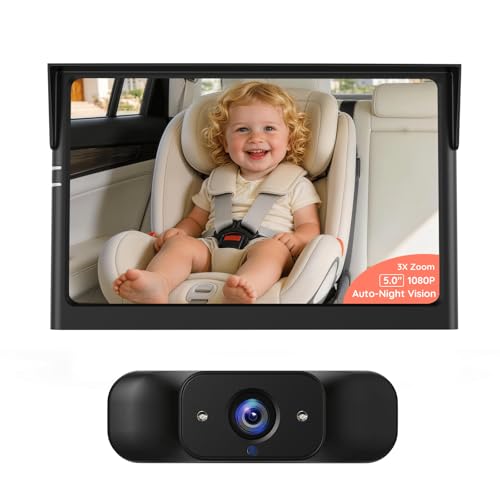
The LUCKVIEW BM1 stands out for its 3X digital zoom, which lets you fill the 5-inch screen with your infant’s face to check for lip color, breathing regularity, or a spit-up incident without leaning forward. The 1080P sensor holds sharpness at full zoom — something lower-resolution cameras cannot do without turning blocky. Daytime video is vibrant, and the wide 150-degree horizontal field of view covers an entire rear-facing seat even when the camera is mounted off-center.
Infrared night vision uses standard 850nm LEDs, which emit a faint red glow. Most babies sleep through it, but light-sensitive toddlers may stir. The suction cup mount adheres firmly to glass or a smooth dashboard surface, and the included cable clips make routing the wire cleanly along the door trim straightforward. Several customer reviews specifically highlight that the company’s support team replaced a cracked lock nut and a faulty charging adapter without hassle.
The 5-inch screen adjusts brightness across a wide range, so you can dial it down for nighttime driving to reduce cabin glare. The only catch is the windshield suction mount — on textured or heated dashes, the included adhesive disc is necessary for a solid grip.
Why it’s great
- 3X zoom captures facial detail without pixelation
- Excellent customer service with fast replacement parts
- Brightness adjustment covers bright sun to dark cabin
Good to know
- 850nm IR emits a faint red glow that may disturb light sleepers
- Suction mount needs extra adhesive disc on textured dashes
3. Faninso 7″ 1296P Baby Car Camera with CarPlay
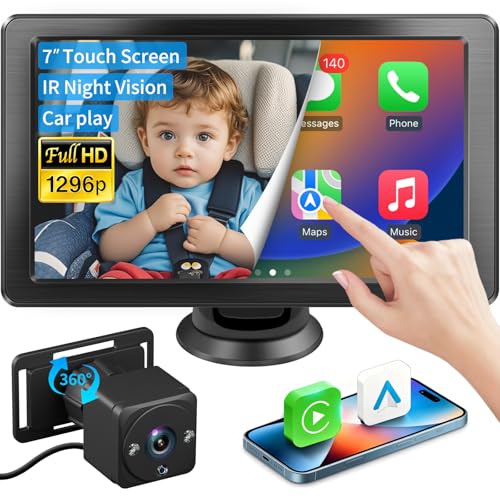
The Faninso is unique because it doubles as a CarPlay and Android Auto receiver — you can view turn-by-turn navigation, take calls, or play music while the baby camera feed runs in the background. The 1296P resolution sits between standard 1080P and the bonoch’s 1440P, delivering 25% more detail than a typical 1080P camera. The 7-inch capacitive touchscreen responds quickly to taps for brightness or volume adjustments, and the IR-CUT filter preserves natural skin tones during the day.
Night vision uses 940nm invisible IR, so there is zero red glow to disturb a sleeping infant. The 150-degree wide-angle lens with 360-degree camera rotation covers the entire back row from a single headrest mount. Some users reported camera vibration on bumpy roads because the camera housing is larger than average; angling the camera downward and cinching the Velcro straps tightly resolves the issue. Faninso’s customer service proactively reached out to one reviewer who mentioned the shake and offered a fix.
The trade-off for the CarPlay integration is that the system is powered only when the car is running — there is no battery backup, so the feed cuts off immediately when you turn off the ignition. The camera cable is long enough for SUVs and minivans.
Why it’s great
- Built-in CarPlay/Android Auto eliminates the need for a separate head unit
- 1296P resolution is noticeably sharper than 1080P
- 940nm IR is completely invisible to baby’s eyes
Good to know
- Camera may vibrate if straps are not tightly cinched
- No battery backup — feed stops when car turns off
4. Kidsneed 7″ Dual Camera (B0DMFNY6NY)
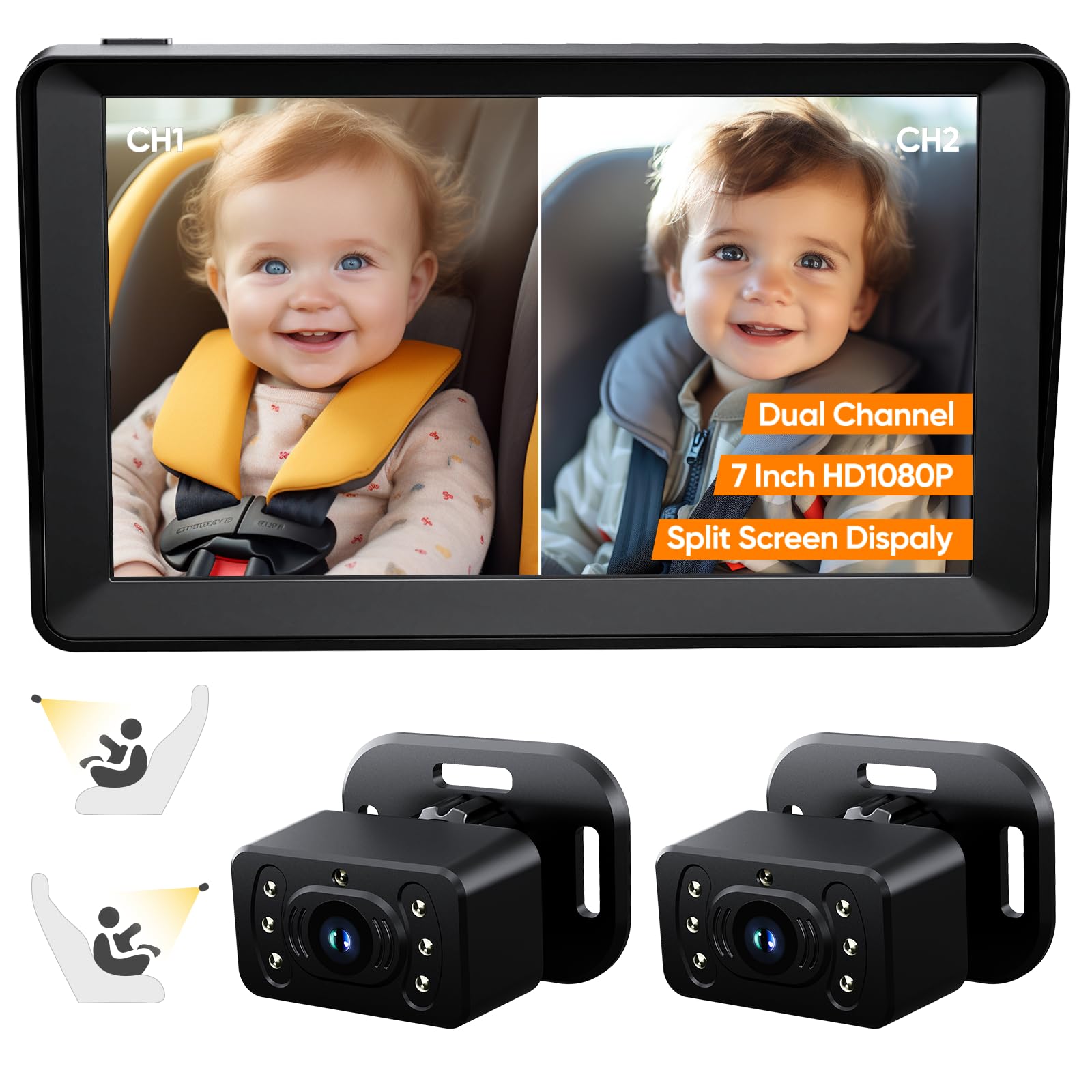
This Kidsneed model solves the two-child monitoring problem with a 7-inch split-screen display that shows both cameras simultaneously. Each camera captures 1080P video with a 150-degree wide-angle lens and 360-degree rotation, so you can position one camera on the rear-facing infant seat and the other on a forward-facing toddler in the third row. The 940nm invisible infrared system means neither child sees a red glow, which preserves sleep quality on evening drives.
The AHD 1080P input delivers a clean image with natural color reproduction by day. The mirror setting intelligently flips the image orientation so what you see on screen matches the actual spatial layout of your car — no mental gymnastics required. Installation is tool-free: Velcro straps wrap around the headrest posts, the monitor cable tucks along the door seal, and the cigarette lighter adapter powers everything.
The main drawback is the lack of a dimmer for the screen at night — several users noted the night vision display is bright enough to create windshield glare in a dark cabin. The suction mount is adequate on smooth surfaces, but the monitor can shift when you adjust the camera angle. The system is durable enough for daily commuting but the plastic screen housing requires careful handling.
Why it’s great
- Dual-camera split screen watches two children at once
- 940nm invisible IR keeps both kids sleeping
- Tool-free install with Velcro headrest straps
Good to know
- No screen dimmer — night mode may cause windshield glare
- Monitor can shift on mount when adjusting camera angle
5. Kidsneed KN70V2 7″ Dual Camera
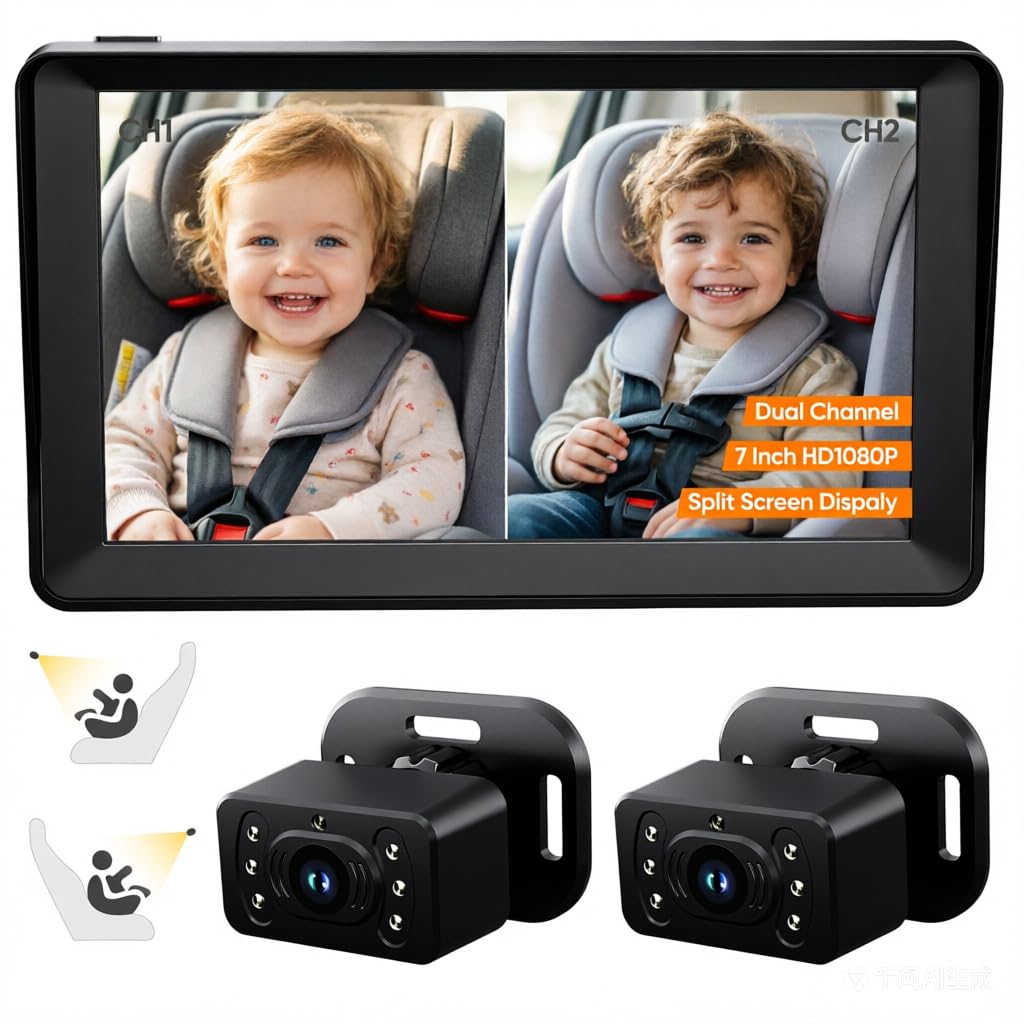
The KN70V2 is essentially the same dual-camera architecture as the newer Kidsneed model above but at a more accessible price point. It uses the same 7-inch AHD 1080P split-screen display and 150-degree wide-angle cameras with 360-degree rotation. The 940nm infrared night vision is equally invisible — no red glow, no sleep disruption — making this the most cost-effective route to watching two children in separate seats.
Image quality is crisp during the day and detailed enough at night to distinguish facial features in grayscale. The mirror setting flips the image correctly, so left and right match reality. Installation is identical to the higher-priced sibling: Velcro straps on the headrests, cable clips along the door seals, and USB or cigarette lighter power. Customer reviews consistently mention the straightforward plug-and-play setup and the durable build quality.
The same caveats apply: the screen brightness cannot be dimmed at night, and the monitor’s suction mount works best on a flat, clean dashboard surface. Some users noted that the mounting bracket could benefit from a stronger adhesive pad on textured dashes. The system is not battery-backed, so it shuts off with the ignition.
Why it’s great
- Dual-camera split screen for two children at a budget-friendly tier
- 940nm invisible IR protects sleep quality
- Quick USB/cigarette lighter install with included cable clips
Good to know
- No night-time screen dimmer
- Suction mount needs clean, smooth dashboard surface
6. Wkzay 6.9″ Dual Camera
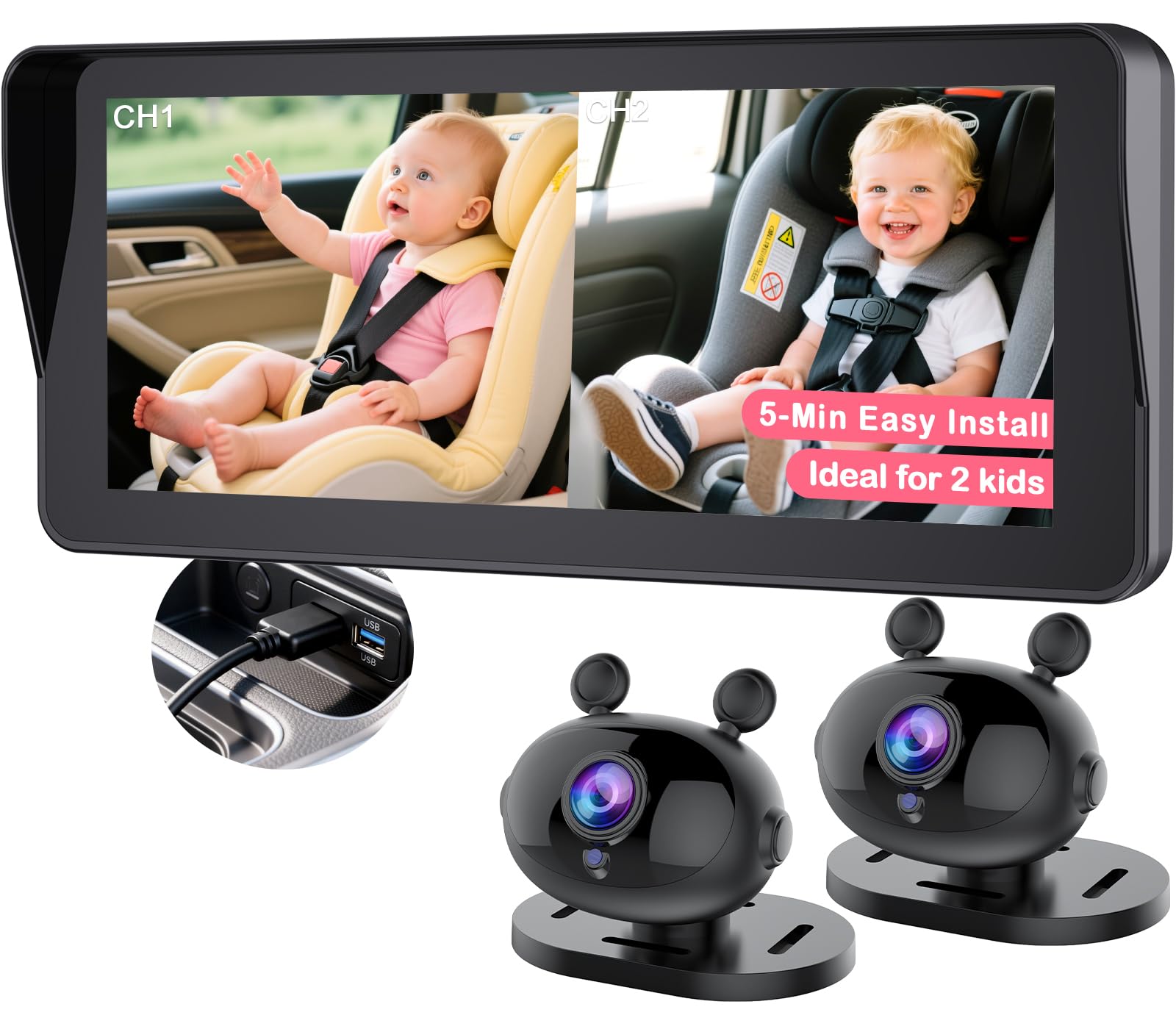
The Wkzay system offers a 6.9-inch monitor — a compromise between the compact 5-inch single-camera units and the full 7-inch panels — paired with two 1080P cameras for simultaneous split-screen viewing. The screen is large enough to see both children clearly without taking up as much dashboard real estate as a 7-inch unit. Each camera provides a 150-degree field of view with full 360-degree rotation, covering two rows of seating without blind spots.
Night vision uses 940nm invisible IR, so neither child is disturbed by a red glow. The cameras auto-switch to night mode based on ambient light, and the transition is smooth without flickering. Setup is genuinely tool-free: the cameras strap to headrests, the monitor sits on a dashboard bracket, and the included 12V adapter and USB cable give you two power options. Customer reviews emphasize the sharp, lag-free image and the sturdy build quality that survived an accidental drop onto gravel.
The 6.9-inch monitor is slightly bulky for very small windshields — compact car owners may need to carefully position it on the center console rather than the dash to avoid blocking the driver’s sightline. The system is not battery-powered and relies on a constant 12V or USB connection.
Why it’s great
- 6.9-inch screen balances size and dashboard fit
- Dual 1080P cameras with 940nm IR for two children
- Rock-solid build quality with lag-free video transmission
Good to know
- Screen may block windshield in very small cars
- No battery backup — runs only when car is on
7. Babyvue BV2 4.5″ USB Camera

The Babyvue BV2 is the most compact and affordable entry in the list, designed for parents who want a simple single-camera setup without complicated wiring. The 4.5-inch screen is small enough to sit on the dashboard without blocking the defroster or windshield, and the camera features a cute ear-shaped design that some parents use to visually calm the baby. The 1080P sensor delivers clear daytime images, and infrared night vision uses no-glow IR to avoid waking the infant.
Setup takes about three minutes: attach the camera to the headrest with the included straps, mount the display on the dash with the adhesive pad, and plug the USB cable into the car’s USB port. The included cable clips keep the wire tucked along the door seal, reducing the risk of a baby pulling on a loose cord. The 360-degree camera rotation and mirror mode ensure the image matches the seat’s physical orientation.
The trade-offs for the compact size and low entry cost are a smaller viewing area and a single-camera limitation. The screen is adequate for a single child in a rear-facing seat, but you will not see facial details as clearly as on a 5- or 7-inch monitor. The USB power cable is on the shorter side, so routing to a rear USB port may require the included extension.
Why it’s great
- Fastest installation — three minutes, no tools
- Compact screen fits any dashboard without obstruction
- No-glow IR night vision protects baby’s sleep
Good to know
- 4.5-inch screen is small for detailed facial checks
- Single camera only — cannot monitor two children
FAQ
Can a backseat camera replace a rear-facing mirror entirely?
Will a backseat camera work if my car has tinted rear windows?
Is a wired or wireless backseat camera better for a baby?
How do I prevent the camera from shaking on bumpy roads?
Final Thoughts: The Verdict
For most users, the backseat camera for baby winner is the bonoch 5″ 1440P because its pixel density is unmatched, the 940nm IR is invisible, and the dual-mount system fits any dashboard. If you want CarPlay integration and a larger touchscreen, grab the Faninso 7″ 1296P. And for watching two children simultaneously on a budget, nothing beats the Kidsneed KN70V2 dual-camera system.