
Our readers keep the lights on and the weekend projects moving. As an Amazon Associate, I earn from qualifying purchases.
A dead power strip won’t cut it when the lights flicker—you need a battery backup that gives your computer time to save its work and shut down safely. The real question is which one delivers enough runtime for your specific setup without costing more than your monitor.
This guide is built by comparing the manufacturers’ published specifications and the patterns across verified customer reviews, so you get each pick’s real strengths and trade-offs instead of marketing spin.
The models below range from a compact 600VA/330W unit (VA stands for volt-amps, a power rating; watts are the actual usable power your computer draws) for a basic desktop to a 1500VA/1000W pure sine wave unit (a power type that delivers clean, smooth electricity like your wall outlet) built for high-end gaming rigs, all competing to be your backup battery for computer.
How To Choose The Best Backup Battery For Computer
A battery backup for a computer isn’t about powering your desk for hours—it’s about giving you enough time to save your work and shut down gracefully. The five specs below are what separate a useful unit from a frustrating one.
VA vs. Wattage — Which Number Actually Matters
VA (volt-amps) is a marketing number that sounds bigger, but wattage is what your computer actually consumes. A desktop with a monitor typically draws between 150W and 350W under load, so you want a unit rated for at least 330W to 600W. A unit with 600VA/330W will power a basic workstation, while a 1500VA/1000W unit can handle a gaming PC with multiple monitors.
The Battery Chemistry — Lead-Acid vs. Lithium Iron Phosphate
Most budget and mid-range backups use sealed lead-acid batteries (a common rechargeable battery type, like a car battery) that last about 3-5 years and need replacement. Premium models use lithium iron phosphate (LiFePO4), which lasts over 10 years and handles over 5,000 charge cycles. The catch is that LiFePO4 units cost 40-60% more upfront, but you pay much less over the system’s lifetime because you rarely replace the battery.
Sine Wave Type — Simulated vs. Pure
Simulated sine wave (a stepped approximation of AC power) works fine for most desktop computers with standard power supplies that aren’t heavily loaded. Pure sine wave (smooth, clean power matching your wall outlet) costs more but is necessary for devices with active PFC (power factor correction) power supplies—common in higher-end gaming PCs, workstations, and anything with a modern 80 PLUS PSU (a standard for power supply efficiency, from basic to titanium). A pure sine wave unit costs roughly 30% to 50% more than a comparable simulated unit.
Number of Outlets — What You Actually Plug In
A typical computer setup uses 2-3 outlets (tower, monitor, router). A unit with 6 total outlets, where 4 are battery-backed and 2 are surge-only, covers a desk nicely. If you need to protect a network stack (modem, router, switch, NAS) plus a computer, look for 10-12 outlet units with at least 6 battery-backed outlets. The extra surge-only ports are useful for printers and speakers that don’t need battery power.
AVR — Why It Matters More Than You Think
AVR stands for Automatic Voltage Regulation—it corrects small dips and spikes in incoming power without switching to battery power, which saves battery life. Without AVR, every minor brownout or overvoltage event drains your battery, shortening its lifespan. Units with AVR are usually about 10% to 20% more than basic models without it.
Quick Comparison
On smaller screens, swipe sideways to see the full table.
| Model | Category | Best For | Key Spec | Amazon |
|---|---|---|---|---|
| CyberPower CP1500PFCLCD | Pure Sine Wave | High-end gaming PCs & workstations | 1500VA / 1000W — 12 outlets | Amazon |
| APC Back-UPS Pro Gaming | Pure Sine Wave | Serious gaming rigs with RGB setups | 1500VA / 900W — 10 outlets | Amazon |
| Eaton Tripp Lite OMNI1500LCDT | Value Performers | Home office & network stacks | 1500VA / 810W — 10 outlets | Amazon |
| GOLDENMATE 1000VA/600W | Lithium Battery | Long-life, quiet backup for PC & network gear | 1000VA / 600W — 8 outlets | Amazon |
| CyberPower AVRG900LCD | Mid-Range | Desktop & workstation with AVR | 900VA / 480W — 12 outlets | Amazon |
| APC BE600M1 | Compact | Basic desktop & Wi-Fi gear | 600VA / 330W — 7 outlets | Amazon |
| SKE SK625 625VA/360W | Budget Friendly | Budget-conscious home office | 625VA / 360W — 6 outlets | Amazon |
In‑Depth Reviews
1. CyberPower CP1500PFCLCD PFC Sinewave UPS

The 1500VA/1000W rating and pure sine wave output make this the top pick for anyone with a modern gaming PC or workstation that uses an active PFC power supply—it delivers clean, smooth electricity like your wall outlet instead of simulated sine wave. At those specs, it can handle an RTX 5090 and a Core Ultra 9 285K at gaming loads, where buyers report drawing 630-870W without triggering any overload warnings.
The 12 total outlets give you six battery-backed ports for critical gear plus six surge-only ports for peripherals, and the color LCD tilts up to 22 degrees so you can read runtime and load wattage from your chair. A Type-A and Type-C USB charging port keep your phone topped off during the outage itself.
This unit costs more than any non-PFC model, but if your computer has a PFC power supply, simulated sine wave can cause random shutdowns and hardware wear—this is the fix for that specific problem.
Why it’s great
- Pure sine wave protects active PFC power supplies from damage
- 1500VA/1000W capacity handles full high-end gaming rigs without overload
- 12 outlets (6 battery backup, 6 surge-only) cover entire desk plus network gear
Good to know
- Heavy at 24.9 lbs — plan a stable spot under your desk
- Strong plastic smell reported when new, usually fades after a day
2. APC Back-UPS Pro Gaming UPS (BGM1500B-US)

Where the CyberPower CP1500PFCLCD delivers pure sine wave at 1000W, this APC Gaming UPS provides the same clean power at 900W—so it falls slightly short for the most extreme builds, but it still holds up to an RX 7900 XTX with a 1200W PSU without issues. The downside is that this unit adds 12 customizable RGB colors and a Reactor Circle display tilted at 160 degrees, making it a better fit if you care how your backup power looks in your gaming setup.
Owners mention it safely shut down a gaming rig during outages with more than 80% battery remaining, and the six battery-backed outlets plus four surge-only outlets cover a full desk. The clean sine wave output also protects your console—PS5 or Xbox Series X—just as thoroughly as a PC.
Pick this over the CyberPower if your gaming rig draws under 900W and you want a unit that visually matches your RGB theme. The trade-off is the 30.86-pound weight and a small chance of receiving a defective unit, as a few customers note.
3. Eaton Tripp Lite Series OMNI1500LCDT

If you run a home office with a desktop PC, monitor, router, modem, and a network hard drive, this unit combines 810W of backup power with AVR (Automatic Voltage Regulation) that corrects voltage between 92V and 150V back to a safe 120V without draining the battery. At 1500VA/810W, it sits between the beefy 1000W units and the mid-tier 480W models, and it is a full 480W stronger than the small APC 600VA/330W unit, giving you room to add a second monitor or a NAS (network-attached storage).
Reviewers point out that a 5-year-old battery still ran a cable modem, network hard drive, and switch for several hours during an outage—impressive longevity for a sealed lead-acid unit. The LCD screen displays runtime, wattage load, and battery status, and the internal battery is user-replaceable with the RBC51 cartridge.
The standout spec here is the connected equipment insurance paired with a 3-year warranty.
Where it shines
- 810W capacity with AVR maintains safe voltage without wasting battery life
- 10 outlets cover a full home office, including network gear
- Shoppers say 5-year-old batteries still performing well in outages
Worth noting
- Strong electronic smell reported for the first few days after unboxing
- Comes with monitoring software that some buyers find difficult to set up
4. GOLDENMATE 1000VA/600W Lithium UPS

The single number that matters most in a battery backup is how many years it lasts before you need to replace the battery—and this unit’s lithium iron phosphate (LiFePO4) chemistry is rated for over 10 years with 5,000 charge cycles. That is roughly 2x to 3x longer than any lead-acid unit on this list, and the manufacturer claims it reduces total ownership cost by over 40% compared to traditional batteries because you rarely replace the cell.
One limitation is that this is a simulated sine wave unit, not pure sine wave, so it is not recommended for PFC power supplies. It delivers 1000VA/600W—82% more wattage than the 330W APC unit—with 8 outlets and an intelligent LCD panel that shows real-time battery and power conditions.
If you run a standard desktop PC and network gear and plan to keep the backup for the next decade, this unit’s long life makes it the most cost-effective option per year of service. However, buyers report there is no USB or network data connection for automated computer shutdown, so you will have to manually save your work.
What stands out
- LiFePO4 battery lasts 10+ years with 5,000 charge cycles — no battery swap needed for a decade
- 600W capacity handles a desktop plus monitor and network devices easily
- Lightweight build and quiet cooling fan under 50 dB
The trade-offs
- Simulated sine wave — not suitable for computers with active PFC power supplies
- No USB or network data port for automated safe shutdown
5. CyberPower AVRG900LCD Intelligent LCD UPS
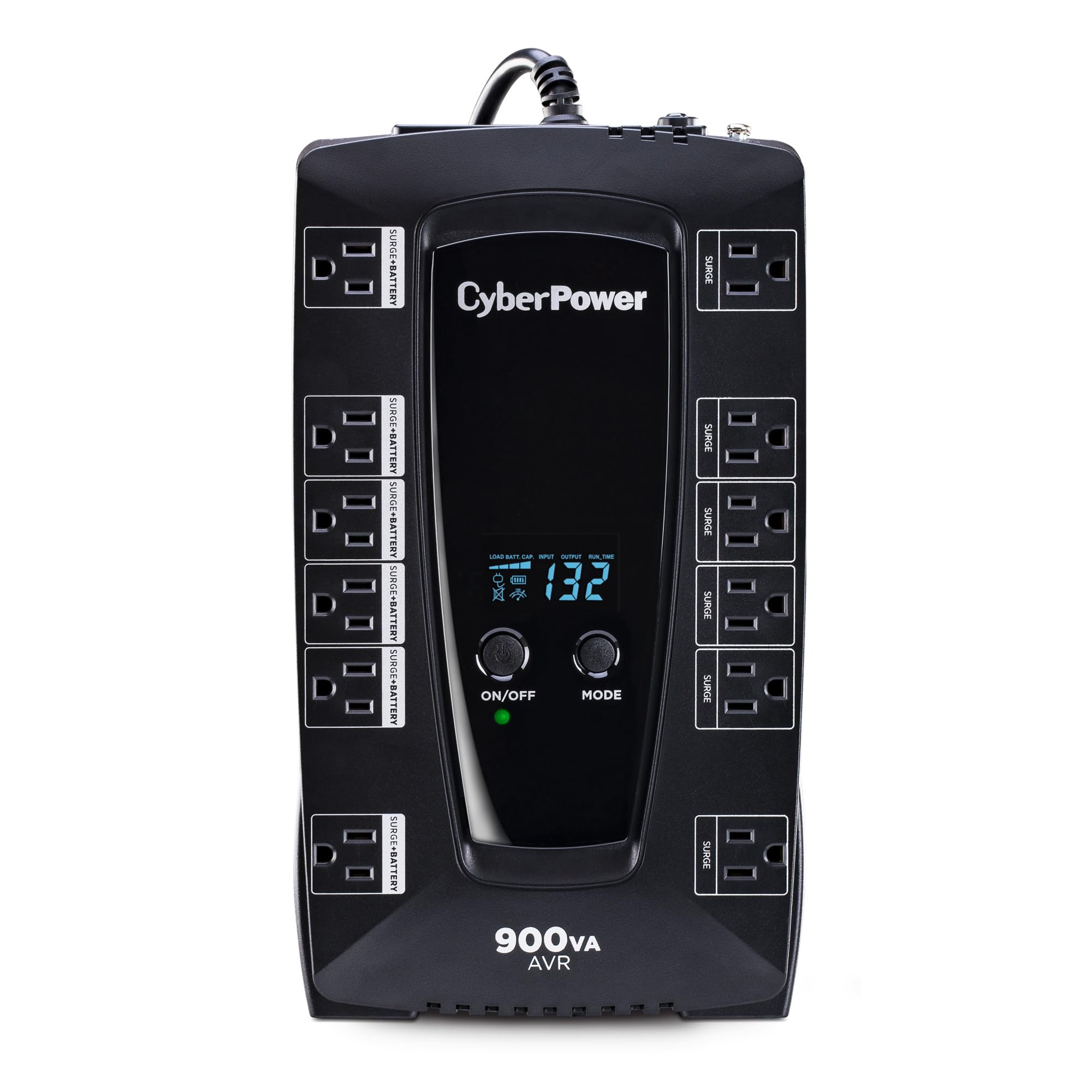
At this lower price you get a 900VA/480W UPS with 12 outlets—three times as many as the SKE SK625—so you can plug in your PC tower, monitor, router, modem, printer, and still have surge-only ports left for speakers and a desk lamp.
Owners mention that at a 72W load (a modest desktop setup), this unit delivers 62 minutes of runtime—more than enough time to save work and shut down. At a heavier 175-200W load with a desktop plus laptop and monitors, it still gives 18-20 minutes, which customers note reliably bridges the gap to generator startup.
At its price point, this unit strikes a fair balance between power capacity and outlet count, making it a step up from entry-level backups without jumping to premium pricing—perfect for the budget buyer who needs more outlets and runtime than a basic 330W unit offers but doesn’t want to overspend on 1000W capacity.
The upsides
- 12 outlets — more than double the capacity of budget units — cover an entire desk
- 62 minutes of runtime at 72W load gives plenty of time for safe shutdown
- AVR saves battery life by correcting voltage dips without switching to battery
Keep in mind
- Compact design but still heavy enough to stay planted during use
- Some reviewers point out initial setup difficulties using the mode button
6. APC UPS Battery Backup BE600M1

This is the pick for someone with a single desktop computer or a home office where space under the desk is tight. At 10.79 x 4.13 x 5.47 inches, it is one of the most compact units available, and its 330W capacity is enough to power a basic desktop tower and monitor for about 10-15 minutes — just enough time to save open documents and shut down properly.
The built-in 1.5A USB port keeps your phone charged during an outage, and the battery is user-replaceable with APC’s APCRBC154 cartridge, which buyers mention is a huge cost saver. One reviewer noted the same model lasted 8 years before needing replacement, making it a reliable long-term investment for a low-power setup.
The compromise is that the 23-minute runtime at 100W load drops sharply if you connect a power-hungry gaming PC — this unit is best for light office workstations and keeping your router/modem running during brief outages.
Why we’d pick it
- Compact footprint fits easily on a desk shelf or under a small desk
- User-replaceable battery extends the unit’s usable life to 8+ years
- Integrated USB port charges your phone while the computer is on backup power
A few caveats
- 330W capacity is only suitable for basic desktops and network gear, not gaming rigs
- Battery takes 10 hours to fully recharge after a full discharge
7. SKE SK625 625VA/360W UPS

Compared to the rest of the field, this is the most wallet-friendly entry into battery backup, giving you AVR (Automatic Voltage Regulation) and a real-time LCD display—features you typically only get on more expensive units. At 625VA/360W, it sits just above the 330W APC unit, and shoppers say it charged from 75% to 100% in about one hour, which is much faster than the 10-hour recharge time on the APC BE600M1.
The 6 outlets include 4 battery-backed ports for critical gear and 2 surge-only ports for less essential devices. The LCD shows input voltage, output voltage, battery capacity, and load level, so you always know exactly what is happening. However, the item dimensions are 12.4 x 3.94 x 5.63 inches — about 3.5x longer than the compact CyberPower AVRG900LCD, so measure your desk space first.
It is perfect for a budget-conscious home office user who wants AVR protection and a clear display without paying a premium. The one clear reason to choose it is the faster recharge and the built-in LCD that removes guesswork about battery status.
Strong points
- AVR and LCD display at a budget-friendly price point — features usually found on more costly units
- Fast recharge time: charges from 75% to 100% in roughly one hour
- 6 outlets with 4 battery-backed ports handle a desktop plus network gear
Before you buy
- Tall, narrow footprint (12.4 inches high) may not fit under shallow desks
- Monitoring software is outdated — manual instructions point to an old version
Understanding the Specs
VA vs. Wattage
VA (volt-amps) is the maximum power the unit can theoretically handle, while wattage is the actual usable power your computer draws. A unit rated 600VA/330W can safely supply up to 330 continuous watts. If your desktop and monitor together draw 250W under load, you have a comfortable 80W headroom. Always use the wattage number—not the VA number—to match your computer’s power supply rating.
Sine Wave Type
Simulated sine wave (a stepped approximation of AC power) works with most standard PC power supplies but can cause problems with active PFC (power factor correction) power supplies found in higher-end gaming PCs and workstations. Pure sine wave (smooth, clean electricity matching your wall outlet) delivers a clean, smooth wave identical to what comes out of your wall outlet. If your PSU is 80 PLUS Gold or better, look for pure sine wave.
AVR
AVR (Automatic Voltage Regulation) monitors incoming power and corrects low voltage (brownouts) and high voltage (overvoltages) without draining the battery. This keeps your equipment running normally during minor power fluctuations and extends the battery’s lifespan because it only switches to battery during actual blackouts, not during every small dip.
Battery Chemistry
Sealed lead-acid (SLA) is the standard found in most budget and mid-range units—affordable upfront but lasts 3-5 years before needing replacement. Lithium iron phosphate (LiFePO4) lasts 10+ years with over 5,000 charge cycles and costs 40-60% more upfront, but saves money over time because you rarely replace the battery. Choose SLA for a short-term setup, LiFePO4 for a workstation you plan to keep for a decade.
FAQ
What wattage backup battery do I need for my desktop computer?
Can I use a regular power strip with a UPS?
How long will the battery last in a backup for my computer?
What is the difference between simulated sine wave and pure sine wave?
Final Thoughts: The Verdict
For most people building a desktop computer setup, the backup battery for computer winner is the Eaton Tripp Lite OMNI1500LCDT because it delivers a strong 810W with AVR regulation and 10 outlets at a price that does not force you to overshoot your needs. If your computer uses a modern PFC power supply, grab the CyberPower CP1500PFCLCD for pure sine wave protection. And if you just need a small, reliable unit to keep a basic desktop and your Wi-Fi running through short flickers, the APC BE600M1 is the most space-efficient choice.