
Our readers keep the lights on and the weekend projects moving. As an Amazon Associate, I earn from qualifying purchases.
Hitching a trailer blind is a recipe for scraped bumpers, crushed tailgates, and campsite shouting matches. A dedicated camera system removes the guesswork by putting a clear view of your hitch and the space behind your rig right on a dashboard monitor. The challenge is finding a system that delivers a stable signal, a sharp enough image to spot low obstacles, and a mount that stays put through highway wind and ruts.
I’m Rikta — the founder and writer behind FitlyFast. I’ve spent dozens of hours cross-referencing signal range claims, battery runtimes, and customer durability reports to separate the dependable systems from the rest.
Whether you tow a camper, a horse trailer, or a work flatbed, choosing the right backup camera for trailer means knowing which specs actually matter when you’re backing into a dark campsite or a tight loading dock.
How To Choose The Best Backup Camera For Trailer
Not every wireless camera works well when your tow vehicle and trailer are connected. Signal interference from the trailer body, the need for constant power, and the stress of a camera that rattles loose at highway speeds are real headaches. Here’s what to prioritize to avoid those failures.
Mounting System: Magnetic vs. Permanent
A magnetic base with six neodymium magnets is the most versatile option for most trailer owners. It lets you swap the camera between a truck and a trailer, or move it to a different vehicle entirely, without drilling holes or running wires. Check the product specs for the type of metal the magnet works on — some systems won’t stick to aluminum trailer frames or fiberglass campers. For non-metal surfaces, look for a supplied metal plate that you mount on the trailer.
Wireless Signal Range and Penetration
Manufacturers often quote an open-field range, but your trailer body, truck cab, and nearby structures will cut that down significantly. A system that claims 300 feet in the open may deliver a reliable 50 to 80 feet through a metal trailer. Look for systems using 2.4GHz frequency-hopping technology with dual antennas, which provide better resistance to dropouts and interference. A wired signal from the camera to a monitor is almost always more reliable, but for a removable, no-drill setup, a strong digital wireless system is the right trade-off.
Battery and Power Management
A camera that dies mid-trip is useless. Battery capacity should be at least 9600mAh for a full day of driving, and a solar panel helps top off the charge if you park in direct sun. Be realistic about solar: a small panel on a 2×4-inch camera provides trickle charging, not full power. The monitor almost always needs a 12V cigarette-lighter or USB connection. Some newer systems feature a remote-controlled on/off function to save battery when the camera isn’t in use.
Video Quality and Viewing Angle
1080p resolution is the baseline for clearly seeing a hitch ball, a low curb, or a person behind the trailer. A 170-degree wide-angle lens eliminates most blind spots, though it will distort distance perception slightly. Night vision is non-negotiable for after-dark arrivals; look for infrared LEDs that automatically switch on in low light. The monitor size also matters: 5 inches is adequate for occasional use, while a 7-inch display is much easier to read at a glance during backing maneuvers.
Multi-Camera Expandability
If you want to monitor the rear of your trailer plus a side blind spot, or both a rear and a hitch view at the same time, choose a system that supports a second or third camera. Monitors with split-screen mode let you see all camera feeds simultaneously. Adding a second camera costs additional money per camera, but it provides a comprehensive view that a single camera can’t match.
Quick Comparison
On smaller screens, swipe sideways to see the full table.
| Model | Category | Best For | Key Spec | Amazon |
|---|---|---|---|---|
| Wkzay R73 | Magnetic Dual-Camera | RV owners needing a second camera | Dual 1080P cameras, 56ft signal through metal | Amazon |
| AUTO-VOX S4B-N | Magnetic Single-Camera | Quick install with protective carrying case | 1080P, 170° view, 15-hour battery | Amazon |
| DOUXURY D-1T1 | Hardwired Multi-Camera | Permanent install with 4-camera support | 1080P, 7″ monitor, 4-channel split-screen | Amazon |
| Fookoo DW7Y5 | Furrion Pre-Wired | Direct swap for Furrion factory outlets | 1080P, 7″ monitor, 120° viewing angle | Amazon |
| VOONOA VN007 | Magnetic Dual-Camera | Largest battery (15000mAh) for long trips | Dual 1080P cameras, 7″ monitor, remote control | Amazon |
| FEISIKE ADC719 | Magnetic Solar | Budget entry with solar charging | 1080P, 5″ monitor, 150° view | Amazon |
| DOUXURY B0916VWL46 | Magnetic Solar | Value magnet with long range | 1080P, 5″ monitor, 170° view, 330ft range | Amazon |
In‑Depth Reviews
1. Wkzay R73

The Wkzay R73 is a dual-camera system that covers both the rear of your trailer and, with the second camera, the hitch area or a side blind spot at the same time. Both cameras are 1080p and include a 9600mAh battery that delivers a claimed 25-hour continuous runtime, backed by a small solar panel for trickle charging.
The 7-inch recording monitor supports split-screen viewing and loop recording to an SD card. Wkzay states a 56-foot stable signal that penetrates two metal layers, which is a realistic claim for a trailer-to-cab connection. User reports confirm zero lag at highway speeds and a magnetic mount strong enough to hold at 70 mph without shifting.
The weakest link is the monitor itself — it must be plugged into a 12V cigarette lighter or USB port, as it has no internal battery. Also, pairing the second camera requires following the manual precisely; a few users found the instructions unclear. For a true two-camera no-wire setup, this is a premium solution that works as advertised.
Why it’s great
- Dual 1080P magnetic cameras with solar support
- Reliable 56ft signal through metal trailer walls
- Loop recording on the monitor adds security value
Good to know
- Monitor requires wired 12V or USB power; not battery-operated
- Pairing the second camera can be fiddly without clear instructions
2. AUTO-VOX S4B-N

The AUTO-VOX S4B-N is designed for the mobile user who needs a camera that can live in a case and come out only when towing. The magnetic base is strong enough for highway use, and a metal plate is included for non-ferrous trailer materials. It uses updated 2.4GHz digital chips for stable signal up to 50 feet, which is adequate for most fifth-wheel, bumper-pull, and box truck setups.
At 1080p with a 170-degree lens and two infrared LEDs, the image quality is clean for daytime hitching and functional in full darkness. The high-capacity battery delivers over 15 hours of runtime per charge, and the camera enters a smart sleep mode when the monitor is off to conserve power. The included protective hard-shell case keeps everything organized.
The 5-inch monitor is adequate, though not as immersive as a 7-inch screen. Some users wish for a screen auto-off timer to extend battery life of the camera even further. If you borrow trailers, rent RVs, or swap between trucks, the portability of this system is a significant advantage.
Why it’s great
- Portable hard case protects camera and monitor during travel
- Powerful magnet secures camera at highway speeds
- Smart sleep mode extends battery life when not in use
Good to know
- 5-inch monitor is acceptable but not as clear as a 7-inch screen
- No auto-screen-off function to further conserve power
3. DOUXURY D-1T1

The DOUXURY D-1T1 is a permanent-install system aimed at owners who want the most camera coverage possible without dealing with batteries. The 7-inch monitor supports up to four cameras in a split-screen view, giving simultaneous coverage of the rear, both sides, and the hitch. The camera uses a hardwired 12-24V power connection, so you never worry about battery life.
It uses a dual-antenna design and claims a reliable 1080p signal up to 320 feet in open areas and 180 feet through vehicles. The built-in loop recording to an SD card is a plus for capturing incidents. The IP69 waterproof rating and wide temperature tolerance make it suitable for year-round outdoor use on RVs and campers.
The recording function has a low frame rate around 15-20 fps, which is fine for live view but not for capturing smooth high-speed events. Some customers report the included suction-cup mount for the monitor is poorly designed. For a user who doesn’t mind a wired install and wants a full four-camera system, this offers the most comprehensive coverage of the group.
Why it’s great
- Expandable to 4 cameras with full split-screen view
- Hardwired power eliminates battery management
- Very reliable digital signal with dual-antenna design
Good to know
- Recording function has a low frame rate (~15-20 fps)
- Monitor mount is not as sturdy as the rest of the system
4. Fookoo DW7Y5

The Fookoo DW7Y5 is designed specifically for RVs and campers that come pre-wired with a Furrion mounting bracket. It replaces the factory Furrion camera with a 7-inch IPS monitor and a 1080p camera for a fraction of the price. The camera uses a dedicated power cable to the pre-wired outlet, so you don’t have to run new wires or deal with batteries.
The large monitor is a major upgrade over the typical 5-inch unit, providing a bright, clear wide-angle view that makes backing up a large trailer much less stressful. The 2.4GHz wireless signal with dual antennas is stable and reliable. Users report no dropouts at 33 feet with a fifth-wheel trailer.
Note that this system is not compatible with the Furrion display or recording unit — it replaces the entire system. Also, some users found that the screw holes did not perfectly align with their pre-wired bracket and had to drill new pilot holes. If you have a pre-wired Furrion RV, this is a thoroughly better camera with a bigger screen at a reasonable cost.
Why it’s great
- Direct fit for Furrion pre-wired mounts on most modern RVs
- Large 7-inch IPS monitor provides excellent visibility
- Clear 1080p image with stable wireless signal
Good to know
- Not compatible with Furrion’s own monitor or recording system
- Screw holes may require drilling if your bracket is misaligned
5. VOONOA VN007
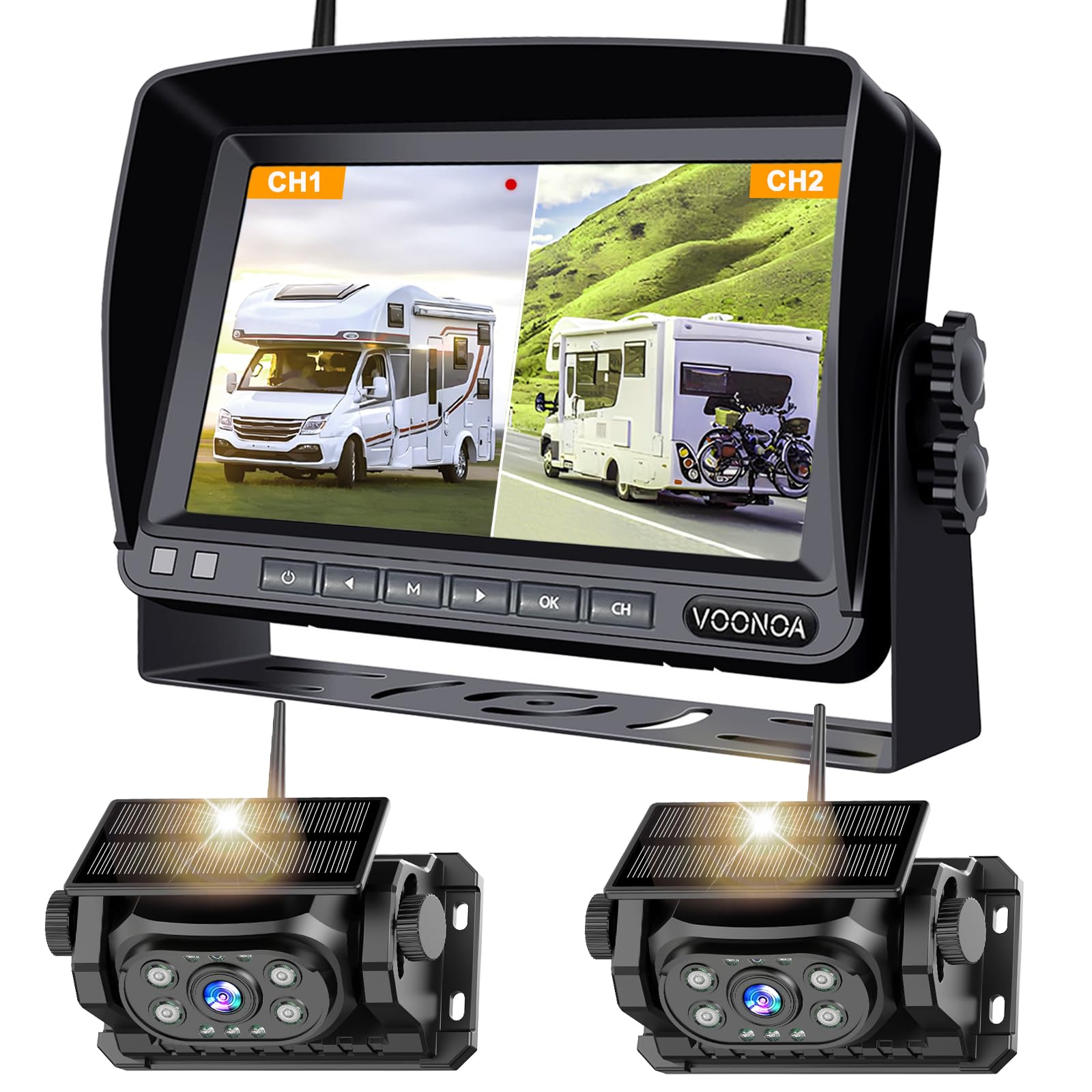
The VOONOA VN007 system includes two magnetic cameras with the largest battery in this group at 15000mAh each, plus a 7-inch monitor. The cameras are truly wireless with strong magnetic bases, making it very easy to swap them between a truck bed and a trailer. The monitor is the key to the system: it’s well-built and provides a split-screen view of both cameras simultaneously.
The company claims a range of up to 300 feet in open air, and users confirm consistent signal beyond 100 feet through moderate interference. The large battery provides over 24 hours of continuous runtime on a single charge, which is enough for multi-day trips without worrying about recharging. A fast charger is included for quick top-ups.
The solar panels on the cameras are insufficient for fully recharging the battery; they only extend the time between charges. The frame rate feels lower than true 1080p 30fps, and some users note the image is not as crisp as other 1080p cameras. For the longest runtime and a complete dual-camera system, this is a high-quality, user-friendly choice.
Why it’s great
- Two cameras with huge 15000mAh batteries for long trips
- Strong magnetic mount holds securely on steel surfaces
- Split-screen view of both cameras on a 7-inch monitor
Good to know
- Video quality is slightly softer than true 1080p 30fps
- Solar panels only trickle charge; nightly charging is still needed
6. FEISIKE ADC719

The FEISIKE ADC719 is an entry-point into magnetic wireless backup cameras with a small budget outlay. It features a 9600mAh battery and a 5W solar panel, a 5-inch monitor, and a single magnetic camera. The 150-degree wide-angle lens provides a 1080p view that is clear in daylight, and the infrared night vision is functional for backing up after dark.
The six built-in magnets are strong enough for most steel trailers, and the camera body is rated IP69 waterproof. The 2.4GHz wireless signal is stable and advertised to work up to 830 feet in open area, but users report a more realistic 35 to 50-foot range through a trailer body, which is still sufficient for standard towing. The monitor includes brightness, contrast, and saturation adjustments.
The 5-inch monitor is adequate for occasional use but small for constant monitoring at highway speeds. Some users note the instruction manual is vague, and the camera enters a sleep state only when the monitor is turned off. For a no-frills, functional wireless camera system at the lowest cost, this is a reliable starting point.
Why it’s great
- Affordable system with a 1080P camera and night vision
- Solar panel helps maintain battery charge between uses
- Strong magnetic base installs in under a minute
Good to know
- 5-inch monitor is on the small side for extended use
- Instructions are vague; setup requires some trial and error
7. DOUXURY B0916VWL46

The DOUXURY B0916VWL46 offers an attractive price-to-spec ratio with a 5-inch 1080p monitor and a single magnetic camera featuring a 170-degree ultra-wide lens. It uses the latest digital chip for quick signal pairing and has a range of up to 330 feet in open areas, with solid performance through a single trailer barrier. The 9600mAh battery provides about 26 hours of runtime.
The camera provides a clear image with good night vision, and the magnetic base is very strong. Users report easy setup and a reliable connection for hitching trailers and monitoring blind spots. The system also features energy-saving mode that puts the camera to sleep when the monitor is off.
Long-term durability is a question: a small number of users report the camera failing after several months of use, and the monitor’s buttons being on the back is inconvenient when it’s mounted. The included windshield suction cup is also cheap. For a cost-conscious shopper who needs a single camera with a wide view and decent battery life, this is a solid choice, but it may not be the most durable over several seasons.
Why it’s great
- Very strong magnet and excellent open-field signal range
- Wide 170-degree lens minimizes blind spots behind the trailer
- Battery lasts through a full day of driving per charge
Good to know
- Reported durability issues for some units after several months
- Monitor buttons are placed on the back, which is hard to reach when mounted
FAQ
Can I use a magnetic camera on an aluminum trailer?
Will the camera stay on at highway speeds?
Do I need a separate monitor for my trailer camera?
How many cameras do I need for a trailer?
Final Thoughts: The Verdict
For most users, the backup camera for trailer winner is the Wkzay R73 because it offers two 1080p cameras with strong magnets, a reliable 56-foot signal through metal, and a large 7-inch DVR monitor — all without needing to drill or run wires. If you want a portable system that lives in a protective case and works across multiple vehicles, grab the AUTO-VOX S4B-N. And for a permanent four-camera setup that never needs battery charging, nothing beats the DOUXURY D-1T1.