
Our readers keep the lights on and the weekend projects moving. As an Amazon Associate, I earn from qualifying purchases.
When the power goes out, you need to know one thing fast: which generator will actually keep your fridge cold, your lights on, and your family safe, without costing a fortune or needing a mechanic to set it up? This guide compares five real home backup generators, from a lightweight portable that one reviewer says ran their house for nine straight days, to a 331‑pound tri‑fuel (gasoline, propane, and natural gas) machine that powered an entire home through Hurricane Beryl. You will learn which specs matter most — starting watts, fuel type, and runtime — what each price level gets you, and the one spec that separates a whole‑house solution from a light‑duty emergency unit.
I’m Rikta — the co-founder and writer behind FitlyFast. This guide is built by comparing the manufacturers’ published specifications and the patterns across verified customer reviews, so you get each pick’s real strengths and trade-offs instead of marketing spin.
If you are shopping for a best backup generator for home, the key is matching your appliance load to the generator’s running watts and surge (peak) watts — not just looking at the highest number.
How To Choose The Best Backup Generator For Home
Picking the right backup generator comes down to matching three numbers to your actual house: the total running watts (what your appliances draw all the time), the surge watts (the extra jolt needed to start motors like a fridge or AC compressor), and the fuel type you can store or hook up. Get these right and you avoid a generator that trips its breaker every time the well pump kicks on, or a giant unit you cannot move and never need.
Running Watts vs. Surge Watts: The Real Deciding Number
Every generator has two wattage ratings: running watts (also called rated watts) and surge or peak watts. Your refrigerator might need 800 watts to run but 1,200 watts for the three seconds it takes the compressor to start. Add a well pump, a furnace fan, and a few lights, and you get your total. The smart move is to add up the running watts of everything you want to power at once, then pick a generator whose running watts comfortably exceeds that total — and ensure its surge watts covers the single biggest motor start-up spike. Ignore this and you risk tripping the breaker or damaging the generator.
Fuel Type: Gasoline, Propane, or Natural Gas
Gasoline is the most common fuel but it goes bad after a few months, so you need a stabilizer and a rotating stock. Propane lasts forever in a tank and burns cleaner (less engine wear), but you have to refill heavy tanks during a long outage. Natural gas is the most convenient if you have a connection at your house — endless supply, no storage — but you are limited by the pipe size and gas pressure. Tri‑fuel generators let you switch between all three with a dial. That flexibility makes a tri‑fuel unit the most future‑proof choice for a home backup generator.
Transfer Switch or Interlock Kit: Hardwiring vs. Extension Cords
A transfer switch or interlock kit connects your generator directly to your home’s breaker panel. This lets you power hardwired circuits like a well pump, furnace, or electric water heater without running extension cords through windows. If you plan to power your whole house, look for a generator that says “transfer switch ready” and has a 240V outlet. If you just want to keep a few essentials running (fridge, lights, phone chargers) via cords, a standard portable generator with 120V outlets works fine and costs less to install.
Quick Comparison
On smaller screens, swipe sideways to see the full table.
| Model | Category | Best For | Key Spec | Amazon |
|---|---|---|---|---|
| WEN (56477i) | Inverter Portable | Essential appliances & electronics | 4,800 surge / 4,000 rated watts | Amazon |
| WEN Tri-Fuel (TF1450) | Tri-Fuel Open Frame | Whole-house backup (gas/propane/NG) | 14,500 surge / 11,500 running watts (gas) | Amazon |
| Westinghouse 12500 Dual Fuel | Dual-Fuel Open Frame | Heavy home loads + remote start | 12,500 peak / 9,500 running watts (gas) | Amazon |
| Westinghouse iGen12000TFc | Tri-Fuel Inverter | Electronics-safe whole-home power | 12,000 peak / 9,000 running watts (gas) | Amazon |
| Champion 201161 | Tri-Fuel Open Frame | Max power for entire home + HVAC | 15,000 starting / 12,000 running watts (gas) | Amazon |
In‑Depth Reviews
4. Westinghouse iGen12000TFc
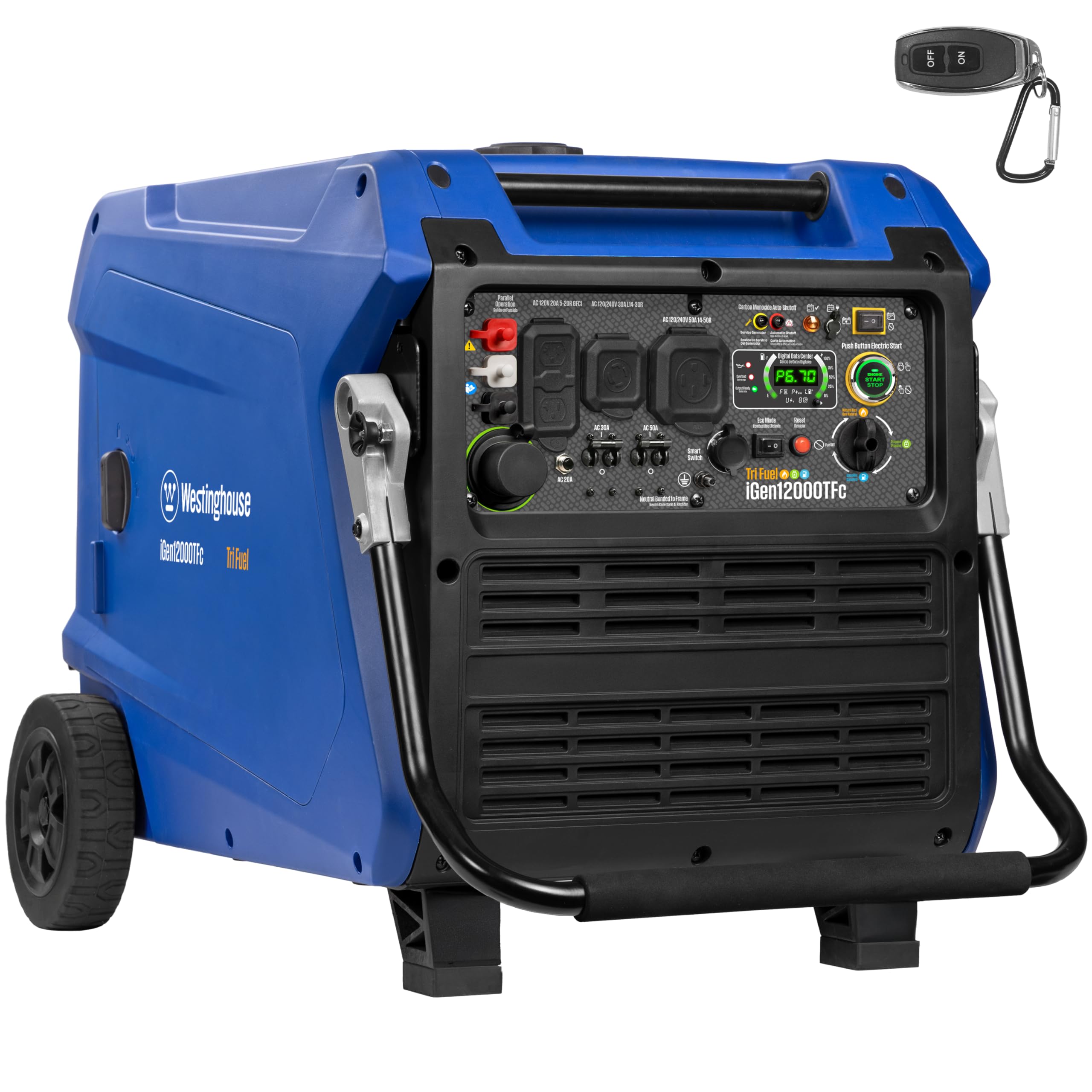
12,000 peak watts and less than 3% THD make this the top pick for anyone who needs clean power for sensitive electronics — computers, a home theater, or an electric car — without risking fried circuit boards. One reviewer described it as “very quiet” and reported it easily charged their EV at 32 amps on a 220V circuit.
Running on gasoline it produces 12,000 peak watts and 9,000 running watts. The big story here is fuel efficiency: the inverter technology dials back the engine speed to match your power demand, cutting fuel use by up to 50% compared to a traditional open-frame generator. That gives you a runtime of up to 19 hours on a single 7.9-gallon tank at 25% load. It runs as quietly as 64 dBA, which is roughly the volume of a normal conversation.
This is the only inverter in the lineup, so it powers down to a whisper when loads are light — meaning quiet nights and neighbors who don’t mind it. On the catch, buyers report the battery could be better. The 191-pound weight, while 38% lighter than the Champion, still needs two people or a ramp to load into a truck. Choose this one if your home has sensitive electronics and you want the longest possible runtime on the least fuel. If you need more raw power for heavy appliances like central AC, the WEN TF1450 is a better fit because it delivers 2,500 more running watts.
Why it’s great
- Inverter produces ≤3% THD for safe electronics use
- Tri-fuel capability (gas, propane, natural gas) offers fuel flexibility
- Up to 19 hours runtime at 25% load saves on refueling
- Very quiet at 64 dBA — neighborhood-friendly
Good to know
- 191 pounds requires two people or a ramp to move
- Reviewers wish the battery were stronger
- Premium price tier compared to open-frame models
1. WEN Quiet and Lightweight 4800-Watt (56477i)

This inverter generator delivers 4,800 surge watts and 4,000 rated watts at just 72.7 pounds — 3.4 times lighter than the WEN tri-fuel unit and 2.9 times lighter than the Champion. That makes it the only true carry-around option in this lineup. It produces clean power (low THD) and its 224cc engine is quiet enough that one reviewer left it running in their garage without disturbance.
Owners mention it “powered wifi, TV, fridge, freezer, appliances for 9 days straight.” The fuel shutoff feature extends engine life by draining the carburetor before the unit stops. The included outlets — four 120V standard plugs, one TT-30R RV receptacle (an RV-style 30-amp plug), one 12V DC port, and two USB ports — cover everything a typical home needs during an outage: fridge, freezer, phones, lights, and a TV.
The honest trade-off is its 224cc displacement (the engine cylinder volume that determines power capacity). That is 2.2 times smaller than the WEN tri-fuel engine, so it cannot run a 240V well pump or central AC. If you can run the basics off extension cords, this is the one you will actually grab first.
Where it shines
- Only 72.7 pounds with wheels and telescoping handle — truly portable
- Clean inverter power protects sensitive electronics
- Dual USB ports for phone and device charging
- Fuel shutoff prolongs engine life between uses
Worth noting
- Standard 120V outlets only — no 240V for well pumps or large AC
- 224cc engine limits surge capacity to 4,800W, not whole-house
2. WEN 14500-Watt Tri-Fuel (TF1450)
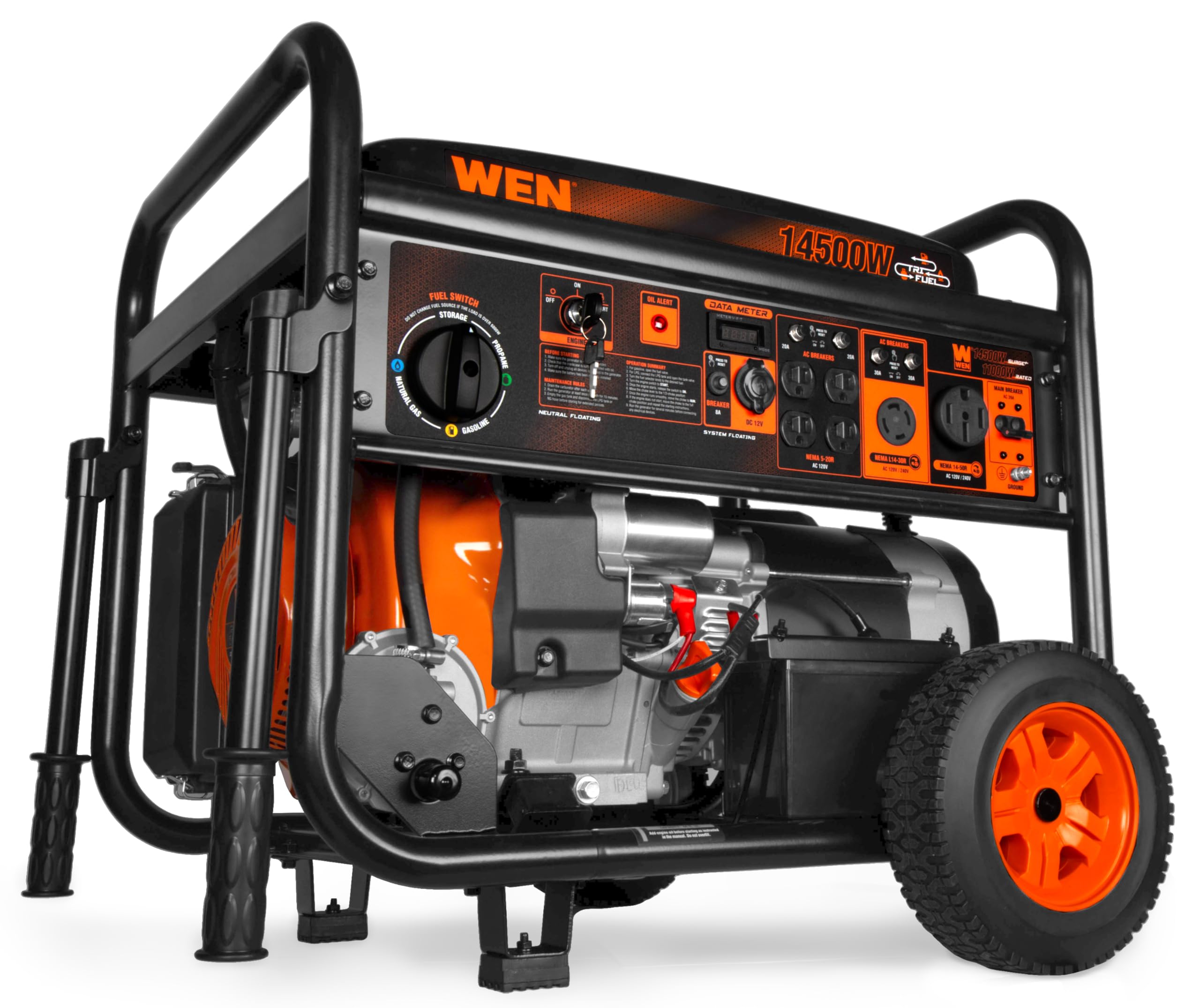
If you need whole-house power and want to avoid paying double for a standby unit, this tri-fuel generator delivers the highest running watts (11,500 on gasoline) in the mid‑range. That beats the Westinghouse 12500’s 9,500 running watts by 21% — enough margin to run a well pump, water heater, and central air all at once. One buyer confirmed it “powers my whole house on propane and/or gasoline” and setup took about an hour with a natural gas quick-connect.
The 500cc engine and 8.2-gallon tank give you up to 12 hours of run time at half load. The electric start fires it up with a key turn. The wheel kit makes the 249-pound unit manageable on flat ground. The three fuel options (gas, propane, natural gas) let you switch with a dial — so you can use cheap grid gas and fall back to propane if supply fails. As one reviewer who used it for hurricane backup put it: “14,500W generator for hurricane backup. powered lights, fans, refrigerators, and A/C for 2,100 sq. ft. house.”
At 249 pounds this is 42 pounds heavier than the Westinghouse iGen12000TFc and far from portable. But the included wheel kit helps you roll it into place. The honest trade-off is that it is an open-frame generator, so it is louder than the inverter models and produces standard power (not the ultra-clean <3% THD needed for sensitive electronics). Choose this over the portable WEN if you need 240V to run large appliances. It delivers a better value per watt than the Champion if you don’t need the extra power.
What stands out
- Highest running watts (11,500 on gas) in mid-range
- Tri-fuel flexibility with simple selection dial
- 12-hour half-load runtime on 8.2-gallon tank
- Transfer switch ready with 240V outlets
The trade-offs
- 249 pounds requires wheel kit for moving; not liftable by one person
- Open frame is noisier than inverter models
3. Westinghouse 12500 Peak Watt Dual Fuel

The single number that matters most in this category is running watts, and this unit delivers 9,500 running watts on gasoline. For the buyer who wants to start their generator from inside the house during a storm, this dual-fuel unit includes a remote start key fob alongside the electric and recoil start options. Customers note the push-button and remote start “work perfectly” and assembly takes under five minutes for wheels and feet. With 12,500 peak watts on gasoline and 9,500 running watts, one reviewer noted it “runs well pump, water heater, fridge/freezer simultaneously.”
The 457cc cast-iron sleeved engine is built for longevity. The 6.6-gallon tank provides up to 12 hours of runtime. Automatic low-oil shutdown and a carbon monoxide sensor add safety layers. The included outlets — two GFCI 120V household plugs (Ground Fault Circuit Interrupter, which cuts power if it detects a shock risk), a 30A twist-lock, and a 50A RV outlet — cover everything from temporary cord use to a transfer switch connection.
An honest head-to-head comparison: it falls short of the WEN TF1450 on running watts (9,500 vs 11,500), but it beats the WEN on convenience with its remote start. Some reviewers point out the manual could be denser to navigate, and the unit is loud — one described it as a “deeper hum” — because it is an open-frame design. Choose this if you want the comfort of a remote start and do not need the extra 2,000 running watts the WEN tri-fuel offers. The price-to-value read: you pay for the remote fob convenience, not raw power output.
The upsides
- Remote start key fob for convenient operation
- Dual-fuel (gas and propane) flexibility
- Cast-iron sleeved engine for durability
- Includes 12V battery charger and full tool kit
Keep in mind
- Open-frame generator is loud — not ideal for quiet neighborhoods
- Wheels and feet require user assembly out of the box
- Manual pages reported to fall out over time
5. Champion 201161

At this lower price you get a 717cc Milwaukee Series V-Twin engine — the largest displacement in this guide — that delivers 15,000 starting watts and 12,000 running watts on gasoline. Reviewers who lived through Hurricane Beryl in Texas report it “ran whole house for 7 days on natural gas” and “powered 3.5-ton AC (with soft start), dryer, fridge, etc.”
At 331 pounds, this is the heaviest unit in the lineup — 4.6 times heavier than the portable WEN. The 33.1-inch height and 33.7-inch depth mean you need dedicated space to store it. The tri-fuel hose kit (both propane and natural gas) is included out of the box, so you can connect it to a natural gas line right away. The Intelligauge displays voltage, frequency, and run hours so you can monitor performance and schedule maintenance.
The honest catch is that some shoppers say its CO2 auto shutoff sensor can be “extremely sensitive,” shutting the generator off after 1.5–2 hours of operation outdoors. One owner noted it costs “half to third the cost of a standby generator” while delivering similar whole-home capacity. This is the perfect budget buyer for anyone who must power their entire house including central HVAC, has a natural gas hookup, and wants standby-level capability at a fraction of standby cost.
Why we’d pick it
- Highest power output: 15,000 starting / 12,000 running watts (gas)
- 717cc V-Twin engine provides massive torque for large loads
- Tri-fuel ready with both propane and NG hoses included
- Great value compared to a whole-home standby generator
A few caveats
- 331 pounds is the heaviest unit and requires a dedicated storage spot
- CO2 shutoff sensor can be overly sensitive and cause shutdowns
- Noise level of 78 dBA is noticeably loud from 23 feet
Understanding the Specs
Starting (Surge) Watts vs. Running (Rated) Watts
The starting wattage is the brief burst of power needed to fire up a motor (like your refrigerator compressor or well pump). The running wattage is what the generator can sustain continuously. If your generator’s surge rating is too low for the biggest motor in your house, you risk a voltage drop that can damage electronics or the generator itself. Always check the surge wattage of your most demanding appliance — typically a well pump or air conditioner — before assuming you have enough headroom.
Inverter vs. Open Frame Engine Design
An inverter generator converts raw AC power to DC and then back to clean AC, creating a stable sine wave with less than 3% total harmonic distortion (THD) — safe for laptops, TVs, and sensitive electronics. An open-frame generator passes raw engine power directly to the outlets (typically 6-8% THD), which is fine for power tools and resistive loads like heaters but can damage delicate phone or computer chargers over time. Inverter generators also throttle down to match your load, saving fuel and reducing noise, while open-frame engines run at a fixed speed regardless of load.
Engine Displacement (cc)
Measured in cubic centimeters, displacement tells you the size of the engine cylinders. Higher displacement generally means more torque capacity (ability to sustain heavy loads over time) and longer engine life under load, but it also means more weight, higher fuel consumption, and more noise. A 224cc engine can comfortably drive a 4,000-watt load, while a 717cc V-Twin is built to push 12,000 watts for hours.
Tri-Fuel vs. Dual Fuel vs. Single Fuel
A tri-fuel generator can run on gasoline, propane, or natural gas via a dial or switch. A dual-fuel unit handles gas and propane only. Single-fuel models run on one fuel. Propane and natural gas burn cleaner (less carbon buildup in the engine), last indefinitely in storage, and reduce maintenance. But natural gas requires a fixed pipe connection, and propane tank refills can become a logistics problem during extended outages. Gasoline is the most available fuel during normal times but degrades in storage and requires a fuel stabilizer (an additive that keeps gasoline from breaking down).
FAQ
Will a 4800-watt generator run my whole house?
Do I need a transfer switch or interlock kit?
What does tri-fuel mean and why should I care?
Are inverter generators quieter than open frame generators?
Final Thoughts: The Verdict
For most homeowners looking for a best backup generator for home use, the winner is the WEN 14500-Watt Tri-Fuel (TF1450) because it delivers the highest running watts in the mid-range (11,500), supports three fuel types, includes a 240V transfer-switch-ready outlet, and costs less than half of the premium whole-home options. If you want a portable unit you can actually lift and store in a garage corner, grab the WEN 4800-Watt Inverter (56477i). And for whole-home backup that can run a 3.5-ton AC and well pump simultaneously, the Champion 201161 with its 717cc V-Twin engine and full natural gas compatibility is the best choice.