
Our readers keep the lights on and the weekend projects moving. As an Amazon Associate, I earn from qualifying purchases.
The moment the grid goes down, the question isn’t if you need power—it’s whether you can keep the refrigerator cold, the internet running, and the lights on without breathing gasoline fumes or waking the whole street. Home backup power has split into two distinct camps: silent battery stations you can run indoors and dual-fuel inverter generators that match engine speed to load for extreme fuel efficiency. Both solve the same problem—they just live in very different realities of noise, runtime, and installation complexity.
I’m Rikta — the co-founder and writer behind FitlyFast. I’ve spent hundreds of hours cross-referencing battery chemistry cycle life, AC surge ratings, alternator charging speeds, and real-world fuel consumption data so you can see past the marketing wattage.
After evaluating 11 models on capacity, recharge speed, fuel flexibility, and safety certification, I’ve distilled everything into this no‑fluff guide to the backup power for home.
How To Choose The Best Backup Power For Home
Before you click “buy,” you need to decide which hill you’re willing to fight on: fuel logistics or battery chemistry. Whole‑house gas generators give you days of runtime but demand ventilation, fuel storage, and regular carburetor maintenance. Battery power stations are silent and fume‑free indoors but require a plan for recharging after the first 24 hours. Let’s break down the decisions that actually matter.
Battery Chemistry vs. Fuel Type
For battery stations, LiFePO₄ (lithium iron phosphate) has made older NMC batteries obsolete. Look for a cycle count above 3,000 — that’s roughly a 10‑year daily‑use lifespan. For gas generators, inverter technology with low total harmonic distortion (THD under 3%) is non‑negotiable if you’re powering computers, CPAP machines, or modern refrigerator control boards. Dual‑fuel capability (gasoline + propane) extends your options during fuel shortages and reduces carburetor gumming when you run propane.
Capacity Isn’t Just Watt‑Hours — It’s Surge Headroom
A 2,000Wh battery station won’t start your 1,200W sump pump if the surge rating is only 2,400W. Motor‑driven appliances can draw 3–5× their running watts for the first half‑second. Check the surge or peak wattage spec, not just the continuous rating. For generator shoppers, the split between starting watts and running watts matters more than the number on the box — a generator that says 12,000 peak but only 9,000 running may still struggle with a 5‑ton AC unit.
Recharge Speed Dictates Your Outage Strategy
A battery station that needs 8 hours to refill is useless in a multi‑day blackout unless you have solar panels. Models that accept 2,400W AC input can recharge in under an hour — that means you can run a small gas generator for one hour, refill the battery, and go silent for the rest of the night. For generator owners, check the fuel tank size and consumption at 25% load: a 7.9‑gallon tank burning 0.21 gallons per hour gives you 37 hours of runtime in Eco Mode.
Transfer Switch Readiness
If you want to power hard‑wired circuits (well pump, furnace, electric water heater), you need a generator or battery station with a twist‑lock outlet (L14‑30R or 14‑50R) and a bonded‑neutral configuration that works with your home’s breaker panel interlock kit. Battery stations with UPS‑grade sub‑10ms switching can replace a transfer switch for a few critical circuits via an inlet box, but you must check whether the unit is UL 1778 listed for that use.
Quick Comparison
On smaller screens, swipe sideways to see the full table.
| Model | Category | Best For | Key Spec | Amazon |
|---|---|---|---|---|
| Westinghouse iGen12000DFc | Dual‑Fuel Inverter | Whole‑home heavy load | 457cc, 19h runtime at 25% load | Amazon |
| EF ECOFLOW DELTA Pro | Expandable Battery | Modular whole‑house | 3600Wh, 25kWh expandable | Amazon |
| AFERIY 3840Wh | Large Battery Pad | Long‑duration off‑grid | 3840Wh, 11.5kWh expandable | Amazon |
| Anker SOLIX C2000 Gen 2 | Fast‑Charge Battery | Rapid 58‑min refill | 2048Wh, 4kWh expandable | Amazon |
| Jackery Explorer 2000 v2 | Lightweight Battery | Portable indoor backup | 2042Wh, 39.5 lb | Amazon |
| DJI Power 2000 | Ultra‑Quiet Battery | Near‑silent RV & home | 2048Wh, 30 dB noise | Amazon |
| BLUETTI AC200L | Expandable Battery | Budget modular backup | 2048Wh, 8192Wh expandable | Amazon |
| WEN DF680iX | Dual‑Fuel Inverter | EV & heavy equipment | 6800W peak, bonded‑neutral 240V | Amazon |
| Champion 4000‑Watt Dual Fuel | Dual‑Fuel Inverter | Lightweight gas/propane | 4000W peak, 64 dBA | Amazon |
| ERAYAK 4500W Inverter | Gas Inverter | Compact jobsite power | 4500W peak, 54 lb | Amazon |
| EBL 2400W Power Station | Budget Battery | Entry‑level home backup | 1843Wh, 2400W AC | Amazon |
In‑Depth Reviews
1. Westinghouse iGen12000DFc
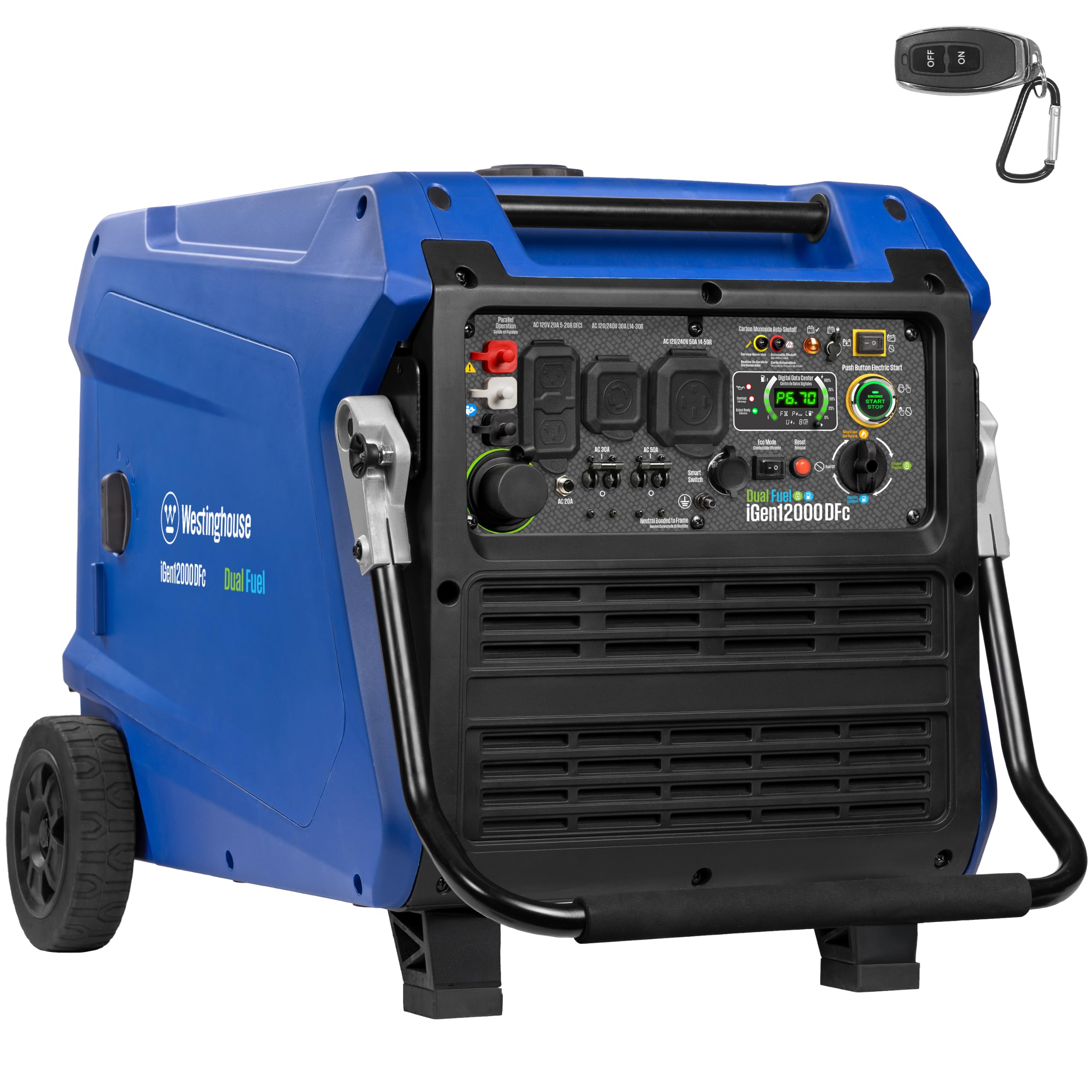
The Westinghouse iGen12000DFc is the only unit on this list that can realistically power an entire home with a transfer switch. Its 457cc dual‑fuel inverter engine delivers 12,000 peak watts on gasoline (9,000 running) and 11,000 peak on propane, with less than 3% THD — clean enough for sensitive electronics. The 50A 14‑50R outlet directly mates to a standard RV or generator inlet panel, and the included remote start key fob adds genuine convenience during heavy rain or snow.
At 187 pounds it’s not portable in the casual sense, but the flat‑free tires and foldable handle make driveway positioning reasonable. The 7.9‑gallon fuel tank yields up to 19 hours at 25% load in Eco Mode, which cuts fuel consumption in half compared to conventional units. Real‑world reports show it can charge a Tesla at 20–25 miles per hour through the 50A outlet, and it runs a heat pump, fridge, and dryer simultaneously without strain.
The integrated CO sensor auto‑shuts the engine if carbon monoxide reaches dangerous levels, a critical safety feature for any generator stored near living spaces. One caveat: the included engine oil is 10W‑30, which may not flow well below 23°F — owners in cold climates should switch to 5W‑30 synthetic after the 5‑hour break‑in period.
Why it’s great
- True whole‑home wattage with clean inverter power under 3% THD.
- Remote start key fob and dual‑fuel flexibility for extended outages.
- 50A 14‑50R outlet is transfer‑switch ready out of the box.
Good to know
- Very heavy at 187 lb — not for casual camping trips.
- Included oil unsuitable for winter operation below 23°F.
2. EF ECOFLOW DELTA Pro
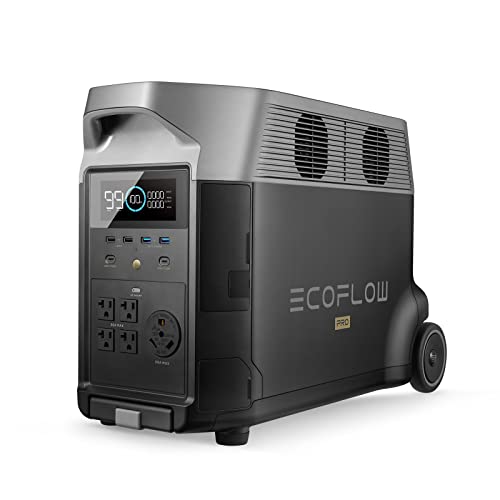
The DELTA Pro sits at the intersection of whole‑home battery backup and modular expandability. Its base 3600Wh LFP battery can be stacked with extra batteries or the Smart Generator to reach 25kWh, enough to run a refrigerator, lights, and a well pump for days. X‑Boost technology pushes AC output from 3,600W to 4,500W, allowing the unit to start appliances that would normally trip a standard 30A inverter.
X‑Stream fast charging refills the battery to 80% in under an hour with a 240V outlet, or in 2.7 hours via a standard 1,800W wall outlet. Solar input up to 1,600W (4×400W panels) provides full off‑grid capability. The 15 output ports include five 120V AC outlets, dual USB‑C at 100W each, and a 12V car port. Smart app control via Wi‑Fi or Bluetooth lets you schedule charging, monitor consumption, and toggle X‑Boost remotely.
Owners highlight its pass‑through charging that seamlessly switches to battery during an outage without dropping connected devices. On a single battery, it ran a home oxygen concentrator for nearly 11 hours. The main trade‑off is weight: at 99 pounds, it stays in one place once positioned.
Why it’s great
- 25kWh maximum expansion provides multi‑day whole‑home backup.
- X‑Boost technology handles heavy surge loads like well pumps.
- App‑enabled scheduling and real‑time energy monitoring.
Good to know
- Heavy at 99 lb — best suited for stationary installation.
- Extra batteries and Smart Generator sold separately at significant cost.
3. AFERIY 3840Wh Power Station

AFERIY brings a massive 3.8kWh base capacity at a price point that undercuts most 2kWh competitors. The unit packs 3,600W continuous output (7,200W peak) across five 120V AC outlets, with the ability to expand to 11.5kWh via add‑on battery packs. UPS transfer times under 10ms make it safe for hardwired medical devices and desktop computers during grid flickers.
Recharge speed is a standout: AC input reaches full charge in 1.5 hours, and the unit supports simultaneous AC + solar pass‑through for faster refills. The 15‑port panel includes dual USB‑C PD 3.0, DC5521, XT60, and a 12V car socket. Smart app control allows remote power‑off, charging schedules, and load monitoring without needing a proprietary dongle.
A late‑breaking issue: some early units shipped with a loose display ribbon cable that caused blank segments. However, the after‑purchase support team has replaced defective units quickly, and the 7‑year support period is among the longest in this category. At 80 pounds and with a pull handle, it’s movable but not portable for frequent camping trips.
Why it’s great
- 3.8kWh base capacity is category‑leading for the price.
- 1.5‑hour full recharge with 7‑year manufacturer support.
- Under‑10ms UPS switching protects sensitive electronics.
Good to know
- Early units had loose display ribbon cables — check batch date.
- 80‑lb net weight limits daily portability despite pull handle.
4. Anker SOLIX C2000 Gen 2
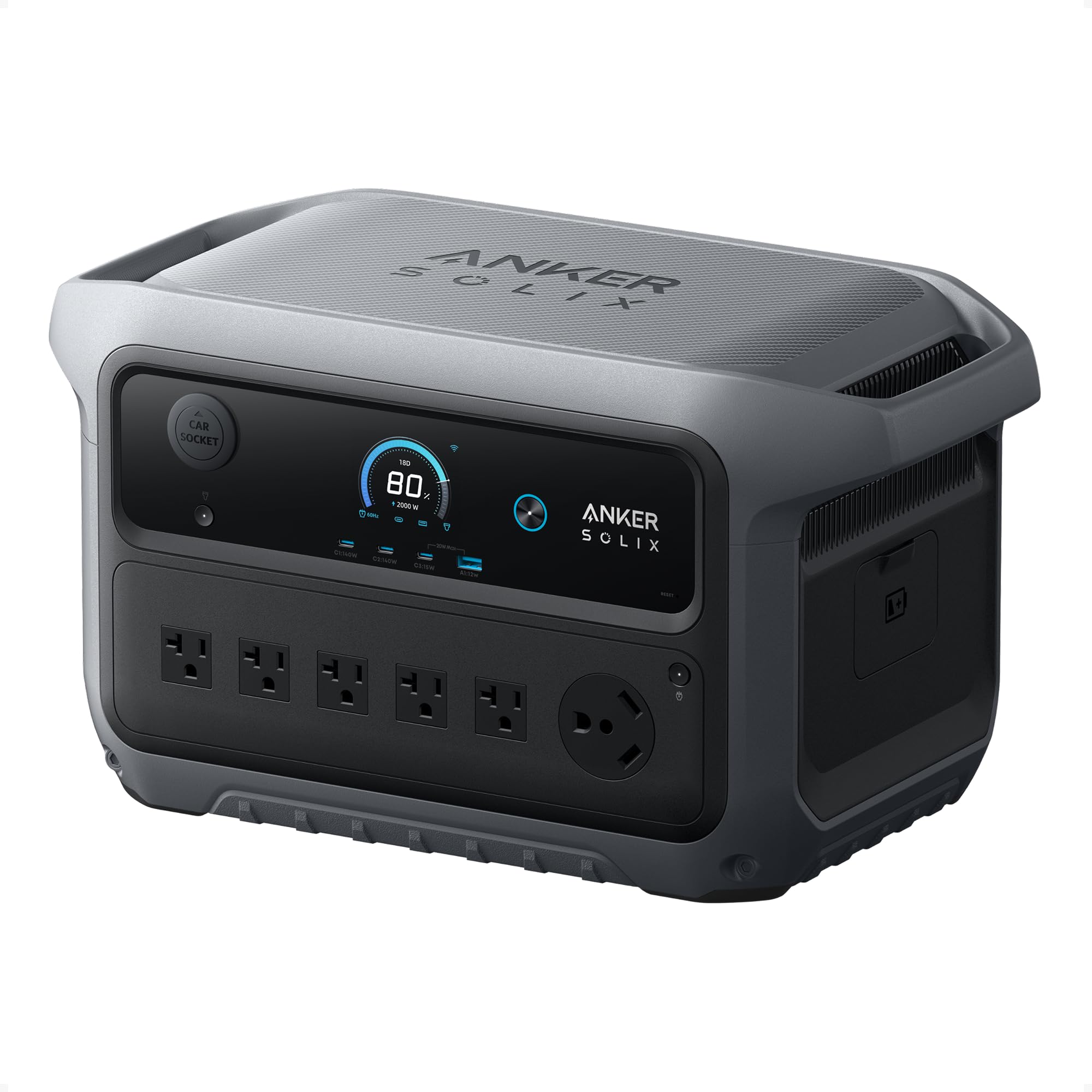
Anker’s SOLIX C2000 Gen 2 solves the single biggest pain point of battery backup — recharge time. At just 58 minutes for a full 2,048Wh charge, this unit can be topped off during a lunch break using a standard wall outlet. The 2,400W rated output (4,000W peak) handles most household appliances, and the standby power draw of only 9W means it won’t drain itself between outages.
Expandable to 4kWh with an add‑on battery, the C2000 Gen 2 can run a dual‑door fridge for up to 64 hours in total. Its 800W alternator charging capability makes it the best option for vehicle‑based backup — hook it to your car’s alternator and reach full charge in 3 hours, 8× faster than a standard 12V socket. At 41.7 pounds, it’s the lightest 2kWh station here, and the 18.1 × 9.8 × 10.1‑inch footprint fits under most RV benches.
The companion app provides detailed usage predictions and Bluetooth control, though there’s no hard‑copy user manual in the box — you’ll need to download it from the app. Owners consistently report clean sine wave output with no interference on sensitive electronics, and the fan noise stays low even under sustained loads.
Why it’s great
- Full charge in under one hour — class‑leading AC refill speed.
- Only 9W standby consumption for worry‑free long‑term storage.
- 800W alternator charging enables quick vehicle‑based refueling.
Good to know
- No printed user manual included — app‑only documentation.
- Expansion battery required for 4kWh total capacity.
5. Jackery Explorer 2000 v2

Jackery reduced the weight of a 2kWh battery station to just 39.5 pounds — 41% lighter than typical 2kWh LFP units. The CTB (Cell‑to‑Body) technology, borrowed from EV manufacturing, integrates the cells directly into the structural shell, saving space and improving rigidity. The result is a power station you can actually carry with one hand, not just roll across a flat driveway.
The 2,200W continuous output (4,400W surge) covers most home essentials: a refrigerator, router, lamp, and phone charging. AC fast charging reaches 80% in 66 minutes, and Emergency Super Charging mode (via the app) hits full in 102 minutes. Silent Charging Mode runs at under 30 dB — quieter than a library — which matters when the station shares your living space during a multi‑day outage.
UL 1778 certification for uninterruptible power systems means the 20ms UPS switching is independently verified for safety. The display is crisp and accurate, though some owners note the Bluetooth connection occasionally drops and requires re‑pairing. The solar barrel ports also lack side reinforcement, so inserting a heavy MC4 plug can flex the frame slightly.
Why it’s great
- Under 40 lb — genuinely portable for a 2kWh station.
- UL 1778 certified UPS with verified 20ms switch time.
- Silent Charging Mode maintains noise below 30 dB.
Good to know
- Bluetooth connection can be unreliable for app control.
- Solar input barrel ports lack frame reinforcement.
6. DJI Power 2000
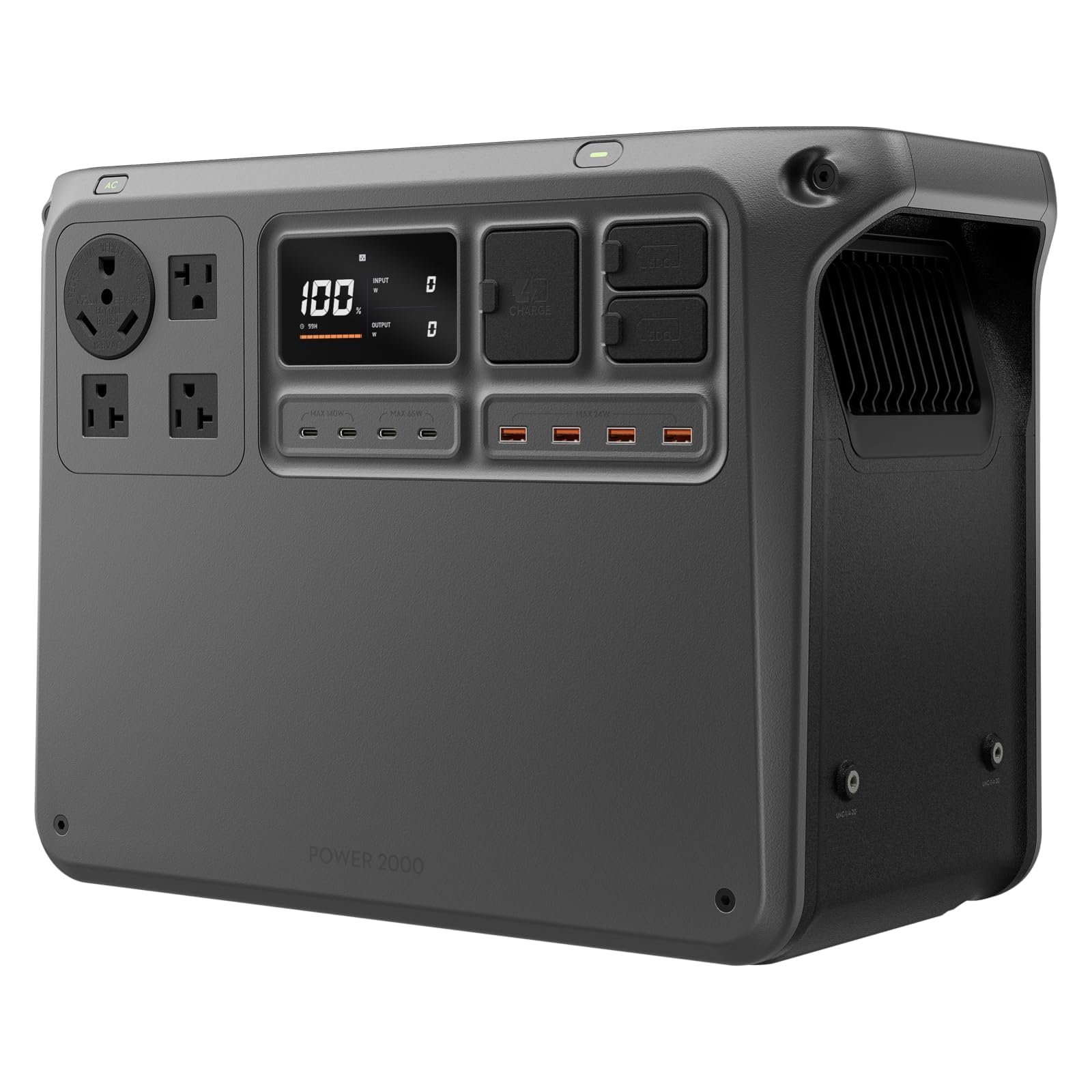
DJI, best known for drones, entered the stationary power market with a unit designed around near‑silent operation. The Power 2000 runs as low as 30 dB — you’ll hear refrigerator compressor noise before you’ll hear this battery. The 2,048Wh LFP pack delivers 3,000W continuous (4,000W peak) with a 10ms UPS switch time, keeping computers and networking gear online through grid glitches.
Fast AC charging hits 80% in 55 minutes (full in 90 minutes), and solar input up to 1,800W makes it one of the fastest‑charging stations for panel arrays. The battery is rated for 4,000 charge cycles, which translates to over a decade of daily use before capacity degrades to 80%. The flame‑retardant housing and 26 internal temperature sensors provide robust thermal management.
The proprietary SDC connectors limit third‑party expansion options, and the DJI Home app is required for advanced features like charging schedules and load balancing. Some early shipments from third‑party sellers were Hong Kong gray‑market units defaulting to 50 Hz, requiring a firmware update to match North American 60 Hz systems. Buy directly from DJI or a verified Amazon seller to avoid this.
Why it’s great
- 30 dB noise floor — barely audible in a quiet room.
- 4,000‑cycle LFP battery for ultra‑long service life.
- 1,800W solar input for rapid off‑grid recharging.
Good to know
- Proprietary SDC connectors limit accessory flexibility.
- Gray‑market units from unverified sellers may ship with wrong frequency.
7. BLUETTI AC200L

The AC200L is the upgraded version of BLUETTI’s best‑selling AC200MAX, adding 200W more output (now 2,400W continuous) and faster AC charging at 2,400W input — 0‑80% in just 45 minutes. Its 2,048Wh base capacity expands up to 8,192Wh with two B300K or B300 batteries, making it a genuine whole‑home contender at a mid‑range entry price.
The 30A RV port and 48V/8A DC port make it ideal for camper electrical systems, and the “Power Lifting” mode delivers up to 3,600W for starting motor‑driven loads like rooftop AC units. Bluetooth and Wi‑Fi app control let you monitor solar harvest, adjust charging speeds, and switch between grid‑priority and battery‑priority modes without walking to the unit.
At 61 pounds it’s on the heavier side for a 2kWh station, and the proprietary power cord means you can’t swap in a standard replacement if it gets lost or damaged. Owners with large solar arrays (800‑1,200W) see excellent pass‑through efficiency, with the unit switching to solar input automatically when the sun returns after a cloudy period.
Why it’s great
- 45‑minute 0‑80% AC charge — fastest in this tier.
- Expands to 8,192Wh for true whole‑home backup.
- 30A RV outlet and Power Lifting mode for motor loads.
Good to know
- Proprietary AC power cord cannot be replaced by standard cables.
- 61‑lb weight limits frequent repositioning.
8. WEN DF680iX

The WEN DF680iX is the most affordable inverter generator on this list that can deliver Level 2 EV charging. Its bonded‑neutral 240V configuration provides low‑power Level 2 charging for battery and hybrid electric vehicles via the L14‑30R receptacle, adding roughly 3‑5 miles of range per hour — enough to top off a PHEV during a multi‑day outage. On gasoline, it peaks at 6,800W (5,100W running); on propane, 6,000W peak (4,500W running).
The 224cc dual‑fuel engine runs the quiet side for a gas unit, thanks to inverter technology that matches engine speed to load. The fuel shut‑off valve automatically drains the carburetor before shutdown, a feature that dramatically extends engine life by preventing gumming. The included CO Watchdog sensor meets industry safety standards for automatic shutoff in enclosed spaces.
At 99 pounds with onboard wheels and a telescoping handle, it’s manageable for one person to roll from garage to driveway. The 240V output is the headline feature here, but it comes with a catch: when the 240V receptacle is active, the 120V outlets are disabled, so you can’t simultaneously charge an EV and power household circuits through the same unit. Customer support response has been inconsistent, with some owners reporting unreturned emails.
Why it’s great
- 240V bonded‑neutral outlet enables Level 2 EV charging.
- Fuel shut‑off valve extends carburetor and engine lifespan.
- Dual‑fuel flexibility with CO Watchdog safety sensor.
Good to know
- 240V output disables all 120V outlets during EV charging.
- Customer support responsiveness has been inconsistent.
9. Champion 4000‑Watt Dual Fuel

Champion’s 4,000‑watt dual‑fuel inverter is the lightest unit of its kind at roughly 53 pounds, making it genuinely portable for camping, tailgating, and quick home backup. On gasoline, 4,000 starting watts and 3,000 running watts provide up to 10 hours of run time; switch to propane for 2,700 running watts and up to 25 hours — a full day‑and‑night cycle on a single 20‑lb bottle.
The 64 dBA noise rating is conversational‑level quiet, and the <3% THD inverter output is safe for CPAP machines, laptops, and modern refrigerator control boards. The TT‑30R RV outlet connects directly to campers without an adapter, and the parallel kit (sold separately) lets you pair two units for 6,000 running watts. Cold start technology fires reliably in low temperatures, a feature often missing on budget‑tier generators.
The 3‑year limited warranty with free lifetime technical support is best‑in‑class for this price range. The main reliability risk comes from occasional early‑life failures — some owners report a bad unit out of the box, and Champion’s support hours (8 AM – 8 PM ET) don’t cover overnight emergencies. The 53‑lb weight makes it easy to store on a garage shelf, but the recoil start can be stubborn if the engine isn’t fully primed.
Why it’s great
- Only 53 lb — easiest dual‑fuel inverter to move and store.
- 25‑hour propane runtime with <3% THD clean power.
- 3‑year warranty with free lifetime tech support.
Good to know
- Occasional early‑life failure reported by some owners.
- Recoil start can be stubborn if the engine isn’t primed.
10. ERAYAK 4500W Inverter Generator

The ERAYAK 4500W inverter generator packs 4,500 peak watts and 3,500 running watts into a 54‑pound frame that competes directly with the Honda EU series on portability but at a more accessible price point. The 60.5 dB(A) noise rating is genuinely quiet for a gas engine — you can hold a conversation beside it. The 208cc engine runs Eco Mode to dynamically adjust RPM, consuming only 0.21 gallons per hour at 25% load.
Parallel‑ready capability allows pairing two units to reach 7,000W rated power with 9,000W peak, making it a viable starter kit for a small home backup setup. The 30A TT‑30R RV outlet provides direct camper hookup, and the dual USB‑C and USB‑A ports handle device charging without an adapter. The low THD (0.2%‑1.2%) is among the cleanest on this list, rivaling pure sine wave battery inverters.
Several owners report exceptional performance for contractor work, running large demolition hammers and chippers without bogging. The main risk is the company’s non‑return policy for Amazon purchases — if a unit arrives defective, the buyer must work through the manufacturer’s warranty process rather than a simple Amazon return. Some units have developed starting issues after four months of use, and the pull cord has broken under heavy use.
Why it’s great
- Extremely clean inverter power with 0.2%‑1.2% THD.
- 54‑lb weight and parallel capability for expandable power.
- 60.5 dB noise level — quietest pure‑gas unit in review.
Good to know
- Amazon sales are non‑returnable — warranty claims go through manufacturer.
- Some units develop starting issues after 3–4 months of use.
11. EBL 2400W Power Station
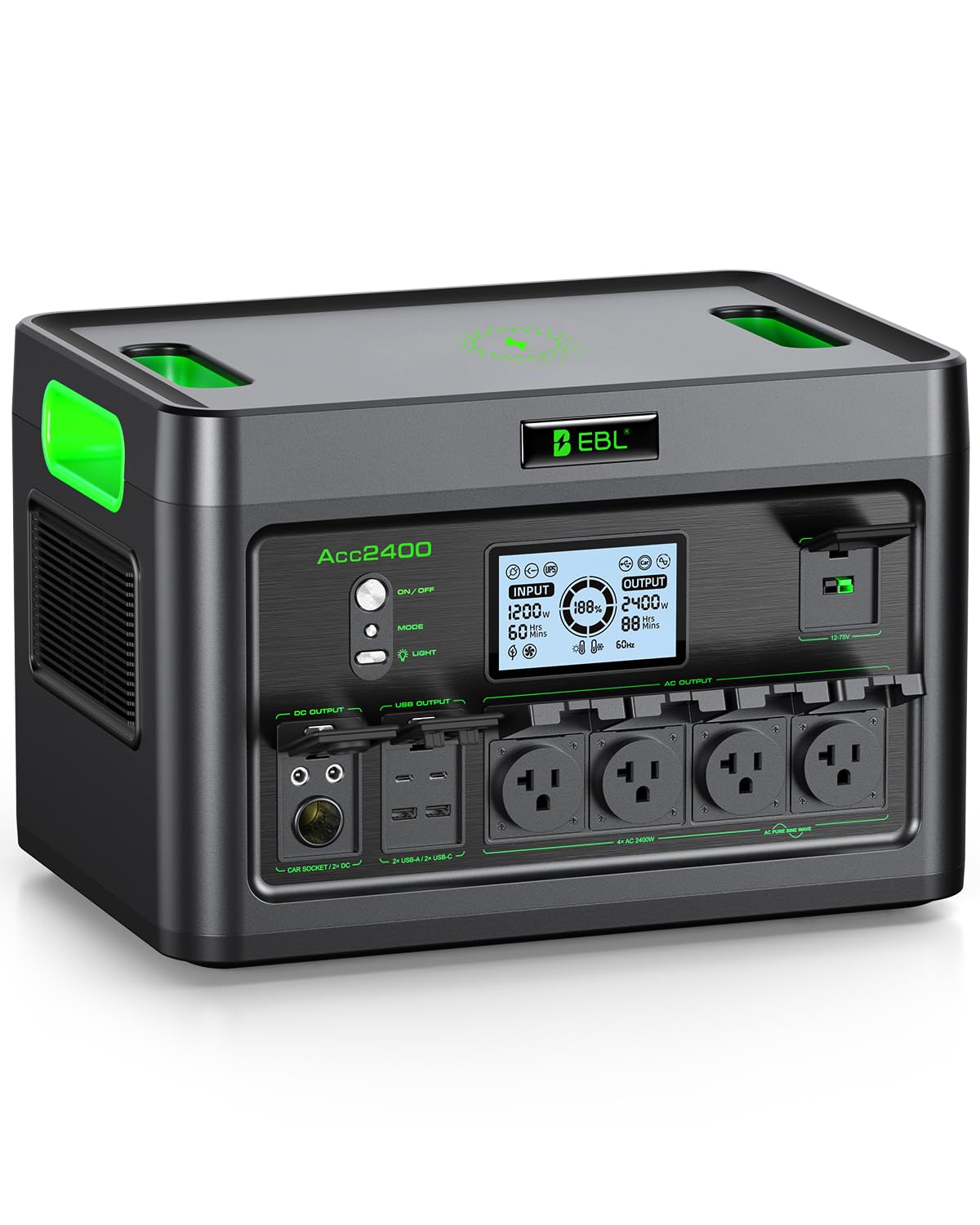
The EBL Acc2400 enters the budget‑friendly tier with a 1,843Wh LFP battery and 2,400W AC output across four outlets. At roughly 55 pounds with dual‑side handles, it fits between a large cooler and a small suitcase in terms of carry‑ability. The 0.1‑second UPS switch time provides seamless transition during outages, and the 4‑mode LED light serves as a camping lantern and emergency strobe.
The battery chemistry is rated for 3,500 charge‑discharge cycles, giving it a theoretical 10‑year lifespan if used weekly. The display screen clearly shows remaining battery percentage, real‑time load, and estimated runtime remaining. It can run a CPAP machine for two nights without recharging, and the wireless charging pad (on top) eliminates cable clutter on nightstands or camping tables.
The main downsides are slow AC recharge (owners report roughly 8 hours for a full refill) and an unreliable stated runtime — one owner found actual usable output around 140Wh under heavy load, far below the advertised capacity. The wireless charger also stops working through most phone cases thicker than 2mm. It’s a capable entry‑level unit for light home backup, but serious users will quickly outgrow its capacity and recharge speed.
Why it’s great
- Budget entry point for LFP battery backup with 3,500 cycles.
- 0.1‑second UPS switching protects computers and data.
- Integrated wireless charging pad for cable‑free device top‑up.
Good to know
- Full AC recharge takes approximately 8 hours.
- Advertised runtime seems inflated — real‑world results are lower.
FAQ
Can I run a gas generator indoors during a power outage?
How do I size a battery power station for my home?
What’s the difference between a transfer switch and an extension cord setup?
How long does a propane tank last with a generator?
Can I leave a battery power station plugged in all the time?
Final Thoughts: The Verdict
For most users, the backup power for home winner is the Westinghouse iGen12000DFc because its 12,000‑watt peak dual‑fuel inverter power is the only unit on this list that can comfortably handle a 50A transfer switch, EV charging, and multi‑day runtime without needing a truck to haul it. If you want silent indoor backup with the fastest recharge and modular expansion, grab the Anker SOLIX C2000 Gen 2 — 58‑minute full charge and 41‑pound weight make it the most practical battery station for the vast majority of households. And for whole‑home battery backup with the deepest expansion potential, nothing beats the EF ECOFLOW DELTA Pro at 25kWh maximum capacity and true X‑Boost surge handling for heavy motor loads.