
Our readers keep the lights on and the weekend projects moving. As an Amazon Associate, I earn from qualifying purchases.
When the lights flicker and the grid goes silent, your entire digital life hangs in the balance. A backup power supply isn’t just a gadget; it’s the bridge between chaos and continuity. Whether you need to save a critical work file, keep a medical device running, or simply preserve the evening’s dinner plans, the right unit determines whether an outage is a mere inconvenience or a full-blown crisis.
I’m Rikta — the co-founder and writer behind FitlyFast. My deep market research focuses on comparing the real-world performance specs of home backup and energy storage systems, from transfer switch speeds to battery chemistry longevity.
After analyzing various models, it’s clear that choosing the right backup power supply depends on understanding your specific runtime needs and the delicate balance between capacity and recharging speed.
How to Choose the Best Backup Power Supply
Selecting a backup power supply starts with identifying your critical load. A basic home office only needs a UPS with pure sine wave output for a desktop computer and modem, while a home backup scenario demands a high-capacity portable power station to run a fridge, lights, and a fan. Understanding these layers prevents you from overpaying for capacity you don’t need or, worse, buying a unit that can’t handle inrush current from motor-driven appliances.
Battery Chemistry: LiFePO4 vs. Lead-Acid
The battery chemistry defines the entire lifecycle cost. Lithium Iron Phosphate (LiFePO4) cells offer over 3,000 charge cycles and a lifespan of 10 years, whereas sealed lead-acid (SLA) batteries typically last 3–5 years and can degrade rapidly with deep discharges. LiFePO4 units are lighter and can be discharged to near-empty without damage, but they cost more up front. For daily or weekly use, the premium on LiFePO4 pays for itself quickly.
Switchover Time & Power Quality
UPS units designed for sensitive electronics must switch from wall power to battery in under 20 milliseconds to prevent a reboot or data corruption. Portable power stations often have slower switchovers (10–30ms) that may be fine for general appliances but risky for high-end audio gear or NAS servers. Pure sine wave output is non-negotiable for any device with a switched-mode power supply or a motor, as modified sine wave can cause humming, overheating, or failure.
Quick Comparison
On smaller screens, swipe sideways to see the full table.
| Model | Category | Best For | Key Spec | Amazon |
|---|---|---|---|---|
| Jackery Explorer 2000 v2 | Portable Station | Whole-Home Essentials | 2042Wh, 2200W AC | Amazon |
| Anker SOLIX C2000 Gen 2 | Portable Station | Fast Recharge Power | 2048Wh, 58-min full charge | Amazon |
| BLUETTI Elite 200 V2 | Portable Station | Long-Term Durability | 2073.6Wh, 2600W AC | Amazon |
| BLUETTI AC200L | Portable Station | Expandable Capacity | 2048Wh, 2400W AC | Amazon |
| EF ECOFLOW DELTA 3 Plus | Portable Station | Smart Home Integration | 1024Wh, 1800W AC | Amazon |
| APC Smart-UPS 1500VA | UPS | Server & NAS Protection | 900W, Pure Sine Wave | Amazon |
| Tripp Lite OMNI1500LCDT | UPS | Desktop & AVR Correction | 810W, 10 Outlets | Amazon |
| VTOMAN Jump 600X | Portable Station | Car Jump Starter Combo | 299Wh, 600W AC | Amazon |
| GOLDENMATE 1000VA | UPS | Compact LiFePO4 UPS | 600W, 153.6Wh LiFePO4 | Amazon |
In-Depth Reviews
1. Jackery Explorer 2000 v2

Jackery’s Explorer 2000 v2 hits the sweet spot for home backup with its 2042Wh LiFePO4 battery and 2200W pure sine wave inverter. The unit uses CTB (Cell-to-Body) technology to achieve a 41% lighter footprint than competing 2kWh stations, making it one of the most portable high-capacity options you can roll into a room. A full recharge takes just over an hour in emergency super charging mode, and the app gives you fine control over charge speed and battery preservation.
Real-world user reports show it running a refrigerator for over 21 hours on a single charge, and the 20ms UPS switchover keeps connected devices online during grid flickers. The silent charging mode drops fan noise to under 30dB, which matters for overnight use in a bedroom or RV. The three AC outlets and dual 100W USB-C ports cover most household electronics without needing an adapter.
At 39.5 pounds, it’s not a carry-on item, but the integrated handle makes transport manageable from garage to living room. The LiFePO4 chemistry promises over 3,000 cycles to 80% capacity, translating to roughly a 10-year service life for weekly cycling. For the blend of capacity, weight, and charging speed, this is the most balanced home backup solution for most households.
Why it’s great
- Exceptional capacity-to-weight ratio thanks to CTB technology
- Fast 1-hour full recharge with emergency mode
- Silent charging mode under 30dB for quiet environments
Good to know
- Charging with a single 200W solar panel is notably slow
- The bright orange accents are not for everyone’s aesthetic
2. Anker SOLIX C2000 Gen 2
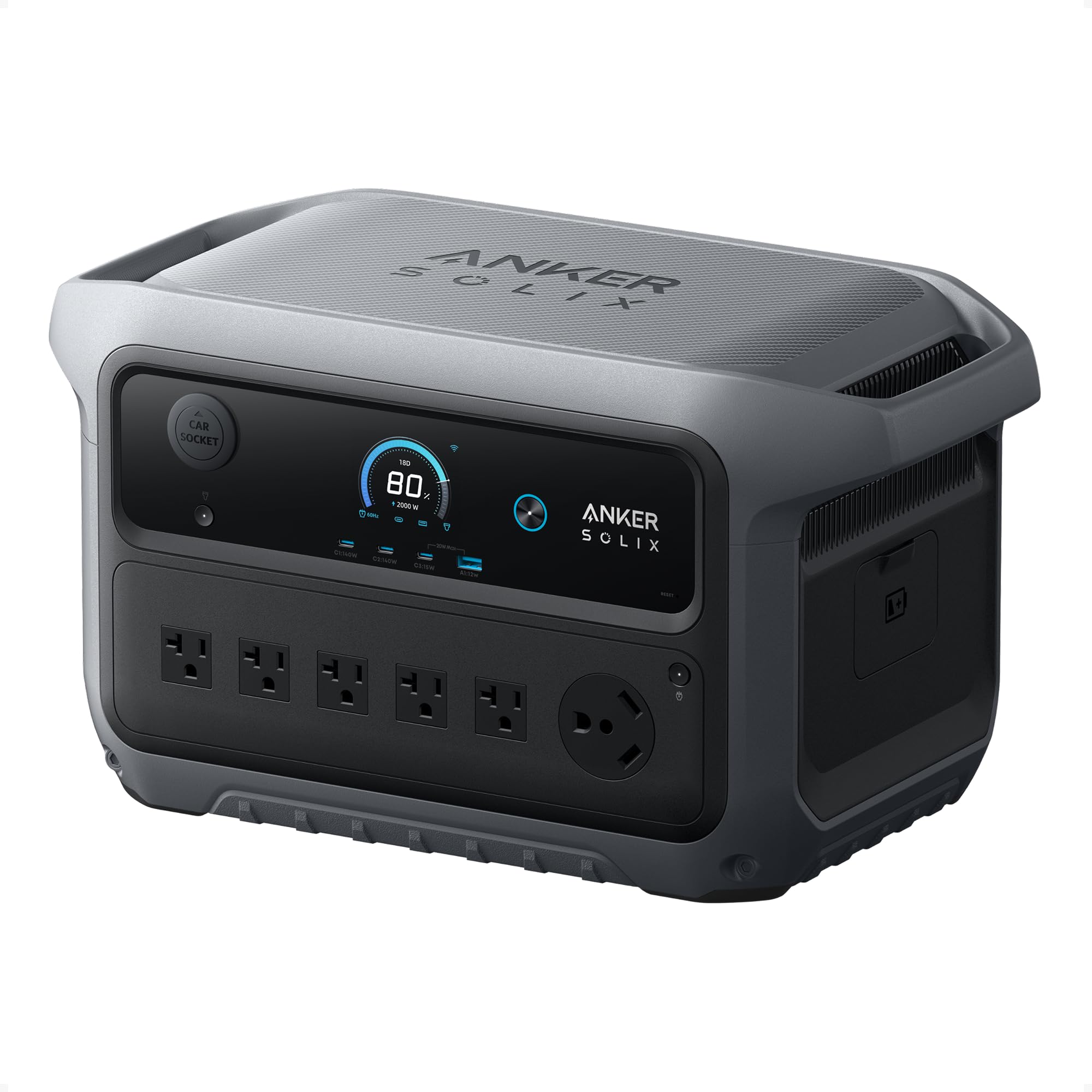
The Anker SOLIX C2000 Gen 2 redefines recharge speed with a full 0-100% cycle in just 58 minutes via AC. This 2048Wh LiFePO4 station delivers 2400W continuous with a 4000W peak, capable of handling the inrush from most window and RV air conditioners. Its 9W standby consumption is remarkably low, meaning less wasted energy when the unit sits idle between outages.
Users consistently praise its ability to run a refrigerator for over 30 hours and a portable fridge for nearly a week on a single charge. The expandable design accepts an extra battery to double capacity to 4kWh. The companion app provides live usage tracking and charge scheduling, which helps during time-of-use rate plans. At 41.7 pounds, it’s 25% lighter than similar 2kWh models, and the physical footprint is tight enough to store under a counter.
The fan noise is well-controlled during normal use, and the pass-through charging allows simultaneous device power and station recharge. For anyone who needs a power station ready to go again quickly after a blackout—like those with frequent short outages—the C2000 Gen 2’s recharge speed is a genuine advantage over slower competitors.
Why it’s great
- Full charge in under 1 hour — fastest in its class
- Ultra-efficient 9W standby consumption
- Expandable to 4kWh for extended runtime
Good to know
- No hard-copy user manual; setup requires the app
- Peak 4000W output is temporary, not continuous
3. BLUETTI Elite 200 V2

BLUETTI’s Elite 200 V2 uses a CNAS-certified automotive-grade LiFePO4 battery rated for over 6,000 charge cycles — that’s roughly a 17-year lifespan with daily use. The 2600W continuous inverter with HyperWatt technology runs high-draw appliances like hair dryers and coffee makers without breaking a sweat, and the 3900W power lifting mode handles refrigerators and window AC units on startup.
The intelligent energy management system keeps standby draw to just 10W, meaning 3 times less waste than comparable units. Users have run a 120V diesel heater for over 3 days on a single charge. Recharge options include an 1800W AC turbo mode that hits 80% in about an hour, plus a silent mode that operates at 16-30dB. The unit is compact at roughly 14x10x13 inches, but the 53-pound weight means it stays where you put it.
For off-grid enthusiasts, the dual 500W solar input supports up to 1000W of panels for a full recharge in around 2.4 hours. The industrial build quality and fan-cooled chassis keep internal temperatures safe even during sustained high-load periods. This is the best choice for buyers who intend to cycle their battery weekly and want true decade-plus longevity.
Why it’s great
- Industry-leading 6,000+ cycle lifespan
- Compact design with powerful 2600W inverter
- Ultra-quiet silent mode for nighttime use
Good to know
- Heavy at 53 pounds for frequent moving
- No dedicated 30A RV port on this model
4. BLUETTI AC200L

The AC200L is BLUETTI’s expandable flagship, starting at 2048Wh and scaling up to 8192Wh by connecting external battery packs like the B300K. Its 2400W pure sine wave inverter with 3600W power lifting drives heavy loads, and the 30A RV port means direct plug-and-play into a travel trailer’s power system. The 2400W AC input brings the unit from 0 to 80% in just 45 minutes, which is among the fastest recharge speeds available.
Reviewers running home security systems, 64-inch OLED TVs, and refrigerators report roughly 10 hours of runtime on a full charge with the base unit. The ≤10ms UPS switchover qualifies it for sensitive networking gear and NAS servers. Bluetooth and Wi-Fi app monitoring work without requiring an internet account, a privacy-friendly approach that appeals to security-conscious buyers.
The 61-pound chassis is substantial, but the form factor is designed for stationary placement in a garage, RV, or utility room. Solar input supports up to 1200W, enabling off-grid recharging in under 2 hours in good sun. For whole-home or RV backup where future expansion is a priority, the AC200L’s modular ecosystem is unmatched in this price tier.
Why it’s great
- Scalable capacity up to 8192Wh
- 30A RV outlet for direct trailer connection
- 45-minute fast recharge to 80%
Good to know
- Heavy at 61 pounds; not portable
- Proprietary AC charging cord limits replacement options
5. EF ECOFLOW DELTA 3 Plus

EcoFlow’s DELTA 3 Plus packs a 1024Wh LiFePO4 battery with an 1800W inverter (2400W peak via X-Boost) into a compact 27-pound chassis. The standout feature is the smart energy management system that provides 12-hour storm alerts, usage dashboards, and automated time-of-use optimization to charge when rates are low. The 10ms UPS switchover makes it suitable for NAS, server racks, and POS systems that cannot tolerate a micro-gap.
Users report running their networking and server rack for over 8 hours on a single charge, charging from 21% to full in about 75 minutes. The dual independent MPPT solar inputs accept up to 1000W, allowing a full solar recharge in about 70 minutes in peak sun. The unit partitions its battery so a portion stays reserved for backup while the rest handles daily solar buffering or peak shaving.
The app integration is more robust than any competitor, offering charge rate control, depletion limits, and power scheduling. The 13 output ports—including two USB-C PD 100W and three USB-A—charge a full desktop. For tech-forward users who want their power station to behave like a smart home device with proactive alerts, the DELTA 3 Plus is the natural choice.
Why it’s great
- Industry-best app integration with storm alerts
- Compact 27-pound chassis with high power density
- Dual MPPT for efficient solar charging
Good to know
- High idle power draw when inverter is active
- May be overkill for simple plug-and-backup scenarios
6. APC Smart-UPS 1500VA

APC’s Smart-UPS SMC1500C is the standard for professional-grade sine wave UPS protection. Its 1500VA / 900W rating provides true double-conversion-grade power conditioning for servers, networking stacks, and medical equipment. The Automatic Voltage Regulation (AVR) corrects brownouts and overvoltages between 92V and 150V without tapping the battery, preserving runtime for actual blackouts.
SmartConnect remote monitoring sends automatic notifications and firmware updates through a secure portal, with a 6-month free trial included. User reports confirm seamless switching during power flickers — computers and monitors never blink. The unit supports apcupsd and NUT open-source monitoring software over USB, making it a favorite for Linux-based homelabs and TrueNAS setups.
The sealed lead-acid battery provides around 70 minutes of runtime at a 350W load. The 8 NEMA 5-15R outlets distribute power to multiple components. While the lead-acid chemistry means shorter overall lifespan than LiFePO4 options, the APC’s build quality, field-replaceable battery module, and connected equipment warranty make it the most reliable UPS for mission-critical applications where switchover speed and power quality cannot be compromised.
Why it’s great
- Pure sine wave output for sensitive electronics
- AVR extends battery life during minor fluctuations
- NUT/apcupsd compatible for Linux monitoring
Good to know
- Lead-acid battery needs replacement every 3-5 years
- SmartConnect is a trial after initial 6 months
7. Eaton Tripp Lite OMNI1500LCDT

The Eaton Tripp Lite OMNI1500LCDT is a time-tested UPS with 1500VA capacity delivering 810W of backup power across 10 outlets. Its AVR circuitry corrects brownouts from 92V to 150V back to standard 120V without draining the battery. The LCD screen provides real-time data on input voltage, load wattage, battery runtime, and AVR status, making it easy to track your power usage at a glance.
Users with 5+ years of ownership report the unit still powers their network stack for hours during extended outages. The 10 outlets include a mix of battery-backed and surge-only ports, giving flexibility for networking gear you want protected and non-critical peripherals you don’t. The internal battery is user-replaceable with the RBC51 cartridge, extending the unit’s service life well past the initial battery’s lifespan.
The 650-joule surge protection shields connected equipment from power spikes, and the RJ11/RJ45 dataline protection prevents damage from strikes traveling through phone or Ethernet lines. The 3-year warranty with connected equipment insurance provides peace of mind. For users who need a high-outlet-count UPS with AVR and a clear display for monitoring, this is the most dependable workhorse available.
Why it’s great
- 10 outlets with AVR for broad device coverage
- User-replaceable battery for longer service life
- Five-year reliability track record in user reviews
Good to know
- Desktop software has compatibility issues reported
- Initial electronic smell during first use
8. VTOMAN Jump 600X

The VTOMAN Jump 600X stands out by integrating a 299Wh LiFePO4 portable power station with a dedicated car jump-start port. This 2-in-1 design saves space and money for drivers who need both roadside emergency capability and portable AC power. The 600W inverter (surge 1200W) runs small appliances, and the battery is expandable to 939Wh with an optional extra pack.
Users report running a CPAP machine for 10 full hours while also charging phones and a fan, and jump-starting a Dodge Ram pickup with the battery at just 9% charge level. The regulated 12V/10A DC outputs are ideal for car refrigerators and tire inflators, maintaining steady voltage even under load. Pass-through charging allows the station to power devices while it recharges simultaneously.
The 14.6-pound weight makes it easy to keep in a trunk, and the built-in LED light includes multiple modes for emergency use. Wall charging takes about 3 hours, and solar charging is supported via a 110W or 220W panel. For budget-conscious users who want a power station that also eliminates the need for a separate jump starter, the Jump 600X delivers practical versatility at a compelling entry price.
Why it’s great
- Unique 2-in-1 design with car jump-start port
- Regulated 12V output for DC appliances
- Expandable capacity up to 939Wh
Good to know
- 299Wh base capacity is modest for home backup
- Slow AC charging takes about 8-12 hours to full
9. GOLDENMATE 1000VA

The GOLDENMATE 1000VA is a rare breed: a UPS that uses a LiFePO4 battery instead of the standard lead-acid. This gives it a claimed 10-year lifespan with over 5,000 charge cycles, cutting total ownership cost by roughly 40% compared to lead-acid units that need battery swaps every few years. The 600W pure sine wave inverter and 8 outlets protect computers, networking gear, and entertainment systems.
The LCD panel shows real-time input voltage and load status, and the buzzer mute switch eliminates the constant beeping during a prolonged outage. Users report the unit running a TV, PS5, and router without issues during a blackout, with the switchover happening seamlessly. The low-noise cooling fan stays under 50dB and only spins up during heavy battery use, so it’s unobtrusive in a living room or office.
One caveat: some reviewers note the lack of a USB data port for automatic computer shutdown, and the outlets are spaced closely enough to block larger AC adapters. At a compact 13x4x10 inches, it fits on a desk shelf but may require a short extension bar for bulky plugs. For users who want a modern LiFePO4-powered UPS that outlasts traditional lead-acid units, this is the most cost-efficient upgrade.
Why it’s great
- LiFePO4 battery with 10-year lifecycle
- Buzzer mute function for quiet operation
- Lightweight and compact desktop form factor
Good to know
- No USB or network port for auto-shutdown
- Outlets are tightly spaced for large adapters
FAQ
Can I plug a portable power station into a wall outlet to recharge while it powers my devices?
What is the difference between a UPS and a portable power station for home backup?
How long can a LiFePO4 backup power supply realistically last before needing replacement?
Can I use a portable power station to power a window air conditioner?
Final Thoughts: The Verdict
For most users, the winner of the backup power supply race is the Jackery Explorer 2000 v2 because it offers the best balance of capacity, weight, and fast recharge speed for whole-home essentials. If you want the fastest recharge on the market and expandable capacity for longer outages, grab the Anker SOLIX C2000 Gen 2. And for protecting a home server or sensitive electronics with a decade-plus lifespan, nothing beats the BLUETTI Elite 200 V2.